Managing Knowledge from
Big Data Analytics in Product Development
White Paper
Tushar Rajpathak
Senior Consultant, Manufacturing Innovation and Transformation Group, TCS Tushar has over 18 years of experience in the automotive, industrial machinery and process domains. He has assumed multiple roles in the areas of product design and application engineering, across the business consulting, projects delivery and program management functions. He has handled and overseen assignments of high strategic importance across both horizontal and vertical value chains, leading to improved competencies and revenue streams for the organizations.
Tushar has a Master’s degree in mechanical engineering from IIT, Kanpur, in India and is a certified Six Sigma specialist. He has completed his Green Belt certification from TRW Automotive, USA (a Tier1 auto major), and has a Black Belt certification from Mahindra Satyam.
Atul Narsingpurkar
Consultant, Manufacturing Innovation and Transformation Group, TCS
Atul has over 18 years of experience in the automotive, industrial machinery, electro-mechanical, and sensing & control domains. He has handled multiple roles in the areas of new product introduction, product development, engineering services, business process consulting and project management. He has experience in product design and development and NPI, and has managed a number of NPI programs. He has also managed several strategic consulting assignments in the product development and lifecycle management domain for major automotive OEMs.
Atul has a master’s degree in Mechanical Engineering from BITS, Pilani. He is a certified Six-Sigma Green Belt.
Successful new product introduction is the key to business success. In these recessionary
times, it has become increasingly important for all organizations, big or small, to develop and
introduce new products more effectively. This can be done through an agile and successful
New Product Development (NPD) process that focuses on retrieving and using information
and knowledge continuously to tackle challenges.
Organizations have recognized the importance of knowledge management in New Product
Introduction (NPI). Typically, an NPI process uses a combination of data, information and
knowledge as inputs during the various stages. In recent years, organizations have realized
the need to tap into the data generated from various sources, and use it in their NPD
processes, since such data offers huge potential to improve product performance, bring
about efficiency in the product development process, contain costs, and enhance customer
experience.
In order to benefit from this data, organizations must have a well-defined strategy to collect,
store, synthesize, and disseminate it in the form of knowledge required for various business
functions. For example, product ideas, customer behavior patterns, Voice of Customer (VoC)
data, Quality Function Deployment (QFD) data, and product trends from social networks and
listening platforms, can help design product strategy and portfolio. Warranty, quality and
testing data, data from Computer Aided Design (CAD) systems and manufacturing process
data can help in product design and validation, as information fed back into the NPD process.
Organizational knowledge for development of products is not available in a simple format,
but is generally in large volumes, and is dispersed across the enterprise. This paper explores
an approach to manage knowledge from analytics and Big Data in the NPD process for the
manufacturing industry, particularly in the context of the automotive domain.
Contents
Introduction 5
Data, Information and Knowledge 5
Knowledge Management is Integral to Product Development 6
Emerging Trends 7
How Big Data can help in NPD 8
Utilizing Product Data 9
Listening to the Voice of the Customer 10
Tapping Internal and External Stakeholders 10
Big Data in Action 10
Future Prospects: The automotive industry leading the way 12
Introduction
The rapid rise of emerging economies, increasing demand for products that can cater to the changing preferences of both local as well as global markets, and the growing importance of information technology throughout a product’s lifecycle, has led to the commoditization of products. The consumer is ‘king’ and drives the success or failure of corporations. Additionally, in order to have a tailored product portfolio to cater to different markets, organizations need to have a clear understanding of customer requirements in different segments and must design products which meet these expectations. Adding to the complexity is the cut-throat competition in the global market, which brings together similar products and thus reduces the scope of differentiation.
Owing to these trends, ‘time to market,’ ‘first time right,’ and ‘cost competitiveness,’ are emerging as key
differentiators for Original Equipment Manufacturers (OEMs) operating in highly competitive industry segments such as automobiles, consumer goods and consumer electronics. Today, the race is not just about creating new products, but doing so faster than the competition. Hence, organizations need to leverage current and past marketing information, design data, manufacturing operations data, and testing and service data, to build a constantly evolving knowledge repository that they can tap into to create new products quickly.
Data, Information and Knowledge
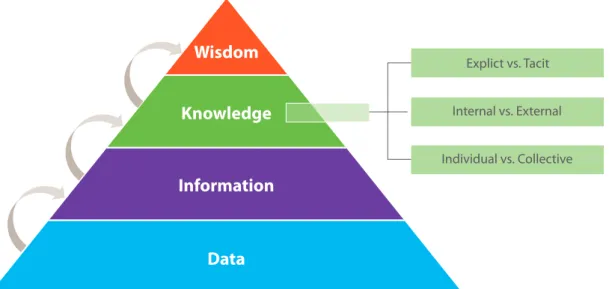
It is important to make a distinction between data, information, knowledge and wisdom in contemporary knowledge literature (see Figure 1). Data is a set of discrete and objective facts about events. Information is a message, usually in the form of a document or audio-visual communication. As with any message, it has a sender and a receiver. Information is meant to change the way the receiver perceives something, and to impact their judgment and behavior. Knowledge is broader, deeper, and richer than data or information. Knowledge emerges from the application, analysis, and productive use of data and/or information.
5
Figure 1: Knowledge Management Pyramid
Data
Information
Knowledge
Wisdom
Explict vs. Tacit Internal vs. External Individual vs. CollectiveThe core of the product development process lies in knowledge and its reuse. Knowledge, when managed effectively, can help reduce NPI project time, improve product quality, and increase customer satisfaction. In a knowledge-based organization, it plays a crucial role in guiding the organization’s actions and establishing a
[1]
sustainable competitive advantage. Typically, the NPI process uses a combination of data, information and knowledge. Wisdom on the Knowledge Management (KM) pyramid comes from the expertise and insight of a few
[2]
individuals in the organization, and is usually manifested as best practices and lessons learnt artifacts.
Knowledge Management is Integral to Product
Development
The conventional product development process (Figure 2) starts from strategizing the product to designing, validating and testing it, and finally ends with the product being phased out — of course, after a designated period of after-sales service.
During the product development process in the manufacturing industry, several types of data are generated, often in large volumes, which may be processed and then used as a reusable knowledge base, and to provide real time intelligence to the product development teams. In some cases, data such as customer insights (structured and unstructured), competitive intelligence and product performance data, etc. can prove to be of great value for the overall success of the product.
Despite the volume of research available on knowledge management, little work has been carried out in the area of integration of knowledge from the above mentioned data elements, into the product development process. Hence, managing this knowledge sourced from various data sources and using it in the product development process, offers great potential for improving process efficiencies.
[1] Shani, A.B., Sena, James A., Knowledge Management and New Product Development: Learning from a Software Development Firm (Oct 2000), accessed Aug 1, 2013, http://ceur-ws.org/Vol-34/shani_sena.pdf
[2] Management, Knowledge and Learning, International Conference 2012, Peter Meza, Product Management and Knowledge Management (2012), accessed Aug 1, 2013,
http://www.issbs.si/press/ISBN/978-961-6813-10-5/papers/ML12_163.pdf 6
Figure 2: Product Development Lifecycle
Product Strategy and Planning Concept, Prototyping and Definition Product-Design and Analysis
Product & Process Verification &
Validation
Manufacturing, Launch, Service and Phase Out
Emerging Trends in Product Development
The manufacturing industry, particularly the automotive segment, is rapidly evolving due to the digital wave that is taking over industry. Based on our observations of the emerging landscape, we believe that conventional product development processes are paving the way for newer and more robust ways to ensure customer acceptance of a product long before it is launched — that is, while it is being designed. Table 1 lists a few examples.
7
Table 1: Emerging Trends in Product Development and Knowledge Management Processes
Trends
Examples/ Implications
Crowdsourcing and social media playing a big role in collaborative product development
[3]
Fiat Mio is the world's first crowd-sourced car , developed based on new ideas sourced from users via a social media platform.
While this trend will change the way products will be designed in the future, organizations will also have to collate, classify, and assess large amount of data, and feed it back into the product
development process. Big Data analytics
close-looping with knowledge base
Many product development organizations, including auto OEMs, are critically analyzing Big Data (product failure data, service data, warranty data, historical design data, materials data etc.) to extract information patterns than can be fed back into the product development process. CAD/CAE/PLM technologies now have capabilities to integrate various extracted knowledge elements into the product design process.
Internal and external collaboration for knowledge sharing
Many leading auto OEMs in North America and Europe have developed collaboration platforms with features including blogs, wikis, chats, communities of practice, expert corners and alerts among others to allow employees to share knowledge through discussion threads, idea voting etc. While collaboration platforms are becoming extremely popular within organizations, in some cases they are also being extended to external users with appropriate security features.
Such collaboration platforms will allow functional teams to work in collaboration rather than working in silos.
Organizations will need to have business processes and supporting infrastructure in place to enable such collaboration platforms and process the information shared on these platforms.
Use of telematics in assimilating knowledge for product development
Sensing devices integrated with remote monitoring devices are being used to gather intelligence on product performance, health diagnostics, usage patterns etc.
Manufacturing organizations are using these techniques to establish a correlation between field test data points to be simulated in the lab and then build these correlations in mathematical models. Manufacturing organizations must work on integrating the knowledge and data generated in this way into the core product development process to enable faster and right decision making. Baking knowledge into the
product development process
Manufacturing organizations the world over are realizing that tacit knowledge available among current employees should be formalized and captured for posterity.
Global auto OEMs are gearing up to put business processes and the required infrastructure in place to capture this tacit knowledge in terms of best practices/lessons learned etc., and close-loop the knowledge management process by integrating these best practices with CAD/PLM tools.
How Big Data can help in NPD
An organization generates and stores an enormous amount of data on a regular basis. This is the result of the design, analysis, testing and service operations of products, and is often referred to as ‘Big Data.’ Before we analyze how this data is transformed into knowledge, let us understand it further.
Big Data is usually defined by three dimensions — volume, velocity and variety. Recently Oracle introduced a fourth
[4]
dimension — value. These four Vs may be elaborated further as follows:
Volume: Machine-generated data is produced in much larger quantities than non-traditional data
Velocity: This refers to the speed of data processing, or the low latency rate at which analytics must be applied to the data, and looped back to the original sources of data to action.. Social media data streams – while not as massive as machine-generated data – produce a large influx of opinions and relationships valuable to customer relationship management
Variety: This refers to the large variety of input data (customer insights, competitive intelligence, trends, benchmarking data, standards, materials, etc.) which in turn generates a large variety of data (CAD/CAM/CAE data, drawings, documents, test data, product failure data, product and process performance data etc.) as output. Value: The economic value of different data varies significantly depending upon both the source and its end use The rapid use of electronics and IT in products during the last two decades has resulted in many organizations sitting on an enormous amount of data — direct and indirect, and/or past and present. Most IT systems used for product design, analysis, engineering, testing, and validation processes generate a large volume and variety of data. The increasing proliferation of computers and embedded electronics in the manufacturing industry, particularly in the automotive segment, has further resulted in the generation of a huge amount of structured and unstructured data. For instance, use of computers and sensors in modern vehicles generates enormous data while a vehicle is in use. The emerging challenge for organizations is to derive meaningful insights from available data and re-apply it intelligently. Knowledge management plays a crucial role in efficiently managing this data and delivering it to the end users to aid in the product development process. This involves collection of data from direct and indirect sources, analyzing and synthesizing it along with relevant enterprise data, to derive meaningful information and intelligence, converting it into a useful knowledge base, storing it and finally delivering it to end users.
To derive the maximum benefit from Big Data, organizations must modify their IT infrastructure to handle the rapid rate of delivery and extraction of huge volumes of data, with varying data types. These can then be integrated with the organization’s enterprise data and analyzed. In fact, organizations, especially those with legacy systems, need to have a clear understanding of their past data and how the same can be merged into their current IT systems.
n
n
n
n
8 [4] Oracle, Big data for the Enterprise (Jun 2013), accessed Aug 2013, http://www.oracle.com/us/products/database/big-data-for-enterprise-519135.pdf
9
[5]
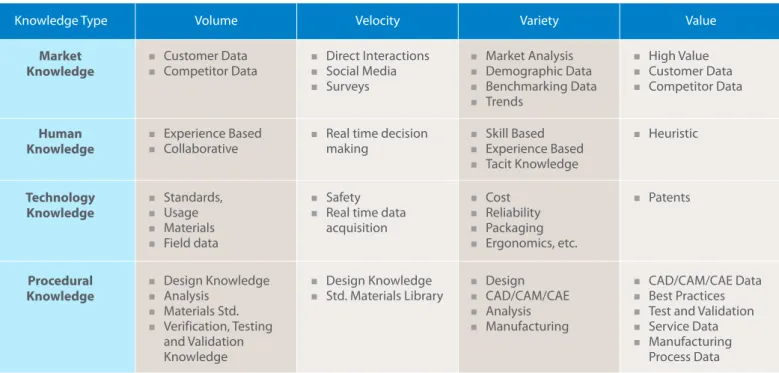
According to Yuan, Yoon, and Helendar, knowledge areas are classified into four types, collectively referred to as M-H-T-P: Market knowledge, Human knowledge, Technology knowledge, and Procedural knowledge. Based on these four knowledge areas, Table 2 depicts the mapping with elements of Big Data in the product development process:
Utilizing Product Data
Most manufacturing companies have IT systems to manage the product data generated via CAD, engineering, manufacturing, and product development management tools. However, the large datasets generated by these systems have remained untapped within the respective systems to a great extent. These datasets, if integrated with one another and to the other enterprise systems, can create a significant Big Data opportunity that the manufacturer can harness to create value. For example, PLM could provide a platform for design collaboration between internal and external stakeholders. OEMs can collaborate with their suppliers and leverage the latter’s skills and knowledge to help develop products faster and better. This way of linking useful knowledge obtained through Big Data analysis with rules, logics etc. can help faster and right-first-time decision making, contain cost, improve reusability and most importantly reduce product development cycle time.
Product data provides information about how a specific component was designed and what challenges were encountered. Extracting this information in a usable format is the first step in the process of making this knowledge available for reuse. The second step is to convert or present this knowledge in the form of business or technical logic/rules which can be used by designers, planners, etc. during the execution of a project. For example, organizations that use configurators extensively find that they not only help in the design of new parts and
assemblies, but can also promote standardization by harvesting old parts from existing databases. Data from the PD value chain can be an enabler in the execution of such projects.
Table 2: Knowledge Areas Mapped to Elements of Big Data
[5] Yuan, Q. F., Yoon, P. C., & Helander, M. G. (2006). Knowledge identification and management in product design,. Journal of Knowledge Management
Knowledge Type Volume Velocity Variety Value
Market Knowledge n n Customer Data Competitor Data n n n Direct Interactions Social Media Surveys n n n n Market Analysis Demographic Data Benchmarking Data Trends n n n High Value Customer Data Competitor Data Human Knowledge n n Experience Based Collaborative
n Real time decision
making n n n Skill Based Experience Based Tacit Knowledge n Heuristic Technology Knowledge n n n n Standards, Usage Materials Field data n n Safety Real time data acquisition n n n n Cost Reliability Packaging Ergonomics, etc. n Patents Procedural Knowledge n n n n Design Knowledge Analysis Materials Std. Verification, Testing and Validation Knowledge n n Design Knowledge Std. Materials Library n n n n Design CAD/CAM/CAE Analysis Manufacturing n n n n n CAD/CAM/CAE Data Best Practices Test and Validation Service Data Manufacturing Process Data
10
Listening to the Voice of the Customer
Organizations are realizing that they also need to tap into the customer’s voice as part of the requirements gathering process in new product development. However, many manufacturers are yet to systematically extract crucial insights from the increasing volume of customer data to refine existing designs and help develop specifications for new models and variants. Best-in-class manufacturers are able to capture the data generated from warranty claims, quality testing and diagnosis, as additional feedback to the system. They supplement these efforts with additional analysis and correlation of the feedback sources to develop better products. New sources of data that manufacturers are starting to mine include customer comments on social media platforms and sensor data that record the actual product usage. In order to develop better products, obtain comprehensive data about customers and gain holistic insights, manufacturers, distributors, retailers and other players must work together and integrate their respective data sets with each other.
For example, through an appropriate analysis of such data, a telecom equipment manufacturer improved its gross margin by 30 percent in 24 months, eliminating unnecessary costly features and adding those that were of a greater relevance to the customer, and for which the customer was willing to pay a higher price.
Tapping Internal and External Stakeholders
Making Big Data readily available to the relevant stakeholders in a timely way can create tremendous value. Companies can use Big Data analysis to improve the performance of their R&D function. Integrating data from the R&D, engineering, and manufacturing units, can enable concurrent engineering techniques that can greatly reduce the waste caused from having to rework designs, and thus accelerate time-to-market.
To drive innovation and to develop products that address emerging customer needs, manufacturers are increasingly relying on outside inputs gathered via innovative channels. Some manufacturers are inviting external stakeholders to submit ideas for innovations or even collaborate on product development via web-based platforms. Consumer goods companies such as Kraft and Procter and Gamble invite ideas from their consumers, and have collaborated with external experts, including chemical research agencies, academics and industry researchers, to develop new products.
But as successful as these open innovation initiatives can be, one key problem remains — how to efficiently extract the truly valuable ideas from the potentially large number of inputs these programs can generate. The challenge for Big Data analysts is to develop techniques and algorithms that are intelligent enough to read and analyze this data to extract right information to aid in the product development process.
Big Data in Action
For decades, companies have been making business decisions based on transactional data stored in relational databases. Beyond that, critical data, however, is a potential treasure trove of non-traditional, less structured data: weblogs, social media, email, sensors, and photographs that can be mined for useful information. Decreases in the cost of both storage and compute power have made it feasible to collect this data. As a result, more and more companies are looking to include non-traditional yet potentially very valuable data — in other words, Big Data — along with their traditional enterprise data in their business intelligence analysis.
11
The use of Big Data and its analysis in product development is very closely driven by the available technologies in the organization, and the tight integration between hardware and software and other data generation mechanisms. A Big Data strategy requires the ability to sense, acquire, transmit, process, store and analyze the data to generate knowledge that can be stored in a repository for later use.
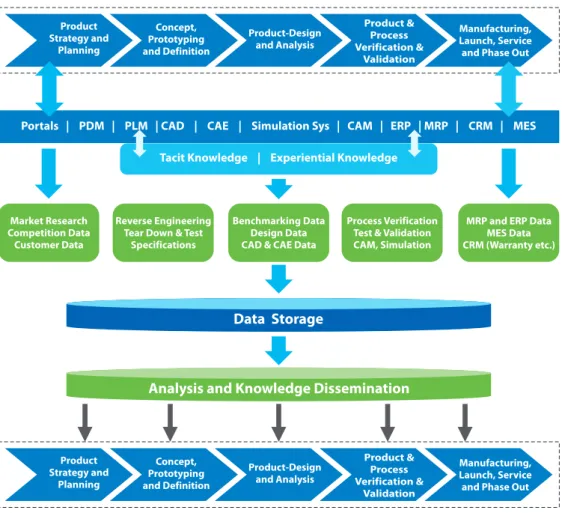
A good approach to analyze Big Data and the consequent knowledge management is shown in Figure 3. A typical NPD process interfaces with enterprise-wide systems like ERP, CRM, PLM, etc., to retrieve information that may be used further. This information is explicit and structured. Information and data are exchanged on a continuous basis with these systems as the product is being realized. The unconventional, unstructured information comes from several sources like simulation, sensors, blogs, warranties, customer experience, etc., and it should be harnessed. While a small part of this information flows back into the enterprise systems, attempts should be made to capture this in a central repository, typically a single data warehouse. A deliberate attempt must be made to keep the data together so that the data can be combined to create information which can be analyzed to generate knowledge that loops back to the knowledge repository and thence the product development process.
Figure 3: Enterprise View of Big Data Sources & Knowledge Management Product Strategy and Planning Concept, Prototyping and Definition Product-Design and Analysis Product & Process Verification & Validation Manufacturing, Launch, Service and Phase Out
Portals | PDM | PLM | CAD | CAE | Simulation Sys | CAM | ERP | MRP | CRM | MES
Tacit Knowledge | Experiential Knowledge
Market Research Competition Data
Customer Data
Reverse Engineering Tear Down & Test
Specifications
Benchmarking Data Design Data CAD & CAE Data
Process Verification Test & Validation CAM, Simulation
MRP and ERP Data MES Data CRM (Warranty etc.)
Data Storage
Analysis and Knowledge Dissemination
Product Strategy and Planning Concept, Prototyping and Definition Product-Design and Analysis Product & Process Verification & Validation Manufacturing, Launch, Service and Phase Out
12
Some of the key benefits of a data-driven approach using a single source of information are:
A single source of data drives many decisions concurrently. For example, continuous availability of market data and voice-of-customer data can be used to improve the features and designs of current and future products. A data analysis approach helps organizations stay ahead of potential problems, as real-time quick resolution is possible. For example, a warranty or a field issue which is driven immediately to the database will alert product designers to product issues which can be eliminated while a batch is still in production.
Real- time performance data from sensors pertaining to engine performance or driver behavior can help product developers capture potential performance issues or add new features to the vehicle.
Product development is typically a stage-gate process and is often well integrated with other business functions, utilizing inputs from customers, service, suppliers, after-market service, etc. Big Data usage in product development offers new ways to integrate data generated from these functions with product design, manufacturing, quality, warranty, diagnostics, vehicle and software specifications as a single unit. We envisage an increasing usage of systems that can hold this data and run analytics on the same to derive information which becomes part of the knowledge pool.
Future Prospects:
The Automotive Industry Leading the Way
The automotive OEM world is already talking about vehicles fitted with a number of sensors to record every minute of the performance, both of the vehicle and of the driver. These vehicles can provide product development teams with performance and failure data in real-time from the field or from the testing facilities and convert it into useful information which can become part of the knowledge repository for future product development. In fact, solutions that integrate the entire population of cars into a single data base are already becoming a reality. For example, understanding the expected and actual performance of two similar vehicles performing in China and Europe under different driving conditions will help design the products to suit the respective needs.
The world’s leading OEMs are pioneers in the use of data and information in various aspects of their vehicle
development program and business operations. Being large organizations that have embraced IT and Big Data long ago, they are using the information to improve product design, quality, cost reduction and customer satisfaction through data-driven decision making and processes.
n
n
13
Conclusion
While the aim of this paper is to provide a holistic and end-to-end view on how Big Data can help in knowledge management to improve the product development process, here are some high level takeaways for manufacturing organizations planning to embark on this journey:
Set a clear vision for knowledge management in your organization
Perform a thorough assessment of your current status, pain areas and future requirements Devise a well thought out long term strategy for knowledge management
Prepare a roadmap to achieve the vision and successful implementation of strategies
Implement knowledge management as a business transformation program with the right amount of focus on business processes, technology, infrastructure and organization change management.
n
n
n
n
All content / information present here is the exclusive property of Tata Consultancy Services Limited (TCS). The content / information contained here is correct at the time of publishing. No material from here may be copied, modified, reproduced, republished, uploaded, transmitted, posted or distributed in any form without prior written permission from TCS. Unauthorized use of the content / information appearing here may violate copyright, trademark and other applicable laws, and could result in criminal or civil penalties. Copyright © 2013 Tata Consultancy Services Limited
IT Services
Business Solutions Consulting
Subscribe to TCS White Papers
TCS.com RSS: http://www.tcs.com/rss_feeds/Pages/feed.aspx?f=w Feedburner: http://feeds2.feedburner.com/tcswhitepapers
Contact
For more information, contact [email protected] About the Manufacturing Solutions Unit
Global manufacturers are trying to reduce operational expenditure, invest in process improvement, utilize existing capacity optimally and increase efficiencies, while maintaining product quality and meeting safety and regulatory norms. TCS' Manufacturing Solutions provide you the bandwidth to innovate on business models, leveraging contemporary technology solutions.
We believe in leveraging learning from across the segments in developing business solutions. Be it in applying the concepts of lean new product introduction from discrete industries to a chemical manufacturer, or leveraging the aerospace industry experience in service management for the
automotive sector, our dedicated Manufacturing Centers of Excellence (CoEs) under these focus vertical industries are continuously looking at breakthrough solutions. Clients can benefit from our rich experience in both the discrete (automotive, industrial machinery and equipment, aerospace) and process industries (chemicals, cement, glass and paper).
About Tata Consultancy Services (TCS)
www.tcs.com
Tata Consultancy Services is an IT services, consulting and business solutions organization that delivers real results to global business, ensuring a level of certainty no other firm can match. TCS offers a consulting-led, integrated portfolio of IT and IT-enabled infrastructure, engineering and
TM
assurance services. This is delivered through its unique Global Network Delivery Model , recognized as the benchmark of excellence in software development. A part of the Tata Group, India’s largest industrial conglomerate, TCS has a global footprint and is listed on the National Stock Exchange and Bombay Stock Exchange in India.
For more information, visit us at
TCS Design Ser vices I M I 12 I 13