Strathprints Institutional Repository
Bugra Ozcan, Mustafa and Gurbuz, Sevgi Zubeyde and Persico, Adriano
Rosario and Clemente, Carmine and Soraghan, John (2016) Performance
analysis of co-located and distributed MIMO radar for micro-doppler
classification. In: European Radar Conference 2016, EuRAD 2016,
2016-10-03 - 2016-10-07. ,
This version is available at http://strathprints.strath.ac.uk/56163/
Strathprints is designed to allow users to access the research output of the University of Strathclyde. Unless otherwise explicitly stated on the manuscript, Copyright © and Moral Rights for the papers on this site are retained by the individual authors and/or other copyright owners. Please check the manuscript for details of any other licences that may have been applied. You may not engage in further distribution of the material for any profitmaking activities or any commercial gain. You may freely distribute both the url (http://strathprints.strath.ac.uk/) and the content of this paper for research or private study, educational, or not-for-profit purposes without prior permission or charge.
Any correspondence concerning this service should be sent to Strathprints administrator:
Performance Analysis of Co-Located and
Distributed MIMO Radar for Micro-Doppler
Classification
Mustafa Bu˘gra ¨
Ozcan, Sevgi Z¨ubeyde G¨urb¨uz
Dept. of Electrical and Electronics Engineering TOBB University of Economics and Technology
Ankara, Turkey
[email protected], [email protected]
Adriano Rosario Persico, Carmine Clemente, John Soraghan
Centre for Excellence in Signal and Image ProcessingUniversity of Strathclyde Glasgow, United Kingdom
adriano.persico, carmine.clemente, [email protected]
Abstract—Over the past few years, the use of Multiple Input Multiple Output (MIMO) radar has gained increased attention as a way to mitigate the degredation of micro-Doppler classification performance incurred when the aspect angle approaches 90 degrees. In this work, the efficacy of co-located MIMO radar is compared with that of distributed MIMO. The performance anaylsis is accomplished for three different classification prob-lems: 1) discrimination of a walking group of people from a running group of people; 2) identification of individual human activities, and 3) classification of different types of walking. In the co-located configuration each radar is placed side by side so as to form a line. In the distributed configuration, the radar positions are separated to observe the subjects from different angles. Starting from the cadence velocity diagram (CVD), the Pseudo-Zernike moments based features are extracted because of their robustness with respect to unwanted scalar and angular dependencies. Two different approaches to integrate the features obtained from multi-aspect data are compared: concatenation and principal component analysis (PCA). Results show that a distributed MIMO configuration and use of PCA to fuse multi-perspective features yields higher classification performance as compared to a co-located configuration or feature vector con-catenation.
I. INTRODUCTION
A typical radar system transmits electromagnetic waves and receives echoes scattering from a target. If the target is not stationary, the received signal is modulated as consequence of the known Doppler effect. The main Doppler shift is directly related to the targets velocity toward the radar. Any other secondary motion of the target, such as rotation or vibration, may introduce additional modulation around the main Doppler shift. This phenomenon, which is known as micro-Doppler effect, is widely described by Chen in [1]. The micro-Doppler information may be used to extract reliable information for target recognition. For example, a remote detection of humans and animals is examined in [2], ballistic missile warhead recognition in [3], while discrimination for helicopters is examined in [4] and human activity classification in [5], [6].
However, as several recent works have shown [7], [8], the performance of micro-Doppler classification algorithms is heavily dependent upon the aspect angle of the target relative to the radar’s line-of-sight. For example, in [9], a
correct classification rate of 95% is obtained when the aspect angle is 0 degress, while this rate drops to 65% when the aspect angle is 90 degrees. Because this is effect is caused by radar only measuring radial, not absolute, velocity, the use of multiple radars to collect multi-perspective data has been proposed to improve classification performance [7]. The Multiple Input Multiple Output (MIMO) concept, which has been widely used in communications, was first investigated for radar applications by Fishler in [10]. Widely separated radars were shown to yield an improvement in detection performance in [11], while in [12] a novel technique was proposed to improve output SINR for co-located arrays. In [13], the effect of vibrating targets on MIMO Synthetic Aperture Radar (SAR) was investigated by considering target micro-Doppler. In [14], a majority voting scheme was utilized to improve the classification performance of armed/unarmed personnel from a three node, linearly aligned, multi-static radar network. Although in [15], information theoretic feature selection was used to choose which node in a radar network was best positioned to give the best possible classification result, a detailed performance analysis of different MIMO configurations for micro-Doppler classification has yet to be investigated.
In this work, the micro-Doppler classification performance attainable using co-located and distributed MIMO configura-tions is evaluated using features fused through two different approaches: concatenation and principal component analysis (PCA). There are many different features that have been proposed in the literature for micro-Doppler classification, including physical features, transform-based features, and even speech features, such as mel-frequency cepstrum coefficients (MFCC) and linear predictive coding. In this work, however, a recently proposed novel feature set extracted using pseudo-Zernike moments is utilized. Pseudo-pseudo-Zernike moments are geometric moments introduced by Hu [16] enhanced in [17] and improved by showing orthogonality in [18]. This approach provides interesting elements of robustness with respect to unwanted dependencies such as angle and scale dependencies in micro-Doppler signatures [19]. Performance analysis is
conducted for three different but important classes of micro-Doppler classification: 1) discrimination of a walking group of people from a running group of people; 2) identification of individual human activities, and 3) classification of different types of walking.
The remainder of the paper is organized as follows. Section II gives information about the experimental test setup and pro-grammable radar hardware used to collect data. Subsequently, Section III describes the micro-Doppler analysis techniques employed, while results for the different MIMO configurations are presented and discussed in Section IV.
II. EXPERIMENTALTESTSETUP
All experimental data was collected using two National Instruments (NI) Universal Software Defined Radio Peripheral (USRP) RIO 2943r units, each of which has two channels functioning as a transmitter and a receiver, thereby establishing a 4-node MIMO network. The channels in each USRP share the same oscillator, and thus are capable of transmitting at exactly the same center frequency. When two devices are operated simultaneously, however, slight differences in trans-mit frequency are possible. Thus, each USRP was synchro-nized through a common reference signal. Each USRP was programmed to transmit a CW waveform, thus requiring a total of eight printed circuit board (PCB) directional antennas. Each antenna utilized has a 5 - 6 dBi directional gain and operates over a 850 MHz to 6.5 GHz frequency range. To avoid channel confusion, each channel transmitted at the same 4.4 GHz center frequency, but with varying modulation of 7, 13, 19, and 24 kHz sinusoids. Experiments were conducted for three different classification problems:
1) Group Classification, distinguishing between group of walking people and running people;
2) Person Classification, making an discrimination between a walking, running or crawling person;
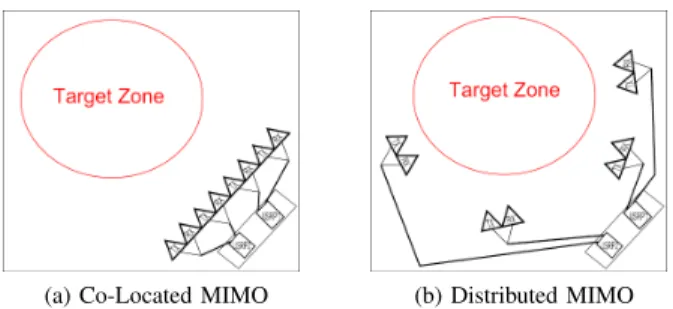
3) Walking Classification, categorizing person who is walk-ing, walking with a backpack or walking with a limp. Towards this aim, a database of micro-Doppler signatures was constructed from radar measurements of human motion collected in an indoor facility, and in particular in an approxi-mately 30 meter square room without any special covering for clutter suppression. Data is collected for two different configu-rations: 1) co-located and 2) distributed positioning of the 4x4 MIMO system depicted on Figure 1. For each configuration, human motion has been observed over 3 different angles, namely 30◦,60◦ and90◦, relative to the radar’s observation direction. Activities observed include
• Walking • Running • Crawling
• Walking with a backpack • Limping
• Group Walking • Group Running
Thus, 16 different micro-Doppler signatures were recorded by the 4 x 4 MIMO system for each test run. Each activity
(a) Co-Located MIMO (b) Distributed MIMO
Fig. 1: MIMO configurations experimentally tested.
was recorded for a duration of 60 seconds, as enacted by 4 test subjects, thereby yielding a total of 240 recordings in the micro-Doppler database.
III. MICRO-DOPPLERCLASSIFICATION
In this work, the micro-Doppler signature is represented in the time-frequency domain using a Short-Time Fourier Transform (STFT), or spectrogram, which was preferred over other time-frequency representations due to its robustness to interference [20]. First the received echoes sk
rx(n) are
formed into a zero mean and unit variance signals˜rx(n). The
pre-processed received signal ˜srx(n) contains kth channels
micro-Doppler components and consist of Ns samples. The
spectrogram is computed with the modulus of short time Fourier transform (STFT) of eachkthsignal˜s
rx(n)as follows χ(v, k) = Ns−1 X n=1 ˜ srxh∗(n−k)e j2πvn Ns (1) k= 0, . . . , K−1
whereKis the total number of channels,vis the normalized frequency and h∗(·)is the smoothing window.
Fig. 2: Block Scheme of the Algorithm
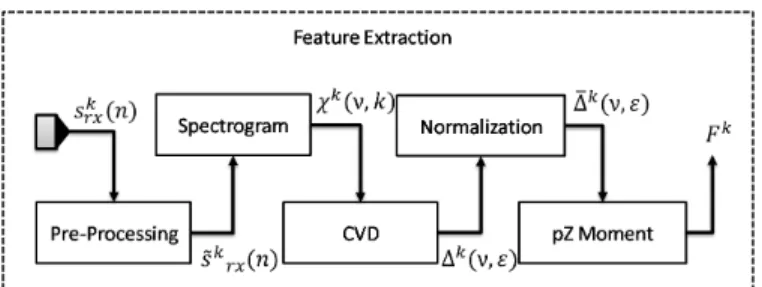
After computation of the spectrogram, the classification process then proceeds through extraction of features that ex-hibit statistical differences for the classes under consideration. In MIMO systems, however, individual feature vectors are obtained for each node in the network. Thus, after feature extraction, a single, composite feature vector formed from the individual feature vectors is computed and supplied to the classifier. The overall micro-Doppler classification process is shown in 2.
A. Feature Extraction
Features are extracted from the spectrogram by first com-puting the cadence velocity diagram (CVD), which may be found from ∆(v, ǫ) = K−1 X k=1 χ(v, k)ej2Kπvǫ (2) where ǫ is the cadence frequency. The motivation of using CVD is its robustness and lack of dependence upon the initial target position [20]. Each CVD obtained from all channels is then projected onto a basis constituted by pseudo-Zernike polynomials. Before calculating moments, normalization and CVD dimensional scaling should be done as the pseudo-Zernike polynomials are defined on the unit circle. This ensures the prevention of information loss due to dimension mismatch. The normalized CVD is acquired with the following formula; ¯ ∆k(v, ǫ) = ∆k(v, ǫ)−min v,ǫ ∆ k(v, ǫ) max v,ǫ [∆ k(v, ǫ)−min v,ǫ ∆ k(v, ǫ)] (3)
Finally, the pseudo-Zernike moments are computed from the normalized CVD. The feature extraction process is summa-rized in Figure 3.
Fig. 3: Feature Extraction Scheme Features are obtained by projecting∆¯k(v, ǫ)
on the pseudo Zernike polynomials of order n which can be written in the following form
Wn,l(x, y, ρ) =Wn,l(ρcosθ, ρsinθ, ρ) =Sn,l(ρejlθ) (4)
where the radial polynomials Sn,l(ρ)are expressed as
Sn,l(ρ) = n−|l| X k=0 (−1)k(2n+ 1−k)! k!(n+|l|+ 1−k)!(n−|l| −k)!)ρ n−k (5) Exploiting (4), the pseudo-Zernike moments are defined as
ψn,l= n+ 1 π 2π Z 0 1 Z 0 Wn,l∗ (ρ, θ)f(ρcosθ, ρsinθ)pdpdθ (6)
By using ∆¯k(v, ǫ) into (6), the pseudo-Zernike coefficients
can be obtained and ifnthorder pseudo-Zernike polynomials
are used,(n+ 1)2
sized output vectors is acquired. Hence the feature vector ofkth channel is
Fk= [ ψ0,0 , ..., ψN,−N ] (7)
Lastly, this output vectors are statistically normalized using the following linear re-scaling
˜ Fk =F k−µ Fk σFk (8) whereµFk andσFk are the mean and standard deviation of
the F the feature vector. As seen in Figure 4, signal skrx(n)
Fig. 4: General Flow of the Algorithm where k = 0,1, . . . , N2
−1 is obtained from 4x4 MIMO system with Ns samples. After the feature extraction stage,
Fk
,k= 0,1, . . . , N2
−1 acquired with length (order+ 1)2
whereorder is the pseudo-Zernike polynomials order. Since we have 16 data vector so the same number of feature vector, an algorithm should be used in order to make a feature vector from feature channel matrix for classifier. Last stage is to acquire a feature vectorF whose dimension isQassociated with the selection algorithm.
1) Feature Fusion: In the 4x4 MIMO system used for this work, a total of 16 different feature vectors are obtained after the feature extraction process. Especially in distributed localization, the target is observed from different perspectives so the feature vectors from different channels might include added information helpful for classification. Two different approaches for fusing the individual feature vectors into a final, overall feature vector are considered in this paper 1) concatenation of all the features from each channel; and 2) principal component analysis (PCA).
Concatenation creates a vector of size1×16N from16×N
matrix whereN is the number of features related to pseudo-Zernike moments order introduced in the previous section. While creating the feature vector, it exploits all features from all channels respectively regardless of any elimination. PCA, on the other hand, reduces the dimension of the feature space by computing an orthogonal basis that spans the entire feature space, thereby ensuring the minimum correlation between PCA feature generated. Although in PCA the relevancy of features (i.e. distance between classes) is not optimized, it is quite efficient in terms of computational time and amount of memory utilized [21].
IV. RESULTS
To statistically discriminate between different classes based on micro-Doppler analysis using pseudo-Zernike feature vec-tors, a support vector machine (SVM) classifier is used to-gether with a Monte Carlo approach. %70 of the data is used to train SVM classifier and the rest is used for testing. The classification results obtained for concatenation and PCA
features for co-located and distributed MIMO configuration is given in Table I and Table II. From these results, it is seen that in all cases, PCA yielded better results than concatenation of features. Moreover, when PCA was applied, the distributed MIMO configuration outperformed the co-located MIMO configuration for all classification problems considered. When concatenation was applied, the distributed configuration performed best, with the exception of the case of individual classification, in which concatenation yielded similar results to that of PCA.
TABLE I: Classification Results of Co-Locate Configuration
Co-Located 4x4 MIMO:PC(%)
Concatenation of All Features PCA Group Classification 94.07 96.57 Individual Classification 93.23 92.39 Walking Classification 75.76 80.60
TABLE II: Classification Results of Distributed Configuration
Distributed 4x4 MIMO:PC(%)
Concatenation of All Features PCA Group Classification 96.16 98.80 Individual Classification 93.02 95.67 Walking Classification 78.03 81.60
V. CONCLUSION
In this paper, the performance improvements attainable with multi-perspective data and the importance of sensor positioning is demonstrated. More specifically, it was found that a distributed configuration yields greater classification performance than a co-located configuration. Two different methods for feature-level fusion of radar data is explored: concatenation and PCA. It was found that through dimension reduction PCA yields superior results to concatenation. Clas-sification results are shown for three different human activity recognition problems: 1) group classification, 2) individual classification, and 3) walking classification (normal, limping, and carrying a backpack).
VI. ACKNOWLEDGEMENTS
This work was supported by the Engineering and Phys-ical Sciences Research Council (EPSRC) Grant number EP/K014307/1, the MOD University Defence Research Col-laboration in Signal Processing, TUBITAK Project No. 113E105, and EU FP7 Proj. No. PIRG-GA-2010-268276.
REFERENCES
[1] V. Chen,The Micro-Doppler Effect in Radar. Arctech House, 2011. [2] D. Tahmoush and J. Silvious, “Remote detection of humans and
ani-mals,” inProc. IEEE Applied Imagery Pattern Recognition Workshop (AIPRW), Oct 2009, pp. 1–8.
[3] H. xia Sun and Z. Liu, “Micro-doppler feature extraction for ballistic missile warhead,” inProc. International Conference on Information and Automation, June 2008, pp. 1333–1336.
[4] D. Gaglione, C. Clemente, F. Coutts, G. Li, and J. Soraghan, “Model-based sparse recovery method for automatic classification of heli-copters,” inProc. IEEE Radar Conference, May 2015, pp. 1161–1165.
[5] S. Gurbuz, B. Tekeli, M. Yuksel, C. Karabacak, A. Gurbuz, and M. Guldogan, “Importance ranking of features for human micro-doppler classification with a radar network,” inProc. 16th International Confer-ence on Information Fusion, July 2013, pp. 610–616.
[6] B. Erol, C. Karabacak, S. Gurbuz, and A. Gurbuz, “Radar simulation of different human activities via kinect,” inProc. IEEE Signal Processing and Communications Applications Conference (SIU), April 2014, pp. 1015–1018.
[7] M. Vespe, C. Baker, and H. Griffiths, “Radar target classification using multiple perspectives,”IET Radar, Sonar Navigation, vol. 1, no. 4, pp. 300–307, Aug 2007.
[8] S. Gurbuz, B. Erol, B. Caglyan, and B. Tekeli, “Operational assessment and adaptive selection of micro-doppler features,”IET Radar, Sonar, and Navigation, vol. 9, no. 9, pp. 1196–1204, 2015.
[9] B. Tekeli, S. Gurbuz, and M. Yuksel, “Information-theoretic feature selection for human micro-doppler signature classification,”IEEE Trans-actions on Geoscience and Remote Sensing, vol. PP, no. 99, pp. 1–14, 2016.
[10] E. Fishler, A. Haimovich, R. Blum, D. Chizhik, L. Cimini, and R. Valen-zuela, “Mimo radar: an idea whose time has come,” inProc. IEEE Radar Conference, April 2004, pp. 71–78.
[11] A. Haimovich, R. Blum, and L. Cimini, “MIMO radar with widely separated antennas,”IEEE Signal Processing Magazine, vol. 25, no. 1, pp. 116–129, 2008.
[12] H. Li and B. Himed, “Transmit subaperturing for MIMO radars with co-located antennas,”IEEE Journal of Selected Topics in Signal Processing, vol. 4, no. 1, pp. 55–65, Feb 2010.
[13] G. Zhao, C. Zhang, Y. Fu, and Z. Zhuang, “Micro-doppler analysis of vibrating target in MIMO SAR,” inProc. 10th European Conference on Synthetic Aperture Radar, June 2014, pp. 1–4.
[14] F. Fioranelli, M. Ritchie, and H. Griffiths, “Aspect angle depen-dence and multistatic data fusion for micro-doppler classification of armed/unarmed personnel,”IET Radar, Sonar, and Navigation, vol. 9, no. 9, pp. 1231–1239, 2015.
[15] B. Tekeli, S. Gurbuz, M. Yuksel, A. Gurbuz, and M. Guldogan, “Clas-sification of human micro-doppler in a radar network,” inProc. IEEE Radar Conference (RADAR), April 2013, pp. 1–6.
[16] M.-K. Hu, “Visual pattern recognition by moment invariants,” IRE Transactions on Information Theory, vol. 8, no. 2, pp. 179–187, February 1962.
[17] M. R. Teague, “Image analysis via the general theory of moments,” vol. 70, Aug. 1980.
[18] A. B. Bhatia and E. Wolf, “On the circle polynomials of zernike and related orthogonal sets,” Mathematical Proceedings of the Cambridge Philosophical Society, vol. 50, pp. 40–48, 1 1954.
[19] C. Clemente, L. Pallotta, A. Maio, J. Soraghan, and A. Farina, “A novel algorithm for radar classification based on doppler characteristics exploiting orthogonal pseudo-zernike polynomials,”IEEE Transactions on Aerospace and Electronic Systems, vol. 51, no. 1, pp. 417–430, January 2015.
[20] A. Persico, C. Clemente, C. Ilioudis, D. Gaglione, J. Cao, and J. Sor-aghan, “Micro-doppler based recognition of ballistic targets using 2d gabor filters,” inProc. Sensor Signal Processing for Defence (SSPD), Sept 2015, pp. 1–5.
[21] A. Miller, C. Clemente, A. Robinson, D. Greig, A. Kinghorn, and J. Sor-aghan, “Micro-doppler based target classification using multi-feature integration,” inProc. IET Intelligent Signal Processing Conference (ISP), Dec 2013, pp. 1–6.