Deutsches Forschungszentrum f ¨ur K ¨unstliche Intelligenz GmbH
Research
Report
RR-96-04CTL
A description logic with expressive concrete
domains
Gerd Kamp and Holger Wache
May 1996
Deutsches Forschungszentrum f ¨ur K ¨unstliche Intelligenz GmbH Postfach 20 80 67608 Kaiserslautern, FRG Tel.: + 49 (631) 205-3211 Fax: + 49 (631) 205-3210 Stuhlsatzenhausweg 3 66123 Saarbr¨ucken, FRG Tel.: + 49 (681) 302-5252 Fax: + 49 (681) 302-5341
Deutsches Forschungszentrum
f ¨
ur
K ¨
unstliche Intelligenz
The German Research Center for Artificial Intelligence (Deutsches Forschungszentrum f ¨ur K ¨unstliche Intelligenz, DFKI) with sites in Kaiserslautern and Saarbr ¨ucken is a non-profit organization which was founded in 1988. The shareholder companies are Atlas Elektronik, Daimler-Benz, Fraunhofer Gesellschaft, GMD, IBM, Insiders, Mannesmann-Kienzle, Sema Group, Siemens and Siemens-Nixdorf. Research projects conducted at the DFKI are funded by the German Ministry of Education, Science, Research and Tech-nology, by the shareholder companies, or by other industrial contracts.
The DFKI conducts application-oriented basic research in the field of artificial intelligence and other related subfields of computer science. The overall goal is to construct systems with technical knowledge and common sense which - by using AI methods - implement a problem solution for a selected application area. Currently, there are the following research areas at the DFKI:
2 Intelligent Engineering Systems 2 Intelligent User Interfaces 2 Computational Linguistics 2 Programming Systems
2 Deduction and Multiagent Systems
2 Document Analysis and Office Automation.
The DFKI strives at making its research results available to the scientific community. There exist many contacts to domestic and foreign research institutions, both in academy and industry. The DFKI hosts technology transfer workshops for shareholders and other interested groups in order to inform about the current state of research.
From its beginning, the DFKI has provided an attractive working environment for AI re-searchers from Germany and from all over the world. The goal is to have a staff of about 100 researchers at the end of the building-up phase.
Dr. Dr. D. Ruland Director
CTL
A description logic with expressive concrete domains
Gerd Kamp and Holger Wache
This work has been supported by a grant from The Federal Ministry of Education, Science, Research and Technology (FKZ ITWM-9405).
c Deutsches Forschungszentrum f ¨ur K ¨unstliche Intelligenz 1996
This work may not be copied or reproduced in whole of part for any commercial purpose. Per-mission to copy in whole or part without payment of fee is granted for nonprofit educational and research purposes provided that all such whole or partial copies include the following: a notice that such copying is by permission of the Deutsche Forschungszentrum f ¨ur K ¨unstliche Intelligenz, Kaiserslautern, Federal Republic of Germany; an acknowledgement of the authors and individual contributors to the work; all applicable portions of this copyright notice. Copying, reproducing, or republishing for any other purpose shall require a licence with payment of fee to Deutsches Forschungszentrum f ¨ur K ¨unstliche Intelligenz.
CTL
A description logic with expressive concrete
domains
Gerd Kamp
University of Hamburg
Vogt-K"olln-Str.30
22527 Hamburg
[email protected]
Holger Wache
DFKI GmbH
P.O. Box 2080
67608 Kaiserslautern
[email protected]
AbstractCompared with frame-based systems, description logics have the advantage of well-dened semantics and powerful inferences. In order to exploit these advantages in technical domains, the ability to use con-crete domains is needed, e.g. systems of (in)equalities over (non)linear polynomials to handle physical laws. Existing systems can only cope with comparisons between attributes.
We present an approach that considerably improves the expressive-ness of the concrete domains. Ctl1 is based on the ideas presented in
1] and 5]. Concrete domains are realised through a well-dened in-terface to external algorithms. Constraint Logic Programming (CLP) systems allow us to easily realise a whole range of concrete domains, e.g. over sets of symbols and numbers. In particular, we are able to handle systems of arbitrary linear polynomials. They also enable us to automatically participate in recent and future improvements in the areas of CLP and computer algebra, e.g. systems capable of handling arbitrary non-linear polynomials.
1Congurable (or Constraint-based) Terminological Logic 1
1 Introduction
In order to use description logics (DL) in technical domains expressive de-scription languages are needed. In addition to the abstract domain, several concrete domains such as numbers, strings and symbols must be added to the language and the inferences of the description logic.
Current representation systems such asLoomor Classictake this into
account by incorporating access to host data types. They realise mainly a single concrete domain over numerical values. But only comparisons between numerical attributes and numerical constants are taken into account when drawing the TBox inferences, and these inferences are themselves incomplete.
In contrast to that, Kris and Taxonhave sound and complete algorithms.
Both use a scheme for the integration of concrete domains developed by Baader and Hanschke 1, 5]. But they also realise only a single concrete domain allowing only comparisons between numeric attributes. Hence this
is only a slight improvement with respect to Loom and Classic. To
sum-marise, there is a need for improvement along two dimensions:
1. Addition of new concrete domains, such as strings and symbols. 2. Enhancement of the expressiveness of an existing domain (i.e. to date
only the numbers) by introducing new predicates.
In this paper we presentCtl, a scheme for improving in both dimensions.
2 Example
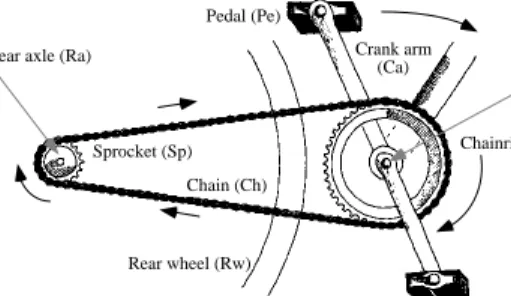
In order to apply description logics to technicalapplications, one mustat least be able to represent the subject of the application, i.e the technical device or assembly. In this section we give a simple, but typical example of such an assembly. The task is to model the simple bike drivetrain shown in Figure 1. Our focus is on the representation of the underlying physical (mechanical) laws. The bike transmission as a special mechanism can be modeled as a set of connected links. The behaviour of mechanisms is largely determined by the relations between the intervening forces and torques. These relations are given by physical laws that apply to all mechanisms, making the drivetrain a good example for mechanical devices in general. For our purposes it is sucient to treat the forces and torques as scalar entities. We also use numerical equations instead of quantity equations to describe the physical
Pedal (Pe) Crank arm (Ca) Bottom bracket spindle (Bbs) Chainring (Cr) Chain (Ch) Sprocket (Sp) Rear axle (Ra)
Rear wheel (Rw)
Figure 1: A simple bike drivetrain
laws2. In order to describe the drivetrain, the representation of the following
physical laws is necessary:
The torques of two links rotating on the same shaft are equal.
MRot1 =MRot2 (1)
A tension link (e.g. a chain) transmits forces along the direction of the tension, i.e. the force applied to two gear wheels driven by the same chain is equal.
FTension =FRot (2)
The torque of a rotational link is the product of the applied force and the radius of the link.
MRot=FRotrRot (3)
The force applied to a link is positive.
FLink 0 (4)
the radius of a rotational link strictly positive.
rLink > 0 (5)
It is important to notice that the right-hand side of Equation 3 is a
quadratic polynomial. It becomes linear when either F or r is bound. This
is usually the case during ABox reasoning but not during TBox reasoning 2This is possible if every quantity is denoted using its base unit.
processes. The drivetrain depicted in Figure 1 can therefore be described
with the following system of nonlinear inequalities3:
MCa=FCarCa MCa=MBbs MBbs=FBbsrBbs MCr =MBbs MCr =FCr rCr FCh=FCr FSp =FCh MSp =FSprSp MRa =MSp MRa =FRarRa MRw =MRa MRw =FRwrRw FCaFCrFBbsFCh FSpFRaFRw0 rCarCrrBbs rSprRarRw > 0 (6)
In general, technical applications impose the following requirement4:
\The T- and ABox reasoning services of description logics for technical applications must take (non)linear systems of (in)equa-lities into account."
3 Admissible concrete domains
Is it possible to develop such systems without losing decidability of the de-scription language? To answer this question we rst give a formal denition of (non)linear systems of inequalities. We then briey introduce the concept of \admissible concrete domains" as developed by Baader and Hanschke 1, 5] and show that systems of (non)linear (in)equations are an admissible con-crete domain by reducing the problem to the decidability of the theory over the elementary algebra of the reals 15].
Denition 1.
A univariate Polynomial over a ring R with 1 (a eld) is an expressionp(x) = X
0 i n
aixi:
The degree of the polynomial is dened by
deg(p) := maxf 2N:a 6= 0g:
Leti = (i1 ::: in)n
2N be a multiindex, and jij=i
1+
+in be the
order of i. A multivariate Polynomial over R in x = (x1:::xn) of degree m is dened by p(x) = p(x1:::xn) = X jij m ai1 ::: inx i1 1 xi n n:
3Neglecting the pedal.
4The representation of the geometry or other aspects leads to the same requirement. 4
Remark 1.
(i) Polynomials with a degree > 1 are generally called non-linear, Polynomials of degree 0123 respectively constant, linear, quadratic or cubic.(ii) In our case we are interested in polynomials with rational coecients,
i.e. in Qx
1:::xn].
(iii) The ai are calledcoecients, thexi indeterminates.
Denition 2.
A System U of inequalities of degreen in the variables x is anite set of equalities and inequalities in x between polynomials of degree at
most n. I.e. U = fg 1:::gm g, with gi =pi qi 2 f<>=6=g and deg(r)nr2fp 1:::pm gfq 1:::qm g.
As we have seen in Section 2, technical applications need concrete do-mains. In contrast to most existing description logics, Baader and Hanschke developed a scheme for integrating concrete domains into description lan-guages rather than describing a particular extension by some specic concrete domain. Additionally this scheme has the following properties:
1. The formal semantics as well as the combination of the algorithms are given on the scheme level.
2. The resulting algorithms for the extension should not only be sound but also complete.
Denition 3.
A concrete domain D is a relational structure, consisting ofa set dom(D), the domain of D, and a set pred(D), the predicate names of
D. Each p2pred(D) is associated with an aritynp and an np-ary predicate
PD dom(
D)n p.
Property 2 from above imposes additional constraints on the concrete
do-main, it must be admissible in order to be useful.
Denition 4.
A concrete domain isadmissible i(i)
it is closed under negation (i.e.8P9Q(Q = dom(D)np
nP, pred(D))),
(ii)
it contains a name>D fordom(
D) (i.e.8d2dom(D)(>
D(d) = true)),
and
(iii)
the satisability problem of nite conjunctions is decidable. (The niteconjunctionK =Vk
i=1pi(~xi) issatisable, i there exists an assignment
of the variables such thatK becomes true).
Theorem 1.
Let D be an admissible concrete domain. Then there exists asound and complete algorithm which is able to decide the consistency problem of an ABox for ALCF(D)
5.
Due to the decidability of the theory of the elementary algebra of the reals15] it is also admissible 1].
Denition 5.
The theory of the elementary algebra over the reals is theset of Terms T and Formula F over the alphabet consisting of the
individ-ual variables V = fxi 2 Ng (interpreted over R), the individual constants
01,the functional symbols +, the predicate symbol >, the logical junctors
:_^!$, the logical quantiers98and the auxiliary symbols ()
6. The
Terms T and formulasF are recursively dened as usual.
Theorem 2.
The theory of the elementary algebra over the reals is decidable.Theorem 3.
The theory of the elementary algebra over the reals is an ad-missible concrete domain.Together with the following observations the admissibility of systems of multivariate polynomials can be concluded.
Remark 2. (i)
Multivariate Polynomials p(~x) 2 Q~x] are terms of the elementary algebra.(ii)
The comparison predicates = etc. can be expressed by acombina-tion of logical junctors and<.
(iii)
The systemU =fg1:::gm
ghas a solution inRi9:::9x
1:::xn(g1
^
^gm) is true.
(iv)
The negation of an inequality is simply the negation of its comparingoperator.
(v)
9x (x = x) is an example for>.Theorem 4.
Systems of (in)equalities between multivariate polynomials of arbitrary degree are an admissible concrete domain.Systems of (in)equalities between linear multivariate polynomials are an admissible concrete domain.
5TBox subsumption and a lot of other reasoning services can be reduced to this problem,
see 1] for details. ALC is a rather expressive concept language introduced in 14]. Since
Taxon as well asCtl implement this language we refer to section 4 for details.
6In current systems one would use a more extensive alphabet providing additional
predicate symbols and all q 2 Q as individual constants. Tarski used the alphabet f10;1x i y i z i +=>:_^9g. 6
4 State of the art
What is the state of the art in implemented DL systems compared to these results? To answer this we analyse the expressiveness of the abstract as well
as the concrete domain of Loom 10], Classic 12], Kris 2] and Taxon
3]7. It turns out, that at best, the systems are only able to handle numerical
constants.
Loom and Classic use structural subsumption algorithms. These
al-gorithms are ecient and sound, but incomplete for expressive description
languages. In contrast to that,KrisandTaxonprovide sound and complete
algorithms based on a model-generating procedure 14] for testing the consis-tency of an ABox 6, 1]. All systems provide dierent description languages and inferences, preventing a comparison of the systems as well as the transfer
of descriptions from one system to another. Within the Krssproject, a
con-crete and an abstract syntax for a very expressive language description logic was developed 13]. Additionally it denes a core of this language on which compliant implementations are required to implement complete algorithms.
We use Krss as a reference for our comparisons.
4.1 Expressiveness of the Abstract Domains
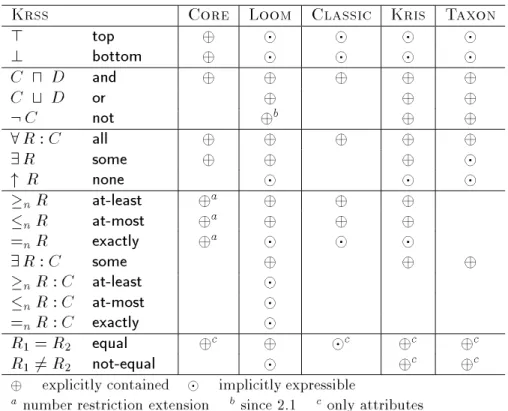
Table 1 gives an overall impression of the expressiveness of the concept terms
in the abstract domain of various systems. Since the Krssspecication was
mainly done by the developers ofClassic, it is not surprising that theKrss
core and Classicare nearly identical. Krisadds number-restrictions to the
language of Taxon. By far the most expressive language is provided by
Loom. But its algorithms are incomplete even where complete ones can be
given, e.g. with respect to or and not.
4.2 Expressiveness of the concrete domains
Krss provides a concrete part of the domain, specied as the rationals and
strings over some alphabet of size at-least 2. Since our example only needs the numeric domain and this is what most of the systems provide, we restrict our analysis to it.
7There a quite a few other DL systems. We have chosen this selection, cause its a
representative cross-section. Furthermore they are freely available (along with their source code) and written in Lisp.
Krss Core Loom Classic Kris Taxon > top ? bottom C u D and C t D or :C not b 8R:C all 9R some " R none nR at-least a nR at-most a =nR exactly a 9R:C some nR:C at-least nR:C at-most =nR:C exactly R 1 = R 2 equal c c c c R 1 6 =R 2 not-equal c c
explicitly contained implicitly expressible
a number restriction extension b since 2.1 conly attributes Table 1: Expressiveness: Concept Terms
4.2.1 Numeric Base Type
Regarding the numeric base type, number is only a non-terminal in the
syn-tax denition of Classic, but looking at the manual one can nd references
to reals. Loomaccepts reals in numerical relations while providing the
pre-dened concepts number (including complex numbers) and integer. Kris is
restricted to naturals while Taxon provides rationals.
4.2.2 Syntax
One requirement of Baader and Hanschkes admissible domains is the strict
separation between the abstract and the concrete domain, i.e. dom(I) \
dom(D) = . Therefore Kris and Taxonrestrict the use of expressions of
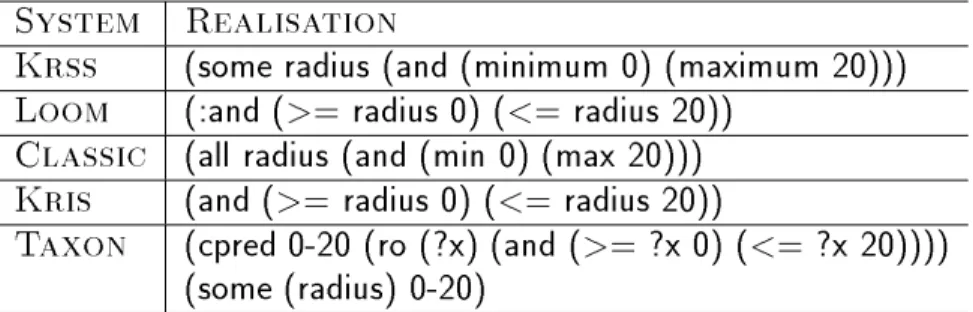
the concrete domain to quantications over attribute chains. This makes it impossible to dene a concept describing the interval 0 20] as it is allowed by
Krss,Loom, andClassic. Taxoncarries the separation between abstract
and concrete domain along to the syntactical level. One rst has to dene
the predicates of the concrete domain with cpredbefore they can be used in
System Realisation
Krss (some radius (and (minimum 0) (maximum 20)))
Loom (:and (>= radius 0) (<= radius 20))
Classic (all radius (and (min 0) (max 20)))
Kris (and (>= radius 0) (<= radius 20))
Taxon (cpred 0-20 (ro (?x) (and (>= ?x 0) (<= ?x 20)))) (some (radius) 0-20)
Table 2: The use of concrete domains in the various systems
concept terms. Table 2 shows how the range of the attribute radiuscould be
restricted in the various systems.
4.2.3 Expressiveness
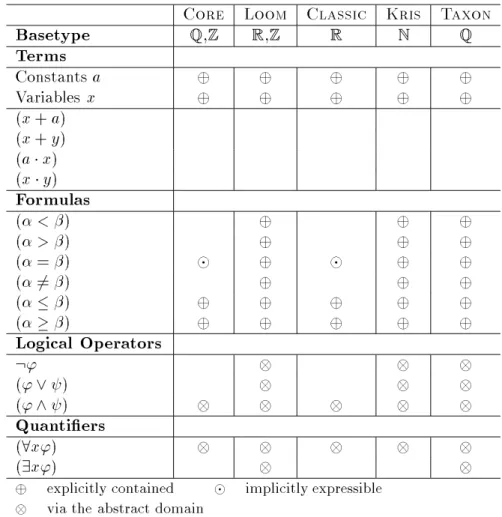
Table 3 summarises the systems' capabilities to handle systems of (in)equa-tions, using the dierent constructs of the elamentary algebra over the reals
as a guideline. The rst and foremost observation is the complete lack of
any function symbols. Therefore, current terminological systems can at best handle arbitrary comparisons between attributes or attributes and numbers.
OnlyLoomdenes a relation +, but it cannot be used within concept
deni-tions. Therefore it is impossible to dene even the simplestequations between
univariate linear polynomials likex = y+1 or diameter = 2radius. Not to
mention linear multivariate polynomials likeperimeter = 2(length+width)
or nonlinear polynomials like torque = radiusforce as in Equation (3).
Krss and Classic show another notable limitation. Unlike the other
sys-tems they provide only and as comparison operators, and one term of
the equation is restricted to be a constant. This makes it impossible to
de-ne a square as a special rectangle with length = width. One has to use the
abstract equality predicate equal in order to describe this. No system
imple-ments logical operators or quantiers within the concrete domain. They rely
on the operators of the abstract domain. Because Krss and Classic only
provide and, it is impossible to dene the missing comparison operator <.
The only way to circumvent the above limitations in some way is the
following: Krss,Loom, and Classicprovide constructs (satises, test-h/c)
to include arbitrary Lisp functions into concept descriptions. Obviously this construct cannot be used at all within the TBox reasoning services, since that would require the decidability of the halting problem. Therefore, in our opinion these constructs are nearly unusable, especially when it is possible to implement sound and complete algorithms as for systems of inequations of
Core Loom Classic Kris Taxon Basetype Q,Z R,Z R N Q Terms Constantsa Variables x (x+a) (x+y) (ax) (xy) Formulas (<) (>) (=) (6=) () () Logical Operators :' ('_) ('^) Quantiers (8x') (9x')
explicitly contained implicitly expressible via the abstract domain
Table 3: Expressiveness: Linear Sentences
polynomials. W.r.t. ABox reasoning they also have the major disadvantage of being lisp functions and not constraints. Therefore they can act only as test predicates. They do not propagate restrictions like constraints nor do
they expose the undirectedness of relations8.
5
CtlThe analysis in the previous section shows the shortcomings of current DL systems w.r.t. systems of (in)equalities. In this section we rst give a princi-pled way how to extend a terminological logic with a concrete domain. We then show how CLP systems provide the decision procedure for a whole range
8When not explicitily programmed that way. 10
of concrete domains and enable us to handle systems of (in)equalities. Realising a concrete domain is mainly the task of integrating a decision procedure for nite conjunctions of predicates (see Denition 2 and Theorem 4). In general there are two ways to do so:
1. Realising the decision procedure through a module hardwired to the
terminological inference engine.
2. Combiningan existingimplementation of the decision procedure through
a well dened interface to the terminological inference engine9.
With solution 1, every modication of the concrete domains, e.g. addition of a new domain, extending the expressiveness or exchanging the decision procedure, leads to a modication of the DL inference engine. With solution 2 this is reduced to the adaptation of the decision procedure to the interface. To our knowledge, all existing terminological systems (e.g. the systems of
the previous section) use approach 1. Ctl is unique by using approach 2
to provide a generic interface for concrete domains. The interface allows us to simultaneously provide multiple concrete domains, resulting in a modular
and congurable terminological system. Due to this open architecture,Ctl
can be adapted to the needs of the application, by only instantiating the concrete domains that are actually needed.
5.1 The Interface
The abstract domain ofCtlis based onALC and comparable to Taxon
10. The inference engine uses a model-generating consistency test 7], resulting in
sound and complete algorithms. We use the syntax of the Krssspecication
13]. Denition 4 serves as a guideline for the design of the interface. The interface itself is two-layered: First, means for dening concrete predicates and distinguishing between dierent concrete domains must be introduced at the representational level. Second, a set of functions realising the interface at the inference level must be dened.
5.1.1 The representational level
The concrete part of Krssis xed (see Section 4 and 13]). Since we want to
be exible w.r.t. concrete domains we have to nd a way to do so. Instead 9This follows the basic ideas presented by Baader and Hanschke in 1].
10adding the missing number-restrictions is simply the task of adding rules to the
infer-ence engine
of dening new constructs for each new predicate (likeKrss does with
min-imum or maximum11), we provide a formalism for introducing new predicate
descriptions, similar to the description of concepts or roles.
Syntax Semantic (hname D i(X 1 :::X n) hexpr D
i) predicate term (see text)
(dene-predicate PN P) PN I= P I (constrain R1 ::: R nP) faj9b 1 :::b n: ( ab 1) 2R I 1 ^^(ab n) 2R I n ^ (b 1 :::b n) 2P I g
Table 4: Extensions: Representational level
Predicate termsP describe concrete predicates. They are either a
predi-cate name PN or a list (hname
D i(x 1:::xn) hexpr D i) consisting of a domain identier hname D
i and a list of variables x
1:::xn. The expression
hexpr D
i is written in a syntax understood by the decision procedure of the concrete
domainD, actually denes the concrete predicate and refers to the variables.
dene-predicate assigns a name PN to a predicate term P. Because
con-crete predicates constrain the llers of relations (i.e. roles and attributes), predicate terms are allowed in concept as well as relation descriptions. We
introduce constrain as an additional concept term with the following
seman-tic: For every combination (d1:::dn) of llers of the relationsR1:::Rn the
predicate term P will be instantiated and the llers accordingly restricted.
Within role and attribute terms the Ri are restricted to chains beginning
with domain or range.
5.1.2 The inference level
On the interface level, the terminological inference engine has to be extended in order to communicate with the decision procedure of the concrete domain.
constrain constructs are handled by the concrete domain rules of the
model-generating procedure 1, 5]. Each time such a rule is called, the inference engine has to determine all combinations of the llers and to instantiate
the expression of the predicate term by substituting every variable xi with
the respective ller di. Second, a pool of the instantiated expressions must
be maintained. Each time an expression is instantiated, it is added to the
pool (add-expr) and the decision procedure of the concrete domain is called
through consistent, to determine whether the extended pool is consistent.
In the case of an inconsistency, expressions may be removed from the pool 11
minimum andmaximum are provided for backward compatibility and handled as
prede-ned concrete predicates.
(rem-expr) if there are any choice points to backtrack to. Third, during the inferences the inference engine may need the negation of a concrete predicate.
Therefore, the concrete domain must provide a function negationfor negating
concrete predicates (e.g. their expressions).
To summarise, a concrete domain interface has to provide a decision pro-cedure, functions for administrating the expression pool (minimal functions to add and remove expressions) and function to convert expressions to their negated form.
5.2 CLP-systems as decision procedures
Our example from section 2 needs a concrete domain handling systems of (non)linear (in)equalities. The basic idea is to realise this domain by
inter-facing to CLP(R)-systems. In our current implementation we interfaced to
a CLP(R)implementation calledEpilytis(derived from 9]) by extending it
with functions for negation and pool management.
This instantly gives us sound and complete inferences over arbitrary lin-ear polynomials, considerably improving the expressiveness of the resulting system. In section 2 we have seen that the handling of Equation 3 within the TBox requires nonlinear constraints. Nonlinear constraints are handled
within CLP(R) systems if they become linear during the inference process.
Overcoming this limitation is one of the central themes in the areas of
CLP as well as computer algebra. Systems like Gdcc 16] make use of
the Buchberger algorithm for computing Gr"obner bases in order to solve the problem over the complex numbers instead of the reals. While still be-ing incomplete this signicantly enhances the expressiveness of the system.
Risc-CLP(Real) 8] is the rst CLP-system delivering complete inferences
for arbitrary systems of inequalities, by improving Collins technique for
nd-ing cylindric algebraic decompositions12.
WithCtl we automatically take advantage of these and any future
im-provements, while this would at least be arduous if not impossible in other systems. Furthermore, interfacing to CLP-systems can be used to realise a whole range of concrete domains, e.g. nite domains (i.e. sets of symbols)
with CLP(FD)13.
12This technique can be applied to the problem of quantier eliminationon which Tarskis
decision procedure is based.
13We already have done that, but this is beyond the scope of this paper.
6 Realising the example with
CtlIn order to realise the example we rst have to dene an appropriate TBox14.
This is done in three steps:
1. First we have to dene the concrete predicates underlying the physical laws (1 - 5),
(define-predicate X=Y (EPILYTIS (?X ?Y) (?X = ?Y))) (define-predicate X*Y=Z (EPILYTIS (?X ?Y ?Z)
(?X * ?Y = ?Z)))
(define-predicate X>=0 (EPILYTIS (?X) (?X >= 0))) (define-predicate X>0 (EPILYTIS (?X) (?X > 0)))
2. This is followed by the denition of concepts describing the compo-nents: general, rotational and tension links.
(define-primitive-attribute link.force TOP) (define-primitive-attribute rot.radius TOP) (define-primitive-attribute rot.torque TOP)) (define-primitive-concept link
(some link.force (minimum 0))) (define-primitive-concept r-link
(and link
(some rot.radius X>0) (some rot.torque X>=0)
(constrain rot.radius link.force rot.torque X*Y=Z)))
(define-primitive-concept t-link link)
3. Third, we have to describe connections between components. We rep-resent them as roles. Note that the physical laws (1) and (2) describe eects taking place on certain kinds of connections.
(define-role linked
(and (domain link) (range link))) (define-role linked.rot.rot
(and (domain r-link)
14Due to space constraints, we provide a minimal TBox. 14
(range r-link)
(constrain (compose range rot.torque)
(compose domain rot.torque) X=Y))) (define-role linked.rot.ten
(and (domain r-link) (range t-link)
(constrain (compose range link.force)
(compose domain link.force) X=Y))) (define-role linked.ten.rot
(and (domain t-link) (range r-link)
(constrain (compose range link.force)
(compose domain link.force) X=Y)))
The Abox describing the drivetrain is then instantiated in 4 steps:
1. First we have to dene the individuals15. Note, that the instantiation
of the individuals already leads to the instantiation and restriction of their attributes.
(state (and
(instance ca-1 r-link) (instance cr-1 r-link) (instance bbs-1 r-link) (instance ch-1 t-link) (instance sp-1 r-link) (instance ra-1 r-link) (instance rw-1 r-link))) Ca r: >0 f:>=0 t: >=0 Bbs r:>0 f:>=0 t:>=0 Cr r:>0 f:>=0 t:>=0 Ch f:>=0 Sp r:>0 f:>=0 t:>=0 Ra r: >0 f:>=0 t: >=0 Rw r:>0 f:>=0 t: >=0
Figure 2: The generated model after step 1. 15The names of the individuals are abbreviated as in Figure 1.
2. Then we establish the connections between the individuals.
(state (and
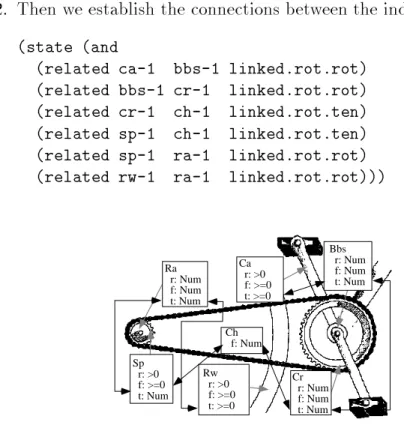
(related ca-1 bbs-1 linked.rot.rot) (related bbs-1 cr-1 linked.rot.rot) (related cr-1 ch-1 linked.rot.ten) (related sp-1 ch-1 linked.rot.ten) (related sp-1 ra-1 linked.rot.rot) (related rw-1 ra-1 linked.rot.rot)))
Ca r: >0 f: >=0 t: >=0 Bbs r: Num f: Num t: Num Cr r: Num f: Num t: Num Ch f: Num Sp r: >0 f: >=0 t: Num Ra r: Num f: Num t: Num Rw r: >0 f: >=0 t: >=0
Figure 3: The generated model after step 2.
If we now dene the values of some attributes, Ctl propagates these values
through the interface to the CLP(R){system. The CLP(R)-system checks
the consistency of the (in)equality system and calculates the values for all other attributes:
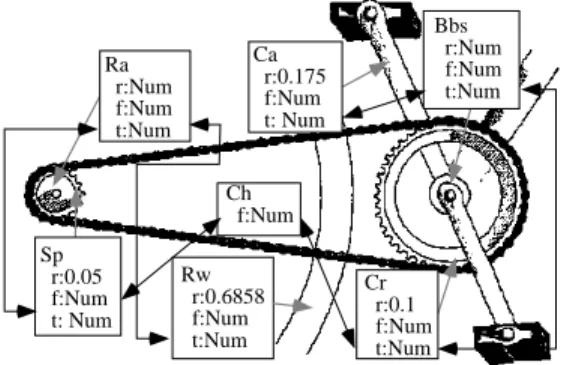
3. First we give the radii of the rotational links.
(state (and (related ca-1 .175 rot.radius) (related cr-1 .1 rot.radius) (related sp-1 .05 rot.radius) (related rw-1 0.6858 rot.radius)))
4. Finally we assert the value of the force applied to the crank arm.
(state (related ca-1 200 link.force))
This leads to the propagation of the constraints and the values of the
other attributes are determined16.
16The values are typical ones for a racing bike and an average cyclist. 16
Ca r:0.175 f:Num t: Num Bbs r:Num f:Num t:Num Cr r:0.1 f:Num t:Num Ch f:Num Sp r:0.05 f:Num t: Num Ra r:Num f:Num t:Num Rw r:0.6858 f:Num t:Num
Figure 4: The generated model after step 3.
Ca r:0.175 f:200 t: 35 Bbs r:Num f:Num t:35 Cr r:0.1 f:350 t:35 Ch f:350 Sp r:0.05 f:350 t: 17.5 Ra r:Num f:Num t:17.5 Rw r:0.6858 f:25.51 t:17.5
Figure 5: The generated model after step 4.
7 Summary and outlook
The example of a bike drivetrain reveals that in order to represent physical laws, terminological systems need to be able to handle systems of (non)linear (in)equalities. This is possible without losing the ability to dene sound and complete algorithms. We analysed a representative set of current DL systems and found that they are way too inexpressive. The shortcomings of existing terminological systems lead us to the development of a new system
calledCtl. Ctlis based on a terminological system with a generic interface
for concrete domains 1], allowing the easy attachment of existing decision procedures. Examples for such decision procedures are existing CLP-systems.
In particular we attached a CLP(R){system for the bike drivetrain example.
Future work is concentrated on attaching more CLP-systems. Currently
we are working on the integration of Eclipse. We plan to attach non-linear
CLP(R)-systems (e.g. 8]) as soon as they are available.
References
1] Baader, F., and Hanschke, P. A scheme for integrating concrete
domains into concept languages. Tech. Rep. RR-91-10, DFKI, Apr. 1991. 2] Baader, F., and Hollunder, B. Kris: Knowledge representation and inference system { system description. Technical Memo TM-90-03, DFKI, 11 1990.
3] Boley, H., Hanschke, P., Hinkelmann, K., and Meyer, M.
Co-Lab: A Hybrid Knowledge Representation and Compilation Laboratory. Tech. Rep. RR-93-08, DFKI, Jan. 1993.
4] Fruhwirth, T., and Hanschke, P. Terminological reasoning with
constraint handling rules. In Principles & Practice of Constraint
Pro-gramming. MIT Press, Cambdrige, MA, 1995, ch. 19, pp. 361{381. 5] Hanschke, P.A Declarative Integration of Terminological,
Constraint-Based, Data-driven, and Goal-directed Reasoning. Dissertation, Univer-sitat Kaiserslautern, 1993.
6] Hollunder, B. Hybrid inferences in kl-one-based knowledge
repre-sentation systems. In Proc. GWAI-90 (Ehringerfeld, Germany, 1990),
Informatik Fachberichte, Springer.
7] Hollunder, B., and Nutt, W. Subsumption algorithms for concept languages. Tech. Rep. RR-90-04, DFKI, Apr. 1990.
8] Hong, H. RISC-CLP(Real): Constraint Logic Programming over the
real numbers. InConstraint Logic Programming: Selected Research.MIT
Press, Cambridge, MA, 1993.
9] Jaffar, J., Michaylov, S., Stuckey, P. J., and Yap, R. H. The CLP(R) Language and System,.
10] MacGregor, R. The evolving technology of classication-based
knowledge representation systems. In Principles of Semantic Networks.
Morgan Kaufmann, 1991.
11] MacGregor, R. M. A description classier for the predicate calculus.
In Proc. of the AAAI-94 (1994), AAAI, pp. 213{220.
12] Patel-Schneider, P., McGuiness, D., Brachman, R., Resnick, L., and Borgida, A. The CLASSIC Knowledge Representation
Sys-tem: Guiding Principles and Implementation Rational. SIGART
Bul-letin 2, 3.
13] Patel-Schneider, P. F., and Swartout, B.Description logic spec-ication from the krss eort. Nov. 1993.
14] Schmidt-Schauss, M., and Smolka, G. Attributive concept
de-scriptions with complements. AI 47 (1991).
15] Tarski, A. A decision method for elementary algebra and geometry.
In Collected Works of A. Tarski, vol. 3. pp. 297{368,.
16] Terasaki, S., Hawley, D. J., Sawada, H., Satoh, K., Menju, S., Kawagishi, T., Iwayama, N., and Aiba, A. Parallel constraint
logic programming language GDCC and its parallel constraint solvers. In
International Conference on Fifth Generation Computer Systems (June 1992).
th e xpressive concrete domains che