Genetic variability and interrelationships of grain yield and its components of
selected bread wheat genotypes
Elfadil M. E. Elbashier1, Izzat S. A. Tahir1, Hala. M. Mustafa and Abu Elhassan S. Ibrahim2
1 Wheat Research Program, Gezira Research Station, Agricultural Research
Corporation, Sudan.
2 Faculty of Agricultural Sciences, University of Gezira, Wad Medani,
Sudan.
ABSTRACT
High temperature is one of major constraints of bread wheat production in the Sudan. Evaluation of different genotypes under heat stress conditions is one of the main tasks of breeders for exploiting genetic variations to improve cultivars under heat stress. Also, association of yield and yield contributing traits is important for selection. The objective of this study was to evaluate bread wheat genotypes under the irrigated hot environment of the Gezira, Sudan. Experiments were conducted at Gezira Research Farm, Wad Medani, Sudan for two consecutive seasons 2006/07 and 2007/08. The experiments were arranged in an augmented design with six checks, 4 and 12 blocks in the first and second seasons, respectively. Results showed wide ranges of variations in grain yield among these genotypes in both seasons. Grain yield ranged from 965 to 4019 kg/ha and from 133 to 6258 kg/ha in the first and second seasons, respectively. Similar wide ranges of variations were found in biomass, harvest index, number of spikes m-2, days to heading, days to maturity and plant height. Grain yield showed positive and significant correlation coefficients with biomass and harvest index, in both seasons. Path coefficient analysis indicated that biomass and harvest index were the most directly related parameters to grain yield, in both seasons.
INTRODUCTION
High temperature is the major constraint of bread wheat production in the Sudan (Elahmadi et. al., 1996). Breeding for heat tolerance is one of the main objectives of the wheat breeding program in the Sudan. Breeding materials and introductions at Gezira Research Station, Sudan, showed very large variability for grain yield among wheat genotypes. Yield, as a function of various components, is a complex character. Many characters have been suggested as selection criteria for heat tolerance or avoidance (Elahmadi et. al, 1996; Tahir et. al., 2006).Variations in the degree of response to heat stress with respect to different characters are observed. Correlation among these characters and selection for heat tolerance are important to increase yield. Also study of direct and indirect effects of components provides the basis for successful selection (Choudhry et al., 1986).
The aims of this study were to investigate genetic variability, interrelationships and path analysis of yield and yield components among some genotypes selected from different trials of the wheat breeding program of the Sudan.
MATERIALS AND METHODS
The experiments were conducted in two consecutive growing seasons (2006/2007 and 2007/2008) at the Gezira Research Farm (GRF), of the Agricultural Research Corporation (ARC), Wad Medani, Sudan (latitude of 14°-24´ N and longitude of 29°-33´ E and 407 masl). The soil of GRF is classified as heavy clay soil, pH of about 8.0-8.4, low organic matter (0.05), deficient in nitrogen (380 ppm), and phosphorus (ESP, 4 ppm).
The experiments were conducted using 94 and 174 genotypes in the first and second seasons, respectively. Genotypes were selected from different trials in the wheat breeding program of the Sudan. The experiments were arranged in an augmented design with six checks, 4 and 12 blocks in the first and second seasons, respectively. Checks were assigned at random to plots within each block while the remaining plots were assigned randomly to the new genotypes under test. Each plot consisted of two rows, 2 and 5 m long in the first and second seasons, respectively and 0.2 m apart.
Seeds were sown at the rate of 120kg/ha in mid November (optimum sowing date). The recommended dose of fertilizer (43 kg P2 O5/ha) was applied prior to sowing and 86 kg N/ha as urea was applied with the second and fourth irrigations. The experiments were irrigated at 10-12 days interval.
Data were recorded on days to heading and maturity, chlorophyll content (SPAD), plant height (cm), number of spikes/m², biomass (kg/ha), harvest index and grain yield (kg/ha). The data were statistically analyzed using IRRISTAT for Windows (Version: 5.0.20050211), simple correlation coefficients were calculated using Stat View for Windows (SAS Institute Inc. Version 5.0.1) and path coefficient was calculated using Excel Computer Program.
RESULTS AND DISCUSSION
Genetic variabilityThe mean, lowest and highest grain yield and other important traits of the checks and adjusted data of the 94 and 174 new entries are shown in Tables 1 and 2. The adjusted grain yield of the new entries ranged from 965 to 4019 (kg/ha), biomass from 3448 to 9948 (kg/ha) and harvest index from 20.5 to
50.4%. In addition, wide ranges were observed in number of spikes m-2, days to heading and maturity, chlorophyll content and plant height in the first season (Table 1). In the second season, grain yield of the new entries ranged from 133 to 6258 (kg/ha), biomass from 4153 to 18838 (kg/ha) and harvest index from 18.4 to 49.6%. Similarly, wide ranges were found in number of spikes m-2, days to heading
and maturity and plant height (Table 2). These results were in agreement with those of Reynolds et al., 1994, Elahmadi et al1996, Khopra and Viswanthan, 1999, Slafer et al., 2005 and Mehment and Telat 2006. They showed significant phenotypic variability for different traits such as days to heading, days to maturity, plant height, number of spikes m-2, biomass and grain yield. Genotypes differed significantly for all traits among these experiments indicating the presence of sufficient genetic variability for selection to identify the superior genotypes.
Table 1. Mean, lowest and highest values for grain yield and other important traits of the 94 new entries and six checks used in the first season (2006/07).
Grain yield (kg/ha) Biomass (kg/ha) Harvest index (%) Spikes m-2 Heading (days) Maturity (days) Chlorophyll content (SPAD) Plant height (cm) New entries Highest 4019 9948 50.4 725 67 104 56.5 104 Lowest 965 3448 20.5 203 53 82 34.7 63 Mean 2329 6807 43.9 425 61 96 42.3 84 Checks El Neilain 2824 7812 36.6 398 61 101 34.7 92 Sasaraib 2222 8906 25.2 373 64 93 56.5 75 Imam 2799 7656 38.8 405 66 101 39.8 89 Khalifa 2525 5469 37.0 398 63 93 38.8 82 Tagana 2309 8125 28.9 450 65 104 43.9 87 Bohaine 2698 7500 36.0 495 54 87 43.5 65 Mean 2562 7578 33.8 419 62 95 42.9 81 S.E.+ 77.1 1350 4.1 17.8 1.2 1.6 1.7 2.9 C.V % 7.8 16.7 18.6 9.3 1.8 1.6 3.7 3.4
Table 2. Mean, lowest and highest values for grain yield and other important traits of the 174 new entries and six checks used in the second season (2007/08).
Grain yield (kg/ha ) Biomas s (kg/ha) Harvest index (%) Spike m-2 Heading (days) Maturity (days) Plant height (cm) New entries Highest 6258 18838 49.6 737 72 109 108 Lowest 1331 4153 18.4 280 41 74 51 Mean 4087 10740 38.7 542 57 92 75 Checks Debeira 5177 14430 35.8 676 59 96 81 Wadi Elneil 4609 11930 40.0 535 64 103 87 Imam 4409 17030 36.7 550 66 99 83 Tagana 4109 17470 33.0 605 69 103 85 Bohaine 4099 10310 39.2 668 51 90 67 Nebta 3833 9375 41.5 477 55 91 65 Mean 4373 13424 38.0 585 61 97 78 S.E.+ 730.7 1641 7.2 90.7 1.6 2.4 2.6 C.V % 16.8 14.1 19.1 16.3 2.7 2.4 5.9 Traits associations
Simple correlation coefficients of grain yield and some important traits of the 94 and 174 entries in the first and second seasons, respectively, are shown in Table 3. Grain yield was positively and significantly correlated with biomass and harvest index in both seasons and was positively and significantly correlated with number of spikes m-², days to heading, days to maturity and plant height
in the second season. Many research workers reported similar findings (Shpiler and Blum; 1986, Hezhong and Rajaram, 1994; Tamman et al., 2000; Osman et al., 2006). In addition, biomass and harvest index are very important selection criteria for yield under high temperature conditions (Hezhong and Rajram 1994, Tahir 1999).
Table 3. Simple correlation coefficients of grain yield and some traits of 94 and 174wheat genotypes grown at the Gezira Research Farm (GRF), seasons 2006/07 and 2007/08.
First season (2006/07) N = 94 GY BIO HI SP/m-2 DH DM Grain yield Biomass 0.67*** Harvest index 0.41*** -0.37*** No of spikes m-2 0.03 -0.03 0.04 Days to heading 0.11 0.08 0.09 -0.04 Days to maturity -0.26* 0.11 0.19 -0.05 0.62*** Plant height -0.02 -0.05 0.03 0.28** 0.03 0.177 Second season (2007/08) N = 174 Grain yield Biomass 0.77*** Harvest index 0.21** -0.45*** No of spikes m-2 0.34*** 0.37*** -0.10 Days to heading 0.29*** 0.58*** -0.49*** 0.20** Days to maturity 0.33*** 0.59*** -0.45*** 0.27*** 0.93*** Plant height 0.67*** 0.67*** -0.48*** 0.26*** 0.77*** 0.77***
N = number of genotypes, GY = grain yield (kg/ha), Bio = biomass (kg/ha), HI = harvest index, SP/m-2 = number of spikes/m2, DH = days to heading, DM = days to maturity
Path coefficient analysis
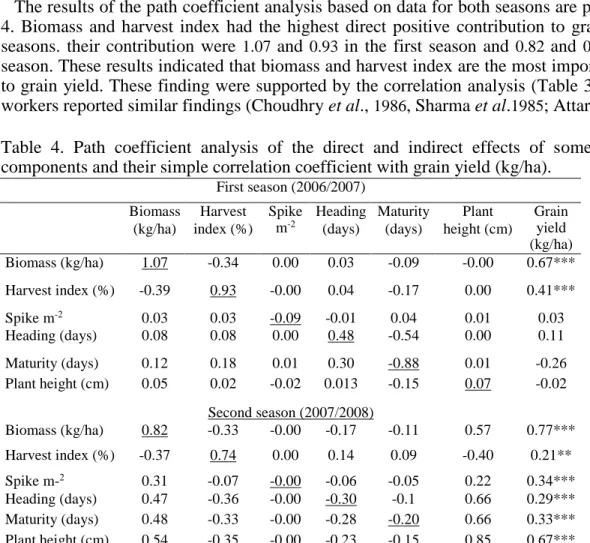
The results of the path coefficient analysis based on data for both seasons are presented in Table 4. Biomass and harvest index had the highest direct positive contribution to grain yield for both seasons. their contribution were 1.07 and 0.93 in the first season and 0.82 and 0.74 in the second season. These results indicated that biomass and harvest index are the most important traits related to grain yield. These finding were supported by the correlation analysis (Table 3). Many research workers reported similar findings (Choudhry et al., 1986, Sharma et al.1985; Attarbashi et al.,2002).
Table 4. Path coefficient analysis of the direct and indirect effects of some important yield components and their simple correlation coefficient with grain yield (kg/ha).
First season (2006/2007) Biomass (kg/ha) Harvest index (%) Spike m-2 Heading (days) Maturity (days) Plant height (cm) Grain yield (kg/ha) Biomass (kg/ha) 1.07 -0.34 0.00 0.03 -0.09 -0.00 0.67*** Harvest index (%) -0.39 0.93 -0.00 0.04 -0.17 0.00 0.41*** Spike m-2 0.03 0.03 -0.09 -0.01 0.04 0.01 0.03 Heading (days) 0.08 0.08 0.00 0.48 -0.54 0.00 0.11 Maturity (days) 0.12 0.18 0.01 0.30 -0.88 0.01 -0.26 Plant height (cm) 0.05 0.02 -0.02 0.013 -0.15 0.07 -0.02 Second season (2007/2008) Biomass (kg/ha) 0.82 -0.33 -0.00 -0.17 -0.11 0.57 0.77*** Harvest index (%) -0.37 0.74 0.00 0.14 0.09 -0.40 0.21** Spike m-2 0.31 -0.07 -0.00 -0.06 -0.05 0.22 0.34*** Heading (days) 0.47 -0.36 -0.00 -0.30 -0.1 0.66 0.29*** Maturity (days) 0.48 -0.33 -0.00 -0.28 -0.20 0.66 0.33*** Plant height (cm) 0.54 -0.35 -0.00 -0.23 -0.15 0.85 0.67***
REFERENCES
Attarbashi, M., R. S. Galeshi and A. Zinali. 2002. Relationship of phenology and physiological traits with grain yield in wheat under rain-fed conditions. Iranian Journal of Agricultural Sciences 33: 8 -21.
Choudhry, A., R. Shah, A. H. Ali and L. M. Bashir.1986. Path coefficient analysis of yield and yield components in wheat. Pakistan Journal of Agricultural Research 7(2): 71-75.
Elahmadi, A. B., O. A. Ageeb, M. B. Solh and M. C. Saxena. 1996. Review of wheatproduction and improvement in the Sudan. Proceedings of the National Research Review Workshop. 27-30 August 1995, Wad Medani, Sudan.
Hezhong, H. and S. Rajram.1994. Differential responses of bread wheat characters to high temperature. Euphytica 72:197 - 203.
Khopra, R., and C. Viswanthan. 1999. Evaluation of heat stress in irrigated environment of
Triticum asetivumL. and related species forstability in yield and yield components. Euphytica
106: 169-180.
Mehment, A., and Y. Telat. 2006. Heritability of yield and some yield components in bread wheat genotypes. Bangladesh Journal of Botany 35: 17-22.
Osman, S. I., M. Tang and M. R. Muhammad. 2006. Phenotypic and genotypic correlation coefficients between yield and yield components in wheat. Journal of Agricultural Research 44 (1):100-108.
Reynolds, M. P., M. Balota, M. I. Delgoado, I. A. Amani and R. A. Fischer. 1994. Physiological and morphological traits associated with spring wheat yield under hot irrigated conditions. Australian Journal of Plant Physiology 21: 717 - 730.
Sharma, D.J., P. K. Yadav and R. K Sharma. 1995. Genetic variability and association for some
yield components in winter spring nursery of wheat. Advances in Plant Sciences. 8 (1): 95-99. Shpiler, L.and A. Blum. 1986. Heat tolerance for yield and its components in
different wheat cultivars. Euphytica 51: 257 - 263.
Slafer, G., A. J. L. Araus and C. Royo. 2005. Physiological traits for genetic improvement of cereal yields in Mediterraneanenvironments. Applied Biology 146 (1): 61 - 67.
Tahir, I. S. A., N. Nakata, A. M. Ali, H. M Mostafa, A . S. I.Saad, K. Takata, N. Ishikawa and O. S. Abdalla. 2006. Temperature effects on wheat grain yield and quality in hot irrigated environment. Plant Breeding 125: 323 - 330.
Tahir, I. S.A.,1999. Genetic improvement in grain yield and accompanied changes in associated traits of bread wheat cultivars in the Sudan. M. Sc. Thesis, University of Gezira, Wad Medani, Sudan.
Tamman, A. M., A. S. Ali and E. A. M. El-Sayed. 2000. Phenotypic, genotypiccorrelation and path coefficient analysis in some bread wheat crosses. Agricultural Science 31(3): 73 - 85.
يف اهتانوكمو ةيجاتنلإل ةلخادتملا تاقلاعلاو يثارولا نيابتلا حمقلا نم ةراتخملا تلالاسلا ضعب 1ىفطصم دمحم ةلاهو 1رهاط يلع دمحأ ديس تزعو 1ريشبلا بيطلا دمحم لضافلا 2ميهاربإ حلاص نسحلا وبأو .حمقلا ثوحب جمانرب ،ةريزجلا ثوحب ةطحم ،ةيعارزلا ثوحبلا ةئيه1 .نادوسلا ،يندم دو ،ةريزجلا ةعماج ،ةيعارزلا مولعلا ةيلك 2 ةصلاخلا يف ايثارو ةنيابتملا تلالاسلا مييقت .نادوسلا يف يرطلا حمقلا جاتنإ يف ةيسيئرلا تاريثأتلا ىدحإ ةيلاعلا ةرارحلا ةجرد ربتعت تافص ديدحت ةيمهلأ ةفاضلإاب فانصلأا نيسحت يف يثارولا نيابتلا اذه للاغتسلا نيبرملل ةيسيئرلا ماهملا دحا ةرارحلا داهجإ فرظ مهملا باختنلاا مييقت ةساردلا نم فدهلا .ة 49 و 179 ةريزجلا ثوحب ةعرزمب ةراحلا ةئيبلا فرظ يف يرطلا حمقلا تلالاس نم يمسوم يف نادوسلا ،يندم دوب 2002 / 2007 و 2007 / 2002 تعزوو مسوم لك يف دهاوش تس دوجوب جمدملا ميمصتلا مدختسا . لع تلالاسلا ى 9 و 12 يلاوتلا يلع يناثلاو لولاا مسوملل عاطق افلاتخا جئاتنلا ترهظا . اريبك لاسلا هذه نيب بوبحلا ةيجاتنا يف تلا نم حوارت ذا 429 ىلإ 9014 نمو 111 ىلا 2292 وليك تافلاتخلاا هذه تدجو .يلاوتلا يلع يناثلاو لولاا مسوملا يف راتكه/مارج ددع ،داصحلا ليلد ،ةيوضعلا ةلتكلا تافص يف ةريبكلا لبانسلا ددع ،عبرملا رتملا يف أ تابنلا عافتراو جضنلاو لابسلاا ماي ترهظا . ةساردلا أ اطابترا اهل راتكهلل بوبحلا ةيجاتنا ن ابجوم ايونعمو راسملا ليلحت حضوا امك .داصحلا ليلدو ةيوضعلا ةلتكلا عم أ ةلتكلا ن تنلإا عم ةرشابم ةقلاع اهل يتلا تافصلا مها يه داصحلا ليلدو ةيوضعلا .راتكهلل ةيجا