THE SIMULATION OF A TOLL-RING
SCHEME FOR MADRID: AN EFFICIENCY
AND EQUITY ANALYSIS
Floridea Di Ciommo, Research Fellow Transport Research Centre (TRANSYT) Universidad Politecnica de Madrid, +34 91 3365259, [email protected] Andrés Monzón, Professor Transport Department Universidad Politecnica de Madrid, +34 91 3365373, [email protected]
Cristina Valdés, PhD Candidate, Transport Research Centre (TRANSYT) Universidad Politecnica de Madrid, +34 91 3366708, [email protected]
Wang Yang, PhD Candidate, Transport Research Centre (TRANSYT) Universidad Politecnica de Madrid, +34 91 3366708, [email protected]
ABSTRACT
Among the interurban road pricing policies, the metropolitan road tolling policies need to be differently analyzed because of its specific characteristics. In fact, the urban and metropolitan areas intercept most of the daily journeys which contribute to congestion and which are very sensible to the toll because of their daily frequency.
The mobility survey developed on the Madrid Metropolitan Area shows that from 1996 to 2004 the number of mechanized trips increased by 52%, whereas the population increased only by 14%. An efficient way to manage the increasing car travel demand could be the implementation of a metropolitan toll in the more congested road sections. One of the most popular “congestion pricing policies” is the toll-ring scheme used in Norwey (such as Trondheim and Bergen) and in Stockholm, where the vehicles are taxed when entering or exiting the city centre, especially during peak periods. In fact, a toll-ring scheme discourages orbital diversions, achieving higher efficiency and environmental benefits.
A methodology to evaluate the implementation of a congestion pricing policy like a toll-ring scheme in a metropolitan area like Madrid during the peak hour will be defined. The main result of the paper is in terms of the equity effects. The comparison of two different road sections shows that in the wealthier metropolitan area, the north of the M40 ring, the burden of the toll is higher on the lower income users.
Floridea Di Ciommo, Andrés Monzón, Cristina Valdés y Wang Yang
INTRODUCTION
Following the EU policy (Towards fair and efficient pricing in Transport, 1996) oriented to implement a tolling system based on social marginal costs, Spain is studying the implementation of an interurban road pricing scheme (Di Ciommo, Monzón and Fernandez, 2010). A starting point is that prices should reflect the marginal social cost imposed on society by consumption of the good (v-km travelled). When car users decide to travel additional kilometres they impose additional costs (Nash, 2007):
• on themselves (operating and time costs)
• on the infrastructure-provider (maintenance and operation costs) • on other users (delay and congestion cost)
• on the rest of society (accident, climate change, pollution and noise).
Costs to other users and to the rest of society are referred to as external costs. These costs, specially the congestion costs, in general, are higher in the metropolitan areas than in the other areas.
As the private and the freight road transport grow, traffic congestion, noise and environmental problems become more and more serious. The society is assuming directly the environmental and accident costs and indirectly the infrastructure costs mainly paid by the public general expenditure. In economics, these costs are included among the social costs, which are defined as the sum of internal and external costs. The internal costs that include mainly time and operation costs, are paid immediately by road users, and external costs that contain congestion, maintenance of infrastructure, accidents, CO2 emissions and noise costs, are a burden on society.
There are only few examples of pricing schemes where charges directly vary by environmental criteria (emissions), by road conditions (to support maintenance policy) or by level of service (except the fast lanes in U.S.). Notable exceptions are the use of discounts or exemptions for alternative fuelled vehicles (e.g. in the London Congestion Charge and the Pollution charge in Milan) or zero-emission engines (e.g. on express lanes in California). Environmental and pavement damage criteria may of course be addressed indirectly via the differentiation of charges according to the vehicle classes. A majority of current road pricing schemes are concentrated in the cities and based on congestion pricing like toll-ring depending on time-of-day (e.g.Trodheim Ring Road in Norway, the Stockolm Congestion Charge).
A main result of the Spanish Road Pricing Model (META, 2007) in terms of policy implications suggests that a road pricing scheme based on the congestion costs makes sense only in the reduced number of metropolitan highways and can be used to manage the travel demand in an urban and metropolitan context, like the Madrid Metropolitan Area. The Madrid Metropolitan Area (MMA) has 6 million inhabitants in an area of 8,000 square km, with an average density of population of 7.42 inhabitants/hectare. The mobility survey for
the MMA shows that from 1996 to 2004 the number of mechanized trips increased by 52%, whereas the population increased only by 14% (Vassallo et al, 2009).
Madrid is experimenting an intensive sprawling process. Consequently, the population in the MMA has been relentlessly spreading out. But the city center still concentrates an important part of both population and activities. Up to now, measures intended to channel or direct such urban sprawl have rarely been applied. In the MMA, the car ownership rate is almost 700 per 1,000 inhabitants, which is the highest motorization rate among the Spanish regions. The phenomenon of the suburbanization of both residence and employment along with the increase of car ownership is prompting new transportation trends in the MMA ((Monzón and De la Hoz, 2009), increasing the congestion phenomena especially during the peak hours. The objective of this paper is to define a methodology to evaluate the possible implementation of a congestion pricing policy like a toll-ring scheme in a metropolitan area like Madrid during the peak hour in the morning. In particular, the analysis is focused on the results of the simulation of a toll-ring defined as a combined toll (access and distance toll based scheme) applied on the one of the more congested ring, the M40.
The choice of the M40 ring is justified by two different reasons: first, it is almost the most congested metropolitan highway that needs a policy traffic measure to mitigate the congestion problems (Santos, G, 2002); second, it is the more external boundary, a toll of access to this ring can incentive a recentralization of the residential and economic activities inside of the ring. Like showed by May (2002) a toll-ring scheme intercepts more of the journeys which contribute to congestion and discourage orbital diversions, achieving higher efficiency and environmental benefits.
The approach adopted in this paper is based on a demand model defined by calibrating the simulator software for travel demand, VISUM. In this model, the demand data is obtained from the Mobility survey of the region of Madrid (EDM 2004), and adjusted using real traffic flow data from different transport bureaucracies. The travelers will then choose the path (route choice) so as to minimize their total costs of operation A toll-ring scheme can be applied directly to this modeling framework. By using a comparative approach, we focus on the performance analysis –as to both efficiency and equity -- of the access and distance-based road pricing scheme. In particular, we compare two different road sections, one in the north of the MMA and another in the south, both characterized by a high degree of congestion, with a speed between 25 and 50 km/h during the peak hour (8-9 a.m.), and the same free flow speed – with no traffic -- is 100 km/h, but with different socio-economic environments.
The paper is organized into four sections. The first section—after the introduction—provides an overview of the current experience on congestion pricing in the metropolitan and urban areas which is necessary for understanding the possible application of a congestion pricing policies in the metropolitan area of Madrid. Section two develops a methodology to evaluate a toll-ring scheme implementation, by using the social costs model estimated for the Spanish road network (META) and the travel demand model software. In section three we discuss the
Floridea Di Ciommo, Andrés Monzón, Cristina Valdés y Wang Yang
results of the simulation and analyze the equity impact by comparing two different road sections characterized by users of different income levels, on whom the burden of the same toll falls differently. The forth section offers conclusions about the implications of congestion pricing policies in terms of the effect on social equity, by comparing two different road sections of the M40 highways.
CONGESTION PRICING POLICIES IN METROPOLITAN AREAS
The congestion pricing policy has been proposed as one of the most effective ways to decrease traffic congestion in the metropolitan area (Ministry of Transport, 1964). By internalizing the externalities of congestion through the implementation of urban or metropolitan toll, it appears that society attains an improvement in total social welfare (Vickrey, 1955). This idea gradually was put more and more into practice throughout the urban and metropolitan areas (May, A., Liu, R, Shepherd, S.P., Sumalee, A 2002). In this context, the toll can be imposed on travellers as they cross each designated toll point (access-based scheme), according to the amount of they use the road, or according to the distance travelled or according to the point of entry (an area-entry based scheme)(area based scheme) or employing a combination of different pricing schemes, as for example, a combination of both access-based and distance based scheme.
The majority of current road pricing schemes are far from real-time congestion charging. Some toll-ring schemes, mainly in cities, do discriminate between peak and off-peak hours, but mostly using larger units of time, rather than just 2-3 hours of peack time, twice a day. . Examples with two or three different charges depending on time-of-day or peak/off-peak are the Trondheim Ring Road (Norway), the Stockholm Congestion Charge and the Highways in Portugal. Higher charges at peak times are generally achieved by offering off-peak discounts rather than by explicitly setting higher charges during the peak periods. In Portugal, off-peak discounts are only available to users of the ETC pass (“Via Verde”). The systems which come closest to charging for real-time congestion charging are the SR91 and IR15 express lanes in California and the road pricing scheme in Singapore. At the express lanes in California (State Road 91) the charges vary according to the day of the week and time of day (with a breackdown according to the hour) and the operator also offers also different charges on public holidays. The aim of the pricing scheme is to provide a safe, reliable and predictable commute option with guaranteed speed. Drivers have the option of choosing to use ordinary lanes without toll. The IR15 scheme, also in California, is even more advanced; here charges vary dynamically to reflect current levels of demand and are set at the lowest level commensurate with maintaining free flow traffic on the tolled lanes. Charges may move up or down several times in an hour. Drivers are informed of the current charge as they approach the tolled lane and have the opportunity to continue their journey on the un-tolled lanes (DeCorla-Souza, P. 2004).
In the Singapore electronic road pricing (ERP) scheme, the road charges vary in half-hourly time slots. Graduated rates have been introduced for the first five minutes of the subsequent
a lower rate, the new rate is introduced for the last five minutes. This applies to cases where the change in the rate is at least $0.50, depending on vehicle type. For car drivers, the graduated rate applies where the change in rate is at least $1. Rates are fixed for approximately 2-3 months and are reviewed in the light of expected demand during the next period.
A METHODOLOGY TO EVALUATE A TOLL-RING SCHEME IN
THE METROPOLITAN AREA OF MADRID
The evaluation of internal and external costs is an essential and effective way to define the toll charge for road users. Economic theory suggests social marginal cost pricing as the optimal pricing principle when charging for the use of transport infrastructure, especially in the metropolitan areas.
The Spanish road pricing model (META, 2010) has developed an easy-to-apply pricing methodology, based on a bottom-up approach. The main variable is the AADT (Average Annual Daily Traffic, daily flow) applied to accurately estimate generalized road transport costs for each kind of vehicle and each type of road. Based on the current Spanish road network, the META model estimates all social costs: internal costs (fuel, vehicle maintenance, labor, insurance and tax) and external costs (infrastructure, congestion, accident and environmental nuisances). Computed for the 13,156 km of interurban highways network, the model calculates the costs for each vehicle type (Car, HGV, LGV and bus) and for each road network section following the interurban road characteristics (AADT, capacity and traffic composition for each section of highway network).
The two main results of META model for costs in terms of policy implications suggest to moderate the construction of new interurban road infrastructures in Spain and to analyze congestion before building new metropolitan roads (Di Ciommo et al. 2010). A road pricing scheme based on congestion costs makes the most sense only in the limited number of metropolitan highways and can be used to manage the travel demand in an urban and metropolitan context. In this case, the marginal costs serve as the basis for defining a congestion road pricing scheme similar to that of a toll-ring (Inge et al. 1996). The aim of a cost model is to estimate the external costs produced by the road users and to assign them with a cost equivalent charge. Consequently, it is necessary to consider a formulation that allows assessing the total, average, and marginal costs in order to establish the most adequate toll to internalize the externalities produced by road traffic. The applied methodology defines the total cost function (CT), which is expressed depending on the hourly traffic flow. Initially, 4 different vehicle categories were considered (a standard private vehicle with a 2 liter engine I1 , an 18tons bus for passenger transportation I2, an 18-20 tons rigid truck, I3, and articulated heavy vehicle for freight transportation, I4). The final expression for the total costs in euros per vehicle-km is given by:
Floridea Di Ciommo, Andrés Monzón, Cristina Valdés y Wang Yang
(
I
1,
I
2,
I
3,
I
4)
C
C
T=
T (1)The external costs derived from road traffic can be classified according to their nature as congestion costs, environmental costs (noise, climate change, pollution), costs of accidents and, in some cases, infrastructure (CE Delft, 2008). The final road traffic social cost function is an additive function of these costs:
TA TENV TI cong TO T
C
C
C
C
C
C
=
+
+
+
+
(2) TOC Operation costs (fuel consumption and travel time)
cong
C
Congestion cost: travel time cost and additional consumption costs during congestionTI
C Maintenance and operation costs for infrastructure
TENV
C Environmental costs (CO2, atmospheric pollution and noise costs)
TA
C Costs of accidents
The marginal external cost, for each kind of vehicle, is obtained deriving the total external costs function:
(
)
1 4 3 2 1 1,
,
,
'
I
I
I
I
I
C
C
T∂
∂
=
(3)In this paper, we mainly focus on the congestion costs, that are the basis for a toll-ring scheme in a metropolitan area and we use the average operation costs estimated by the META model in the travel demand simulation model.
The travel demand model
Demand modelling deals with traffic conditions, as determined by the daily travel behaviour of people (De Palma, A., Lindsey, R., & Niskanen, E., 2006). According to the policies of congestion pricing , different types of toll schemes can be implemented within the road network of the region of Madrid. For this article, we focus on a metropolitan toll-ring scheme, for the reasons given in previously, but it seems to produce interesting results as well when considered from the viewpoint of efficiency and equity impact .
In this context, we employ a travel demand model for the main road network of Madrid, for private car travellers using the roads during the peak hour during weekdays (8-9 a.m.). The origin–destination matrix (O-D matrix) for the peak rush hour has been obtained from the Mobility Survey completed by the Transport Authority in 2004 (CRTM, 2006). This survey
was conducted in the Madrid region, with about 35,000 families interviewed about their daily trips.
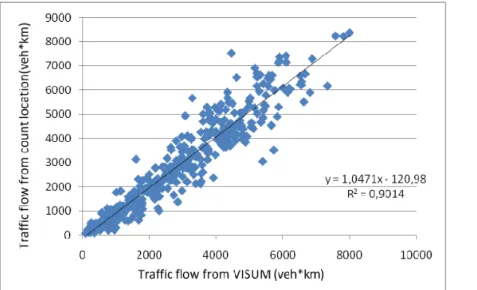
The O-D matrix has been calibrated by using 394 traffic flow data points of traffic flow from the Ministry of transport and infrastructures, the Regional Government of Madrid and the Council of Madrid.
Figure 1 - Dispersion graphic of traffic flow from VISUM model and count location Four BPR volume delay functions are considered, depending on the link type.
= *(1+a* ) (1)
(2)
With q being the traffic flow, qmax the road capacity, and a, b and c parameters (See Table I) have been calculated using the correspondence between velocity and traffic hourly volume per hour per lane for each type of road section as estimated for Spain in the META model (Di Ciommo et al. 2010).
Table I - Parameters of VDF function
a B c
Highway 3.92 2.45 0.50
Avenue 2.60 4.80 0.40
Road 3.92 2.45 0.50
Floridea Di Ciommo, Andrés Monzón, Cristina Valdés y Wang Yang
An equilibrium algorithm is used for assignment, which means each trip selects the route of least cost; in our case, the cost function includes travel time, operation costs, and the toll.
Definition of the reference and toll-ring scenarios
In this context, a combined toll based on an access and distance scheme is simulated in the metropolitan highway M40 during the peak hour (8-9 a.m.), capturing mainly the workplace trips.
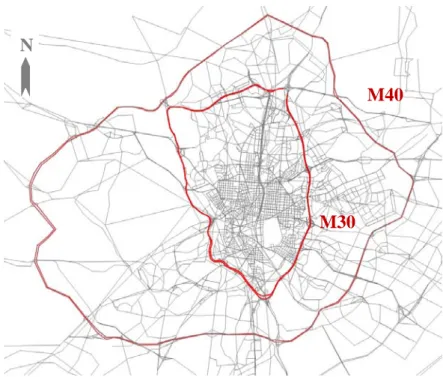
M-40 is the main metropolitan ring surrounding Madrid. Its total length of 63.3 km, looping around the city at a mean distance of 10.1 km to Puerta del Sol, the heart of the city. Furthermore, it is the only one of the several ring roads serving Madrid that functions as a full-fledged motorway for all its length (the inner ring, M-30, has a span about 2 km long at the northern arc that are not freeway-grade, having level crossings and traffic lights, and M-45 and M-50 are not complete rings). Some road sections of the M40 are the most congested roads in Spain, as shown by META. As a consequence, we set up the toll at all the points of entrance to the inner ring delimited by M40 and at the links of the M40 as well. The combined access and at distance based charges are estimated at around 1.0€+0.1€/veh-km: 1.0€ represents the charge for entrance to the inner ring and 0.1€/veh-km is the toll based on the distance travelled. The entrance toll is placed at the entrance points to the ring delimited by M-40, while the kilometric toll is applied to all the links of the M-40. An operation cost of 0.1€/veh-km is added
Results are compared with the reference scenario, which means the current situation.
Table II - Simulation scenarios for M40 ring
Scenarios Description
Reference Free of toll
Toll-ring
M40 ring with toll scheme 1.0 € + 0.1€/veh-km
(1.0 € for the entrance of M40 and 0.1 €/veh-km for the use of the ring)
Figure 2 - Geographic location of metropolitan rings
The simulation process of toll-ring scheme
Figure 3 describes the simulation process of the implementation of a road pricing scheme.
Figure 3 - Simulation process of a toll-ring scheme
Define attribute of links in scenario of toll-ring, and assign the new OD matrix based on the coefficient of the model.
Transformed into model coefficient Toll-ring pricing scheme
(1.0 € + 0.1 €/vkm)
M30
M40
Floridea Di Ciommo, Andrés Monzón, Cristina Valdés y Wang Yang
The toll-ring has a fix element and a variable part depending on the distance. This toll is converted into time and included in the generalized cost function as follows:
CG = T cur + (Toll entrance + TollM40*L + OC*L) λ Being:
Tcur: the current travel time, given by the demand transport model ;
Toll entrance: fixed toll (€) entering the inner ring limited by M40. In our case this value is 1€. TollM40: kilometric toll (€/km) depending on the travelled distance in M40; in this case, we have assigned the amount 0.1€/km.
OC: operation costs. The value assigned has been obtained from META estimation: 0.1€/km (Di Ciommo, F et al., 2010).
λ: conversion factor of euro into seconds, considering a value of time (VDT) of 9€/h. This value has been tested in the model derived from the current toll highways in the MMA (R2, R3, R4 and R5).
L: the length, in km.
Effects on traffic volume and travel speed
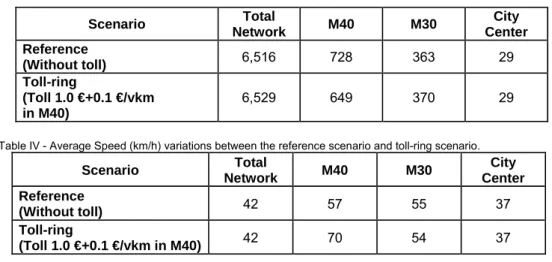
The following tables shows the results of the simulation obtained from VISUM in terms of traffic volume (veh-km) and current travel speed for the whole network, the M30 and M40 rings, and the city center, respectively
Table III- Hourly traffic volume (1,000 veh-km) changing between the reference scenario and toll-ring scenario
λ= 3600 s/h9€
h
Table IV - Average Speed (km/h) variations between the reference scenario and toll-ring scenario. Scenario Total Network M40 M30 City Center Reference (Without toll) 42 57 55 37 Toll-ring (Toll 1.0 €+0.1 €/vkm in M40) 42 70 54 37
Analyzing these results, we note a clear improvement in the M40 (70 km/h in the Toll-ring scenario versus 57 km/h in the reference scenario without toll), while speed does not decrease for the M30 road-ring and the city center. . The travel demand model used for this toll simulation considers only the private car traffic: in other words the travellers cannot change their mode choice, as to mode of transportation, nor the travel time.
From Table III and IV, firstly we could see the hourly traffic volume and travel speed changed significantly in the tolled area. The traffic volume decreases 11% in the M40 and the travel speed increase 23%, without affecting the traffic flow in the M30.
TOLL-RING SIMULATION: ANALYZING EFFICIENCY AND
EQUITY IMPACTS
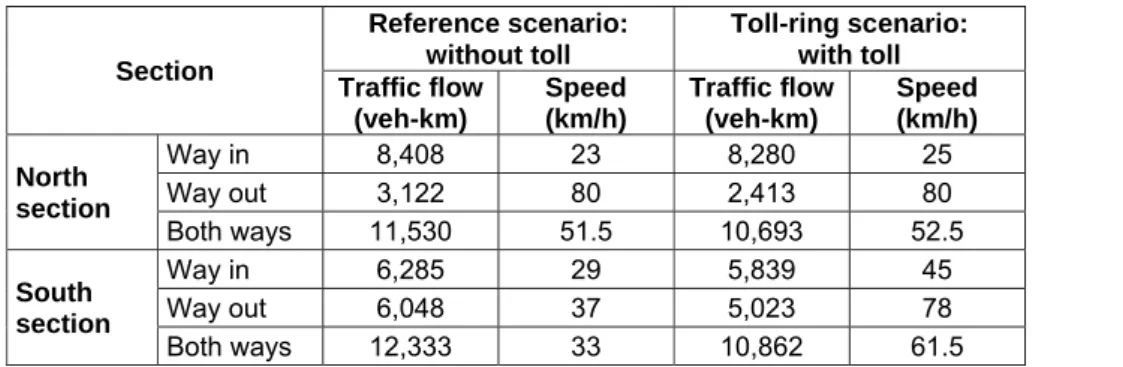
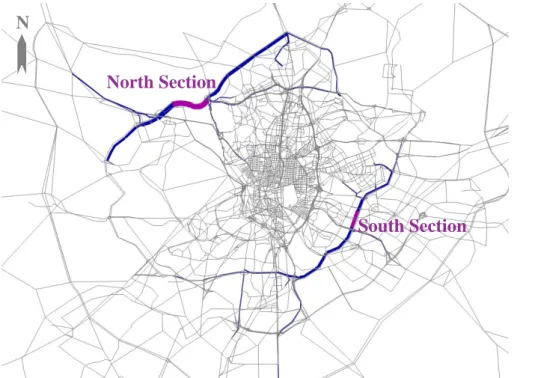
To complete an analysis in terms of the efficiency and equity terms, we compare the congestion pricing simulation in two different road sections located in the south and north parts of M40, as shown in Figure 4. In this way, we can analyze the influence of the metropolitan toll in different areas of Madrid.
Two kinds of analysis have been performed, one based on demand variation ; the other focused on social in terms of the equity impact analyzing the income distribution of the users of the two different road sections before and after tolls are put in place (Viegas, J.M. ,2001). The adopted criteria to select the two road sections to compare the efficiency and the equity effects are basically four:
Scenario Total Network M40 M30 City Center Reference (Without toll) 6,516 728 363 29 Toll-ring (Toll 1.0 €+0.1 €/vkm in M40) 6,529 649 370 29
Floridea Di Ciommo, Andrés Monzón, Cristina Valdés y Wang Yang 1. both road sections of the M40 are congested
2. the socio-economic environment is different: wealthy in the north and poor in the south.
3. road alternatives to the M40 are different: while in the north section the only alternative ring in the M30, for the south section, there also exist M45 and M50, which are rings (not yet completed) surrounding Madrid.
4. an important quantitative difference characterizes the traffic flow with and without toll.
Table V - Characteristics of two selected road sections in the M40ring
Section Reference scenario: without toll Toll-ring scenario: with toll Traffic flow (veh-km) Speed (km/h) Traffic flow (veh-km) Speed (km/h) North section Way in 8,408 23 8,280 25 Way out 3,122 80 2,413 80 Both ways 11,530 51.5 10,693 52.5 South section Way in 6,285 29 5,839 45 Way out 6,048 37 5,023 78 Both ways 12,333 33 10,862 61.5
Figure 4 - north and south sections localization with traffic volume
The efficiency impact: a demand variation analysis
In the toll-ring scenario, we tried different levels of toll to see how this road pricing scheme influenced the traffic volume. The result in terms of the efficiency of different toll levels was that by increasing 2 or 3 times the variable part of the toll fee, the traffic volume would be decreased more than 2 or 3 times. In other words, the traffic flow is very sensitive in respect of the toll costs.
Table VI - Traffic demand reduction with different toll values
Toll values M40 South Road section North Road section
1.0 € + 0.1 €/vkm 11% 12% 7%
1.0 € +0.2 €/vkm 24% 31% 11%
1.0 € +0.3 €/vkm 38% 53% 15%
When the South and North sections are compared, the results show that the road section located in the south of M40 is much more price-sensitive, that is influenced by the toll, the demand decreases of 31% by using 0.2 €/vkm and 53% by using 0.3 €/vkm because of the alternative metropolitan highways (M45 and M50, for example), while the variability of the demand variation in road section in the North of the M40is lower, because of the fewer alternative roads available there.
South Section
North Section
Floridea Di Ciommo, Andrés Monzón, Cristina Valdés y Wang Yang Equity impact evaluation
The objectives more commonly pursued when implementing a pricing policy are: congestion reduction, improving the environment and generating revenue (May and Milne, 2000). However, there are other important aspects to consider, as urban sprawl or equity. This last one is considered by several authors as one of the main obstacles for citizen acceptability of the measure (Litman, T. 1996; Schlag, B. and Teubel, U. 1997; Link, H. 2007).
Equity can be considered from various angles. One of the most common is the so-called “vertical equity”, which can be understood as the unequal impact that results from the scheme on different groups of the population, distinguished according to income level, sex, available alternative to car, age, or even race (Sumalee, 2003). In this respect, the income level of users is one of the main variables considered in equity analysis. Foster (1974, 1975) was perhaps the first to argue that road pricing discriminates against the poor. One of the ways to mitigate this effect is to use at least some of the revenues obtained, to improve the public transport system. Since that system is used disproportionately by those with lower incomes, this helps transfer costs from higher-income individuals to lower income ones, which means, according to the Dalton principle, an improvement in equity (Ramjerdi, 2006, Rietveld, 2003).
It also exists the “horizontal equity”, or spatial equity, which can be described as the distribution of the benefits and costs of the scheme across the population from different areas in the network (Sumalee, 2003).
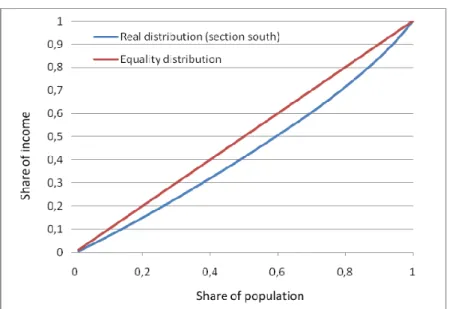
Traditional economic equity analysis supplies the notion of an income-distribution index, that is a measurement of income distribution within any given population Several such indexes have been proposed in the literature (Cowell, 1995). In transport, these measures have been occasionally adopted as part of the policy analysis. Vold (2005) adopted the Gini coefficient to evaluate the spatial equity impact of different transport policy packages using Kolm’s measure. Sumalee (2003) adopted the Gini coefficient to evaluate the spatial equity impact based on different charges within the cordon design. In this paper, the Gini coefficient will be used to measure the equity effects in different areas in the network, though using the same toll design.
Given the structure of the O-D matrix, it is appropriate to evaluate the distribution of income amongst the users of the M40 according to their origin-destination, following the spatial equity analysis (Maruyama, T. and Sumalee, A., 2007) and, once categorized by their route choice after the introduction of the toll intended to lessen congestion, to examine the incidence of a congestion pricing policy on the income distribution, comparing the Gini index in both the reference scenario and the toll-ring scenario.
Given the socio-economic characteristics of MMA, with a wealthier North and a poorer South, it is appropriate to evaluate the distribution of income amongst the users of the M40 according to their origin-destination, following the spatial equity analysis (Maruyama, T. and A. Sumalee, 2007) and, once categorized by their route choice after the introduction of the toll intended to lessen congestion, to examine the incidence of a congestion pricing policy on
the income distribution of the users, comparing the Gini index in both the reference (without toll) and the toll-ring scenario. The Gini coefficient thus takes a value between 0 and 1, in which Gini = 0 represents the case of greatest, indeed perfect, equity.
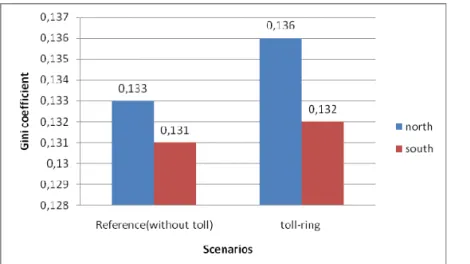
Comparing the users situations in the two road sections, the Gini coefficient shows a similar situation in terms of income distribution before the traffic-congestion toll is imposed.
Figure 5 - Lorenz curve for measuring the Gini coefficient for the northern road section
Floridea Di Ciommo, Andrés Monzón, Cristina Valdés y Wang Yang
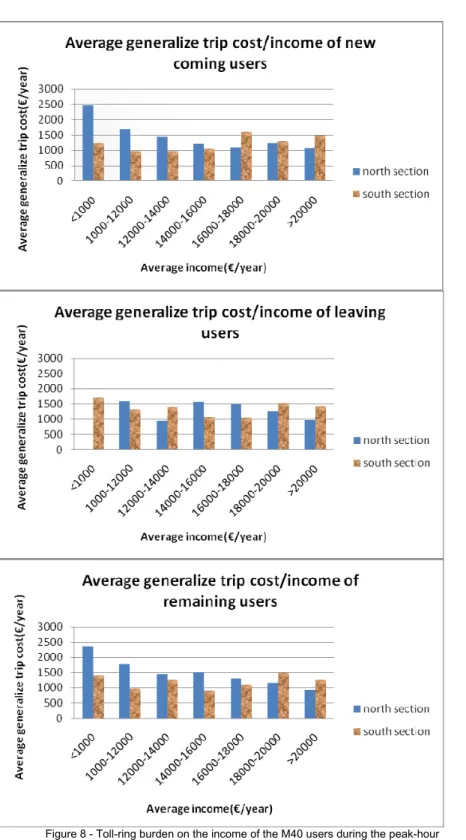
Therefore, after the toll-ring implementation, the Gini index shows a change among the users of the northern road section. In other terms, in this area of the network, the burden of the congestion toll has a greater effect on the lower-income users as shown in the figure 7, while in the south, the burden of the congestion toll is more evenlydistributed and the Gini coefficient is quite constant with respect to the “ reference or no tolled scenario”.
Figure 7 - Gini coefficient level for each road section selected with and without toll
Finally, the results presented in figure 8 show a clearly increasing level of socio-spatial inequalities. Categorizing the road users by their route choice, leaving the tolled M40, continuing as users of the M40 or becoming new users of the M40, after the toll-ring implementation, the congestion pricing policy in the north has a greater effect on low-income users, the new coming users and the remaining users of the M40, while in the south the burden of the congestion pricing is evenlydistributed. These results are symmetric in respect of the Gini evolution index. An analysis of the two different populations of users-- north and south of the M40, shows that even if the population in the north has, in general, a higher level of income, the lower-income commuters in that area, who use the north section of the M40, pay proportionally more for the congestion toll policy because they are obliged to use the north sections of the M40 to get to their workplaces (Martin et al.).
Floridea Di Ciommo, Andrés Monzón, Cristina Valdés y Wang Yang
CONCLUSIONS
The research carried out shows clearly that a congestion metropolitan policy could achieve the objective of a congestion reduction like showed in the table VI. The result of the simulation shows that a toll-ring scheme during the peak-hour applied to a metropolitan ring like the M40, could solve the congestion situation with an important gain in terms of time for the user with a modification of the hourly speed by 23 km/h to 45 km/h for the area in the network with viable alternative routes.
In terms of social equity, the redistribution principle affirms that it is better to be a poor amongst the wealthy people than a poor amongst the poor people (Piquetty, 1994; Davezies, 2008). But by a first analysis of the results, the simulation of a metropolitan toll-ring scheme in Madrid seems to contrast this result: the burden of the congestion pricing affects more the poor people living amongst the wealthy people in the north of the ring of the M40 than the poor people living between the less wealthy people in the south of the M40 ring.
The results of the simulation in terms of efficiency effects and demand elasticity variation show that a congestion pricing policy like the implementation of a toll-ring has a deep incidence on the behaviour of the road users. If an increasing toll-ring produces a quite high variation of the travel demand with a demand elasticity reaching 53%, knowing that the incidence of the average operation costs linked to the introduction of the ring-toll is high (until 2,500 € by year), it is possible that in the long term the road users change their residential and socio-economic behaviour. A recentralization of the residential and economic activities could be possible inside of the ring of the M40.
Finally, the implementation of a metropolitan road pricing scheme can be useful in terms of Travel Demand Management (TDM). and in the long term the travellers could change their residential and economic behaviour, localizing them inside of the M40 ring. In terms of efficiency, we could obtain a better situation. The problem remains in terms of equity effects: if the burden of the toll-ring in the north of the M40 is higher for the low income people, it is necessary to see if they can or cannot choose an inside of the M40 residence. If lower-income people have choices, the effects of such inequity resulting from toll roads can be diminished by a long-term residential recentralization. If this is not the case, the implementation of a toll ring scheme can increase the inequality of income distribution, especially among the users of the northern sections of the M40.
Commision of the European Communities (CEC (1996)). Towards Fair and Efficient Pricing in Transport. Brussels.
Cowell, F.A., 1995. Measuring Inequality. Harvester Wheatsheaf, Hemel Hempstead. Davezies Laurent (2008), La République et ses territoires : la circulation invisible des
richesses, Paris, La République des Idées, Seuil, 110 p.
DeCorla-Souza, P. (2004). Recent U.S. experience: Pilot projects. In G. Santos (Ed.), Road pricing: Theory and evidence, research in transportation economics (Vol. 9, 283– 308). Oxford: Elsevier.
De Palma, A., Lindsey, R., & Niskanen, E. (2006). Policy insights from the urban road pricing case studies. Transport Policy, 13(2), 149–161.
Di Ciommo, F. Monzón, A., Fernandez, A. (2010). Measuring the acceptability of interurban road pricing among different groups of stakeholders. The case of Spain, 89th Transport Research Board congress, WDC, Annual Meeting CD-Rom.
Fang J., Di Ciommo F., Monzón A. et al. (2009). The internalization of external Costs of motorway: the case of Spain, International Conference on Transportation Engineering 2009, ASCE, 2725-2730.
Foster, C. (1974). The regressiveness of road pricing. International Journal of Transport Economics 1(2), 133-141
Foster, C. (1975). A Note on the Distribution Effects of Road Pricing: A Comment. Journal of Transport Economics and Policy 9, 186-187
Inge, M., Sara, O., and Stef, P. (1996). The marginal external cost of urban transport. Transport Res-D, Leuven, Elsevier, 1, 111-130
Link, H. (2007). Acceptability of the German Charging Scheme for Heavy Goods Vehicles: Empirical Evidence From Freight Company Survey.” Transport Reviews, Vol. 28, No. 2, 141-158.
Litman, T. (1996). Using Road Pricing Revenue: Economic Efficiency and Equity Considerations. Transportation Research Record: Journal of the Transportation Research Board. No. 1558, TRB, National Research Council. Washington. D.C. (40) Martin, J.C., Gutierrez J., García-Palomares, J.C. and C. Román (2010). Efficiency
and equity of orbital motorways in Madrid, Journal of Transportation and Land use, vol. 3, pp.67-84.
May, A.D., Milne, D.S., (2000). Effects of alternative road pricing systems on network performance. Transportation Research 34A (6), 407–435.
Floridea Di Ciommo, Andrés Monzón, Cristina Valdés y Wang Yang
May, A., Liu, R, Shepherd, S.P., Sumalee, A (2002) The impact of cordon design on the performance of road pricing schemes, Transport Policy, 9(3), 209-220.
Maruyama, T. and Sumalee, A. (2007) Efficiency and equity comparison of cordon- and area-based road pricing schemes using a trip-chain equilibrium model, Transportation Research A, 41(7), 655-671.
META. Modelo Español de Tarifación de Carreteras, (2007) Informe 2 Modelo de Costes, Monzón A., Vassallo, J-M, Di Ciommo F. and Pérez P.
Ministry of Transport, 1964. Road Pricing : The economic and technical Possibilities. HMSO, London.
Monzón, A. and D. de la Hoz, (2009). Efectos sobre la movilidad de la Dinámica territorial de Madrid. URBAN, 14, 58-71.
Nash, C. (2007). Road Pricing in Britain. Journal of Transport Economics and Policy, 41, 135-147.
Piquetty T (1994). Inégalité de redistribution.Revue d’Economie Politique. 104 (6): 769-800. Ramjerdi, F. (2006). Equity Measures and Their Performance in Transportation.
Transportation Research Record, vol. 1983, Trans Res Board, 67-74 Rietveld, P.(2003). Winners and losers in transport policy: on efficiency, equity and
compensation. Handbook of transport and the environment, 585-602 Sumalee, A., (2003). Optimal toll ring design with spatial equity impact constraint: an
evolutionary approach. Journal of Eastern Asia Society for Transportation Studies 5, 1813-1828
Santos, G (2002). Double cordon tolls in urban areas to increase social welfare. Transportation Research Record 1812: 53-59.
Schlag, B. and Teubel, U. (1997) Public acceptability of transport pricing. IATSS Research, 21, 134-142.
Vassallo, J.M., P. Pérez de Villar, R. Muñoz and T. Serebrisky. 2009. Public Transport Funding Policy in Madrid. Is there Room for Improvement? Transport Reviews. Vickrey , W.S.(1955). Some implications of marginal cost pricing for public utilities. .
American Economic Review. Issue 45(2), 605-620.
Con formato: Español (alfab. internacional)
Viegas, J.M. (2001). Making urban road pricing acceptable and effective: searching for quality and equity in urban mobility. Transport Policy 8 (4), 289-294.
Vold, A. (2005). Optimal land use and transport planning for the Greater Oslo area. Transportation Research 39A (6), 548-565.