The challenges in developing VET competencies in
e-commerce
John Mitchell
Managing Director, John Mitchell and Associates
Background
E-commerce is an important national issue, as it may provide some of the
overarching set of business principles and practices needed to drive Australia in the global, networked economy. The training needs for e-commerce may become extensive, so it is imperative that competencies developed for e-commerce are valid for industry and acceptable to clients.
This paper reports on the evaluation in 2000-2001 of an innovative project funded by the Australian National Training Authority (ANTA) to develop competencies and qualifications in e-commerce. The ANTA E-commerce Initiative project is a response to E-competent Australia (Mitchell 2000), which argued that it was both possible and important to identify competencies in e-commerce. E-competent Australia also noted the huge demand for VET courses in e-commerce and the need to design
competencies carefully.
Two industry training advisory boards (ITABs) - the information technology and telecommunications (IT&T) ITAB and the business services (BST) ITAB - were
commissioned in 2000 to develop approximately 100 competencies in e-commerce. A further four ITABs will commence the development of around 30 competencies in mid-2001. A project manager external to ANTA was appointed to oversee the project. The evaluation of the ANTA E-commerce Initiative Project commenced in September 2000 and will conclude in early October 2001. This interim report on the evaluation highlights the complexities faced by VET course designers working on the leading edge.
The author is undertaking a Doctorate in Education in the Department of Education at Deakin University (having commenced in 1997), focusing on e-commerce in the VET sector, particularly in relation to flexible and online delivery. The author brings his learning from this earlier research into e-commerce to this evaluation.
Methodologies for the formative evaluation
The purpose of the evaluation of the ANTA E-commerce Initiative is to assess both the efficiency and effectiveness of the project. The formative evaluation focuses on inputs, processes and interim outputs, identifying both good practice and areas for improvement. The summative evaluation will clarify how effectively the project’s outcomes achieve the project’s stated objectives. This framework of efficiency and effectiveness is a modification of one proposed by the Department of Finance (1994).
The formative evaluation of the project measures the efficiency of the project, and the summative evaluation measures the effectiveness of the project. The formative
evaluation is concerned with:
• the inputs, such as the resources used in the project (eg the staff supporting the project);
• the processes (activities, strategies, operations) by which competencies are developed (taking into account the particular contexts for each Training Package developer, eg the internal evaluation strategies used by the two ITABs); and
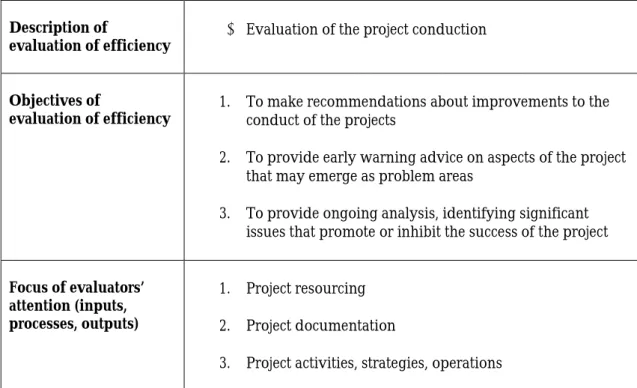
• the outputs, ie the deliverables provided by the project (eg the number of competencies developed) over which the developers have direct control. Efficiency is about improving processes and doing it better. Formative evaluations of efficiency are undertaken regularly during the project, to determine how inputs, processes and outputs may be improved. The formative evaluation provides an opportunity to share best practices, and these lessons are discussed with the Project Manager and each ITAB, particularly at regular workshops held with the ITABs. Table 1 relates the methodologies used in the formative evaluation of the objectives. Table 1: Objectives and methodologies for formative evaluation
Description of
evaluation of efficiency • Evaluation of the project conduction Objectives of
evaluation of efficiency 1. To make recommendations about improvements to the conduct of the projects 2. To provide early warning advice on aspects of the project
that may emerge as problem areas
3. To provide ongoing analysis, identifying significant issues that promote or inhibit the success of the project
Focus of evaluators’ attention (inputs, processes, outputs)
1. Project resourcing 2. Project documentation
Qualitative
methodologies 1. Routine monitoring of inputs, processes and outputs
2. SWOT analysis of individual training package developer project
3. Case studies of field tests. 4. Interviews with key stakeholders
Quantitative
methodologies 1. Analysis of documentation of actual numbers of competencies and qualifications developed 2. Questionnaire (for stakeholders)
Audiences • Training Package developers
• Project Manager
• Steering Committee
• Expert Steering Committee
• Other ITABs
Methodologies for the summative evaluation
Evaluations of effectiveness are also called summative evaluations. Effectiveness is defined as the extent to which a program’s expected and unexpected outcomes achieve its stated objectives. Evaluating effectiveness is about accountability: it is about the setting of objectives, producing and reporting on outcomes, and the consequences of getting things right or wrong.
The objectives of the ANTA E-commerce Initiative project are to extend the endorsed and support materials of existing Training Packages with new and enhanced
competency standards and qualifications for commerce as part of the ANTA e-commerce initiative for the National Training Framework. Together with a minor enhancement proposal for modifications to the current standards and qualifications, the outcomes of this project will provide a contemporary range of competency standards and qualifications for application in industry. Working to the E-commerce Project Manager, for each ITAB, this will involve endorsed components and support materials.
• drafting and validating new and revised competency standards for inclusion in Training Packages that fit with existing assessment guidelines;
• packaging and aligning the new and revised competency standards into new e-commerce qualifications that fit with existing assessment guidelines; and • revising existing Training Packages to include the e-commerce standards and
qualifications.
Support materials
• identifying available learning resources that would support delivery of the endorsed components;
• developing validated support materials for learners, facilitators and RTOs that effectively contribute to learning and assessment processes; and • in the case of the IT&T ITAB, revising existing materials (Resources Data
Base, Case Study Maker, Traineeship Generators and Professional Development products) to incorporate the e-commerce standards and qualifications.
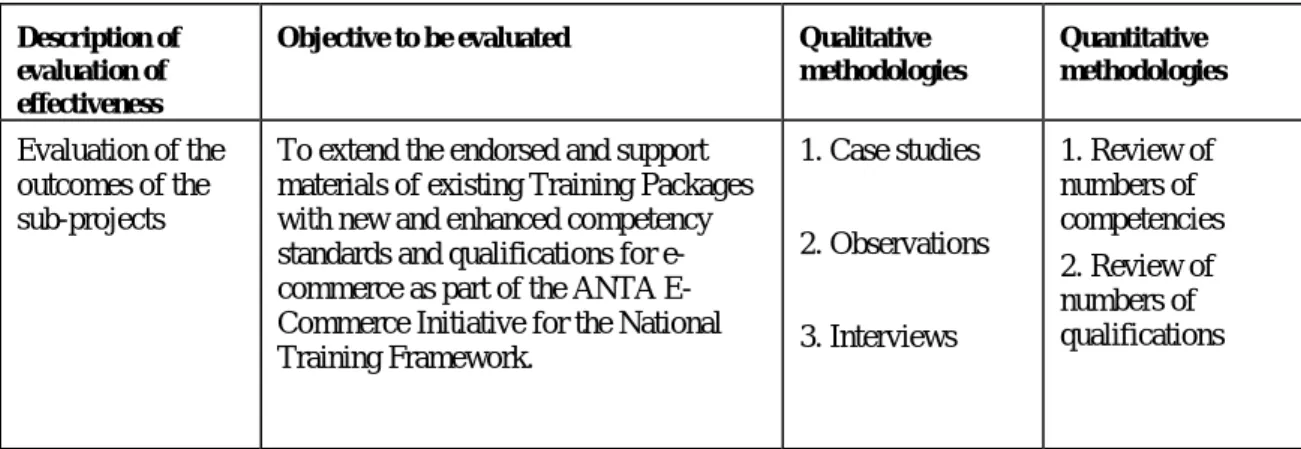
Table 2 relates the methodologies used in the summative evaluation of the project objectives.
Table 2: Objective and methodologies for summative evaluation
Description of evaluation of effectiveness
Objective to be evaluated Qualitative methodologies Quantitative methodologies Evaluation of the outcomes of the sub-projects
To extend the endorsed and support materials of existing Training Packages with new and enhanced competency standards and qualifications for e-commerce as part of the ANTA E-Commerce Initiative for the National Training Framework. 1. Case studies 2. Observations 3. Interviews 1. Review of numbers of competencies 2. Review of numbers of qualifications
The results of the summative evaluation of the ANTA E-commerce Initiative will inform a second 12 months of the Initiative, if a second stage is funded.
Findings
This section reports on the general findings from the evaluation for the period September 2000 to March 2001. The section demonstrates that the major challenge to developers of competencies in e-commerce is that the field of e-commerce is
Changing business models
Business models involving e-commerce changed during 2000, producing many challenges for developers of e-commerce competencies. Changes to business models were affected by developments such as:
• In April-March 2000, the sharp fall in the stockmarket value of many companies that solely used online technologies: the ‘dotcoms’.
• The rise in the popularity of business-to-business e-commerce, particularly trade exchanges, epitomised in Australia by the CorProcure group of 14 different companies (AMP, ANZ, Australia Post, Amcor, BHP, Coca-Cola Amatil, ColesMyer, Fosters, Goodman Fielder, Orica, Pacific Dunlop, Qantas, Telstra and Westpac).
• The emergence of new business models during 2000, such as ColesMyer’s ColesOnline, which is integrating bricks and mortar business with its online operations. (In the final week of November 2000, four of the top five retailing web sites in Australia were owned by conventional department store retailers - Myers, Kmart and Target (owned by ColesMyer) and David Jones were the first, third, fourth and fifth most popular sites. The second most popular site, dstore, is now owned by retailer Harris Scarfe.
• Changes to the business models of companies such as Wine Planet that was previously only a dotcom operation. Wine Planet is now developing
conventional retail outlets.
• The reduction in value in late 2000 of some prominent dotcoms that survived the March-April 2000 sharemarket fall, but experienced difficulty in late 2000, such as the online share trading company Etrade and the world’s largest portal Yahoo!
• Mergers between dotcoms and conventional businesses, eg Harris Scarfe’s purchase of dstore and Woolworths’ acquisition of shares in
Greengrocer.com.
• Mergers between former rivals in the dotcom domain, in areas such as online auctions.
• The surge in the number of educational organisations, mostly in the USA, that only operate with a web interface with the student.
• The rise of mobile telecommunication technology, such as text messaging via mobile phones, that shows that e-commerce does not always require
computer networks.
An interesting story to emerge from the ‘dotbomb’ year 2000 is the success of online auction site e-Bay. In the third quarter of 2000 alone, e-Bay hosted 68.5 million auctions, facilitating the exchange of $US1.4 billion in merchandise (Sydney Morning Herald, Jan 2001). Its business model avoids two of the flaws of other dotcoms: it does not rely on banner ads for revenue (Yahoo’s problem) and it does not need to
warehouse goods (Amazon.com’s problem). EBay’s business model works: it is an online exchange connecting buyers and sellers and collects a fee for each transaction (Sydney Morning Herald, Jan 2001).
Ongoing debates about the nature of E-commerce
As of March 2001, there are ongoing debates about a number of key aspects of e-commerce, increasing the difficulty of developing competencies in e-e-commerce, namely:
• whether the distinction between ‘old’ and ‘new economy’ is valid or worthwhile;
• whether e-commerce will worsen the ‘digital divide’: the gap between those who use online communication and those who don’t;
• whether business-to-business networks will have negative effects on small providers;
• whether all business-to-business networks will deliver the benefits sought by their owners (Forrester Research predicted in August 2000 that of the 1,000 online marketplaces in the USA, fewer than 2000 will exist in 2003 - see BRW
15 Dec 2000);
• whether dotcoms will be able to overcome an apparent weakness in ‘fulfilment’ of online orders;
• whether the security and privacy issues will be solved and users will be convinced that they can safely provide their credit card details to online companies;
• whether vertical business-to-business networks that link together companies in one specific industry are more likely to succeed than horizontal networks that link disparate organisations from many industries.
These ongoing debates will ensure that the definition of e-commerce will continue to be challenged.
Continual development of new technologies
E-commerce will change in 2001 due to the implementation of new versions of previous technology and the availability of wholly new technologies, which means that new competencies in e-commerce will continue to be needed. For example, a report in the Sydney Morning Herald on 14 October 2000, drawing on research from Forrester Research, Gartner Group, Dataquest and Yankee Group, identified the following information technology and business trends.
• Spending on e-commerce software is expected to climb from $US3.1 billion in 1999 to $US14.5 billion in the US alone by 2003. ‘As B2B and B2C markets become more competitive, vendors will need increasingly sophisticated software’.
• Due to the shortage in IT skills within organisations, there will be an increasing demand for providers of corporate IT services.
• The worldwide Application Service Provider (ASP) market will grow from $US3.6 billion in 2000 to $US25.3 billion in 2004, as software transforms from a product to a service. However, 60% of ASPs are expected to fail by 2001. ‘This will have a devastating effect on businesses that have outsourced their data services to an insolvent ASP’.
• The B2C will continue to be the USA leader, with online retail sales expected to reach $US10 billion in the US in Christmas 2000; double the total in 1999. By 2003, US consumers and businesses will spend $US2 trillion over the Net, but retailing will make up just $US144 billion of the total.
• The B2B e-commerce activity will continue to dominate, growing quickly from $US145 billion worldwide in 1999 to $US7.3 billion by 2004. By 2004, B2B e-commerce will represent 7% of total global sales transactions. • Broadband technologies will continue to be provided. In the Asia-Pacific
there will be 11.3 million residential broadband subscribers by 2003, mostly using cable modems and ASDL (high-speed access over normal telephone lines). The roll out is happening more quickly in the USA than in Australia or Europe: in the USA 3.3 million homes had broadband access in 2001 and this is expected to grow to 16.6 million homes by 2004.
• Telecommunications infrastructure, particularly the provision of fibre optic technology, is expected to grow exponentially, to satisfy the rapidly
increasing demand for data traffic. Wireless technology will become more common, enhanced by new and faster mobile phone networks. Wireless technology is expected to move through a number of different generations in the next few years.
• As sales of PCs slow, the focus of chip makers will shift from PCs, to mobile phones and other wireless devices, providing increased memory and new consumer products. The global market for memory chips will grow from $US222 billion in 2001 to $US320 billion by 2004.
Debates about the terminology
The main difficulty for developers of e-commerce competencies is that the definition of e-commerce and its popular alternative e-business continues to be debated. To define e-commerce, firstly we need to clarify the changing definitions in 1998-1999, as discussed in E-competent Australia (ANTA 2000). The definitions of e-commerce shifted in 1998-1999 in two major respects:
• It was common during 1998 to see e-commerce defined as ‘financial transactions over the Net’, but the trend by late 1999 was to define e-commerce as any business communication involving electronic communication, including internal communication.
• In 1998, e-commerce was often defined as the technical event of an electronic communication, but the trend by late 1999 was to see e-commerce as an approach to business, with the technology as the enabler.
These changes to the definition in 1999 were modelled by the National Office for the Information Economy (NOIE). For instance, the following definition was provided by NOIE in April 1999 in Australia’s e-commerce report card:
E-commerce is defined as every type of business transaction in which the participants (i.e. suppliers, end users etc.) prepare or transact business or conduct their trade in goods or services electronically. (p 3)
While e-commerce is dominated by online technologies, the scope of e-commerce covers ‘all forms of electronic processes’:
Online technologies are the most significant facets of e-commerce and include Internet retailing, Electronic Data Interchange, Internet banking, electronic settlements and browsing and selection of products and services over the Internet. (p 3)
This 1999 definition is much more substantial than previous definitions of e-commerce as buying and selling over the net.
A fuller definition of e-commerce was provided in NOIE’s October 1999 report, E-Australia.com.au. The October 1999 definition widens the scope of e-commerce, and clarifies that e-commerce is not just about buying and selling goods; it is also about
inter-company and intra-company activities:
In e-commerce, business is communicated and transacted over networks and through computer systems. The most restrictive definition limits e-commerce to buying and selling goods and services, and transferring funds through digital communications. However, e-commerce also may include all inter-company and intra-company functions (such as marketing, finance, manufacturing, selling, and negotiation) that enable commerce and use electronic mail, EDI, file transfer, facsimile, video-conferencing, workflow, or interaction with a remote computer. E-commerce also includes buying and selling over the World Wide Web and the Internet, transferring electronic funds, using smart cards and digital cash, and doing business over digital networks. (p 60)
In E-competent Australia (Mitchell 2000), this October 1999 definition was
recommended as the main reference point for the ANTA E-commerce Initiative, taking into account the fact that the nature and definition of e-commerce may change in future, due to new developments in business and technology.
In E-competent Australia (Mitchell 2000), e-business was taken to mean an individual company, enterprise or organisation or business unit that uses e-commerce, eg the online travel agency travel.com.au could be called an e-business. However, in defining e-commerce as ‘doing business electronically’ (Timmers 1999), E-competent Australia (Mitchell 2000) was suggesting that e-commerce is an overarching set of business principles behind new ways of doing business electronically.
However, the use of the terms e-commerce and e-business have continued to change since the publication of E-competent Australia (2000) and different interpretations of
the terms e-commerce and e-business may continue in Australia for some time, for the following reasons. Firstly, some people see e-business as interchangeable with the term e-commerce. Secondly, the popular media likes to use e-business instead of e-commerce and to place the prefix e- before many words, particularly in newspaper headlines. Thirdly, academics are divided in their definitions of the two terms, with some seeing e-commerce as the overarching concept and others seeing e-commerce narrowly as buying and selling electronically. While we can expect that e-commerce and e-business will continue to be defined differently, present indications are that the term e-business may emerge as the most popular one in daily use.
The ANTA e-commerce project commenced by using the term e-commerce as the basic reference point. Business Services Training clearly prefers the term e-business, which is understandable, given its close relations with the business community, while IT&T ITAB generally uses the term e-commerce and sometimes e-business for the project. In late March 2001, the evaluator and the two ITABs agreed that, in the majority of cases, the term e-business would be used in relation to the competencies being developed. However, a glossary will be developed, providing definitions of e-business and e-commerce. The reasons for this decision included the strong desire of the Business Services ITAB to use e-business, and the value of not causing concern for trainers by using business for one set of competencies and commerce and e-business for the other set.
Discussion
To date, the formative evaluation of the ANTA project shows that the development of competencies and qualifications in e-commerce is challenging developers for a number of reasons. Firstly, there is an ongoing, international debate about the meaning of the term e-commerce. Secondly, the field of e-commerce is fluid, due to the continual development of new technologies that enable the creation of new business processes. Thirdly, the field of e-commerce is in flux, evidenced by the failure of many business models during 2000 and the emergence of new business models.
The definition of e-commerce will continue to be debated, affected by the
development of new technologies, new business thinking and changing business practices. While debate will continue about the best business models and practices, there will be no preventing the inevitable increase in e-commerce activity, leading to the need for additional training.
References
Mitchell J G (2000) E-competent Australia. The impact of e-commerce on the National Training Framework. Melbourne: Australian National Training Authority.
Mitchell J G (2001) The evolving definition of e-commerce.
www.catalystinteractive.com.au/ecommerce.
National Office for the Information Economy (1999, April) Australia’s e-commerce report card. Canberra: Department of Communications, Information Technology and the Arts.
National Office for the Information Economy (1999, October) E-Australia.com.au. Canberra: Department of Communications, Information Technology and the Arts. National Office for the Information Economy (1999, November) Summary of e-commerce - beyond 2000. Canberra: Department of Communications, Information Technology and the Arts.
Sydney Morning Herald (2000) Keeping on top of the technology wave. 14 October. Timmers P (1999) Electronic commerce, strategies and models for business to
business trading. Chichester: John Wiley and Sons Ltd.
Turban E, Lee J, King D and Chung H (2000) Electronic commerce, a managerial perspective. New Jersey: Prentice Hall.
Contact details
John MitchellManaging Director, John Mitchell and Associates PO Box 151
Pyrmont NSW 2009 Ph: +61 2 9660 0255 Fax: +61 2 9660 0255 Email: [email protected]