Optimizing unit test execution in large software programs
using dependency analysis
Taesoo Kim, Ramesh Chandra, and Nickolai Zeldovich
MIT CSAIL
Abstract
TAOis a system that optimizes the execution of unit tests in large software programs and reduces the programmer wait time from minutes to seconds. TAOis based on two key ideas: First, TAOfocuses on efficiency, unlike past work that focused on avoiding false negatives. TAO imple-ments simple and fast function-level dependency tracking that identifies tests to run on a code change; any false neg-atives missed by this dependency tracking are caught by running the entire test suite on a test server once the code change is committed. Second, to make it easy for pro-grammers to adopt TAO, it incorporates the dependency information into the source code repository. This paper describes an early prototype of TAOand demonstrates that TAOcan reduce unit test execution time in two large Python software projects by over 96% while incurring few false negatives.
1
Introduction
After fixing a bug or implementing a new feature in a software project, programmers typically run unit tests to check that the individual components of the software con-tinue to function correctly, before committing their code changes to the software’s source code repository. Many open source projects, such as the Twisted networking en-gine [3] and the Django web application framework [1], mandate that all unit tests pass before accepting a pro-grammer’s commits into the source code repository [2].
Because programmers run unit tests interactively, a unit test suite is generally expected to run within a few seconds. However, large software projects like Django have unit test suites with several thousand tests and take tens of minutes to complete. This significantly increases the wait time of programmers, making them less productive. It also raises the likelihood that a programmer does not
run the unit test suite before committing code changes, increasing the chances of a bug in the committed code.
Therefore, in practice, software projects use several approaches to reduce running time of unit tests. One approach is to offload running of unit tests to a test exe-cution serverafterthe programmer commits the changed code to the repository; however, unlike in interactive test execution, it takes longer for the programmer to learn of a test failure and fix the bug, thereby reducing programmer productivity. Another approach is to have the program-mer manually select the tests to run; for example, the programmer could run the full test suite once and if a test fails, only rerun that test while fixing the bug that caused it, and finally rerun the full suite before committing to the source repository. This approach, however, burdens the programmer in avoiding unintentional changes tested by other unit tests, thus making them less productive in developing large software projects.
Past work has proposed regression test selection (RTS) techniques [5, 8, 12] to address the limitations of the above approaches. At a high level, RTS’s goal is to iden-tify and run the tests whose results may change due to a source code modification. To identify those tests, RTS analyzes a software’s source code as well as the past executions of the software’s test suite, and computes de-pendencies of each test on the software’s code elements such as functions, classes, or basic blocks. When a pro-grammer modifies the source code, RTS identifies the code elements affected by the modification, and uses its dependency information to flag the tests whose results may change and thus need to be rerun.
Though RTS has the potential to reduce unit test ex-ecution time, it is not used in practice, and we are not aware of a real-world unit testing framework that employs RTS. An important reason for this is that existing RTS techniques focus on avoiding false negatives, and so flag anytest that may be affected by a code change; in practice, this results in too many false positives. For example, if a commit adds a new static variable to a Python class, ex-isting RTS techniques rerun all tests that loaded the class. However, in practice many of these are false positives (see §4 and [7]); typically it is sufficient to run a much smaller set of tests that only executed functions which were modified to access the new variable.
We used this observation to design TAO,1a practical system to optimize unit test execution. TAO’s key con-tribution is in making RTS practical by addressing two challenges. The first challenge is that TAO should be efficient—the total time to identify and execute the af-fected tests with TAOshould be a fraction of time needed to run the unit tests without TAO. TAOdoes this by track-ing only function-level dependencies, which is fast and in practice has low false positives. During test execu-tion, TAOtracks which functions were accessed by each test; when the programmer modifies the program’s source, TAOanalyzes the diff to determine the functions that were modified and executes only the tests that accessed those functions. In return for this efficiency, TAOgives up on false negatives; as function-level dependency tracking is not complete, TAOcan miss some tests whose results may change due to the code change (see §2 for examples). In practice, such false negatives are uncommon (§4), and to catch them TAOruns the complete test suite on a test server after every commit; only for these few false nega-tives does the programmer learn of any failures at a later time.
The second challenge faced by TAOis bootstrapping TAO’s dependency analysis and keeping it up-to-date as the source code evolves: TAOloses its usefulness if a programmer has to run all unit tests to generate TAO’s dependency information every time she updates from the source repository. To solve this problem, TAOaugments a source tree’s repository with adependency serverthat stores the dependency information for each version of the source tree, much like symbol servers that store debug symbols for different versions of software packages. TAO uses dependency information from the dependency server to determine unit tests to run for a code change. Before code is committed to the source code repository, TAO runs the unit tests affected by the code changed by the commit, generates incremental dependency information for the affected unit tests, and updates the dependency server.
We have implemented a prototype of TAOfor Python, and integrated it with PyUnit, the standard unit-testing framework for Python. This makes it easy for Python programmers who already use PyUnit to take advantage of TAO. We evaluated TAOwith two large Python software projects, Django and Twisted, and demonstrate that for recent source code commits to these projects, TAOruns unit tests in an average of 0.3% and 3.1% of the time required to run the unit tests without TAO, suggesting the TAO’s unit test optimization works well in practice.
In the rest of this paper, §2 describes TAO’s design, §3 describes TAO’s implementation, §4 presents the results of our preliminary evaluation, §5 summarizes related work, and §6 concludes.
1TAOstands for Test Analyzer and Optimizer.
Repository server Modified files Dependency info Analyzing dependencies Incremental dependency info Unit testing Testing results HEAD:a98465c
Affected test cases
HEAD:a98465c
Local source tree
HEAD:a98465c Development cycle Dependency info HEAD:a98465c Source tree Dependency server Programmer's computer Test server HEAD:ac0ffee
Full unit testing
HEAD:ac0ffee
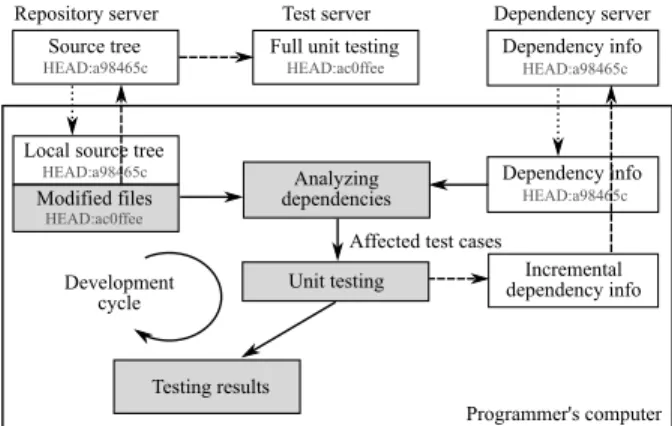
Figure 1: Programmer workflow while using TAOfor unit testing. The dotted lines show the update of the local source tree from the repository server, and local dependency information from the dependency server. The shaded boxes illustrate the programmer’s development cycle and TAO’s optimized execution of unit tests. The dashed lines indicate committing changes in code and dependency information to the servers, and the running of the full unit test suite on the test server after every commit.
2
Design
Figure 1 illustrates the programmer workflow with TAO. When a programmer clones a local source tree from a repository server, the dependency information for unit tests in that version of the source is downloaded by TAO from the dependency server. After modifying the source, when the programmer runs unit tests, TAOanalyzes the source modifications to determine the modified functions, and uses the dependency information to select tests to run. Finally, when the programmer commits changed source to the repository server, TAOgenerates the dependency information for the new version of the source and uploads it to the dependency server. The rest of this section de-scribes TAO’s dependency analysis and management in more detail.
Dependency tracking. Dependency tracking in TAO consists of runtime interception and static analysis com-ponents. When unit tests are run, TAOintercepts every function executed by each unit test, and constructs a de-pendency mapof functions to unit tests that executed the functions. Functions are named by a tuple consisting of the function name, class name, and source file name.
TAOstatically analyzes the changed source code to identify modified functions, as follows. TAOfirst parses the source-level diffs of the changed source to determine the source files and the line numbers in the files that changed. Then, TAOparses the original and modified ver-sions of each source file to construct abstract syntax trees. Finally, it determines the functions in the original and modified versions that contain the changed line numbers— these are the modified functions. These functions include those that were newly added to the code as well those that were removed. TAOlooks up the modified functions in
1 class A: 2 def foo(): 3 pass 4 class B(A): 5- pass 6+ def foo(): 7+ pass 8 B().foo()
(a) Inter-class dependency
1 def foo(): 2- return 1 3+ return 2 4 5 if rand() % 2: 6 foo() (b) Non-determinism 1 class A: 2 pass 3 class B: 4 pass 5 6-C = A() 7+C = B() (c) Global scope 1 class A: 2- a = 1 3+ a = 2 4 def foo(): 5 A.a 6 7 foo() (d) Class variables 1-class A: 2+class B: 3 def foo(): 4 pass 5 6-A().foo() 7+B().foo()
(e) Lexical dependency
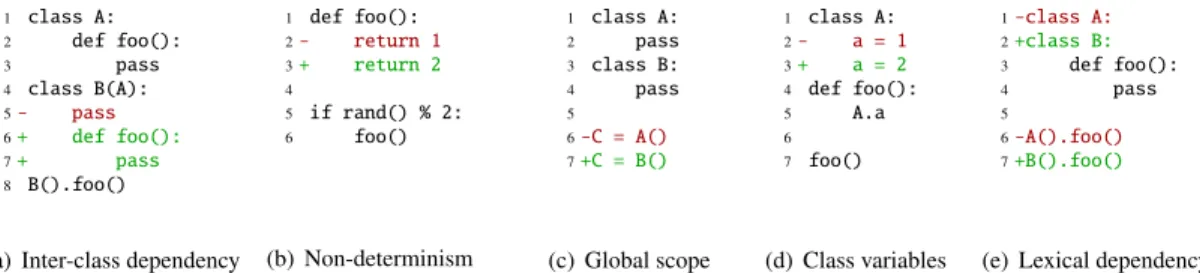
Figure 2: Examples of dependencies that TAO’s function-level tracking misses. TAOmisses (a) because its runtime interception records thatA’s
foowas called; whereas its patch analysis reports thatB.foowas added, as the patch analysis does not understand thatBis a subclass ofA. TAO
misses (b) if the result ofrandwas odd during runtime interception. TAOmisses (c), (d), and (e) because it tracks only function execution and not statements executed in global or class scope.
the dependency map to determine the affected tests and runs those tests. All new unit tests are run as well. Dependency server. TAOrequires the dependency map to determine unit tests to run on a code change. One op-tion is to generate the dependency map by running all unit tests whenever the programmer updates the local source tree from the repository server; however, this defeats the purpose of TAO’s unit test optimization.
To solve this issue, TAOstores the dependency map on a dependency server, with a separate version of the depen-dency map for each version of the source tree. When the local source tree is updated to a new version, TAO down-loads the dependency map for that version and uses it for analysis. Two challenges arise while implementing depen-dency servers. First, managing a dependepen-dency server and its permissions places extra burden on the repository main-tainers. To avoid this issue, TAOstores the dependency map as a file in the source code repository itself; thus, programmers who have write access to the repository can also update the dependency map. Second, updating the entire dependency map on every commit wastes network bandwidth, as it needs to be downloaded on an update as well. Instead, TAOgenerates an incremental dependency map for each commit, which contains only the map for the tests that were affected by the committed code change and were rerun. Periodically, TAOgenerates a full depen-dency map on a commit to avoid having to collapse long chains of incremental dependency maps.
Missing dependencies. TAO’s function-level depen-dency tracking is not complete and can miss some de-pendencies of tests on changed code. Figure 2 shows examples of missing dependencies, which can sometimes result in TAOnot rerunning tests whose outputs may have changed due to the changed code (i.e., false negatives); §4 evaluates the frequency of TAO’s false negatives.
3
Implementation
We have implemented a prototype of TAOfor PyUnit, the standard unit testing framework for Python, and the Git
Component Lines of code
Execution tracing 210 lines of Python Dependency analysis 350 lines of Python Django test runner 50 lines of Python Twisted test runner 110 lines of Python
Figure 3: Lines of code of each component of the TAOprototype, including the incremental test runners for Django and Twisted. version control system. The implementation is 720 lines of Python code in total, as shown in Figure 3.
TAOintercepts function calls withsettrace, Python’s system tracing function used to implement Python debug-gers. The dependency map is stored as a log of functions executed for each unit test case. Incremental maps are stored in the same format as well; merging them is simply a concatenation of the logs, with later entries for a test overriding the previous entries. The dependency maps are compressed with Gzip to reduce storage overhead.
TAO’s patch analysis gets a Git diff of the modified source, identifies the modified Python source files from the diff, and then uses Python’s standardastmodule to parse those source files into abstract syntax trees and identify the functions that were modified.
4
Evaluation
Our preliminary evaluation of TAOanswers the following questions:
• For real software, how many functions are modified in each commit?
• What fraction of unit tests can be skipped for each commit, and how much execution time is saved as a result?
• How many missed dependencies and false negatives does TAOincur?
• What is the overhead of TAO’s dependency tracking? In our evaluation we used the source code repositories of Django [1] and Twisted [3], and the patches for the most recent 100 commits in those projects. By design, TAOreruns tests affected by a commit to find potential
0 200 400 600 800 1000 1200 1400 1600 1800 2000 0 10 20 30 40 50 60 70 80 90 100 #Modified functions #Affected testcases 0 200 400 600 800 1000 1200 1400 1600 1800 2000 0 10 20 30 40 50 60 70 80 90 100 #Modified functions #Affected testcases Django Twisted
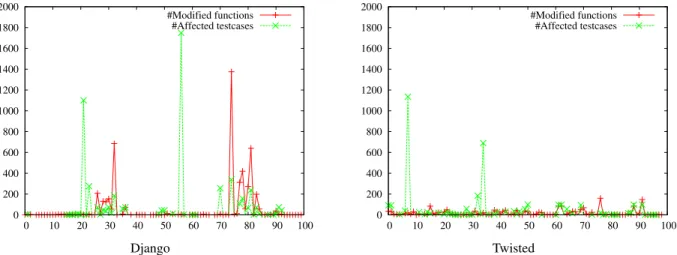
Figure 4: The number of modified functions and affected tests cases (Y-axis) for each of the last 100 commits (X-axis) of Django (left) and Twisted (right), respectively. The total number of functions in Django and Twisted were 13,190 and 23,096, and the total number of test cases were 5,166 and 7,150.
Project Number of Tests Runtime
All RTS TAO All TAO
Django 5,166 759.7 50.8 520.3s 1.7s Twisted 7,150 1,668.3 28.7 72.1s 2.2s
Figure 5: TAOunit test execution performance. The number of tests columns show the total number of tests, and the average numbers of tests executed by an existing RTS technique and TAOfor the latest 100 commits in Django and Twisted. The runtime columns show the time to execute all tests and the average time taken by TAOto execute unit tests for the latest 100 commits.
bugs; however, it did not catch any bugs because all unit tests pass for all these commits, likely because developers diligently followed the checkin policies of these projects and ensured that all unit tests passed before committing their code modifications to the repositories. The exper-iments were run on a computer with a 2.80 GHz Intel Core i7-860 processor and 8 GB of RAM running Ubuntu 12.10.
4.1
Functions modified in each commit
We analyzed the patches for the last 100 commits in Django and Twisted to understand the typical number of functions modified per commit in real-world software. The results are shown in the top graphs of Figure 4. Out of a total number of 13,190 and 23,096 functions in Django and Twisted, respectively, only 50.8 and 18.2 functions (or 0.3% and 0.07%) were modified on average by each commit, and 90% of the commits modified less than 10 functions. As unit tests generally test isolated portions of code, this indicates that the number of affected test cases would be low as well.
4.2
Reduction in test execution time
For the same 100 commits as in the previous experiment, we measured the number of test cases executed by TAO for each commit. The aggregate results are shown in
Figure 5. Django and Twisted have 5,166 and 7,150 unit test cases and running all the tests takes 520 seconds (8.7 min) and 72 seconds, respectively. On an average, TAO ran only 50.4 and 28.7 tests per commit (1% and 0.4% of all tests), and took 1.7 seconds and 2.2 seconds to run them (0.3% and 3.1% of the total time). This shows that TAOis very effective in reducing execution time of unit tests. To compare with existing RTS techniques, we also implemented an RTS technique that avoids false negatives by tracking class, module, and global scope, and measured its performance; on an average it executes 759.7 and 1668.3 tests (14.7% and 23.3% of all tests), which is significantly more than TAO.
The top plots of Figure 4 show the distribution of num-ber of tests executed by TAOfor each of the 100 com-mits. The plots show that the number of tests executed is mostly correlated with the number of modified functions (i.e., greater number of modified functions results in more number of tests executed). However, the graphs illustrate exceptions that fall into two interesting categories. First, some commits change only a few functions, but affect many tests; this happens because those commits modify common functions that are invoked in many tests. For ex-ample, theWSGIRequestclass represents a web request in Django and is instantiated in 1,094 out of 5,166 unit tests; a commit that changes the constructor of that class would therefore require rerunning all those tests. Simi-larly, in Twisted, thePlatform.getTypefunction that checks the environment affects 1,054 out of 7,150 test cases.
Second, some commits change a large number of func-tions but affect only a few tests. This happens when com-mits contain new features, perform code refactoring, or code maintenance. For example, in Django, a commit to supportunittest2modifies 1,375 functions but affects
Project FN/I FN/N FN/G FN/C FN/L Django 0/0 0/0 2/ 8 1/ 3 1/23 Twisted 1/2 0/0 1/20 1/17 0/11
Figure 6: False negatives and missed dependencies due to TAOfor the latest 100 commits of Django and Twisted. Each FN/X (where X is one of I, N, G, C, L, corresponding to the missed dependency types in Figure 2,) represents the number of commits with false negatives (FN) and the number of commits with a missed dependency of type X. A commit can have more than one type of missed dependency and more than one type of false negative. The total number of false negatives was 3 for both projects.
only 341 out of 5,166 test cases. In Twisted, implement-ing a SSH command end point modifies 160 functions but affects only 20 out of 7,150 test cases.
4.3
False negatives
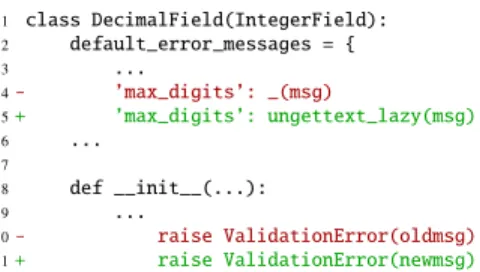
We manually inspected each of the latest 100 commits for Django and Twisted, and counted the number of commits with code changes that TAO’s function-level dependency tracking misses. These missed dependencies fell into the categories in Figure 2. For each of the missed dependen-cies, we also manually identified the tests that needed to be executed to test that dependency. For some commits, TAO’s function-level dependency tracking may have al-ready flagged all the tests corresponding to the missed dependencies because the commit also included function-level changes. In this case TAOdoes not have false neg-atives for that commit; Figure 7 illustrates an example scenario for this case. However, if TAO’s function-level algorithm missed flagging any of those tests, we counted that commit as having a false negative.
Figure 6 shows the results of this experiment. Although the total number of commits with missed dependencies is about 25%, only 3 commits out of 100 in either project had any false negatives. For the remaining 97 commits, the result of execution of all tests is the same as that of TAO’s optimized test execution on the programmers’ computers; so, TAO’s test execution suffices to catch bugs in 97% of the commits. Combined with the more than 96% reduction in unit test execution time, this shows that TAOin practice strikes a good balance between optimizing test execution time and the number of commits with false negatives.
4.4
Performance overhead
To measure the overhead of TAO’s dependency tracking, we ran the unit tests of Django and Twisted, with and with-out TAO, and measured the running time and the size of the compressed dependency maps. The results are shown in Figure 8. TAO’s dependency tracking adds an overhead of 60% and 117% for Twisted and Django, respectively; this high overhead is due to Python’ssettracedebug function being slow. Implementing TAO’s dependency tracking in the Python runtime should significantly reduce
1 class DecimalField(IntegerField): 2 default_error_messages = { 3 ... 4- ’max_digits’: _(msg) 5+ ’max_digits’: ungettext_lazy(msg) 6 ... 7 8 def __init__(...): 9 ... 10- raise ValidationError(oldmsg) 11+ raise ValidationError(newmsg)
Figure 7: Simplified snippet of the Django commit be9ae693 that illustrates why missed dependencies typically do not result in false negatives for TAO. In addition to a missed class variable dependency, the commit also includes a change to the__init__function; the tests flagged by this function-level dependency on the__init__function are a superset of the tests affected by the change to the class variable.
Project Runtime Storage
no TAO TAO Full Incremental
Django 520.3s 1,129.1s 9.9MB 270KB Twisted 72.1s 115.6s 1.3MB 280KB
Figure 8: TAOoverhead during execution of Django and Twisted unit tests. The runtime columns show total times taken to run all the unit tests without TAOand with TAO. The storage columns show the size of TAO’s compressed full dependency maps and the average size of TAO’s compressed incremental dependency maps for each commit.
this overhead. More importantly, the significant reduction in the number of executed tests dwarfs this high overhead, with the bottom line result that the overall execution time of unit tests is still a small fraction of the time taken to execute all the tests.
TAO’s dependency information occupies 10MB and 1.3MB for Django and Twisted unit tests, respectively. This corresponds to 2KB and 0.18 KB per test. For the tests that TAO reruns for the recent 100 commits, the average size of incremental dependency maps is less than 300KB per commit, for both Django and Twisted.
5
Related work
The existing work closest to TAOis research on regression test selection [4, 5, 8, 12]. TAO’s contributions are in making RTS practical by exploiting the insight that simple and fast function-level dependency tracking works well in practice; and in making it easy for programmers to adopt TAOas part of their workflow by integrating with PyUnit and including dependency information as part of each commit.
Other methods have been proposed to reduce unit test execution time: for example, Khalek et al. [9] show that eliminating common setup phases of unit tests in Java can speed up test execution. However, Khalek et al. require the programmer to define undo methods for all operations in a unit test, which places a significant burden on the pro-grammer that TAOavoids with its automatic dependency tracking.
Past work has also used dependency tracking for ap-plications other than test optimization: Poirot [10] and TaintCheck [11] have used dependency analysis and taint tracking for intrusion recovery, and TaintDroid [6] has used taint tracking for privacy monitoring. TAOshows that dependency tracking can be applied to optimize unit test execution.
6
Summary
TAOhelps programmers run unit tests faster by running only the tests that may be affected by the programmers’ source code modifications. TAOdoes this by tracking during test execution the functions executed by each test; analyzing changed code to determine the modified func-tions; and combining this information to determine the affected tests. To bootstrap dependency information with-out needing the programmer to run all the unit tests, TAO stores this information along with the source code repos-itory. An initial prototype of TAOreruns an average of less than 1% of the unit tests for each commit in two large Python software projects.
Acknowledgments
Thanks to the anonymous reviewers for their feedback. This work was supported by the DARPA Clean-slate de-sign of Resilient, Adaptive, Secure Hosts (CRASH) pro-gram under contract #N66001-10-2-4089, and by NSF award CNS-1053143.
References
[1] Django: The Web framework for perfectionists
with deadlines. http://www.djangoproject.
com, 2013.
[2] Unit tests: Django documentation. https://docs. djangoproject.com/en/dev/internals/ contributing/writing-code/unit-tests, 2013.
[3] Twisted.http://twistedmatrix.com, 2013.
[4] H. Agrawal, J. R. Horgan, E. W. Krauser, and S. A. London. Incremental regression testing. In Proceed-ings of the IEEE Conference on Software Mainte-nance, September 1993.
[5] S. Biswas, R. Mall, M. Satpathy, and S. Sukumaran. Regression test selection techniques: A survey. In-formatica, 35(3):289–321, October 2011.
[6] W. Enck, P. Gilbert, B. Chun, L. P. Cox, J. Jung, P. McDaniel, and A. N. Sheth. TaintDroid: An information-flow tracking system for realtime pri-vacy monitoring on smartphones. InProceedings of the 9th Symposium on Operating Systems Design
and Implementation (OSDI), Vancouver, Canada, October 2010.
[7] T. L. Graves, M. J. Harrold, J.-M. Kim, A. Porter, and G. Rothermel. An empirical study of regression test selection techniques. ACM Transactions on Software Engineering and Methodology, 10(2):184– 208, April 2001.
[8] M. Harrold and M. Souffa. An incremental approach to unit testing during maintenance. InProceedings of the Conference on Software Maintenance, pages 362–367, 1988.
[9] S. A. Khalek and S. Khurshid. Efficiently running test suites using abstract undo operations. IEEE International Symposium on Software Reliability Engineering, pages 110–119, 2011.
[10] T. Kim, R. Chandra, and N. Zeldovich. Efficient patch-based auditing for web application vulnerabil-ities. InProceedings of the 10th Symposium on Op-erating Systems Design and Implementation (OSDI), Hollywood, CA, October 2012.
[11] J. Newsome and D. X. Song. Dynamic taint analy-sis for automatic detection, analyanaly-sis, and signature generation of exploits on commodity software. In Proceedings of the Network and Distributed System Security Symposium (NDSS), 2005.
[12] S. Yoo and M. Harman. Regression testing min-imization, selection and prioritization: a survey. Software Testing Verification and Reliability, 22(2), March 2012.