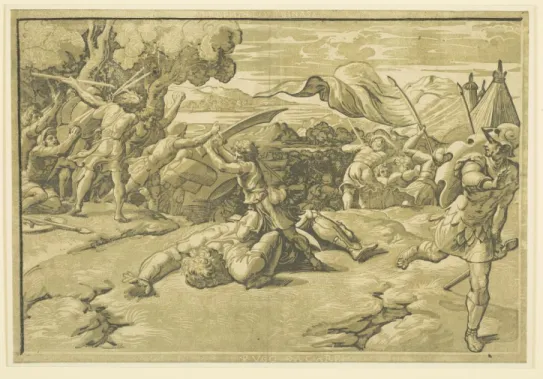
The Maker's Knowledge: Production and
Analysis of Ugo da Carpi's David Slaying Goliath
Item Type text; Electronic Thesis
Authors Church, Sophie Oriana
Publisher The University of Arizona.
Rights Copyright © is held by the author. Digital access to this material
is made possible by the University Libraries, University of Arizona. Further transmission, reproduction, presentation (such as public display or performance) of protected items is prohibited except with permission of the author.
Download date 20/01/2021 03:05:51
THE MAKER’S KNOWLEDGE: PRODUCTION AND ANALYSIS OF UGO DA CARPI’S DAVID SLAYING GOLIATH
by
Sophie Church
____________________________ Copyright © Sophie Church 2019
A Thesis Submitted to the Faculty of the
DEPARTMENT OF ART HISTORY
In Partial Fulfillment of the Requirements
For the Degree of
MASTER OF ARTS
In the Graduate College
THE UNIVERSITY OF ARIZONA
3 ACKNOWLEDGEMENTS
I would first like to thank my thesis advisor and committee chair, Dr. Pia Cuneo of the
Department of Art History at the University of Arizona. She consistently steered me in the right
direction every time I got lost in my research. Her unwavering support and guidance made this
thesis possible.
I would also like to acknowledge Dr. Sarah Moore of the Department of Art History and
Dr. Nancy Odegaard of the Department of Anthropology and the Department of Materials
Science at the University of Arizona as my second and third readers of this thesis. I am grateful
to both their valuable insights and comments on this thesis.
I would also like to thank my numerous colleagues within the Art Conservation
community: Nancy Odegaard, Gina Watkinson, Dana Hemmenway, Dana Tepper, and Linda
Stiber Morenus, for their continuous support and input throughout my research and hands-on
examination of the print from the University of Arizona Museum of Art’s collection.
Furthermore, I am very grateful to the UAMA for their cooperation, and to Registrar Kristen
Schmidt for making this research possible. Without Registrar Schmidt’s help I would not have
been able to analyze and test the print in person. These analyses later proved integral to my thesis
research. Additionally, a huge thank you to the Arizona State Museum and the Center for
Creative Photography for allowing me to utilize their facilities and equipment in the examination
of the UAMA’s print.
Finally, I must express my profound gratitude to Professor Cerese Vaden for introducing
me to Intaglio printmaking and supporting me throughout my experimentation with etching and
4 DEDICATION
5 CONTENTS LIST OF FIGURES………...7 ABSTRACT………...29 INTRODUCTION……….………30 Literature Review………...31
THE BIBLE AND THE LOGGIA……….………...34
PRINTMAKING AS A COLLABORATIVE PROCESS……….36
PRINTMAKING HISTORY………..………...37
The Chiaroscuro Woodcut……….39
Printmaking States of Ugo da Carpi’s David Slaying Goliath ..………...40
RELIEF PRINTMAKING……….41
The Chiaroscuro Woodcut Process………42
Editing Woodblocks………...43
Single Woodblock Reductive Method………...44
PRINTMAKING MATERIALS: CHIAROSCURO WOODCUT……….………..45
Woodblocks………...45
Ink Processing ………47
Analysis of the Inks Present in the University of Arizona Museum of Art’s Print……...49
Ink Viscosity and Printing Pressure………...52
Printmaking Ink Today………..55
Paper Processing………55
6
Quality and Sale of Paper for Printmaking………58
ART HISTORY, ART CONSERVATION, AND STUDIO ART………....61
APPENDICES………...………63
List of Ugo da Carpi’s David Slaying Goliath in other collections………...63
My Experience: Intaglio Printmaking………63
X-ray Fluorescence Spectrum Results: Highlight Ink Layer of UAMA David Slaying Goliath………66
7 LIST OF FIGURES
Figure 1: Verso, David Slaying Goliath, after Ugo da Carpi, after Raphael, Sixteenth century,
Chiaroscuro woodcut, Fourth state, University of Arizona Museum of Art, Tucson, Arizona.
Pages 1 and 30.
Figure 2: Recto, David Slaying Goliath, after Ugo da Carpi, after Raphael, Sixteenth century,
Chiaroscuro woodcut, Fourth state, University of Arizona Museum of Art, Tucson, Arizona.
8
Figure 3: David Slaying Goliath, Raphael, 1519, Fresco painting, Loggia, Vatican, Rome, Italy
Page 5.
9
Figure 6: David Beheading Goliath, Marcantonio Raimondi, after Raphael, 1520-25, Engraving,
Minneapolis Institute of Art, Minneapolis, MN. Pages 7 and 36.
Figure 7: Detail, David and Goliath, Ugo da Carpi, after Raphael, 1520-27, Chiaroscuro
10
Figure 8: TheMassacre of the Innocents, Ugo da Carpi, after Raphael, 1520-27, Chiaroscuro
woodcut, The Metropolitan Museum of Art, New York, NY. Page 8.
Figure 9: The Massacre of the Innocents, Marcantonio Raimondi, after Raphael, 1512-13,
11
Figure 10: Detail, David Slaying Goliath, after Ugo da Carpi, after Raphael, Sixteenth century,
Chiaroscuro woodcut, Fourth state, University of Arizona Museum of Art, Tucson, Arizona.
Pages 11 and 15.
Figure 11 (Left): Detail, David Slaying Goliath, after Ugo da Carpi, after Raphael, Sixteenth
century, Chiaroscuro woodcut, Fourth State, University of Arizona Museum of Art, Tucson, AZ.
Pages 11, 15, and 25.
Figure 12 (Above Right): Detail, David Slaying Goliath, Ugo da Carpi, after Raphael, 1520-27,
Chiaroscuro Woodcut, Third State, Metropolitan Museum of Art, New York, NY. Pages 11, 15,
12
Figure 13: David Kills Goliath, Ugo da Carpi, after Raphael, 1518-1520, Chiaroscuro woodcut,
First state, Royal Collection Trust, England. Page 11.
Figure 14: David Cutting off the Head of Goliath, Ugo da Carpi, after Raphael, 1520-1529,
Chiaroscuro woodcut, Second state, Ashmolean Museum of Art and Archaeology, University of
13
Figure 15: David and Goliath, Ugo da Carpi, after Raphael, 1520-27, Chiaroscuro woodcut,
Third state, The Metropolitan Museum of Art, New York, NY. Page 11.
Figure 16: David onthoofdt Goliat, after Ugo da Carpi, after Raphael, 1502-1532, Chiaroscuro
14 Figure 17: Woodcut relief printmaking tools. Page 17.
Figure 18: Portable X-ray Fluorescence at the Arizona State Museum Conservation Lab, analysis
15 Figure 19: Portable X-ray Fluorescence at the Arizona State Museum Conservation Lab, analysis
of David Slaying Goliath, University of Arizona Museum of Art, Tucson, AZ. Page 22.
Figure 20: X-radiography Cabinet at the Arizona State Museum Conservation Lab, analysis of
16
Figure 21: X-ray image from analysis of David Slaying Goliath in the Arizona State Museum
Conservation Lab, Tucson, AZ. Page 23.
Figure 22: Detail, Recto, David Slaying Goliath, after Ugo da Carpi, after Raphael, Sixteenth
century, Chiaroscuro woodcut, Fourth state, University of Arizona Museum of Art, Tucson,
17
Figures 23-27: Photomicrograph, David Slaying
Goliath, after Ugo da Carpi, after Raphael, Sixteenth century, Chiaroscuro woodcut, Fourth
state, University of Arizona Museum of Art,
18
Figure 28: Detail, David Slaying Goliath, after Ugo da Carpi, after Raphael, Sixteenth century,
Chiaroscuro woodcut, Fourth state, University of Arizona Museum of Art, Tucson, AZ. Page 25.
Figure 29: Raking Light, David Slaying Goliath, after Ugo da Carpi, after Raphael, Sixteenth
century, Chiaroscuro woodcut, Fourth state, University of Arizona Museum of Art, Tucson, AZ.
19
Figure 30 (Left): Print depicting a sixteenth-century wooden platen press. Page 25.
Figure 31 (Above right): Self Portrait, Sophie Church, woodcut, 2016. Page 25.
Figure 32: Transmitted Light, David Slaying Goliath, after Ugo da Carpi, after Raphael,
Sixteenth century, Chiaroscuro woodcut, Fourth state, University of Arizona Museum of Art,
20
Figure 33 and 34: Hikers, Sophie Church, woodcut, 2016. Page 30.
Figure 35: After Raphael’s David Slaying Goliath, Sophie Church, Drypoint etching, 2019. Page
21
Figure 36: Transmitted Light, After Raphael’s David Slaying Goliath, Sophie Church, Drypoint
etching, 2019. Page 31.
22 Figure 38: Drypoint etching, Over wiping, regular wiping, under wiping, Sophie Church, 2019.
Page 34.
23 Figure 40: Etching, zinc plate with hard ground design, Sophie Church, 2019. Page 35.
Figure 41 (Left): Acid bath equipment in the UA School of Art Print Studio, 2019. Page 35.
24
Figure 43: Zinc printing plate, After Raphael’s David Slaying Goliath, Sophie Church, Etching,
2019. Page 35.
Figure 44: Raking Light, Zinc printing plate, After Raphael’s David Slaying Goliath, Sophie
25
Figure 45: After Raphael’s David Slaying Goliath, Sophie Church, Etching, 2019. Page 35.
26
Figure 47: Photomicrograph, Drypoint etching print. Page 35.
Figure 48: Photomicrograph, Etching. Page 35.
Figure 49: Photomicrograph, Etching zinc plate. Page 35.
27
Figure 50: After David Slaying Goliath, Sophie Church, Engraving on zinc plate, 2019. Page 36.
28 Figure 52: Engraving burin, whetstone and other sharpening tools, 2019. Page 36.
29 ABSTRACT
This study explores the technique and materials used in the making of the University of
Arizona Museum of Art's sixteenth-century chiaroscuro woodcut print David Slaying Goliath. It
also poses the question of: was this print produced by Ugo da Carpi or another workshop of the
sixteenth century? Through observations of the composition, materials used, and the chiaroscuro
woodcut technique, I analyze Ugo da Carp's mark-making method to determine how this print
was made. I argue that we find evidence of the alteration of Ugo's woodblocks and this print's
production by another workshop, which accounts for the poor quality of the materials used and
the overall craftsmanship. To better understand printmaking materials, techniques, and
technologies, I learned intaglio printmaking and mimicked the mark-making methods of these
30
Introduction
When I first saw David Slaying Goliath by Ugo da Carpi (Fig. 1-2) in the University of
Arizona Museum of Art, I was filled with questions.1 What is happening in this scene of war?
What materials is this print made of? Is one of the ink layers faded? Why is there a line down the
center of the print? But most of all, I wanted to know how Ugo da Carpi made this image and
whether or not it was truly made by him. This curiosity lead me to analyze the materials of this
print using technology ranging from a simple microscope to an advanced X-radiography machine
available to me in the conservation laboratories on campus at the Center for Creative
Photography and the Arizona State Museum. This analysis provided me with scientific data to
support my art historical research and hypotheses. However, I wanted to know more about how
prints are made and decided to take an introductory intaglio printmaking course to provide me
with insight into what it is like to carve wood and metal, to spread ink on a printing plate or
woodblock, and to prepare paper and print my final image using a press.
As I began my research, I found that there are not many English sources which discuss
this specific print by Ugo da Carpi. The Chiaroscuro Woodcut in Renaissance Italy briefly
references Ugo da Carpi’s prints of David Slaying Goliath.2 Within this short selection, the
author, Naoko Takahatake, mentions the multiple states of this print and woodblock. It is from
the footnotes of this selection that I was able to track down several examples of the five total
states of this print and compare them to the University of Arizona Museum of Art’s version to
1 The UAMA dates the print to 1518. My research has indicated that the date would be sometime after 1530.
Indeed, Naoko Takahatake, The Chiaroscuro Woodcut in Renaissance Italy (New York, Los Angeles: Delmonico Books; Los Angeles County Museum of Art, 2018), 94; argues for a date before the 1560s or 1570s.
2 Naoko Takahatake, The Chiaroscuro Woodcut in Renaissance Italy (New York, Los Angeles: Delmonico Books; Los
31 determine which state the print in their collection is. Additionally, this selection supported my
hypothesis that this print was not inked or pressed by Ugo da Carpi.
Through observations of the composition, materials used, and the chiaroscuro technique,
I will analyze David Slaying Goliath and Ugo da Carpi’s mark-making process to determine how
this print was made. I argue that we find the evidence of the alteration of Ugo’s woodblocks and
this print’s production by another workshop, which accounts for the poor quality of the materials
used and the overall craftsmanship. To better understand printmaking materials, techniques, and
technologies, I learned intaglio printmaking and mimicked the mark-making methods of these
early modern printmakers and carvers through etching and engraving processes. Although I did
not have the opportunity to directly learn the chiaroscuro woodcut technique, I did learn about
relief printmaking from current printmaking graduate students and was able to refresh my
memory of an introductory course on relief printmaking from my undergraduate career. Overall,
I am approaching my research from a material and art conservation perspective, and therefore am
interested in the knowledge to be gained from the hands-on practice of these printmaking
techniques. Pamela Smith and Linda Stiber Morenus are two scholars who approached their
research similarly and provided me with the inspiration for this thesis.
Literature Review
In “Making Things: Techniques and Books in Early Modern Europe,” Pamela Smith
discusses her personal experience in performing life-casting technique and examines how
learning this process was essential to her understanding of artists workshops in early modern
Europe. She also discusses the sudden burst of artists writing on these experiences and why the
recording of their personal process may have been important to them. She then records her own
32 process. She states, “Sometimes the maker’s knowledge is written down, but technical writings
seldom convey sufficient information to actually engage in making an object”3 This coincides
with her statement “experience is essential” or that true knowledge can only be obtained through
the whole body. She concludes with what she learned about this period of art production from
reconstructing the techniques in modern day. I think it is important as a historian to have
experience in creating and working with the materials you are researching. Reading about the
creation process will not teach your body and hands how to perform it. Learning with your hands
can provide additional insights into the object, artist, patron, and period, as well as into the
interaction between the materials and the artist.
In “Recreating the Italian Chiaroscuro Woodcut,” a chapter by Linda Stiber Morenus in
The Chiaroscuro Woodcut in Renaissance Italy by Naoko Takahatake, Morenus discusses what she learned from creating her own prints in the chiaroscuro woodcut technique. Additionally,
Morenus also reproduced the inks and matched the paper quality used by artists like Ugo da
Carpi to further learn about his process and intentions. Morenus then tested the prints she
produced by exposing them to different environmental conditions, such as light or moisture
intense circumstances. Morenus then used the results to compare the effects on each print and
how each condition could alter the appearance of these prints over time. This information helped
me to evaluate the damage I observed on the University of Arizona Museum of Art’s version of
Ugo da Carpi’s David Slaying Goliath.
In “Sixteenth and Seventeenth-Century Italian Chiaroscuro Woodcuts: Instrumental
Analysis, Degradation, and Conservation,” Morenus discusses the results of a technical survey of
3 Pamela Smith, “Making Things: Techniques and Books in Early Modern Europe,” In Early Modern Things: Objects and their Histories, 1500-1800 (Abingdon: Routledge, 2012) 179.
33 over two-thousand Italian chiaroscuro woodcuts of the sixteenth and seventeenth centuries. This
survey revealed trends in the deterioration of colored inks and their paper supports. Additionally,
Morenus provides a table of different types of inks found in the survey and furthermore the
results from instrumental analyses of seventy-two prints from collections of the Library of
Congress, the Los Angeles County Museum of Art, and the Grunwald Center for the Graphic
Arts. These results determined several unstable colorants and documented their behavior, so
researchers can infer how the visual appearance of a print is likely to have changed.4 For my
research, this reading showed me many examples of how prints from this period and by Ugo da
Carpi and other artists deteriorate. I was able to compare the deterioration visible on the
University of Arizona Museum of Art’s print to the results listed and described in the paper. It
also enabled me to further understand the clues I should look for and to plan my own analytical
testing of the UAMA’s print.
In “The Chiaroscuro Woodcut Printmaking of Ugo da Carpi, Antonio da Trento and
Niccolò Vicentino: Technique in Relation to Artistic Style,” Morenus differentiates between the
working methods of three early modern printmakers. She also discusses how recognizing each
artists’ mark-making process is essential to the attribution of their prints for museums and other
institutions. Her research applies a diagnostic approach that relies on the systematic analysis of
physical evidence, such as ink character, palettes, manner of printing and chronology of
woodblock state and wear, to individuate the workshop practices of these printmakers.5 Her
4 Linda Stiber Morenus, Charlotte W. Eng, Naoko Takahatake and Diana C. Rambaldi, 16th and 17th Century Italian Chiaroscuro Woodcuts: Instrumental Analysis, Degradation, and Conservation (Journal of the American Institute for Conservation, 2015, 54:4) 238-271.
5 Linda Stiber Morenus, “The Chiaroscuro Woodcut Printmaking of Ugo da Carpi, Antonio da Trento and Niccolò
Vicentino: Technique in Relation to Artistic Style,” in Printing Colour 1400-1700: History, Techniques, Functions, and Receptions, by Ad Stijnman and Elizabeth Savage (Leiden: Brill, 2015) 67.
34 analysis is informed by practical knowledge gained from recreating chiaroscuro woodcuts and by
comparing these to historic originals. Her research is very similar to the way I wanted to
approach my own.
The Bible and the Loggia
High up on the ceiling, in the halls of the Loggia in the Vatican in Rome, is a small fresco
painting by Raffaello Sanzio da Urbino (1483-1520), depicting the moment in which David
killed Goliath (Fig. 3-5). In the center of the composition, David is depicted as a young boy on
the battlefield, holding a sword above his head, in the act of slaying Goliath who is shown as a
large man on the ground beneath David’s knee. Goliath’s head is down, his face is out of view,
and his arm is reaching out for help. His back and arms are quite muscular, and he appears to be
a strong man. However David, a young shepherd boy, is still able to overpower and hold him on
the ground. The two figures are surrounded by chaos as many others are battling around them.
One figure on the right side of the composition seems to be fleeing the battlefield. Another figure
on the left side is down on his knees, begging for his life. This painting captures the moment of Goliath’s defeat and with his downfall, his soldiers are also defeated.
The sword David wields to behead Goliath, and the chaotic battlefield around them,
indicate that this image follows the biblical narrative in which David is a young shepherd living
with his father in the Kingdom of Israel.6 The story begins when God is upset with the king of
Israel, Saul, who disobeyed a divine command to kill all of the Amalekites and to destroy their
confiscated property. God sends Samuel, a prophet, to anoint David to be king instead. After
6 OT: 1 Samuel, 17
35 Saul is tormented by an evil spirit, his courtiers advise him to send for David, and thus David
enters the king’s service as one of the royal armor-bearers.
Later, war comes between Israel and the Philistines, and the giant, Goliath of the
Philistines, challenges the Israelite army to send out a champion to face him in single combat.
Goliath states that if he wins the single fight, then the Israelites must follow the Philistines, and
that if the Israelite challenger wins, then the Philistines will follow King Saul. David is sent to
the battlefield by his father to seek out his brothers who were already there with the rest of the
Israelite army. He arrives when Goliath declares his challenge and he then tells King Saul that he
can defeat Goliath. At first the king refuses, since David is still a youth and Goliath is a warrior.
However, David persuades the king to let him fight after telling him about the numerous beasts
he has protected his flock of sheep from as a shepherd. The king accepts David as the chosen
champion of the Israelites and offers him royal armor. David refuses the armor and goes to fight
Goliath with only his sling. During the fight, David knocks Goliath down with his sling and then
takes Goliath’s sword and beheads him. Some members of the Philistine army attempt to flee
after seeing their strongest warrior fall, though most pledge allegiance to the Israelites. After the
battle all of Israel loves David, though the king begins to fear him and worries that David wishes
to steal the throne. David later acquires Goliath’s sword, fights in various other battles, and later
makes up with King Saul rather than killing him.
This particular image by Raphael was created, along with many others decorating the
hall, in 1519 by Raphael and his team of artists. These paintings provided references for
printmakers and other artists for centuries. The Loggia was originally a hall open to the air on
one side and visitors to the Apostolic Palace would walk through this space. It was not
36 there are no large paintings or gilding. It is likely that anyone visiting the palace would have
walked down this hall and viewed the paintings on the ceiling. An artist wishing to mimic
Raphael’s painting and composition could create a sketch of the design. However, I am unsure
how visible these images are from the ground, or how many details can be perceived. Therefore,
a drawing from the original installation of the paintings was more likely used. Printmakers and
painters, such as Marcantonio Raimondi, helped Raphael to paint the walls and ceilings of the
Loggia and Vatican palace.7 This relationship between the printmakers and Raphael likely
accounts for how the design was acquired for reproduction.
Printmaking as a Collaborative Process
In the sixteenth century, multiple artists were involved in the creation of a single print.
The first artist would draw the initial design on paper for the craftsman, who would then carve
the design into the woodblock.8 Ugo da Carpi (1480-1532) was one of these trained craftsmen,
even though he had training as a painter as well. He would carve, ink, and print each of the
woodblocks following the artist’s design. For David Slaying Goliath, Ugo da Carpi followed an
engraving (Fig. 6) by Marcantonio Raimondi (1480-1534), after Raphael’s original painting,
whom he credits by printing Raphael’s name on each print, “Raphael Urbinas Per Ugo da Carpi”
(Fig. 7). David Slaying Goliath is not the only chiaroscuro print by Ugo in which he follows an
engraving by Marcantonio after a painting by Raphael. Ugo’s chiaroscuro woodcut, Massacre of
the Innocents, made in 1520-27 (Fig. 8) also copies another engraving by Marcantonio from
7 Landau and Parshall, The Renaissance Print: 1470-1550, 25.
8 John Dawson, The Complete Guide to Prints and Printmaking Techniques and Materials (Oxford: Phaidon Press
37 1513 (Fig. 9). Ugo’s chiaroscuro woodcut prints confidently declare his skill by inviting
comparison with Marcantonio’s acknowledged masterwork.9
Printmaking History
The process of creating images by impression is as ancient as the Assyrian cylinder seals
of the Near East from 3500 BC and the stamping of coins first observed in sixth-century Turkey.
However, when the printing of images on paper began in Europe, it opened a new channel to
exchange art and ideas.10 Although the techniques of creating these works is ancient, never
before had prints made with such detail and intricacy been successfully manufactured. Woodcut
relief printmaking, originating in fourth-century China, began in Europe around 1380.11 Fifty
years later, engravings from metal plates, an intaglio printmaking technique, appeared in 1430.
Shortly after in 1440, with the invention of moveable type and the printing press by Johannes
Gutenberg in Germany, came letterpress printing. This enabled faster publishing of books and
printing of images. Then in the early sixteenth century, around 1513, etching of metal plates,
another intaglio printmaking technique, was introduced. During this same period, chiaroscuro
woodcut printmaking was also invented.
Around 1470, printmaking style and subject matter began to change in both the north and
the south of Europe. A class of printmakers who were both painters and engravers, or more
complexly masters who can be said to have conceived of printmaking primarily as an extension
9 Takahatake, The Chiaroscuro Woodcut in Renaissance Italy, 95.
10 David Landau and Peter W. Parshall, The Renaissance Print: 1470-1550 (New Haven: Yale University Press, 1994),
4.
38
of the painter’s art, began to emerge.12 The appearance of these printmakers marks the beginning
of the notion of the autonomous print as a work of art. These painter-printmakers employed
mark-making techniques such as cross-hatching to express light and capture tonality as well as
textural differences in their prints.
The beginning of printmaking however is closely tied to the activities of carpenters and
metalworkers.13 Goldsmiths knew how to inscribe a design on a metal surface but creating a
historical narrative or composing figures was not so often done. Therefore, apprenticing under a
metalworker or a painter meant approaching the making of a print with different skill sets at
hand. Accordingly, many early printmakers were trained in both these crafts. In early
sixteenth-century Europe, the arts and crafts were associated with different guilds that regulated the
teaching of apprentices and the production and distribution of their works. Usually, artists
practicing printmaking would have allied with the painters in guilds that frequently also included
sculptors.14 Consistent with the guild divisions, we find that most known printmakers identified
themselves first as painters or goldsmiths. It is probably to the printmaker’s advantage that they
did not belong to a specific guild due to the commercial nature of their product.15 Additionally,
those who were purely technicians of early printmaking such as the woodblock cutter often
belonged to the carpenters’ guild, or they sometimes aligned themselves with a variety of other
crafts, including the card painters and document illuminators. By the end of the fifteenth century,
12 Landau and Parshall, The Renaissance Print: 1470-1550, 4. 13 Landau and Parshall, The Renaissance Print: 1470-1550, 8. 14 Ibid.
39 these printmakers, with their diverse skillsets, began to show the extent to which a
three-dimensional illusion could be attained without color.
The Chiaroscuro Woodcut
The chiaroscuro woodcut technique was developed by Hans Burgkmair in Augsburg,
Germany during the beginning of the sixteenth century as a method more comparable to
watercolor and wash drawings.16 This technique was an attempt to make printmaking less
mechanical and more artistic in appearance, as well as to further mimic the qualities and values
of a painting. About a decade later, Ugo da Carpi also claimed to haveinvented the chiaroscuro
technique. In 1516, Ugo requested an exclusive privilege from the Venetian Senate to protect his
“invention”.17 Although the technique was not in fact created by him, Ugo did introduce it to
Italy and further developed it into a painterly manner of expression. It is likely that Ugo
extrapolated this method of woodcut carving after seeing a Northern European example.18 This
development in printmaking style throughout Italy became important for the growth of the
chiaroscuro woodcut.19
Ugo da Carpi made many prints using the chiaroscuro woodcut technique. Several of
these prints are also made after compositions by Raphael, including the UAMA’s David Slaying
Goliath. Today, edition numbers are used by printmakers to indicate the total number of prints made from one plate or block. Unfortunately, it is impossible to know exactly how many prints
16 Takahatake, The Chiaroscuro Woodcut in Renaissance Italy, 10.
17“Ugo da Carpi David and Goliath,” The Metropolitan Museum of Art, 2018,
https://www.metmuseum.org/art/collection/search/632712.
18 Takahatake, The Chiaroscuro Woodcut in Renaissance Italy, 10.
19 Peter Weaver, Printmaking, a Medium for Basic Design (London, New York: Studio Vista; Reinhold Book, 1968)
40 Ugo made from this woodblock design because edition numbers were not used in the early
modern period. This makes it difficult to track down all of Ugo’s prints depicting this
composition of David and Goliath. However, I was able to find several prints of this composition
in the chiaroscuro technique by Ugo within collections around the world.20
Printmaking States of Ugo da Carpi’s David Slaying Goliath
In printmaking, a state is a different version of a print, created after a permanent change
by the artist to the woodblock. There are a total of five states of this chiaroscuro print by Ugo da
Carpi. The rare first state shows the names of the designer “Raphael Urbinas” and the printmaker “P Ugo da Carpi” in the light tone block, in the top and bottom of the perimeter that frames the
composition (Fig. 13). In the second state, both names appear together within the image
composition at the bottom center foreground of the light tone block, and the perimeter is cut back
(Fig. 14). Between the second and third states, the spears held by a combatant at the upper left
were modified with a plug inserted into the darkest block (Fig. 15). In the fourth state of this
print, Ugo’s name is excised from the light tone block (Fig. 16). Finally, in the extremely rare
fifth state of this print, Raphael’s name is also removed.21
When the University of Arizona Museum of Art’s copy of David Slaying Goliath is
compared with other known copies, the linework of this print is considerably less well defined.
This is due to the lower quality of inks used and the amount of pressure applied during printing.
Areas of clear and precise cross-hatching appear to be blotches. This is most noticeable in
Goliath’s back and in the shadows on the ground around his body (Fig. 10-12). This poor quality
20 See appendix for full list.
41 of materials and lesser craftsmanship lead me to believe that this print was not produced by Ugo
da Carpi. In fact, this version of David Slaying Goliath at the UAMA is the fourth state of this
print.
During the sixteenth century, carved woodblocks would be sold to workshops and
publishing houses by artists or their families when they were done using them.22 After the
production of the first three states of David Slaying Goliath, it is likely that Ugo sold his
woodblocks to another workshop or artist. It is also possible that after his death around 1530,
someone else took and printed his blocks. This is also evident by the removal of Ugo da Carpi’s
name from the bottom of the composition in the fourth state of the print, suggesting that the new
owner of the woodblocks did not want to credit Ugo in his editions.
Relief Printmaking
Relief printmaking, including the chiaroscuro technique used by Ugo da Carpi, is a
process in which the surface of the block is cut away until all that remains is the final design to
be printed. The negative space of the initial design is removed by the blade; therefore the
printmaker must think in reverse and consider the parts of the block untouched or unmarked as
positive space. This can be challenging because in traditional mark-making such as in the
painting process, wherever the artist applies his brush, the mark created expresses positive space.
Positive space is used in intaglio printmaking techniques, in which the ink applied to the metal
plate and later absorbed by the paper when printed, sits within the lines incised by the printmaker
using a burin, scratcher, or acid. However, in relief printmaking it is the opposite and the ink is
applied to the surface of the block, not within the carved lines. Therefore the ink is picked up by
42 the paper from the surface during the pressing, further indicating that the design derives from the
woodblock surface not carved away by the printmaker.
The Chiaroscuro Woodcut Process
The relief process, and furthermore the chiaroscuro technique specifically following the
prints by Ugo da Carpi of David Slaying Goliath, begins with the engraving of Raphael’s
composition by Marcantonio Raimondi. A drawing of Marcantonio’s engraving was used to
create the “key block” or the outline for all other woodblocks carved, in this case a total of three:
the highlight block, the midtone block, and the key block. The back of the drawing was coated in
chalk and then placed on each of the three separate woodblocks. The printmaker would use a
pencil or charcoal to trace the design through the paper, leaving a chalk outline on each block.
This remaining chalk drawing was then secured with an ink wash, following the chalk lines on
the wood.23 The printmaker then had the drawing copied on all three woodblocks and could
follow it closely in the carving process.
The carving of the key block would follow the lines of the drawing exactly, creating a
relief of the image, in which these lines would be the only parts of the wood not carved away.
The other two woodblocks would be carved to follow the highlights and the midtones necessary
to add depth and value to the image. Once completed, each woodblock appears to have a
different part of the drawing’s values carved into it. For example, the woodblock containing the
highlights may seem formless because the lines of the figures and other compositional elements
are not defined on the surface the way they would be on the key block. It is only when printing
that each of these carved blocks come together to form a complete image with values and depth.
23 Bamber Gascoigne, How to Identify Prints : A Complete Guide to Manual and Mechanical Processes from Woodcut to Ink Jet (London: Thames and Hudson, 1986) 23.
43 The block carved with the highlights would be inked and printed first, followed by the block
with midtones, and finally the key block with the outline, typically printed in black or the darkest
color of ink.
Editing Woodblocks
It is also possible for these woodblocks to be edited during the printing process. If the
printmaker decided he did not like the way one of the woodblock layers printed, he could easily
carve additional pieces of the wood away to achieve the desired effect. However, this only
worked in one direction, as any wood carved away could not be returned easily. Wood pieces,
often called “plugs,” could be inserted and adhered to the area of loss. However, a noticeable
seam often remains and can be viewed in the final print which is not desirable. This can be seen
in between the second and third states of Ugo’s print David Slaying Goliath (Fig. 14-15). It is
typical for printmakers to create proofs, or prints made during the carving process, to see the
current state of the block prior to printing the final version.24 It is important for the printmaker to
line up each of these woodblocks precisely during this process. A registration frame can be made
to exactly fit to the woodblocks and paper size used. In printmaking, registration is the process of
correlating overlapping colors onto a single image. A frame allows for the location of both
woodblock and paper to be assured and the images printed would fit each other perfectly after
each layer.25
24 Dawson, The Complete Guide to Prints and Printmaking Techniques and Materials, 50. 25 Dawson, The Complete Guide to Prints and Printmaking Techniques and Materials, 71.
44
Single Woodblock Reductive Method
The chiaroscuro effect could also be achieved using a single woodblock. This is known
as the “waste” or “reductive” method and can be challenging for the printmaker as it cannot be
reversed. This process involves the removal of the relief image at each stage of printing a new
color, until eventually only the last color layer, the key, is left remaining on the block.26 This
process restricted the order in which the colors could be printed, as you could not return to the
first color once you proceeded to the next. The key block, or the final layer printed, contained
only the outline of the initial design in which all other information, highlights and mid-tones,
would be carved away. For example, first the printmaker would carve the highlights into the
single woodblock, which would then be inked in the lightest tone of pigment and printed onto all
the sheets of paper desired for the edition. The printmaker would then carve the mid-tones onto
that same woodblock and repeat this printing process. This is continued for the final key block
layer previously discussed, and further until the desired final image is achieved. More wood is
carved away after each layer, making this process difficult as it does not allow for adjustments or
edits to be made. Additionally, the amount of prints produced would need to be planned in
advance. The printmaker would have to start from the beginning with a new woodblock if he
wanted to return to the first layer. It is known that the UAMA’s David Slaying Goliath was
printed with multiple blocks and not using this single block, reductive method because the later
layers, such as the top black ink layer, or key block, is in areas where the previous layer, the
mid-tone brown, is not present (Fig. 10-12). If it was produced with a single woodblock, this would
26 Gascoigne, How to Identify Prints : A Complete Guide to Manual and Mechanical Processes from Woodcut to Ink Jet, 26.
45 not be possible as the areas where the top layer are would have been carved away when the
mid-tone layer was printed.
Printmaking Materials: Chiaroscuro Woodcut
Most of what can be gathered about specific types of materials and tools used by early
modern printmakers comes indirectly from related sources such as records of early book printers
and Renaissance publishing houses.27 Techniques were typically developed in the workshop and
passed down to apprentices without being recorded in any lasting way. Inventories of workshop
supplies, and even more so contracts, are also rare since printmakers did not usually work on
commission. Therefore, it can be challenging to identify a standard set of materials used by
printmakers even when they worked in similar geographic locations. Since workshop records are
lacking, analysis of the materials and the physical evidence intrinsic to the prints themselves
enables us to infer the process of printing chiaroscuro woodcuts in the sixteenth century.28
Woodblocks
The wood used for printmaking blocks needed to be resilient and capable of
accommodating the precision of relief cutting. The planks also needed to have greater density
and stability to endure the pressure under the press and to potentially survive multiple decades of
printing. This quality of wood was valuable and, depending on the region, it could be difficult to
obtain. Precise documentation detailing the exact woods used is scarce. In Cennino Cennini’s
Trattato della Pittura from 1390, he recommends pearwood or nut wood blocks for textile
27 Landau and Parshall, The Renaissance Print: 1470-1550, 14. 28 Takahatake, The Chiaroscuro Woodcut in Renaissance Italy, 256.
46
printing.29 It is likely that the wood of fruit or nut trees was also used for woodcut relief printing.
The planks were generally cut from the ends of a log sawn parallel to the grain.30 Therefore
when warping did occur, the woodblocks would split down their longer axis. Warping is caused
by exposure to moisture in the air over time. A trained craftsman wishing to preserve his carved
block for additional printing in years to come, could cover it in wax or oils to prevent warping
and protect it from the humidity and other environmental effects.
The basic tools used to create a woodcut are much the same as they are now. A simple
knife pointed at the tip and beveled along one side of the blade was standard for any craftsmen
(Fig. 17).31 These knives also varied in size and shape in order to produce wider or narrower
lines. They would need to be consistently sharpened on a wet stone to maintain their precision
and production of delicate linework.
Today, woodblocks for printmaking are still made from fruit and nut tree wood. Cherry,
shina, and boxwood are the most commonly used, although, linoleum, scratch foam, and
gomuban are also used as relief blocks. Cherry wood is most comparable to the pear wood
planks used in the sixteenth century.32 Cherry planks have their drawbacks; they tend to warp
easily, and their size is limited by the trees available. Today cherry wood planks are made from
black cherry trees which are native to the New England area.33 The wood is very dense and
close-grained because it grows in the cold climate. The wood is milled and then air-dried for four
29 Cennino Cennini and Fernando Tempesti, Il Libro dell’Arte, o, Trattato della Pittura (New Haven: Yale University
Press, 1932).
30 Landau and Parshall, The Renaissance Print: 1470-1550, 23. 31 Sotriffer, Printmaking; History and Technique, 16.
32 Takahatake, The Chiaroscuro Woodcut in Renaissance Italy, 257.
47 years to achieve low amounts of humidity similar to how wood was treated before carving in the
early modern period.
Linoleum blocks are made of a rubber slab mounted on a wooden board. These blocks are
commonly used for beginning printmakers as their surface is soft and easy to carve into with a
knife while still learning the technique.34 For the same reason, scratch foam and gomuban are
also used for beginner courses. Scratch foam is most commonly used with children’s
printmaking classes because simple objects such as a pen point or a stick can be used to make
marks on the sheet.35 Gomuban is a rubber block typically used in Japanese classrooms. The
material is comparable to that of a white eraser and is very easy to carve into. All of these
materials, despite their ease and malleability, are capable of receiving precise mark-making and
are perfect for a beginning student to work on before advancing to hard wood.
Ink Processing
In the fourteenth century, colored, oil-based inks were used to print woodblock-decorated
textiles in Europe. It was not until the invention of movable type and the printing press by
Johann Gutenberg around 1440 that printing inks developed into well formulated and refined
consistencies.36 In the early sixteenth century, ink was made by mixing pigments or insoluble
colored materials with a liquid vehicle. Additionally, by the mid-sixteenth century, inks were
fabricated by trade specialists, resulting in the establishment of some quality standards.37 To
expedite this manufacturing process, larger workshops would grind and mix their own ink,
34 Cerese Vaden (Printmaking Professor) in discussion with the author, February 2019.
35“McClain’s Printmaking Supplies,” McClain’s Printmaking Supplies, 2019, http://www.imcclains.com/ 36 Takahatake, The Chiaroscuro Woodcut in Renaissance Italy, 257.
48 similar to the treatment of pigments in a painter’s studio. Pigments could be created by grinding
up a variety of different mineral or vegetal sources. Without trade networks, the artist would be
limited to local resources for the creation of colors in his images. Historic recipes for chiaroscuro
printing inks are challenging to come by. Therefore, two Renaissance treatises on the printing of
textiles with oil-based, colored inks provide valuable insight: Cennino Cennini’s Il Libro
dell’Arte and the Nurnberger Kunstbuch both originating from the fifteenth century.38Il Libro
dell’Arte details the basic recipes for inks of lamp black, red lead, vermilion, indigo, and lead
white; The Nurnberger Kunstbuch mentions vermilion, indigo, and lead white, as well as ochre
and verdigris.
Pigments required some processing from the raw state. First, they were cleansed of
impurities and then ground to the desired level of coarseness. The most effective printing inks for
the chiaroscuro woodcut technique possessed a uniform and smooth consistency which required
finely ground pigments and moderately viscous binding agents.39 The liquid vehicle or binding
agent determined the way the ink flowed as well as its drying properties.40 It also acted as the
adhesive component which bound the colored pigments to the surface of the paper. Historical
recipes mention the use of organic oils, such as linseed and walnut, often in combination with
natural resins to thicken the binder and hasten drying.41 Moreover, as early as the fourteenth
century, organic oils for printing ink were thermally treated through sun exposure, boiling, or
38 Takahatake, The Chiaroscuro Woodcut in Renaissance Italy, 257. 39 Takahatake, The Chiaroscuro Woodcut in Renaissance Italy, 258.
40 Dawson, The Complete Guide to Prints and Printmaking Techniques and Materials, 36. 41 Takahatake, The Chiaroscuro Woodcut in Renaissance Italy, 257.
49
even burning.42 This process modified the properties of the binder, increasing its viscosity. A
moderate level of viscosity or stickiness was desired to cleanly transfer the ink from the
woodblock to the paper in the printing process. However, too much tack could cause
performance problems with the ink.
The color of the printed ink perceived by the viewer would depend on the amount of
light which the pigment absorbs and the amount it reflects back. Darker colors, such as black,
absorb more light or energy, while brighter colors absorb less.43 The darker the tone of pigment,
the more intense the color is perceived by the viewer. To maintain the quality of the colors and
layers in the printing process, each layer of ink would need to dry hard to prevent smudging or
mixing of the pigments on the paper. The ink dries mainly through oxidation of the liquid
vehicle, in this case organic oil, although there is some absorption by the paper support.44 In this
process the vehicle reacts chemically and produces large molecules which form a hard film.
Analysis of the Inks Present in the UAMA print
Based on a survey conducted in 2018 by the Los Angeles County Museum of Art and
Linda Stiber Morenus of seventy-two chiaroscuro woodcut prints from this period, the most
predominant pigments found are as follows: vermilion, indigo, lead white, ochres, copper-based
pigments (such as verdigris), orpiment, and carbon black. Additionally several organic colorants
42 Takahatake, The Chiaroscuro Woodcut in Renaissance Italy, 258.
43 Margaret Holben. Ellis, J. Paul Getty Trust, and American Association for State Local History, The Care of Prints and Drawings. American Association for State and Local History Book Series (Walnut Creek: AltaMira Press, 1995) 47.
50
were also identified, including yellow, green, and brown substances.45 All known versions of
Ugo’s David Slaying Goliath were made with three different layers of ink. Most known versions
of this print are produced with either blue or brown tones of ink. The University of Arizona
Museum of Art’s copy of David Slaying Goliath is printed with brown tones. It is most likely
that the highlight and midtone inks are both ochres, and the darkest ink is carbon black.
If ochre was used for both the midtone and highlight layers, it is possible that the
highlight ink is a “tint” of the midtone.46 This means lead white ink was mixed into the original
ochre ink batch used for the midtone, therefore creating a lighter tint to be used for the
highlights. If this is the case, then the UAMA’s David Slaying Goliath is not faded and has not
lost any original detail, but rather this was the printmaker’s choice of color. On the other hand, if
the highlight layer was not a tint of ochre and has faded significantly over time, it is likely a lake
pigment or an organic colorant, both of which were commonly used in chiaroscuro woodcuts and
are prone to deteriorate when exposed to light.47 Lake pigments are an insoluble organic material
made from dyes. They are manufactured by precipitating a soluble dye with an inorganic
mordant, usually a metallic salt such as calcium carbonate.48 Generally, lake pigments are
dispersible in oils and therefore could be mixed with the same binding agents as regular
pigments to create printing inks.
45 Morenus, Eng, Takahatake and. Rambaldi, 16th and 17th Century Italian Chiaroscuro Woodcuts: Instrumental Analysis, Degradation, and Conservation, 238-271.
46 Takahatake, The Chiaroscuro Woodcut in Renaissance Italy, 268.
47 Linda Stiber Morenus (Paper Conservator) in discussion with the author, March 2019.
48“Lake Pigment,” Encyclopedia Britannica, accessed March, 2019,
51 X-ray fluorescence (XRF) can help to confirm the presence of an ochre or an inorganic
mordant in the highlight ink layer.49 This testing would determine whether the UAMA print has
faded or if the highlight layer is the original color. XRF technology reads the elemental
composition of the sample material by measuring the fluorescent, secondary X-ray emitted from
the sample when it is excited by a primary X-ray source.50 Each element produces its own set of
fluorescent X-rays which are unique to that element, similar to a finger print. When the primary
X-ray from the XRF machine excites the target atoms, it causes electrons to transfer in and out of
the electron orbitals surrounding the nucleus. Energy peaks of varying intensities are created on a
spectrum read by the device and depicted graphically. Testing using the portable XRF machine
in the Arizona State Museum’s Conservation Lab showed high amounts of lead, iron, and arsenic
in the highlight layer of ink.51 (Fig. 18-19) This supports my hypothesis that the highlight layer
ink is a “tint” of the midtone ink, meaning the ink is a mixture of an ochre and lead white.
X-rays are also used in X-radiography to enhance understanding of the materials and
provide information for condition assessment. The radiographic image is the record of how the
radiation is absorbed, transmitted, or scattered by an object.52 X-rays, like visible light, are a
wavelike form of electromagnetic energy carried by particles called photons. The key difference
between X-rays and visible light, however, is the amount of energy of the individual photons,
measured as the wavelength of the rays. For example, shorter wavelengths have higher
49 Linda Stiber Morenus (Paper Conservator) in discussion with the author, March 2019. 50“X-ray Fluorescence,” Geochemical Instrumentation and Analysis, accessed March, 2019,
https://serc.carleton.edu/research_education/geochemsheets/techniques/XRF.html.
51 See XRF analysis spectrum in the appendix.
52“Digital Radiography,” Smithsonian Museum Conservation Institute, 2019,
52 frequencies and therefore exhibit higher energy levels. Our eyes are only sensitive to the
particular wavelength of visible light, which is why we are unable to see x-rays and other forms
of radiation. X-ray photons, like radio waves, are able to pass through most things. Materials
made of smaller atoms absorb less of these photons, while materials made of larger atoms, such
as calcium and other elements, absorb more.53
The X-rays we view are essentially photographic negatives. Areas of the image which
absorbed more light appear brighter, while areas in which less light was absorbed are darker.
When analyzing an image of a painting which has been tested with X-radiography, we are able to
see the various layers of pigments and underdrawings because those different elements are
absorbing and reflecting different levels of light back at the camera. In the image collected by the
X-ray cabinet in the Arizona State Museum’s Conservation lab, we are able to see bright areas in
which the x-rays were reflected in the midtone ochre ink (Fig. 20-21). These areas are also the
most dense in ink which likely contributed to their absorption and visibility. This x-ray image
shows us what Ugo’s second block for the midtone layer possibly looked like since only the
areas containing the midtone ink on the final print are reflecting back in this image.
Ink Viscosity and Printing Pressure
In the University of Arizona Museum of Art’s version of David Slaying Goliath, oily
stains can be seen on the verso of the print in areas of dense ink on the recto (Fig. 22). This
shows that the inks used varied in viscosity and were not well mixed.54 Moreover, at low
magnification, we are able to distinguish pigment particles which indicates that the pigments
53“X-Radiography of Paintings,” Victoria and Albert Museum, 2018,
http://www.vam.ac.uk/content/articles/x/x-radiography-of-paintings/.
53 were not finely ground (Fig. 23-27). Finely ground pigments would take more time to process
and were therefore more costly during the early modern period. The smaller the particle size of a
pigment, the greater the surface area available to absorb an ink binder such as linseed oil.55
Therefore, if not ground properly, the pigment will not fully absorb the binding agent resulting in
the oily stains we see today in which the excess was absorbed by the paper support.
Additionally, poorly ground pigments tend to yield short inks, or ink that ruptures when
elongated, that does not flow well. Large pigment particles can also clog the fine, cut-away areas
of the woodblock design, preventing a crisp impression.56 The quality of these inks significantly
effects the quality of the final print produced.
The appearance of the inks today can also tell us a lot about the pressure used in the
printing process. The term “squash” refers to the spread of the ink beyond the area of contact
between the block and paper.57 This effect shows us that the printmaker applied too much
pressure when printing, causing the ink to spread off the edge of the block, and enabling the
paper to show through along the block’s form. The printing pressure has squashed the ink so
much that the two separate lines of the design nearly meet (Fig. 11-12). Since this effect is the
result of excessive pressure, it is commonly accompanied by embossment of the sheet from the
woodblock.58 This effect also shows that the black ink used was less viscous than the other
midtone and highlight ink layers. The pressure combined with the ink viscosity caused suction
55 Takahatake, The Chiaroscuro Woodcut in Renaissance Italy, 267. 56 Ibid.
57 Takahatake, The Chiaroscuro Woodcut in Renaissance Italy, 259. 58 Takahatake, The Chiaroscuro Woodcut in Renaissance Italy, 258.
54 between the paper and the woodblock, therefore creating the channeled squash effect when the
paper was peeled off the block after printing.
The midtone and highlight ochre color both show spottiness of the ink on the paper (Fig.
28). This indicates that the inks used for these layers were more viscous and thicker than the
black ink layer and that less pressure was applied. These spots are the result of stiff viscosity ink
on dry paper. Since the ink is less liquid in nature, it does not come into complete contact with
all the valleys of the paper during printing.59 The ribbed texture of David Slaying Goliath, which
is also common for many sixteenth-century papers, can be seen under raking light (Fig. 29). If
the design is printed when the paper is dry, it is less elastic and will not contour to the shape of
the woodblock and pick up as much ink as when it is moist. It is also possible that the woodblock
was not thoroughly inked, or that an uneven amount of pressure was applied. Ink was spread on
the woodblock surface using leather daubers. These were mushroom shaped tools made of
leather pads stuffed with wool or hair, and attached to leather handles.60 Today, rollers are used
to apply a smooth and even coating of ink. Moreover, wooden platen presses were used in the
sixteenth century for printmaking (Fig. 30). The amount of pressure would vary with each pull
making it challenging to maintain a consistent pressure for each edition. This spottiness can also
be seen in one of my relief prints where I did not evenly ink the surface of my woodblock (Fig.
31).
59 Takahatake, The Chiaroscuro Woodcut in Renaissance Italy, 265. 60 Takahatake, The Chiaroscuro Woodcut in Renaissance Italy, 258.
55
Printmaking Ink Today
Today’s inks are divided into two classes: printing inks and writing inks.61 Printing inks
are also further broken down into: ink for traditional printing, in which a plate or block comes
into contact with or transfers an image to the paper or object being printed on; and ink for digital
nonimpact printing, which includes ink-jet and electrophotographic technologies. Most colored
inks today are a mixture of the organic pigment with a liquid vehicle such as linseed oil, soybean
oil, or a heavy petroleum distillate. The organic pigments are made up of salts and dyes,
including yellow lake, peacock blue, and phthalocyanine green. Inorganic pigments such as
Prussian blue, cadmium yellow, and chrome green are less often used. Black inks, like in the
early modern period, are made using carbon black. Today’s inks also contain additives such as
waxes, lubricants, surfactants, and drying agents to aid printing and to impart any desired special
characteristics.62
Paper Processing
Aside from inks, the type of paper used and how it was made both contribute to the
overall longevity of the print and its appearance. In Europe, paper was being made in large
quantities by the fourteenth century. Paper-making depended on access to suitable rags and clean
running water. Decent rags for paper-making became more available as linen began to replace
woolen clothing. During the early modern period, paper pulp was almost exclusively composed
of linen or hemp.63 After the rags were acquired, they were sorted for quality, then soaked in
61 Steve Ritter, “What’s that Stuff?”Royal Society of Chemistry, Analyst Publication, Volume 76, Number 46, 1998,
Cambridge, England (ejournal), 10.
62 Steve Ritter, “What’s that Stuff?”, 10.
56 water and an alkaline substance such as lime was used to break down the fibers. The resulting
lump was then washed and placed into a wooden or stone trough and mechanically beaten with a
series of wooden hammers typically geared to a water wheel. The beaten pulp was then removed
to vats. A deckel, or frame made from a finely stretched wire screen or mold was then dipped
into the vat, under the pulp, by the vatman who then sifted the liquid away and over its surface to
leave a thin residue of fiber. The deckel was then removed from the vat and passed on to another
craftsman, the coucher, who then let the mold drain further and “couched it” or turned the
congealed sheet out onto an absorbent felt. The coucher stacked the raw sheets and interleaved
them with felts. After a certain number of sheets were stacked, they were put into a press and
squeezed to get rid of any excess water. The pressed sheets were then removed from the felts and
repiled directly upon one another, pressed again, and hung on lines to dry completely. After they
were dry, they were then ready for any sizing or surface treatment needing to be applied. This
rendered the sheets less porous and more oil resistant. Sizing was applied by soaking the sheets
in a gelatinous substance made from boiled animal hides and bones. Lightly sized papers were
preferred for the oil-based inks used in printing.64
Physical Evidence Observed
Evidence of this paper-making process can be seen in almost all prints examined today
through the presence of chain and laid lines. These lines or impressions are from the wires of the
deckel frame used by the vatman in the initial sifting of the pulp material. Every effect is from
the lesser or greater density of the pulp deposited on the surface. Therefore any imperfect or
uneven beating of the pulp can create a mottled appearance to the completed paper. Laid lines
57 are closely spaced parallel lines visible through transmitted light. They appear as alternating
bright and shaded areas. Chain lines are perpendicular to these and also appear bright and
sometimes shaded.65 (Fig. 32) If the rags are not purified by clean water or there is an
insufficient digestion of the pulp, knots may be seen as clumps or dark spots in the final sheet. A
residue of fibers from the felts used for interleaving can also often be visible in early paper.66 In
many papers from the fifteenth and sixteenth centuries, it is also common to see a line through
the middle of the sheets. This is caused by the hair ropes upon which they had been hung to
dry.67 Another possible cause may be from the print’s storage in an illuminated manuscript as
was common practiced by collectors.
I examined David Slaying Goliath from the University of Arizona Museum of Art’s
collection with the help of Paper Conservator, Dana Tepper, and Photography Conservator, Dana
Hemmenway. While examining the line visible down the center of this print, we considered
whether it was formerly stored inside a book and closely examined it under a microscope and
with transmitted light. According to Tepper and Hemmenway, a paper image from a book would
contain a severe mark from years of applied pressure from the other pages and binding. The line
seen on this print is not sharp enough to identify it as having been a part of a book.68 Even with
modern conservation technology, it would be very difficult for a conservator to repair a fold from
a weighted housing like that. The paper used for this print by Ugo da Carpi is also very thin and
65 Carlo James, Caroline Corrigan, Marie Christine Enshaian, and Marie Rose Greca, Old Master Prints and Drawings: A Guide to Preservation and Conservation (Amsterdam: Amsterdam University Press, 1997), 40.
66 James, Corrigan, Enshaian, and Greca, Old Master Prints and Drawings: A Guide to Preservation and Conservation, 39.
67 Ibid.
68 Dana Tepper (Paper Conservator) and Dana Hemmenway (Photography Conservator) in discussion with the