Remote Procedure Calls (RPC)
Jan 19, 2021
416 Distributed Systems
Last class
•
Networks review
•
Fate sharing•
End-to-end principle•
UDP versus TCP; blocking sockets•
IP thin waist, smart end-hosts, dumb (stateless) networkRemote procedure calls (RPC)
•
RPC overview
•
RPC challenges
•
RPC other stuff
Common communication pattern
Client
Hey, do somethingServer
working {
Writing it by hand (in C)
struct foomsg { u_int32_t len; }
send_foo(char *contents) {
int msglen = sizeof(struct foomsg) + strlen(contents); char buf = malloc(msglen);
struct foomsg *fm = (struct foomsg *)buf; fm->len = htonl(strlen(contents));
memcpy(buf + sizeof(struct foomsg), contents,
strlen(contents)); write(outsock, buf, msglen); }
RPC abstraction
•
Captures a type of client/server
communication
•
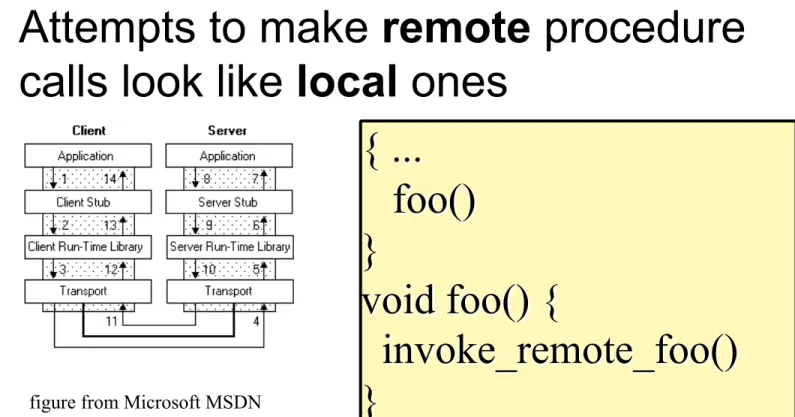
Attempts to make
remote
procedure
calls look like
local
ones
figure from Microsoft MSDN
{ ...
foo()
}
void foo() {
invoke_remote_foo()
}
Go Example
•
Need some setup in advance of this but…
// Synchronous call
args := &server.Args{7,8} var reply int
err = client.Call("Arith.Multiply", args, &reply) if err != nil {
log.Fatal("arith error:", err) }
fmt.Printf("Arith: %d*%d=%d", args.A, args.B, reply)
RPC Goals
•
Ease of programming
•
Hide complexity
•
Automates task of implementing distributed
computation
•
Familiar model for programmers (just make a
function call)
Historical note: Seems obvious in retrospect, but RPC was only invented in the ‘80s. See Birrell & Nelson, “Implementing Remote Procedure Call” ... or
Remote procedure call
•
A remote procedure call makes a call to a remote
service look like a local call
• RPC makes transparent whether server is local or remote
• RPC allows applications to become distributed transparently
• RPC makes architecture of remote machine transparent
• E.g., x86, ARM, big-endian, little-endian..
Emphasis on transparency
Remote procedure call
•
A remote procedure call makes a call to a remote
service look like a local call
• RPC makes transparent whether server is local or remote
• RPC allows applications to become distributed transparently
• RPC makes architecture of remote machine transparent
• E.g., x86, ARM, big-endian, little-endian..
Emphasis on transparency
What are some problems with this transparency?
RPC: it’s not always simple
•
Calling and called procedures run on different
machines, with different address spaces
• And perhaps different environments .. or operating systems ..
•
Must convert to local representation of data
•
Failures: Machines and network can fail
•
Performance of the RPC call is enormously
Two styles of RPC implementation
•
Shallow integration
. Must use lots of library calls
to set things up:
• How to format data
• Registering which functions are available and how they are invoked.
•
Deep integration.
• Data formatting done based on type declarations • (Almost) all public methods of object are registered.
•
Go has deep RPC integration with the PL
Stubs: obtaining transparency
•
Compiler generates stubs from API for a
procedure on the client and server
•
Client stub
• Marshals arguments into machine-independent format • Sends request to server
• Waits for response
• Unmarshals result and returns to caller
•
Server stub
• Unmarshals arguments and builds stack frame • Calls procedure
• Server stub marshals results and sends reply
Marshaling and Unmarshaling
•
(From example) hotnl() --
“
host to
network-byte-order, long
”
(in C)
• network-byte-order (big-endian) standardized to deal with cross-platform variance
•
(in prev. lecture) Note how we arbitrarily decided to
send the string by sending its length followed by L
bytes of the string? That’s marshaling, too.
•
Floating point...
•
Nested structures? (Design question for the RPC
system - do you support them?)
•
Complex data structures? (Some RPC systems let
you send lists and maps as first-order objects)
“
stubs
”
and IDLs
•
RPC stubs do the work of marshaling and
unmarshaling data
•
But how do they know how to do it?
•
Typically: Write a description of the function
signature using an IDL -- interface definition
language.
• Lots of these. Some look like C, some look like XML, ... details don’t matter much.
Remote Procedure Calls (1)
• A remote procedure call occurs in the following steps: 1. The client procedure calls the client stub in the normal
way.
2. The client stub builds a message and calls the local operating system.
3. The client’s OS sends the message to the remote OS. 4. The remote OS gives the message to the server stub. 5. The server stub unpacks the parameters and calls the
server. Continued …
Remote Procedure Calls (2)
•
A remote procedure call occurs in the following steps
(continued):
6.
The server does the work and returns the result to the
stub.
7.
The server stub packs it in a message and calls its
local OS.
8.
The server’s OS sends the message to the client’s
OS.
9.
The client’s OS gives the message to the client stub.
10.
The stub unpacks the result and returns to the client.
Passing Value Parameters (1)
•
The steps involved in doing a
remote computation through RPC.
Passing Value Parameters (1)
•
The steps involved in doing a
remote computation through RPC.
Passing Value Parameters (1)
•
The steps involved in doing a
remote computation through RPC.
Passing Value Parameters (1)
•
The steps involved in doing a
remote computation through RPC.
Passing Value Parameters (1)
•
The steps involved in doing a
remote computation through RPC.
Passing Value Parameters (1)
•
The steps involved in doing a
remote computation through RPC.
Passing Value Parameters (1)
•
The steps involved in doing a
remote computation through RPC.
Passing Reference Parameters
•
Replace with pass by copy/restore
•
Need to know size of data to copy
• Difficult in some programming languages
•
Solves the problem only partially
• What about data structures containing pointers? • Access to memory in general?
RPC land
•
RPC overview
•
RPC challenges
•
RPC other stuff
RPC vs. LPC
•
3 properties of distributed computing that make
achieving RPC transparency difficult:
• Partial failures • Latency
• Memory access
RPC failures
•
What could go wrong:
•
Request from cli
à
srv lost
•
Reply from srv
à
cli lost
•
Server crashes after receiving request
•
Before processing the request•
After processing the requestPartial failures
•
In local computing:
• if machine fails, application fails • (fate sharing!)
•
In distributed computing:
• if a machine fails, part of application fails
• cannot tell the difference between a machine failure and network failure
•
How to make partial failures transparent to client?
Strawman solution
•
Make remote behavior identical to local behavior:
• Every partial failure results in complete failure• You abort and reboot the whole system
• You wait patiently until system is repaired
•
Problems with this solution:
• Many catastrophic failures • Clients block for long periods• System might not be able to recover
• (Also, why do distribution in the first case if during failures the d. system acts like a non-d. system?)
Real solution: break transparency
•
Possible semantics for RPC:
• Exactly-once (what local procedure calls provide)
• Impossible in practice (side effects)
• At least once:
• Ideal for idempotent operations
• At most once
• Zero, don’t know, or once
• Zero or once
• Transactional semantics (databases!)
• Requires solving distributed atomic commitment (hard!)
Exactly-Once?
•
Sorry - no can do
in general
•
Side effects
•
Imagine that message triggers an external
physical thing (say, a drone delivers a burrito
to my home office)
•
The drone could crash immediately before or
after delivery and lose its state. Don’t know
whether the burrito was delivered or not.
Real solution: break transparency
•
At-least-once: Just keep retrying on client side until you get a response.•
Server just processes requests as normal, doesn’t rememberanything. Simple!
•
At-most-once: Server might get same request twice...•
Must re-send previous reply and not process request (implies: keep cache of handled requests/responses)•
Must be able to identify requests•
Strawman: remember all RPC IDs handled. -> Ugh! Requires infinite memory.•
Real: Keep sliding window of valid RPC IDs, have client number them sequentially.Implementation Concerns
•
As a general library, performance is often a big
concern for RPC systems
•
Major source of overhead: copies and
marshaling/unmarshaling overhead
•
Zero-copy tricks:
• Representation: Send on the wire in native format and indicate that format with a bit/byte beforehand. What does this do? Think about sending uint32 between two little-endian machines
Dealing with Environmental Differences
•
If my function does: read(foo, ...)
•
Can I make it look like it was really a local
procedure call??
•
Maybe!
• Distributed filesystem...
•
But what about address space?
• This is called distributed shared memory
• People have kind of given up on it - it turns out often better to admit that you’re doing things remotely
Summary:
expose remoteness to client
•
Expose RPC properties to client, since you cannot
hide them
•
Application writers have to decide how to deal
with partial failures
• Consider: E-commerce application vs. game
Important Lessons
• Procedure calls
• Simple way to pass control and data
• Elegant/transparent way to distribute application
• Not only way…
• Hard to provide true transparency
• Failures
• Performance
• Memory access
• Etc.
• How to deal with hard problem à give up and let programmer deal with them
• “Worse is better”
• https://en.wikipedia.org/wiki/Worse_is_better
RPC land
•
RPC overview
•
RPC challenges
•
RPC other stuff
Asynchronous RPC (1)
•
The interaction between client and
server in a traditional synchronous RPC.
Asynchronous RPC (2): making the call
•
The interaction using asynchronous RPC.
Asynchronous RPC (3): getting result
•
A client and server interacting through
two
asynchronous RPCs.
Using RPC
•
Request
à
Server
à
Response: Classic synchronous
RPC
•
Consider scenario1: Worker—notify—>Server.
• Synch RPC, but no return value.
• "I'm a worker and I'm listening for you on host XXX, port YYY."
•
Consider scenario2: Server—do work—>Worker.
• Synch RPC? No that would be a bad idea. Better be Asynch.
• Otherwise, it would have to block while worker does its work, which misses the whole point of having many workers.
Other RPC systems
• ONC RPC (a.k.a. Sun RPC). Fairly basic. Includes
encoding standard XDR + language for describing data formats.
• Java RMI (remote method invocation). Very elaborate. Tries to make it look like can perform arbitrary methods on remote objects.
• Thrift. Developed at Facebook. Now part of Apache Open Source. Supports multiple data encodings & transport
mechanisms. Works across multiple languages.
• Avro. Also Apache standard. Created as part of Hadoop project. Uses JSON. Not as elaborate as Thrift.