Going Agile – A Case Study
Dwayne Read
Software Process Consultant Strategic Systems [email protected] Grey Properjohn Systems Analyst Snowden Technologies [email protected] Abstract
This case study examines the approach undertaken by Snowden Technologies in adopting a range of agile techniques into their product and custom software solutions for the mining industry. The catalyst to adopt various agile techniques stemmed from the growth of the development team (30+) and the need to further integrate the development activities across multiple offices. This required a clearer and more consistent approach to the software development process.
Snowden Technologies involved the users (Developers, Project Managers, Team Leaders, Geologists, etc) upfront and proritised the project’s scope resulting in the selection of specific techniques from a range of agile methodologies (XP, FDD, Scrum, Crystal, DSDM, RAD/JAD). Implementation of the techniques paralleled various agile principles through the use of scoped releases, development iterations and feedback through regular reflections. The selected agile techniques (e.g. iterative development, Domain Object Models, code inspection, automated testing) were incorporated into a consistent software process with various “value add” techniques (e.g. CUT complete, code coverage, code analysis) that integrated with the development tools.
The key lessons learnt from the this approach were that to incrementally introduce agile techniques was very effective; embedding the process elements into the development tools helped to reinforce the techniques; and it proved that the agile techniques and PRINCE 2 for project management could be customised to collaborate into an effective solution. The latter required some compromises from the “pure” agile view such as to allow a project schedule to define all Work Packages (Iterations) at the start of each Stage (Releases).
1.
Keywords
Agile, methodology, software process, change management, project management, brain-storming, reflection, iterative development, JAD, Domain Object Model, architecture, code inspection, automated testing, Team Foundation Server, TFS, PRINCE 2.
2.
Background
Snowden Technologies is a division of the Snowden Group that provides global consultancy services and software solutions to the mining industry, and has a development capacity of over thirty developers located in Perth (head office), Brisbane and Johannesburg. The reliance on delivering quality software solutions to its clients has continued to increase over recent years to the point that being able to rapidly respond to the needs and unique/specific requirements of clients is a critical success factor to the business.
3.
Motivation to Go Agile
The driving force to initiate and implement the new agile techniques originated from expansion of Snowden’s development capacity which presented the necessity for a clearer defined and (multi) team oriented approach to its software development activities. Key areas identified by Snowden developers and managers that were targeted as part of this approach were:
1. Specification and scope definition
2. Estimation (essentially reducing the non-billable hours) 3. Minimising defects and instigating code quality reporting
4. Establishing standard and consistent practices across teams and offices 5. Improving system deployment and build processes
6. Providing feedback mechanisms (within and across teams) 7. Initiating mentoring programs (sharing skill sets)
The need to address these key software development areas were being compounded by the ongoing growth of the team (in a time of very competitive recruitment) and the need to improve the Project Management process. Four separate improvement projects had been identified by the business as focus areas, one of which was the Agile Project (the other three were Project Management (PRINCE 2), SPI (the Snowden Project Index reporting tool), and Team Foundation Server (TFS)). The intention was that the Agile Project would be able to address the majority of the identified key areas by selecting and tailoring the techniques from a range of industry proven agile methodologies. The techniques would define the "Snowden Technologies Agile" methodology, herein referred to as STAg.
4.
Approach
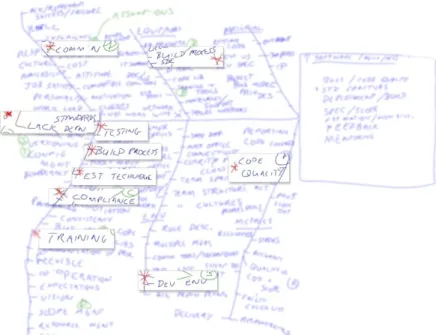
The starting point was a brainstorming session (based on the typical Cause-Effect diagram technique) conducted with all developers to examine the causes behind the identified problems. As a facilitated brainstorming session, all participants contributed their ideas, of which, 99 tentative causes were identified in the session. The "top 10" causes were then examined in more detail in terms of the impact, influence, cost, effort and duration.
From this, a prioritised list of the "top 10" was determined and the higher priority items became the basis of the selection of the agile techniques (from the likes of eXtreme Programming (XP) [1], Scrum [2], FDD [3], Crystal [4], DSDM [5] and even RAD/JAD [6]).
Project teams were formed for all four improvement projects, with the Agile and TFS project teams merging within the first month due to the overlap of process and tool. There was a total of four staff involved in the Agile Project (one lead ~50% to 80% of his time, and 3 "consulting" staff, one being an external agile consultant).
Consistency of concepts and terminology between the Agile Project and the Project Management/PRINCE 2 project was deemed important to ensure a clear message was communicated to all. As such, close and regular communication between the projects (with two individuals common to both) was ensured. As a result, the Agile Project used the PM/PRINCE 2 concept and terminology for "Stages" (Releases from XP [1]) and “Work Packages” (Iterations from XP).
Following the Agile principle [7] of "satisfy the customer through early and continuous delivery" (plus wanting to avoid any "big bang") the definition, templating and training of techniques were undertaken as (2-4 week) Work Packages (Iterations), with introduction of these techniques primarily undertaken through pilot projects. This was the vehicle to trial the selected techniques and mentor the handful of developers and team leads involved, who eventually would become "seeds" of this knowledge in the next project they worked on.
Some techniques (such as code inspection) were rolled out across all active developments using in-house workshops, where the immediate benefits were more obvious. Several in-house training sessions were also conducted to provide the developers with overviews of the "Best of Agile" techniques (including a customised version for Snowden’s other development offices), plus an overview of automated build and
test processes that formed part of the second stage of STAg
Following the agile principle [7] of "business people and developer must work together", working groups of 3-5 employees were used for various techniques to ensure that a suitable cross-section of inputs and ideas were brought together. There were working groups for the Code Inspection, Coding Standards and Estimation.
Focused feedback from the pilot project team members was sought, via
Figure 2: Stages and Work Packages Define the Fundamental Scope and Schedule Controls (other activities are derived from the PRINCE 2 Project Management methodology)
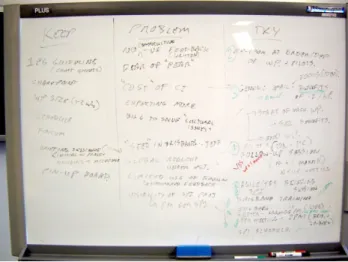
Figure 3: Reflection Sessions Proved Useful to Adjust the Direction and for Positive Reinforcement
Reflection workshops, on a monthly basis, with global feedback from all developers sought via the weekly Tec meeting with the Agile Project as an agenda item, and also through direct communications with the Agile Project team members. These feedback mechanisms were the start of establishing a continuous improvement philosophy.
5.
Process Flow
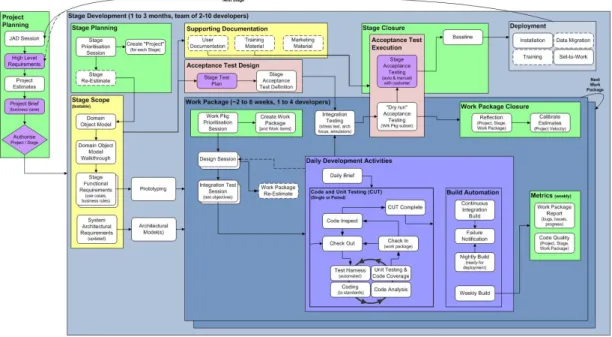
A "road-map" of the development process showing the relationship of the selected techniques was produced in the first Work Package for the project. This is seen as the equivalent of the "logical architecture" model and also captures the high level requirements of the proposed implemented methodology. This agile view, Figure 4, also served as a planning and progress "information radiator" (as per the Crystal methodology [4]), by highlighting the techniques that were being introduced for a given Stage of the Agile Project. Figure 4 shows the process road-map at the time of writing this paper. This includes a handful of techniques from the Project Management / PRINCE 2 process (e.g. High Level Requirements, Project Brief, Authorise Project/Stage, Stage Test Plan and Stage Acceptance Testing) which serves to give further context in the developers’ view.
The STAg methodology process road-map captures the complete suite of activities, which were prioritised and implemented, mostly via pilot projects incrementally. The implementation of each activity included the creation of “cheat sheet(s)” which are one page summaries of each technique(s) employed with examples of the output, and templates where applicable. The effectiveness of the activities introduced to date are listed below in the order of implementation.
Technique
Priority (Stage-Wrk Pkg)
Number of: Effectiveness
Notes Cheat
Sheets Templates Quality Mgnt
Daily Brief 1-2 1 - Medium High Ideal communication
Reflection 1-2 1 1 Medium High Good for feedback and
morale Code
Inspection
1-3 1 2 V. High Medium Immediate roll-out, progress indicator Code
Analysis
1-4 1 - High Low A high number of issues
initially
Check In 1-4 1 - Medium Low More of a “given”
Coding Standards
1-4 2 2 Medium Low To ensure consistency
Estimation 1-5 2 1 Medium High Project and Stage
estimates using Wideband Delphi CUT
Complete
1-6 1 1 High High Ensures Code Insp,
auto-test, code analysis, etc Test
Harness
2-1 1 1 V. High Medium Automated testing is seen as a must
6.
The People Side
The highest priority cause of development issues identified in the initial brainstorming session was "communication". Snowden’s main driver for establishing clear communication channels derived from the agile principle that the focus should be on "individuals and interactions over processes and tools" from the Agile Manifesto [7]. As such, two key aspects were focused on to improve the communication:
1. All developers, project managers and domain experts were involved throughout the Agile Project. This includes working groups, feedback sessions, training sessions, weekly Tec meetings and "Seeds" roles within project teams)
2. Agile techniques that actually facilitate (or at least prompt for) focused communications (e.g. JAD sessions, Work Package prioritisation, design sessions, code inspections, daily briefs and Domain Object Model walkthrough) were selected to form part of the STAg.
The implementation of this communication approach was conducted in the Stage One Work Package named "Communication", and its deliverables included rollout of the Daily Brief, Reflection meetings and Role Identification (including the "Seed" role). Outlining the project roles and their lines of communication through the Role Identification deliverable helped to reinforce each of the related activities.
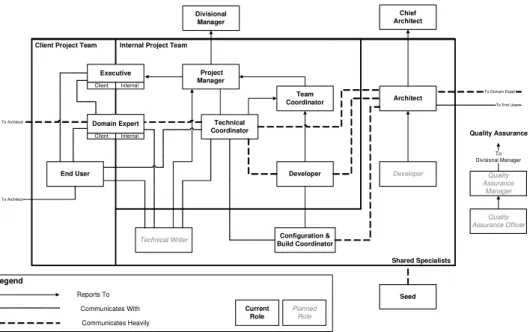
The established project roles and their relationships are shown in Figure 5, with the grayed/italic roles proposed for later adoption.
After the initial roll-out of the techniques, a focus group was established to help facilitate the introduction and mentoring of subsequent techniques across the three development sites. This group was named the Technical Operations Management Group or “TOM Group”
7.
Tools
Initially, there was a separate improvement project focused on the primary development tool set - Microsoft's Team Foundation Server (TFS). It soon became obvious that the process needed to be the primary focus and that the tools needed to support, automate and reinforce elements of this. As such, the two improvement projects were merged with the emphasis to integrate the applicable process elements into the tools. The following activities (from Figure 4) relate to the use of the tools in the context of the STAg methodology:
• Check In and Check Out • Test Harness (automated) -
TFS has an NUnit style automated test framework
• Code Analysis • Code Coverage • CUT Complete • Continuous Integration Build • Email Notification of Failure • Nightly Build • Weekly Build Project Manager Technical Coordinator Team Coordinator Developer
Technical Writer Configuration &
Build Coordinator Architect Chief Architect Developer Quality Assurance Manager Quality Assurance Officer Divisional Manager End User To Divisional Manager Shared Specialists Internal Project Team
Client Project Team
To End User Legend Current Role Reports To Communicates With Communicates Heavily To Architect To Architect To Domain Expert Planned Role Quality Assurance Domain Expert Client Internal Executive Client Internal Seed
Figure 5: Team Structure - Focused Roles/Responsibilities Helped to Reinforce the Activities
Figure 6: CUT Complete Implemented as an Extension to TFS
TFS provided Snowden the ability to modify incorporating and reinforcing the
and Unit Test) implemented in Stage One
tools with consistency in naming conventions, tailored training, etc to help reinforce the related activities.
8.
Lessons Learnt
In qualifying the lessons learnt for this paper, we have Reflection on both the approach
the STAg methodology. As such, the "Keep/Problem/Try" used to "reflect" on the lessons learnt:
8.1. Keep
8.1.1 Implementing Agile Techniques:
• Involvement of all developers,
experts are a must.
• Focus on the gradual introduction of techniques 4 weeks duration) and pilot
• Establish a clear "road • Develop cheat sheets
example(s).
• Reflection sessions
• A clear (and simple) role definition to identify resourcing
8.1.2 Applied Agile Techniques:
• Code Inspection -and communication tool
quality of the code with minimal effort (we found an additional
maintenance defects in the first month).
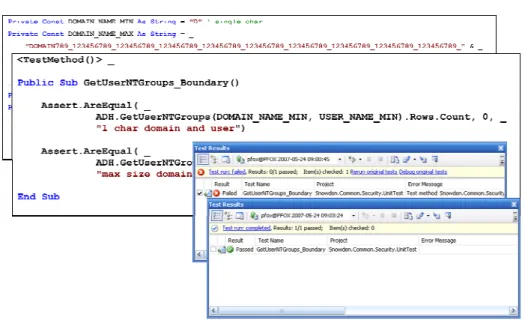
Figure 7: Automated Testing = TFS Test Harness + Naming
the ability to modify and extend its behavior, which proved ideal for incorporating and reinforcing the new STAg activities, especially the “CUT complete” (Code
implemented in Stage One. Other elements simply required the use of
tools with consistency in naming conventions, tailored training, etc to help reinforce the related
In qualifying the lessons learnt for this paper, we have effectively on both the approach taken and the selection of agile techniques
. As such, the "Keep/Problem/Try" (from Crystal used to "reflect" on the lessons learnt:
Agile Techniques:
Involvement of all developers, team leaders, project managers are a must.
radual introduction of techniques - utilising Work Packages ( ) and pilot projects.
lear "road-map" of the techniques - ideal information radiator
heat sheets - one page (A5) summary of each technique with
Reflection sessions - focused feedback every 4 to 6 weeks with key staff r (and simple) role definition to
resourcing short-falls.
Applied Agile Techniques:
- powerful peer review and communication tool, that improves the quality of the code with minimal effort (we found an additional 387 run-time and 664 maintenance defects in the first month).
: Automated Testing = TFS Test Harness + Naming Convention + TFS Result Window
Figure 8: Summary of Some of the Defects Found in Code Inspections
extend its behavior, which proved ideal for STAg activities, especially the “CUT complete” (Code ther elements simply required the use of in-built tools with consistency in naming conventions, tailored training, etc to help reinforce the related
effectively presented a and the selection of agile techniques employed in [4]) prompts are
project managers and domain
ork Packages (at
2-ideal information radiator. one page (A5) summary of each technique with
focused feedback every 4 to 6 weeks with key staff.
Convention + TFS Result Window
: Summary of Some of the Defects Found in Code Inspections
• Automated build and test - specs the code and provides the best form of regression testing.
• Daily briefs – a vehicle for good communication!
• Work Packages - frequent closure on subset of scope - good for team morale. • Static Code Analysis – an integrated tool and process providing easy
identification of code problems.
• Reflection sessions - positive reinforcement and adjustments where required.
• CUT complete - tool integration and definitive statement of quality and progress.
8.2. Problems (with some explanation)
• Communication and Scope Definition – The implementation of the first Work Package was delayed due to a misunderstanding of the business’ expectations of the deliverables by the project team.
A couple of elements caused this situation:
a. There was no formal briefing or introduction to the projects’ expectations and objectives within the team (there was no real "ownership” or “big picture” view of the project);
b. The project team did not have a clear understanding of the scope of their deliverables to be able to communicate effectively amongst each other and with other developers in the business.
This was resolved initially in the first Reflection session by showing concrete examples of what was required to be produced (templates, cheat sheets, etc) and by providing positive feedback on the direction. Getting closure on the first work packages from each project (which delivered the "road-map") was also an effective reinforcement of the intended approach. It still took an another 2-3 weeks before the idea that the group was to actually define the scope of their projects (drawing from industry techniques and methodologies) - but when they did then the true "ownership" began.
• Information radiators – The use of Microsoft SharePoint and pin-up boards as information radiators were not as effective as we hoped. They are still useful, but the regular Tec meetings are by far the most effective forum to share the information and seek feedback. In addition, reflection sessions complimented this well. Ultimately, "face-to-face”, albeit involving video-conferencing, is the best.
• Other offices – The understanding and up-take of techniques in Snowden’s other
development offices were initially limited. Having only two developers involved in teleconferencing sessions and video recordings of in-house training is now seen as inadequate. One senior developer was involved in pilots, yet due to location was isolated when the sharing of knowledge was paramount. If the "seeds" had been identified and available for mentoring "face-to-face" the techniques would have rolled across offices easier.
• Alignment with management practices and tools - The evolutionary development style of iterative development (Work Packages being scoped and planned every 2-3 weeks) was a difficult one for the Project Management planning view to handle. A compromise was developed that required the Work Packages to be identified at the start of the Stage for planning purposes (although this is not considered agile). The (re)prioritization of the later Work Packages would occur to still give the opportunity to ensure the focus is on the highest risk and most important set of features for the next Work Package.
There is concern that the initial Work Package allocation will bias the subsequent prioritization session and therefore lose some of the benefit of this approach (but at least the highest priority elements will still be in the initial Work Packages at the start of the Stage). There was also the alignment with the in-house project management system (SPI) and accounting systems through the integration of reporting requirements and mapping of Stages and Work Packages to a relatively restrictive (and fixed) structure.
8.3. Try
• Create a defined set of objectives for any improvement program (at a Stage level)
• Establish more working groups – although a trade off, and we see it still needs to be
selective, but we should (and will) have more working groups to define and refine particular techniques. This was done for the Coding Standards, Code Inspection and Estimation activities and worked well by getting a variety of inputs and ownership.
• Ensure the "Seeds" are more involved in the working groups as they need to "own"
and represent the techniques moving forward.
• Increase the communication and visibility to all developers on the progress and
direction of the techniques being implemented.
• Establish a continuous improvement environment - this is more an ethos and
openness to improve the way we work, but so long as we maintain the Reflection session (and follow through on the agreed actions) then this should be sustainable.
• An exchange program between the team members. There were a few visits by staff from other offices which facilitated a much deeper exchange of knowledge and techniques as well as building up a stronger relationship.
9.
Summary
Overall, the approach used so far in tailoring and introducing a selection of agile techniques has worked well. The most fundamental lesson learnt has been to involve as many of the “users” (developers, team leaders, etc) as possible throughout the entire improvement project. It's also been critical that it is done in small, digestible slices (i.e. Iterations / Work Packages) and to seek and give feedback all the way through.
Having the target areas for improvement provided a clearer view for the adoption of particular agile and value add techniques. We selected the techniques from a range of industry agile methodologies, some common, some fairly unique, but all of them to improve our target areas. What has been selected and tailored to date is working and working well. Testimony to this is the very successful delivery of the single and multi-team projects that piloted the initial techniques:
“… it was a very successful trip… big smile on his face and feeling very proud… [the projects] were within 5% of the budget – both delivered on time!”
Rayleen Riske, Project Manager and Geologist The STAg diagram is a key information radiator providing an ongoing reference point for the context of our development activities on a given project as well as identification of further improvements we wish to incorporate.
The realization that the integration and alignment of our agile software development methodology with the project management methodology and development tools was important as the three perspectives need to complement each other.
Not only have we established a "continuous improvement" mindset, but we have reinforced this through explicitly embedding feedback mechanisms throughout the STAg methodology itself.
10.
Acknowledgements
The author’s would like to acknowledge the contributions of the following colleagues that have been and continue to be involved in the Agile Project (in alphabetical order):
Jeffrey Alexander Paul Fox Peter Gibbes Chris Gilbert Mark Holst Rayleen Riske
and all the developers, team leaders and project managers that have been involved.
11.
References
[1] K. Beck, eXtreme Programming Explained – Embrace Change, 2nd Ed., Addison Wesley, 2004 [2] Advanced Development Methods Inc., “Controlled Chaos: Living on the Edge”, 1996
[3] S. Palmer, and J. Felsing, A Practical Guide to Feature-Driven Development, Prentice Hall, 2002 [4] A. Cockburn, Crystal Clear: A Human-Powered Methodology for Small Teams, Addison Wesley, 2004 [5] DSDM Consortium and J. Stapleton, DSDM: Business Focused Development, 2nd Ed., Addison Wesley, 2003 [6] J. Wood and D. Silver, Joint Application Development, Wiley, 1995