INTRODUCTION
A stranding is an event when an individual or group of marine mammals washes ashore dead or live strands on a beach or in shallow water, unable to return to the water without assistance (Geraci &
Lounsbury 2005). Each stranding and mortality event is a valuable scientific opportunity to gain knowl-edge and understanding regarding both individuals and populations (Perrin & Geraci 2002). Even a decomposing carcass on a beach may still provide important information regarding an individual’s life
© Inter-Research 2017 · www.int-res.com *Corresponding author: [email protected]
REVIEW
Database documentation of marine mammal
stranding and mortality: current status review
and future prospects
Derek K. P. Chan
1, Henry C. L. Tsui
2, Brian C. W. Kot
1, 3,*
1School of Medical and Health Sciences, Tung Wah College, Homantin, Kowloon, Hong Kong, SAR 2Office of the Vice-President (Development and External Relations), City University of Hong Kong, Kowloon,Hong Kong, SAR
3Department of Applied Biology and Chemical Technology, The Hong Kong Polytechnic University, Hunghom, Kowloon, Hong Kong, SAR
ABSTRACT: Databases are systematic tools to archive and manage information related to marine mammal stranding and mortality events. Stranding response networks, governmental authorities and non-governmental organizations have established regional or national stranding networks and have developed unique standard stranding response and necropsy protocols to document and track stranded marine mammal demographics, signalment and health data. The objectives of this study were to (1) describe and review the current status of marine mammal stranding and mortal-ity databases worldwide, including the year established, types of database and their goals; and (2) summarize the geographic range included in the database, the number of cases recorded, acces-sibility, filter and display methods. Peer-reviewed literature was searched, focussing on published databases of live and dead marine mammal strandings and mortality and information released from stranding response organizations (i.e. online updates, journal articles and annual stranding reports). Databases that were not published in the primary literature or recognized by government agencies were excluded. Based on these criteria, 10 marine mammal stranding and mortality data-bases were identified, and strandings and necropsy data found in these datadata-bases were evaluated. We discuss the results, limitations and future prospects of database development. Future prospects include the development and application of virtopsy, a new necropsy investigation tool. A central-ized web-accessed database of all available postmortem multimedia from stranded marine mam-mals may eventually support marine conservation and policy decisions, which will allow the use of marine animals as sentinels of ecosystem health, working towards a ‘One Ocean−One Health’ ideal.
KEY WORDS: Cetacean · Monitoring system · Inventory · Stranding network · Stranding response programme
history, genetics, predators, contaminants and feed-ing ecology through necropsy. Strandfeed-ings occur worldwide, and when the expertise and resources are available, interventions with live strandings and necropsies of euthanized or dead animals provide information to biologists, veterinarians and resource managers through the use of statistics and in-depth analysis of parameters, such as seasonal distribution, life history, population health, contaminant levels and prevalence of disease.
A stranding and mortality database conceptually works as (1) an information repository, like a spread-sheet recording large volumes of stranding and necropsy parameters; (2) a tool that displays data in tables and forms as defined by structured query lan-guage in relational database management systems; and (3) a search tool for trend analysis or particular questions of interest. Stranding and mortality data-bases are no longer limited to a desktop/standalone database physical format and are mostly developed into an online system, which can be web-accessed any time. To perform a systematic analysis of stranded marine mammal data, a managed and presented system is indispensable.
The purposes of a multimedia platform are to (1) standardize data entry of marine mammal health
findings across species and within geographic re
-gions; (2) combine diverse data sources, including stranding response, entanglement response, live cap-ture-release or research investigations; (3) allow the analysis of health and disease trends to support the public and resource managers in recognizing poten-tial public health hazards; and (4) enable quick com-munication of health data, combined with environ-mental data and additional disease information from terrestrial wildlife (Simeone et al. 2015). Ocean health may be declining as indicated by increases in the reporting of mortality and morbidity in marine mammals worldwide (Gulland & Hall 2007, Bossart 2011). The recognition of the ocean’s importance and the inextricable links between the health of people and the health of animals and ecosystems has led to the ‘One Ocean−One Health’ research paradigm (Schwacke et al. 2013).
Despite some literature regarding individual strand -ing and mortality databases worldwide, to date, we lack a thorough review of the currently available marine mammal stranding and mortality databases. There is a need to integrate currently available mar-ine mammal stranding datasets in order to under-stand larger trends and how these datasets have been stored in databases. This article is divided into 2 sections. The first section is a systematic review and
summary of existing databases relating to the storage of records for both live and dead strandings. The sec-ond section is a discussion on results, limitations and future prospects of database development.
REVIEW OF EXISTING MARINE MAMMAL STRANDING AND MORTALITY DATABASES Several public databases including Google Scholar, PubMed, Medline, ResearchGate, Academia and ScienceDirect were queried for terms related to the documentation system (i.e. database, inventory, re -pository, platform, monitoring and data exchange system), as well as necropsy findings of both live and dead marine mammal strandings (i.e. marine
mam-mal/cetacean/pinniped strandings, mortalities, un
-usual mortality events, diseases, illnesses, pathologies and health data). Marine mammals, including all cetaceans, pinnipeds, sirenians, sea otters and polar bears, were included. English printed peer-reviewed journal articles, proceedings and official reports from conferences, workshops, symposia and authorized institutions and governments that developed data-bases related to marine mammal strandings and mor-tality were selected. Databases that were not pub-lished in the primary literature or recognized by government agencies were excluded, due to diffi-culty with verification and limited credibility. Only strandings and necropsy data recorded in identified databases were evaluated.
In principle, stranding and mortality databases can be categorized into 2 types. One is the
custom-designed relational database (Type 1), solely de
-signed to be managed by information technology personnel for the collection, categorization and illus-tration of marine mammal data. The other type of database is the use of existing software packages with specific customization to cluster marine mam-mal data (Type 2). Various biological recording soft-ware packages were commercially available, which offered standards-based means for compilation and collation of biological recordings.
The content review for each independent database is divided into 2 parts. First, an overview of the data-base is provided, data-based on the written description from published reports, journals, leaflets and the offi-cial websites. Data collected included the name of the database, year of establishment, type of database and the organization responsible for database opera-tion. Second, the databases are described based on their geographic range for stranding response, acces-sibility, filter and display method. Additional
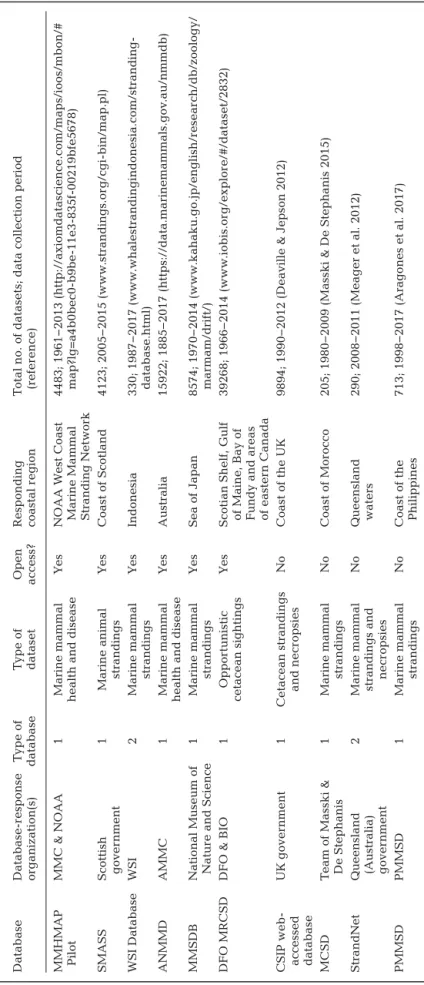
infor-mation regarding the total number of datasets and data collection period is summarized in Table 1. A summary of goals of the listed databases is provided in Table 2.
RESULTS
We reviewed 6 publicly accessi-ble and 4 non-publicly accessiaccessi-ble databases for marine mammal strandings (Table 1). The listed databases had a more intense geo-graphic coverage in well-devel-oped regions compared to under-developed regions. A higher degree of cooperation between the stranding networks also con-tributed to a larger geographic coverage of data collection. In
most of the well-developed re
gions and countries, stranding re -sponse organizations and net-works have been developed over 3 to 4 decades with a general aim to obtain information, which
facili-tates further diagnostics and re
-search and contributes to eco
-logical un derstanding of a local
stranding event. This distinct aim was also presented as a goal for most of the databases.
Marine Mammal Health Monitoring and Analysis Platform (MMHMAP) pilot The US MMHMAP was a 3 yr pilot project developed by the National Oceanic and Atmosphe
-ric Administration’s (NOAA) Na
-tional Marine Fisheries Service (NMFS), Marine Mammal Com-mission (MMC), The Marine Mammal Center (MMC) and the National Marine Mammal Foun-dation (NMMF). Many additional groups have collaborated on the project, including the Integrated Ocean Observing System (IOOS)
and the National Wildlife Health Database
Database-r e sponse T ype of T ype of Open Responding T otal n
o. of datasets; data collection period
or ganization(s) database dataset access? coastal r egion (r efer ence) MMHMAP MMC & NOAA 1 Marine mammal Y e s NOAA W e st Coast 4483; 1961−2013 (http: //axiomdatascience. com/ maps/ ioos/ mbon/ # Pilot
health and disease
Marine Mammal map ?lg=a4b0bec0-b9be-11e3-835f-00219bfe5678) Stranding Network SMASS Scottish 1 Marine animal Y e s Coast of Scotland 4123; 2005−2015 (www .strandings.or g/cgi-bin/map.pl) gover nment strandings WSI Database WSI 2 Marine mammal Y e s Indonesia 330; 1987−2017 (www strandings database.html) ANMMD AMMC 1 Marine mammal Y e s Australia 15 922; 1885−2017 (https://data.marinemammals.gov .au/nmmdb)
health and disease MMSDB
National Museum of 1 Marine mammal Y e s Sea of Japan 8574; 1970−2 014 (www .kahaku.go.jp/english/r esear ch/db/zoology/ Natur e and Science strandings mar m am/drift/) DFO MRCSD
DFO & BIO
1 Oppor tunistic Y e s
Scotian Shelf, Gulf
39268; 19 66−2014 (www .iobis.or g/explor e/#/dataset/2832) cetacean sightings of Main e, Bay of Fundy and ar eas of easter n Canada CSIP UK gover nment 1 Cetacean strandings No Coast of the UK 9894; 1990−
2012 (Deaville & Jepson 2012)
accessed and necr opsies database MCSD T
eam of Masski &
1 Marine mammal No Coast of Mor o cco 205; 1980−2
009 (Masski & De Stephanis 2015)
De Stephanis strandings StrandNet Queensland 2 Marine mammal No Queensland 290; 2008−2011 (Meager et al. 2012) (Australia) strandings and waters gover nment necr opsies PMMSD PMMSD 1 Marine mammal No Coast of the 71 3; 1998−2017 (Aragones et al. 2017) strandings Ph ilippines T able 1. Summar y of the cur
rent status of marine mammal stranding and mor
tality databases. T
ype 1 databases ar
e custom-designed
; T
ype 2 databases use existing
com-mer
cial packages. MMHMAP: Marine Mammal Health Monitoring and Analysis Platfor
m; MMC: Marine Mammal Center; NOAA: National Ocea
nic and Atmospheric
Ad-ministration; SMASS: Scottish Marine Animal Stranding Scheme; WSI: Whale Stranding Indonesia; ANMMD: Australian National Marine
Mammal Database; AMMC:
Aus-tralian Marine Mammal Centr
e; MMSDB: Marine Mammals Stranding DataBase; DFO: Fisheries and Oceans Canada; MRCSD: Maritimes Regi
on Cetacean Sightings
Database; BIO: Bedfor
d Institute of Oceanography; CSIP: Cetacean Strandings Investigation Pr
ogramme; MCSD: Mor
o
ccan Coast Stran
dings Database; PMMSD:
Database
Goals of database
MMHMAP
(1) Develop a marine mammal health monitoring and analysis platfor
m with consistent and standar
dized fields an
d ter
minology by collaborating
Pilot
with potential data pr
oviders
(2) Pr
omote collaborations and ensur
e the availability of marine mammal health data to r
e
sear
chers
, scientists, managers and the public
(3) Cor
re
late marine mammal health tr
ends with biological, chemical and physical envir
onmental par
ameters
SMASS
(1) Pr
ovide a systematic and coor
dinated appr
oach to the sur
veillance of Scotland’
s marine species
(2) Collate, analyse and r
epor
t data of all stranded cetaceans, seals, marine tur
tles and basking
sharks on the Scottish coastline
(3) Per
for
m investigation of stranded marine animals that can yield solid infor
mation on the healt
h and ecology of these species and highlight
possible conser
vation issues they may face
ANMMD
(1) Pr
ovide a summar
y
of the biology of marine mammals to the Australian public
(2) Assist data-driven management and conser
vation planning
(3) Collate, pr
otect and ar
chive marine mammal health and disease data
(4) Suppor
t with cetacean sighting, entanglements, ship strikes and strandings
(5) Pr
omote the collaboration, analysis and r
epor
ting among ocean r
e
sear
chers and marine exper
ts i n Australia DFO MRCSD (1) Impor t sightings r e cor d s fr om dif fer ent sour
ces including whale watchers, r
e
sear
chers, fisher
men and the at
-sea obser
ver pr
ogramme
(2) Accommodate infor
mation on lar
ge marine animals such as sea tur
tles and basking sharks
(3) Evaluate the impact of human interaction (4) Study the migration, distributions and feeding habits of cetaceans CSIP
(1) Collate, analyse and r
epor
t data for all cetacean strandings ar
ound the coast of the UK
accessed
(2) Examine the cause of death in stranded cetaceans, including by-catch and physical trauma
database
(3) Per
for
m sur
veillance on the incidence of disease in stranded cetaceans and identify any substantial new
thr
eats to their conser
vation status
(4) Pr
eser
ve a national cetacean tissue collection
MCSD
(1) Describe 16 species stranding along the Mor
o
ccan coast
(2) Examine the r
e
lative impor
tance and potential distribution of cetaceans
(3) Study their possible interactions with human activities (4) Impr
ove the collaboration between Mor
o
ccan institutions and raise awar
eness in the Mor
o ccan pu blic of envir onmental issues StrandNet (1) Summarize all r e cor d s of sick, injur
ed, dying and dead marine cetaceans, pinnipeds, dugongs and tur
tle
s in the coastal ar
ea of Queensland,
Australia
(2) Assess causes of injur
y
and death, especially fr
om anthr
opogenic ef
fects, to dif
fer
ent species
(3) Indicate the overall tr
ends in number
, species composition and distribution of strandings, inc
luding other species of marine animals such as
sharks, rays and seabir
d
s
PMMSD
(1) Collate all data on stranding events nationwide
(2) Examine the species composition, temporal variation (i.e. fr
equency of stranding per year and
seasonality), spatial variation (i.e. fr
equency of
stranding per r
egion and pr
ovince), pr
opor
tions of live or dead specimens and the stranding hotspots for dif
fer
ent aspects of m
arine mammal
strandings in the Philippines
T
able 2. Summar
y
of the goals of the investigated marine mammal stranding and mor
tality databases. MMHMAP: Marine Mammal Health
Monitoring and Analysis
Platfor
m; SMASS: Scottish Marine Animal Stranding Scheme; ANMMD: Australian National Marine Mammal Database; DFO: Fisheries and
Oceans Canada; MRCSD:
Maritimes Region Cetacean Sightings Database; CSIP: Cetacean Strandings Investigation Pr
ogramme; MCSD: Mor
o
ccan Coast Stranding
s Database; PMMSD:
Center (NWHC), as well as a variety of non-govern-mental organizations (NGOs), academics and state agencies (MMC & NOAA Fisheries 2015). This cus-tom-designed relational database is operated by the IOOS and can be accessed via the IOOS portal (http:// axiomdatascience. com/ maps/ ioos/ mbon/ # map ? lg = a 4 b 0 bec 0-b 9 be-11 e 3-835 f-00219 bfe 5678).
Prior to developing a national MMHMAP database, a pilot project was created to integrate data from the California stranding network organizations (Simeone et al. 2014). Cases of dead strandings were inserted into MMHMAP, and each was assigned into a health category. Health categories were then as signed based on their reported cause of death (COD), including infectious disease, biotoxin, trauma, neoplasia, mal-nutrition, other or unknown (Table 2). Development is currently underway to expand the MMHMAP nationally.
Scottish Marine Animal Stranding Scheme (SMASS)
SMASS is a custom-designed relational database that has been operating since 1992. This project is funded by the Scottish and UK governments, which jointly contribute to the Cetacean Strandings Investi-gation Programme (CSIP). Numerous institutions have also contributed, such as the Moredun Founda-tion, National Museums Scotland, University of Chester and Animal and Plant Health Agency. Post-mortem findings and cause of death are classified into 1 of 15 categories, such as generalized debili tation, infectious disease, physical trauma and starvation/ hypothermia. By using the spatial map of strandings (www. strandings. org/cgi-bin/map.pl), the stranding location of a case filtered by date, species and COD is clearly illustrated on Google Earth. Limited requested data (2000 cases) can be displayed at a time. With the use of SMASS, a density plot can be calculated and visualized from areas of high stranding reports in Scotland.
Whale Stranding Indonesia (WSI) database
WSI is the first online stranding database in In
-donesia, operating since 2013 (Mustika et al. 2016). Any cetacean and sirenian strandings in Indonesia are recorded by WSI. This online database does not belong to an NGO or governmental authority but is administered collaboratively with the Indonesian government. The mission of WSI is to compile,
ana-lyse and present marine mammal stranding events in Indonesia in a systematic and user-friendly manner. Currently, WSI is managed and maintained by Ceta -cean Sirenian Indonesia (Cetasi) and uses a commer-cial existing package, Knack, for storage of the mar-ine mammal stranding data in Indonesia (www. whalestrandingindonesia. com/ stranding-database. html). WSI uses simple tables, charts and maps to represent the details and locations of the disclosed stranding data.
Australian National Marine Mammal Database (ANMMD)
ANMMD is a custom-designed relational database developed by the Australian Marine Mammal Centre (AMMC) in 2010 (original name: Western Australian Whale and Cetacean Sightings database). Strandings found in 7 states including New South Wales, Victo-ria, Queensland, Northern Territory, South Australian,
Tasmania and Western Australia, are re ported to
ANMMD. The majority of stranding and necropsy information is provided by AMMC, International Whaling Commission (IWC) and Department of Pri-mary Industries, Parks, Water and Environment (DPIPWE). The public can access this data base via
the ANMMD portal (https:// data. marine mammals.
gov. au/ nmmdb). With grids, maps and tables, the spatial location, the top 6 species and their corre-sponding ne cropsy information are clearly displayed. Such an integrated, multi-disciplinary, cross-jurisdic-tional research framework allows high quality sci-ence to support management and policy making by the Australian government and marine-user stake-holder groups.
Marine Mammals Stranding DataBase (MMSDB) MMSDB, a custom-designed database, was estab-lished by the National Museum of Nature and Sci-ence, Tokyo, Japan (www.kahaku.go.jp/index.php), and jointly compiled with the Institute of Cetacean Research (ICR) and the Shimonoseki Academy of Marine Science (SAMS). It is used to document the distribution, population structure and movements of over 60 species of marine mammals from the coasts of Japanese waters. This online database (www. kahaku. go. jp/ english/ research/ db/ zoology/ marmam/ drift/) summarizes necropsy findings based on biotic infor-mation (e.g. species, sex, identification number and body length) and discovery data (e.g. date found,
prefecture, geographical region and spatial informa-tion), and displays the information in tabular form instead of a mapping system. In addition to basic ani-mal data, health assays are also included in the datasets, such as analyses of morphometrics, blood-work, histology and tissue contaminant levels.
Fisheries and Oceans Canada (DFO) Maritimes Region Cetacean Sightings Database (MRCSD) DFO MRCSD is a national database to collect opportunistic sighting data on large marine animals, especially for species at risk in Canadian coastal regions. Opportunistic sightings represent marine mammal incidents reported by any observer to a re -sponsible body (i.e. DFO or marine mammal re sponse
network). Multiple marine mammal re sponse
net-works operate throughout Atlantic Canada. Stranded cetacean data in the Maritimes from 1990− 2009 have been integrated (Hooker et al. 1997, Nemiroff et al. 2010). Diverse stranding networks contribute to this national database (Harris 2015). MRCSD is a custom-designed database operating in the Ocean Biogeo-graphic Information System (OBIS) Canada, and is managed by DFO and the Bedford Institute of Oceano -graphy (BIO). The design and structure of this data-base are consistent with other DFO datadata-bases and the University of Rhode Island (USA) whale sightings database.
Opportunistic sightings of over 50 species have been recorded in the MRCSD (www. iobis. org/ explore/ #/ dataset/ 2832). The vast majority originate from the Scotian Shelf, Gulf of Maine, Bay of Fundy and other areas along the east coast of Canada. The Whale Sighting Database contains data from opportunistic sightings of live animals reported by the public and whale watching companies, and observer reports from commercial fishing, as well as records of strand-ings, floating carcasses and fishing gear interactions (Themelis et al. 2016). This open database displays the collected data in OBIS maps, tables and charts. This mapping system allows the visualization of the density of reports, while histograms enable under-standing of entire trends in opportunistic sighting data.
Cetacean Strandings Investigation Programme (CSIP) web-accessed database
Funded by the UK government, the CSIP web-accessed database was established in 2008 and fully
integrates data on both stranding and necropsy infor-mation in the UK (http://ukstrandings.org/). Operat-ing since 1990, CSIP has been responsible for coordi-nating data on stranding and death investigation of all cetaceans, marine turtles and basking sharks in UK waters. This custom-designed project is currently under the management of the Institute of Zoology, Zoological Society of London (ZSL). All information on stranding and mortality events are summarized and included in the CSIP annual report (http:// ukstrandings. org/ csip-reports/).
To better integrate the data collected in adjacent waters, CSIP has also contributed to the UK’s pro-gramme of research in the North Sea and the Agree-ment on the Conservation of Small Cetaceans of the Baltic, North East Atlantic, Irish and North Seas (ASCOBANS) regions. A small project under ASCOBANS is to create a centralized web-accessed database in Europe. This web-accessed database
was proposed at the 19thASCOBANS Advisory
Com-mittee Meeting held in 2012. Deaville & Jepson (2012) noted near unanimous approval for the con-cept of a centralized web-accessed database, which will be used to integrate and collaborate on the col-lected data provided by 9 countries (Belgium, Den-mark, France, Spain, Germany, Ireland, Netherlands, Portugal and UK) with 9 stranding networks (Marine Animals Research and Intervention Network, Miljø ministeriet Naturstyrelsen, Pelagis Obser vatory, Co -ordinadora para o Estudio dos Mamíferos Mariños, Schleswig-Holstein regional network, Irish Whale and Dolphin Group, Naturalis, Portuguese Wildlife Society and CSIP). It is anticipated that at least 41 380 cetacean stranding cases, in which over 7000 animals were necropsied, will be included in the database. It is believed this centralized database will act as a cen-tralized repository for selected data from strandings and necropsy by national stranding networks, and serve as a successful analytic tool in ASCOBANS regions.
Moroccan Coast Strandings Database (MCSD) MCSD was constructed by Masski & De Stephanis (2015), with collaboration by the Institut National De Recherche Halieutique (INRH) and Department of Fisheries, National Fisheries Board, Morocco (DFNFB). The MCSD collated cetacean stranding data along the
Moroccan coast. This non-publicly accessible data
-base presents stranding datasets using maps, circular charts and geographic distribution to assist data analysis and statistics. The establishment of this
ob-servation network has collated robust data and al-lowed structured monitoring of cetacean stranding and population densities in Morocco.
StrandNet
StrandNet is a commercial package of the Oracle database managed by the Department of Environ-ment and Heritage Protection and Queensland gov-ernment, Australia, since 2012. It collaborates with the Department of National Parks, Recreation, Sport and Racing, the Great Barrier Marine Park Author-ity and the Department of Agriculture, Fisheries and Forestry. All necropsy and stranding reports since 1999 have been imported into StrandNet (https:// www. derm. qld. gov. au/ strandnet/ application/ public/ security/ logon. xhtml). This internal online database is not open to the public. Information on stranding
and mortality events has been integrated and in
-cluded in marine wildlife stranding annual reports (https:// www. ehp. qld. gov. au/wildlife/caring-for-wildlife/ strandnet-reports. html). StrandNet displays
data using tables and maps of geographical dis
-tribution, allowing systematic analysis of species com position and distribution.
Philippines Marine Mammal Stranding Network (PMMSN) database
PMMSN responds to stranding and unusual mor-tality events in the coastal regions of the Philippines. In 2008, a 12 yr database (PMMSND) covering the period 1998 to 2009 was created, recording a total of 178 stranding events comprising 163 single and 10 mass stranding events (Aragones et al. 2010). Cur-rently, this custom-designed database is operated and maintained by the University of the Philippines, which is located in Quezon Province. Various partner institutions contribute to PMMSND, including the Department of Agriculture, Republic of the Philip-pines, Wildlife In Need and Ocean Adventure.
This non-publicly accessible database records stranding events and summarizes necropsy data from stranded marine mammals in Philippine waters. Geo-graphical distribution is recorded using hot spots on maps and in tables, allowing analysis of strandings. By changing the map filter, an analysis of stranding data can be presented in terms of trends in seasonal-ity, stranding distribution and stranding density. Recognition of the top 5 regions and species compo-sition can also be demonstrated. Collating stranding
data on a national level is remarkable, and has enhanced and developed response capabilities for strandings and the related rehabilitation programme for live stranded marine mammals.
DISCUSSION
Diverse databases for the documentation and man-agement of marine mammal stranding and mortality events have been established and continue to be developed and advanced. Although a standardized method for the documentation of postmortem infor-mation, data entry and data retrieval (i.e. the param-eters of preliminary data and necropsied data) is still lacking, various stranding networks are progres-sively working together, sharing their datasets and establishing collaborative work between regional experts. These repository systems are anticipated to continuously improve, with better and more system-atic data displays (i.e. online mapping interfaces), which can be used in conjunction with statistical analysis for meta-analyses of marine mammal health trends and stranding locations, and most importantly, creating links between human health and the health of marine mammals and ecosystems.
Over the past 3 decades, databases have been de -veloped in regions of marine mammal strandings worldwide to advance the interests and needs of NGOs, research scientists and government agencies. Eight of the 10 databases evaluated herein are cus-tom-designed. This approach is believed to guaran-tee the simplicity and expandability and reduce errors in data import and export, such as the MMHMAP pilot. A custom-designed system is usually more user friendly, since the design of functions and the ways to store and interpret data are not limited by the frame-work of the existing commercial system. The devel-opment cost for a new database and the maintenance charge vary, depending on the functionality, effi-ciency, stability and size of the custom-designed sys-tem. The remaining 2 evaluated databases made use of existing software packages with specific custom i -zation to cluster marine mammal data. These soft-ware packages ensure the standardized collection of death records and smooth integration of records into larger databases. Examples of commercial packages are Marine Recorder (exeGesIS Spatial Data Man-agement), Jeppesen PRIMAR ECDIS Service (Jeppe-sen Marine) and Knack (EvenlyOdd). Both database types enable structured documentation and develop-ment of an online mapping interface for the display of marine mammal data.
We found some potential limitations in the course of preparing this review. The most critical one is database accessibility. Although published papers and reports related to stranding records are avail-able, access to raw data for review would ensure the authenticity and update of this review. A second con-sideration is the extent of data sharing or openness. Most organizations reserve their right to revoke or restrict the public’s access to proprietary data. Here we assumed that stranding and health data were made available under the listed databases. Many of these databases involve multiple collaborators, which may hamper data sharing. A third limitation is the status of the database. It is important to note (1) that the databases are operational; (2) types of data re -corded in the database; (3) when a database started operating and how far back the recorded data go; (4) the date of the last update and display of updated cases; (5) the quality of the data (i.e. quality assur-ance and quality control regarding data uploading and verification of information). For example, the MMHMAP pilot has 4483 marine mammal cases from 1961 to 2013, and was operating as of 2015. However, cases have not been updated for public access since 2013 (Table 1). This delay can impede contemporaneous or real-time assessment of marine mammal stranding data.
In the past few decades, NOAA has acted as an excellent role model and collaborator between differ-ent stranding networks across the boundaries of countries to obtain the prospective data, and has used retrospective information from its own database for extensive studies on threatened marine mammal species, such as southern right whales Eubalaena australisin South America (Uhart et al. 2008, Figu -eiredo et al. 2017, Torres et al. 2017), Irrawaddy
dol-phins Orcaella brevirostris in South and Southeast
Asia (Jackson-Ricketts et al. 2016, Peter et al. 2016),
beluga whales Delphinapterus leucas(Hobbs et al.
2015, Bettridge et al. 2016) and bowhead whales Bal-aena mysticetus in the Arctic (Mocklin et al. 2015, Stafford et al. 2017). Another highlighted NOAA pro-gramme is the National Marine Laboratory’s Polar Ecosystems Program, which conducts studies and monitoring on pinnipeds, such ringed seals Phoca hispida and their endangered sub-species, Ladoga
ringed seals P. hispida ladogensisand Saimaa ringed
seals P. hispida saimensis in the Arctic, sub-Arctic
and Antarctic marine ecosystems (Quakenbush et al. 2011, NMFS 2012, 2014, 2016).
Studies on the demography, ecology, health and acoustic assessments of these threatened marine mammal species are essential to learn about
popula-tions and distribupopula-tions, and to determine appropriate conservation and policy making strategies. Collabo-ration and integCollabo-ration between stranding networks are urged, not only across regional boundaries, but also across multiple disciplines, agencies, institutions and even international boundaries, allowing unifica-tion of retrospective informaunifica-tion. This will allow measurement of marine mammal health trends and contribute a centralized web-accessed database. Such a complete ecosystem indicator may eventually support the conservation and policy decision for all oceans, leading to a ‘One Ocean−One Health’ para-digm using marine animals as sentinels of potential emerging hazards.
FUTURE PROSPECTS
Veterinary clinical and diagnostic sciences have experienced revolutionary changes in different fields (Thrall 2013, Miller & Fowler 2014). Apart from the recording of marine mammal health and conven-tional necropsy data, a variety of ancillary diagnostic examinations and their datasets have become an option to integrate with the existing databases, for example, photo identification of marine mammals, 3-dimensional photogrammetric analysis and advanced imaging on live, euthanized and freshly dead (code 2) animals. Conventional X-ray technology has been used on dead cetaceans (Brook 1994, Butti et al. 2007), and more advanced imaging modalities such as computed tomography (CT) and magnetic reso-nance imaging (MRI) have been increasingly used postmortem.
Virtopsy, using postmortem CT and postmortem MRI, provides a virtual alternative to the conven-tional autopsy for death investigations (Thali et al. 2003, Dirnhofer et al. 2006). It increases the accuracy in diagnosis of the COD in human adults (Roberts et al. 2012), and contributes findings that are not readily obtained during conventional autopsy (Thali et al. 2003). Kot et al. (2016) applied virtopsy to 160 stranded cetaceans in the waters of Hong Kong, Bohai Sea and the Yangtze River, augmenting conventional necropsy protocols. These volumetric image datasets provide invaluable initial or supplementary information of the COD in the stranded marine animals prior to a conventional necropsy. With the advantages of being observer-independent, non-subjective, non-invasive, digitally storable and transferable, thereby facilitat-ing a second opinion, virtopsy has become a valuable alternative technique to provide new insights of find-ings in stranded carcasses. For example,
atlanto-occipital dissociation was among the recognizable
findings commonly ob served in virtopsy of the
stranded cetaceans in Hong Kong and adjacent waters, which could be difficult to recognize via necropsy (Kot et al. 2016).
Virtopsy-driven databases could serve to (1) assist individual projects and diagnostic procedures for stranded marine mammals through non-invasive imaging; (2) enable analysis, comparison and re-evaluation of large numbers of deceased cases using both virtopsy and necropsy data through the access of personal computers and mobile applications; (3) allow further education of stranding response per-sonnel and pathologists by providing initial or addi-tional information, which is a virtual alternative to the conventional necropsy; (4) enhance the efficiency of communication among stranding response person-nel, researchers and marine experts via telemedical distance conferencing; (5) facilitate further investiga-tion of stranding and mortality trends in correspon-ding coastal regions; and (6) support a wide range of
researchers with topics ranging from in vivo
diagnos-tics and taxonomy and distribution, to global warm-ing and climate change for strandwarm-ing rehabilitation and conservation.
Acknowledgements. Sincere appreciation is extended to
veterinarians, staff and volunteers from Ocean Park Hong Kong, Ocean Park Conservation Foundation Hong Kong, and Tung Wah College for their great efforts with the strand-ing response programme in Hong Kong. We also thank the Agriculture, Fisheries and Conservation Department of the Hong Kong Special Administrative Region Government for continuous support in the pioneer cetacean virtopsy project. Special thanks to Dr. Michael Bradley for English editing of this manuscript. We thank the anonymous reviewers and responsible editor Dr. Stephen Raverty, who provided help-ful comments on the refinement of this manuscript. This project was financially supported by the Marine Ecology En -hance ment Fund (grant number: MEEF 2017014/ L01). Any opinions, findings, conclusions or recommendations expressed herein do not necessarily reflect the views of the Marine Ecology Enhancement Fund or the Trustee. The pioneer stranded cetacean virtopsy project received financial sup-port from the Hong Kong Research Grants Council (Grant number: UGC/FDS17/M07/14).
LITERATURE CITED
Aragones LV, Roque MA, Flores MB, Encomienda RP and others (2010) The Philippine marine mammal strandings from 1998 to 2009: animals in the Philippines in peril? Aquat Mamm 36: 219−233
Aragones LV, Laggui HLM, Amor AKS (2017) The Philip-pine marine mammal strandings from 2005 to 2016. Tech Rep 1. PMMSN, Quezon City
Bettridge SOM, Brownell RL Jr, Garcia MA, Hobbs RC and others (2016) Status review of the Sakhalin Bay-Amur
River beluga whale (Delphinapterus leucas)under the Marine Mammal Protection Act. US Department of Com-merce. NOAA Tech Memo NMFS-OPR-51
Bossart GD (2011) Marine mammals as sentinel species for oceans and human health. Vet Pathol 48: 676−690 Brook F (1994) Ultrasound diagnosis of anencephaly in the
fetus of a bottlenose dolphin (Tursiops aduncas). J Zoo Wildl Med 25: 569−574
Butti C, Corain L, Cozzi B, Podestà M, Pirone A, Affronte M, Zotti A (2007) Age estimation in the Mediterranean bottle -nose dolphin Tursiops truncatus(Montagu 1821) by bone density of the thoracic limb. J Anat 211: 639−646 Deaville R, Jepson PD (2012) Interest and feasibility of a
web-accessed database for marine mammal strandings and necropsy data in the ASCOBANS region. A project report of 19th ASCOBANS Advisory Committee Meet-ing. March 20–22, 2012, Galway. www. ascobans. org/ fr/document/project-reportinterest-and-feasibility-web-accessed-database-marine-mammal-strandings-and Dirnhofer R, Jackowski C, Vock P, Potter K, Thali MJ (2006)
VIRTOPSY: minimally invasive, imaging-guided virtual autopsy. Radiographics 26: 1305−1333
Figueiredo GC, Marcos CDO, Siciliano S, Moura JF (2017) Southern right whales (Eubalaena australis)in an urban-ized area off the southwestern Atlantic Ocean: updated records and conservation issues. Aquat Mamm 43: 52−62 Geraci JR, Lounsbury VJ (eds) (2005) Marine mammals ashore: a field guide for strandings, 2nd edn. Texas A&M Univer-sity Sea Grant College Program, College Station, TX Gulland FMD, Hall AJ (2007) Is marine mammal health
deteriorating? Trends in the global reporting of marine mammal disease. EcoHealth 4: 135−150
Harris LE (2015) DFO Maritimes Region Cetacean Sight-ings. Version 6. OBIS Canada Digital Collections. Bedford Institute of Oceanography, Dartmouth, NS. www. iobis. org (accessed 2 April 2017)
Hobbs RC, Shelden K, Rugh DJ, Sims CL, Waite JM (2015) Estimated abundance and trend in aerial counts of beluga whales, Delphinapterus leucas, in Cook Inlet, Alaska, 1994–2012. Mar Fish Rev 77: 11−32
Hooker SK, Baird RW, Showell MA (1997) Cetaceans strand-ings and bycatches in Nova Scotia, Eastern Canada. IWC Doc SC/49/05. IWC, Cambridge
Jackson-Ricketts J, Hines E, Ruiz-Cooley RI, Costa DP (2016) An example of comprehensive research on little-known cetaceans: the Irrawaddy dolphin (Orcaella brevirostris) in the Eastern Gulf of Thailand. In: 2016 American Geo-physical Union Ocean Sciences Meeting Proceedings, New Orleans, LA. ME14B-0606
Kot BCW, Fernando N, Gendron S, Heng HG, Martelli P (2016) The virtopsy approach: bridging necroscopic and radiological data for death investigation of stranded ceta -ceans in the Hong Kong waters. IAAAM 47th Annual Conference Proceedings. Virginia Beach, VA
Masski H, De Stephanis R (2015) Cetaceans of the Moroccan coast: information from a reconstructed strandings data-base. J Mar Biol Assoc UK, Cambridge University Press, 1−9
Meager JJ, Winter KM, Biddle TM, Limpus CJ (2012) Marine wildlife stranding and mortality database annual re -port 2008–2010. II. Cetacean and pinniped. Conserv Tech Data Rep 2012 2:1–76
Miller RE, Fowler ME (eds) (2014) Fowler’s zoo and wild ani-mal medicine, Vol 8. Elsevier Health Sciences, St. Louis, MO
MMC, NOAA Fisheries (Marine Mammal Commission, National Oceanic and Atmospheric Administration Fish-eries) (2015) Marine Mammal Health Monitoring and Analysis Platform (MMHMAP) 3-Year Strategic Plan: 2015–2017. https: //www.mmc.gov/wp-content/ uploads/ MMHMAP-Vision-Document-Final.pdf (accessed 24 Feb 2017)
Mocklin J, Brattstrom LV, Tudor B, George JC, Givens GH (2015) Update on the 2011 Bowhead Whale Aerial Abun-dance Spring Survey (BAASS) photoanalysis. Paper SC-67-BRGX0 presented to the IWC Scientific Committee. IWC, Cambridge
Mustika PLK, Purnomo FS, Kreb D, Mira S and others (2016) Marine mammal stranding responses in Indonesia 2004– 2016. National Marine Animal Health and Stranding Network Conference, Shepherdstown, WV
Nemiroff L, Wimmer T, Daoust PY, McAlpine DF (2010) Cetacean strandings in the Canadian Maritime pro -vinces, 1990–2008. Can Field Nat 124: 32−44
NMFS (National Marine Fisheries Service) (2012) Endan-gered and threatened species; threatened status for the Arctic, Okhotsk, and Baltic subspecies of the ringed seal and endangered status for the Ladoga subspecies of the ringed seal. Docket No. 101126590-2478-03. Fed Regist 77: 76706−76738
NMFS (2014) Endangered and threatened species; designa-tion of critical habitat for the Arctic ringed seal. Docket No. 120912447-4999-02. Fed Regist 79: 73010−73025 NMFS (2016) Ringed Seal (Pusa hispida hispida): Alaska
Stock. www. nmfs. noaa. gov/ pr/ sars/ pdf/ stocks/ alaska/ 2016/ ak 2016 _ ringedseal. pdf (accessed 2 Sep 2017) Perrin WF, Geraci JR (2002) Strandings. In: Perrin WF,
Würsig PB, Thewissen JGM (eds) Encyclopedia of marine mammals. Academic Press, San Diego, CA, p 1192−1194
Peter C, Poh ANZ, Ngeian J, Tuen AA, Minton G (2016) Identifying habitat characteristics and critical areas for Irrawaddy dolphin, Orcaella brevirostris: implications for conservation. In: Das I, Tuen AA (eds) Naturalists, ex -plorers and field scientists in south-east Asia and Australa-sia. Springer International Publishing, Cham, p 225−238 Quakenbush L, Citta J, Crawford J (2011) Biology of the ringed seal (Phoca hispida) in Alaska, 1960–2010.
Final Report to NMFS. Arctic Marine Mammal Program, Alaska Department of Fish and Game, Fairbanks, AK Roberts ISD, Benamore RE, Benbow EW, Lee SH and others
(2012) Post-mortem imaging as an alternative to autopsy in the diagnosis of adult deaths: a validation study. Lancet 379: 136−142
Schwacke LH, Gulland FM, White S (2013) Sentinel species in oceans and human health. Laws EA (ed) Environmen-tal toxicology: selected entries from the encyclopedia of sustainability science and technology. Springer Sci-ence+Business Media, New York, NY, p 503−528 Simeone CA, Norris TA, St. Legar J, Nilson E and others
(2014) Marine mammal health map: goals, vision, and re -sults from pilot study using data from California strand-ing responders. In: IAAAM 45th Annual Conference Pro-ceedings, Gold Coast, QLD
Simeone CA, Gulland FMD, Norris T, Rowles TK (2015) A systematic review of changes in marine mammal health in North America, 1972–2012: the need for a novel inte-grated approach. PLOS ONE 10: e0142105
Stafford KM, Castellote M, Guerra M, Berchok CL (2017) Seasonal acoustic environments of beluga and bowhead whale core-use regions in the Pacific Arctic. J Acoust Soc Am 141: 3939
Thali MJ, Yen K, Schweitzer W, Vock P and others (2003) Virtopsy, a new imaging horizon in forensic pathology: virtual autopsy by postmortem multislice computed tomography (MSCT) and magnetic resonance imaging (MRI) — a feasibility study. J Forensic Sci 48: 386−403 Themelis D, Harris L, Hayman T (2016) Preliminary analysis
of human-induced injury and mortality to cetaceans in Atlantic Canada. DFO Res Doc 2016/085. Canadian Sci-ence Advisory Secretariat, Ottawa
Thrall DE (2013) Textbook of veterinary diagnostic radiol-ogy. Elsevier Health Sciences, St. Louis, MO
Torres LG, Rayment W, Olavarría C, Thompson DR and oth-ers (2017) Demography and ecology of southern right whales Eubalaena australis wintering at sub-Antarctic Campbell Island, New Zealand. Polar Biol 40: 95−106 Uhart M, Rowntree VJ, Mohamed N, Pozzi L and others
(2008) Strandings of southern right whales (Eubalaena australis) at Península Valdés, Argentina from 2003. Doc-ument SC/60/BRG15. IWC, Cambridge
Editorial responsibility: Stephen Raverty, Abbotsford, British Columbia, Canada
Submitted: May 15, 2017; Accepted: September 11, 2017 Proofs received from author(s): October 24, 2017