1
Going Concern Note, Downsizing and Exit
2 Abstract
This paper investigates the effect of accounting standard requiring financial
statement going concern notes on subsequent bankruptcy as well as the effects on
subsequent corporate downsizing. We examine that extreme poor performing firms are
more likely to disclose going concern uncertainties with a restructuring plan
announcement. But firms with more financial institutional ownership, more managerial
ownership hesitate to disclose uncertainties about business survival. The average going
concern note effect on subsequent bankruptcy is statistically and economically
significant. In particular, there are aggressive downsizing in assets, borrowings and
labor workforce for survival firms as results of proposed solutions to mitigate disclosed
adverse conditions and events. Our going concern note effects estimators are in
comparison with potential outcomes if the going concern note had not been disclosed.
We provide important evidence that newly adopted management going concern
disclosure requirement works as a means to enhance downsizing or exit of extreme poor
performing firms by informing market participants.
Keywords: going-concern note; accounting standards; downsizing; exit
3 1. Introduction
In US-GAAP, there was no guidance about management’s responsibility to evaluate
whether there is substantial doubt about an entity’s ability to continue as a going
concern or to provide related footnote disclosures. However, the FASB published an
update of the accounting standard ASU 2014-15 (August 2014). The standard update
came into force in the late 2016. The FASB updating accounting standard is similar to
international accounting standard IAS 1. It mandates going concern disclosures as part
of the financial report. After the Norwalk Agreement, we have seen international
convergence of accounting standards, though there are still differences between IFRS,
Unites States and other countries (Misawa, 2005; Bar-Hava and Katz, 2016).
In comparison, the US auditing standards requiring auditors to issue going concern
opinions have existed for several decades. Accordingly, since the beginning of the 1980s
studies have mainly focused on auditing standards requiring going concern opinions in
United States. Earlier studies document that quite a number of bankrupt companies
did not have a prior going-concern opinion (Altman, 1968, 1982; Menon and Schwartz
1987; Hopwood, McKeown and Mutchler 1989; Mutchler, Hopwood, and McKeown 1997;
Shumway 2001). The predict accuracy of the going concern opinion has been one of the
4
After the sensational Enron and WorldCom bankruptcies, Raghunandan and
Subramanyam (2003) find that a model that uses both financial statement and market
information is an unambiguously superior predictor of bankruptcy than the going
concern opinion. However, the going concern opinion has incremental predictive ability
for bankruptcy beyond both financial statement and market-driven variables. Also,
auditors appear to underweight stock price information and overweight conventional
financial ratios and firm size when issuing going concern opinions. Recently, Carson,
Fargher, Geiger, Lennox, Raghunandan, and Willekens(2013) show that the percentage
of US public companies received a going concern opinion has risen and that there is a
high probability that a going concern audit report indeed leads to a survival problem.
Audit going concern reporting is known as its self-fulfilling prophecy effect. The
self-fulfilling prophecy effect is the adverse effects of the auditor’s public expression of
doubt about a client’s ability to remain a going concern itself on the company’s fate. This
leads auditors to issue fewer going-concern opinions. Regarding this issue, Kida's (1980)
survey suggests that a going concern opinion might bring a company to financial
distress. Tucker, Matsumura and Subramanyam (2003) argue that a firm can attempt
to avoid a going concern opinion for its potential self-fulfilling prophecy effect by
5
opinion. In the regulatory context of Belgium, Vanstraelen (2003) examines the
self-fulfilling prophecy effect.
On the other hand, given quite a number of bankruptcies without prior warning
from either the management or the auditors, it is debated that more information is
needed from management to inform investors and creditors of pressing firm failure.
Conversely, it is argued that voluntary management MD&A disclosures provide
sufficient information in predicting a firm's ability to continue as a going concern.
Mayew, Sethuraman and Venkatachalam (2015) find that both management's opinion
about going concern reported in the MD&A and the linguistic tone of the MD&A
together provide significant explanatory power in predicting whether a firm will cease
as a going concern. Moreover, the predictive ability of MD&A disclosure is incremental
to financial ratios, market-based variables, and even the auditor's going concern opinion.
In contrast, only 27% had specific going concern disclosure in their MD&A prior to
bankruptcy in Canada where accounting standard mandates management going
concern disclosure (Ontario Securities Commission, 2010). In addition, Uang, Citron,
Sudarsanam and Taffler (2006) find that the mandatory management going concern
statements do not provide incrementally information for predicting bankruptcy.
6
disclosure is appropriate. In this paper, we investigate the effect of accounting standard
requiring management going concern notes on subsequent corporate restructurings as
well as the effects on subsequent bankruptcy filings. In response to a spate of
bankruptcies without voluntary warning in MD&A disclosure or audit reports
expressing doubt as a going concern around 2000, Japan enacted a requirement for
disclosure on concerning going concern uncertainties. Since the March 1st,2003, the top
management of a listed company has been required to disclose its going concern status.
Additionally, the top management is required to work out a restructuring plan to
improve continuing ability in case of going concern uncertainties. The firm receives an
audit opinion regarding both financial statements and going concern disclosure. The
auditors are also required to collect sufficient evidence to assess effects and feasibility of
the restructuring plan if doubt exists about going concern status.
We examine that extreme poor performing firms are more likely to disclose going
concern uncertainties with a restructuring plan announcement. Interestingly, firms
with more financial institutional ownership, with more managerial ownership are less
likely to disclose uncertainties about business survival. The average going concern note
effect on subsequent bankruptcy is statistically and economically significant.
7
opinion. Downsizing is also a significant feature of management going concern
disclosure. Importantly, we find that assets, debt and workforce shrink sharply as
results of proposed restructuring solutions to mitigate disclosed adverse conditions and
events about going concern uncertainties. This suggests that managers of firms
disclosing uncertainties about business survival recognize that they themselves must
downsize sharply; otherwise they have to exit.
This paper contributes to empirical literature on going concern disclosures as follows.
First, we provide important evidence on the efficiency of accounting standard requiring
management’s disclosure regarding going concern uncertainties. More importantly, the
mandatory management going concern disclosure requirement applied in Japan
provides a solution with the aim of forcing extreme poor performing firms to
restructure or to exit by informing market participants in due time, whereas impaired
banks and troubled firms have perverse incentives to avoid or to delay bankruptcy. In
an environment of excess capacity, extreme poor performing firms ought to downsize
or exit. Mandatory management going concern disclosure requirement works as a part
of market mechanisms by informing market participants in selecting firms. Also, we
find that a firm with more financial institutional ownership, with more management
8
incidence of perverse incentives of financial institutions and top management with more
stakes. Finally, we explore more appropriate methodologies to deal with the endogeneity
of going concern notes. Our estimators are robust in an environment with endogeneity
and omitted variables.
The paper is organized as follows. In Section 2, we review the introduction of going
concern disclosure in Japan. In Section 3, we describe our econometric methodologies.
Section 4 describes the data and empirical results. In Section 5, we conclude.
2. Restructuring, Bankruptcy and Going Concern Disclosure in Japan
It was viewed as a striking aspect of the Japanese main bank system: it provided a
flexible and more effective private alternative to bankruptcy reorganization, for dealing
with financial distress and debt restructurings. Till the early the 1990s, bankruptcy
resolutions were rarely employed for large Japanese firms. Most financially distressed
large firms in Japan restructured troubled debt privately with main bank intervention,
rather than through formal bankruptcy.
Since the late 1990s, bankruptcy filings in Japan substantially increased and this is
quite similar to the bankruptcy wave in the 1980s US downturn of economy. Most of
9
Appendix indicates. This is consistent with the timing of the 1990s’ recession in Japan.
Even worse, to avoid, or to delay bankruptcy, impaired banks "evergreened" loans by
funding distressed firms to enable them to meet interest payments on outstanding loans
(Peek and Rosengren, 2000). As a result, the banks had healthier looking balance sheets,
because the banks reported fewer problem loans and make smaller loan loss provisions.
Eventually, quite a number of troubled firms filed for bankruptcy without any prior
warnings triggered by bank failures.
The deteriorating banking system was owing to insufficient disclosures. Misawa
(2005) pointed out that there would have no delay in disclosures of bad loans if the "net
realizable value" (fair value) method according to U.S. accounting standard had been
applied. In the late 1990s, there was a general international mistrust among investors
in Japanese capital markets and the inclusion of a legend such as; "This is prepared
based on the Japanese accounting standards, not on international standards" was
requested by the Big Five accounting firms in the United States (Misawa 2005)1.
Accordingly, harmonization with international accounting standards including
mandatory management disclosure and audit reporting about going concern
1 Misawa (2005) also noted that the legends of cautionary statements were required only for the English version of financial statements based on the Japanese Securities Exchange Law, not in any financial statements of SEC registered Japanese companies prepared based on the U.S. Accounting Standards.
10
uncertainties emerged as an important issue for revising accounting and auditing
standards in 1999. For details, Misawa (2005) analyzed the Japanese government's
positions and makes comments on the problems and issues indicated in the MOF
(Ministry of Finance) Memorandum entitled "Adoption of International Accounting
Standards in Japan".
The Accounting Standards Board of Japan enacted a requirement for both
management disclosure and audit opinions about going concern uncertainties since
March 1st 20032.. After that, the top management of a list company has been required
to disclose its going concern status. And the auditors assess the top management’s
disclosure on going concern uncertainties. In 2002, the JICPA (Japanese Institute of
Certified Public Accountants) Audit Standard Committee Report 74 provides detailed
guidance regarding adverse conditions and events that may raise substantial doubt
about an entity’s ability to continue as a going concern. Management should disclose
going concern uncertainties in financial statement notes with proposed solutions if
adverse conditions and events exist and continue. Besides going concern note, related
information is also required to be adequately disclosed in the parts of “risks of business,
2 Without any audit standards on going concern uncertainties, auditors had to issue special notes to express doubt about a client’s business continuance ability. Till 1999, the Japan Corporate Accounting Principles placed importance on the profit and loss calculation for a particular period, assuming that the particular period and the particular corporation was of on-going concern, as augured in Misawa (2005).
11
etc.” and “analysis of financial position, operating results, and cash flows" under the
"business condition" section in the Annual Securities Report if a firm is at the risk of
adverse conditions and events. This is also mandatory requirement in accordance with
the Security Exchange Law.
The Report 74 also provides specific going concern risk indications related to (1)
financial ratios, (2) financial difficulties, (3) operating activities, (4) others as follows.
First, the management should consider the risk of the validity of the going concern
assumption by examining warning signs from the financial statements, such as,
substantial decline in sales, consecutive operating losses or consecutive negative
operating cash flow, substantial operating losses, ordinary losses or net losses,
substantial negative operating cash flow, total liability exceeding assets. Regarding
financial difficulties, management should assess going concern risk if it is difficult to
repay operating debt, to meet covenants of loans, to pay off corporate bonds, to raise
new money, to sell major asset as scheduled, or, to pay dividends. Also, a firm should
evaluate its ability to continue operations in cases of the termination of transactions or
withdrawing trade credits by the main suppliers, substantial losses of market share or
favorite customers, lapses of indispensable patents, losses of core personnel, damages,
12
business. Significant likelihoods of losses from litigation such as damages, substantial
deteriorations of brand image are other adverse conditions and events that may cast
doubt on ability to continue as going concern. The auditor issues an unqualified opinion,
or a qualified opinion, or an adverse opinion or disclaimer by assessing management’s
going concern disclosure and proposed solution to mitigate adverse conditions and
events.
As mentioned above, impaired banks and troubled firms have perverse incentives to
avoid or to delay bankruptcy. Since the late 1990s, Japan has been experiencing excess
capacity, and the requirement for downsizing and exit. The lost two decades in Japan
indicate the conventional banking system has failed to deal effectively with the
requirement for downsizing and exit, as known zombie lending phenomena in Caballero,
Hoshi and Kashyap (2008). Also, Jensen (1993) addressed the failure of internal control
systems in the U.S. 1980s. The aim of Japan mandatory management going concern
disclosure is to provide important information to market participants regarding
potential restructuring, reorganization or liquidation. More importantly, extreme poor
performing firms are required to prove solvency and feasibility of proposed solution to
mitigate the adverse conditions and events. Informed market participants should make
13
as a means to force extreme poor performing firms to downsize or to exit. Along the line
of this, we investigate the effects of management going concern note on downsizing and
exit.
3. Methodologies and Hypotheses
Now we turn to our econometric methodologies and hypotheses. Some firms issue
financial statement notes about going concern uncertainties and the rest do not issue
going concern notes. We would like to know the likelihoods of exit for firms with
financial statement going concern notes. However, it is not possible to observe what
would have happened to firms that disclosed going concern uncertainties if had they not
disclosed them. Moreover, management going concern uncertainty disclosures are
endogenously determined. In this paper, we employ methodologies which estimators are
robust in an environment with endogeneity and omitted variables as follows.
Treatment-effects estimation
It would be ideal for us to observe the bankruptcy probability when a firm issues a
going concern financial statement note (which we denote as Pgcn), and the bankruptcy
14
as Pclean). We could then average the difference between Pgcn and Pclean across all the
sample firms to obtain a measure of the average impact of going concern notes.
Unfortunately, it is impossible to observe a specific firm having a going concern note and
having a clean note. Also, it is impossible to observe the firm’s bankruptcy probability
under both circumstances.
We employ the treatment-effect estimators to estimate the efficacy of going concern
notes using observational data. Consider firm 𝑖 which has a clean note so that we
observe outcome yclean,i. What would ygcn,i be for the same firm if it issues a note on going
concern uncertainties? We call ygcn,i the potential outcome or counterfactual for that firm
with a clean report. For firm j with a going concern note, we observe ygcn,j, so yclean,j would
be the counterfactual outcome. Treatment-effect methods can account for this
missing-data problem.
We estimate three parameters. The potential-bankruptcy means (POmeans) are the
means of ygcn and yclean. The average going concern note effect (ATE) is the mean of the
difference (ygcn-yclean). Finally, the average conditional effect on bankruptcy of a going
concern note (ATET) is the mean of the difference (ygcn-yclean) among the firms that
actually report a going concern note.
15
note) is the going concern note variable, x is a vector of covariates that affect
bankruptcy outcome, and zis a vector of covariates that are related to disclosure on
going concern uncertainties. The bankruptcy functional forms conditionally on going
concern disclosures are.
𝑦𝑐𝑙𝑒𝑎𝑛 = {1 𝑖𝑓 𝑥 ′𝛽 0+ 𝜖0> 0 0 𝑖𝑓 𝑥′𝛽 0+ 𝜖0≤ 0 𝑦𝑔𝑐𝑛= {1 𝑖𝑓 𝑥 ′𝛽 1+ 𝜖1> 0 0 𝑖𝑓 𝑥′𝛽 1+ 𝜖1≤ 0
where 𝛽0 and 𝛽1 are coefficients to be estimated, 𝜖0 and 𝜖1 are error terms that are
not related to x or z. This potential-outcome model separates each potential outcome
into a predictable component, 𝑥′𝛽𝑡, and an unobservable error term, 𝜖𝑡 . We let μ(x, t, 𝛽𝑡)
denote a conditional-mean bankruptcy probability E(y|x, t) conditional on covariates x
and going concern disclosure t. The bankruptcy functional form for μ(x, t, 𝛽𝑡) is Φ(x𝛽𝑡).
Φ(∙) is the cumulative function of normal distribution.
The going concern disclosure t depends on both financial statement and market
information which is related to bankruptcy probabilities as follows
𝑡 = {1 𝑖𝑓 𝑧′𝛾 + 𝜂 > 0 0 𝑜𝑡ℎ𝑒𝑟𝑤𝑖𝑠𝑒
16
to either x or z. p(z, t, γ) denotes the conditional probability model for the probability
that a firm has a going concern note conditional on covariates z. The functional form is
the normal cumulative distribution function Φ(zγ).
The three parameters of interest are
(1) the potential-bankruptcy mean (POmean) 𝛼0= 𝐸(𝑦0)
(2) the average going concern note affect (ATE) τ = 𝐸(𝑦1− 𝑦0) ; and
(3) the average going concern note effect conditional on going concern note (ATET)
δ = 𝐸(𝑦𝑡|𝑡 = 1).
The potential bankruptcy estimators and the average going concern note effect
estimators use normalized inverse probability weights. The unnormalized weights for
firm i and going concern disclosure t are 𝑑𝑖(𝑡) = 𝑡𝑖(𝑡)/𝑝(𝑧𝑖, 𝑡, 𝛾̂), and the normalized
weights are 𝑑̅ (𝑡) = 𝑁𝑖 𝑡𝑑𝑖(𝑡)/ ∑ 𝑑𝑁𝑖 𝑖(𝑡). Here, 𝑁𝑡 is the number of observations in going
concern disclosure t, and 𝑡𝑖(𝑡) = 1 𝑖𝑓 𝑡𝑖 (𝑡) = 𝑡; 𝑡𝑖(𝑡) = 0 𝑖𝑓 𝑡𝑖 (𝑡) ≠ 𝑡.
The unnormalized conditional inverse probability weights are 𝑓𝑖= 𝑝(𝑧𝑖, 𝑡̃, 𝛾̂)/𝑝(𝑧𝑖, 𝑡, 𝛾̂)
, and the normalized conditional inverse probability weights are 𝑓̅ = 𝑁𝑓𝑑𝑖 𝑖/ ∑ 𝑓𝑁𝑖 𝑖. The
normalized conditional inverse probability weights are used to estimate the average
going concern note effect conditional on disclosing going concern uncertainties.
17 𝑦𝑐𝑙𝑒𝑎𝑛 = 𝑥′𝛽0+ 𝜖0
𝑦𝑔𝑐𝑛= 𝑥′𝛽1+ 𝜖1
where 𝛽0 and 𝛽1 are coefficients to be estimated, 𝜖0 and 𝜖1 are error terms that are
not related to x or z. This potential-outcome model separates each potential outcome
into a predictable component, 𝑥′𝛽𝑡, and an unobservable error term, 𝜖𝑡 . We let μ(x, t, 𝛽𝑡)
denote a conditional-mean downsizing E(y|x, t) conditional on covariates x and going
concern disclosure t.
We implement inverse probability weighted regression-adjustment (IPWRA)
estimators for the effects of going concern notes on exit and downsizing as described
above. The IPWRA estimators are known as “Wooldridge’s double-robust” estimators
(Wooldridge, 2007, 2010). Our estimators are robust in an environment with
endogeneity and omitted variables.
Hypotheses: downsizing effects of going concern notes
According to mandatory management going concern disclosure requirement in Japan,
the top manage should also work out a restructuring plan to mitigate adverse events
and conditions that may influence the likelihood of business survival in addition to
18
is also required to find solutions such as downsizing of excess capacities and debt
restructurings to avoid bankruptcy. Bankruptcy is essentially an institution for forcing
downsizing excess capacity or exit as a part of market mechanisms that are supposed to
help market participants in selecting firms. To avoid bankruptcy, the management is
more likely to undertake actions to restore its financial position. And only firms failing
to restructure their debt have to exit eventually.
The downsizing feature regarding going concern opinions and disclosures has not
been fully explored. So far, extant studies mainly focus on the explanatory power in
predicting subsequent firm failure of auditing opinions, management opinions or
management disclosures about going concern. Exceptionally, Nogler (1995) find
significant linkage of debt restructuring activities of going concern opinion firms to
subsequent successful long-term resolution defined as subsequent receipt of an
unqualified opinion. This evidence strongly suggests that viable firms receiving going
concern opinions would have had filed for bankruptcy if they had not restructured debt.
In other words, we should take into account the benefits of downsizing efforts in
measuring accuracy of going concern notes.
Conventionally, the potential costs of Type I errors and Type II errors are considered.
19
management was not necessarily wrong to disclose doubt about its ability to continue as
going concern. Such subsequent viability is an outcome of successful downsizing and
debt restructurings rather than a wrong management going concern disclosure. The
point is that whether management going concern disclosures not only provide early
warnings but also inform investors by working out solutions for going concern problems.
In this paper, we examine subsequent corporate restructuring activities as well as
subsequent viability status of firms following going concern notes. We develop our
hypotheses as follows.
If a firm is facing with extreme poor performance such as substantial decline in sales,
consecutive operating losses or consecutive negative operating cash flow, total liability
exceeding assets, the management has to disclose going concern issues in accordance
with the Report 74 as mentioned above. Otherwise, the management would risk civil
liability and criminal responsibility for inappropriate disclosures according to the
Security Exchange Law. Our first hypothesis is on the relationship between firm
performance and going concern disclosures.
H1: Extreme poor performing firms are more likely to disclose going concern
20
Facing costs of civil liability and criminal responsibility, the management still has
incentives not to or delay to disclose its ability to continue as going concern. Going
concern problems also mean that assets in place are of exposure to high risks but low
return. Therefore, the asset substitution agency problem (Jensen and Meckling,1976) is
much more severe for firms with going concern uncertainties. The management may
choose to risk creditors’ interests if managerial ownership level is high. For perverse
incentives, banks may exercise control over management to delay going concern
disclosures. Our second hypothesis is on effects of managerial ownership and financial
institutional ownership on decisions to disclose going concern issues as follows.
H2: Firms with high managerial ownership and high financial institutional
ownership are less likely to disclose doubts about going concern.
In the literature of corporate finance3, extreme poor performance implies needs to
downsize, to restructure debt or to exit. To regain viability, the firm fist needs to
downsize and restructure debt. Also, it is possible that the firm is forced to exit
regardless of downsizing efforts. For going concern note firms, it is required for the
3 As mentioned above, extreme poor performing firms are more likely to file for bankruptcy. Empirical studies on bankruptcy resolution and private debt restructurings all show that downsizing and debt restructurings in distressed firms to regain viability. For details, see Gilson (1989, 1990), Gilson et al. (1990), Weiss (1990), Franks and Torous(1994) and Xu(1997).
21
management to work out solutions in order to undertake actions to restore its financial
positions. Our final hypothesis is on subsequent downsizing and exit of going concern
note firms.
H3: Going concern note firms downsize more and exit more subsequently.
4. Data and Descriptive Statistics
To test our hypotheses, we use FINANCIALQUEST database to identify listed and
OTC non-financial firms with first time going-concern uncertainty disclosure for the
fiscal years 2002 through 2015. Since we are interested in bankruptcy filings
subsequent to the going concern disclosure, we obtain our sample of bankrupt firms
from TSR bankruptcy database in the period from April 2003 through March 2016.
We use rolling estimations in all our analyses. Each estimation period have a one
year window and the two subsequent years for downsizing. The first estimation period
includes firm-years with fiscal years ending on March 31, 2003 and the associated
subsequent period includes firm years ending on March 31, 2005. Correspondingly, the
last estimation period includes firm-years ending during the period April 30, 2013 to
March 31, 2014 with the associated holdout period including firm-years with fiscal
22
every firm year is examined over a twelve-month period starting on the date of the
going concern note. Thus firms’ bankruptcy status is examined up to March 2016. As
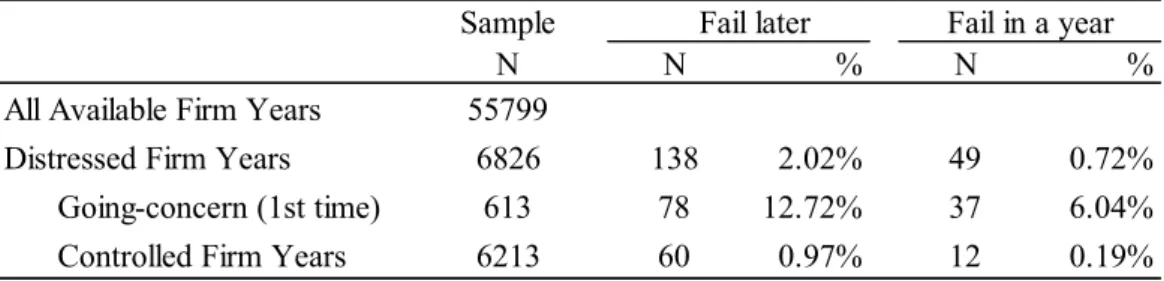
seen in the first row of Table 1A, starting from 55799 all available firm*years, 613 firms
issued first time going-concern financial statement notes. 138 firms filed for bankruptcy
and 60 firms (43.4%) went bankrupt without prior going concern financial statement
notes.
To examine H1 that going concern note firms are extreme poor performing, we
select poor performing firms in the same industry as control firms for each firm with the
first time going concern note. Control firms are defined as industrial peers suffering
from loss at the same fiscal year, in addition to firms with liability in excess of assets,
firms with negative surplus. Suffering from loss is a significant sign for downsizing.
Also, it is a sign for investors to pay attentions to corporate business viability. Firms
with liability in excess of assets are deeply financially distressed. And firms with
negative surplus are not allowed to pay dividends. Intuitively, investors pay more
attentions to such deeply distressed firms regarding bankruptcy risk. However,
subsequent annual data of firms with first time going concern notes are excluded from
control firms. This yields 6213 firm years. We examine that bankrupt firms were all
23
ignoring data on healthy firms that eventually go bankrupt (Shumway, 2001).
The purpose of this paper is to figure out what would have happened to firms
disclosing going concern uncertainties if had they not disclosed them. In the real world,
researchers use matching methodologies to impute the missing potential outcome for
each firm by using an average of the outcomes of similar firms4 that do not disclose
business viability issues. The sampling schemes are in the spirit of matching
methodologies. According to recently developed treatment estimation methodologies,
the going concern note effect is computed by taking the average of the difference
between the observed and imputed potential outcomes using inverse probability
weighted regression-adjustment estimators as mentioned above. One of the
assumptions required to use the IPWRA estimators is the overlap assumption, which
states that each firm has a positive probability of disclosing going concern uncertainties
and a positive probability of no going concern disclosures. Including healthy firms with
a zero probability of disclosing going concern issues would violate the overlap
assumption. Obviously, healthy firms also do not match going concern note firms
because they are much different from extreme poor performing firms.
Out of the 613 firms with first time going concern notes, 37 firms filed for
4 Similarity between firms is based on a weighted function of the firm characteristic covariates or estimated going concern note probabilities (propensity scores).
24
bankruptcy within the following year. And 60 firms in the poor performing sample filed
for bankruptcy within the following year did not disclose going-concern uncertainties in
the immediately preceding financial statements. The fraction of bankrupt firms without
going concern notes the immediately preceding financial statements is much higher
than that reported in earlier research for going concern audit report (e.g., Hopwood,
McKeown, and Mutchler, 1989, 1994; Raghunandan and Subramanyam, 2003, Carson
et al., 2013). In a longer horizon, 78 out of 138 bankrupt firms (56.52 %) had a prior
going concern note. To achieve robust going concern note effect on subsequent
bankruptcy filings, next we turn to IPWRA estimation models.
Descriptive Statistics
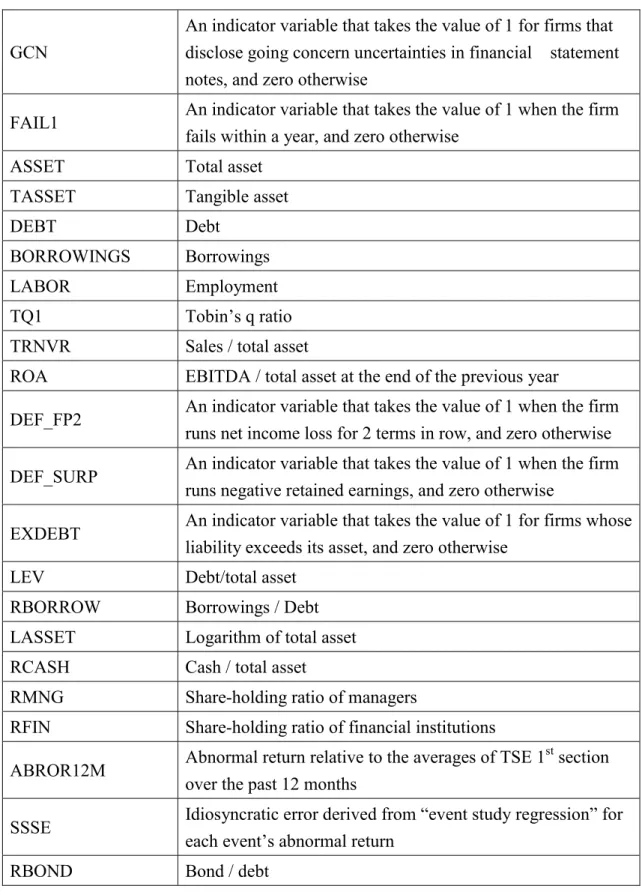
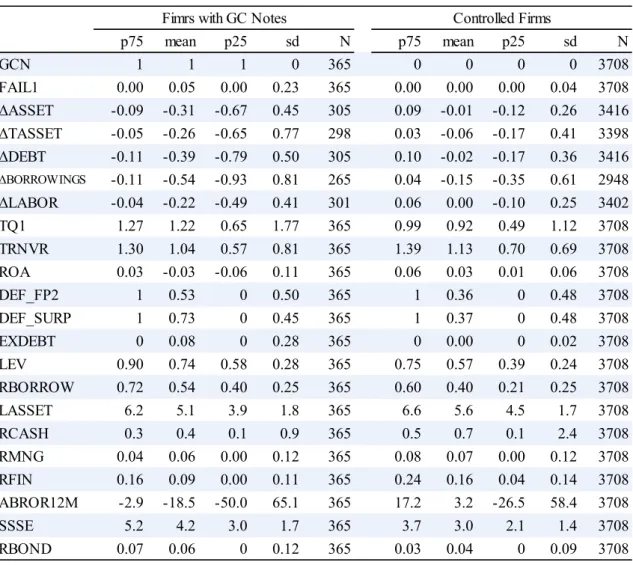
Table 2 presents variables used in our IPWRA estimation models. In addition to
variables used in well-known bankruptcy hazard models mentioned above, we include
financial institutional ownership and managerial ownership to control for perverse
incentives of banks and management. After excluding firm years without data
availability, we have 365 firm years with first time going concern note and 3708 control
firm years. Table 3 presents descriptive statistics for the variables defined in Table 2.
25
sample firms report a loss in two consecutive years (DEF_FP2) and that on average they
have negative cash flow (ROA) in the prior year. Also, going concern note firms have
lower sales/assets (TRNVR) than control firms. Regarding ability to pay dividends, 73%
of going concern sample firms were not able to pay dividends for negative retained
earnings (DEF_SURP), whereas 37% of control firms do not have enough surplus to pay
dividends. Mean leverage (LEV, BORROW) indicates a high incidence of debt,
borrowing on average and 8% of going concern note sample firms had liability exceeding
assets (EXDEBT). The mean liquidity measures (RCASH) indicates that control firms
have more cash than going concern note sample firms. Overall, in comparison with the
control firms, the going concern note firms are extreme poor performing, extreme high
leveraged and extreme illiquid. In other words, going concern note firms all have some
problems. The mean firm size, measured in natural logarithms of total assets (LASSET)
show that control firms are larger than going concern note sample firms. Going concern
note firms use more bonds (RBOND) than do control firms.
Regarding market information, mean abnormal twelve month stock return
(ABROR12M) is -18.5% for our going concern note sample firms, in comparison with
+3.2% mean of control firm years. Also, going concern note firms have higher
26
prices and high exposure to risk of the going concern note firms. Finally, our going
concern note sample firms have lower managerial ownership (RMNG) and financial
institutional ownership (RFIN). However, on average going concern note firms have
higher market to book ratio (TOBINQ) than control firms. As indicated in Table 4,
T-tests and median tests of differences across firms with going concern notes and control
firms indicates statistically significant differences in most variables at the one percent
level.
Looking at subsequent changes in assets, tangible assets, debt, borrowing and work
force, Table 3 exhibits that firms with going concern notes restructure their assets, debt,
borrowings and labor force (ΔASSET, ΔTASSET,ΔDEBT,ΔBORROWINGS,Δ
LABOR) aggressively more than their poor performing industrial peers. As indicated in
Table 4, T-tests and median tests of differences across firms with going concern notes
and control firms indicates statistically significant differences in all variables at the one
percent level. In sum, the going concern note firms downsize more subsequently.
Empirical Results
To examine whether management going concern disclosure works as a means to
27
estimators for the effects of going concern notes on exit and downsizing. First, Table 5
indicates that extreme poor performing firms are more likely to disclose going concern
uncertainties. Market information is significantly related to going concern disclosure.
This supports our hypothesis H1 that extreme poor performing firms are more likely to
disclose uncertainties about their ability to continue as a going concern. Consistent with
hypothesis H2, firms with high financial institutional ownership, with high managerial
ownership are less likely to disclose going concern uncertainties.
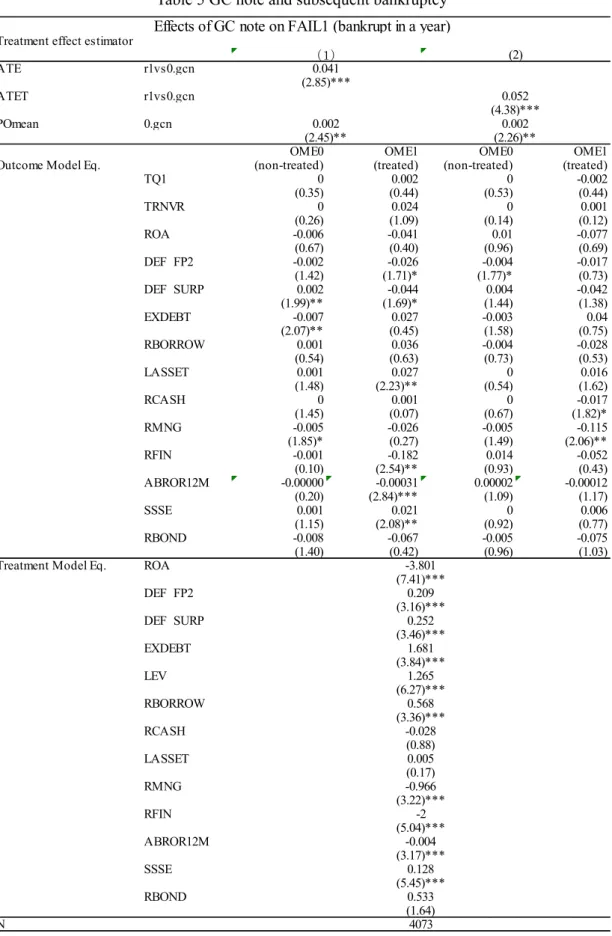
Potential outcome estimation for going concern notes suggest that subsequent
bankruptcy filings are relying more on market information than financial ratios. This
indicates that market participants make informed decisions whether to leave the firm
to the jurists. This is consistent with hypothesis H3. More importantly, the average
bankruptcy probability among all sample firms would have been 4.1% (ATE) higher
with significance at the one percent level if all of them had disclosed going concern
uncertainties. In comparison with potential mean bankruptcy probability of 0.2% if all
of them had not disclosed doubt about going concern, the impact of management going
concern disclosure is also economically significant. This impact is very robust. The
average bankruptcy probability would have been 5.2% (ATET) lower significantly at the
28 concern. This is in support of our hypothesis H3.
Prior studies have found that around 80-90 percent of companies receiving a going
concern opinion do not file for bankruptcy in the subsequent year for USA, UK.
Australia, Belgium (Carson et al., 2013). We find that only 5 percent of going concern
note firms file for bankruptcy in the subsequent year. Even taking endogeneity and
omitted variable issues into account, the effect of going concern note on bankruptcy
filing in the subsequent year is only 4-5 percent. Thus, the Japan mandatory going
concern disclosure requirement seems have higher Type I errors. However, as noted in
Carson et al. (2013), bankruptcy is only one of the possible outcomes for a firm receiving
a going concern opinion. Similarly, exit is one of the possible consequences for a firm
disclosing a going concern issues in financial statement note. So far, downsizing efforts
or debt restructurings around going concern opinions or disclosures have not been fully
explored. Now we turn to the impacts of going concern disclosure on downsizing.
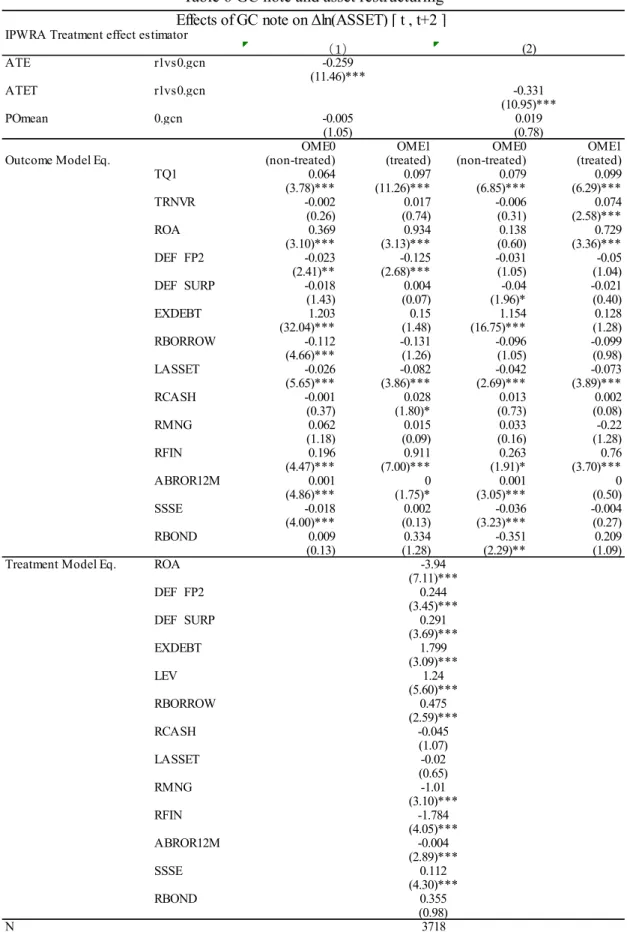
Table 6 shows that firms with going concern disclosure restructure assets more
aggressively than their counterparts. Even suffering of losses, Japanese firms would cut
only 5-6 percent of tangible assets if they had not disclosed going concern uncertainties.
By contrast, disclosing doubt about its ability to continue as a going concern forces a
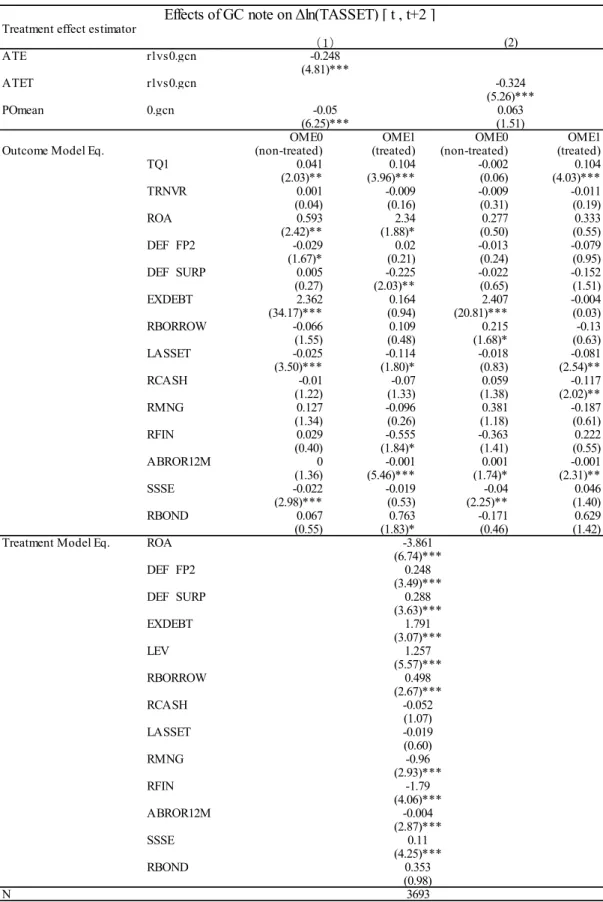
29
note sample firms is -33% with significance at the one percent level. IPWRA estimators
in Table 7 indicate a similar pattern for downsizing tangible assets. Going concern note
firms cut about one third tangible assets in comparison with potential outcome without
a going concern note. Similarly, poor performing firms would have cut 25% of tangible
assets if they had disclosed going concern issues.
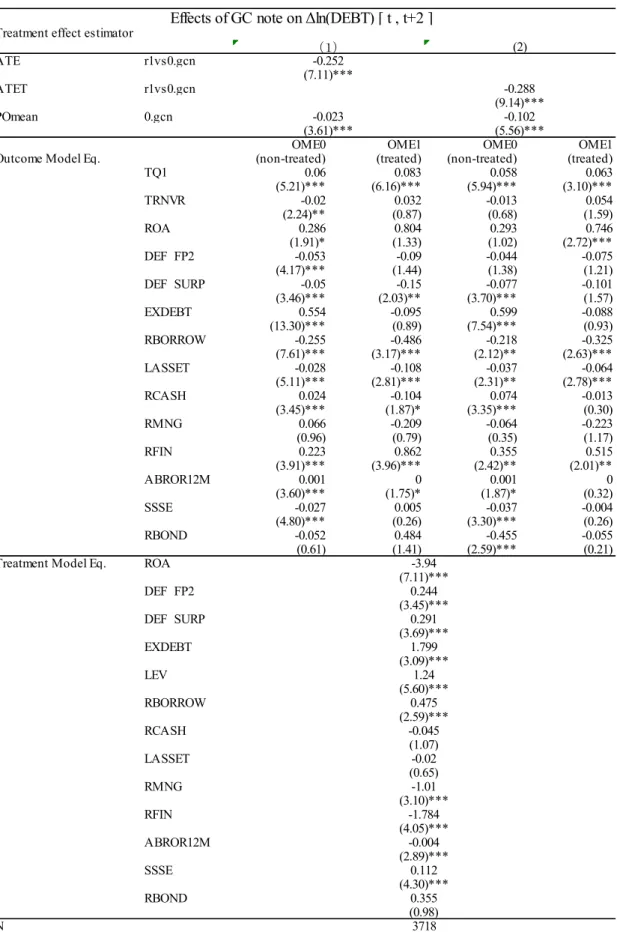
At the same time, Table 8 exhibits that debt would have declined by 25.2% (ATE) if
all sample firms had disclosed going concern uncertainties. In comparison, all firms
would only cut 2.3% of debt if they had no financial statement going concern notes.
Firms disclosing going concern problems would have cut 10.2% of debt even they had
not disclosed going concern notes. The going concern note effect among firms with going
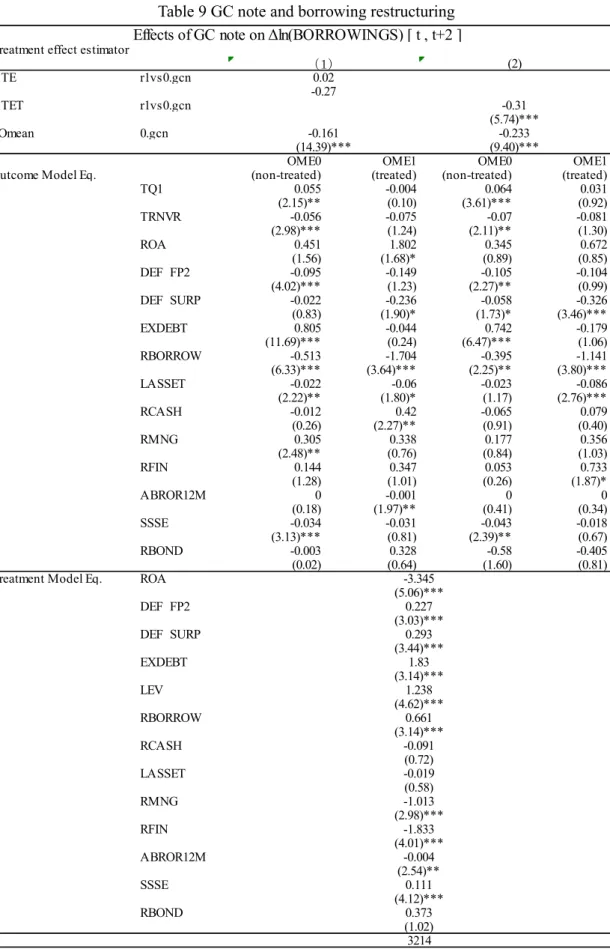
concern doubt is stronger as ATET indicates. Similarly, Table 9 indicates that firms with
going concern note aggressively restructure borrowings in comparison with
counterfactual restructuring if they had not disclosed doubt on business survival. But it
is the case for all firms.
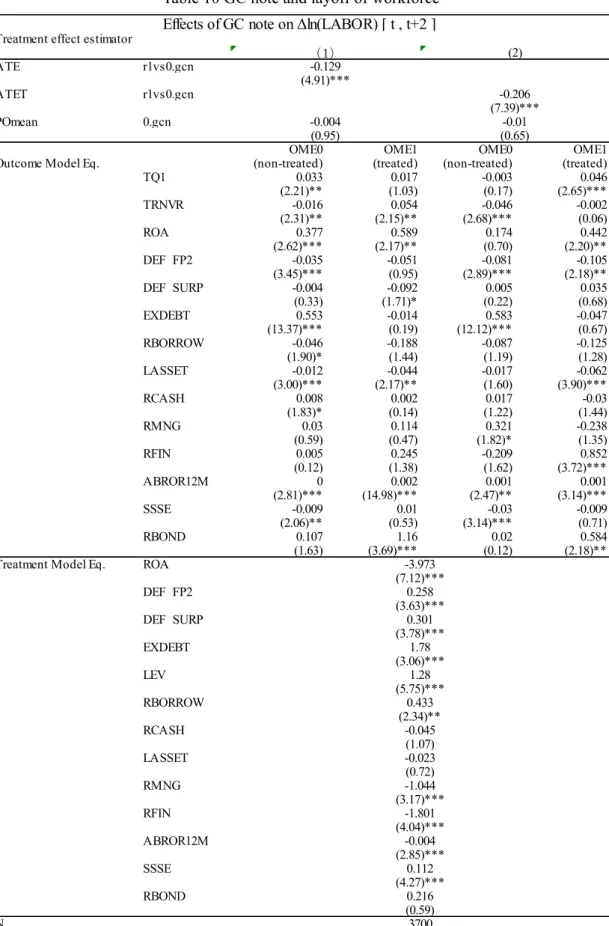
Pomean of cut on labor force is 0.4%, 1% respectively without significance at the ten
percent level in Table 10. This means that poor performing firms without going concern
notes tend to maintain employment. Also, extreme poor performing firms would have
30
still resist to layoff workforce regardless of extreme poor performance, inability to pay
dividends and deep financial distress. This is consistent with Jensen(1993)’s argument
that managers tend to buy labor peace even facing with technical innovation and
worldwide competition. However, the treated effect is -12.9% among all sample firms
and on average going concern note sample firms cut 20.6% of workforce around
disclosure, in comparison with counterfactual outcomes. These strongly suggest
disclosing going concern uncertainties enhances extreme poor performing firms to lay
off employees aggressively.
We find that extreme poor performing firms are more likely to disclose going concern
uncertainties in financial statement notes. The firms with a going concern uncertainty
note are more likely to subsequently file for bankruptcy in comparison with potential
outcomes without a going concern note. More importantly, the firms disclosing going
concern uncertainties restructure assets, debt and workforce much more aggressively
subsequently. Noteworthy is that viable firms undertake aggressive corporate
restructurings in order to regain viability. This implies that the management accurately
recognizes going concern issues as disclosed in financial statement notes and is eager to
downsize to regain viability. It is not the case that the decision to disclose doubt on going
31
seems to undertake no actions to mitigate adverse conditions. Rather, we examine
aggressive downsizing and debt restructurings around disclosures to regain viability.
Overall, our results suggest that the mandatory management going concern disclosure
requirement works as a means to force extreme poor performing firms to downsize or to
exit by informing market participants.
5. Conclusions
In this paper, we investigate the effect of accounting standard requiring
management going concern notes on subsequent bankruptcy as well as the effects on
subsequent corporate restructurings in comparison with potential outcomes when the
management had not disclosed. We examine that extreme poor performing firms are
more likely to disclose going concern uncertainties with a restructuring plan. However,
a firm with more financial institutional ownership, more managerial ownership is less
likely to disclose uncertainties about business survival. The average going concern note
effect on subsequent bankruptcy is statistically and economically significant. As results
of proposed restructuring solutions, assets shrink, borrowings contract and workforce
declines aggressively around disclosing going concern uncertainties. Nonetheless, the
proportion of bankrupt firms that disclose going concern issues in the immediately
32
Recently, there is convergence to mandatory management going concern disclosures
as part of the financial report. We provide important evidence on effects of mandatory
management going concern disclosure, along the line of requirement of downsizing and
exit in economies with excess capacity. Our evidence strongly suggests that
management going concern disclosure requirement works as a means to force extreme
weak firms to downsize or to exit by informing market participants.
Our research is subject to several caveats. First, we do not control for audit opinions
though most audit opinions are unqualified in Japan. Second, it is not possible to
observe downsizing in firms filing for bankruptcy in the subsequent year because
bankrupt firms often do not make timely filings. Also, we do not control for the
voluntary linguistic tone of the MD&A. Recent studies find that the linguistic data in
the MD&A provides significant explanatory power in predicting corporate survivals.
Our project in this study, however, is not to develop a bankruptcy prediction model. Our
purpose is to estimate whether the bankruptcy probability and downsizing activities of
a going concern note firm would have differed if it had not disclosed survival risk.
Limited to our best knowledges, it is the first to provide important evidence that
companies disclosing business survival issues engage in aggressive downsizing and debt
33
restructuring efforts on subsequent viability over a longer horizon. Aggressive
downsizing and debt restructurings could mitigate adverse conditions and events to
regain viability and thus to increase conventional Type I errors. Researchers should
34 References
Altman, E. (1968) Financial Ratios, Discriminant Analysis and the Prediction of Corporate Bankruptcy, Journal of Finance, pp. 589-609.
Altman, E. (1982) Accounting implications of failure prediction models, Journal of Accounting Auditing and Finance, pp. 4-19.
Bar-Hava, K. and Katz, R. (2016) The Asymmetric Market Reaction of Stockholders and Bondholders to the Implementation of Early-Warnings Pre Going Concern Opinion, http://dx.doi.org/10.2139/ssrn.2729774
Carson, E., Fargher, N. L., Geiger, M. A., Lennox, C.S., Raghunandan, K. and Willekens ,M. (2013) Audit Reporting for Going-Concern Uncertainty: A Research Synthesis. Auditing : A Journal of Practice & Theory 32: 353-384
Caballero, R. J., Hoshi, T., Kashyap, A. K.(2008) Zombie Lending and Depressed Restructuring in Japan, American Economic Review 98 (5): 1943-1977
Franks, Julian R., and Torous, Walter N. (1994), A comparison of financial recontracting in distressed exchanges and Chapter 11 reorganizations, Journal of Financial Economics 35, 349-370.
Gilson, S. C. (1989), Management turnover and financial distress, Journal of Financial Economics 25, 241-262.
Gilson, S. C. (1990), Bankruptcy, boards, banks, and block holders, Journal of Financial Economics 27, 355-387.
Gilson, S. C., John, K. and Lang, L. H.P. (1990), Troubled debt restructurings, Journal of Financial Economics 27, 315-353.
Hopwood, W., McKeown, J. and Mutchler, J. (1989) A test of the incremental explanatory power of opinions qualified for consistency and uncertainty, The Accounting Review, pp.28-48.
Hopwood, W., McKeown, J. and Mutchler, J. (1994), Reexamination of auditor versus model accuracy within the context of the going concern opinion decision, Contemporary Accounting Research 11, pp.295-310.
Jensen, Michael C.(1993), The modern industrial revolution, exit, and the failure of internal control systems, Journal of Finance 48, 831-880.
Kang, J.K. and Shivdasani, A. (1997), Corporate restructuring during performance declines in Japan, Journal of Financial economics 46, pp.29-65
Kida, T. (1980) An investigation into auditors continuity and related qualification judgments, Journal of Accounting Research 18, 506–523.
Mayew, W. J., Sethuraman, M. and Venkatachalam, M. (2015) MD&A Disclosure and the Firm's Ability to Continue as a Going Concern. The Accounting Review 90, pp.
35 1621-1651.
Misawa, Mitsuru (2005) The Japanese Issues and Perspective on the Convergence of International Accounting Standards, Northwestern Journal of International Law & Business. 25, pp.711-745
Nogler, G. E. (1995). The resolution of auditor going concern opinions, Auditing: A Journal of Practice & Theory 14, pp. 54–73.
Ontario Securities Commission (OSC) (2010), Going Concern Disclosure Review. (December) Staff Notice 52-719. Available at: http://www.osc.gov.on.ca/documents/ en/Securities-Category5/sn_20101214_52-719_improve-disclosure.pdf
Peek, J., Rosengren, E.S.(2005) Unnatural Selection: Perverse Incentives and the Misallocation of Credit in Japan, The American Economic Review 95, pp. 1144-1166(23)
Raghunandan, K. and Subramanyam, K.R. (2003) Market Information and Predictive Accuracy of the Going Concern Opinion, Available at SSRN: https://ssrn.com/abstract=427682 or http://dx.doi.org/10.2139/ssrn.427682
Shumway, T. (2001) Forecasting bankruptcy more accurately: A simple hazard model, Journal of Business 74, 101-124.
Tuckera, R. Matsumura,E. M. and Subramanyam, K.R. (2003) Going-concern judgments: An experimental test of the self-fulfilling prophecy and forecast accuracy, Journal of Accounting and Public Policy, Vol.22, Issue 5, pp.401-432 Uang, J., D. B. Citron, S. Sudarsanam, and Taffler, R. J. (2006), Management
going-concern disclosures: Impact of corporate governance and audit reputation. European Financial Management 12 (5): 789–816.
Vanstraelen, A. (2003) Going-Concern Opinions, Auditor Switching, and the Self-Fulfilling Prophecy Effect Examined in the Regulatory Context of Belgium, Journal of Accounting, Auditing and Finance, 18 (2), pp. 231-253.
Weiss, Lawrence A. (1990), Bankruptcy resolution, Journal of Financial Economics 27,285-314.
Xu, Peng(2007),Corporate Governance in Financial Distress: The New Role of Bankruptcy, in Corporate Governance in Japan in Aoki, M., Jackson, G. and Miyajima, H. (Eds.) Institutional Change and Organizational Diversity, Oxford University Press
36
Table1 Sample, Going Concern Notes and Bankruptcies
Table 1A Sample and Incidence of Going-Concern Opinion and Subsequent Bankruptcies Sample Fail later Fail in a year
N N % N %
All Available Firm Years 55799
Distressed Firm Years 6826 138 2.02% 49 0.72%
Going-concern (1st time) 613 78 12.72% 37 6.04%
Controlled Firm Years 6213 60 0.97% 12 0.19%
Note: "Distressed" includes both Going-concern Firms and Controlled samples. See text for details of Controlled Firms.
Table 1B Financailly Distressed and Going-Concern Firms by Year
(firms)
Year Sample Distressed Going-concern (1st time)
All Fail later Fail in a year All Fail later Fail in a year 2002 4307 971 37 12 101 18 6 2003 4266 584 17 4 66 10 4 2004 4221 425 11 3 42 6 3 2005 4185 347 7 1 46 1 0 2006 4162 448 12 1 71 7 1 2007 4111 554 27 17 125 22 14 2008 4079 1049 15 8 77 10 6 2009 3945 703 5 1 22 1 1 2010 3823 445 3 0 18 0 0 2011 3731 291 2 0 8 1 0 2012 3709 224 1 1 4 1 1 2013 3737 228 1 1 13 1 1 2014 3783 284 0 0 12 0 0 2015 3740 273 0 0 8 0 0 55799 6826 138 49 613 78 37
Note: "Distressed" includes both Going-concern Firms and Controlled samples. See text for details of Controlled Firms.
37
Table 2 Variable Definitions
GCN
An indicator variable that takes the value of 1 for firms that
disclose going concern uncertainties in financial statement
notes, and zero otherwise
FAIL1
An indicator variable that takes the value of 1 when the firm
fails within a year, and zero otherwise
ASSET
Total asset
TASSET
Tangible asset
DEBT
Debt
BORROWINGS
Borrowings
LABOR
Employment
TQ1
Tobin’s q ratio
TRNVR
Sales / total asset
ROA
EBITDA / total asset at the end of the previous year
DEF_FP2
An indicator variable that takes the value of 1 when the firm
runs net income loss for 2 terms in row, and zero otherwise
DEF_SURP
An indicator variable that takes the value of 1 when the firm
runs negative retained earnings, and zero otherwise
EXDEBT
An indicator variable that takes the value of 1 for firms whose
liability exceeds its asset, and zero otherwise
LEV
Debt/total asset
RBORROW
Borrowings / Debt
LASSET
Logarithm of total asset
RCASH
Cash / total asset
RMNG
Share-holding ratio of managers
RFIN
Share-holding ratio of financial institutions
ABROR12M
Abnormal return relative to the averages of TSE 1
st
section
over the past 12 months
SSSE
Idiosyncratic error derived from “event study regression” for
each event’s abnormal return
38
Table 3 Descriptive Statistics
Fimrs with GC Notes Controlled Firms
p75 mean p25 sd N p75 mean p25 sd N GCN 1 1 1 0 365 0 0 0 0 3708 FAIL1 0.00 0.05 0.00 0.23 365 0.00 0.00 0.00 0.04 3708 ΔASSET -0.09 -0.31 -0.67 0.45 305 0.09 -0.01 -0.12 0.26 3416 ΔTASSET -0.05 -0.26 -0.65 0.77 298 0.03 -0.06 -0.17 0.41 3398 ΔDEBT -0.11 -0.39 -0.79 0.50 305 0.10 -0.02 -0.17 0.36 3416 ΔBORROWINGS -0.11 -0.54 -0.93 0.81 265 0.04 -0.15 -0.35 0.61 2948 ΔLABOR -0.04 -0.22 -0.49 0.41 301 0.06 0.00 -0.10 0.25 3402 TQ1 1.27 1.22 0.65 1.77 365 0.99 0.92 0.49 1.12 3708 TRNVR 1.30 1.04 0.57 0.81 365 1.39 1.13 0.70 0.69 3708 ROA 0.03 -0.03 -0.06 0.11 365 0.06 0.03 0.01 0.06 3708 DEF_FP2 1 0.53 0 0.50 365 1 0.36 0 0.48 3708 DEF_SURP 1 0.73 0 0.45 365 1 0.37 0 0.48 3708 EXDEBT 0 0.08 0 0.28 365 0 0.00 0 0.02 3708 LEV 0.90 0.74 0.58 0.28 365 0.75 0.57 0.39 0.24 3708 RBORROW 0.72 0.54 0.40 0.25 365 0.60 0.40 0.21 0.25 3708 LASSET 6.2 5.1 3.9 1.8 365 6.6 5.6 4.5 1.7 3708 RCASH 0.3 0.4 0.1 0.9 365 0.5 0.7 0.1 2.4 3708 RMNG 0.04 0.06 0.00 0.12 365 0.08 0.07 0.00 0.12 3708 RFIN 0.16 0.09 0.00 0.11 365 0.24 0.16 0.04 0.14 3708 ABROR12M -2.9 -18.5 -50.0 65.1 365 17.2 3.2 -26.5 58.4 3708 SSSE 5.2 4.2 3.0 1.7 365 3.7 3.0 2.1 1.4 3708 RBOND 0.07 0.06 0 0.12 365 0.03 0.04 0 0.09 3708 note:
Controlled firms are:(i) running net income loss
39
Table 4 Difference Tests between GCN and Controlled Firms]
Mean Comparison Test Rank-sum Test Median Test
With GCN
Controlled
Samples diff.
A B A-B z-value Pearson's χ2
FAIL1 0.054 0.002 0.052 *** 12.3 *** 152.3 *** ΔASSET -0.312 -0.006 -0.306 *** -16.3 *** 142.4 *** ΔTASSET -0.257 -0.058 -0.199 *** -9.8 *** 66.2 *** ΔDEBT -0.392 -0.014 -0.378 *** -15.5 *** 139.6 *** ΔBORROWINGS -0.547 -0.154 -0.393 *** -9.9 *** 51.3 *** ΔLABOR -0.217 -0.002 -0.215 *** -13.1 *** 97.0 *** TQ1 1.236 0.951 0.285 *** 8.1 *** 58.1 *** TRNVR 1.042 1.133 -0.091 ** -3.8 *** 8.0 *** ROA -0.029 0.032 -0.061 *** -12.6 *** 81.6 *** DEF_FP2 0.530 0.354 0.176 *** 6.7 *** 45.0 *** DEF_SURP 0.727 0.376 0.351 *** 13.1 *** 172.2 *** EXDEBT 0.089 0.001 0.088 *** 17.7 *** 312.8 *** LEV 0.739 0.563 0.176 *** 12.2 *** 77.7 *** RBORROW 0.543 0.402 0.141 *** 10.2 *** 63.1 *** LASSET 5.093 5.599 -0.506 *** -5.7 *** 26.2 *** RCASH 0.392 0.723 -0.331 *** -7.8 *** 41.2 *** RMNG 0.057 0.072 -0.015 ** -6.6 *** 19.0 *** RFIN 0.092 0.157 -0.065 *** -10.3 *** 58.1 *** ABROR12M -18.471 4.460 -22.931 *** -11.2 *** 70.2 *** SSSE 4.217 3.039 1.178 *** 13.1 *** 111.5 *** RBOND 0.062 0.039 0.023 *** 4.8 *** 22.3 *** * p<0.1; ** p<0.05; *** p<0.01
Note:Based on observations used for FAIL1 regression
Between GCN & Controlled
Between GCN & Controlled
40
Table 5 GC note and subsequent bankruptcy
Effects of GC note on FAIL1 (bankrupt in a year) Treatment effect estimator
(1) (2) ATE r1vs0.gcn 0.041 (2.85)*** ATET r1vs0.gcn 0.052 (4.38)*** POmean 0.gcn 0.002 0.002 (2.45)** (2.26)**
OME0 OME1 OME0 OME1
Outcome Model Eq. (non-treated) (treated) (non-treated) (treated)
TQ1 0 0.002 0 -0.002 (0.35) (0.44) (0.53) (0.44) TRNVR 0 0.024 0 0.001 (0.26) (1.09) (0.14) (0.12) ROA -0.006 -0.041 0.01 -0.077 (0.67) (0.40) (0.96) (0.69) DEF_FP2 -0.002 -0.026 -0.004 -0.017 (1.42) (1.71)* (1.77)* (0.73) DEF_SURP 0.002 -0.044 0.004 -0.042 (1.99)** (1.69)* (1.44) (1.38) EXDEBT -0.007 0.027 -0.003 0.04 (2.07)** (0.45) (1.58) (0.75) RBORROW 0.001 0.036 -0.004 -0.028 (0.54) (0.63) (0.73) (0.53) LASSET 0.001 0.027 0 0.016 (1.48) (2.23)** (0.54) (1.62) RCASH 0 0.001 0 -0.017 (1.45) (0.07) (0.67) (1.82)* RMNG -0.005 -0.026 -0.005 -0.115 (1.85)* (0.27) (1.49) (2.06)** RFIN -0.001 -0.182 0.014 -0.052 (0.10) (2.54)** (0.93) (0.43) ABROR12M -0.00000 -0.00031 0.00002 -0.00012 (0.20) (2.84)*** (1.09) (1.17) SSSE 0.001 0.021 0 0.006 (1.15) (2.08)** (0.92) (0.77) RBOND -0.008 -0.067 -0.005 -0.075 (1.40) (0.42) (0.96) (1.03)
Treatment Model Eq. ROA -3.801
(7.41)*** DEF_FP2 0.209 (3.16)*** DEF_SURP 0.252 (3.46)*** EXDEBT 1.681 (3.84)*** LEV 1.265 (6.27)*** RBORROW 0.568 (3.36)*** RCASH -0.028 (0.88) LASSET 0.005 (0.17) RMNG -0.966 (3.22)*** RFIN -2 (5.04)*** ABROR12M -0.004 (3.17)*** SSSE 0.128 (5.45)*** RBOND 0.533 (1.64) N 4073
41
Table 6 GC note and asset restructuring
Effects of GC note on Δln(ASSET) [ t , t+2 ] Effects of GC note on Δln(TASSET) [ t , t+2 ]
IPWRA Treatment effect estimator
(1) (2) ATE r1vs0.gcn -0.259 (11.46)*** ATET r1vs0.gcn -0.331 (10.95)*** POmean 0.gcn -0.005 0.019 (1.05) (0.78)
OME0 OME1 OME0 OME1
Outcome Model Eq. (non-treated) (treated) (non-treated) (treated)
TQ1 0.064 0.097 0.079 0.099 (3.78)*** (11.26)*** (6.85)*** (6.29)*** TRNVR -0.002 0.017 -0.006 0.074 (0.26) (0.74) (0.31) (2.58)*** ROA 0.369 0.934 0.138 0.729 (3.10)*** (3.13)*** (0.60) (3.36)*** DEF_FP2 -0.023 -0.125 -0.031 -0.05 (2.41)** (2.68)*** (1.05) (1.04) DEF_SURP -0.018 0.004 -0.04 -0.021 (1.43) (0.07) (1.96)* (0.40) EXDEBT 1.203 0.15 1.154 0.128 (32.04)*** (1.48) (16.75)*** (1.28) RBORROW -0.112 -0.131 -0.096 -0.099 (4.66)*** (1.26) (1.05) (0.98) LASSET -0.026 -0.082 -0.042 -0.073 (5.65)*** (3.86)*** (2.69)*** (3.89)*** RCASH -0.001 0.028 0.013 0.002 (0.37) (1.80)* (0.73) (0.08) RMNG 0.062 0.015 0.033 -0.22 (1.18) (0.09) (0.16) (1.28) RFIN 0.196 0.911 0.263 0.76 (4.47)*** (7.00)*** (1.91)* (3.70)*** ABROR12M 0.001 0 0.001 0 (4.86)*** (1.75)* (3.05)*** (0.50) SSSE -0.018 0.002 -0.036 -0.004 (4.00)*** (0.13) (3.23)*** (0.27) RBOND 0.009 0.334 -0.351 0.209 (0.13) (1.28) (2.29)** (1.09)
Treatment Model Eq. ROA -3.94
(7.11)*** (6.74)*** DEF_FP2 0.244 (3.45)*** (3.49)*** DEF_SURP 0.291 (3.69)*** (3.63)*** EXDEBT 1.799 (3.09)*** (3.07)*** LEV 1.24 (5.60)*** (5.57)*** RBORROW 0.475 (2.59)*** (2.67)*** RCASH -0.045 (1.07) LASSET -0.02 (0.65) RMNG -1.01 (3.10)*** (2.93)*** RFIN -1.784 (4.05)*** (4.06)*** ABROR12M -0.004 (2.89)*** (2.87)*** SSSE 0.112 (4.30)*** (4.25)*** RBOND 0.355 (0.98) N 3718
42
Table 7 GC note and tangible asset restructuring
Effects of GC note on Δln(TASSET) [ t , t+2 ] Effects of GC note on Δln(DEBT) [ t , t+2 ]
Treatment effect estimator
(1) (2) ATE r1vs0.gcn -0.248 (4.81)*** ATET r1vs0.gcn -0.324 (5.26)*** POmean 0.gcn -0.05 0.063 (6.25)*** (1.51)
OME0 OME1 OME0 OME1
Outcome Model Eq. (non-treated) (treated) (non-treated) (treated)
TQ1 0.041 0.104 -0.002 0.104 (2.03)** (3.96)*** (0.06) (4.03)*** TRNVR 0.001 -0.009 -0.009 -0.011 (0.04) (0.16) (0.31) (0.19) ROA 0.593 2.34 0.277 0.333 (2.42)** (1.88)* (0.50) (0.55) DEF_FP2 -0.029 0.02 -0.013 -0.079 (1.67)* (0.21) (0.24) (0.95) DEF_SURP 0.005 -0.225 -0.022 -0.152 (0.27) (2.03)** (0.65) (1.51) EXDEBT 2.362 0.164 2.407 -0.004 (34.17)*** (0.94) (20.81)*** (0.03) RBORROW -0.066 0.109 0.215 -0.13 (1.55) (0.48) (1.68)* (0.63) LASSET -0.025 -0.114 -0.018 -0.081 (3.50)*** (1.80)* (0.83) (2.54)** RCASH -0.01 -0.07 0.059 -0.117 (1.22) (1.33) (1.38) (2.02)** RMNG 0.127 -0.096 0.381 -0.187 (1.34) (0.26) (1.18) (0.61) RFIN 0.029 -0.555 -0.363 0.222 (0.40) (1.84)* (1.41) (0.55) ABROR12M 0 -0.001 0.001 -0.001 (1.36) (5.46)*** (1.74)* (2.31)** SSSE -0.022 -0.019 -0.04 0.046 (2.98)*** (0.53) (2.25)** (1.40) RBOND 0.067 0.763 -0.171 0.629 (0.55) (1.83)* (0.46) (1.42)
Treatment Model Eq. ROA -3.861
(6.74)*** (7.11)*** DEF_FP2 0.248 (3.49)*** (3.45)*** DEF_SURP 0.288 (3.63)*** (3.69)*** EXDEBT 1.791 (3.07)*** (3.09)*** LEV 1.257 (5.57)*** (5.60)*** RBORROW 0.498 (2.67)*** (2.59)*** RCASH -0.052 (1.07) LASSET -0.019 (0.60) RMNG -0.96 (2.93)*** (3.10)*** RFIN -1.79 (4.06)*** (4.05)*** ABROR12M -0.004 (2.87)*** (2.89)*** SSSE 0.11 (4.25)*** (4.30)*** RBOND 0.353 (0.98) N 3693
43
Table 8 GC note and debt restructuring
Effects of GC note on Δln(DEBT) [ t , t+2 ] Effects of GC note on Δln(BORROWINGS) [ t , t+2 ]
Treatment effect estimator
(1) (2) ATE r1vs0.gcn -0.252 (7.11)*** ATET r1vs0.gcn -0.288 (9.14)*** POmean 0.gcn -0.023 -0.102 (3.61)*** (5.56)***
OME0 OME1 OME0 OME1
Outcome Model Eq. (non-treated) (treated) (non-treated) (treated)
TQ1 0.06 0.083 0.058 0.063 (5.21)*** (6.16)*** (5.94)*** (3.10)*** TRNVR -0.02 0.032 -0.013 0.054 (2.24)** (0.87) (0.68) (1.59) ROA 0.286 0.804 0.293 0.746 (1.91)* (1.33) (1.02) (2.72)*** DEF_FP2 -0.053 -0.09 -0.044 -0.075 (4.17)*** (1.44) (1.38) (1.21) DEF_SURP -0.05 -0.15 -0.077 -0.101 (3.46)*** (2.03)** (3.70)*** (1.57) EXDEBT 0.554 -0.095 0.599 -0.088 (13.30)*** (0.89) (7.54)*** (0.93) RBORROW -0.255 -0.486 -0.218 -0.325 (7.61)*** (3.17)*** (2.12)** (2.63)*** LASSET -0.028 -0.108 -0.037 -0.064 (5.11)*** (2.81)*** (2.31)** (2.78)*** RCASH 0.024 -0.104 0.074 -0.013 (3.45)*** (1.87)* (3.35)*** (0.30) RMNG 0.066 -0.209 -0.064 -0.223 (0.96) (0.79) (0.35) (1.17) RFIN 0.223 0.862 0.355 0.515 (3.91)*** (3.96)*** (2.42)** (2.01)** ABROR12M 0.001 0 0.001 0 (3.60)*** (1.75)* (1.87)* (0.32) SSSE -0.027 0.005 -0.037 -0.004 (4.80)*** (0.26) (3.30)*** (0.26) RBOND -0.052 0.484 -0.455 -0.055 (0.61) (1.41) (2.59)*** (0.21)
Treatment Model Eq. ROA -3.94
(7.11)*** (5.06)*** DEF_FP2 0.244 (3.45)*** (3.03)*** DEF_SURP 0.291 (3.69)*** (3.44)*** EXDEBT 1.799 (3.09)*** (3.14)*** LEV 1.24 (5.60)*** (4.62)*** RBORROW 0.475 (2.59)*** (3.14)*** RCASH -0.045 (1.07) LASSET -0.02 (0.65) RMNG -1.01 (3.10)*** (2.98)*** RFIN -1.784 (4.05)*** (4.01)*** ABROR12M -0.004 (2.89)*** (2.54)** SSSE 0.112 (4.30)*** (4.12)*** RBOND 0.355 (0.98) N 3718
44
Table 9 GC note and borrowing restructuring
Effects of GC note on Δln(BORROWINGS) [ t , t+2 ] Effects of GC note on Δln(LABOR) [ t , t+2 ]
Treatment effect estimator
(1) (2) ATE r1vs0.gcn 0.02 -0.27 ATET r1vs0.gcn -0.31 (5.74)*** POmean 0.gcn -0.161 -0.233 (14.39)*** (9.40)***
OME0 OME1 OME0 OME1
Outcome Model Eq. (non-treated) (treated) (non-treated) (treated)
TQ1 0.055 -0.004 0.064 0.031 (2.15)** (0.10) (3.61)*** (0.92) TRNVR -0.056 -0.075 -0.07 -0.081 (2.98)*** (1.24) (2.11)** (1.30) ROA 0.451 1.802 0.345 0.672 (1.56) (1.68)* (0.89) (0.85) DEF_FP2 -0.095 -0.149 -0.105 -0.104 (4.02)*** (1.23) (2.27)** (0.99) DEF_SURP -0.022 -0.236 -0.058 -0.326 (0.83) (1.90)* (1.73)* (3.46)*** EXDEBT 0.805 -0.044 0.742 -0.179 (11.69)*** (0.24) (6.47)*** (1.06) RBORROW -0.513 -1.704 -0.395 -1.141 (6.33)*** (3.64)*** (2.25)** (3.80)*** LASSET -0.022 -0.06 -0.023 -0.086 (2.22)** (1.80)* (1.17) (2.76)*** RCASH -0.012 0.42 -0.065 0.079 (0.26) (2.27)** (0.91) (0.40) RMNG 0.305 0.338 0.177 0.356 (2.48)** (0.76) (0.84) (1.03) RFIN 0.144 0.347 0.053 0.733 (1.28) (1.01) (0.26) (1.87)* ABROR12M 0 -0.001 0 0 (0.18) (1.97)** (0.41) (0.34) SSSE -0.034 -0.031 -0.043 -0.018 (3.13)*** (0.81) (2.39)** (0.67) RBOND -0.003 0.328 -0.58 -0.405 (0.02) (0.64) (1.60) (0.81)
Treatment Model Eq. ROA -3.345
(5.06)*** (7.12)*** DEF_FP2 0.227 (3.03)*** (3.63)*** DEF_SURP 0.293 (3.44)*** (3.78)*** EXDEBT 1.83 (3.14)*** (3.06)*** LEV 1.238 (4.62)*** (5.75)*** RBORROW 0.661 (3.14)*** (2.34)** RCASH -0.091 (0.72) LASSET -0.019 (0.58) RMNG -1.013 (2.98)*** (3.17)*** RFIN -1.833 (4.01)*** (4.04)*** ABROR12M -0.004 (2.54)** (2.85)*** SSSE 0.111 (4.12)*** (4.27)*** RBOND 0.373 (1.02) N 3214
45
Table 10 GC note and layoff of workforce
Effects of GC note on Δln(LABOR) [ t , t+2 ] Effects of GC note on FAIL1 (bankrupt in a year)
Treatment effect estimator
(1) (2) ATE r1vs0.gcn -0.129 (4.91)*** ATET r1vs0.gcn -0.206 (7.39)*** POmean 0.gcn -0.004 -0.01 (0.95) (0.65)
OME0 OME1 OME0 OME1
Outcome Model Eq. (non-treated) (treated) (non-treated) (treated)
TQ1 0.033 0.017 -0.003 0.046 (2.21)** (1.03) (0.17) (2.65)*** TRNVR -0.016 0.054 -0.046 -0.002 (2.31)** (2.15)** (2.68)*** (0.06) ROA 0.377 0.589 0.174 0.442 (2.62)*** (2.17)** (0.70) (2.20)** DEF_FP2 -0.035 -0.051 -0.081 -0.105 (3.45)*** (0.95) (2.89)*** (2.18)** DEF_SURP -0.004 -0.092 0.005 0.035 (0.33) (1.71)* (0.22) (0.68) EXDEBT 0.553 -0.014 0.583 -0.047 (13.37)*** (0.19) (12.12)*** (0.67) RBORROW -0.046 -0.188 -0.087 -0.125 (1.90)* (1.44) (1.19) (1.28) LASSET -0.012 -0.044 -0.017 -0.062 (3.00)*** (2.17)** (1.60) (3.90)*** RCASH 0.008 0.002 0.017 -0.03 (1.83)* (0.14) (1.22) (1.44) RMNG 0.03 0.114 0.321 -0.238 (0.59) (0.47) (1.82)* (1.35) RFIN 0.005 0.245 -0.209 0.852 (0.12) (1.38) (1.62) (3.72)*** ABROR12M 0 0.002 0.001 0.001 (2.81)*** (14.98)*** (2.47)** (3.14)*** SSSE -0.009 0.01 -0.03 -0.009 (2.06)** (0.53) (3.14)*** (0.71) RBOND 0.107 1.16 0.02 0.584 (1.63) (3.69)*** (0.12) (2.18)**
Treatment Model Eq. ROA -3.973
(7.12)*** (7.41)*** DEF_FP2 0.258 (3.63)*** (3.16)*** DEF_SURP 0.301 (3.78)*** (3.46)*** EXDEBT 1.78 (3.06)*** (3.84)*** LEV 1.28 (5.75)*** (6.27)*** RBORROW 0.433 (2.34)** (3.36)*** RCASH -0.045 (1.07) LASSET -0.023 (0.72) RMNG -1.044 (3.17)*** (3.22)*** RFIN -1.801 (4.04)*** (5.04)*** ABROR12M -0.004 (2.85)*** (3.17)*** SSSE 0.112 (4.27)*** (5.45)*** RBOND 0.216 (0.59) N 3700
46
Appendix
Time series of bankruptcy filings under Corporate Reorganization Law, Civil Rehabilitation Law and Liquidation Law of Japan in the years of 1987 - 2002 Year Number of Corporate
Reorganization filing
Number of Civil Rehabilitation filing
Number of
Liquidation filing Total
’87-‘96 10 - 0 10 ‘97 6 - 0 6 ‘98 4 - 3 7 ‘99 2 - 0 2 ‘00 3 7 1 11 ‘01 3 12 1 15 ‘02 8 14 5 27
![Table 4 Difference Tests between GCN and Controlled Firms]](https://thumb-us.123doks.com/thumbv2/123dok_us/96882.2511020/39.892.134.766.177.656/table-difference-tests-gcn-controlled-firms.webp)