Butler University
Butler University
Digital Commons @ Butler University
Digital Commons @ Butler University
Scholarship and Professional Work - Business
Lacy School of Business
2007
A U.S. Manager's Guide to Differences Between IFRS and U.S.
A U.S. Manager's Guide to Differences Between IFRS and U.S.
GAAP
GAAP
James F. Sander
Butler University, [email protected]
Susan B. Hughes
Follow this and additional works at: https://digitalcommons.butler.edu/cob_papers Part of the Accounting Commons
Recommended Citation
Recommended Citation
Sander, James F. and Hughes, Susan B., "A U.S. Manager's Guide to Differences Between IFRS and U.S. GAAP" (2007). Scholarship and Professional Work - Business. 69.
https://digitalcommons.butler.edu/cob_papers/69
This Article is brought to you for free and open access by the Lacy School of Business at Digital Commons @ Butler University. It has been accepted for inclusion in Scholarship and Professional Work - Business by an authorized administrator of Digital Commons @ Butler University. For more information, please contact
Permission to post this publication in our archive was granted by the
copyright holder, Institute of Management Accountants
(
http://www.imanet.org/resources_and_publications/management_acc
ounting_quarterly.aspx
). This copy should be used for educational and
research purposes only.
The original publication appeared at:
Hughes, S. B., Sander, J. (2007). A U.S. Manager's Guide to
Differences Between IFRS and U.S. GAAP. Management Accounting
Quarterly, 8(4): 1-8.
1
M A N A G E M E N T A C C O U N T I N G Q U A R T E R L Y S U M M E R 2 0 0 7 , V O L . 8 , N O . 4
A
ccountants know that financial reporting standards differ by country or region. In the United States, financial accountants, auditors, and analysts are very familiar with U.S. GAAP. Accountants and auditors in other countries may be well-versed in their home-country GAAP, or they may be familiar with the requirements of International Financial Reporting Stan-dards (IFRS) developed by the InternationalAccount-ing Standards Board (IASB). The European Commis-sion’s adoption of IFRS for EU public company consoli-dated reports in 2005 required many preparers, auditors, and analysts to become familiar with the content and application of IFRS. Standards similar to IFRS were required in Australia for the first time in 2005 as well. It has been estimated that, during that year, 8,000 addi-tional financial statements were based on IFRS. This number will continue to grow as more countries adopt
A U.S. Manager’s
Guide to Differences
Between IFRS and
U.S. GAAP
W
ITH THE GREATER LIKELIHOOD THAT YOU WILL FACE SITUATIONS THAT REQUIRE AN UNDERSTANDING OF THE DIFFERENCES BETWEENU.S. GAAP
ANDIFRS,
THE ODDS INCREASE THAT YOU WILL ALSO HAVE TO BE ABLE TO ESTIMATE THE IMPACT
OF THESE DIFFERENCES
.
BY SU S A N B . HU G H E S, PH. D . , C P A , A N D JA M E S F. SA N D E R, PH. D . , C P A
EXECUTIVE SUMMARY International Financial Reporting Standards (IFRS) are now required for consolidated finan-cial reports for all European Union exchange-listed companies. Offifinan-cials estimated that for 2005, the initial year of EU adoption, 8,000 financial statements were prepared in accordance with IFRS for the first time. Other countries have also adopted IFRS or IFRS-equivalent financial reporting standards. IFRS differ from U.S. Generally Accepted Accounting Principles (GAAP) in many key areas. The International Accounting Standards Board (IASB) and the Financial Accounting Standards Board (FASB) are working on various convergence projects designed to reduce or eliminate differences between the two sets of reporting standards. But existing differences will likely continue for at least the next two years, and, for many accounting topics, differences are likely to last much longer. This article high-lights the 20 convergence projects and summarizes the differences between the two sets of standards. In addition, dif-ferences in three topics that are not included in the convergence efforts are identified. Difdif-ferences between IFRS and U.S. GAAP found in actual EU company Form 20-F filings are used to illustrate the impact of the reporting-standard differences.
IFRS or IFRS-equivalent financial reporting standards. Canada, for example, is expected to adopt IFRS effec-tive January 1, 2011.1
In today’s global business environment, it is likely that U.S. businesses have customers, suppliers, or potential acquisition candidates that prepare their finan-cial statements in accordance with IFRS. To evaluate the financial condition and net income of these compa-nies appropriately, accountants familiar with U.S. GAAP need to understand where U.S. GAAP and IFRS differ and be able to estimate the potential impact of these differences. We will look at current differences between U.S. GAAP and IFRS using three steps:
1. The FASB and IASB identified short- and long-term convergence projects in their 2006 “Roadmap for Convergence.”2The accounting topics mentioned in these convergence projects are listed in two tables, and key differences between IFRS and U.S. GAAP are provided.
2. A few additional accounting topics not addressed by either convergence project are noted, and key differ-ences are highlighted.
3. The actual impact of the key differences on net income is illustrated using Form 20-F reconciliations of IFRS-based net income compared to that comput-ed using U.S. GAAP.
In 2006, the IASB announced that no major changes in IFRS will occur before 2009.3The implementation dates for new standards adopted during the next two years will be delayed until then. This means that even if differences between the two sets of accounting stan-dards are resolved through the FASB and IASB conver-gence projects, important differences in the existing financial reporting standards will continue for at least the next few years. There are other differences between the two sets of financial reporting standards that are not included in the convergence projects, and these differences may continue to exist indefinitely.
SH O R T- A N D LO N G- TE R M
CO N V E R G E N C E PR O J E C T S
Short-term Convergence Projects.The Boards are working individually and jointly on nine short-term convergence projects. The goal is to complete work on these specific standard-setting projects by the end of
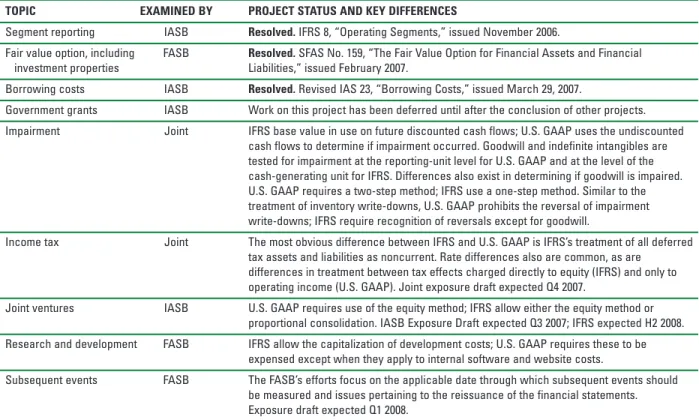
2008. See Table 1 for a list of the short-term conver-gence projects. The table provides information on which Board is examining the topic, the underlying dif-ferences between IFRS and U.S. GAAP, and the status of the project as of July 2007.4
As indicated in Table 1, three of the short-term con-vergence projects have been completed: IFRS 8, “Operating Segments,” was issued by the IASB in 2006; Statement of Financial Accounting Standards (SFAS) No. 159, “The Fair Value Option for Financial Assets and Financial Liabilities—Including an amend-ment of FASB Stateamend-ment No. 115,” was issued by the FASB in 2007; and Revised IAS 23, “Borrowing Costs,” was issued by the IASB in 2007. Completion of these projects indicates that significant accounting differences in these topics no longer exist. For the six ongoing proj-ects, the project status and key differences column of Table 1 describes the existing points of divergence between IFRS and U.S. GAAP, and it provides the expected timetable for each project. Exposure drafts are expected for three of the projects (income taxes, joint ventures, and subsequent events) by the first quarter of 2008. Neither the FASB nor the IASB website lists the anticipated work schedule for projects related to impair-ments or research and development. The IASB website indicates that work on government grants is deferred until other projects are completed.
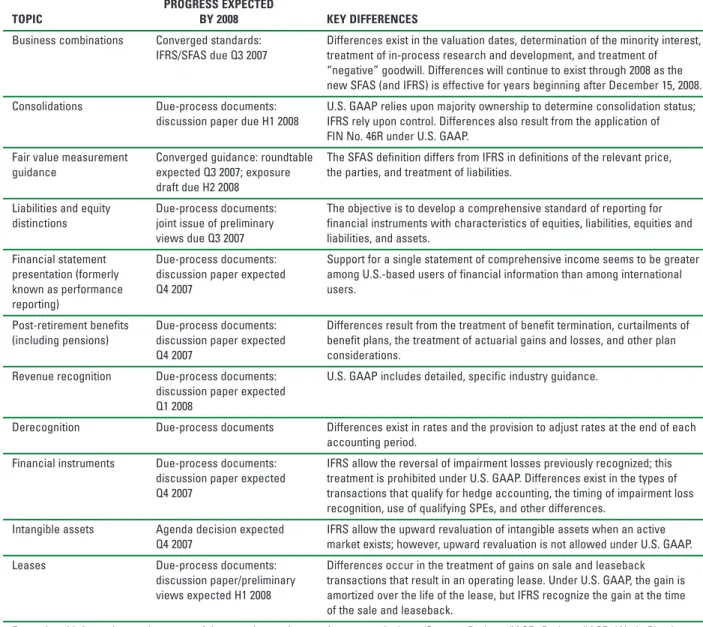
Long-term Convergence Projects.The Boards identi-fied 11 long-term “areas of focus” that will be complet-ed or in process by the end of 2008. Table 2 lists the long-term projects in the order in which they were announced, details the progress expected by 2008, and provides key differences between the two Boards’ stan-dards.5The first seven topics were on the agendas of both Boards when the Roadmap for Convergence was announced; the last four topics were not on the active agendas then. While the Boards anticipate issuing con-verged standards in the area of business combinations during 2007 and converged guidance on measuring fair values during 2008, the other topic areas are in prelimi-nary stages of development.
Together, the short- and long-term lists include 20 different reporting areas. Differences in three of the areas have been resolved (fair-value option, segment reporting, and borrowing costs). One or both Boards
3
M A N A G E M E N T A C C O U N T I N G Q U A R T E R L Y S U M M E R 2 0 0 7 , V O L . 8 , N O . 4 have indicated that differences in business
combina-tions and measuring fair values should be resolved no later than 2008. Even if the two Boards are able to com-plete the anticipated work on schedule, differences between IFRS and U.S. GAAP will continue for many years in those topics for which only the due-process documents or decisions on scope and timing are antici-pated by 2008.
DI F F E R E N C E S I N OT H E R RE P O R T I N G AR E A S
Some noteworthy differences between the reporting standards are not addressed by either the short- or long-term convergence project. These differences that affect many industries include:
Inventory—Two key differences exist in the area of inventory valuation. First, IFRS prohibits the use of the LIFO (Last-in, First-out) inventory valuation method allowed under U.S. GAAP. Second, IFRS requires the
reversal of inventory write-downs under certain condi-tions, whereas reversals are prohibited under U.S. GAAP.
Property, Plant, and Equipment—The most obvious and significant difference is that IFRS allows compa-nies to revalue property, plant, and equipment to fair value while U.S. GAAP relies on historic cost.
Share-based Payments—Differences exist in the treat-ments of volatility, the measurement date, and the determination of expense when awards are modified.
EX A M P L E S O F CO M PA N Y DI F F E R E N C E S
B E T W E E N I F R S A N D U. S . G A A P
NE T IN C O M E S
Some differences between IFRS and U.S. GAAP result in immaterial or small differences between their income calculations, while others result in significant changes in net income. One way to determine the impact of the
Table 1:
SHORT-TERM CONVERGENCE PROJECTS
TOPIC EXAMINED BY PROJECT STATUS AND KEY DIFFERENCES
Segment reporting IASB Resolved.IFRS 8, “Operating Segments,” issued November 2006.
Fair value option, including FASB Resolved.SFAS No. 159, “The Fair Value Option for Financial Assets and Financial investment properties Liabilities,” issued February 2007.
Borrowing costs IASB Resolved.Revised IAS 23, “Borrowing Costs,” issued March 29, 2007.
Government grants IASB Work on this project has been deferred until after the conclusion of other projects. Impairment Joint IFRS base value in use on future discounted cash flows; U.S. GAAP uses the undiscounted
cash flows to determine if impairment occurred. Goodwill and indefinite intangibles are tested for impairment at the reporting-unit level for U.S. GAAP and at the level of the cash-generating unit for IFRS. Differences also exist in determining if goodwill is impaired. U.S. GAAP requires a two-step method; IFRS use a one-step method. Similar to the treatment of inventory write-downs, U.S. GAAP prohibits the reversal of impairment write-downs; IFRS require recognition of reversals except for goodwill.
Income tax Joint The most obvious difference between IFRS and U.S. GAAP is IFRS’s treatment of all deferred tax assets and liabilities as noncurrent. Rate differences also are common, as are
differences in treatment between tax effects charged directly to equity (IFRS) and only to operating income (U.S. GAAP). Joint exposure draft expected Q4 2007.
Joint ventures IASB U.S. GAAP requires use of the equity method; IFRS allow either the equity method or proportional consolidation. IASB Exposure Draft expected Q3 2007; IFRS expected H2 2008. Research and development FASB IFRS allow the capitalization of development costs; U.S. GAAP requires these to be
expensed except when they apply to internal software and website costs.
Subsequent events FASB The FASB’s efforts focus on the applicable date through which subsequent events should be measured and issues pertaining to the reissuance of the financial statements. Exposure draft expected Q1 2008.
For updated information on the status of these projects, please refer to www.iasb.org/Current+Projects/IASB+Projects/IASB+Work+Plan.htm and www.fasb.org/project. Information included in Table 1 reflects the information on the two websites as of July 19, 2007.
differences is to apply both sets of financial reporting standards to the same underlying financial information. U.S. users of IFRS-based financial reports may find themselves doing just that to derive comparative U.S. GAAP results to evaluate potential investments. Anoth-er way to identify whAnoth-ere significant diffAnoth-erences exist between IFRS and U.S. GAAP is to review company-prepared reconciliations of IFRS to U.S. GAAP net income and equity. These can be found in some Form
20-Fs filed with the SEC.
Form 20-Fs are filed on an annual basis by foreign private issuers with securities traded on U.S. markets and exchanges. Foreign private issuers are defined as those companies in which the majority of shareholders and officers are located outside the United States. Oth-er foreign companies with securities traded on U.S. markets and exchanges file Form 10-K. Companies fil-ing Form 10-K must prepare financial statements in
Table 2:
LONG-TERM CONVERGENCE PROJECTS
PROGRESS EXPECTED
TOPIC BY 2008 KEY DIFFERENCES
Business combinations Converged standards: Differences exist in the valuation dates, determination of the minority interest, IFRS/SFAS due Q3 2007 treatment of in-process research and development, and treatment of
“negative” goodwill. Differences will continue to exist through 2008 as the new SFAS (and IFRS) is effective for years beginning after December 15, 2008. Consolidations Due-process documents: U.S. GAAP relies upon majority ownership to determine consolidation status;
discussion paper due H1 2008 IFRS rely upon control. Differences also result from the application of FIN No. 46R under U.S. GAAP.
Fair value measurement Converged guidance: roundtable The SFAS definition differs from IFRS in definitions of the relevant price, guidance expected Q3 2007; exposure the parties, and treatment of liabilities.
draft due H2 2008
Liabilities and equity Due-process documents: The objective is to develop a comprehensive standard of reporting for distinctions joint issue of preliminary financial instruments with characteristics of equities, liabilities, equities and
views due Q3 2007 liabilities, and assets.
Financial statement Due-process documents: Support for a single statement of comprehensive income seems to be greater presentation (formerly discussion paper expected among U.S.-based users of financial information than among international
known as performance Q4 2007 users.
reporting)
Post-retirement benefits Due-process documents: Differences result from the treatment of benefit termination, curtailments of (including pensions) discussion paper expected benefit plans, the treatment of actuarial gains and losses, and other plan
Q4 2007 considerations.
Revenue recognition Due-process documents: U.S. GAAP includes detailed, specific industry guidance. discussion paper expected
Q1 2008
Derecognition Due-process documents Differences exist in rates and the provision to adjust rates at the end of each accounting period.
Financial instruments Due-process documents: IFRS allow the reversal of impairment losses previously recognized; this discussion paper expected treatment is prohibited under U.S. GAAP. Differences exist in the types of Q4 2007 transactions that qualify for hedge accounting, the timing of impairment loss
recognition, use of qualifying SPEs, and other differences.
Intangible assets Agenda decision expected IFRS allow the upward revaluation of intangible assets when an active Q4 2007 market exists; however, upward revaluation is not allowed under U.S. GAAP. Leases Due-process documents: Differences occur in the treatment of gains on sale and leaseback
discussion paper/preliminary transactions that result in an operating lease. Under U.S. GAAP, the gain is views expected H1 2008 amortized over the life of the lease, but IFRS recognize the gain at the time
of the sale and leaseback.
For updated information on the status of these projects, please refer to www.iasb.org/Current+Projects/IASB+Projects/IASB+Work+Plan.htm and www.fasb.org/project. Information included in Table 2 reflects the information on the two websites as of
5
M A N A G E M E N T A C C O U N T I N G Q U A R T E R L Y S U M M E R 2 0 0 7 , V O L . 8 , N O . 4 accordance with U.S. GAAP. Companies filing Form
20-F may submit their financial statements in accor-dance with U.S. GAAP or in accoraccor-dance with non-U.S. GAAP. If non-U.S. GAAP is used (for example, if the company prepares its financial statements in accordance with IFRS), the company must then reconcile income and equity determined under that basis of accounting to the amounts determined under U.S. GAAP. The 20-F reconciliations of IFRS to U.S. GAAP net income and equity clearly indicate where differences between IFRS and U.S. GAAP occur. The reconciliations also provide explanations for each of the reconciling items, allowing readers to determine if the differences will recur on an annual basis or are a one-time occurrence.
On June 21, 2007, the Securities & Exchange Com-mission (SEC) reiterated the possibility of allowing U.S. companies to file regulatory reports in accordance with IFRS.6These developments further emphasize the need for U.S. accountants to familiarize themselves with the differences between the two sets of standards.
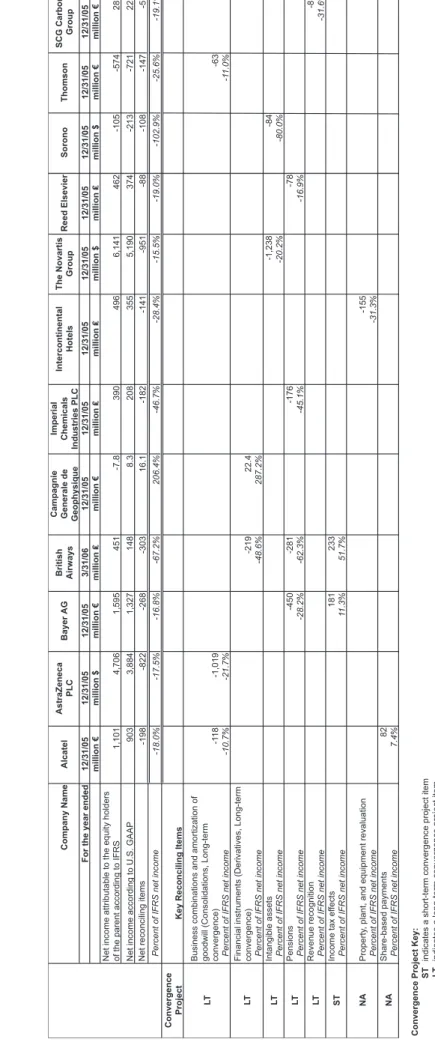
We selected 12 EU company Form 20-Fs filed in accordance with IFRS for 2005 to illustrate where sig-nificant differences occur between IFRS and U.S. GAAP.7Table 3 lists each of the sampled companies and summarizes the net income determined under IFRS and U.S. GAAP, the difference in the incomes, and the relative size of the difference as a percentage of IFRS net income. We reviewed the individual reconcil-ing items and identified those greater than 10% of IFRS net income. These reconciling items are also shown in Table 3. The reconciling items are classified as relating to a long-term convergence project topic (LT), a short-term project topic (ST), or a topic not addressed by either convergence project (NA).
As shown in Table 3, converting IFRS net income to its U.S. GAAP equivalent generally reduces net income. Specifically, it decreased the net income of nine compa-nies, increased the net income of one company, and increased the net loss of two. The change in net income ranged from a decrease of $951 million for Novartis to an increase of €16 million for Campagnie Generale de Geophysique. When the change in net income is divid-ed by IFRS net income, the effects of the change range from a decrease of 67.2% to an increase of 206.4%. The changes occurred because of reconciling items related
to topics included in the short- and long-term gence projects and areas not included in the conver-gence projects.
Reconciling items included in the long-term conver-gence projects resulted in income-reducing adjustments related to pensions and other post-retirement benefits (four companies), business combinations (three compa-nies), intangible assets (two compacompa-nies), and revenue recognition (one company). Two companies included reconciling items related to financial instruments: In one case, income was increased, and, in the other, income was reduced.
Among the nine short-term convergence project top-ics, we found that only the topic of income-tax effects resulted in significant reconciling items, and that item is seen in the reconciliations of two companies. Within the topics for which no convergence projects are planned, property, plant, and equipment reporting differences resulted in a 31.3% reduction in IFRS net income for Intercontinental Hotels, and differences in reporting share-based payments increased Alcatel’s IFRS net income by 7.4%. Although this reconciling item is less than the 10% of IFRS net income we used as a cutoff in identifying other reconciling items, we show it to illus-trate that companies include reconciling items related to many topics that could have a substantial impact on net income.
To understand the net income effect of differences in U.S. GAAP and IFRS, it is also important to consider reconciling item effects by company. Seven of the 12 companies included in Table 3 had only one significant reconciling item. The other five companies had a vari-ety of reconciling items. When offsetting items exist, the net change in income from IFRS to U.S. GAAP may not reveal significant differences between the two sets of accounting standards.
For example, Novartis reported IFRS net income (in millions) of $6,141 and U.S. GAAP net income of $5,190, a difference of $951 (16% of IFRS net income). Accounting for intangible assets resulted in a $1,248 reconciling item (20.2% of IFRS net income). No other significant reconciling items were included for 2006. A different pattern is seen in British Airways’s March 31, 2006, reconciliation.8IFRS net income was reported (in millions of British pounds) as £451, U.S. GAAP net
Company Name Alcatel AstraZeneca PLC Bayer AG British Airways Campagnie Generale de Geophysique Imperial Chemicals Industries PLC Intercontinental Hotels The Novartis Group Reed Elsevier
For the year ended
12/31/05 12/31/05 12/31/05 3/31/06 12/31/05 12/31/05 12/31/05 12/31/05 12/31/05 million € million $ million € million € million $
Net income attributable to the equity holders of the parent according to IFRS
1,101 4,706 1,595 451 -7.8 390 496 6,141 462
Net income according to U.S. GAAP
903 3,884 1,327 148 8.3 208 355 5,190 374
Net reconciling items
-198 -822 -268 -303 16.1 -182 -141 -951 -88
Percent of IFRS net income
-18.0% -17.5% -16.8% -67.2% 206.4% -46.7% -28.4% -15.5% -19.0% Convergence Project
Key Reconciling Items
Business combinations and amortization of goodwill (Consolidations, Long-term convergence)
-1
18
-1,019
Percent of IFRS net income
-10.7%
-21.7%
Financial instruments (Derivatives, Long-term convergence)
-219
22.4
Percent of IFRS net income
-48.6%
287.2%
Intangible assets
-1,238
Percent of IFRS net income
-20.2% Pensions -450 -281 -176 -78
Percent of IFRS net income
-28.2%
-62.3%
-45.1%
-16.9%
Revenue recognition Percent of IFRS net income Income
tax
ef
fects
181
233
Percent of IFRS net income
11 .3% 51.7% Property , plant, and equipment revaluation -155
Percent of IFRS net income
-31.3%
Share-based payments
82
Percent of IFRS net income
7.4%
ST
indicates a short-term convergence project item
LT
indicates a long-term convergence project item
NA
indicates that the topic is not addressed by either convergence project
LT ST NA NA LT LT LT LT Sorono Thomson SCG Carbon Group 12/31/05 12/31/05 12/31/05 million $ million € million € -105 -574 28.2 -213 -721 22.8 -108 -147 -5.4 -102.9% -25.6% -19.1% -63 -1 1.0% -84 -80.0% -8.9 -31.6%
Table 3:
7
M A N A G E M E N T A C C O U N T I N G Q U A R T E R L Y S U M M E R 2 0 0 7 , V O L . 8 , N O . 4 income as £148, resulting in a difference of £303 (67.2%
of IFRS net income). Three significant items were included in the reconciliation: Differences in reporting financial instruments reduced income by £219, differ-ences in pensions reduced income by £281, and income-tax effects increased IFRS net income by £233.
The reconciling items included in Table 3 also indi-cate that reconciling items pertaining to a specific topic may increase IFRS net income for one company and decrease it for another. These mixed effects make it difficult to anticipate whether the presence of these items will increase or decrease IFRS net income. Therefore, the effects of reporting differences in these topic areas must be considered on a company-specific basis.
DI S C U S S I O N A N D CH E C K L I S T
Accountants in the United States are increasingly more likely to encounter situations with customers, suppliers, or potential acquisition candidates that require both an understanding of where U.S. GAAP and IFRS differ and the ability to estimate the potential impact of these differences. Current differences between U.S. GAAP and IFRS, as well as examples taken from Form 20-F reconciliations, illustrate the potential magnitude of the resulting income differences.
In our small sample of 12 Form 20-F reconciliations, we identified material reconciling items that correspond with five long-term convergence project topics, one short-term convergence project item, and two topics not included in the convergence projects. Work on most of the convergence project topics is in the initial phase, so most reconciling items will continue to exist through at least 2008, and some differences may persist much longer. When you combine the evidence that differ-ences may be material with the understanding that income differences are likely to persist for several years, you see why U.S. accountants should understand where differences are likely to occur and why they should adjust for these differences when evaluating or compar-ing companies that report under the two different sets of accounting standards.
When evaluating or comparing companies that use different sets of reporting standards, accountants might want to consider the following questions. Although this
is not a complete checklist, it could help them identify factors that contribute to significant reporting differ-ences in their global operations.
1. Has the company made a significant acquisition dur-ing the past year? What is the IFRS impact of the acquisition compared to the impact when measured using U.S. GAAP?
2. Has the company elected to revalue property, plant, and equipment under IFRS? Check the notes for disclosure.
3. Does the company utilize financial instruments? Again, check the notes, and estimate the reduction in U.S. GAAP net income.
4. Be clear about the standards governing revenue recognition. IFRS do not require companies to rec-ognize up-front fees over the life of a contract, but U.S. GAAP does. What is the potential need for rev-enue adjustment?
5. IFRS do not allow the use of LIFO to estimate inventory cost. This restriction may actually simplify a financial evaluation or comparison of companies because the restriction eliminates the possible need to adjust LIFO inventory amounts to in, First-out (FIFO) values for foreign companies.
6. Disclosures under IFRS are likely to be less compre-hensive than under U.S. GAAP. When dealing with disclosures under IFRS, plan to look through multi-ple notes, and be ready to piece together fragmented disclosures from multiple locations in order to obtain the complete disclosure about a topic.9
Readers should keep in mind that the Boards and the SEC have acknowledged that it will take many years to achieve a common set of high-quality standards. Taking the time to identify where differences occur between the two sets of standards and the impact of those differ-ences should result in better decision making for many years to come. ■
Susan B. Hughes, Ph.D., CPA, is an associate professor of accounting at the University of Vermont, Burlington. You can reach Susan at [email protected].
James F. Sander, Ph.D., CPA, is an associate professor of accounting at Butler University, Indianapolis, Ind. You can reach James at [email protected].
EN D N O T E S
1 Information on Canada’s planned adoption of IFRS can be found in “Implementing Plan for Incorporating International Financial Reporting Standards into Canadian GAAP,” www.acsb canada.org/client_asset/document/3/2/7/3/5/document_8 B452E12-FAF5-7113-C4CB8F89B38BC6F8.pdf?sfgdata=4. 2 International Accounting Standards Board and the Financial Accounting Standards Board, Memorandum of Understanding
between the FASB and the IASB: A Roadmap for Convergence between IFRSs and U.S. GAAP—2006-2008, February 27, 2006.
3 International Accounting Standards Board, “No New Major Standards to be Effective before 2009,” 2006. www.iasb.org/ Current+Projects/No+new+major+standards+to+be+effective+ before+2009.htm?m=print.
4 The status of the short- and long-term convergence projects included in this article was last updated on July 19, 2007. Read-ers should access the Current Projects link on the IASB (www.iasb.org) and the FASB (www.fasb.org) websites to identi-fy later progress on the projects.
5 See Deloitte, “IFRSs and U.S. GAAP: A Pocket Companion,” March 2007, for more detail about the differences between IFRS and U.S. GAAP. www.IASPLUS.com/dttpubs/pubs.htm# mar2007.
6 Kara Scannell and David Reilly, “Foreign Affair: Is End Near for ‘U.S. Only’ Accounting?” The Wall Street Journal, June 21, 2007, C1-2. See also Securities & Exchange Commission Releases Nos. 33-8818; 34-55998; International Series Release No. 1302; File No. S7-13-07, Acceptance from Foreign Private
Issuers of Financial Statements Prepared in Accordance with Interna-tional Financial Reporting Standards without Reconciliation to U.S. GAAP.
7 Readers interested in locating additional 20-F reconciliations should refer to Staff Comments on Annual Reports Containing Financial Statements Prepared for the First Time on the Basis of International Financial Reporting Standards (www.sec.gov/ divisions/corpfin/ifrs_reviews.htm) or to Susan B. Hughes, “Using Form 20-F Reconciliations to Internationalize an Accounting Course,” Accounting Education, 2007.
8 British Airways’s year-end is March 31, so those statements are as of March 31, 2006.
9 A summary of the SEC Staff Comments pertaining to the first-year review of IFRS-based financial statement disclosures can be found at www.sec.gov/divisions/corpfin/ifrs_staffobservations. htm.