Al Masum, M. and Parker, L. D. (2020) Local implementation of global accounting reform: evidence from a developing country. Qualitative Research in Accounting and Management, (doi: 10.1108/QRAM-10-2018-0073)
There may be differences between this version and the published version. You are advised to consult the publisher’s version if you wish to cite from it.
http://eprints.gla.ac.uk/209807/
Deposited on 10 February 2020
Enlighten – Research publications by members of the University of Glasgow http://eprints.gla.ac.uk
1
Local implementation of global accounting reform: evidence
from a developing country
Mahmud Al Masum
Adelaide Business School, University of Adelaide, SA 5005, Australia, and
Lee D. Parker
Distinguished Professor of Accounting, School of Accounting, RMIT University, Melbourne, Australia; Research Professor of Accounting, University of Glasgow, Scotland Abstract
Purpose - While the world-wide adoption of International Financial Reporting Standards (IFRS) aims to eliminate differences in national accounting standards between countries, the socio-political institutions surrounding financial reporting practices remain localised. This paper aims to penetrate and reveal the manner in which local national context, stakeholder intentions and financial reporting practices can moderate the compliance with IFRS in a developing country.
Design/methodology – An interview-based qualitative research framework was utilised to analyse the experience and attitudes of accountants, auditors and financial reporting regulators during a passage of accounting reform initiatives.
Findings – This paper provides a critical analysis of the financial reporting practices of a developing country that has ostensibly implemented accounting reforms prescribed by the World Bank. It has revealed the key firm- and field-level logics that are experienced and managed by regulators and corporate managers in their approaches to financial reporting and accountability. The World Bank-led accounting reform can be constrained by a complex mix of institutional logics originating from market and corporate structures, networks of institutionalised family and political relationships, professional and regulatory structure and resourcing limitations, and cultural business conventions. This paper provides evidence of firm- and field-level logics that contest and influence the emergence of a financial reporting oversight body and lead to highly variable compliance with international accounting standards.
Originality/value – This paper aims to extend our knowledge beyond broad national-level elements of institutional orders. It presents a more penetrating examination of the existence and contestation of logics originating from various local and global actors and interests. It presents a theoretical mapping of institutional logics which operate in international and local settings and also encompass firm- and field-level imperatives. Any effort to understand and improve accounting practices of a developing country need to consider the power, contestation and influence of multiple logics operating in its institutional environment.
Keywords - Financial reporting, Developing countries, corporate governance, Regulation & IFRS.
Paper type – Research paper
1.
Introduction
Many countries have now adopted International Financial Reporting Standards (IFRS) as their national accounting standards. The widespread adoption of IFRS provides an opportunity to
2
evaluate the impact of global accounting standards in local environment. This issue has become more prevalent as the development of IFRS is significantly influenced by Anglo Saxon developed countries1. Most research published in the accounting literature has investigated
the implementation of IFRS in the economically developed western world (Street, 2012; Nurunnabi, 2014; Gray et al. 2009). The IFRS is now used as national accounting standards in 116 countries of the world (International Accounting Standards Board [IASB], 2016). Developing countries represent the majority of these IFRS jurisdictions. Three quarters of the world’s population is located in the developing countries and given their economic and social significance, accounting and associated accountability practices of these countries are relatively opaque.
The implementation and compliance with accounting standards in the context of a developing country is the domain area for this investigation. This paper aims to contribute to that domain by providing a deeper field-level account of regulations and accounting practices in Bangladesh. The development of IFRS is influenced by western developed countries and assumes a capital market-driven demand for accounting information. These institutional characteristics are not necessarily prevalent in developing countries who adopt IFRS as their national standards. Puxty et al. (1987) and Chua and Poullaos (1998) argued that Anglo-American models of governance rely on a number of institutional forces such as well-developed capital markets, established accounting bodies and democratic institutions. Uddin and Choudhury (2008) questioned the suitability of regulations developed in western society (such as the USA and UK) to a traditional society like Bangladesh. Drawing on Weber’s notions of traditionalism, they showed that the Bangladesh business environment characterises a number of features of a traditional society such as corporate ownership concentrated in few families, family-led politics, poverty, business linked to political powers and loyalty toward powerful people rather than formal authority. Uddin (2009) demonstrated that the managers of even large publicly-listed companies are inclined to serve the sponsoring directors (and their families), often at the expense of other stakeholders.
Bangladesh, like many developing countries, is characterised by a small capital market, bank-led external finance, and family ownership: similar features of many developing countries (Tsamenyi and Uddin, 2008). While every individual country, including the developing ones, are distinct in some aspects, the field-level knowledge about what has and has not been effective and under what circumstances can provide valuable contextual knowledge about the workings of a global accounting framework such as IFRS within a traditional society like Bangladesh. The findings from this study generates useful insights into how accounting regulations such as IFRS are practised in developing countries. This research offers an analytical generalisation by relating financial reporting motivations, pressures and practices to social processes and relations (Parker and Northcott, 2016). The knowledge accumulated in the research represents a ‘process generalisation’ (Simons, 2009) which may be transferable between and among developing countries’ contexts. The knowledge about the local institutional framework can be useful for World Bank and other international development organisations who are increasingly playing an important role in shaping the accounting and accountability in developing countries (Uddin and Choudhury, 2008).
3
The economic growth and increasing connectedness to global trade has made Bangladesh a relevant setting in which to evaluate its accounting practices. With a current population of about 160 million, Bangladesh aims to be a middle-income country by 2021 (Raihan, 2016). PricewaterhouseCoopers predicted that Bangladesh would be the 28th largest economy by 2030, from 31st in 2016 (Daily Star, 2017). In the context of the Bangladesh Government’s aspiration for future economic development and foreign investment, corporate accounting practices are increasingly become relevant to local and international investors. This paper investigates how the World Bank’s effort to improve financial reporting practices interacts with local institutions and actors in Bangladesh. The paper focusses on how financial reporting standards (IFRS in the context of Bangladesh) are implemented and what institutions and forces shape financial reporting practices and their extent of compliance with IFRS. The study also aims to penetrate and explicate the multiple institutional logics that prevail at various institutional and organisational levels, thereby influencing the extent of compliance with IFRS in Bangladesh.
This paper employs a processual view (Parker, 2007) of the reporting environment of Bangladesh to identify and analyse the complex interplay of actors and institutions in resisting and implementing financial reporting reforms. It argues that such a processual view enhances our understanding about ‘how’ things work in the local reporting environment and ‘what’ influences such practices. Interviewing important stakeholders within the financial reporting environment offers an explanation that goes beyond a statistical measure of compliance with IFRS. Existing research has provided evidence about broad determinants (such as ineffective enforcement, weak accounting profession and small capital market) affecting compliance with accounting standards in developing countries. These studies (as discussed in Section 2) have mostly utilised cross-sectional statistical analysis of disclosure adequacy in annual reports of listed companies. The disclosure adequacy has been measured by comparing the content of the financial statements against a check-list prepared by researchers. While these past research papers reveal important generic and broad-level determinants of compliance with accounting standards, we argue that our understanding can be extended by knowing how the firm- and field-level logics and practices construct the higher-level institutional logics. Existing literature has identified the basic national level determinants of compliance with IFRS. Moving on from that foundation, the overall objective of this paper is to uncover field-based logics that shape actual financial reporting incentives and practices. The objective will be addressed by investigating three research questions (RQ):
RQ 1: What and how do firm-level logics (familial corporate ownerships and corporate governance practices) influence corporate compliance with IFRS?
RQ 2: What and how do field-level logics (regulations, accounting profession and financial institutions) contribute to corporate compliance with IFRS?
RQ 3: What logics underlie any change in regulatory arrangements?
Through investigating these research questions, the paper aims to address Lounsbury’s (2008) call for institutional researchers to go beyond broad structural elements of institutional orders. To understand how broad structural elements influence ground level practices, we investigated how familial control impacts corporate management and its financial reporting, the roles of external capital providers (banks) in institutionalising accounting practices in
4
businesses and the impact of regulations on reporting and auditing practices. Rather than relying on a set of broad-level structural elements (such as stock market size, foreign investments, common versus code law origins), we investigate how institutional pressures and incentives are experienced and managed at firm-level by preparers and users of financial reports. This paper provides direct evidence of how preparers, users and regulators of financial reports practice, enforce and negotiate international accounting standards in a developing country context.
The paper is structured with following six sections. Section 2 provides a discussion about the literature on compliance with accounting standards in developing countries and how this paper positions itself relative to that literature. The next section will explain the theoretical framework, followed by an outline of the research methodology employed in this study. An analysis of interviews and documentary evidence will be then presented in section 5 and finally an overall discussion and conclusion will be provided.
2.
Literature and gap
Samaha and Khlif (2016) have reviewed the literature on IFRS adoption and compliance in developing countries. They concluded that compared to developed countries, IFRS implementation issues remain under-researched in developing countries. The majority of the IFRS literature focusses on discussing the actors and interests who have been influential in the adoption of IFRS as national accounting standards. This literature provides some evidence of institutional logics underpinning IFRS-adoption. Thus Nobes (1998) argued that a country’s financial reporting system is influenced by the prevalent modes of external financing. His model predicted that a country’s financial system that is dominated by bank financing rather than capital market financing would diminish the importance of external reporting and associated financial reporting regulations. As a further example, Boolaky et al. (2018) attributed the existence and growth of a capital market as the motivation for adopting IFRS in four Middle Eastern and North African countries. Thus jurisdictions that are perceived to make their capital market accessible to foreign investors are more likely to adopt IFRS (Hope et al., 2006) as a strategic response to transnational pressures as well as local factors (Alon and Dwyer, 2014). Further drivers for IFRS adoption have been found to include a country’s foreign aid dependence, its reliance on international trade and the level of education with its national economy (Judge et al., 2010).
While identifying drivers and logics for IFRS adoption, this literature does not provide a critical assessment of the outcome of IFRS adoption with respect to such issues as organisational transparency, market efficiency, financial market development and foreign investments. This is particularly important as many developing countries, despite their adoption of IFRS, have nonetheless encountered institutional weaknesses such as a weak capital market, and a lack of corporate transparency and accountability (Uddin and Choudhury, 2008; Claessens and Fan, 2002). There are few studies that have investigated the implementation experience of IFRS in developing countries. Three studies of China GAAP versus IFRS financial reporting have been published. Overall they found substantial differences between Chinese GAAP and IFRS financial statements (Lin and Wang, 2001) with the 1998 Chinese government’s reforms to
5
harmonise the Chinese GAAP and IFRS not reducing the gap between Chinese GAAP-based and IFRS-based earnings (Chen et al., 2002). This gap has been attributed to weak enforcement, lack of accounting infrastructure and low quality auditing in China. However, more recently, an observed decline in earnings difference between Chinese GAAP and IFRS has been attributed to the Chinese Government’s 2001 compliance policy implementation (Chen and Zhang, 2010). In other national jurisdictions, variable compliance with IFRS by listed companies has been reported. These include high compliance by companies listed on the Zimbabwe (Chamisa, 2000) and the Saudi (Naser and Nuseibeh, 2003) Stock Exchanges and variable disclosure and compliance of accounting policies among Asia-Pacific countries (Taplin et al., 2002). Thus research on compliance with IFRS or indeed with national accounting standards has produced mixed results.
Research suggests that compliance with accounting standards largely depends on country- and firm-specific characteristics. However most existing research has utilised statistical analysis of earnings quality to identify broad and high-level determinants of compliance with accounting standards. These studies have investigated IFRS adoption and implementation using aggregate and broad-level determinants such as the legal systems (code versus common laws), capital market size and compliance index (comparing annual report disclosures against self-constructed checklists). While this evidence has made a valuable contribution to our understanding of broad-level determinants of accounting regulations, this study offers a firm- and field-level investigation that reveals how the local professional, social and political actors and interests mediate the influence and efficacy of IFRS in a developing country.
Decision usefulness and accountability are embedded in the formulations of IFRS. This assumes the existence of a large stock market accompanied by a demand for accounting information for aiding shareholders’ investment decisions. Many developing countries like Bangladesh do not have a large capital market. In the absence of stock market-led demand for accounting information, we need to investigate the incentives and pressures for financial reporting and associated accountability. For example, as the primary provider of external funding, the role of financial institutions in financial reporting governance requires careful investigation. Claessens and Fan (2002) called for future research on the role of financial institutions in corporate governance while Holland (1999) has explored how some UK financial institutions pursue a corporate governance agenda with their client companies. This paper investigates whether the financial institutions in Bangladesh exert influence and pressure on the borrowers to understand and improve their governance processes including financial reporting practice.
Research has provided evidence that institutional characteristics such as corporate ownership are not necessarily dispersed as in the case of some industrial western economies such the United Kingdom and Unites States. Majority shares of a typical Asian corporation are held by one or several members of a family (Claessens and Fan, 2002). A family often realizes effective control of the companies in the group using stock pyramids and cross shareholding (Yeh et al., 2001). In such family-controlled environment, it is important to investigate how the managers provide accounting information to outside shareholders and other constituents such as banks. This paper investigates the influence of such familial corporate ownership over the financial reporting practices in a developing country.
6
By employing qualitative research methodology, this study aims to reveal firm- and field-level behaviours, constraints and pressures that shape accounting practices in a developing country. Accordingly, it enhances the existing literature in two ways. First, it does not limit itself to the broad-level forces (such as foreign investment dependence or World Bank’s pressures) that require a developing country to adopt IFRS as its national standard. It extends the literature by providing empirical evidence about the implementation experience of IFRS in a developing country context. Second, it employs an institutional logics framework that maps logics prevailing at firm- and field-levels. It addresses the role of financial institutions in financial reporting governance, the emergence of a new financial reporting regulator logic and characteristics of the local environment. This micro-processual view of financial reporting practices and their determinants will add value to our understanding of accounting practices in a developing country like Bangladesh.
3.
Theoretical approach
Accounting practices in Bangladesh have been explored in this paper using the institutional logics perspective to inform the analysis and interpretation of interview data and supporting documentary evidence. In this way, we aim to illuminate how institutions in the global and local spaces contribute to shaping the implementation of IFRS. The basic New Institutional Theory (NIT) proposition argues that organisations follow institutional norms in order to achieve legitimacy. This legitimacy-seeking compliance with institutional arrangements may result in structural uniformity among organisations in a field (Meyer and Rowan, 1977). Thus the adoption of IFRS by many developing countries may resemble a structural uniformity in relation to accounting standards. However, what influence this has on actual reporting practices at local levels remains unclear.
NIT assists our interpretation of financial reporting practices in Bangladesh during a time when some significant accounting reforms have taken place. For example, DiMaggio and Powell’s (1983) coercive, normative and mimetic reasons for assuming institutional norms have the potential to explain Bangladesh’s adoption of IFRS and financial reporting oversight structures. Organisations may respond to institutional pressures through ceremonial conformity where formal structures may decouple from actual practices (Meyer and Rowan, 1977). Oliver (1991) discussed other organisational responses to institutional pressures such as compromise, avoidance, defiance and manipulation. Rather than assuming an imposing constraint, Scott (2008) highlighted the importance of knowing how institutions are addressed in individual organisations and how such practices transform social expectations and legitimacy. Modell (2009) argued that conformity with institutional demands varies across organisations. These varied responses to institutional pressures highlight the power and role of actors in shaping the field-level practices. This means that actors’ power and opportunities not only shape the creation and maintenance of institutions, but also influence field-level compliance.
This paper has utilised Lounsbury’s (2008) theorisation of institutional logics to explain the multiplicity of influences over the financial reporting practices in Bangladesh. An institutional
7
logics perspective locates institutions at individual, organisational, field and societal levels. Thornton et al. (2012) argued that organisational actors are situated in multiple social locations and that institutional orders may originate from family, religion, state, market, professions and organisations. This perspective provides a useful framework for understanding how individual agents and organisational actors’ choices and actions are conditioned by the constraints and opportunities provided by multiple institutions that constitute their environment (Friedland and Alford, 1991). These are present at both local and global levels in relation to financial reporting practices in Bangladesh. Narayan et al. (2017), for example, illustrated how two universities responded differently while addressing an institutional demand for research commercialisation in the tertiary education sector. The responses were shaped by the universities’ respective historical contexts, expertise and strategic positions.
Lounsbury (2001) argues that organisational decision-making requires a more penetrating examination of actors and practices. Friedland and Alford (1991), for example, conceptualised organisational fields as collections of multiple, competing logics that confront managers. The institutional environment could enable managers to choose from a set of logics that correspond to their particular contexts and positions. This notion of multiple logics and a contestation between actor micro-processes and institutions could uncover the determinants of organisation-level practices. This can potentially open up a ‘multi-level, meso range of research’ and expand the scope of institutional analysis (Lounsbury 2008, p. 351).
The concept of institutional logics has revealed a range of explanations of institutional imperatives including institutional rationality (Meyer and Rowan, 1977), practice variation (Lounsbury, 2007) and institutional ambiguity (Meyer and Scott, 1983; D’Aunno et al., 1991). Research has provided evidence that institutional logics can shift over time (Lounsbury, 2002; Thornton and Occasion, 1999). This transforming nature of institutional logics conceptualises institutional environment as fragmented and contested (Schneiberg, 2007; Washington, 2004). For example, Fiss and Zajac (2004) showed that German corporations varied in their adoption of western style corporate governance structures. The dynamics of variations in reporting practice can be driven by multiple logics.
Lounsbury (2008) argued that multiple logics enable ‘variety in cognition orientation and contestation over which practices are appropriate’. Enforcement effectiveness, capital market size, concentrated family ownerships in businesses and political corruption are regarded as broad-level determinants of compliance with accounting standards (such as IFRS) in a developing country. Our study, using an interview-based qualitative research method, aims to find evidence of the pressures on managers and their motivations with respect to financial reporting practices. The interview sample represents managers in a range of organisations and regulators to shed light on how multiple logics influence firm-level financial reporting practices.
Lounsbury (2008) also argued that the challenge for any institutional analysis is to understand how variation in field-level practices results in the creation of socially acceptable new practices. This paper investigates how actual financial practices deviate from expected practices anticipated by IFRS adoption and how such deviations lead to structural changes in
8
the reporting environment. This paper goes on to find some evidence of the emergence of a new logic (formation of a new financial reporting oversight body) in the financial reporting environment. Similarly, the paper evaluates how financial institutions, as the major source of external finance, position themselves in relation to the financial reporting practices of business organisations.
4.
Research method
Bangladesh’s financial reporting environment was investigated as a case study of a developing economy that has adopted World Bank’s prescribed accounting reforms such as IFRS and an oversight body. The utilisation of field-based case study method enables this research project to conduct a holistic investigation and analysis of financial reporting incentives by considering the broader and complex social and environmental context in which accounting operates in Bangladesh (Stake, 2010). Through offering thick description, this study aims to unpack the processes and rationales behind the IFRS implementation process within the context of this case study country (Eriksson and Kovalainen, 2008; Woodside, 2010).
This study employs an embedded single-case study design where attention is paid to various sub-units under the broad area of interest (Yin, 2014). The primary unit of analysis is implementation of accounting reform in Bangladesh. The sub-units include the regulators, report preparers, report users and auditors of financial reporting, regulatory processes, enforcement mechanisms and institutional frameworks. Therefore, the sub-units embrace both the structures and processes to reflect the actions of the relevant actors.
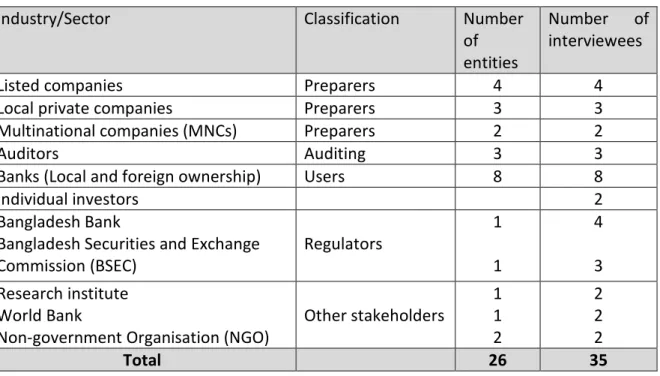
Interviews of relevant stakeholders are the primary source of data for this research project. The initial interviews were conducted in 2009-2010. Subsequent interviews were conducted in 2016. The interviewees’ comments in 2016 were similar to the views expressed in earlier interviews. The Institute of Chartered Accountants of Bangladesh (ICAB) has adopted IFRS as the Bangladesh Financial Reporting Standards (BFRS). Interviews allowed access to important processual and contextual information about the various aspects of the financial reporting environment. Thirty-five interviews with senior managers of various stakeholder organizations were undertaken. Interviewee identification and selection involved purposive sampling based on meeting one or more of the following criteria: preparers and users of financial reports, auditors, regulators, World Bank officials and senior researchers. Table 1 provides a sectoral allocation of interviewees.
Table 1 should be inserted here
The selection of interview respondents paid attention to the need to obtain a variety of perspectives on financial reporting practice in Bangladesh (McKinnon, 1988). The researchers in this study therefore interviewed a range of stakeholders associated with financial reporting practice in Bangladesh. In this way, we sought to penetrate financial reporting stakeholders’ experiences and attitudes (King, 2004; Hennink et al., 2011). They constituted a set of identifiable experiential ‘experts’ in relation to financial reporting practices in Bangladesh, allowing us to address this process from the perspectives of those involved and eliciting what
9
they consider pertinent to accounting reform implementation, influences and outcomes (Meuser and Nagel, 2009). Snowball sampling technique was also utilised, as interviewees often referred to people who have important insights about the area of investigation. Every effort was made to interview such referrals to enrich the understanding of the various governance aspects of financial reporting practice. The overall approach allowed the researchers to obtain information from a wide range of stakeholders. Appendix A provides detail concerning the industry, designation and education of the interviewed participants. This research employed semi-structured interviews of individuals with different perspectives and interests, aiming to identify their perceptions, motivations, decisions and practices (Ferreira and Merchant, 1992; Hennink et al., 2011). The guiding interview questions are included in the Appendix B. Even though a general set of open-ended interview questions was utilised as a guide, the interviewer retained a flexible approach which accommodated the interview taking new directions based on the issues which were discussed by the interviewees. Thus interviews often took the form of a guided conversation and flexible exchange between interviewer and interviewee (Fontana and Frey, 1994). The approach of the researcher was to allow and facilitate the interviewees to express their views, and with the use of probe questions to further penetrate and unpack those views and their explanations (Glesne, 2016). In some cases, the interview questions were based on the ‘leads’ which the interviewer followed up from interviewee to other questions responses (Rubin and Rubin, 1995).
All interviews were audio-recorded and then transcribed in word document format. Field and reflective notes were also utilised to record insights and reflections experienced during and after the interviews. The notes often recorded contradictions or new insights which prompted further investigation by posing new sets of questions. One of the authors possesses knowledge about the financial reporting environment by virtue of prior professional experience in Bangladesh. This provided a valuable contextual understanding about the financial reporting regulation and practices in Bangladesh. Uddin and Choudhury (2008) highlighted the use of researchers’ work experience for facilitating and enhancing insights into data interpretation and analysis.
Initial memos were prepared from the transcribed interview data and field notes. These memos were based on preliminary concepts arising from the interviews and were labelled by assigning blocks of text (interviewee comments) to a particular theme. Following Gioia et al. (2012, p. 21) a data structure was developed with ‘first order concepts’, ‘second order themes’ and ‘overarching (aggregate) dimensions’. Reflecting Gioia et al.’s (2012) data analysis method, Appendix C provides a detailed account of how the interview data were structured and analysed in this study. A similar approach was introduced by Garrett-Jones et al. (2005) where themes were organised into a hierarchy of broad themes and their sub-themes. The texts of a number of interviews are provided to project the context in which the analysis was made. The texts also provide the opportunity to reflect the opinion of the interviewees (Islam and Deegan, 2008).
One important determinant of the compliance with IFRS is the disclosure regulations and their enforcement. In order to understand and explain the interviewees’ positions in relation to the
10
enforcement of disclosure regulations, three legislative Acts (Companies Act 1994, Finance Act 2018 and Bank Company Act 19912) were consulted. This additional documentary
evidence was utilised to reflect the institutional logics that underlie the enforcement pressures and practices in Bangladeshi reporting environment.
5.
Analysis of interview data and documentary evidence
This section presents an analysis of interview data and some documentary evidence (various regulatory Acts regarding financial reporting) to explore the incentives, pressures and capacities within the financial reporting environment during some World Bank-led accounting reforms in Bangladesh. The reflections from the interview data are grouped into five overarching themes, each indicating a set of institutions impacting on financial reporting practices. These classifications reveal that actors and influences span both firm- and field-levels. Overall the evidence suggests that that financial reporting practices within organisations are deeply rooted in the professional and regulatory practices prevailing in the country. While the technical requirements of the accounting standards are important, the actual accounting practices respond to a wide range of institutional forces.
5.1 Familial control over reporting practices and accountability
The interviewed managers identified familial corporate ownership as an influential institutional logic impacting financial reporting practice. The majority of large businesses (including the ones which are listed on the stock exchange) in Bangladesh are controlled by the promoters and their families. The promoters’ families retain enough share-holding rights to control the businesses. In order to reduce the concentration of ownership and control, the Bangladesh Bank (the central bank of Bangladesh) does not allow a person and his/her spouse to be the director for more than six consecutive years and they together cannot hold more than 5% of issued shares in any one bank. However, some entrepreneurs continue to hold majority shares in the names of their relatives and thereby keep the controlling voting rights within the family:
Promoters now keep shares in different names and still control the banks. Still many financial institutions comply with the guidelines in paper, but have not changed their actual practices [Deputy General Manager, Bangladesh Bank].
An NIT perspective pays particular attention to the roles of key actors in microinstitutionalising processes. This leads us to examine the role of key actor groups in Bangladesh corporate governance and financial reporting practice. One such group is families who effectively control many Bangladesh companies. A controlling family dominates the organisational decision making process by occupying key management positions (such as Chief Executive Officer and Head of Operations). That controlling family often appoints a management team who is loyal to them. It is common to find employees who work in a company for their entire career. These employees often hold managerial positions and carry out the instructions of the controlling family. The controlling family exerts significant influence over the recruitment, compensation, and promotion of professional managers
11
including accountants. In a Bangladeshi environment, managers have the economic incentive to act in the best interests of the controlling family shareholders. So financial reporting and transparency are subject to the self-interests and power relations of local actors.
Officially we work in a listed company, but in reality we actually work in a family business. We serve the family owners and they take all the decisions. The family (members) actually gets more benefits in addition to dividend. Even if the company makes a loss, the family owners can take Tk 100,000 monthly. We just show it as an expense. The family members do not need to wait for the company to officially declare dividend. We have to accommodate the various benefits which were taken by the promoters’ families. They receive more than their legitimate entitlements. This is a reflection of weak corporate governance and accounting integrity in Bangladesh corporate environment. [General Manager (Accounts), local large listed group of companies]
The accountability imperative of financial reporting embedded in IFRS is moderated by the family-controlled corporate environment in Bangladesh. The question of consolidated financial statements provides a particular insight into how familial control over corporate groups of companies affect the compliance with IFRS. Concentrated family ownership is common in groups of companies in Bangladesh. Successful business entrepreneurs often diversify into various businesses that operate under the control of the promoters’ families. Interviewed auditors declared that most of the corporate groups do not comply with IFRS 10 Consolidated Financial Statements. The absence of consolidated financial statements is illustrated by the practice of one of the largest group of companies in Bangladesh. The Chief Financial Officer (responsible for the preparation of financial statements) of the group was interviewed for this research. This group (labelled as ‘A’ in this paper) operates several subsidiary companies operating in a number of industries. Most of the subsidiary companies are registered as private entities. A few subsidiaries are listed on the stock exchange with majority shareholding maintained by the promoter’s family. A holding company was formed that owns the shares of the large private companies. The promoter’s family members hold the shares of the holding company, which is registered as a private company. Thus a corporate structure was formed which is not subject to the financial reporting regulations of the stock exchange and Bangladesh Securities and Exchange Commission (BSEC). Once more this reflects controlling families’ manipulation of reporting structures, decoupling actual practice from international standards.
Such noncompliance with international standards, even by some of the largest corporate groups of the country, appears to be often accepted by auditors. For example a partner of one audit firm revealed the following conversation with the Chairperson of group ‘A’ in relation to the preparation of consolidated financial statements:
Audit partner: All the companies within your group work under the control of the holding company. Your group should prepare consolidated financial statements. The member companies within the group are large and regularly involved transactions with banks and other parties.
12
Chairperson of group A: The Companies Act 1994 does not require the preparation of consolidated financial statements. It actually does not mandate the compliance with IFRS for the preparation of financial reports. Explain what would happen, if we do not do it [consolidated financial statements]. If you say that I will get a penalty for not doing it, then I will do it. Otherwise, I will not.
This shows the lack of enforcement of accounting regulations even in the case of a large corporate group audited by a well-known audit firm. This evidence indicates the strength of familial ownership logic that opted for minimal corporate reporting knowing the absence of penalties for non-compliance with accounting standards. A further example relates to consolidated financial statements. An interviewed Chief Financial Officer revealed that all companies within the group ‘A’ work under the common control of the promoter’s families. There are also transactions (sale of goods and services, loans and guarantee) among the member companies of the group. If a bank provides a loan to one company of a group, it would be arguably beneficial for the bank to see the consolidated financial statements of the group. However such statements are not prepared. Furthermore, potential investors do not have the opportunity to examine the consolidated financial statements when one company of a group issues shares in the stock market. Thus as NIT argues, corporations can respond to consolidation standards and regulations in highly creative ways (in case of group A, it is the formation of a holding company which is not listed on a stock exchange) that avoid those requirements and manipulate or suppress disclosure. This leaves other actors such as auditors and investors in passive and powerless positions.
5.2 Corporate governance practices limiting reporting accountability
The BSEC introduced a ‘Corporate Governance Guidance’ for all listed companies in 2006. Companies need to disclose information about their governance processes according to the guideline on a ‘comply or explain’ basis. The guidance encourages companies to establish an audit committee, compliance officer and independent directors. These corporate governance mechanisms were aimed to improve the financial reporting practices and associated accountability in listed companies in Bangladesh. However interviewees also reported that controlling shareholders select their own associates as independent directors. Due to their close relationship with the controlling family owners, many companies’ independent directors do not effectively oversee the activities of the board and management. Many interviewees revealed that independent directors are mostly appointed to secure their specialised services, not to provide an independent review of the operation of the business. Interviewees asserted that reputed information technology specialists or retired bankers are appointed as independent directors to help the company to develop its information system or to obtain loans from the financial institutions. For obtaining loans, the banking regulations of Bangladesh, specify that commercial banks need to ensure that the requirements of a ‘credit risk grading’ are fulfilled by client organisations. This requires the banks to assess governance structure and financial reporting practices of borrowers.
Some of our borrowers do not maintain proper accounting records. They lack the knowledge about the importance of maintaining a proper accounting
13
system. We often estimate the revenue of client organisations based on bank statements and some sales vouchers. We often assume an estimated percentage of the revenue as profit. [Manager of a local bank]
However financial statements of some borrowing organisations are prepared on the basis of the judgement of bank credit officers and are not based on a reliable accounting system. From the observations of interviewees across the study, the banks and their credit risk grading do not contribute to the development of financial reporting and other governance structures in client organisations. Rather the banks prepare simplified information on behalf of corporate clients in ceremonial compliance with their own lending policies. Alternative financial evaluation practices become legitimised as the norm and effectively institutionalised. This reinforces the entrenched decoupling of actual financial reporting and accountability practices from those mandated by corporate regulations and international standards.
From within the banking community, interviewed bank managers argued that the Bangladesh Bank should exert more pressure on banks to play an effective role in improving corporate governance and reporting practices of borrowing companies. They also contended that if some banks are assessing the governance and reporting practices of borrowers whereas other banks are not doing the same, then the latter banks would attract more business as borrowers find it easier to obtain loans from them:
It is not an even playing field. Sometimes when I start assessing the governance and reporting practice of borrowers, they often ask me why I am asking for so many things when other banks do not require anything. Therefore, I make a compromise to secure business. [Senior Manager (Credit) of a local bank]
Weak corporate governance at the firm level has resulted in inadequate financial reporting practices. Though acknowledging the need for accurate and adequate accounting practices, the banks fail to exert any pressure for effective reporting and accountability due to competitive pressures. External financing pressures, either from the banking sector or the small capital market, largely fail to influence financial reporting governance of borrowing companies. The information needs of capital market participants underpinning a western financial reporting model do not resonate in the Bangladesh reporting environment.
5.3 Fair value accounting in underdeveloped capital markets: a misfit
A number of international accounting standards (such as IFRS 13 Fair value measurement; IAS 32 Financial instruments: presentation; IAS 39: Financial instruments: recognition and measurement; and IAS 41: Agriculture) incorporate measurement of assets and liabilities at fair values. This fair value accounting raises some difficulties with respect to accounting practices in Bangladesh. In the absence of an active capital market, fair value accounting allows the utilisation of recent transaction history or valuation models. Interviewed auditors and bank officials were concerned that corporate managers can use this discretion to overstate profit and the asset base of the business in order to secure new loans, or to raise
14
new capital from the stock market. Interviewed managers also highlighted the shortage of technical resources and expertise in the implementation of IFRS:
To my knowledge, there are only two actuaries who are available to assess retirement benefit obligation for businesses. No local companies hire actuary to value the post-employment benefits and liability. [Manager of a listed company]
Interviewees contended that capital markets in Bangladesh are not developed and efficient. In particular, interviewed accountants explained that due to the small size of the stock market and ineffective law and enforcement, a small number of investors often influence the share prices by trading heavily or by spreading rumours in the market. Some interviewed investment bankers also revealed that application of IFRS 32 and 39 would make the accounting profit volatile because of the major fluctuations in the stock prices. Interviewed accountants declared that most of the companies record investment in financial instruments at initial cost. Changes in fair value of investment in financial instruments are not recorded in the income statement. Highlighting the irrational behaviour of the market, one interviewed investment banker said that the price-earnings ratio often reaches above 50 for many companies listed on the stock exchange. Most investors have very little knowledge about the fundamentals of stock valuation and trading strategies.
Most of the shareholders and investors of the stock exchanges here have little knowledge about accounting information. They may see some accounting information, but mostly they transact on word-of-mouth or rumour. There were few occasions where few people manipulated the market prices. These people placed an upward price movement by buying shares in the market. By seeing these upward trends, the general investors become confused and start buying these shares. Once the general inventors start to buy the shares, the manipulators got out of the market by selling the shares. [Senior Manager (Accounts) of a multinational company]
Thus given the Bangladesh market conditions and corporate governance structures, influential actors such as controlling families can creatively and strategically respond to any IFRS adoption pressures, entirely preserving their own interests. In the absence of pressure from the capital market and banks, it is important to see how regulations and their enforcement influence the financial reporting practices.
5.4 Reporting pressures in a weak regulatory enforcement
At the formal institutional level, national reporting regulations present an initial image of regulatory activity and intent. However such national level regulations are not necessarily promoting IFRS and can result in quite different reporting practices and compliance levels. Three regulatory Acts govern the financial reporting practices in Bangladesh. The Companies Act 1994 requires all registered companies to audit their financial reports. However, the Act does not prescribe or mandate any accounting standard (such as IFRS) or auditing standards.
15
In contrast, the Finance Act 2018 requires all private and public companies to prepare and audit financial reports in complying with the IFRS. According to this Act, companies are required to submit the financial reports with their annual income tax return. The third legislative Act, the Bank Company Act 1991, governs the financial reporting requirements in the banking sector. This Act only mandates the former IAS 30 (corresponding to current IFRS 7 and 9, IAS 32 and 39) (Ahmed, 2015). The Act is silent on whether the rest of the IFRS is required to be applied.
With respect to banking regulation, these three regulatory Acts are simultaneously applicable to banking companies. These Acts’ financial reporting regulations are often inconsistent. This resulted in ambiguous financial reporting regulations for banking companies. The Companies Act 1994, Finance Act 2018 and Bank Company Act 1991 should specify the required accounting and auditing standards. Interviewed managers suggested that these Acts need be coordinated to avoid any conflicting regulatory requirements. About one half of the banks and financial institutions are listed on the country’s two stock exchanges. In addition to the three Acts, these listed bank companies are subject to the financial reporting regulations of the BSEC.
There are six agencies occupying the financial reporting regulatory space in Bangladesh. These agencies and associated Acts are often conflicting and result in ambiguity within the regulatory framework. Table 2 provides a list of financial reporting regulators and their regulatory framework. The banking sector is the main source of private sector finance in Bangladesh. Bangladesh Bank regulates 57 banks and 21 non-bank financial institutions. The Bank Company Act 1991 governs the financial reporting requirements in the banking sector. This Act only mandated select number of IFRS. Interviewed senior manager of the Bangladesh Bank highlighted large-scale variations of the financial reporting practices among the financial institutions in Bangladesh.
Insert Table 2 here
With respect to reporting regulation and enforcement, the Registrar of Joint Stock Companies and Firms (RJSC) requires all registered companies and firms to file audited financial statements. The World Bank (2015) found that only 10% of the companies comply with this requirement. Interviewed auditors informed that the RJSC suffers from serious lack of resources, technical expertise and work force to check the quality of financial reports of registered entities. Furthermore, the BSEC requires all listed companies to prepare and audit financial reports in compliance with IFRS and international standards on auditing (ISA). The BSEC’s Corporate Finance Department oversees the financial reporting of listed companies. The listed companies are required to submit their audited financial statements to the BSEC, which however does not have necessary expertise and resources to examine their financial reports. This lack of resources is reflected in the following comments made by one Director of the Corporate Finance Department of the BSEC:
We have three employees who are overseeing the financial reporting of 271 listed companies. We do not have any professionally qualified chartered accountants. This
16
limited resource is a big problem for overseeing the financial reporting practices of the listed companies.
Interviewed auditors and investors contended that inadequate penal actions of the BSEC create limited pressure on companies to comply with disclosure regulations. Interviewed BSEC officials mentioned that companies use their political connections to influence the BSEC’s enforcement actions. The BSEC also faces pressures from political parties to waive many imposed penalties on companies. In most cases, the BSEC enforcement activities are limited to issuing warnings and directives.
The directors of many businesses maintain connections with the political leaders. Our organisation is not outside the socio-political realm of the country. Companies often use their political connection to avoid penalties for non-compliance with accounting standards or breach of disclosure regulations. Often we end up with issuing ‘warnings’ which is a weak forms of enforcement action. [Director of the BSEC]
Institutionalised local legal frameworks and customs present a further limitation to financial reporting compliance. The legal and judiciary system of Bangladesh is not conducive to protecting the rights of investors and creditors. The interviewed managers of the BSEC believed that the majority of general investors are not aware of their legal rights. Enforcement actions of regulators sometimes become ineffective because of lengthy legal processes. Interviewed BSEC enforcement managers explained that companies often appeal to the higher Court and are awarded ‘stay orders’ against the penalties imposed by the BSEC. The legal system allows a repetitive ‘stay order’ for several years, with many cases not reaching any definitive conclusion. This lengthy legal process consumes time and resources and often works as a deterrent to seeking legal action by the regulators and general investors.
We [BSEC] are semi-judicial body. The companies can appeal to the higher court3
against the financial penalty imposed by the BSEC. Once a case goes to the higher court, it takes time to settle the issue. Often, the companies get ‘stay order’ from the higher court to stop the hearing in the BSEC. Many companies take advantage of the limitations of the current legal system to hold the court proceedings for several years. At some stage, we give up and stop pursuing the companies who breached the disclosure regulations. We need a special bench of the higher court who will deal the issues quickly and efficiently. [Deputy Director of the BSEC]
The interviewed BSEC officials revealed that they had sent financial statements of some listed companies to the ICAB for further examination as they felt that the financial statements did not comply with the accounting standards. According to the BSEC officials, the ICAB did not investigate the financial statements and no action was taken by the ICAB against the auditors and accountants for failing to discharge their professional responsibilities. This is further evidence of local level regulations presenting a ceremonial image decoupled from actual practice. Thus, similarly to the auditors, regulators are powerless to produce effective regulatory or standards enforcement. From an NIT perspective, they emerge as passive actors standing on the sidelines as mute witnesses to the national game of accountability failure and
17
reporting manipulation. In a sense, they maintain watch over a chaotic corporate governance environment that persists as an ongoing and stable phenomenon.
In response to this situation, a number of interviewees highlighted the need to reform the Companies Act 1994 to specify the financial reporting requirements and applicable standards for all companies. Interviewed senior audit managers also suggested regulatory bodies coordinate their activities in specifying accounting standards and enforcing their compliance. They also highlighted that sharing information between regulatory bodies about the accounting record of business entities would encourage integrity in financial reporting practices.
It is a common practice to maintain three books of account – one for the bank, one for the tax office and one for the management. The banks, tax office and other regulatory organisation should ensure that a single set of accounts are prepared. This will create some pressure for businesses to bring integrity and reliability in their financial reporting practices. [Senior research fellow of a research institute]
5.5 Financial reporting surveillance: from self-regulation to establishment of an oversight body
In the context of limited oversight of financial reporting practices of regulatory organisations in Bangladesh, the private regulation of the accounting professional bodies becomes important. The ICAB, a member of the International Federation of Accountants (IFAC), has 1583 members (designated as Chartered Accountant) (as of 01 July 2016, ICAB 2018). The members of the ICAB (chartered accountants) are eligible to receive a licence as auditors or accountants for public practice in Bangladesh. The second largest professional organisation is the Institute of Cost and Management Accountants of Bangladesh (ICMAB) with 1271 members (ICMAB, 2018). The ICAB adopts most of the IFRS without any changes and renames them as BFRS4. Mir and Rahman (2004) attributed the adoption of IFRS to the pressures by
donor agencies on the Bangladeshi Government and professional accounting bodies. The membership and accreditation of IFAC and other international accounting bodies require the adoption of IFRS. This was the reason ICAB had adopted the IFRS as its prescribed accounting standards. Professional accounting bodies of many countries also accepted IFRS as their prescribed accounting standards. International organisations such the World Bank supports and encourage the adoption of IFRS to improve the financial reporting practices in Bangladesh. [Senior Audit Manager of a Big 4 Audit Firm]
The training and provision of qualified accountants also constrains institutional reform, interviewed managers revealed financial reporting practices as being constrained by the limited number of chartered accountants available, therefore also limiting the preparation of financial reports in accordance with the IFRS. Interviewed senior managers of the professional accounting bodies also highlighted the difficulty in attracting high-calibre graduates to its chartered accountancy programs. The Report on the Observance of Standards and Codes (ROSC)5 declared that about 90% of the students having successfully completed the ICAB
18
exams are business graduates from the University of Dhaka, which is the oldest and highest status University in the country. Many of the graduates entering into the accounting profession and ICAB’s Chartered Accountancy program come from other Universities but they often lack the required skills to complete the ICAB’s chartered accountancy programs. The issue became more prevalent once the ICAB revised its syllabus, study materials, and examination systems based on those of the UK’s Institute of Chartered Accountants in England and Wales (ICEAW), under the World Bank–led reform to strengthen the training and education for accounting profession in Bangladesh. Furthermore, the IFRS, as adopted by the ICAB, are not translated from English into Bengali. Highlighting the limitations within the business education in most tertiary education providers in Bangladesh, the World Bank (2015, p. 27) reports:
Teaching and examination quality remain significant challenges, especially for the education institutes under the National University6. Entrants from public
universities (includes the National University) are weak in English as the medium of class lectures is Bengali and exams are mostly in Bengali. Overall, the entrants (to the ICAB’s Chartered program) fall short in the critical-thinking and analytical ability required for being a professional accountant.
The limited cohort of professional accountants is also reflected in the profile of the accounting firms providing accounting and auditing services, the majority of them being very small in size. There are few large accounting firms (including the Big 4) and a limited number of mid-sized firms. In most cases, small accounting practices have one or two partners (chartered accountants) with a limited client base. Due to the inability to compete with the big firms and low audit fees, small firms cannot hire qualified staff. This also forces these smaller firms to compromise audit quality in order to retain the smaller clientele.
Our company, like most multinational companies operating in Bangladesh, appoint one of the big 4 accounting firm to conduct audit. The big 4 has accounting experts who can interpret the IFRS. As a multinational company, we need to follow IFRS as part of our global accounting platform. We hired a lot more chartered accountant than many local companies as we need the expertise to apply IFRS. As a multinational company, our accounting department is sufficiently resourced with professional accountants and accounting information system. [Senior Manager, Multinational Company]
Of the small professional accounting community in Bangladesh, about a quarter of the members of ICAB (chartered accountants) work overseas (ICAB, 2018). Thus, the ICAB members have a very small local professional community in which they know each other very well. According to the interviewed regulators (the BSEC and the Bangladesh Bank), the ICAB takes a very lax approach to accounting regulation as it is entirely dominated by the interests of its members.
The important thing to consider here is that who is regulating whom. For example, I should not be only authority to regulate myself, right. The auditors run ICAB. Auditors are the members of all committees of the ICAB. They will not set any rules or
19
undertake any activities that may harm their business. I myself will not set any rules that may harm me. The ICAB is a members’ club. I think that we need independent member in the ICAB’s Board to check the quality of auditors’ work. [Senior Audit Manager of a big 4 accounting firm]
As a self-regulatory body, the ICAB does not have the structure and resources to oversee the activities of its members. Most of the committees of the ICAB are convened by volunteer chartered accountants. As the committee members are elected for short terms, they do not feel motivated to take disciplinary actions against other members. The activities of the ICAB are primarily limited to management of the professional accountancy examination. It does not play an effective role in ensuring quality of audit and accounting practices conducted by its members.
The ICAB suffers from weaknesses in its institutional capacity to strengthen the financial reporting practices in Bangladesh. Most of its committees are occupied by member auditors who volunteer their time. The ICAB need employ more chartered accountants, researchers and analysts to perform its oversight and development functions. Currently, it does not have adequate resource and capacity to contribute to the development of accounting and auditing practices in Bangladesh. [Audit Partner of an accounting firm]
With respect to audit services, investors and creditors have serious concerns about the quality of audits in Bangladesh. Many auditors are financially dependent on their clients, interviewees arguing that many auditors provide audit reports without undertaking adequate audit work. Neither banks nor investors have confidence in companies’ audited financial statements, with banks often not using audited financial reports of borrower companies in their credit evaluation process:
Some auditors keep audit reports ready for purchase for a fee. Even though we talk about the lack of reliability of audit report, in my knowledge no banks have ever sued an auditor. Some auditors issue audit report without examining the financial statements of companies. We are missing the culture that auditors are accountable for their actions and the need to act professionally and ethically. [Vice President of a local bank]
Poor quality audits are aggravated by low levels of audit fees. According to auditors and report preparers, the current audit fees are not sufficient to conduct a good quality audit. The low audit fees and associated revenue streams also limit the ability of the accounting firms to hire accountants with the required skills.
The audit fees we get from a bank is not adequate to undertake a high quality audit. We visit only a handful of bank branches and perform limited audit functions. The banks are making large profit, but they are not willing to pay audit fees, which can ensure high quality audit. When we raise this issue with the bank, they say that there are many auditor who are willing to offer the audit service at the current fees. The senior managers of the banks do not understand the value
20
of good quality audit and as such not will not commit resources for it. The ICAB should intervene and investigate how a good quality audit is possible with the current fee structure? [Senior audit manager, accounting firm]
The failure of the existing regulators in ensuring the quality of financial reporting practices and the perceived low credibility of audit reports resulted in proposals to establish an independent oversight body. This was initially proposed by the World Bank and then considered by ICAB, BSEC and Ministry of Finance (World Bank, 2003). The establishment of such body was delayed because of disagreement about its structure, authority and membership. For example, interviewed auditors and preparers of financial reports expressed fears that government bureaucrats will be appointed as the members of the oversight body. They believe that an accounting oversight body should be resourced with accounting experts (senior chartered accountants with auditing experience). However, the interviewed senior managers of the BSEC believed that an accounting oversight body should be independent from the control of the ICAB and its membership should come from different stakeholders within the business and regulatory communities. This may reflect local actors’ differing political objectives, hence delaying further efforts to institutionalise financial reporting transparency.
The Financial Reporting Act 2015 was finally approved by the Bangladesh Parliament leading to the establishment of a new oversight body, Financial Reporting Council (FRC). The newly established body assumes the responsibility of accounting and auditing standard setting, financial reporting monitoring, audit practice review and enforcement of disciplinary actions. This resulted in a significant change in accounting standard setting and auditing oversight arrangements in Bangladesh. The interviewed audit managers and preparers of financial reports were sceptical about the structure and ability of the newly established FRC in bringing any effective improvement in the financial reporting and auditing practices in the country.
The FRC is responsible for accounting standard setting, overseeing audit quality and ensuring compliance with accounting standards. How will they do it when most of its members do not have specialised accounting and auditing expertise? Most of the members are nominated by the government representing various regulatory institutions. Standard setting and surveillance of audit and reporting quality requires specialised accounting knowledge and experience. How will the FRC be able to perform the tasks without the involvement of expert accounting professionals? [Preparer of financial statements and Project manager of a large NGO]
Interviewed senior audit managers believed that the formation of FRC is not going to provide an ‘automatic’ solution to the problems. Again referencing the regulatory enforcement resourcing restrictions, they cautioned that a lack of accounting expertise, resources and enforcement power could potentially render the FRC similar to the existing regulators operating in this space. Interviewed preparers of financial reports believe that the effectiveness of the existing regulators needs significant improvement before a financial reporting culture in corporate entities in Bangladesh can be created.
21
It is unfortunate that we [ICAB] lost some of our authorities over the financial reporting in Bangladesh. The FRC will now assume the responsibility to provide accounting standards and monitor the financial reporting and auditing practice. However, I do not believe that the formation of FRC is going to achieve any positive outcome unless the existing limitations in the financial reporting environment is addressed. Bangladesh Bank for the banks, BSEC for the listed companies, RJSC for the registered entities and ICAB for its member auditors – all need to play their effective roles in bring discipline and credibility in financial reporting and auditing practices. FRC needs these regulators to perform effective oversight function to bring any noticeable improvement in accounting and auditing practices in the country. [Preparer of financial reports in a large listed company and member of ICAB]
6.
Overall discussion
The findings of this research provide evidence of a multi-level institutional construct as illuminated by Lounsbury (2008). Figure 1 provides a graphical representation of how actors and institutions working at various levels influence the ultimate financial reporting framework and practices in Bangladesh. It has been argued that financial reporting practices are not subject to a given set of institutions in a particular space. Rather the reporting practices travel through a web of institutions situated in multiple spaces as represented by panel 1 (global), panel 2 (firm-level) and panel 3 (field-level) of Figure 1. Thus we construct a theoretical framework of institutional logics which operates in both international and local settings and also encompasses both firm- and field-level imperatives. This framework facilitates a better understanding of the financial reporting practices in developing countries such as Bangladesh as it reveals the existence and contestation of logics originating from various local and global actors and interests.
Panel 1 in Figure 1 shows the existence of isomorphic pressures in the adoption of IFRS by some powerful actors. Tyrrall et al. (2007) found similar evidence in Kazakhstan where foreign financial aid was conditioned upon acceptance of IFRS, international auditing standards and internationally recognised audit firms. The World Bank and International Monetary Fund (IMF) impose conditions such as IFRS compliance financial reports for local organisations to access their loans. The BSEC mandated IFRS for listed companies in order to portray an image of high quality financial reporting practices to attract local and foreign investment in the country’s capital markets. This is consistent with the Bangladesh Government’s economic policy to encourage foreign investment. As a member of the IFAC, ICAB has adopted IFRS as a best practice financial reporting framework. Mimetic pressure has also been operative as majority of the accounting bodies of other countries adopted IFRS as their financial reporting standards. Thus the professional accounting body and BSEC utilised the IFRS as an isomorphic stamp to claim conformity with the international best practice accounting framework.