instit u te for higher educ ation
le a der ship
&policy
Realizing the Potential of Career Technical Education in
the California Community Colleges
THE ROAD LESS TR AVELED:
Institute for Higher Education Leadership & Policy
6000 J Street, Tahoe Hall 3063 | Sacramento, CA 95819-6081 T (916) 278-3888 | F (916) 278-3907 | www.csus.edu/ihelp
Nancy Shulock
Colleen Moore
Jeremy Offenstein
Executive Summary
Potential of Career Technical Education
Mission is Not Fully Tapped
The Career Technical Education (CTE) mission of California’s community colleges is not well understood by policymakers in comparison to the transfer mission of the colleges. This exploratory study, to be followed by a more comprehensive research agenda, is motivated by the belief that CTE is a vital piece of the college completion agenda but is not receiving sufficient attention. While students can be successful in CTE in ways besides earning a certificate or degree, the issuing of workforce-related credentials is an undeniably important function of the colleges.
CTE is important to the college completion agenda because it can help California:
■ Meet completion goals
■ Meet workforce goals
■ Meet equity goals
■ Increase postsecondary productivity
■ Realize benefits of high school reforms.
California is not yet poised to take full advantage of the potential of the CTE mission area because CTE is generally characterized by:
■ A lack of priority across the system
■ Weak credential structures and transfer pathways
■ Underdeveloped data and accountability systems
■ Higher costs that are not well addressed
■ A lack of integration with core institutional operations. There is solid evidence of good job prospects for students with certificates and associate degrees in career fields. Student interest in vocational coursework is high, with 30% of course enrollments in vocational courses. Yet of the more than 255,000 degree/certificate-seeking students in the 2003-04 entering cohort (defined as enrolling in more than 6 units in the first year), only 5% earned certificates and only 3% earned vocational associate degrees within six years.
Key Findings: Apparent Lack of Priority
on Technical Credentials
As a basis for exploring CTE more generally, we studied patterns of student enrollment and progress in four high-wage, high-need pathways (information technology, engineering technology, engineering, and nursing), visited CTE programs, interviewed faculty and staff, and reviewed college catalogs and other materials. We know we can’t generalize to all programs in all colleges, given the great variety in both, but the following findings strike us as important to any effort to understand and improve student outcomes in CTE programs.
1. Data constraints limit knowledge and college actions.
The absence of provisions for students to declare a program of study seriously impedes efforts to understand and improve student success in CTE programs because it is difficult to know which students are pursuing which programs.
2. Good student progress is not translating into credentials. Few certificates and degrees were awarded despite considerable student progress. Far more students accrue 30 or more college-level credits and pass degree-applicable math than the relatively few who earn certificates or degrees. Additionally, more students completed at least 60 transferable credits than the number who transferred.
3. Pathway structures do not promote attainment of technical credentials. A picture emerged of CTE pathways that do not reflect a high priority on career-oriented credentials or on sequencing lower-to-higher credentials within a field. The route by which entering students are expected to attain the basic skills needed for their programs was unclear. There was no strong pattern of students attaining credentials in the chosen field of study, with the great majority of associate degrees in interdisciplinary studies rather than in a technical field. There is a huge variety of programs in some fields and an equally huge variation across colleges in unit and programmatic requirements for the same credential. Few students who transferred earned associate degrees and few who earned associate degrees earned certificates.
Recommendations: More Structure to
Help Students Meet Career Goals
This study is the first stage of a broader research agenda aimed at understanding how state and system policies might best promote the success of students pursuing occupational programs. CTE is a richly complex mission area that we believe can benefit from more attention and greater understanding by policymakers and other stakeholders. We have much to learn from the work ahead, but this exploratory research, in the context of national momentum to increase structure and simplify pathways for students, leads us to make the following recommendations:
1. Require students to declare a program of study and colleges to ensure access to programs
Having students formally select, and colleges provide access to, well-defined programs of study would have tremendous advantages for student success. Students would have a clear roadmap toward completion, colleges could better align the course schedule with student needs, and the means to monitor and improve program outcomes would be greatly enhanced.
2. Consider fewer and more consistent program offerings
Hand-in-hand with requiring students to declare programs of study should be a commitment by colleges to ensure that the programs they offer are accessible to students and responsive to regional needs. The sheer number of and variation across programs lead us to question how students can navigate all of the choices and whether all programs “on the books” are still vital. Leading national researchers are calling for community colleges to review their multiple, variable program offerings to ensure they meet labor market needs, based on research findings that many choices and a lack of structure can deter student success.
3. Focus on basic skills for CTE
5IFTZTUFNhTIJHIQSJPSJUZ#BTJD4LJMMT*OJUJBUJWFIBTOPUJODMVEFE an explicit focus on students in CTE programs and it does not appear to be serving CTE well. Few CTE students enroll in basic skills courses and many CTE faculty believe such courses do not benefit their students. Yet there is no systematic alternative for addressing basic skills deficiencies among students in CTE programs. Few certificate programs require English or math, raising the question whether they are producing graduates with the skills to succeed in the workplace. It is important that the
system address basic skills for the CTE mission - both curricular requirements and means to help students meet them.
4. Reexamine associate degree
The associate degree in California has been asked to serve the dual purpose of preparing students for transfer and for FOUSZUPUIFXPSLGPSDF5IFQBTTBHFPG4#JOJTBO acknowledgement that the current degree does not work well GPSUSBOTGFS#VUUIFEFHSFFNBZOPUXPSLXFMMGPSXPSLGPSDF bound students either. Most degrees earned by students in the career pathways we studied were in interdisciplinary studies – a degree that does not signal to employers that a student has subject matter expertise in a field. As work begins to develop a new set of associate degrees for transfer, parallel efforts should examine how the existing associate degree might better serve students who are not intending to transfer.
5. Conduct additional research
The data we reviewed raised specific questions that, if the Chancellor’s Office could answer with additional research, would expedite efforts to understand and improve CTE outcomes. Why do students amass so many excess units along the way to earning certificates and associate degrees? What levels of math and English proficiency do and
should individual certificate programs require? Are there sufficient opportunities for incoming students to receive knowledgeable academic and career advising about CTE program options? How many students satisfy certificate requirements but fail to officially earn one and why?
Strengthening the CTE mission area in these ways should yield substantial benefits for students, colleges, employers, and all Californians.
Acknowledgements
We thank the following individuals who reviewed and provided helpful comments on an earlier draft but, of course, we take responsibility for the findings and DPODMVTJPOT1BNFMB#VSENBO%BSMB$PPQFS)B[FM)JMM Davis Jenkins, Kelley Karandjeff, Nick Kremer, Jane Patton, +FTTJDB1JUU%BWJE3BUUSBZ#BSSZ3VTTFMM,JN4DIFOL&WB 4DIJPSSJOH#JMM4DSPHHJOT3PO4FMHF7JODF4UFXBSU$IVDL Wiseley, David Wolf, and the California Community College Vocational Research and Accountability Committee.
Career-Technical Education (CTE) and
the Community College Completion Agenda
and most certificates are awarded in occupational fields, and there is evidence that the market value of associate degrees in occupational fields is greater than other associate degrees.2 That finding is especially relevant amid the
growing concerns that the completion agenda cannot just be about the number of credentials but must be about quality credentials with labor market value. Certificates, in particular, can reduce time-to-completion of a meaningful credential, removing a significant barrier to completion for the many students whose lives don't accommodate many years of college-going. Researchers have found that students with clear occupational goals are more likely to complete their programs of study,3 suggesting that community college
CTE programs can make important contributions to the completion agenda.
Meeting Workforce Goals
California faces a severe shortage of educated workers as the baby boom generation retires, the economy shifts to ever-higher dependence on high-level knowledge and skills, and the fastest-growing populations are not being educated at levels to fill job openings. Data confirm projected shortfalls in both jobs requiring a bachelor’s degree and “middle skill” jobs requiring more than a high school education but less than a bachelor’s degree (e.g., engineering technician, radiological technician, dental hygienist). A recent study found that California could have jobs for one million more bachelor’s degree holders than the state is currently on track to produce.4 Other research has documented that a large
share of future job openings are “middle skills” jobs.5 Clearly,
more Californians with occupationally-oriented certificates and associate degrees are needed to supply the state’s future workforce.
Meeting Equity Goals
Differential rates of completion across racial/ethnic groups in the California Community Colleges (CCC) present a severe social and economic challenge to California’s efforts to increase educational attainment.6 Structured
career pathways that include certificates and associate degrees could be an important means to improve social mobility for economically disadvantaged Californians. Research suggests that high school students who take CTE coursework along with traditional academic courses have better employment outcomes, and at least comparable California, along with most other states, has made community
college completion a major priority in the effort to boost educational attainment for broad sectors of the population and strengthen economic health. The research presented in this report is motivated by the belief that the career technical education (CTE) mission of California’s community colleges is a vital piece of the college completion agenda but is not yet receiving sufficient attention. We are well aware that students succeed in CTE in ways that do not involve completing certificates or degrees. At the same time, the issuing of workforce-related credentials is an undeniably important function of community colleges. In this study we are interested in the CTE mission as it relates to completion of certificates and degrees.
While efforts to address student success and college completion are generally relevant to CTE, there are unique aspects of CTE that warrant more specific study. In this research we examine student progress through four career pathways as a basis for exploring more broadly how CTE can contribute to the college completion agenda. This report is the first part of a larger project to study whether state and system policies could better support student success in CTE programs. Although admittedly an exploratory study, our findings confirm our initial supposition that there is untapped potential across the system for CTE to better serve students and the state.
High Potential in the CTE Mission Area
CTE is important to the college completion agenda for the reasons described below.
Meeting Completion Goals
National college completion goals, such as those
articulated by the Gates and Lumina foundations, include associate degrees as well as bachelor’s degrees, and both foundations are investing in efforts to improve understanding of the role and value of certificates. The Obama administration, by calling for more Americans to get a year or more of college, also signaled the importance of postsecondary certificates. The report recently released by the California Community College League’s Commission on the Future sets targets for increases in certificates as well as associate degrees.1 Many associate degrees
postsecondary outcomes, compared to students taking only academic courses.7 In the postsecondary arena,
research suggests that there are economic benefits to low-income students who pursue longer-term certificates (30 or more units),8 and that such programs can “lead to
well-paid careers, particularly among low-performing students.”9 Students who earn credentials in occupational
programs can have substantial earnings advantages over those earning traditional academic degrees.10 Today’s
economy offers good-paying careers in many technical fields that don’t require four-year degrees. Moreover, by one estimate 85% of occupational enrollments in community colleges are in fields that have counterparts in four-year colleges, raising the prospect of career ladders to higher paying positions if educational pathways are structured well.11
Increasing Productivity
Streamlining and strengthening career pathways can increase postsecondary education productivity. Poorly structured career pathways can result in students taking courses in pursuit of lower-unit credentials that don’t count towards higher-unit certificates and degrees. This inefficiency in the accumulation of units has been well documented in the literature on community college transfer but may also be a factor impeding student movement from lower-unit certificates to higher-unit certificates and associate degrees. If relevant units don’t carry forward to the next highest credential, the cost to the state and the cost to students in time and money increase. Additionally, CTE programs lend themselves to a cohort approach and to integrating basic skills instruction into the curriculum, both of which can contribute to increased rates of persistence and completion.12
Complementing High School Reforms
A growing body of research points to the benefits of multiple forms of career-oriented education in high schools and a growing body of practice is producing promising results.13 Since community colleges serve the vast majority
of California high school graduates who proceed to postsecondary institutions, strong career-oriented offerings that align well with those in high schools would optimize the benefits of high school reform efforts.
CTE Potential is as yet Unrealized
California is not yet poised to take full advantage of the great potential of the community college CTE mission area to help with the state’s college completion agenda.
Lack of Priority
The legislature periodically reaffirms that the three core mission areas of the CCC are transfer, CTE, and basic skills education, yet the attention paid to the CTE mission has not matched that given the other two areas. Lawmakers express far more interest in and understanding of the transfer function, even though they know of the important contribution community colleges make to the state’s XPSLGPSDFUISPVHIDBSFFSFEVDBUJPO5IF#BTJD4LJMMT Initiative, a top priority of the system for several years, has been pursued largely apart from the CTE mission. CTE programs are highly complex, as they often involve partnerships with state, local, and community organizations, have multiple funding streams, serve students with a variety of goals and prior experiences, and offer a wide array of certifications. Whether due to the sheer complexity of the mission area, the dominance of “academic” faculty in college leadership positions, or purposeful ordering of priorities by policymakers and the college system itself, CTE carries less status across the colleges.
Weak Credential Structures and Transfer Pathways Despite the national research findings that certificates of at least one year and associate degrees in occupational fields have good economic returns,14 such credentials appear
to be undervalued in California. Relatively few students indicate a goal of earning a certificate or an associate degree and relatively few certificates and associate degrees are awarded. Many CTE students amass credits in career fields without acquiring a certificate or degree or they earn an interdisciplinary studies degree that does not reflect their field of study. The CCC does not differentiate applied associate degrees from associate degrees as is done in many states. The associate degree has been forced to serve a dual function but it has not served the transfer function well nor does it clearly signal career-relevant competencies. While the newly authorized associate degrees for
transfer15 are aimed to align a subset of associate degrees
Career-Technical Education (CTE) and
the Community College Completion Agenda
discussion of the need to retool existing associate degrees to better prepare students for the workforce and better communicate to employers the learning outcomes from associate degree programs.
Underdeveloped Data and Accountability Systems Data and accountability systems are poorly suited to monitor progress and success within the CTE mission. The CCC system’s Accountability Reporting for Community Colleges (ARCC) reports student success rates without accounting separately for CTE. The section of ARCC on vocational and career education reports only the number of certificates and associate degrees awarded by program area, providing no information about rates of student progress and success. Only certificates of 18 units or more are required to be reported, so there is no uniformity in reporting short-term certificates and no basis for determining the extent to which short-term certificates are earned as a step toward higher-unit certificates or degrees. This would be important data since research has failed to document economic returns to short-term certificates alone.16
There are two other major shortcomings of CTE accountability. First, systemwide data do not record the program of
enrollment for students because, with a few exceptions like nursing, community college students in California do not formally declare a program of enrollment. Colleges report CTE outcomes to the federal government under the Carl D. Perkins Vocational and Technical Education Act but this is limited by the lack of data on program of enrollment. Student course-taking patterns rather than declared program intent is the basis for reported program outcomes. This method is unable to identify students until they are well along in their programs, and is thus more valuable for compliance with federal
requirements than for informing college efforts to improve student success. Second, there is no systematic reporting of employment outcomes for CTE programs even though the purpose of most programs is to help students obtain paying (or higher paying) employment. Anecdotal reports that students get job offers or raises before earning a credential are sometimes offered as explanations for successful “non-completions” but lack rigorous labor market outcomes data by program to back up the claims.
Higher Costs Not Well Addressed
CTE programs tend to be more costly than other instructional programs. They are heavily dependent on equipment, many have class size restrictions due to access to equipment or specialized accreditation requirements, and they involve more frequent curriculum change as well as structured engagement with the employer community. The state funding formulas employed at most colleges do not accommodate these higher costs (even accounting for federal Perkins funds received for CTE programs) and CTE program administrators must seek external funding for what many would consider core instructional costs. Lack of Integration with Core Institutional Operations
Finally, at many colleges CTE seems to operate quite separately from other instructional units, with separate administrative structures, less integration with core student support areas, and separate funding structures that leave CTE program administrators much more dependent on external resources to keep their programs operating. Efforts to strengthen CTE are generally undertaken as separate projects or initiatives apart from the state’s multi-billion dollar investment in its community colleges – usually through grant application opportunities at local or regional levels that affect small numbers of students.17
This lack of integration suggests that emerging efforts to address college completion could have less impact on CTE programs and student outcomes unless special care is taken to reduce “silos” that can interfere with college-wide planning for student success.
The Complexities of Studying CTE
Student Success
Any effort to study student progress in CTE confronts a problem of language and definition. “Career technical education” has largely replaced “vocational education” as the term used to describe educational programs designed to prepare students for employment opportunities that do not initially require four-year degrees. Yet neither “career” nor “technical” helps us understand the distinct nature of these
community college programs. Many four-year programs are just as career oriented as are one- and two-year programs and many are highly technical. Some fields designated as CTE in the community colleges, like nursing, have well-established transfer pathways to universities and others do not. The Chancellor’s Office data system classifies certain programs and courses as “vocational” for purposes of compliance with the Perkins Act but about 20% of the vocational courses are transferable and efforts are underway to increase the transferability of CTE coursework.18 The term
“sub-baccalaureate credentials” to reference certificates and associate degrees connotes something of lesser value and could impede efforts to strengthen these pathways into well-paying careers that are a prominent feature of today’s economy.
While the nation could benefit from new terminology that better reflects the economy, which offers good technical career options at all levels of postsecondary education, we raise the issue here as context for our efforts to examine student success within the CTE mission. Our prior work has documented patterns of student success for all degree/ certificate-seekers, but in this report we examine success in occupational programs specifically. We learned that both the definitions of CTE programs and the pathways along which one might measure progress are ambiguous. For example, we chose engineering as one pathway to study but wrestled with whether engineering technology and engineering are one pathway or two, and certainly between them they span the CTE and the transfer missions of the colleges. We chose nursing, which could potentially be the upper end of a career pathway that includes allied health fields, and which certainly encompasses the transfer function. We settled on four pathways (explained on page 9) that admittedly do not represent the full breadth of CTE offerings and consider the research merely exploratory and illustrative of issues that should be addressed on a larger scale.
Tracking student progress toward occupational program completion is complicated by variability in the value of certificates and degrees across occupations and by the different goals of the diverse populations that enroll in CTE courses and course sequences. Genuine questions have arisen, with respect to the national college completion agenda, about the wisdom of using the number of baccalaureate degrees as a measure of college success, irrespective of degree field and measures of degree quality. #VUXJUI$5&XFFODPVOUFSNPSFGVOEBNFOUBMRVFTUJPOTPG whether and which credentials should be counted and how well a count of completed credentials measures the value of these programs. As examples:
■ Associate degrees in some transferable technical fields lack or are perceived to lack market value, so many transfer-bound students do not bother to satisfy degree requirements.
■ Many students earn an interdisciplinary studies associate degree that does not accurately reflect their occupational field of study, making it hard to define and monitor success in those occupational programs.
■ Many CTE students are older, working professionals who need coursework rather than degrees, often for improved job security or advancement; many already have degrees (10% of the students who earned certificates in our study already had bachelor’s degrees).
■ There is a huge variety of certificates of varying lengths, many of which are shorter than the 30 units found by researchers as a threshold for economic return but may nevertheless have career advancement value for students, raising questions about which certificates should be counted as “completions.”
■ Some students are seeking industry certification and/ or licensure as opposed to college-awarded certificates, outcomes that are not tracked by the colleges.
Career-Technical Education (CTE) and
the Community College Completion Agenda
A Summary Look at CTE Enrollments
and Outcomes
In spite of definitional issues and the challenges of studying student progress and completion, the importance of preparing Californians to fill good middle skill positions in the economy and to acquire the foundation for further education justifies the effort to understand these complex issues. To that end, we present some summary data as background for the analysis that follows.
Unlike the transfer mission of the colleges, the CTE mission area exists in a highly competitive arena in which for-profit institutions play a large and growing role. Figure 1 shows that while the for-profit sector enrolls fewer than 10% of all undergraduates in two-year (or less) institutions in California, it awards over 20% of the associate degrees in career fields19 and between one-half and two-thirds
of certificates. Figures 2 and 3 compare the career fields in which certificates and associate degrees are awarded by the for-profit and public sectors. Each graph shows the four largest program areas in that sector and, for comparison purposes, the share of awards in the other sector’s top four programs. (Not shown in the for-profit
Total Undergraduate Enrollment Associate Degrees in Career Fields Certificate of Less than 1 Year Certificate of 1-2 Years Certificate of 2-4 Years 100% 90% 80% 70% 60% 50% 40% 30% 20% 10% 0%
Source: The Integrated Postsecondary Education Data System (IPEDS). Survey year 2009.
Figure 1
Share of Total Enrollment Compared to Share of Completion in Career Fields, For-Profits and Community Colleges in California
Public Private, for-profit < 2 years Private, for-profit, 2 years
graph is family and consumer sciences, which accounts for 11 percent of CCC awards but a negligible share at the for-profits.) Health professions account for the largest share in both sectors and business is also among the top four in each sector. While 91% of the awards by the for-profit sector are in four areas (health, mechanic and repair, business, and personal/culinary), those four areas account for only 55% of the awards by community colleges, which have a broader range of offerings.
Figures 4 and 5 present data on CTE course-taking, progress, and completion in the CCC. Figure 4 shows that nearly one-third of all credit enrollment in the community colleges is in vocational courses.
Despite these robust course enrollments, few students earn certificates or associate degrees in vocational areas. Figure 5 shows that of the 255,253 degree-seeking students entering the CCC in 2003-04, only 5% and 3%, respectively, had earned certificates or vocational associate degrees after six-years - far fewer than the share that transferred to a four-year institution. (We define “degree-seeking” as enrolling in more than six units in the first year.) Only 29% of all associate degrees awarded across the CCC in 2008 were in fields identified by the system as CTE, while 56% of all degrees
Source: The Integrated Postsecondary Education Data System (IPEDS). Survey year 2009.
Health professionals and related clinical sciences Mechanic and repair technologies/technicians
Business, management, marketing, and related support services Personal and culinary services
Security and protective services
Family and consumer sciences/human sciences Other 5% 11% 27% 21% 13% 5% 18% Figure 2
Certificates and Associate Degrees Awarded in Career Fields by Private For-Profit 2-Year Colleges in California by Field
Source: The Integrated Postsecondary Education Data System (IPEDS). Survey year 2009.
Health professionals and related clinical sciences Mechanic and repair technologies/technicians
Business, management, marketing, and related support services Personal and culinary services
Security and protective services Other 67% 11% 8% 7% 6% 1% Figure 3
Career-Technical Education (CTE) and
the Community College Completion Agenda
Figure 4
Distribution of Credit Enrollments, Fall 2009
Transfer, not vocational Basic Skills Vocational - transferable Vocational - non-transferable 61% 16% 15% 7% Figure 5
Milestone Attainment within 6 Years among All Degree Seekers
Source: Community College Chancellor’s Office Data Mart, reflecting the system’s course classification definitions
Note: Students may be included in more than one completion measure as they could have, for example, earned both a certificate and an associate degree.
Source: Divided We Fail, IHELP, 2010.
100% 90% 80% 70% 60% 50% 40% 30% 20% 10% 0% P er c ent of Deg ree S eekers A chieving M ilest one Retained 2nd Term 73% 3% 23% Retained 2nd Year Certificate Non-Vocational Associate Degree Vocational Associate Degree Transferred 56% 5% 8%
were in interdisciplinary studies.20 We know that these
general purpose associate degrees don’t serve students well in qualifying them to transfer as juniors into specific majors,21
and this has been addressed through new legislation $IBQUFS4UBUVUFTPG4#UPEFWFMPQBTTPDJBUF degrees for transfer. We also suspect that they don’t help students qualify for jobs in technical fields since they don’t provide students with core content in a technical area or signal to employers what skills students have gained. With nearly one-third of course enrollments in vocational courses and an economy that is growing more dependent on workers with technical postsecondary preparation, it seems reasonable to explore how students pursue and progress through CTE programs, why so few students earn vocational credentials in the community colleges, and whether community college programs are structured to meet student and employer needs. This report only begins to address these questions.
Research Plan
Our research methods were necessarily adaptive because of the fundamental data constraint of not being able to identify which CCC students are attempting to pursue which occupational pathway. Most students do not declare a program of enrollment so system data cannot track enrollment by academic program. We had to use course-taking behavior to judge which students were likely pursuing each pathway. The findings are necessarily less conclusive than our previous studies of student success where we did not try to draw any conclusions about specific academic programs. We take care to offer appropriate caveats in the presentation of our findings.
Our research involved the following steps:
1. Select CTE pathways. We selected four pathways that were of interest in their own right as wage, high-need fields, but primarily as a sample of the universe of CTE programs in order to learn more generally about issues of student progress and success in CTE programs.
2. Learn about the pathways. We studied the demographics and the enrollment patterns of
community college students who completed programs in these four areas – those who had earned certificates or associate degrees at a community college or had transferred and earned a bachelor’s degree at a California State University. This helped us know what patterns of progress and success to look for when we studied a new cohort of incoming students. In order to learn more about the pathways, we visited CTE programs at several colleges, conducted telephone interviews with CTE program staff and other experts, reviewed catalogs for 20 colleges of varying sizes and from different regions of the state to understand curricular requirements in these four fields, and reviewed published material.
3. Learn about progress of students attempting the pathways. As best we could, given data limitations, we applied the milestone and success indicator framework we have used in previous research22 to learn where
students may be encountering obstacles on the path to completion. We drew on the findings about completers (step 2 above) to determine what milestones and success indicators to monitor.
The remainder of this report describes these steps in order and offers findings and recommendations that are necessarily preliminary given the exploratory nature of this study.
Four Career Pathways – Setting the Stage
Choosing Pathways to Study
To select the high-wage, high-need, career pathways for study, we examined the Occupational Employment Projections 2008-2018 of the California Employment Development Department to find fields with relatively high expected growth in employment and relatively high median wages.23 We also examined data on the annual number of
undergraduate certificates and degrees awarded by the CCC and California State University (CSU) systems in related programs.24#BTFEPOUIFTFEBUBBTXFMMBTDPOWFSTBUJPOT
with workforce and education experts, we selected four occupational areas for study:
1. Nursing 2. Engineering
3. Engineering technology 4. Information technology
Our focus on high-need, high-wage fields led to a selection of fields with more rigorous math and science requirements and more obvious opportunities at the baccalaureate level than is the case for many CTE programs. While this limits the ability to extrapolate specific findings to other CTE programs, examining student success in these fields may still serve as a foundation for a broader research agenda on the CTE mission of the community colleges.
Each of the fields includes a number of occupations. Nursing occupations include registered and vocational nurses and nursing assistants. Engineering includes the various subfields of engineering (e.g., electrical, civil) and engineering technology occupations include engineering technologists, drafters, and designers. We had originally grouped engineering technology and engineering into one pathway of engineering-related occupations, on the presumption that pathways might exist from engineering technology in community college UPFOHJOFFSJOHBUUIFVOJWFSTJUZMFWFM#VUPVSFBSMZSFTFBSDI indicated that, despite similarities, the two disciplines function as separate pathways with different levels of foundational skills and little movement between the pathways. So we studied engineering technology as a separate pathway despite fairly modest growth and numbers of people employed. Information technology occupations include computer programmers, software and hardware engineers, network administrators, and various information technology specialists.
Description of Pathways
Nursing
There are four major nursing pathways in the community colleges:
1. Programs, typically certificates, that prepare students to become licensed vocational nurses (LVN)
2. Programs that prepare students for registered nursing (RN) and award an associate degree in nursing (ADN) 3. Programs that prepare LVNs for RN licensure
4. Preparation for transfer to bachelor’s programs in OVSTJOH #4/BUGPVSZFBSVOJWFSTJUJFT#4/TUVEFOUTIPME the same licensure as ADN students but take additional coursework in subjects such as public health and management.
Nursing programs generally admit students in cohorts that progress through coursework and clinical training on a full-time basis. Admission to an ADN program in the community colleges requires that students pass an entrance exam that tests skills in math, reading, English, and science. Students also have to complete prerequisite coursework prior to admission to the ADN program. Although prerequisite courses vary by community college, college-level English, microbiology, chemistry, human physiology, and human anatomy are common. There are fewer requirements for admission into LVN programs than for ADN programs. LVN applicants are not required to take an admissions exam (although they may have to demonstrate competency in math, English, or other subjects) and generally have fewer prerequisites. Although some community colleges offer programs that train LVNs to become RNs, articulation between LVN and ADN programs remains difficult because the programs have different prerequisites. The difference in prerequisites occurs both between programs offered in different community colleges and between programs in a single college or district. Although some consistency is achieved through accreditation requirements, the lack of a statewide ADN curriculum creates BSUJDVMBUJPOQSPCMFNTCFUXFFO"%/BOE#4/QSPHSBNTBOEIBT led to a system that requires program-by-program articulation. Through our interviews we learned that articulation problems are greatest between the community colleges and the CSU and University of California (UC). Students who
earned an ADN degree in the community colleges have an FBTJFSUJNFUSBOTGFSSJOHUP#4/QSPHSBNTJOQSJWBUFVOJWFSTJUJFT Engineering
There is one dominant pathway in engineering followed by community college students – transferring to a four-year university without earning a community college certificate or associate degree. Lack of alignment between associate degree requirements and transfer requirements is partly accountable for this pattern, as the heavy unit requirement for some majors does not fit well within the current associate EFHSFFGPSNBU 5IJTTIPVMEDIBOHFVOEFS4#UIF newly passed law that requires development of associate degrees for transfer in specific disciplines.) In addition, there is little market demand for engineers with less than a bachelor’s degree, reflecting licensure requirements. Consequently, while most colleges have engineering articulation agreements with universities, many lack formal engineering programs that confer associate degrees. Of the twenty colleges whose catalogs we reviewed, 11 offer associate degrees in engineering and two offer certificate programs. Students seeking to transfer in engineering, with or without the associate degree, take a heavy load of math and physical science courses, but fewer engineering courses, as most of those courses are taken at the university following transfer. As engineering fields become more specialized, evolving into different disciplines, transfer becomes more problematic. The choices are more difficult for students to navigate and the array of specialized course offerings are more difficult for community colleges to offer.
Relatively few associate degrees are awarded in Engineering compared to the number of colleges offering the degree, likely because students find they are better served by following individual articulation agreements for transfer requirements than by satisfying degree requirements. Most of the associate degree programs we identified were general engineering programs, suggesting that they may become even more under-subscribed as the field becomes more specialized. They were also extremely variable, ranging from 19 to 29 general education units and 9 to 53 major units. The new legislation authorizing associate degrees for transfer could change this situation dramatically. New engineering transfer degrees should be designed to ensure that students take an efficient route toward meeting lower division major requirements for transfer to CSU in their
engineering specialty. Determining the core competencies for such two-year engineering degrees is a challenge facing the engineering field nationally.25
Calculus and physics are the gateway courses that students must pass in order to proceed to the subsequent set of calculus-based math and physics courses. These courses set this pathway apart from the engineering technology pathway.
Engineering Technology
There are two major pathways in the community colleges for students studying engineering technology:
1. Certificate and associate degree programs covering a set of entry-level technical skills, with the associate degree adding general education coursework to the technical courses that the certificate requires
2. Preparation for transfer into baccalaureate programs in engineering technology and related fields - fields less prevalent in the state’s public universities than engineering but ones that are increasingly viewed as preparing important parts of the “engineering team.”26
Students preparing for direct entry into the workforce may have more opportunities if they earn the associate degree because of the addition of the general education coursework, but the certificates and the degrees are both aimed at preparing students for the workforce and cover a diverse set of fields such as laser technology, mechanical drafting, and surveying. Of the 20 colleges whose catalogs we reviewed, 11 offer certificate programs and most of them offer more than one engineering technology certificate. One college offers 11 different certificate programs in engineering technology fields. We found a huge variety of certificate program lengths as well, ranging from 4 to 55 units of credit. Only 5 of the 36 certificate programs require a math course and none requires English. The associate degree – offered at 11 of our 20 sample colleges – falls under the systemwide requirements for English and math but beyond that, they exhibit significant variation as well, ranging from a low of 18 to a high of 35 general education units required and from 18 to 50 required major units.
Table 1 (top half) shows more specifically the variation we found across one particular certificate program in three
Four Career Pathways – Setting the Stage
colleges in southern California. One college requires far fewer total units and, for the two colleges with the same unit requirement, specific requirements vary considerably. Engineering technology coursework is rarely transferable to engineering because it is not calculus-based or sufficiently science-oriented. One program faculty we interviewed thought, however, that a curriculum could be designed to provide such a pathway. Transfer is possible into other four-year programs such as engineering technology, manufacturing technology, and construction management. The variety of associate degree requirements and an unsettled definition of a lower division engineering technology core amid rapidly changing fields, make it problematic for students to use the associate degree as a route to transfer eligibility.
Information Technology
In the area of information technology, there are three major pathways in the community colleges:
1. Industry certification, where students pursue coursework to prepare them for exams that lead to certification of skills by industry associations (e.g., Cisco Certified Networking Associate, Microsoft Certified Systems Administrator)
2. Community college certificate and degree programs covering a set of entry-level skills, with the coursework for a certificate often applicable to a related associate degree
3. Preparation for transfer into baccalaureate programs in computer science, computer engineering, or other IT programs.
Students intending to transfer generally do not seek an IT-related associate degree along the way, as the requirements for those degrees are not well aligned with the requirements for transfer. Those interested in industry certification may or may not seek a CCC certificate in the process (some colleges have certificates that consist of courses students would take to prepare for certification exams). In addition to these pathways, many students, including some who already have related degrees, take IT courses to upgrade specific skills, and others take courses to learn computer skills needed as part of non-IT certificate
and degree programs. The wide range of roles played by the CCC in the IT area increases the complexity of understanding student pathways and student success in these programs. Even for the pathways involving completion of a CCC credential, there is wide variation across the colleges in the types of certificates and degrees offered and the requirements to obtain them. Of the 20 colleges whose catalogs we reviewed, IT-related programs were offered at 19. On average, each college offered 7 different certificates and 3 different associate degrees, but one college offered 28 different IT certificates and another offered 9 different IT associate degrees. Certificate unit requirements also varied considerably, including, for example, an 8-credit certificate in Cisco Networking Associate and a 39-credit certificate in Computer Network Engineering. Fewer than 10% of the certificate programs require English or math courses. Associate degree program requirements for units in the major varied from 16 to 43 with comparable variations in general education requirements.
Table 1 (bottom half) illustrates the variation we found for one associate of science program in the IT pathway. Among three southern California colleges, there is considerable variation in general education requirements, number of credits required in the major, core course requirements, and the level of math required. The breadth and variation of program offerings, combined with the various pathways, suggests that it may be challenging for students to understand their options. The numerous short-term certificates offered also raises questions about market value given research demonstrating that workforce and economic benefits may only be associated with longer-term certificates of at least 30 credits.27 Some colleges are moving to structure programs
as a series of “stackable” short-term certificates to encourage completion, but that may prove to be a benefit only to the extent that completion of the shorter-term certificates actually encourages students to continue the program.
Our interviews and review of documents revealed several common issues confronted by colleges offering IT programs including the prevalence of math barriers, the challenge of professional development in fast-changing fields, limited adoption of new pedagogical approaches that may be more effective in engaging students, and employer opinion that such programs do better at providing technical skills than the business and project management skills employers value. 28
Table 1
Certificate and Associate Degree Program Variability Across Colleges
Certificate: Drafting/Computer-Aided Design (CAD)
El Camino College Citrus College Santa Barbara City College
31 credits
■ Intro to Mechanical Drafting
■ Wireframe w/Surfaces, Solid Modeling & Assemblies
■ Advanced Parametric Solid Modeling & Assemblies
■ Orientation to CATIA ■ Product Modeling w/CATIA ■ Analyses & Simulations w/CATIA ■ Adv. CATIA Functions
■ Geometrical Dimensioning and Tolerancing ■ 2-Dimensional Mechanical CADD I & II ■ Technical Mathematics
19 credits
■ #FHJOOJOH%SBXJOH
■ Digital Media Production I
■ Computer Aided Design and Mechanical
%SBXJOH03#FHJOOJOH$PNQVUFS"JEFE
Design (CAD)
■ Intermediate Computer Aided Drafting OR Introduction to Engineering CAD ■ Technical Illustration
■ Advanced Mechanical Drawing ■ Advanced Computer Aided Design and
Drafting - Mechanical (CADD)
31 credits
■ #BTJD%SBGUJOH
■ Computer-Assisted Draft and Design I and II
■ 18 credits of drafting electives, up to 16 of which may be Work Experience in Drafting
Associate of Science Degree: Computer Science
Glendale Community College Chabot College Santa Barbara City College
37 major credits
30 GE/other required credits
■ Intro to Programming
■ Concepts of Programming Languages ■ Programming in C/C++
■ Java
■ Computer Architecture & Assembly Language I & II
■ Data Structures I & II
■ Intro to Algorithms using Pascal
■ Math required: Intermediate Algebra, Calculus optional
31-33 major credits 19 GE/other required credits
■ Intro to Programming Using Visual
#BTJD/FU ■ Intro to Programming in C++ ■ Object-Oriented Programming in C++ ■ Java Programming ■ Intro to UNIX ■ Intro to HTML
■ Math required: Statistics or Trigonometry, Calculus optional
40.5 – 45.5 major credits 29-31 GE/other required credits
■ Programming Fundamentals ■ Computer Concepts ■ C Programming ■ Java Programming ■ Intro to UNIX
■ Assembly Language Programming ■ Intro to Data Structures
■ Math required: Discrete Math and Calculus I & II
Four Career Pathways – What Can We Learn
from those Who Succeed?
Data Used to Study Successful
Certificate/Degree Earners
The CCC Chancellor’s Office maintains student-level data for each college for each term with information on every course enrollment as of the census date, and certificates and degrees awarded. The CSU Chancellor’s Office maintains student-level data for each university for each term including all degrees awarded by major field. We obtained two sets of data for the analysis of certificate/degree earners:
1. Records for all CCC students who earned associate degrees or certificates in one of the four pathways in 2007 or 2008. All of the course enrollments for these students, over whatever period of time they attended a community college, were included (records dated back to 1992-93). All certificates and degrees earned as of 2008 were included, although colleges are required to report only certificates of 18 credits or more, so shorter-term certificates are not fully represented in the data.
2. Records for all CCC transfer students who earned a bachelor’s degree from CSU in one of the four career areas in 2007 or 2008. The CSU Chancellor’s Office provided the relevant student identifiers to the CCC Chancellor’s Office, which then provided all CCC records for those students (the same information as described in item 1 above). As an initial effort to learn about students in these
four career areas and their progress along the
educational pathway, we studied the patterns exhibited by community college students who successfully completed a postsecondary credential in one of these areas. There are limits to what can be concluded based on studying “successes” because there is no way to determine whether the patterns observed among successful students are any different from what we would observe among unsuccessful students (i.e., no way to conclude that the observed patterns were the reasons for the student’s success). Nevertheless, we hoped to gather some initial information about the kinds of course-taking patterns students who succeeded had engaged in that might have helped to account for their success, information to be used in additional analyses and as the basis for interviews with subject-area experts. We examined data for all transfer students who earned a bachelor’s degree from the CSU or a certificate or associate degree from a CCC in one of the four areas in 2007 or 2008 (see box at right).29
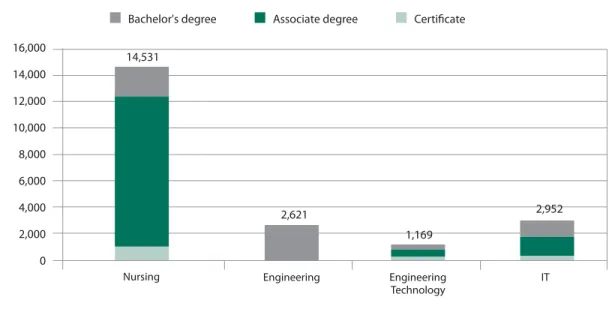
Figure 6 shows the total number of students studied by pathway and type of credential earned. The four pathways present an interesting variation in the mix of credentials. Engineering is almost exclusively a bachelor’s degree field. While there were a small number of associate degrees
Figure 6
Certificate/Degree Earners in the Four Pathways (CSU and CCC, 2007 and 2008)
Bachelor's degree Associate degree Certificate 16,000 14,000 12,000 10,000 8,000 6,000 4,000 2,000 0
Nursing Engineering Engineering
Technology IT 14,531 2,621 1,169 2,952
Table 2
Demographic Characteristics of Completers awarded (imperceptible in the graph), nearly all completions
in the field were bachelor’s degrees awarded to students entering the CCC directly from high school and transferring to the CSU. The other three fields are a mix of credentials at all levels with the associate degree dominating the nursing pathway and engineering technology being the most balanced across the three credential levels. The mix of certificates, associate degrees, and bachelor’s degrees across the four program areas allows us to explore pathway issues from certificates to associate and from associate, via transfer, to bachelor’s degrees.
Demographic Patterns of Graduates
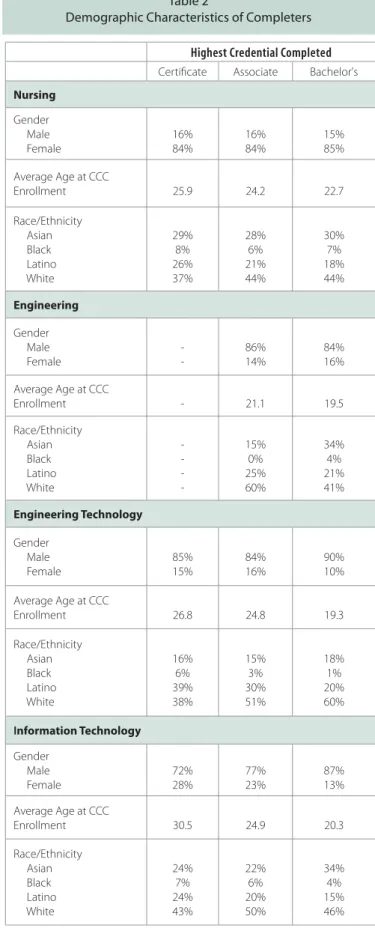
Table 2 shows demographic information about these certificate and degree completers, organized by the highest credential earned as of 2008 (students included in the group with an associate degree as the highest credential could have also earned a certificate at some point, and the CSU graduates could have earned a certificate and/or associate degree during their enrollment at the CCC). Among the interesting demographic findings:
Gender. There were significant gender disparities in these career pathways. A large majority of students earning certificates and degrees in nursing were female, while similarly large majorities of graduates in IT, engineering, and engineering technology were male. The gender gap in IT programs increases with each higher level credential. Age. Students earning a certificate as their highest credential were more likely to be older at the time of initial enrollment in the CCC than students earning a degree. Most bachelor’s degree earners entered the CCC shortly after high school graduation, especially those earning degrees in engineering, engineering technology, or IT. Race/ethnicity. #MBDLBOE-BUJOPTUVEFOUTXFSFHFOFSBMMZ underrepresented among completers in these pathways compared to their shares of enrollment in the CCC, while white and Asian students were generally over-represented among graduates compared to their shares of enrollment. In general, the racial gaps in each field grow with progress along the educational pipeline, with smaller gaps at the certificate level and larger gaps at the baccalaureate level.
Highest Credential Completed
Certificate Associate #BDIFMPShT Nursing Gender Male Female 16% 84% 16% 84% 15% 85% Average Age at CCC Enrollment 25.9 24.2 22.7 Race/Ethnicity Asian #MBDL Latino White 29% 8% 26% 37% 28% 6% 21% 44% 30% 7% 18% 44% Engineering Gender Male Female -86% 14% 84% 16% Average Age at CCC Enrollment - 21.1 19.5 Race/Ethnicity Asian #MBDL Latino White -15% 0% 25% 60% 34% 4% 21% 41% Engineering Technology Gender Male Female 85% 15% 84% 16% 90% 10% Average Age at CCC Enrollment 26.8 24.8 19.3 Race/Ethnicity Asian #MBDL Latino White 16% 6% 39% 38% 15% 3% 30% 51% 18% 1% 20% 60% Information Technology Gender Male Female 72% 28% 77% 23% 87% 13% Average Age at CCC Enrollment 30.5 24.9 20.3 Race/Ethnicity Asian #MBDL Latino White 24% 7% 24% 43% 22% 6% 20% 50% 34% 4% 15% 46%
Four Career Pathways – What Can We Learn from
those Who Succeed?
Course-taking Patterns of Graduates
In examining the course-taking patterns of graduates for signs of what might be important milestones and indicators of likely success, we found some interesting results that span across the four career areas:
Basic skills. Students completing certificates and degrees earned very few credits in basic skills courses (i.e., pre-college level courses), an average of only a credit or two. This tells us that a majority of graduates completed no basic skills courses. Excess credits. On average, graduates had completed significant numbers of “excess credits,” i.e., more credits than would have been required for the level of credential earned. The total number of CCC credits earned ranged from 60 to 80 for students earning a certificate as the highest credential, where the number of credits required would be 18 to 60 (with certificates of less than 30 credits most common). Associate degree completers earned an average of 90 to over 100 credits, while 60 credits are generally required. Those earning a bachelor’s degree had earned an average of 80 to 90 CCC credits before transfer. While more research is needed on the reasons for so many credits, the patterns may suggest a need to simplify and/or clarify options for students through better advising, curriculum design, and/or course scheduling.
Technical coursework. As would be expected, the number of math and science courses taken increased with the level of credential completed. Also as expected, given the focus of transfer students on general education and lower-division prerequisites, students earning bachelor’s degrees in these fields took substantially less major coursework in the specific discipline (i.e., engineering technology, nursing, IT) than did those earning certificates or associate degrees.
Pathway issues. Successful students navigated through a complex environment in which the pathway was more aligned at the certificate and associate degree levels:
■ Associate degrees in these fields are not generally serving as a step on the pathway to a bachelor’s degree. Among students who completed an associate degree before transferring to CSU, far more earned that degree
in interdisciplinary studies than in a specific field. The exception is nursing, where about half of the associate degrees were in nursing. This is likely because many students who earned a bachelor’s degree were practicing nurses who had earned an associate degree at an earlier QPJOUBOESFUVSOFEUPDPMMFHFUPHFUB#4/ BOVNCFSPG CSUs have specific programs designed for practicing RNs UPHFUB#4/EFHSFF
■ A certificate in one of these fields is somewhat likely to serve as a step on the pathway to an associate degree, as about one-third to one-half of the associate degree earners had also earned a certificate, most in the same field. This was less the case in nursing, where the transition from a nursing assistant certificate to a degree in vocational or registered nursing is more difficult. Associate degrees in engineering technology and information technology are often specifically designed to layer general education coursework on top of the technical courses that count toward a certificate. We imposed no backward time limit for when a student earning an associate degree might have earned the related certificate, so some of these students may have earned the certificate well before they proceeded to the next credential level.
Questions Raised about CTE Pathways
from the Data on Completers
Our analysis of the patterns among certificate and degree earners in these four career pathways raises a number of general questions about CTE pathways in the CCC. Why have the students completing certificates and degrees in CTE areas earned so few basic skills credits? We know that a substantial majority of CCC students enter college with skills in English/Language Arts and/or math that place them below college level.30 There would seem to be
several possible explanations for finding so few basic skills enrollments among the completers:
1. A lack of requirement for math/English coursework (e.g., most certificates involve only technical coursework with no English or math course requirements, possibly allowing certificate-earning students to avoid basic skills courses)
2. A preference among CTE program faculty for addressing students’ basic skills deficiencies in the context of the occupational curriculum over relying on the college basic skills offerings
3. A low rate of completion for students who enter the CCC with remedial needs. Certainly the amount of math and science coursework required for degrees in nursing, engineering, engineering technology, and IT could pose a challenge for students who enter the CCC without a good foundation in math skills.
In our site visits and our consultation with the system’s
Vocational Research and Accountability Committee, we learned that many CTE faculty do believe that students stand a better chance of persisting if they avoid regular basic skills sequences and learn requisite skills in their CTE coursework. A 2011 research study found better outcomes for CCC students who took contextualized developmental math compared to those in the basic skills math sequence.31 Given the importance of
sound basic skills for career and college pursuits and the very poor completion rates of students beginning in developmental math,32 it is important to learn more about the degree to which
basic skills are required in certificate programs and the extent to which skill deficiencies are impeding the completion of certificates and degrees, especially in high-growth fields such as the ones we have studied.
Why are so many students in technical fields earning their associate degrees in interdisciplinary studies? We know that associate degree requirements are not fully aligned with the requirements for transfer, leading most transfer students to transfer without first earning an associate degree.33 The transfer students who did earn an
associate degree before earning their bachelor’s degree in one of our selected fields mostly earned a degree in interdisciplinary studies rather than in their field of study. Most advanced occupational courses at the CCC are not transferable, so students intending to transfer focus on general education courses at the community college, saving the technical coursework for the university. Since the associate degree is not serving the transfer mission well, we might assume that the current set of associate degrees is designed for direct entry into the workforce. Yet we
learned from interviews and other conversations that the associate degree in many technical fields does not have strong market value and does not give employers sufficient information about students’ skills and competencies. This raises the prospect that the current array of associate degrees may not be serving the needs of either transfer students or those seeking to go directly to the workforce.
Does it serve students well to have so many different offerings of certificates and associate degrees within the same general field, and so much variation within and across colleges in subject matter and credit requirements for certificates and degrees in similar fields?
The considerable curricular variation we found across colleges could be an accurate reflection of the specialization within these fields. Alternatively, it could reflect some lag in curriculum planning by which emerging programs are added faster than lower priority ones are removed. If greater consistency is feasible, it could simplify the choices facing students and possibly reduce the excess credits that we documented among completers – especially at the certificate and associate degree levels. Additionally, more consistency across programs and colleges could send clearer signals to employers about the set of skills and competencies they could expect from a student with a given credential. That could, in turn, increase the market value of the credentials that the colleges offer but that are apparently not highly valued by students.
Four Career Pathways – What Can We Learn
from Students Attempting these Pathways?
Data and Methods Used to Identify
New Students Pursuing the Selected
Pathways
We obtained a data set from the CCC Chancellor’s Office that included all first-time students who entered the system in the 2003-2004 academic year and tracked them for six years through 2008-09.* The data included student demographic characteristics, all course enrollments, and degrees and certificates earned and transfers to a university. #FDBVTFUIFEBUBEPOPUDPOUBJOJOGPSNBUJPOPOQSPHSBN intent, we used enrollment behaviors as a proxy to identify students pursuing a degree, certificate, or transfer in one of the four areas of interest.** To limit our analysis to degree/certificate-seekers we selected students who enrolled in more than six units of any type in the first year,
Identifying Students in Each Pathway
#VJMEJOHPOXIBUXFMFBSOFEGSPNPVSJOUFSWJFXT literature and catalog reviews, and analysis of students who successfully completed a program of study in one of the four career pathways, we examined a cohort of first-time students who entered the system in the 2003-2004
a criterion we have applied in other research. Guided by our analysis of course-taking patterns by completers, interviews with CCC faculty and administrators and other experts in these fields, and a review of program requirements as specified in a sample of college catalogs, we chose a set of enrollment behaviors that would best identify certificate/degree-seeking students in each pathway. We used multiple criteria to differentiate students in the targeted pathways from students in related pathways (e.g., identify nursing students but not biology majors).
* Concurrently enrolled high school students and students enrolled only in non-credit courses were not included.
** See Appendix 4 in the online appendices at http://www.csus.edu/ihelp/ pdfs/cte_web_appendix.pdf for the specific enrollment behaviors used to identify students pursuing one of the four fields of interest.
(>6 units year 1)Degree-Seekers (N = 255,253)
Nursing
(N = 10,034) Engineering (N = 4,350) Engineering Technology (N = 1,381) (N = 8,136)IT
Gender Male 47.0% 33.4% 55.7% 80.5% 69.1% Female 53.0% 66.6% 44.3% 19.5% 30.9% Age Mean 23.5 22.7 20.2 24.8 25.7 Race/Ethnicity White 39.2% 37.5% 43.1% 42.5% 39.2% Latino 33.5% 22.4% 27.0% 38.2% 22.2% Asian 17.7% 33.2% 23.7% 16.1% 30.1% #MBDL 8.6% 6.3% 5.3% 2.7% 7.9% Table 3
Characteristics of 2003-04 Cohort of First-Time CCC Students in Selected Career Pathways
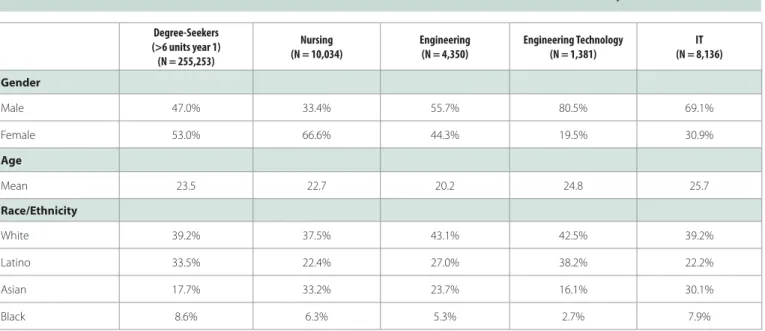
academic year to learn about the patterns of student progress in and through these pathways (see box below). Table 3 shows the number of students in each of the career pathways, as we were able to identify them with our criteria, and their demographic composition.
Cautions Due to Proxy Method of
Identifying Students in Pathways
To the extent that we have misidentified students in a pathway, our results would be skewed. For example, some students who failed to reach a pathway milestone (e.g., completing four nursing courses) may have faced barriers that would be important to understand; others who failed to complete those courses may not have been seeking a nursing credential. While we used course-taking behaviors as best we could to identify students in each pathway, the findings cannot be interpreted with the same level of confidence as our findings for the entire degree-seeking cohort, where it was not necessary to determine students’ academic program goals. The proxy method of using enrollment behaviors to identify students in pathways also likely overstates completion. We cannot recognize students as belonging to a pathway until they have achieved a fair amount of success, i.e., enrolled in the courses that we set as criteria for pathway status. We miss those students who intended to pursue the pathways but dropped out before enrolling in those courses. Our analysis is necessarily limited to those students who are further along and, therefore, more likely to be successful. In addition, the criteria applied to each pathway are different and therefore completion findings across the pathways are not meaningfully compared. For example, completions could look better in nursing than in IT because more students who intended to complete a nursing program dropped out before meeting the criteria for us to identify them as a nursing student than was the case for IT.
Milestone Attainment – How Far Do
Students Get?
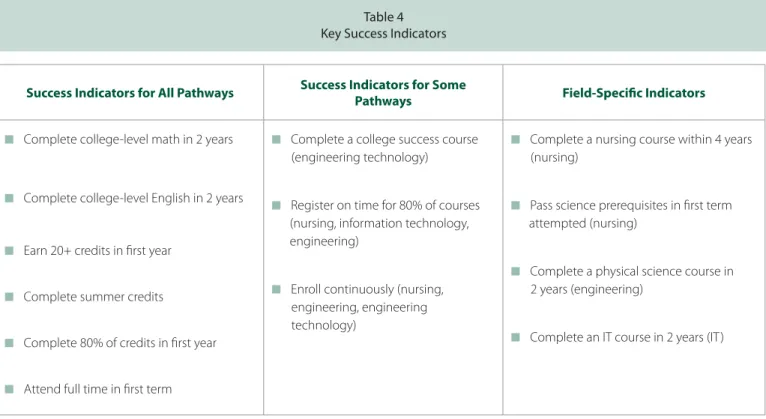
We used the milestone and success indicator framework that we have developed for previous research (see Steps to Success, Divided We Fail) to analyze student progress along the pathways and to determine whether certain enrollment behaviors were more predictive of student success. We included the generic milestones and success indicators that we have applied to all degree-seekers as well as ones that we developed specifically for students enrolled in the four pathways. Our findings come with a caveat due to the proxy method required to determine which students belong in each pathway (see box below).
Figures 7 through 10 show the number of students who reached the intermediate milestones for each of the four pathways, as well as those who completed a credential or transfer.34 The analysis shows that across all fields many
students are lost before completing 30 college-level credits and many more are lost between completing 30 or more college-level credits and earning a certificate or degree or transferring. Math seems to be a more serious barrier for engineering and IT than for nursing or engineering technology, perhaps because of the higher levels of math required in engineering and because many IT students are returning adults who may have lost some of their math skills. Specialists in each of these fields may find some specific patterns of note in the attainment of intermediate milestones. Here we point to just a few field-specific findings that suggest how such an analysis could help target efforts at key stall points – particularly with better data that allowed earlier and more accurate identification of students in the pathway.
■ Nursing. Anatomy/physiology seems to be a bigger barrier than either math or chemistry, likely accounting significantly for low rates of completing all nursing prerequisites.35 It is likely that our data reflect student
failure to pass anatomy/physiology rather than their JOBCJMJUZUPFOSPMMJOUIFDPVSTFT#FDBVTFXFVTFE enrollment in prerequisite courses to identify students seeking a nursing degree, most students that stopped pursuing a nursing program because they could not enroll in a prerequisite class were probably excluded from our analysis.
■ Engineering. Math seems to be a bigger barrier than physical science.
■ Engineering technology. No single barrier stands out, particularly as the drop off to the second year and beyond could be partially explained by students completing short-term certificates, which are a bigger portion of the completions in this pathway than in the others.
■ Information technology. Math appears to be a significant barrier and few students persist to the point of completing four IT courses.
Four Career Pathways – What Can We Learn from
Students Attempting these Pathways?
Figure 7
Milestone Attainment among Students in the Nursing Pathway
Figure 8
Milestone Attainment among Students in the Engineering Pathway
Award in Interdisciplinary Studies Award in Other Field
Award in Field
Award in Interdisciplinary Studies Award in Other Field
Award in Field
Note: Students can be counted in more than one category of completion, e.g., they may earn a certificate and an associate degree.
Note: Students can be counted in more than one category of completion, e.g., they may earn a certificate and an associate degree.
Completion Completion 12000 10000 8000 6000 4000 2000 0 Number in Pathway 30+ College-level Credits Degree Applicable Math Course Anatomy/ Physiology Course Chemistry Course Nursing Prerequisite Courses Four Nursing/ Health Courses Transfer Curriculum Transfer w/o Assc. Degree Transfer w/ Assc. Degree Certificate Associate Degree Intermediate Milestones Intermediate Milestones 5000 4500 4000 3500 3000 2500 2000 1500 1000 500 0