The State of the Art in End-User Software Engineering
ANDREW J. KO
The Information School, DUB Institute, University of Washington ROBIN ABRAHAM
Microsoft Corporation LAURA BECKWITH Unaffiliated
ALAN BLACKWELL
The Computer Laboratory, University of Cambridge
MARGARET BURNETT, MARTIN ERWIG, AND CHRIS SCAFFIDI
School of Electrical and Engineering and Computer Science, Oregon State Uni-versity
JOSEPH LAWRANCE MIT CSAIL
HENRY LIEBERMAN MIT Media Laboratory BRAD MYERS
Human-Computer Interaction Institute, Carnegie Mellon University MARY BETH ROSSON
Information Sciences and Technology, Penn State University GREGG ROTHERMEL
Department of Computer Science and Engineering, University of Nebraska at Lincoln
MARY SHAW
Institute for Software Research, Carnegie Mellon University SUSAN WIEDENBECK
College of Information Science and Technology, Drexel University
________________________________________________________________________ Most programs today are written not by professional software developers, but by people with expertise in other domains working towards goals for which they need computational support. For example, a teacher might write a grading spreadsheet to save time grading, or an interaction designer might use an interface builder to test some user interface design ideas. Although these end-user programmers may not have the same goals as professional developers, they do face many of the same software engineering challenges, including understanding their re-quirements, as well as making decisions about design, reuse, integration, testing, and debugging. This article summarizes and classifies research on these activities, defining the area of End-User Software Engineering (EUSE) and related terminology. The article then discusses empirical research about end-user software engi-neering activities and the technologies designed to support them. The article also addresses several crosscutting issues in the design of EUSE tools, including the roles of risk, reward, and domain complexity, and self-efficacy in the design of EUSE tools and the potential of educating users about software engineering principles. Categories and Subject Descriptors: D.2 [Software Engineering], D.3 [Programming Languages], H.5 [ In-formation Interfaces and Presentation], K.4 [Computers and Society], J.4 [Social and Behavioral Sci-ences]
General Terms: Reliability, Human Factors, Languages, Experimentation, Design
develop-1. INTRODUCTION
From the first digital computer programs in the 1940’s to today’s rapidly growing soft-ware industry, computer programming has become a technical skill of millions. As this profession has grown, however, a second, perhaps more powerful trend has begun to take shape. According to statistics from the U.S. Bureau of Labor and Statistics, by 2012 in the United States there will be fewer than 3 million professional programmers, but more than 55 million people using spreadsheets and databases at work, many writing formulas and queries to support their job [Scaffidi et al. 2005]. There are also millions designing websites with Javascript, writing simulations in MATLAB [Gulley 2006], prototyping user interfaces in Flash [Myers et al. 2008], and using countless other platforms to sup-port their work and hobbies. Computer programming, almost as much as computer use, is becoming a widespread, pervasive practice.
What makes these “end-user programmers” different from their professional counter-parts is their goals: professionals are paid to ship and maintain software over time; end users, in contrast, write programs to support some goal in their own domains of expertise. End-user programmers might be secretaries, accountants, children [Petre and Blackwell 2007], teachers [Wiedenbeck 2005], interaction designers [Myers et al. 2008], scientists [Segal 2007] or anyone else who finds themselves writing programs to support their work or hobbies. Programming experience is an independent concern. For example, despite their considerable programming skills, many system administrators view programming as only a means to keeping a network and other services online [Barrett et al. 2004]. The same is true of many research scientists [Carver et al. 2007, Segal 2007].
Despite their differences in priorities from professional developers, end-user pro-grammers face many of the same software engineering challenges. For example, they must choose which APIs, libraries, and functions to use [Ko et al. 2004]. Because their programs contain errors [Panko 1998], they test, verify and debug their programs. They also face critical consequences to failure. For example, a Texas oil firm lost millions of dollars in an acquisition deal through an error in a spreadsheet formula [Panko 1995]. The consequences are not just financial. Web applications created by small-business owners to promote their businesses do just the opposite if they contain bad links or pages that display incorrectly, resulting in loss of revenue and credibility [Rosson et al. 2005].
Software resources configured by end users to monitor non-critical medical conditions can cause unnecessary pain or discomfort for users who rely on them [Orrick 2006].
Because of these quality issues, researchers have begun to study end-user program-ming practices and invent new kinds of technologies that collaborate with end users to improve software quality. This research area is called end-user software engineering (EUSE). This topic is distinct from related topics in end-user development in its focus on software quality. For example, there have been prior surveys of novice programming en-vironments [Kelleher and Pausch 2005], discussing systems that either help students ac-quire computing skills or enable the creation of computational artifacts; while quality is a concern in these contexts, this work focuses largely on learning goals. There have also been surveys on end-user programming [Sutcliffe and Mehandjiev 2004, Lieberman et al. 2006][Wulf et al. 2006], but these focus on the construction of programs to support other goals, but not on engineering activities peripheral to construction, such as requirements, specifications, reuse, testing, and debugging.
In this article, these software engineering activities are our primary focus. We start by proposing definitions of programming, end-user programming, and end-user software engineering, focusing on differences in intents and priorities between end-user program-ming and professional software development. We follow with a lifecycle-oriented treat-ment of end-user software engineering research, organizing more than a decade of re-search on incorporating requirements, design, testing, verification, and debugging into end users’ existing work practices. We then discuss a variety of crosscutting issues in end-user software engineering research, including the role of risk, reward, and domain of practice on end users’ decision-making, as well as strategies for persuading users to en-gage in more rigorous software engineering activities as part of their normal work. We also discuss individual factors, such as self-efficacy and gender, and their influence on how effectively people use EUSE tools.
What we found in our review of these research efforts were two different histories. First, studies of end-user software engineering concerns have had a consistently broad scope. Researchers have studied children [Petre and Blackwell 2007], middle-school stu-dents [Baker 2007, Kelleher et al. 2007], system administrators [Barrett et al. 2004], peo-ple at home [Blackwell 2004], knowledge workers in large companies [Bogart et al. 2008, Scaffidi et al. 2006], interaction designers [Ko et al. 2004, Brandt et al. 2008, Myers et al. 2008], natural scientists [Carver et al. 2007, Segal 2007], software architects [Lakshminarayanan et al. 2006], bioinformatics professionals [Letondal 2006], web
de-signers [Rode and Rosson 2003], and even volunteers helping with disaster relief [Scaf-fidi et al. 2007].
In contrast to studies of EUSE, contributions to EUSE tools have historically had a narrow scope. Early work focused largely on spreadsheets and event-based computing paradigms and on perfective aspects of end-user software engineering, such as testing, verification and debugging. Part of this historical bias is due to the fact that doing re-search on a particular paradigm has required mature and flexible programming languages, platforms, and IDEs on which to build more helpful software engineering tools, and most end-user programming platforms have not exhibited these properties. More recently how-ever, this bias has been eliminated, with recent work focusing on a much broader set of domains and paradigms, including the web, mobile devices, personal information man-agement, business processes, and programming in the home. Researchers have also ex-tended their focus from perfective activities to design, including work on requirements, specifications, and reuse. Part of this shift is due to the advent of interactive web applica-tions, as sharing code is becoming much more common.
These trends, coupled with the fact that computing is rapidly being incorporated into an incredible array of human activities, suggest that EUSE research will become similarly diverse. This will pose many challenges for the field, since the various domains studied and supported by research may have little in common. This is also an opportunity, how-ever, for researchers to identify what is common across these diverse areas of practice. This article represents an effort at identifying some of these fundamental challenges, grounded in lessons from prior work.
2. DEFINITIONS
One contribution of this article is to identify existing terms in EUSE research and fill in terminology gaps, creating a well-defined vocabulary upon which to build future re-search. In this section, we start with a basic definition of programming and end with a definition of end-user software engineering.
2.1.Programming and Programs
We define programming similarly to modern English dictionaries, as the process of plan-ning or writing a program. This leads to the need for a definition of the term program. Some definitions of “program” are in terms of the language, in which the program is writ-ten, requiring, for example, that the notation be Turing complete, and able to specify se-quence, conditional logic and iteration. However, definitions such as these are heavily
influenced by the type of activity being automated. To remove these somewhat arbitrary constraints from the definition, for the purposes of this paper we define a program as a collection of specifications that may take variable inputs, and that can be executed (or interpreted) by a device with computational capabilities. Note that the variability of input values requires that the program has the ability to execute on future values, which is one way it is different from simply doing a computation once manually. This definition cap-tures general purpose languages in wide use, such as Java and C, but also notations as simple as VCR programs, written to record a particular show when the time of day (in-put) satisfies the specified constraint, and combinations of HTML and CSS, which are interpreted to produce a specific visual rendering of shapes and text. It also captures the use of report generators, which take some abstract specification of the desired report and automatically create the finished report.
2.2.End-User Programming
We now turn to end-user programming, a phrase popularized by Nardi [1993] in her in-vestigations into spreadsheet use in office workplaces. An end user1 is simply any com-puter user. We then define end-user programming as programming to achieve the result of a program primarily for personal, rather public use. The important distinction here is that program itself is not primarily intended for use by a large number of users with vary-ing needs. For example, a teacher may write a grades spreadsheet to track students’ test scores, a photographer might write a Photoshop script to apply the same filters to a hun-dred photos, or a caretaker might write a script to help a person with cognitive disabilities be more independent [Carmien and Fischer 2008]. In these end-user programming situa-tions, the program is a means to an end and only one of potentially many tools that could be used to accomplish a goal. This definition also includes a skilled software developer writing “helper” code to support some primary task. For example, a developer is engag-ing in end-user programmengag-ing when writengag-ing code to visualize a data structure to help di-agnose a bug. Here, the tool and its output are intended to support the developers’ par-ticular task, but not a broader group of users or use cases.
In contrast to end-user programming, professional programming has the goal of pro-ducing code for others to use. The intent might be to make money, or to write it for fun, or perhaps as a public service (as is the case for many free and open source projects).
1
The “end” in “end user” comes from economics and business, where the person who purchases a software product may be different from the “end user” who uses it. Our use of the phrase in this article is more for
his-Therefore, the moment novice web designers move from designing a web page for them-selves to designing a web page for someone else, the nature of their activity has changed. The same is true if the developer mentioned above decides to share the data structure visualization tool with the rest of his team. The moment this shift in intent occurs, the developer must plan and design for a broader range of possible uses, increasing the im-portance of design and testing, and the prevalence of potential bugs.
It is also important to clarify two aspects of this “intent”-based definition. First, our definition is not intended to be dichotomous, but continuous. After all, there is no clear distinction between a program intended for use by five people and a program intended for fifty. Instead, the key distinction is that as the number of intended uses of the program increases, a programmer will have to increasingly consider software engineering con-cerns in order to satisfy increasingly complex and diverse constraints. Second, even if a programmer does not intend for a program to be used by others, circumstances may change: the program may have broader value, and the code which was originally un-tested, hacked together, and full of unexercised bugs may suddenly require more rigorous software engineering attention.
While our definition of end-user programming is a departure from previously pub-lished definitions, we do so both to bring clarity to field and to discuss some of the under-lying dimensions of historical use. For example, a number of connotations of the phrase have emerged in research, many using it to refer to “novice” programming or “non-professional” programming, or system design that involves the participation of end users. Many have also used it to describe an individual’s identity [Nardi 1993]. We believe these connotations conflate a number of related, but non-equivalent concepts.
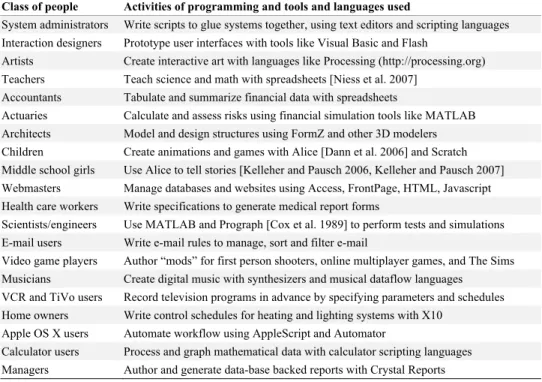
For example, consider its use as an identity. A wide variety of people may engage in end-user programming; Table 1 gives just a glimpse of the diversity of people’s computa-tional creations. While it is natural to use the phrase “end-user programmers” to describe these groups, it is not always accurate, because a persons’ intent in programming can depend on their task. For example, an accountant may use spreadsheets at home to keep track of a family loan, but use and share a spreadsheet at work to manage annual tax preparation activities with other accountants. It would be inaccurate to call this account-ant an end-user programmer in all situations, when the spreadsheet at home is intended for personal, short-term use, but the one at work is heavily maintained and repeatedly used by multiple people. Thus, when we use the phrase “end-user programmer” in this paper, we are indicating the intent behind a programming task, not a fundamental aspect of the programmer’s identity.
Class of people Activities of programming and tools and languages used
System administrators Write scripts to glue systems together, using text editors and scripting languages Interaction designers Prototype user interfaces with tools like Visual Basic and Flash
Artists Create interactive art with languages like Processing (http://processing.org) Teachers Teach science and math with spreadsheets [Niess et al. 2007]
Accountants Tabulate and summarize financial data with spreadsheets
Actuaries Calculate and assess risks using financial simulation tools like MATLAB Architects Model and design structures using FormZ and other 3D modelers Children Create animations and games with Alice [Dann et al. 2006] and Scratch Middle school girls Use Alice to tell stories [Kelleher and Pausch 2006, Kelleher and Pausch 2007] Webmasters Manage databases and websites using Access, FrontPage, HTML, Javascript Health care workers Write specifications to generate medical report forms
Scientists/engineers Use MATLAB and Prograph [Cox et al. 1989] to perform tests and simulations E-mail users Write e-mail rules to manage, sort and filter e-mail
Video game players Author “mods” for first person shooters, online multiplayer games, and The Sims Musicians Create digital music with synthesizers and musical dataflow languages VCR and TiVo users Record television programs in advance by specifying parameters and schedules Home owners Write control schedules for heating and lighting systems with X10
Apple OS X users Automate workflow using AppleScript and Automator
Calculator users Process and graph mathematical data with calculator scripting languages Managers Author and generate data-base backed reports with Crystal Reports
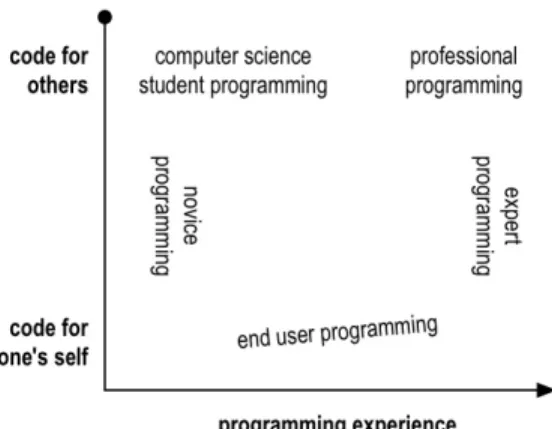
8 It is also important to not conflate end-user programming with inexperience. Profes-sional developers with decades of experience can engage in end-user programming by writing code for personal use, with no intent to share their program with others. They may complete their end-user programming task more quickly and with fewer bugs, but they will not approach the work with the same quality goals that they would for produc-tion code. To illustrate this distincproduc-tion, consider Figure 1, which portrays programming experience and intent as two separate dimensions. Computer science students and profes-sional programmers code with the intent of creating software for people to use (or grade), but vary in their experience. Similarly, end-user programming involves programming for personal use, but can include a wide range of programming expertise (of course, there are many more inexperienced programmers than experienced ones; we are not arguing that the distribution of experience is uniform).
Similarly, it is important to not conflate end-user programming with the use of “sim-ple” languages. Experienced developers may use general purpose languages like C++ to achieve end-user programming goals, and in fact, many scientists do use such languages to do exploratory scientific analyses, without the intent of sharing the code or polishing it for future use [Segal 2007]. Similarly, experienced developers may use simple markup languages such as HTML and CSS to design commercial web sites. In general, end-user programming can involve a wide range of languages, from macro recording, to domain-specific languages, to conventional, general-purpose languages. The key distinction in the choice of language is whether it helps a person achieve their personal goal (e.g., “choos-ing the right tool for the job”).
Related to the choice of language, end-user programming should not be conflated
Figure 1. Programming activities along dimensions of experience and intent. The diagram is not intended to suggest the distribution of programmers (as there are many more without experience than with), but simply the
with the use of particular interaction technique for constructing code. Java programs can be written with a text editor or a visual editor [Ko and Myers 2006] and languages that are traditionally written with visual editors, such as dataflow languages like Yahoo Pipes (http://pipes.yahoo.com) and Prograph [Matwin & Petrzykowski 1985], can also be ex-pressed in textual syntax. The use of visual code editors has more to do with the difficulty of learning and manipulating textual syntax than the intent of the programmer.
There are a number of phrases related to “end-user programming” that are worth dis-cussing relative to our definition. End-user development has been defined as “a set of methods, techniques, and tools that allow users of software systems, who are acting as non-professional software developers, at some point to create, modify, or extend a soft-ware artifact” [Lieberman et al. 2006]. This notion of end-user development also focuses on the use and adaptations of software over time, and focuses on elements of the software lifecycle beyond the stage of creating a new program. More specifically, mutual-development, co-development, and participatory design refer to activities in which end users are involved in a system design, but may or may not be involved in its actual coding [Henderson and Kyng 1991, Costabile et al. 2009, Mackay 1990]. These accounts of or-ganizational, social, and collaborative perspectives on end-user development offer several valuable perspectives on how people appropriate and customize software, most of which are beyond the scope of this survey.
Terms such as customization, configuring [Eagan and Stasko 2008], and tailoring [Trigg and Bødker 1994, Kahler 2001] include parameterization of existing programs, but not direct modification of a program’s source code. Visual programming refers to a set of interaction techniques and visual notations for expressing programs. The phrase often implies use by end-user programmers, but visual notations are not always targeted at a particular type of programming practice. Domain-specific languages are programming languages designed for writing programs for a particular kind of context or practice. End-user programming may or may not involve such languages, since what defines end-End-user programming is the intent, not the choice of languages or tools. Finally, scripts and scripting languages are often distinguished from programs and programming languages by the use of machine interpretation rather than compilation and their “high-level” use in coordinating the functions of multiple programs or services. The phrase end-user pro-gramming, because it is often conflated with inexperience, often connotes the use of scripting languages since these languages have the reputation of being easier to learn.
2.3.End-User Software Engineering
With definitions of programming and end-user programming, we now turn to the central topic of this article, end-user software engineering. As we discussed in the previous sec-tion, the intent behind programming is what distinguishes end-user programming from other activities. This is because programmers’ intents determine to what extent they con-sider concerns such as reliability, reuse, and maintainability and the extent to which they engage in activities that reinforce these qualities, such as testing, verification, and debug-ging. Therefore, if one defines software engineering as systematic and disciplined activi-ties that address software quality issues2, the key difference between professional
soft-ware engineering and end-user software engineering is the amount attention given to software quality concerns.
In professional software engineering, the amount of attention is much greater: if a program is intended for use by millions of users, all with varying concerns and unique contexts of use, a programmer must consider quality regularly and rigorously in order to succeed. This is perhaps why definitions of software engineering often imply rigor. For example, IEEE Standard 610.12 defines software engineering as “the application of sys-tematic, disciplined, quantifiable approaches to the development, operation, and mainte-nance of software.” Systematicity, discipline, and quantification all require significant time and attention, so much so that professional software developers spend more time testing and maintaining code than developing it [Tassey 2002] and they often structure their teams, communication, and tools around performing these activities [Ko et al. 2007].
In contrast, end-user software engineering still involves systematic and disciplined activities that address software quality issues, but these activities are secondary to the goal that the program is helping to achieve. Because of this difference in priorities and
2
Because the meaning of the phrase software engineering is still under much debate, we use the definition from current IEEE standards.
Software Engineering Activity Professional SE End-user SE
Requirements explicit implicit
Specifications explicit implicit
Reuse planned unplanned
Testing and Verification cautious overconfident
Debugging systematic opportunistic
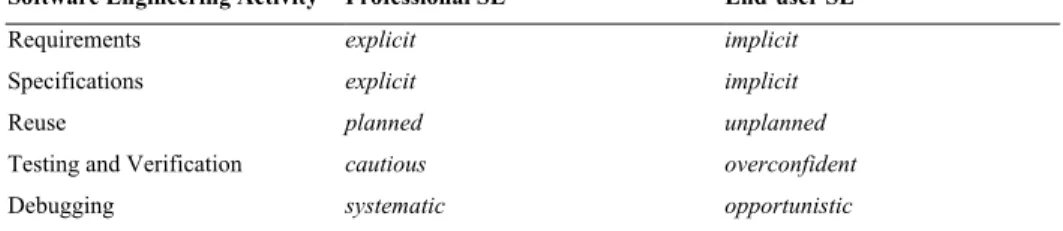
because of the opportunistic nature end-user programming [Brandt et al. 2008], people who are engaging in end-user programming rarely have the time or interest in systematic and disciplined software engineering activities. For example, Segal [2007] reported on several teams of scientists engaging in end-user programming, finding that software itself is not valued, that the process of creating software was highly iterative and unpredictable, and that testing was not considered important relative other domain-specific risks [Segal 2007]. These differences are coarsely summarized in Table 2, showing that end-user software engineering can be characterized by its unplanned, implicit, opportunistic na-ture, due primarily to the priorities and intents of the programmer (but perhaps also to inexperience).
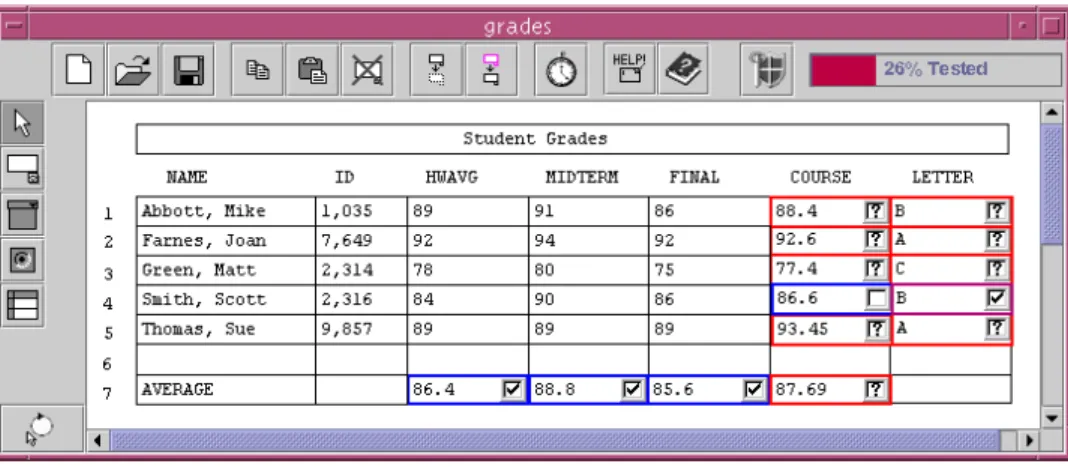
Given these differences, the challenge of end-user software engineering research is to find ways to incorporate software engineering activities into users’ existing workflow, without requiring people to substantially change the nature of their work or their priori-ties. For example, rather than expecting spreadsheet users to incorporate a testing phase into their programming efforts, tools can simplify the tracking of successful and failing inputs incrementally, providing feedback about software quality as the user edits the spreadsheet program. Approaches like these, and the ones reported throughout the rest of this article, allow users to stay focused on their primary goals (teaching children, record-ing a television, makrecord-ing scientific discoveries, etc.), while still achievrecord-ing software qual-ity.
It is important to note that we do not discuss the issue of educating users about soft-ware engineering practices in this article. Many of the techniques discussed in our review may have the side effect of teaching users about the importance of testing, for example, but this is not the primary goal of these techniques. There is a case to be made that any-one creating software with some potential for costly failure ought to engage in more rig-orous and disciplined software engineering activities. This viewpoint and any research associated with it, is outside the scope of this article.
3. END-USER SOFTWARE ENGINEERING RESEARCH
End-user software engineering research is interdisciplinary, drawing from computer sci-ence, software engineering, human-computer interaction, education, psychology and other disciplines. Therefore, there are several dimensions along which we could discuss the literature in this area, including tools, language paradigm, research approach, and so on. However, because we aim to contrast EUSE with professional software engineering,
we chose to organize the literature by software engineering activities commonly listed in software engineering textbooks (e.g., [Ghezzi et al. 2002]). For each of these, however, we frame the discussion from the perspective of an end user:
1.Requirements. How the software should behave in the world.
2.Design and specifications. How the software behaves internally to achieve the re-quirements.
3.Reuse. Using preexisting code to save time and avoid errors (including integration, extension, and other perfective maintenance).
4.Testing and verification. Gaining confidence about correctness and identifying failures.
5.Debugging. Repairing known failures by locating and correcting errors.
In our discussion of each of these, we will review research in understanding and sup-porting these activities, and characterize the historical emphasis on particular paradigms or end-user programming domains. In doing so, however, we do not imply that these ac-tivities take place in sequence; indeed, the waterfall model [Ghezzi et al. 2002] is even less appropriate in end-user programming than it is in professional development.
It is important to note that we do not explicitly discuss the implementation and use of end-user programs, even though these activities are a central part of end-user program-ming activity. Surveys of implementation issues in end-user programprogram-ming have been dis-cussed extensively in previous literature [Sutcliffe and Mehandjiev 2004, Kelleher and Pausch 2005, Lieberman et al. 2006][Wulf et al. 2006]. The use of end-user programs depends largely on for what purpose they were created and most end-user software engi-neering research has attempted to be independent of purpose. We do, however, discuss the maintenance of end-user programs in our discussion of sharing in Section 3.3. 3.1.What Should My Program Do? — Requirements
The term “requirements” refers to statements of how a program should behave in the world (as opposed to the internal behavior of a program, which is how it achieves these external concerns). For example, a requirement for a tax program might be “Create a properly formatted 1040 tax form based on my financial data.” This is a statement of a desired result, but not of how the result is achieved.
In considering the history of work on this activity, the contributions have largely fo-cused on understanding the sources and types of requirements of different domains of end-user programming and contrasting these with the role of requirements in professional software engineering.
For example, in professional software engineering, projects usually involve a re-quirements gathering phase that results in rere-quirements specifications. These specifica-tions can be helpful in anticipating project resource needs and for negotiating with cli-ents. For end-user software engineering, however, the notion of requirements has to be reinvented. Because their motivations are not related to the software, but to some other goal, people engaging in end-user programming rarely have an interest in explicitly stat-ing their requirements. This means they may be less likely to learn formal languages in which to express requirements or to follow structured development methodologies. Fur-thermore, in many cases, end users may not know the requirements at the outset of a pro-ject; the requirements may only become clear in the process of implementation [Costabile et al. 2006, Fischer and Giaccardi 2006, Mørch and Mehandjiev 2000, Segal 2007]. While this is also true in Agile development [Coplien and Harrison 2004], Agile develop-ers explicitly recognize that requirements will evolve and have tools and processes that plan for emergent requirements. In contrast, people engaging in end-user programming are unlikely to plan in this way.
Another difference between requirements in professional and end-user software engi-neering is the source of the requirements. In professional settings, the customers and us-ers are usually different people from the developus-ers themselves. In these situations, re-quirements analysts use formal interviews and other methods [Beyer and Holtzblatt 1998] to arrive at the requirements. End-user programmers, on the other hand, are usually pro-gramming for themselves or for a friend or colleague. Therefore, end-user software engi-neering is unlike other forms of software engiengi-neering, where the challenge of require-ments definition is to understand the context, needs and priorities of other people and organizations. For end users, requirements are both more easily understood (because the requirements are their own) and more likely to change (because end users may need to negotiate such changes only with themselves). Furthermore, end users’ requirements are able to be implicit, and perhaps not even consciously recognized.
The situation in which an end user programs also affects the type of requirements. For example, at an office, the requirements are often to automate repetitive operations (such as transferring or transforming pieces of information such as customer names, products,
accounts, or documents). In this context, a decision to write a program at all corresponds directly to real investment since time is money. End users who become successful at automating their own work often find that their programs are passed on to others, whether by simple sharing of tools between peers [MacLean et al. 1990], or as a means for man-agers to define office procedures. These social contexts start to resemble the concerns of professional software developers, for whom requirements analysis extends to the defini-tion and negotiadefini-tion of work practices [Ko et al. 2007].
At home, end-user software engineering is seldom about efficiency (except in the case of office-like work that is done at home, such as taxes). Instead, typical tasks include automation of future actions, such as starting a cooker or recording television. It is often the case that one member of a household becomes expert in operating a particular appli-ance, and assumes responsibility for programming it [Rode et al. 2005, Blackwell 2004]. In this context, requirements are negotiated within the social relations of the household, in a manner that might have some resemblance to professional software experiences. Sometimes there are no requirements to start with; for example, there is a long tradition of “tinkering,” in which hobbyists explore ways to reconfigure and personalize technol-ogy with no definite end in mind [Blackwell 2006]. Even though these hobbyists might have envisioned some scenario of use when they made the purchase [Okada 2005], those motivations may be abandoned later. Instead, requirements evolve through experimenta-tion, seeing what one can do, and perhaps motivated by the possibility of exhibiting the final product to others as a demonstration of skill and technical mastery.
In online contexts, end users must often consider the users of the web site or service they are creating [Rode et al. 2006], demonstrating that the distinction between the intent behind end-user programming and professional programming is a continuum rather than a mutually exclusive categorization. Further, in some situations, requirements are shared and negotiated, as happens with professional software developers. For example, Scaffidi et al. interviewed six Hurricane Katrina site developers and found that three relied on teammates for evaluating what features should be present and whether the site was viable at all [Scaffidi et al. 2006]. In this same study, requirements were derived from beliefs about the users of the program. One writer on the aggregators' email distribution list rec-ognized that this “loosey goosey data entry strategy” would provide end users with maximal flexibility. Unfortunately, the lack of validation led to semantic errors that soft-ware propagated into the new database.
In educational contexts, programming is often used as a tool to educate students about mathematics and science. What makes these classroom situations unique is how require-ments are delivered to and adapted by students. For example, Rosson et al. [2002] de-scribe a participatory design workshop in which pairs of students and senior citizens cre-ated simulation projects to promote discussion about community issues. In this situation, requirements emerged from interpersonal communication in conversation and then were later constrained by the capabilities of the simulation tool. This contrasts with a class-room study of AgentSheets [Ioannidou et al. 2006], in which small groups of elementary school students followed a carefully designed curriculum to design biological simula-tions. In this situation, the instructions set the scope of the programming and students chose the detailed requirements within this scope. In other contexts [Niess 2007], the teachers and the students are end-user programmers. The degree to which the teachers understood the abilities and limitations of spreadsheets affected not only the requirements they developed in lab activities, but also the degree to which the students understood the abilities and limitations of spreadsheets.
In general, research has not attempted to explicitly support requirements capture, and the studies we have discussed should help reveal why. There are some techniques, how-ever, that can be viewed as a form of requirements elicitation. For example, the Whyline [Ko and Myers 2004], which allows users to ask “why” questions about their program’s output, is an implicit way of learning about what behavior the user intended and did not intend. The same is true of the goal debugging work in the spreadsheet paradigm [Abra-ham and Erwig 2007b], which allows users to inquire about incorrect values in spread-sheet output. Both of these systems are a form of requirements elicitation, in which the requirements are used to support debugging.
3.2.How Should My Program Work? — Design and Design Specifications In software engineering, design specifications specify the internal behavior of a system, whereas the requirements are external (in the world). In professional software engineer-ing, software designers translate the ideas in the requirements into design specifications. These specifications can be helpful in coordinating implementation strategies and ensur-ing the right prioritization of software qualities such as performance and reliability. De-sign processes can ensure that all of the requirements have been accounted for.
In end-user programming, the challenge of translating one’s requirements into a working program can be daunting. For example, interview studies of people who wanted
to develop web applications revealed that people are capable of envisioning simple inter-active applications, but cannot imagine how to translate their requirements into working applications [Rosson et al. 2005]. Further, in end-user software engineering, the benefits of explicit design processes and specifications may be unclear to users. Most of the bene-fits of being explicit come in the long term and at a large scale, whereas end users may not expect long-term usage of their programs, even though this is not particularly accu-rate. For example, studies of spreadsheets have shown that end users are creating more and more complex spreadsheets [Shaw 2004], with typical corporate spreadsheets dou-bling in size and formula content every three years [Whittaker 1999].
In general, research on incorporating specifications into end-user programming has been quite pragmatic. If systems have supported any form of specifications, they have been used (1) to support a particular kind of design process, such as prototyping or ex-ploratory activities, (2) as the primary programming language, (3) or as an intermediate language that either makes it easier to generate correct programs or helps with program validation. Most of these technologies have focused on improving the creation and vali-dation of spreadsheets, the prototyping of web sites, and the expression of preferences in the privacy domain. There is considerably less work on model- and specification-based approaches for interactive and web-based applications, though this is beginning to change. In the rest of this section, we review these approaches in light of the various imbalances and biases.
3.2.1.Design Processes. Software design processes constrain how requirements are translated into design specifications and then implementations. They also involve a care-ful consideration of tradeoffs among conflicting goals such as reliability, maintainability, performance and other software qualities. These processes are usually learned by profes-sionals through experience or training. Many end-user programmers, however, are “silent designers” [Gorb and Dumas 1987], with no training in design and often seeing no bene-fit to ensuring such qualities.
Some have proposed dealing with this lack of design experience by enforcing particu-lar design processes. For example, Ronen et al. propose a design process that focuses on ensuring that spreadsheets are reliable, auditable, and safe to update (without introducing errors) [Ronen et al. 1989]. Powell and Baker define strategies and best practices for spreadsheet design to improve the quality of created spreadsheets [Powell and Baker 2004]. Outside of the spreadsheet domain, Rosson et al. tested a design process with end-user web programmers based on scenarios and concept maps, finding that the process was
useful for orienting participants towards particular design solutions [Rosson et al. 2007]. One problem with dictating proper design practices is that end-user programmers often design alone, making it difficult to enforce such processes.
An alternative to enforcing good behavior is to let end users work in the way they are used to working, but inject good design decisions into their existing practices. One cru-cial difference between trained software engineers’ and end users’ approaches to problem solving is the extent to which they can anticipate design constraints on a solution. Soft-ware engineers can use their experience and knowledge of design patterns to predict con-flicts and dependencies in their design decisions [Lakshminarayanan et al. 2006]. End-user programmers, however, often come to understand the constraints on their programs’ implementations only in the process of writing their program [Fischer and Giaccardi 2006].
Because end-user programmers’ designs tend to be emergent, like their requirements, requirements and design in end-user programming are rarely separate activities. This is reflected in most design approaches that have been targeted at end-user programmers, which largely aim to support evolutionary and exploratory prototyping, rather than up-front design. For example, DENIM, a sketching system for designing web sites, allows users to leave parts of the interface in a rough and ambiguous state [Newman et al. 2003]. This characteristic is called provisionality [Green et al. 2006], where elements of a design can be partially, and perhaps imprecisely stated.
Another approach to dealing with end users’ emergent designs is to constrain what can be designed to a particular domain. The WebSheets [Wolber et al. 2002] and Click [Rode et al. 2005] environments both strive to aid users in developing web applications at a level of abstraction that allows the environment to generate database-driven web appli-cations, rather than write the necessary code at a lower level. There are several other commercial systems that impose similar constraints on design within a certain domain. Yahoo Pipes (http://pipes.yahoo.com), for example, allows the composition, selection and refinement of RSS feeds, but limits these activities to a pre-defined set of operators. Ap-ple’s Automator is a similar system, enabling the construction of dataflow programs that process and operate on data with multiple applications, but limiting these operations to a pre-defined set.
Supporting emergent designs under changing ideas of requirements can also be done by supporting asynchronous or synchronous collaborations between professional software developers and end-user programmers. Approaches that emphasize synchronous aspects view professional developers and end-user programmers as a team (e.g., [Costabile et al. 2006, Fischer and Giaccardi 2006]). On the other hand, in strictly asynchronous ap-proaches, the professional developer provides tailoring mechanisms for end-user pro-grammers, thereby building in flexibility for end-user programmers to adjust the software over time as new requirements emerge [Bandini and Simone 2006, Dittrich et al. 2006, Figure 2. Links between web site content, sketched in DENIM, an informal web site sketching tool. Reprinted from [Newman et al. 2003] with permission from authors.
Letondal 2006, Stevens et al. 2006, Won et al. 2006, Wulf et al. 2008]. As Pipek and Kahler point out, tailorability is a rich area, including not only issues of how to support low-level tailoring, but also numerous collaborative and social aspects [Pipek & Kahler 2006].
3.2.2.Writing Specifications. In professional software engineering, one way to ensure that requirements have been satisfied is to write explicit design specifications and then have tools check the program for inconsistencies with these specifications. In general, tools and languages for expressing specifications tend to be declarative in nature, allow-ing users to express what they want to happen, but not necessarily how.
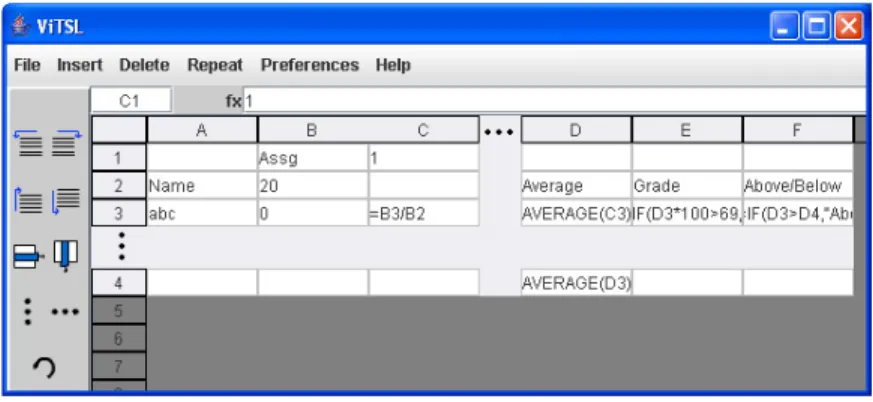
In applying this idea to end-user software engineering, one approach is for a tool to require up-front design. For example, ViTSL separates the modeling and data-entry as-pects of spreadsheet development [Erwig et al. 2005]. The spreadsheet model is captured as a template [Abraham et al. 2005] like the one in Figure 3. The ellipsis under row 3 indicates that the row can be repeated downwards; each row stores the scores of a student enrolled in the course. These templates can then be imported into a system called Gencel [Erwig et al. 2005, Erwig et al. 2006], which can be used to generate spreadsheets that are guaranteed to conform to the model represented by the template. For example, an in-stance of the template in Figure 3 is shown in Figure 4. The menu bar on the right allows the user to perform insertion and deletion, protecting the user against unintended changes. One limitation of this approach is that once a spreadsheet is generated from a template, edits to the generated spreadsheet cannot be propagated back to the template. (This same problem occurs in code generation systems in software engineering, where changes to the code are not reflected back to the specifications.)
Some systems are intended to support the exploration of specifications by supporting modeling for a particular type of application. For example, Berti et al. [2004] describe CTTE, a system that helps users convert natural language descriptions of tasks and sce-narios into a hierarchy of subtasks. This is essentially a modeling language that helps users to express the design and underlying workflow of a user interface. In a similar sys-tem, Lin and Landay [2008] describe Damask, a system that allows designers to proto-type ubiquitous computing applications and test them with users. In both of these sys-tems, the modeling languages were carefully designed with a particular domain and class of applications in mind.
Most other systems that support specification writing are used for later verification and checking, rather than generating programs. For example, Topes [Scaffidi et al. 2008] allowing users to define string-based data types that can be used to check the validity of data and operations in any programming language that stores information as strings. Other researchers have developed end-user specification languages for privacy and secu-rity. For example, Dougherty et al. [2006] describe a framework for expressing access-control policies in terms of domain concepts. These specifications are stated as “differ-ences” rather than as absolutes. For example, rather than stating who gets privileges in a declarative form, the system supports statements such as “after this change, students should not gain any new privileges.” Cranor et al. [2006] describe Privacy Bird, a related approach, which includes a specification language for users to express their privacy pref-erences in terms of the personal information being made accessible. Privacy Bird then uses these specifications to warn users about web sites’ violations of these preferences.
Figure 3. A ViTSL template, specifying the underlying structure of a grading spreadsheet. The names appear in rows and the assignments appear in columns, with the ellipses indicating repetition. Reproduced from [Abraham
and Erwig 2006c] with permission from authors.
Figure 4. An instance of the grade sheet template from Figure 3 loaded into Excel. The operations in the toolbar on the right utilize the spreadsheet’s underlying structure to help users avoid introducing errors into the
Finally, some approaches for writing specifications take a direct manipulation, what you see is what you get (WYSIWYG) approach, moving the description of behavior and appearance to the user’s language, rather than a machine language. For example, many WYSIWYG web site tools allow users to directly manipulate the design of a web site and then let the tool generate the HTML and CSS for use in a web browser (most notably at the time of this writing is Adobe’s Dreamweaver). To enable direct manipulation, such tools often limit the range of design possibilities to facilitate code generation, requiring users to learn the underlying language to express more complicated designs.
3.2.3.Inferring specifications. One approach to the problem of how to support a de-sign process is to eliminate it, replacing it with technologies that can determine require-ments automatically through various forms of inference.
Several systems have used a programming by example approach to this problem (such systems are described in detail in [Lieberman 2000]). These systems allow users to pro-vide multiple examples of the program’s intended behavior and the tool observes the be-havior and attempts to generalize from it. For example, Abraham and Erwig developed an approach for automatically inferring the templates discussed in the previous section from an example spreadsheet [Abraham and Erwig 2006a], allowing users more flexibility in redefining the spreadsheet template as requirements change. In the domain of event-based simulations, the AgentSheets environment [Repenning and Perrone 2000] lets the pro-grammer specify that a new type of “part” is just like an existing part, except for its icon; the tool will then generate all of the instructions necessary for the new part. McDaniel and Myers [1999] describe an approach to inferring interaction specifications, allowing users to click and drag objects from one part of the screen to another to demonstrate a desired movement at runtime.
Recent work has begun to apply programming by example to web sites. For example, Toomim et al. [2009] allow users to select example data from web sites and automatically generate a range of user interface enhancements. Nichols and Lau [2008] describe a simi-lar system, which allows users to create a mobile version of a web site through a combi-nation of navigating through the desired portion of the site and explicitly selecting con-tent. Macias and Paterno [2008] take a similar approach, in which users directly modify the web page source code. These modifications are used as a specification of preferences, which are then generalized and applied to other pages on the same site. Yet another ap-proach allows users to identify the same content with multiple markings, increasing the robustness of the inference [Lingham and Elbaum 2007].
One problem with programming by example approaches is that the specifications in-ferred are difficult to reuse in future programs, since most systems do not package the resulting program as a reusable component or a function There are some exceptions to this, however. For example, Scaffidi et al. [2007] describe an approach to inferring data type specifications from unlabeled textual examples and then allowing users to review and customize the specification. The specification can then be easily packaged and reused for use in other applications. Another counter example is [Smith et al. 2000].
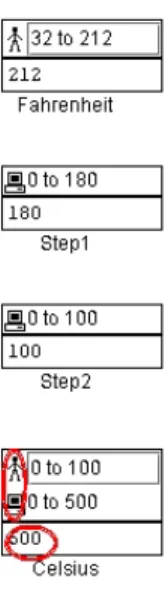
An alternative to programming by example is to elicit aspects of the specification di-rectly from end users. Burnett et al. [2003] describe an approach for spreadsheets, attach-ing assertions to each cell to specify intended numerical values. In this approach, seen in Figure 5, users can specify an intended range of a cell’s value at any time. Then, the sys-tem propagates these ranges through cell formulas, allowing the syssys-tem to further reason about the correctness of the spreadsheet. If a conflict is found between a user-generated assertion and a system-generated assertion, the system circles the two assertions to indi-cate the conflict. This assertions-based approach has been shown to increase people’s effectiveness at testing and debugging [Wilson et al. 2003, Burnett et al. 2003]. Scaffidi describes a similar approach for validating textual input [Scaffidi et al. 2008]; we de-scribe this approach in Section 3.3.4.
Other approaches take natural language descriptions of requirements and attempt to translate them into code. For example, Liu and Lieberman [2005] describe a system that Figure 5. An assertion conflict in Forms/3. The user wrote the assertion on the Celsius cell (0 to 100), which conflicts with the computer generated assertion (0 to 500). This prompts the user to check for errors in the cells’
takes descriptions of the intended behavior of a system and generates Python declarations of the objects and behaviors described in the descriptions. Little and Miller [2006] devel-oped a similar approach for Chickenfoot [Bolin et al. 2005] (a web scripting language) and Microsoft Word’s Visual Basic for Applications. Their approach exploits the user’s familiarity with the vocabulary of the application domain to express commands in that domain. Users can state their goals in terms of the domain keywords that they are familiar with and the system generates the code. Other systems have attempted to teach com-mands to users when their effect may not be visible, as in the case of scriptable group-ware applications [Wulf 2000].
3.3.What Can I Use to Write My Program? — Reuse
Reuse generally refers to either a form of composition, such as “gluing” together compo-nents APIs, or libraries, or modification, such as changing some existing code to suit a new context or problem. In professional programming, most of the code that developers write involves reuse of some sort, whether copying code snippets, adapting example code, or using libraries and frameworks by invoking their APIs [Bellon et al. 2007]. Tra-ditionally, the motivations for these various types of reuse are usually to save time, to avoid the risk of writing erroneous new code, and to support maintainability [Ye and Fischer 2005, Ravichandran and Rothenberger 2003].
While these practices are also true in end-user programming, in many ways they are made more difficult by end users’ shift in priorities. In particular, finding, reusing, and even sharing code becomes more opportunistic, as the goals of reuse are more to save time and less to achieve other software qualities. Furthermore, in end-user programming, reuse is often what makes a project possible, since it may be easier for an end user to per-form a task manually or not at all than to have to write it from scratch without other code to reuse [Blackwell 2002a].
Prior work on reuse has largely focused on studies of reuse in more conventional pro-gramming languages with large APIs or object hierarchies. Consequently, many of the challenges that professionals face, end users face as well. Where these populations differ is in how APIs, libraries, and frameworks must be designed to support a certain popula-tion. While APIs designed for professionals use often focus on optimizing flexibility, end users often need much more focused support for achieving their domain-specific goals. In this section, we characterize prior work on these different reuse activities and compare and contrast the role of reuse in end-user programming and professional development.
3.3.1.Finding Code to Reuse. A fundamental challenge to reuse is finding code and abstractions to reuse or knowing that they exist at all [Ye and Fischer 2005]. For exam-ple, Ko found that students using Visual Basic.NET to implement user interfaces strug-gled when trying to use search tools to find relevant APIs, and instead relied on their more experienced peers for finding example code or APIs [Ko et al. 2004]. This is similar to Nardi’s finding that people often seek out slightly more experienced coworkers for programming help [Nardi 1993]. Example code and example programs are one of the greatest sources of help for discovering, understanding, and coordinating reusable ab-stractions, both in professional programming [Rosson and Carroll 1996, Stylos and Myers 2006] and end-user programming [Wiedenbeck 2005, Rosson et al. 2005]. In many cases the examples are fully functional, so the programmer can try out the exam-ples and better understand how they work [Rosson and Carroll 1996, Walpole and Burnett 1997].
Researchers have also invented a number of tools to help search for both example code and APIs. For example, the CodeBroker system watches the programmer type code and guesses what API functions the programmer might benefit from knowing about [Ye and Fischer 2005]. Other systems also attempt to predict which abstractions will benefit a professional programmer [Mandelin et al. 2005, Bellettini et al. 1999]. Mica [Stylos and Myers 2006] lets users search using domain-specific keywords. While all of these ap-proaches are targeted at experienced programmers, many of the same ideas are beginning to be applied to languages intended for end-user programming. For example, CoScrip-ter’s support for sharing and finding others’ scripts not only helps users search for exam-ples, but utilizes other meta data such as a users’ social network to help users find rele-vant programs [Bogart et al. 2008].
3.3.2.Reusing Code. Even if end users are able to find reusable abstractions, in some cases, they may have difficulty using abstractions that were packaged, documented, and provided by an API. One study of students using Visual Basic.NET for user interface prototype showed that most difficulties relate to determining how to use abstractions cor-rectly, coordinating the use of multiple abstractions, and understanding why abstractions produced certain output [Ko et al. 2004]. In fact, most of the errors that the students made had more to do with the programming environment and API, and not the programming language. For example, many students had difficulty knowing how to pass data from one window to another programmatically, and they encountered null pointer exceptions and other inappropriate program behavior. These errors were due primarily to choosing the
wrong API construct or violating usage rules in the coordination of multiple API con-structs. Studies of end-user programming in other domains, such as web programming [Rode et al. 2003, Rosson et al. 2004], and numerical programming [Nkwocha and El-baum 2005], have documented similar types of API usage errors.
There are several ways of addressing mismatch between code and the desired func-tionality. In the case of code, one way is to simply modify the code itself, customizing it for a particular purpose. A special case of adapting such examples is the concept of a template. For example, Lin and Landay [2008], in their tool for prototyping user inter-faces across multiple devices, provide a collection of design pattern examples [Beck 2007] that users can adapt, parameterize, and combine. Some end-user development plat-forms, such as Adobe Flash, implement user interface components as modifiable tem-plates. Templates have also been used to facilitate the creation of scripts for mobile de-vices to support the independencies of people with cognitive disabilities [Carmien and Fischer 2008].
The mismatch between code and desired functionality can sometimes be addressed through tailoring by the end user. In this case, the user supplies parameters, rules, or even more complex information to the component or application, thereby changing its behav-ior. Tailoring enables component developers to offload some adaptive maintenance ac-tivities onto end users [Dittrich et al. 2006], who essentially become asynchronous col-laborators with the component developers [Mørch and Mehandjiev 2000]. In order for a component to be tailorable, the component designer must engage in significant upfront planning; in particular, the designer must consider how users in the target population will differ from one another, then determine which aspects of the component should accord-ingly be tailorable [Dittrich et al. 2006]. There are several ways to uncover user needs, such as including users in the design and construction of the component [Letondal 2006], performing ethnographies [Stevens et al. 2006], or interviewing users about their likely requirements [Eagen and Stasko 2008]. Such approaches assume that the users involved in component design can represent the diverse needs of the target population. Since users often vary not only in their requirements, but also in their level of tailoring skill, some component designers provide multiple mechanisms for tailoring, so that users with more skill can take advantage of more complex mechanisms in order to effect more specialized tailoring [Eagan and Stasko 2008, Morch and Mehandjiev 2000, Wulf 1999, Wulf et al. 2008]. Tailorability can be greatly facilitated by integrated support for collaborated tailor-ing [Pipek and Kahler 2006], integrity checks for detecttailor-ing tailortailor-ing mistakes [Won et al.
2006, Wulf et al. 2008], and evaluation features for helping users to understand the im-pact of tailoring [Won et al. 2006, Wulf et al. 2008].
Actually modifying the source code of APIs, libraries and other kinds of abstractions is generally not possible, since the code for the abstraction itself is not usually available. The programmer can sometimes write additional code to adapt an API [DeLine 1999], but there are certain characteristics of APIs and libraries, such as performance, that are difficult to adapt. Worse yet, when an end-user programmer is trying to decide whether some API or library would be suitable for a task, it is difficult to know in advance whether one will encounter such difficulties (this is also true for professionals [Garlan et al. 1995]).
Another issue for API and abstraction use is whether future versions of the abstraction will introduce mismatch because of changes to the implementation of the API behavior. For example, ActionScript [DeHaan 2006] (the programming language for Adobe Flash) and spreadsheet engine upgrades often change the semantics of existing programs’ be-havior. In the world of professional programming, one popular approach to detecting such changes is to create regression tests [Onoma et al. 1988]. Another possibility is to proxy all interactions with the API and log the API’s responses; then, if future versions of the API respond differently, the system can show an alert [Rakic and Medvidovic 2001]. Regression testing has been used in relation to spreadsheets [Fisher et al. 2002b]; beyond this, these approaches have not been pursued in end-user development environments.
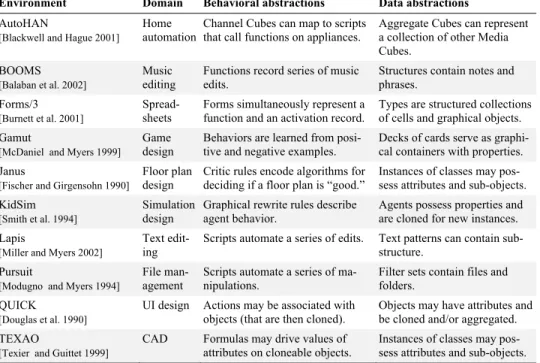
3.3.3.Creating and Sharing Reusable Code. Thus far, we have discussed reusing ex-isting code, but most end-user programming environments also provide ways for users to create new abstractions. Table 3 lists several examples of reusable abstractions, distin-guishing between behavioral abstractions and data abstractions. Studies of certain classes of end users suggest that data abstractions are the most commonly created type [Rosson et al. 2005, Scaffidi et al. 2006].
Although end users have the option of creating such reusable abstractions, examples are the more common form of reusable code. Unfortunately, it is extremely time-consuming to maintain a well-vetted repository of code. For example, Gulley [2006] de-scribes the challenges in maintaining a repository of user-contributed Matlab examples, with a rating system and other social networking features. For this reason, many organi-zations do not explicitly invest in creating such repositories. In such cases, programmers cannot rely on search tools but must instead share code informally [Segal 2007, Wieden-beck 2005]. This spreads repository management across many individuals, who share the work of vetting and explaining code.
Although it is common for end-user programmers to view the code they create as “throw away,” in many cases such code becomes quite long-lived [Mackay 1990]. Some-one might write a simple script to streamline some business process and then later, some-one might reuse the script for some other purpose. This form of “accidental” sharing is one way that end-user programmers face the same kinds of maintainability concerns as professional programmers. In field studies of CoScripter [Leshed et al. 2008, Bogart et al. 2008], an end-user development tool for automating and sharing “how-to” knowledge, scripts in the CoScripter repository were regularly copied and duplicated as starting points for new scripts, even when the original author never intended such use [Bogart et
Environment Domain Behavioral abstractions Data abstractions
AutoHAN
[Blackwell and Hague 2001]
Home automation
Channel Cubes can map to scripts that call functions on appliances.
Aggregate Cubes can represent a collection of other Media Cubes.
BOOMS [Balaban et al. 2002]
Music editing
Functions record series of music edits.
Structures contain notes and phrases.
Forms/3 [Burnett et al. 2001]
Spread-sheets
Forms simultaneously represent a function and an activation record.
Types are structured collections of cells and graphical objects. Gamut
[McDaniel and Myers 1999]
Game design
Behaviors are learned from posi-tive and negaposi-tive examples.
Decks of cards serve as graphi-cal containers with properties. Janus
[Fischer and Girgensohn 1990]
Floor plan
design Critic rules encode algorithms for deciding if a floor plan is “good.” Instances of classes may pos-sess attributes and sub-objects. KidSim
[Smith et al. 1994]
Simulation design
Graphical rewrite rules describe agent behavior.
Agents possess properties and are cloned for new instances. Lapis
[Miller and Myers 2002]
Text
edit-ing Scripts automate a series of edits. Text patterns can contain sub-structure. Pursuit
[Modugno and Myers 1994]
File man-agement
Scripts automate a series of ma-nipulations.
Filter sets contain files and folders.
QUICK [Douglas et al. 1990]
UI design Actions may be associated with objects (that are then cloned).
Objects may have attributes and be cloned and/or aggregated. TEXAO
[Texier and Guittet 1999]
CAD Formulas may drive values of attributes on cloneable objects.
Instances of classes may pos-sess attributes and sub-objects. Table 3. Behavioral and data abstractions in some end-user programming environments.
al. 2008]. This unplanned sharing also means that improvements to the originally copied or shared code do not propagate to the copies that need it. This distinction between planned and unplanned reuse can demand different reuse technologies. For example, many professional development tools that support copying, such as the “linked editing” technology described by Toomim et al. [2004], require users to plan their copying activi-ties.
3.3.4.Designing Reusable Code for End Users. One way to facilitate reuse by end us-ers is to choose the right abstractions for their problem domains. This means choosing the right concepts and choosing the right level of abstraction for such concepts. For example, the designers of the Alice 3D programming system [Dann et al. 2006] consciously de-signed their APIs to provide abstractions that more closely matched peoples’ expectations about cameras, perspectives, and object movement. The designers of the Visual Ba-sic.NET APIs based their API designs on a thorough study of the common programming tasks of a variety of programmer populations [Green et al. 2006]. The Google Maps API is related in that the key to its success has been the relative ease with which users can annotate geographical images with custom data types.
In other cases, choosing the right abstractions for a problem domain involves under-standing the data used in the domain, rather than the behavior. For example, Topes [Scaf-fidi et al. 2008] is a framework for describing string data types unique to an organization, such as room numbers, purchase order IDs, and phone number extensions (see Figure 6). By supporting the design of these custom data types, end-user programmers can more easily process and validate information, as well as transform information between differ-ent formats. This is a fundamdiffer-ental problem in many new domains of end-user program-ming, such as “mashup” design tools [Wong and Hong 2007] and RSS feed processors (e.g., http://pipes.yahoo.com).
Of course, as with any design, designing the right abstractions has tradeoffs. Special-izing abstractions can result in a mismatch between the functionality of a reusable ab-straction and the functionality needed by a programmer [Ye and Fischer 2005, Wieden-beck 2005]. For example, many functional mismatches occur because specialized abstrac-tions often have non-local effects on the state of a program [Biggerstaff and Richter 1989]. In addition to functional mismatch, non-functional issues can cause abstractions not to mesh well with the new program [Ravichandran and Rothenberger 2003, Shaw 1995]. End-user software engineering research is only beginning to consider this space of API and library design issues.
3.4.Is My Program Working Correctly? —Verification and Testing
There is a large range of ways to gain confidence about the correctness of a program, including through verification, testing, or a number of other approaches. The goals of testing and verification techniques are universal: they enable people to have a more ob-jective and accurate level of confidence than they would if they were left unassisted. Where EUSE and professional SE differ is that end-user programmers’ priorities often lead to overconfidence in the correctness of their programs.
Figure 6. The Toped++ pattern editor [Scaffidi et al. 2008], allowing the creation of string data types that sup-port recognition of matching strings and transformation between formats. Original figure obtained from authors.

![Figure 6. The Toped++ pattern editor [Scaffidi et al. 2008], allowing the creation of string data types that sup- sup-port recognition of matching strings and transformation between formats](https://thumb-us.123doks.com/thumbv2/123dok_us/1027383.2635829/29.918.193.733.108.483/figure-pattern-scaffidi-allowing-creation-recognition-matching-transformation.webp)