Issues and Advantages of Using Agile and Incremental
Practices
Industrial Case Study vs. State of the Art
Kai Petersen
∗School of Engineering, Blekinge Institute of Technology
Box 520
SE-372 25 Ronneby, Sweden
Claes Wohlin
School of Engineering, Blekinge Institute of Technology
Box 520
SE-372 25 Ronneby, Sweden
ABSTRACT
The importance of agile methods increased in recent years due to the need of being more flexible due to unstable re-quirements and high competitive pressure. Therefore, recent empirical studies have been conducted identifying a number of issues and advantages of incremental and agile methods. However, the majority of studies focused on one model (Ex-treme Programming) and small projects. Thus, in order to draw more general conclusions there is a need to also study large scale implementations of agile and incremental practices. Therefore, this paper 1) investigates a large-scale implementation of agile and incremental practices and iden-tified issues and advantages and 2) compares them with the findings of previous studies mainly focusing on small-scale agile implementations.
Keywords
Agile Practices, Incremental Development, Case Study, Em-pirical
1.
INTRODUCTION
The nature of software development has changed in re-cent years. That is, software is included in a vast amount of products (cars, entertainment, mobile phones) and is a major success factor determining whether a product suc-ceeds. Therefore, it becomes more and more important to be flexible in handling changing requirements to meet cur-rent customer needs and to deliver fast to the market. As a solution agile methods have stareted to be adopted by in-dustry and recent studies have been focusing on evaluating agile and incremental development models.
∗The author is also affiliated with Ericsson AB, Box 518,
SE-37123 Karlskrona, Sweden, [email protected]
.
A systematic review [3] identified and analyzed studies on agile software development. They identified a total of 33 studies relevant for the review of which 25 investigated Ex-treme Programming (XP). Furthermore, only three papers investigated projects with more than 50 people involved in total. That is, the results so far are hard to generalize due to the focus on one specific method and small projects. In order to address this research gap a large-scale implementa-tion of a set of agile and incremental practices is investigated through an industrial case study at Ericsson AB. In partic-ular, issues and advantages of using agile and incremental methods are extracted from existing studies and are com-pared with the results of the case study. Three subsystems have been investigated at Ericsson through 33 interviews, covering persons from each subsystems and different roles.
The incremental and agile model used at the company is a selection of agile and incremental practices, thus it cannot be mapped one to one to the models presented in literature. However, the company’s agile and incremental model uses practices from SCRUM (SC), XP and incremental and itera-tive development (IID). Some of the key practices used at the company are for example the devision of internal and exter-nal releases, small and motivated teams developing software in three month projects (time-boxing), frequent integration of software, and always developing the highest prioritized features first.
The main contribution of the study is to help in the de-cision of adopting agile methods and showing the problems that have to be addressed as well as the merits that can be gained by agile methods. Based on this the following objectives are formulated for the study:
• Illustrate one way of implementing incremental and agile practices in a large-scale organization.
• Provide an in-depth understanding of the merits and issues related to agile development. This is possible due to the qualitative nature of the study and by ex-tracting issues and advantages from state of the art literature.
• Increase the generalizability of existing findings by in-vestigating a different study context (large scale and telecommunication domain) and comparing it to state of the art.
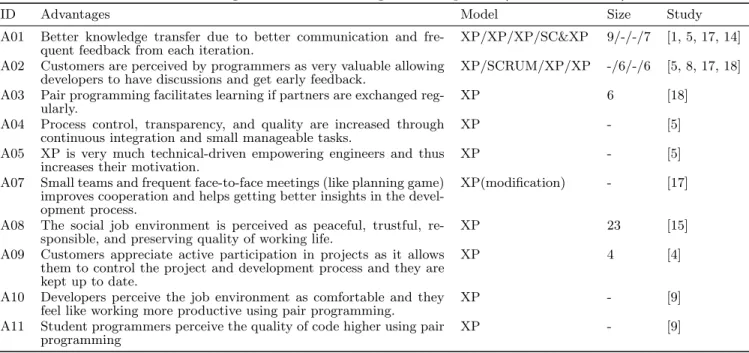
Table 1: Advantages in Incremental Agile Development (State of the Art)
ID Advantages Model Size Study
A01 Better knowledge transfer due to better communication and fre-quent feedback from each iteration.
XP/XP/XP/SC&XP 9/-/-/7 [1, 5, 17, 14] A02 Customers are perceived by programmers as very valuable allowing
developers to have discussions and get early feedback.
XP/SCRUM/XP/XP -/6/-/6 [5, 8, 17, 18]
A03 Pair programming facilitates learning if partners are exchanged reg-ularly.
XP 6 [18]
A04 Process control, transparency, and quality are increased through continuous integration and small manageable tasks.
XP - [5]
A05 XP is very much technical-driven empowering engineers and thus increases their motivation.
XP - [5]
A07 Small teams and frequent face-to-face meetings (like planning game) improves cooperation and helps getting better insights in the devel-opment process.
XP(modification) - [17]
A08 The social job environment is perceived as peaceful, trustful, re-sponsible, and preserving quality of working life.
XP 23 [15]
A09 Customers appreciate active participation in projects as it allows them to control the project and development process and they are kept up to date.
XP 4 [4]
A10 Developers perceive the job environment as comfortable and they feel like working more productive using pair programming.
XP - [9]
A11 Student programmers perceive the quality of code higher using pair programming
XP - [9]
The structure of the paper is shown in Figure 1: Section 2 presents the state of the art summarizing issues and advan-tages identified in literature. Thereafter, the investigated process model is described in Section 3, and the practices applied in the company’s model are mapped to the princi-ples associated to XP and SCRUM for the purpose of gen-eralizability. Section 4 illustrates the research design which constitutes the context in which the study is conducted, the data collection procedures, and a description of the data analysis methods. The analysis of collected data (Section 5) results in issues and advantages identified in the case study, as well as a comparison between the case and the state of the art described in Section 2 (see SotA vs. Case in Figure 1). Sections 6 and 7 draw everything together. The implications of the comparison of state of the art and case are discussed, and the mapping (3) can be used to discuss generalizability and comparability of results.
State of the Art (SotA)
(Section 2)
Process Model
(Section 3)
Case Study Design
(Section 4)
Analysis and Comparison
(Section 5)
Discussion
(Section 6)
Conclusion
(Section 7) SotA (Issue, Advantages)
Model, Mapping Context, Data Collection, Analysis
SotA vs. Case Study Case Study (Issues, Advantages)
Study Results
Outcome
Figure 1: Structure of the Paper
2.
STATE OF THE ART
The studies presenting advantages and issues of agile and incremental methods have been identified in a recent system-atic review of empirical studies in agile software development [3]. The issues and advantages presented here are from the review as well as looking at the original articles included in the review. Furthermore, one further article not included
in the systematic review has been identified ([14]). The is-sues and advantages are presented as tables receiving an ID (A01-A11, I01-I10) which is used as a reference when com-paring the issues and advantages identified in this case study with the findings in state of the art. The tables also contain information of which development models are related to a specific issue and how large the project was (measured in number of team members).
Table 1 provides an overview of advantages of agile and incremental development that have been empirically shown in the studies identified in [3]. The advantages that have been shown for agile methods are clearly dominated by stud-ies that investigated XP or a modified version of XP ([5]). One advantage (A02) has been shown for SCRUM as well. The size of the projects is quite small (up to 23) and for many projects the size has not been reported. The main advantages are related to benefits of communication lead-ing to better learnlead-ing and knowledge transfer (A01, A03, A07). Furthermore, it is emphasized that people feel com-fortable using agile methods (A08, A10). Also, the cus-tomers appreciate agile methods as they provide them with the opportunity of influencing the software process and get-ting feedback (A09). The same is true vice versa, meaning developers also appreciate the presence of customers (A02). Developers value the technical focus of agile methods in-creasing their motivation (A05). There is also a perception of increased quality in software products (A11) and higher productivity (A10) when using pair programming.
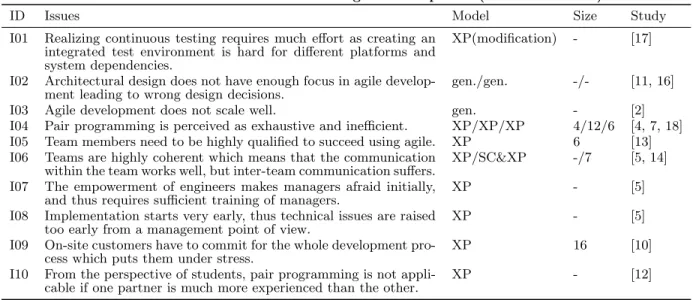
Besides the advantages, agile and incremental models face a number of issues that are summarized in Table 2. Studies identifying issues reveal the same pattern as studies identify-ing advantages, that is small projects have been studied and the main focus has been on XP. The positive effects that have been shown for pair programming (A03, A10, A11), like higher quality and productivity and facilitated learning, need to be seen alongside a number of issues. That is, pair programming is perceived as exhaustive (I04) and requires
Table 2: Issues in Incremental and Agile Development (State of the Art)
ID Issues Model Size Study
I01 Realizing continuous testing requires much effort as creating an integrated test environment is hard for different platforms and system dependencies.
XP(modification) - [17]
I02 Architectural design does not have enough focus in agile develop-ment leading to wrong design decisions.
gen./gen. -/- [11, 16]
I03 Agile development does not scale well. gen. - [2]
I04 Pair programming is perceived as exhaustive and inefficient. XP/XP/XP 4/12/6 [4, 7, 18]
I05 Team members need to be highly qualified to succeed using agile. XP 6 [13]
I06 Teams are highly coherent which means that the communication within the team works well, but inter-team communication suffers.
XP/SC&XP -/7 [5, 14]
I07 The empowerment of engineers makes managers afraid initially, and thus requires sufficient training of managers.
XP - [5]
I08 Implementation starts very early, thus technical issues are raised too early from a management point of view.
XP - [5]
I09 On-site customers have to commit for the whole development pro-cess which puts them under stress.
XP 16 [10]
I10 From the perspective of students, pair programming is not appli-cable if one partner is much more experienced than the other.
XP - [12]
partners with equal qualifications (I10). Agile can also be considered an exhaustive activity from customers’ point of view as the customer has to commit and be present through-out the whole development process. Team related issues are that members of teams have to be highly qualified and inter-team communication suffers (I05, I10). From a management point of view two issues are identified, namely that they feel threatened by the empowerment of engineers (I07) and that technical issues are raised too early (I08). Furthermore, agile projects do not scale well (I03) and have too little focus on architecture development (I01). Agile also faces implemen-tation problems when realizing continuous testing as this requires much effort (I01).
The advantages and issues of the state of the art shown in Tables 1 and 2 are used as an input for the comparison with the results from the case study in Section 5.
3.
PROCESS MODEL
The process model used at the company is described and thereafter its principles are mapped to SCRUM and XP.
3.1
Model Description
Due to the introduction of incremental and agile devel-opment at the company the following and company specific practices have been introduced:
• Small teams: The first principle is to have small teams conducting short projects lasting three months. The duration of the project determines the number of re-quirements selected for a requirement package. Each project includes all phases of development, from pre-study to testing.
• Implementing highest priority requirements: The pack-aging of requirements for projects is driven by require-ment priorities. Requirerequire-ments with the highest priori-ties are selected and packaged to be implemented. An-other criterion for the selection of requirements is that they fit well together and thus can be implemented in one coherent project.
• Use of latest system version: If a project is integrated with the previous baseline of the system, a new base-line is created (referred to as LSV). Therefore, only one product exists at one point in time, helping to re-duce the effort for product maintenance. The LSV can also be considered as a container where the results of the projects (including software and documentation) are put together. On the project level, the goal is to focus on the development of the requirements while the LSV sees the overall system where the results of the projects are integrated. When the LSV phase is completed, the system is ready to be shipped.
• Anatomy plan: The anatomy plan determines the con-tent of each LSV and the point in time when a LSV is supposed to be completed. It is based on the depen-dencies between parts of the system developed which are developed in small projects, thus influencing the time-line in which projects have to be executed.
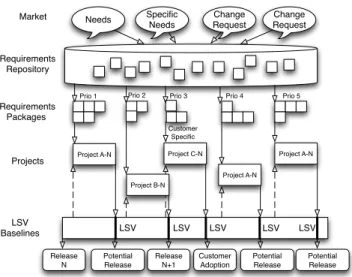
• Decoupling Development from Customer Release: If every release is pushed onto the market, there are too many releases used by customers that need to be sup-ported. In order to avoid this, not every LSV has to be released, but it has to be of sufficient quality to be possible to release to customers. LSVs not released to the customers are referred to as potential releases. The release project in itself is responsible for making the product commercially available and to package it in the way that the system should be released. In Figure 2 an overview of development process is pro-vided.
On the top, the requirements packages are created from high priority requirements stored in the repository. These requirements packages are implemented in projects (for ex-ample Project A-N). Such a project has a duration of ap-proximately three months (time-boxed). When a project is finished, it is integrated with the lastest baseline of the sys-tem which creates a new baseline (LSV). The LSV has a pre-defined cycle (for example, projects have to drop their com-ponents within a specific timeframe to the LSV). In the
bot-Requirements Repository Requirements Packages Needs Specific Needs Change Request Change Request Market
Prio 1 Prio 2 Prio 3 Prio 4 Prio 5
Customer Specific Project A-N Project B-N Project C-N Project A-N Project A-N LSV Baselines LSV LSV LSV LSV LSV Release N Potential Release Release N+1 Customer Adoption Potential Release Potential Release Projects
Figure 2: Development Process
tom, the different releases of the system are shown. These are either potential releases or customer releases.
The incremental development on project level is run as iterations and each iteration creates an increment. The project does not deliver one increment but a set of incre-ments put together in a drop to the LSV. The process flow works as follows: A set of requirements comes into a new project having a duration of three months. The project is divided in several iterations, each iteration creating a new in-crement. An iteration takes approximately two weeks. Each iteration is a continuous flow with the following steps:
• The requirements come into the project.
• Requirements are designed and implemented.
• The implementation is deployed within the test envi-ronment (including test cases).
• The results from the executed test are monitored.
3.2
Mapping
The principles used in the process model at the company (C) are mapped to the ones in incremental and iterative de-velopment (IID), extreme programming (XP), and SCRUM (SC). The purposes of the mapping are to be able to gen-eralize lessons learned to other model and to compare the company model with literature. Table 3 (created based on the information provided in [6]) shows that 4 out of 5 in-cremental principles are fulfilled which means that lessons learned in this study are generalizable to IID. Furthermore, the model used at the company shares 7 out of 13 principles with XP and 6 out of 11 principles with SCRUM. The com-pany’s model realizes the principles shared with ID, XP and SCRUM as follows:
Iterations and Increments: Each new LSV is an incre-ment of the product. Projects are conducted in an iterative manner where a set of a project’s increments is dropped to LSV.
Internal and External Releases: Software products deliv-ered and tested in the LSV can be potentially delivdeliv-ered to the market, however, they do not have to. Instead, they can just be used as an input to the next internally or externally used increment.
Table 3: Mapping
Principle IID XP SC C
Iterations and Increments √ √ √ √
Internal and External Releases √ √
Time Boxing √ √ √ √
No Change of Started Projects √ √ √
Incremental Deliveries √
On-site Customer √ √
Frequent Face-to-Face Interaction √ √ √
Self-organizing Teams √ √
Empirical Process √ √
Sustainable Discipline √
Adaptive Planning √ √
Requirements Prioritization √ √ √
Fast decision making √
Frequent Integration √ √ √
Simplicity of design √
Refactoring √
Team Code Ownership √
Time Boxing: Time boxing means that projects have a pre-defined duration with a fixed deadline. In the company model the time box is set to approximately three month. Furthermore, the LSV cycles determine when a project has to finish and drop its components to the LSV.
No Change to Started Projects: If a feature is selected and the implementation realizing the feature has been started then it is finished.
Frequent Face-to-Face Interaction: Projects are realized in small teams sitting together. Each team consists of people fulfilling different roles. Furthermore, frequent team meet-ings are conducted in the form of stand-up meetmeet-ings as used in SCRUM.
Requirements Prioritization: A prioritized requirements list where the highest prioritized requirements are taken from the top and implemented first is one of the core prin-ciples of the company’s model.
Frequent Integration: Within each LSV cycle the results from different projects are integrated and tested. As the cycles have fixed time frames frequent integration is assured. Overall it is visible that the model shares nearly all prin-ciples with ID and realizes a majority of XP and SCRUM principles. However, we would like to point out that when comparing the results with models investigated in empirical research it is not always made explicit to what degree differ-ent principles are fulfilled in those studies. In other words, it is unknown to what extent a so-called XP-study actually implements all XP practices. This issue and its implications are further discussed in Section 6.
4.
CASE STUDY DESIGN
4.1
Case Study Context
Ericsson AB is a leading and global company offering so-lutions in the area of telecommunication and multimedia. Such solutions are for example charging systems for mobile phones, multimedia solutions and network solutions. The company is ISO 2001:2000 certified. The market in which the company operates can be characterized as highly dy-namic with high innovation in products and solutions. The
development model is market-driven meaning that the re-quirements are collected from a large base of potential end-customers without knowing exactly who the customer will be. Furthermore, the market demands highly customized solutions, specifically due to differences in services between countries.
4.2
Research Questions and Propositions
This study aims at answering the following research ques-tions:
• RQ1: What are the advantages and issues in indus-trial large-scale software development informed by agile and incremental practices? So far, very little is known about advantages and issues of using agile and incre-mental practices in large-scale industrial software de-velopment. Thus, the answer to this research question makes an important step toward filling this research gap.
• RQ2: What are the differences and similarities between state of the art and the case study results? By answer-ing this research question new insights in comparison to what has been studied before become explicit. Fur-thermore, contradictions and confirmations of previous results are made explicit and facilitate the generaliz-ability of results.
Furthermore, propositions are stated which are similar to hypotheses, stating what the expected outcome of a study is. Propositions also help in identifying proper cases and units of analysis. The proposition is stated for the outcome of RQ3: As the case differs from those presented in state of the art new issues and benefits are discovered that have not been empirically identified before.
4.3
Case Selection and Units of Analysis
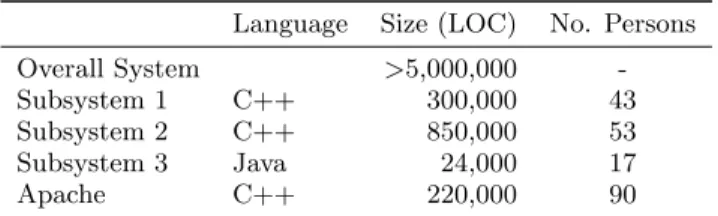
Three subsystems that are part of a large-scale product are studied at the company. The large-scale product is the case being studied while the three subsystems are distinct units of analysis embedded in the case. Table 4 summarizes some characteristics of the case and units of analysis. The LOC measure only includes code produced at the company (excluding third-party libraries). Furthermore, the approx-imate number of persons involved in each subsystem are stated. A comparison between the case and the Apache web server shows that the case and its units of analysis can be considered large-scale, the overall system being 20 times larger than Apache.
Table 4: Units of Analysis
Language Size (LOC) No. Persons
Overall System >5,000,000
-Subsystem 1 C++ 300,000 43
Subsystem 2 C++ 850,000 53
Subsystem 3 Java 24,000 17
Apache C++ 220,000 90
4.4
Data Collection Procedures
The data is collected through interviews and from process documentation.
4.4.1
Selection of Interviewees
The interviewees were selected so that the overall develop-ment life cycle is covered, from requiredevelop-ments to testing and product packaging. Furthermore, each role in the develop-ment process should be represented by at least two persons if possible. The selection of interviewees was done as follows: 1. A complete list of people available for each subsystem
was provided by management.
2. At least two persons from each role have been ran-domly selected from the list. The more persons are available for one role the more persons have been se-lected. The reason for doing so is to not disturb the projects, that is if only one person is available in a key role it disturbs the project more to occupy that person compared to when several people share the same role. 3. The selected interviewees received an e-mail explain-ing why they have been selected for the study. Further-more, the mail contained information of the purpose of the study and an invitation for the interview. Overall, 44 persons have been contacted of which 33 accepted the invitation.
The distribution of people between different roles and the three subsystems (S1-S3) is shown in Table 5. The roles are divided into ”What”, ”When”, ”How”, ”Quality Assurance”, and ”Life Cycle Management”.
Table 5: Distribution of Interviewees Between Roles and Units of Analysis
S1 S2 S3 Total
What (Requirements) 2 1 1 4
When (Project Planning) 3 2 1 6
How (Implementation) 3 2 1 6
Quality Assurance 4 3 - 7
Life Cycle Management 6 4 - 10
Total 18 12 3 33
What: This group is concerned with the decision of what to develop and includes people from strategic product man-agement, technical managers and system managers. Their responsibility is to document high-level requirements and breaking them down for design and development.
When: People in this group plan the time-line of software development from a technical and project management per-spective.
How: Here, the architecture is defined and the actual im-plementation of the system takes place. In addition, devel-opers do testing of their own code (unit tests).
Quality Assurance: Quality assurance is responsible for testing the software and reviewing documentation.
Life Cycle Management: This includes all activities sup-porting the overall development process, like configuration management, maintenance and support, and packaging and shipment of the product.
4.4.2
Interview Design
The interview consists of five parts, the duration of the interviews was set to approximately one hour. In the first part of the interview the interviewees were provided with
an introduction to the purpose of the study and explana-tion why they have been selected. The second part com-prised questions regarding the interviewees background, ex-perience, and current activities. Thereafter, the actual is-sues and advantages were collected through a semi-structured interview. The interview was designed to collect issues and advantages from the interviewees. The interview was ini-tially designed to only capture issues, however, during the course of the interview advantages were mentioned by the interviewees and we asked follow-up questions. In order to collect as many issues as possible, the questions have been asked from three perspectives: bottlenecks, rework, and un-necessary work. The interviewees should always state what kind of bottleneck, rework, or unnecessary work they ex-perienced, what caused it, and where it was located in the process.
4.4.3
Process Documentation
The company provides process documentation to their em-ployees, as well as presentations on the process for train-ing purposes. We study this documentation to facilitate a good understanding of the process in the organization. Fur-thermore, presentations given at meetings are investigated which show the progress and first results of introducing agile and incremental principles from a management perspective. However, the main source of information are the interviews, and the process documentation is mainly used to get a bet-ter understanding of the process and to triangulate what has been said in the interviews.
4.5
Data Analysis Approach
As mentioned earlier the conclusions of the case study are based on the mapping of the company’s model to general process models, the state of the art, and the case study investigating issues and advantages.
State of the art: In order to identify from literature which issues and advantages exist, the systematic review on agile methods [3] is used as an input. As a starting point the advantages and disadvantages have been extracted from the review (SotA). To identify more advantages and issues, the results and discussion sections of the identified papers in the review have been read, focusing on qualitative results as those are best comparable to the outcome of this study.
Process mapping: The mapping was done based in the in-formation gathered in the interviews, documentation of the development process, and validation with a process expert at the company. The process expert is a driver for agile im-plementation at the company and has profound knowledge of general agile models as well as the company’s model.
Advantages/issues mapping: The derivation of advantages and issues is done in a similar way and advantages/issues is here referred to as factors. As part of the case study analysis, the first author of the paper transcribed more than 30 hours of audio recordings from the interviews which are used for the data analysis. The data was analyzed in a four-step process, the first four steps being conducted by the first author over a three-month period.
1. Clustering: The raw data from the transcriptions is clustered, grouping statements belonging together. For example, all statements related to requirements engi-neering are grouped together. Thereafter, statements aaddressing similar areas are grouped.
2. Derivation of Issues: The raw data contains detailed explanations and therefore is abstracted by deriving factors from the raw data, explaining them shortly in one or two sentences. The result was a high number of factors where factors varied in their abstraction level and could be further clustered.
3. Mapping of Factors: The factors were grouped based on their relation to each other and their abstraction level. For example, factors that negatively affect the coverage of the system by test cases are grouped within one branch called ”low test coverage”. The grouping was documented in form of a mind map. Factors with higher abstraction level are closer to the center of the mind map than factors with lower abstraction level. 4. Validation of Factors: In studies of qualitative nature
there is always a risk that the data is biased by the interpretation of the researcher. Therefore, the factors have been validated in two workshops with three repre-sentatives from the company. The reprerepre-sentatives have an in-depth knowledge of the processes. Together, the four steps of analysis described here have been repro-duced together with the authors and the representa-tives. Therefore, a subset of randomly selected issues and advantages have been selected. The outcome of the workshop was positive as there was no disagree-ment on the interpretation of the factors. To further improve the data the workshop participants reviewed the final list of issues and advantages and only pro-vided small improvement suggestions on how to formu-late them. Thus, the list of factors can be considered being of high quality.
Finally, the SotA and case study results are compared to for example identify whether new issues have been identi-fied in this case study, or to explain why other advantages found in SotA cannot be seen in the case study. It is im-portant to mention that not all issues and advantages found in the case study are considered in the comparison. That is, only general issues and advantages should be taken into consideration. Thus, we only included issues that have been mentioned by two or more persons.
4.6
Threats to Validity
Threats to the validity of the outcome of the study are important to consider already during the design of the study allowing to take actions mitigating them. Threats to validity in case study research are reported in [19]. The threats to validity can be divided into four types: construct validity, internal validity, external validity and reliability.
Construct Validity: Construct validity is concerned with obtaining the right measures for the concept being studies. One threat is the selection of people to obtain the appropri-ate sample for answering the research questions. Therefore, experienced people from the company selected a pool of in-terviewees as they know the persons and organization best. From this pool the random sample was taken. The selec-tion by the representatives of the company was done having the following aspects in mind: process knowledge, roles, dis-tribution across subsystem components, and having a suffi-cient number of people involved (although balancing against costs). Furthermore, it is a threat that the presence of the researcher influences the outcome of the study. The threat is
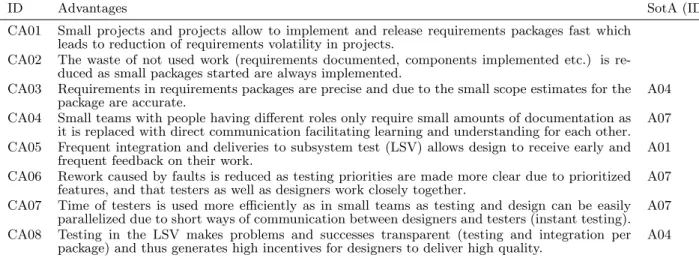
Table 6: Advantages Identified in Case Study
ID Advantages SotA (ID)
CA01 Small projects and projects allow to implement and release requirements packages fast which leads to reduction of requirements volatility in projects.
CA02 The waste of not used work (requirements documented, components implemented etc.) is re-duced as small packages started are always implemented.
CA03 Requirements in requirements packages are precise and due to the small scope estimates for the package are accurate.
A04 CA04 Small teams with people having different roles only require small amounts of documentation as
it is replaced with direct communication facilitating learning and understanding for each other. A07 CA05 Frequent integration and deliveries to subsystem test (LSV) allows design to receive early and
frequent feedback on their work.
A01 CA06 Rework caused by faults is reduced as testing priorities are made more clear due to prioritized
features, and that testers as well as designers work closely together.
A07 CA07 Time of testers is used more efficiently as in small teams as testing and design can be easily
parallelized due to short ways of communication between designers and testers (instant testing). A07 CA08 Testing in the LSV makes problems and successes transparent (testing and integration per
package) and thus generates high incentives for designers to deliver high quality.
A04
mitigated as there has been a long cooperation between the company and university and the author collecting the data is also employed by the company and not viewed as being external. Construct validity is also threatened if interview questions are misunderstood or misinterpreted. To mitigate the threat pre-tests of the interview have been conducted.
Internal Validity: Internal validity is primarily for ex-planatory and causal studies, where the objective is to es-tablish a causal relationship. As this study is of exploratory nature internal validity is not considered.
External Validity: External validity is the ability to gen-eralize the findings to a specific context. It is impossible to collect data for a general process, i.e. exactly as it is de-scribed in literature. The process studied is an adoption of principles from different general process models (see Section 3). Care has been taken to draw conclusions and map results to these general models to draw general conclusions and not solely discussing issues that are present due to the specific instantiation of the process at the studied setting. However, if one maps the general findings in this paper to other devel-opment processes their context must be taken into account. Furthermore, a potential threat is that the actual case study is conducted within one company. To minimize the influence of the study being conducted at one company, the objective is to map the findings from the company specific processes and issues to general processes. The characteristics of the context and principles used in the process are made explicit to ease the mapping (see Table 3).
Reliability: This threat is concerned with repetition or replication, and in particular that the same result would be found if re-doing the study in the same setting. There is al-ways a risk that the outcome of the study is affected by the interpretation of the researcher. To mitigate this threat, the study has been designed so that data is collected from differ-ent sources, i.e. to conduct triangulation to ensure the cor-rectness of the findings. The interviews have been recorded and the correct interpretation of the data has been validated through workshops with representatives of the company.
5.
ANALYSIS AND COMPARISON
First, the advantages identified in the case study are com-pared with SotA, and the same is done for the issues.
5.1
Advantages
Table 6 shows the advantages identified in the case study, furthermore the ID of the advantages of SotA clearly related to the ones in the case study are stated in column SotA (ID). It is shown that six out of eight advantages can be clearly linked to those identified in literature.
Transparency and control: Better control and transparency is achieved by having small and manageable tasks (A04). The case study led to the same result. The prioritized list of requirements consists of requirements packages that have to be implemented and the requirements packages have a small scope (for example compared to waterfall models where the complete scope is defined upfront). Due to clear separation of packages which are delivered as an increment, responsi-bilities for an increment can be clearly defined increasing transparency (CA03). In particular problems and successes are more transparent. That is, if an increment is dropped to the LSV for test one can trace which increments are of high or low quality and who is responsible for them. Con-sequently, this creates incentives for teams to deliver high quality as their work result is visibly linked to them (CA08).
Learning, understanding, and other benefits of face-to-face communication: In agile development team members com-municate intensively face-to-face as they have frequent meet-ings and are physically located together (A07). Thus, learn-ing and understandlearn-ing for each other are intensified. In the case study, the interviewees provided a concrete example for this. Before using agile, testers and designers were sepa-rated. Therefore, designers were not able to put themselves in the shoes of the testers verifying their software and what information or documentation would help testing. Now that designers and testers sit together, they can learn from each other. The designers understand how the quality of what they implement impacts the testers. Furthermore, testers can point designers to parts of the system that from their perspective are critical and thus require more intensive test-ing (CA04). The direct communication also enables instant testing due to short ways of communication (CA07). An additional benefit is the increased informal communication where important information is continuously shared, ulti-mately resulting in less rework and higher quality (CA06).
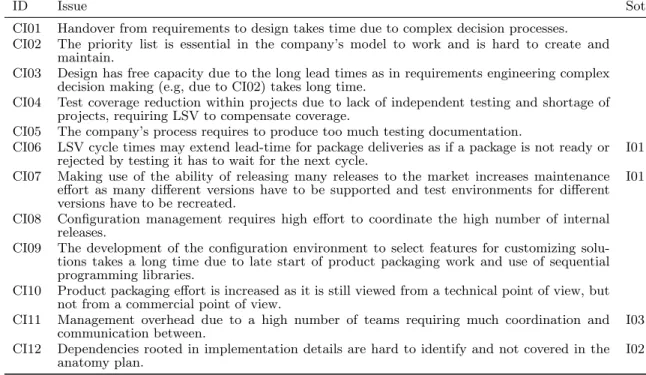
trans-Table 7: Issues Identified in Case Study
ID Issue SotA (ID)
CI01 Handover from requirements to design takes time due to complex decision processes. CI02 The priority list is essential in the company’s model to work and is hard to create and
maintain.
CI03 Design has free capacity due to the long lead times as in requirements engineering complex decision making (e.g, due to CI02) takes long time.
CI04 Test coverage reduction within projects due to lack of independent testing and shortage of projects, requiring LSV to compensate coverage.
CI05 The company’s process requires to produce too much testing documentation.
CI06 LSV cycle times may extend lead-time for package deliveries as if a package is not ready or rejected by testing it has to wait for the next cycle.
I01 CI07 Making use of the ability of releasing many releases to the market increases maintenance
effort as many different versions have to be supported and test environments for different versions have to be recreated.
I01
CI08 Configuration management requires high effort to coordinate the high number of internal releases.
CI09 The development of the configuration environment to select features for customizing solu-tions takes a long time due to late start of product packaging work and use of sequential programming libraries.
CI10 Product packaging effort is increased as it is still viewed from a technical point of view, but not from a commercial point of view.
CI11 Management overhead due to a high number of teams requiring much coordination and communication between.
I03 CI12 Dependencies rooted in implementation details are hard to identify and not covered in the
anatomy plan.
I02
fered through frequent feedback whenever completing an it-eration and delivering it (A01). In the case study a similar result was obtained. Whenever increments are dropped to the LSV there is a clear visibility of who delivered what and with which quality. Furthermore, the frequency of in-tegration is enforced by pre-defined LSV cycles that require integration every few weeks. This of course also facilitates frequent feedback (CA04).
Further advantages that have not been explicitly identified in literature surfaced during the case study.
Low requirements volatility: Small requirements packages are prioritized and can go quickly into the development due to their limited scope. When implemented they are dropped to the LSV and can potentially be released to the market. As the market in this case is highly dynamic this is an impor-tant advantage. That is, if ”hot” requirements can be imple-mented quickly as increments they may be released before the needs change within short periods of time (CA01).
Work started is always completed: Packages that have started are always implemented. Therefore, there is very little waste in development as work done is not discarded, but ends up as a running part of the software. However, it should be emphasized that it is essential to implement the right things, making requirements prioritization an essential issue for this advantage to pay off (CA02).
5.2
Issues
The issues identified in this case study as well as the ref-erences to similar issues of SotA are shown in Table 7. The following issues are shared between SotA and the findings of this study.
Testing Lead times and Maintenance: The realization of continuous testing with a variety of platforms and test en-vironments is challenging and requires much effort (I01).
This SotA issue relates to two issues identified in this case study. First, testing lead times are extended as packages that should be delivered to the LSV might not be dropped due quality issues or that the project is late. If this happens shortly before an LSV cycle ends and the next increment is built, the package has to wait for the whole next cycle to be integrated (CI07). Secondly, if increments are released more frequently maintenance effort increases. That is, cus-tomers report faults for many different versions of the soft-ware making it harder to reproduce the fault on the right software version as well as in the right testing environment including released hardware (CI07).
Management overhead and coordination: Agile methods do not scale well (I03). In fact, we found that it is chal-lenging to make agile methods scalable. On the one hand, small projects can be better controlled and results are bet-ter traceable (as discussed for CA08). On the other hand, many small projects working toward the same goal require much coordination and management effort. This includes planning of the technical structure and matching it against a time-line for project planning (CI11).
Little focus on architecture: The architecture receives lit-tle focus in agile development leading to wrong design de-cisions (I02). The company’s development model requires a high level architecture plan (anatomy plan) enabling them to plan the time-line of the projects. However, dependen-cies between parts of the system rooted in technical details are not covered in the plan. As one project implementing a specific package has no control over other packages the discovery of those dependencies early has not been possible (CI12).
Further issues that have not been explicitly identified in literature surfaced during the case study.
Requirements prioritization and handover: In the develop-ment of large scale products the strategy of the product and
the release plans have to be carefully planned and involve a high number of people. Due to the complexity and the number of people that have to be involved in each decision the continuity of the requirements flow is thwarted (CI01). Consequently, teams have to wait for requirements and thus a backlog is created in development (CI03). The decision is further complicated by prioritization which is perceived as an essential success factor by the interviewees, which also plays an important role in other agile methods. SCRUM uses a product backlog which is an ordered list of features, the feature of highest priority always being at the top of the list. XP groups requirements into ”must, have, can, wait”. Getting the priority list right is challenging as the requirements list in itself has to be agile reflecting changing customer needs (dynamic re-prioritization)(C2).
Test coverage reduction of basic test: Teams have to con-duct unit testing and test their overall package before deliv-ering to the LSV. However, the concept of small projects and the lack of independent verification make it necessary that the LSV compensates the missing test coverage. That is, the perception of interviewees was that it is hard to squeeze the scope into three month projects. One further factor is the get-together of designers and testers resulting in depen-dent verification and validation. For example, designers can influence testers to only focus on parts of the system, saying that other parts do not have to be tested because they did not touch them.
Increased configuration management effort: Configuration management has to coordinate a high number of internal re-leases. That is, each LSV is a baseline that could be poten-tially released to the market. Thus, the number of baselines in agile development is very high.
Issues CI05, CI09, and CI10 are very specific for the case, even though from the company’s perspective they play an important role and thus have been mentioned by several people. Because of the limited generalizability of those issues to other models they are only discussed briefly.
Due to the previous way of working at the company a high amount of documentation remained (CI05). The am-bition is to reduce the number of documents as many doc-uments are unnecessary because they are quickly outdated while other documents can be replaced by direct commu-nication (CA04). Issues (CI09) and (CI08) are related to product packaging which mainly focuses on programming the configuration environment of the system. The environ-ment allows to select features for specific customers to tailor the products to their specific needs (product customization). The findings are that this requires long lead times (CI09) and that product packaging gets information too late, even though they could start earlier (CI10).
6.
DISCUSSION
Practices lead to advantages and issues: Using certain practices bring benefit and at the same time raise different issues. In related work this was visible for outcomes related to pair programming. On the one hand it facilitates learn-ing, but on the other hand it is also exhaustive and leads to problems if the programmers are on different levels. In this case study several examples have been identified as well:
• Small projects increase control over the project, in-crease transparency, and effort can be estimated in a better way (CA08). At the same time the small
projects have to be coordinated which means that a high effort for management and planning is required as the number of projects increases with scale in terms of size of product and people involved (CI11).
• Frequent integration and deliveries to the LSV in given cycles provide regular feedback to the developers cre-ating packages (A01). Though related issues are that if a package is rejected it has to wait for the whole new LSV cycle (CI06) and configuration management has increased work effort related to baselining (CI08).
• On the one hand, direct communication facilitates learn-ing and understandlearn-ing for each other (CA04). On the other hand, the relation between testers and designers affects independent testing negatively CI04).
In conclusion it is important to address the issues in order to utilize the benefits that come with agile to an even high degree. Looking at the studies presented in the systematic review by Dyb˚a et al. [3], none of the studies had the iden-tification of issues and problems as the main study focus. Therefore, we propose to conduct further qualitative studies focusing on issues which often seem to come together with the advantages. Research on new methods is needed to fully utilize the benefits of agile, to name a few:
• Agile requirements prioritization techniques to support and deal with frequent changes in priority lists which have been identified as success critical (see CI02).
• Research on tailoring of configuration management for agile due to high number of baselines and changes that need to be maintained (see CI08).
• Research on decision making processes and decision support in agile processes (see CI01).
Similarities and differences between SotA and industrial case study: The initial proposition was that there is a differ-ence in issues between what is said in SotA and the findings of the case study. The opposite is true for the advantages, we found that there is quite a high overlap between advan-tages identified in SotA and this case study. Six out of eight advantages have also been identified in SotA as discussed in Section 5. This is an indication that agile leads to similar benefits in large scale development and small scale develop-ment. On the other hand, the overlap regarding the issues is smaller. Many issues identified in SotA are not found in this case study, mainly because a few of them are related to pair programming which is not a principle that is applied yet at the company. On the other hand, only a few issues (three out of twelve) identified in this case study have been empirically shown in other studies. Several explanations are possible for that. For one, the studies did not have issue identification as a main focus. Another explanation is that even though agile leads to benefits in large-scale development it is also harder to implement due to increased complexity in terms of prod-uct size, people and number of projects (reflected in issues like CI01, CI02, CI03, CI08, CI11), which of course results in more issues raised. Therefore, this observation leads to the same conclusion as the previous one (practices lead to advantages and issues): further knowledge is needed about what are the main issues in large scale agile development and how they can be addressed to get the most out of the benefits.
A research framework for empirical studies on agile de-velopment: In order to learn more about issues and make different studies comparable we believe that there is a great need for a framework of empirical studies on agile develop-ment. For example, when agile is studied it is often not clear how a certain model is implemented and to what degree the principles are fulfilled. Instead, it is simply said that XP or SCRUM is studied. However, from our experience in in-dustry we know that methods presented in books are often tailored to specific needs and that practices are enriched or left out as they do not fit into the context of the company. This makes it hard to determine which practices or combi-nations of practices in a given context lead to advantages or issues. Such a framework could for example contain infor-mation of:
• Attributes that should be provided in order to describe the context. For example, studies do not report the do-main they are investigating or how many people are in-volved in the development of the system (see for exam-ple Table 2). Furthermore, product comexam-plexity should be described and it needs to be clear whether a team or product has been studied.
• Practices should be made explicit and it should be ex-plained how and to what degree they are implemented allowing the reader to generalize the outcome of the studies. For example, the framework should describe when a practice is considered as fully, partly, or not at all fulfilled.
7.
CONCLUSIONS AND FUTURE WORK
In this study we compared the state of the art of issues and advantages when using agile and incremental development models with an industrial case study where agile as well as incremental practices are applied. The case being studied can be characterized as large-scale. The study showed that agile and incremental practices are similar between the case and state of the art, but there are new issues as it is harder to implement agile in large scale (e.g, coordination of high number of projects, coordination of tests on system levels, complex decision processes, creation of baselines for a high number of internal releases, management overhead). Fur-thermore, we identified the need for an empirical research framework for agile methods. In future work more qualita-tive studies with an explicit focus on issues and problems have to be conducted.
8.
REFERENCES
[1] B. Bahli and E.-S. Abou-Zeid. The role of knowledge creation in adopting xp programming model: An empirical study. InITI 3rd International Conference on Information and Communications Technology: Enabling Technologies for the New Knowledge Society, 2005.
[2] D. Cohen, M. Lindvall, and P. Costa.Advances in Computers, Advances in Software Engineering, chapter An Introduction to Agile Methods. Elsevier, Amsterdam, 2004.
[3] T. Dyb˚a and T. Dingsøyr. Empirical studies of agile software development: A systematic review.
Information & Software Technology, 50(9-10):833–859, 2008.
[4] S. Ilieva, P. Ivanov, and E. Stefanova. Analyses of an agile methodology implementation. InProc. of the 30th EUROMICRO Conference (EUROMICRO 2004), pages 326–333, 2004.
[5] D. Karlstr¨om and P. Runeson. Combining agile methods with stage-gate project management.IEEE Software, 22(3):43–49, 2005.
[6] C. Larman.Agile and Iterative Development: A Manager’s Guide. Pearson Education, 2003. [7] A. MacKenzie and S. R. Monk. From cards to code:
How extreme programming re-embodies programming as a collective practice.Computer Supported
Cooperative Work, 13(1):91–117, 2004.
[8] C. Mann and F. Maurer. A case study on the impact of scrum on overtime and customer satisfaction. In
Proc. of the AGILE Conference (AGILE 2005), pages 70–79, 2005.
[9] K. Mannaro, M. Melis, and M. Marchesi. Empirical analysis on the satisfaction of it employees comparing xp practices with other software development methodologies. InProc. of the 5th International Conference on Extreme Programming and Agile Processes in Software Engineering (XP 2005), pages 166–174, 2004.
[10] A. Martin, R. Biddle, and J. Noble. The xp customer role in practice: Three studies. InAgile Development Conference, pages 42–54, 2004.
[11] P. McBreen.Questioning Extreme Programming. Pearson Education, Boston, MA, USA, 2003. [12] G. Melnik and F. Maurer. Perceptions of agile
practices: A student survey. InSecond XP Universe and First Agile Universe Conference on Extreme Programming and Agile Methods (XP/Agile Universe 2002, pages 241–250, 2002.
[13] H. Merisalo-Rantanen, T. Tuunanen, and M. Rossi. Is extreme programming just old wine in new bottles: A comparison of two cases.J. Database Manag., 16(4):41–61, 2005.
[14] M. Pikkarainen, J. Haikara, O. Salo, P. Abrahamsson, and J. Still. The impact of agile practices on
communication in software development.Empirical Softw. Engg., 13(3):303–337, 2008.
[15] H. Robinson and H. Sharp. The characteristics of xp teams. InProc. of the 5th International Converence on Extreme Programming and Agile Processes in Software Engineering (XP 2004), pages 139–147, 2004.
[16] M. Stephens and D. Rosenberg.Extreme Programming Refactored: The Case Against XP. Apress, Berkeley, CA, 2003.
[17] H. Svensson and M. H¨ost. Introducing an agile process in a software maintenance and evolution organization. InProc. of the 9th European Conference on Software Maintenance and Reengineering (CSMR 2005), pages 256–264, 2005.
[18] B. Tessem. Experiences in learning xp practices: A qualitative study. InProc. of the 4th International Conference on Extreme Programming and Agile Processes in Software Engineering (XP 2004), pages 131–137, 2003.
[19] R. K. Yin.Case Study Research: Design and Methods, 3rd Edition, Applied Social Research Methods Series, Vol. 5. Prentice Hall, 2002.