Thesis for the degree of doktor ingeniør
Trondheim, September 2006
Norwegian University of
Science and Technology
Faculty of Engineering Science and Technology
Department of Civil and Transport Engineering
Project Flexibility in Large
Engineering Projects
Thesis for the degree of doktor ingeniør
Faculty of Engineering Science and Technology Department of Civil and Transport Engineering
©Nils Olsson
ISBN 82-471-8121-5 (printed ver.) ISBN 82-471-8120-7 (electronic ver.) ISSN 1503-8181
The work presented in this thesis has been carried out at Department of Civil and Transport Engineering at NTNU. I would like to express my sincere thanks for the supportive and inspiring guidance that I have received from my supervisor Professor Knut Samset. He has always supported my choices and believed that this could be done.
During my work on several large projects, project flexibility has emerged as a key issue. I have frequently observed it to be a critical success factor, major risk and conflict topic, but rarely as an issue that was subject to a common understanding and a structured approach for handling. It appeared to be an area where it was possible to make a research contribution. Consequently, the topic became the ‘glue’ in the thesis.
Both scientifically and financially, this research has benefited from the Concept research programme. Concept focuses on front-end management of major investment projects. Funded by the Norwegian Ministry of Finance, the programme aims to develop know-how to make more efficient use of resources and improve the effectiveness of major public investments. In addition, I have received financial and scientific support from the Department of Civil and Transport Engineering at NTNU. This research has also been carried out in co-ordination with railway related research involving NSB AS, the Norwegian National Rail Administration and the Norwegian Research council.
Throughout the work on the thesis, I have enjoyed the discussions with my fellow Ph.D. candidates Ola Lædre, Ole Morten Magnussen, Andreas Seim, Mads Veiseth and Alexander Langlo. I have also appreciated the valuable co-operation with Per T. Eikeland, Ole Jonny Klakegg and Agnar Johansen.
My warmest thanks and love go to my wife, Rønnaug, and sons, Erland, Einar and Henrik, who have supported me all the way. According to the boys, the work on this thesis has made me more like a ‘nerd’ than ever before. My parents and sister have also been supportive. They have all personally illustrated what lifelong learning really means. Thanks to my father for proof reading.
And warm thanks to all my friends and colleagues at NTNU and SINTEF; it has been a pleasure working with you.
Trondheim, September 18, 2006
Preface and Acknowledgements ... i
Table of Contents ... v
Figures and Tables... vi
Paper Overview ... vii
Abstract ... ix
1. Introduction ... 1
1.1 Perspectives on project management ... 1
1.2 Uncertainty... 2
1.3 Flexibility... 2
1.4 Project flexibility ... 3
1.5 Efficiency versus effectiveness... 4
1.6 Structure of the thesis ... 5
1.7 Research questions... 5
2. Study design ... 7
2.1 Research approach ... 7
2.2 Empirical evidence ... 7
2.3 Quality of information ... 9
3. Flexibility in different project phases... 11
3.1 A time perspective on projects... 11
3.2 Quantifications of flexibility based on scope reduction options... 12
3.3 Flexibility visualisations ... 14
4. Project stakeholders ... 17
4.1 Stakeholders... 17
4.2 Incentives ... 18
4.3 Internal and external flexibility... 18
5. Effectiveness and efficiency ... 23
5.1 Cost implications ... 23
5.2 Changes ... 24
5.3 Redundancy ... 26
6. Project flexibility categorisations... 29
6.1 Producing a flexible result or producing the result in a flexible manner... 29
6.2 Modularity ... 31
7. Conclusions ... 35
7.1 How can different aspects of flexibility in projects be analysed? ... 35
7.2 What are the implications for front-end management? ... 39
7.3 Generalising results... 43
7.4 Further research ... 44
Figures
Figure 1. Performance measurement dimensions. (Moseng & Bredrup 1993) ...4 Figure 2. Development of selected project characteristics in a time perspective. (Paper
3, fig. 1. Based on Christensen & Kreiner 1991: 40, Midler 1995: 369, Samset 2001: 33, Mikkelsen & Riis 2003: 47)...12 Figure 3. The relative size of the reduction lists as a percentage of the total budget at
different phases of the projects. N=19 ...14 Figure 4. Consequences of different values of the uncertainty, significance of
decisions and the degree of freedom to manoeuvre compared to the desired room for manoeuvring in different project phases. (Paper 7, fig. 6. Based on Eikeland 2001: 40) ...15 Figure 5. Internal and external flexibility, combined with internal and contextual
uncertainty...19 Figure 6. Stakeholder perspectives on external flexibility in project phases...20 Figure 7. External and internal flexibility in a time perspective...21 Figure 8. Indications of cost in relation to the degree of flexibility for internal
flexibility and external flexibility. ...24 Figure 9. Flexibility strategies in relation to redundancy and change management.
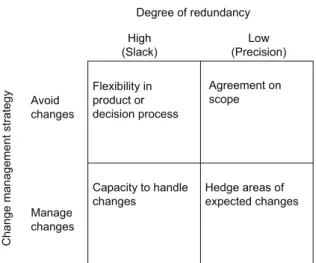
(Paper 8, fig. 3) ...27 Figure 10. Flexibility in the product and the decision process. (Based on Paper 1, fig.
1) ...30 Figure 11. A model for planning and execution of railway investment projects, and
how the studied projects fit the model. (Paper 5, fig. 2) ...32 Figure 12. The Norwegian rail network and location of studied projects (in grey). The
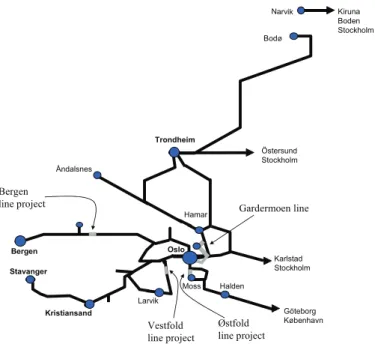
size and location of the new built rail lines are only for illustrational purpose. (Paper 5, fig. 1) ...33 Figure 13. Framework for analysing project flexibility. (Paper 8, fig. 1)...35 Figure 14. Internal and external flexibility versus efficiency and effectiveness. ...37 Figure 15. Illustration of a situation of late locking of scope and fast execution.
(Based on Midler 1995, fig. 5)...41 Figure 16. Illustration of a situation of where areas of uncertainty are shielded off for
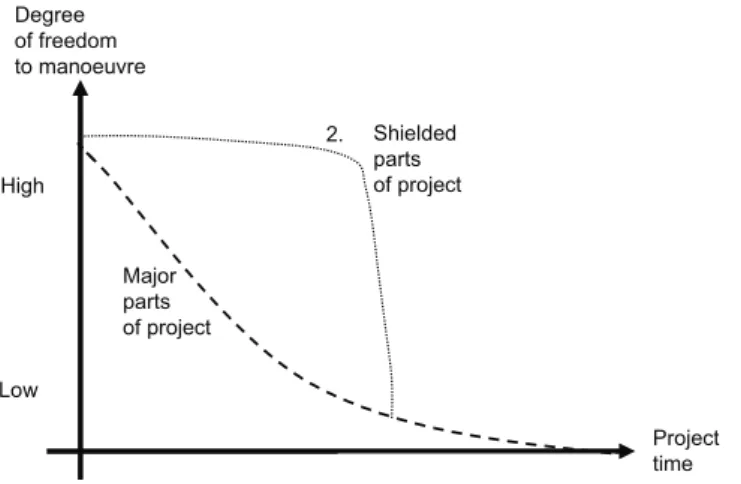
late locking. (Paper 7, fig. 7)...42 Figure 17. Illustration of a situation of incremental commitments, in three steps...42 Figure 18. Illustration of a situation where a project is designed to absorb changes.
(Based on Figure 4)...43
Tables
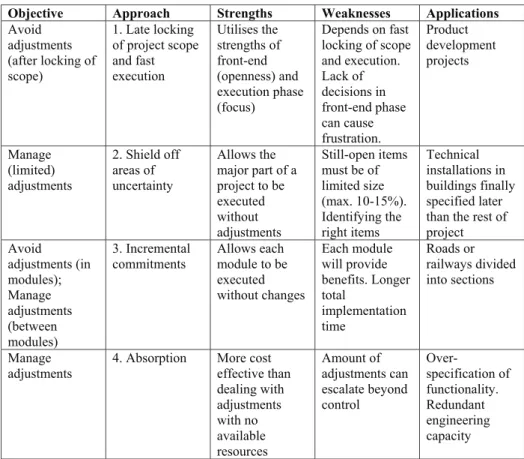
Table 1. The primary information sources upon which the thesis is based. ...9 Table 2. Observed impact from the studied project strategies. (Paper 5, table 8) ...33 Table 3. Approaches to external flexibility management. ...40
The following papers are found in Part 2 of the thesis.
Paper 1.
Olsson, N.O.E. 2006. Management of flexibility in projects. International Journal of Project Management 24:1, 66–74.
Paper 2.
Magnussen, O.M. & Olsson, N.O.E. 2006. Comparative analysis of cost estimates of major public investment projects. International Journal of Project
Management 24:4, 281–288.
Paper 3.
Olsson, N.O.E. & Magnussen, O.M. 2006. ‘Projects trapped in their freedom: Flexibility aspects of front-end quality assurance of major projects’. Paper submitted to Project Management Journal.
Paper 4.
Olsson, N.O.E. 2004. ‘Flexibility in Engineering Projects: Blessing or Curse?’ Paper presented at the NORDNET 2004 International PM Conference, 29 September – 1 October 2004, Helsinki, Finland.
Paper 5.
Olsson, N.O.E. 2006. ‘Impact analysis of railway projects in a flexibility perspective’. Transport Reviews 26:5, 557-569.
Paper 6.
Henriksen, B., Olsson, N. & Seim, A. 2006. ‘Adjustments, effectiveness and efficiency in Norwegian hospital construction projects’. Proceedings CIB W70 Trondheim International Symposium. Changing User Demands on Buildings, 12–14 June 2006, Trondheim, Norway.
Paper 7.
Olsson, N.O.E. & Samset, K. 2006. ‘Front-End Management, Flexibility and Project Success’. Paper presented at PMI Conference, 17-19 July 2006, Montreal, Canada.
Paper 8.
Olsson, N.O.E. 2006.‘Flexibility and Front-End Management; Key to Project Success and failure’ Paper accepted for presentation by ProMAC International Conference on Project Management, 27-29 September 2006, Sydney, Australia.
Traditionally, projects tend to strive for increased predictability by managing details and attempting to bring all variables under control. However, experience shows that the chance of realising a plan without major amendments decreases with an increasing time horizon, which points to a need for flexible projects. A number of scholars argue that flexibility is necessary to face changes and uncertainty in the business environment. On the other hand, flexible projects are generally not described as desirable in project management literature. These conflicting approaches to flexibility have justified an analysis of the dynamics related to project flexibility, both from a theoretical and an empirical perspective. Such an analysis is presented in this thesis, based on analyses of large engineering projects in Norway. Most of the projects are governmental investments.
This thesis aims at structuring knowledge on project flexibility. Two types of results have emerged; the first related to how to analyse project flexibility, and the second related to how to manage flexible projects. Based on studies of different parts of the life cycle of projects, the research provides indications as to how flexibility can be addressed in the front-end phase of large public investments. A framework for analysing project flexibility is also proposed.
Chapter 1 discusses flexibility in a project management perspective, and raises key research questions. The research presented in this thesis addresses the dynamics between utilising benefits from flexible approaches and avoiding drawbacks. Being flexible is characterised by a capability to adapt to new, different or changing requirements.
Flexibility is used in a rather wide sense in the thesis, but is always related to the managing effects of uncertainty. Project flexibility includes adjustments and preparations in response to both internal and contextual uncertainty, such as for example, scope change management, iterative decision process and adjustments related to uncertain funding. Chapter 1 ends with two key research questions related to how to analyse and manage project flexibility.
Chapter 2 presents the research design. The thesis is based on nine papers. These papers are summarised in part one of the thesis. Three main data sources have been used, along with complementary information. First, project evaluations and summaries of 18 Norwegian investment projects have been analysed. Second, this research has benefited from access to an established database for major governmental investments, including results from 48 front-end assessments of large governmental projects. Third, a wider range of data has been collected in a multi-case study of four Norwegian railway projects.
The research is based on an inductive-deductive approach, using a combination of qualitative and quantitative information. Validity and reliability associated with the data used in this thesis are not sufficient to provide solid answers, taken in isolation. As is common in project management research, the small samples in the studies generally do not support statistical analysis of the data, particularly when subgroups
understanding of project flexibility. Further research is needed to clarify to what extent these indications are of a general nature or project-specific.
Chapter 3 discusses project flexibility in different project phases. A distinction is made between three project phases: front-end, planning and execution. Both this thesis and previous research point to a flexible front-end phase as the least controversial aspect of project flexibility. Low flexibility after the front-end phase increases the likelihood of projects being completed on time, within budget and according to specifications. Some models and measures of project flexibility in a time perspective are also presented in this chapter.
Chapter 4 analyses project flexibility from a stakeholder perspective. Project stakeholders are actively involved in a project, or their interests may be positively or negatively affected by the project. Project flexibility is perceived differently by different stakeholders. Flexibility for one project stakeholder can be another stakeholder’s risk.
An analysis of flexibility in stakeholder perspective called for a distinction between internal and external project flexibility. Project internal flexibility relates to flexibility within defined scope – how requirements are to be met. External flexibility refers to adjustments of project scope – what requirements are to be met. Project internal flexibility appears to be particularly desirable to project managers and contractors. Project external flexibility is more likely to be looked upon favourably by users and project owners. Incentives open to stakeholders affect their approaches to project flexibility. In general, flexible projects have a value for stakeholders which benefit from adjustments and come at a cost for those who have to adapt.
Chapter 5 highlights the relevance of efficiency and effectiveness when discussing flexible projects. In general, efficiency is related to producing direct project outputs, often measured in terms of cost, time and quality. Effectiveness is related to added value for owners and users. The case in favour of flexibility emphasises the possibility to increase a project’s effectiveness. The case against project flexibility highlights the negative effects on efficiency due to changes and the possibilities for frustration due to lack of decisions and commitments.
Analyses presented in this thesis indicate challenges in materialising the expected benefits of flexible projects. On the other hand, the expected decrease in efficiency in flexible projects has been frequently observed throughout the analysis. Chapter 5 also addresses redundancy as an enabler for project flexibility. Redundancy is created when more resources than strictly necessary are available. The logic behind redundancy is that a project with redundant resources will be efficient because it can be executed as planned, compared to a project with no redundancy that turns out to be error-prone in reality.
Chapter 6 discusses flexibility related to modularity, flexible decision processes and flexible final products. Flexibility in the decision process means that decisions and commitments in projects are made sequentially over phases. Flexibility in the product is achieved when the final product that a project is to produce is prepared for
dimensions at the expense of the other. When analysing flexibility in decision processes, there was a need to make a distinction between planned and actual approaches to flexibility. Actual approaches turn out to be different from planned ones.
Modularity can be an enabler for flexible project management. On a macro level, modularity means that projects are divided into independent sub-units. Decision makers can then make incremental commitments to each sub-unit at a time. In the studied projects, macro modularisation was associated with cost control but also with lower benefit realisation than planned. On a micro level, modularisation means a decomposition of a product into modules with specified interfaces. Such modularisation can reduce the ‘knock-on’ effects of design changes.
Chapter 7 summarises a framework for analysing project flexibility and indicates guidelines for managing flexible projects. The framework for analysis consists of project flexibility categorisations, perspectives of analysis, and flexibility drivers and enablers. Approaches for the management of project flexibility are also suggested in Chapter 7. Successful strategies for project flexibility either aim at avoiding flexibility or at enabling projects to be flexible. Projects can avoid adjustments or live with them. One key to successful flexibility management in projects lies in the transition from an initial open-minded environment to the subsequent focused phases. Based on the results in the thesis, an attempt is made to list approaches to project flexibility management.
Even though the results are based on studies of only a few projects, there are indications that the drawbacks of flexible projects are largest when projects do not prepare for future adjustments. This notion is consistent with previous works on flexibility, which highlight that flexible decisions require a structural framework of strategies and guidelines. The suggested approaches and categorisations related to project flexibility are intended as an input to such a structural framework.
1. Introduction
This chapter discusses different approaches to project management from a flexibility perspective. One purpose of the chapter is to define how project flexibility is understood in this thesis, but also to give some illustrations of how others have used the concept of flexibility. Key research questions related to project flexibility are stated in this chapter. These questions have in common that they address the dynamics between utilising benefits from flexible approaches and avoiding drawbacks. The thesis is designed to address these questions.
A number of scholars have argued that flexibility is necessary to face the changes and uncertainty in the business environment. On the other hand, a wide range of studies indicate that a clear project definition and minimisation of changes also are critical factors for the success of projects. These approaches to project flexibility, which can appear as conflicting, have justified the study of the dynamics related to project flexibility that is presented in this thesis. The subject is analysed both from a theoretical and an empirical perspective.
1.1
Perspectives on project managementIn a wide sense, projects include any activity that meets the characteristics of projects listed by the PMI (Project Management Institute) (2004: 5): ‘A project is a temporary endeavour undertaken to create a unique product or service’. Common characteristics of projects include: finite budgets and schedule constraints, complex and interrelated activities, clearly defined goals, and uniqueness (PMI 2004).
Projects are traditionally seen as temporary organisations designed for unique tasks (Cleland 2004), often in contrast to the mass producing core activities of organisations. Projects are initiated to solve tasks of almost any type (Engwall 2003) to such an extent that Western society seems to be heading towards a projectified society (Lundin & Söderholm 1998, Gareis 2004). A major benefit of organising a task as a project is the freedom to create an organisation more or less from scratch. While uniqueness is the competitive advantage of projects as a way of organising, changes and lack of predictability are commonly seen as the major pitfalls of projects. Successful projects are often claimed to be characterised by control and governance (Hall 1980, Morris & Hough 1987, Miller & Lessard 2000).
Söderlund (2004) discusses two main theoretical traditions in project management research. The first tradition has its roots in engineering science. Planning techniques and methods of project management, including the recent emphasis on uncertainty quantification and risk management, have been the major focus. This is in accordance with Packendorff (1995), who claims that a number of writers trace the intellectual roots of project management research and knowledge to various types of planning techniques, such as PERT (program evaluation and review technique) and CPM (critical path method). The other tradition has its intellectual roots in the social sciences and focuses especially on the organisational and behavioural aspects of projects. Söderlund (2004) terms these the engineering tradition and the social science tradition, respectively. In a similar distinction between project management
Pollack relate ‘hard’ project management approaches to objectivist, scientific approaches and that have parallels to Söderlund’s (2004) engineering tradition. The ‘soft’ project management approaches stem from interpretivist and constructivist schools of thought, and share similarities with Söderlund’s (2004) social science tradition.
1.2
UncertaintyTheuncertainty of a decision in a project can be described as ‘the gap between the amount of information needed to perform at task and the amount of information already possessed by the organisation’ (Galbraith 1973: 5). Christensen & Kreiner (1991) make a distinction between operational and contextual uncertainty. They relate operational uncertainty to uncertainty within the defined scope of a project, and contextual uncertainty to the project context. Karlsen (1998) discusses environmental uncertainty, which represents uncertainty generated by factors outside a project’s system boundaries, and task uncertainty which relates to factors within project boundaries. Jensen et al. (2006) divide environmental uncertainty into two categories: institutional and interactional uncertainty. The purpose is to identify interactional uncertainty as representing environmental explanations necessary for understanding the circumstances of a project without including everything outside the projects.
This thesis does not aim at covering the issue of uncertainty in a broad perspective. However, the distinction between the two types of uncertainty that Karlsen (1998) and Christensen & Kreiner (1991), among others, discuss has implications for the analysis of project flexibility. This thesis uses the terms contextual uncertainty and internal uncertainty. Internal uncertainty is related to operational uncertainty (Christensen & Kreiner 1991) or task uncertainty (Karlsen 1998).
1.3
FlexibilityThe term flexibility is used in a rather wide meaning in this thesis, but generally related to managing effects of uncertainty. Bahrami & Evans (2005) list 11 concepts related to flexibility: adaptability, agility, elasticity, hedging, liquidity, malleability, mobility, modularity, robustness, resilience, and versatility. According to the Merriam-Webster Online Dictionary (2006), being flexible is ‘characterised by a ready capability to adapt to new, different, or changing requirements’, a definition of flexibility which is also used in this thesis. With such a wide definition, project flexibility includes preparations to manage both internal and contextual uncertainty, such as scope change management, iterative decision process, and adjustments related to uncertain funding in general.
In a planning perspective, Sager (1994) presents flexible planning as a proper response to an environment aiming at conflict solutions, since it favours democracy in collective choice processes. Further, Sager makes a distinction between opportunism andrigidity, and places ‘flexibility’ in between these two extremes. Rigidity implies unwillingness or lack of ability to adjust to a changing situation. In contrast, opportunism can be described as a policy of extreme adapting to new circumstances, without being guided by any rules or overall strategy. He points out that flexibility refers to future choices among satisfactory alternatives, and that flexibility implies adjustments in accordance with principles and criteria.
Flexible projects are generally not described as desirable in project management literature. In other management disciplines, such as in strategic management, flexibility is an established enabler to manage uncertainty (see, for example, Mintzberg 1994). Flexibility is so well acknowledged as a key success factor of competitive organisations that Bahrami & Evans (2005) used the term ‘super-flexibility’ to describe the most flexible companies.
1.4
Project flexibilityProject flexibility is part of a fundamental dilemma in project management. On the one hand, projects need stability and control to be executed efficiently, typically measured in terms of time, cost and meeting specifications. In this perspective, flexibility should be minimised. On the other hand, important decisions in projects must be taken based on limited information in an unpredictable world, creating a need for flexibility options.
The PMI (2004: 368) defines project management as ‘the application of knowledge, skills, tools, and techniques to project activities to meet project requirements’. In this terminology, project management is aimed at meeting project requirements, and not necessarily related to meeting the overall objectives of projects. The PMI (2004) and Bahrami & Evans (2005) argue that projects and project management are applied once an organisation has decided to escalate initial activities in a focused implementation. Other authors (e.g. Miller & Lessard 2000, Samset 2001) highlight the front-end phase in relation to project management. As discussed in Paper 7, the emphasis on the front-end phase in project management is related to how “project management” is defined by different authors. As an example, it is not entirely clear if PMI (2004) considers selecting the right project as a part of project management.
Mikkelsen & Riis (2003) have identified a dilemma in project planning: namely, that the importance of decisions is highest at the when the availability of information is at its lowest. A common way of reducing this dilemma is to increase the available knowledge about the project. A project flexibility approach to address this dilemma is to postpone irreversible decisions until more information is available.
The engineering tradition of project management, referred to by Söderlund (2004) and Crawford & Pollack (2004), focuses on stability for projects, particularly in their later phases. The social science tradition has a greater understanding of the benefits of project flexibility. Kreiner (1995) points out that the traditional focus on stability becomes challenged under conditions of uncertainty, which creates what he calls ‘drifting environments’. The drifting environments of a project are not necessarily caused by actual changes but may also result when the project owners, users or other stakeholders gain a better understanding of, and ability to express, their actual needs. The results presented in Paper 4 indicate that flexible projects are generally not desirable when the unit of analysis is limited to the project itself, but can be rational when a wider context is included in the analysis.
Real options represent one approach to project flexibility (see, for example, Amram & Kulatlaka 1999, Brennan & Trigeorgis 2000). Real options illustrate the value of
owning an option – the right, but not the obligation to take an action in the future (Amram & Kulatlaka 1999). The real options paradigm recognises that decisions are made sequentially over phases. Uncertainty can increase the value of a project as long as flexibility is preserved and resources are not irreversibly committed. The value of flexibility can be quantified in monetary terms. Uncertainty about the future profitability of an investment project makes it often optimal to postpone commitment to a project, compared to a situation in which there is no uncertainty (Brennan & Trigeorgis 2000).
Koskela (2000) describes how production principles, such as just-in-time, have been adopted in a theoretical framework aimed at the construction industry under the term lean construction. In this framework, the term ‘last responsive moment’ is used to achieve flexibility in projects (Ballard & Howell 2003). According to Ballard & Howell (2003), the last responsive moment means that decisions must be made within the lead time for realising alternatives and that a decision should not be made until it has to be made.
1.5
Efficiency versus effectivenessA project’s ability to produce its immediate outcome can be measured in terms of efficiency. It is a question of doing things right and producing project outputs in terms of the agreed scope, quality, cost, and time. It is a measure internal to the project and restricted to the project or contractor’s perspective. The longer-term effects of the project can be measured in terms of effectiveness – or, in other words, doing the right things. It is an external measure. Eikeland (2001) relates effectiveness to how the results of a project contribute to added value for owners and users. In OECD terms, effectiveness measures the realisation of the project’s objectives (OECD 2000). This is the perspective of the project owner or financing party, who in many types of projects might have a perspective similar to that of the users.
Performance measurement systems in organisations frequently strive to capture a range of performance aspects (see, for example, Sink & Tuttle 1989). Figure 1 shows that these aspects often include measures of efficiency, effectiveness and changeability. Project success is commonly measured in terms of efficiency and effectiveness. It is less common to measure changeability, or flexibility, in project management. While a high degree of flexibility is desirable to many organisations, it is more often mentioned as a threat than a key success criterion for projects.
Efficiency
Changeability Performance
Effectiveness
A literature review in an early part of the work on this thesis (Paper 4) gave indications that flexible projects are primarily enablers for improvement of effectiveness rather than efficiency. This notion has served as guidance for the methodological choice of data collection and projects to be studied.
1.6
Structure of the thesisThe thesis consists of two parts. Part one serves three main purposes. First, it states the key research questions that the whole thesis addresses. The research questions are presented in the next section of this chapter. Second, part one discusses the applied methodology of the thesis as a whole. The studies presented in each paper are utilised with the aim of making the whole thesis more than just the sum of its individual parts. Finally, part one provides a summary of results from the research.
Part two consist of nine papers. Paper 1, 2 and 3 present results relating to studies of major engineering projects, most of them governmental. One aim of these papers is to analyse similarities and differences between projects and flexibility approaches. Paper 4 consists of a literature study on flexibility. The next paper, Paper 5, focuses on railways. Railway investment projects were chosen for in-depth studies of one particular type of governmental investment. Another sector-specific study related to hospitals is presented in Paper 6. Paper 7 and 8 benefited from the analyses presented in the preceding papers, but also contribute other aspects to the subject.
1.7
Research questionsThe purpose of this research is to structure knowledge on project flexibility. Based on studies of different parts of the life cycle of projects, the research aims at providing indications as to how flexibility can be addressed in the front-end phase of large public investments.
The following two key research questions are addressed in the thesis:
How can different aspects of flexibility in projects be analysed?
Flexibility is discussed as a blessing and a curse. Flexibility for one stakeholder is often viewed as another stakeholder’s risk. The thesis also aims at identifying other aspects of flexibility which can contribute to an analysis of the issue. These aspects will be summarised as an analytical framework for project flexibility.
After studying project flexibility, what are the implications for project front-end management?
The thesis aims at identifying characteristics of successful project flexibility management. Such knowledge may prove valuable in the preparations of future projects. The results will be summarised as generic approaches for flexibility management.
2. Study design
The research design of the thesis as a whole is presented in this chapter. Empirical evidence used in the thesis is also presented, including how it was obtained and why this particular information was chosen. Based on the empirical evidence and the design of the study, there is also a discussion of the quality of the data and how the evidence may be interpreted. In addition, the applied methodology in each study is presented in more detail for each of the included papers.
2.1
Research approachIn this thesis, one phenomenon – flexibility – is analysed in a complex environment with several influencing factors. Investigating project flexibility from different angles has provided a multidimensional view of the subject. A combination of qualitative and quantitative information has been used. The thesis provides opportunities for triangulation, as described by Fellows & Liu (2003). An advantage of using multiple sources of information lies in the development of converging lines of evidence. To achieve a triangulation effect, information from two or more sources has been used to address the same research questions.
The research is based on an inductive-deductive approach, described by Fellows & Liu (2003). Inductive research explores an issue through observation. The aim is to establish explanatory principles or hypotheses. In deductive research, hypotheses are tested against observations.
Case studies included in the thesis apply a research methodology based on the works of Yin (2003). Three important principles in the research have been: (a) multiple sources of information, (b) use of case study databases to assemble evidence related to the cases, and (c) maintaining a chain of evidence with links between the questions asked, data collected and conclusions drawn.
2.2
Empirical evidenceSeveral different information sources have been used. The main sources are:
1. Evaluations of Norwegian public investments
2. Ex-ante uncertainty analyses of major governmental investments 3. Case studies of Norwegian railway projects
In addition, the thesis benefits from case studies of the effects of the quality assurance of major governmental investment, railway traffic analyses and experiences from hospital projects.
To analyse project flexibility, information was needed to cover both efficiency and effectiveness aspects of projects. As the prime source of information regarding efficiency, major governmental investments were chosen. Work related to preparations and execution of the Norwegian quality-at-entry regime provided data that covered enough projects to justify some quantitative analysis. The quality-at entry
regime was introduced in 2000 by the Norwegian Ministry of Finance. It calls for mandatory quality assurance and uncertainty analysis of all governmental investments in Norway exceeding NOK 500 million (c.60 million USD). To achieve a wider perspective, the same type of information was also obtained for a limited number of non-governmental projects. Analysing effectiveness required a different approach regarding the number of projects as well as type of information. Railway projects were chosen because of the possibilities to gather information for a number of years.
In the following, the main information sources are described. Each of the papers in the annexes gives additional details.
Evaluations of Norwegian public investments
A set of independent project evaluation reports was collected. Personal experience from projects was also utilised. To analyse the information related to the projects, codified data were entered into a database. This included information on the general characteristics of the project. On the basis of the descriptive information, an assessment was made of approaches to project flexibility. This was based on subjective assessments made by the researcher.
Ex-ante uncertainty analyses of major governmental investments
The thesis has befitted from access to reports from assessments made under the Norwegian quality-at-entry regime. These assessments are made by consultants prior to the parliament’s appropriation of the projects. Information from the quality assurance reports has been entered into a database. The information is relatively detailed, but limited to the situation at the time of approval of the project investments in parliament. Transportation infrastructure includes roads, bridges and tunnels, and railways account for more than one-third of these projects. Defence-related projects also represents more than one-third. The remaining group of projects includes public buildings, hospitals and IT systems.
Case studies of Norwegian railway projects
The benefits of projects materialise after the projects have been commissioned, calling for a rather long time perspective of the analysis. Railway projects were chosen because of the possibilities to gather information for fairly long time spans. The availability of timetables means that it is possible to measure key benefit elements such as travel time and frequency based on documentation. In addition, data on number of travellers and punctuality were included in the analyses. Being a multi-case study in the terminology used by Yin (2003), the analysis of four railway projects is based on multiple information sources. The most important sources are:
x Documents from the involved organisations, as well as publicly available information. This includes reports, evaluations and quantitative information, such as timetables and statistics.
x Interviews
x Participant observation in meetings and other arenas where the projects have been discussed.
Information Content N= Paper Type of information Sources Evaluations of Norwegian public investments
Public and private sector projects from different sectors. Projects initiated 1986-2000 18 Paper 1 Paper 3 Primarily qualitative Evaluation reports; personal experience Ex-ante uncertainty analyses of major governmental investments Governmental investments projects approved 2000-2004 48 Paper 2 Paper 3 Primarily quantitative Consultant reports Case studies of Norwegian railway projects Railway investment projects 1986-2000 4 Paper 5 Qualitative and quantitative Interviews; statistics; evaluation reports; personal experience Table 1. The primary information sources upon which the thesis is based.
2.3
Quality of informationBecause of the design of the study, the possibilities to assert the validity or test the reliability of the findings are limited. It cannot be statistically proved that the findings are generally applicable.
Reliability is related to consistency of a measure. Information is reliable if the measurement procedures provide the same result if applied repeatedly, even by different researchers. In this type of study, reliability cannot be ensured through large, representative samples of research material. The methods to extract and codify information may be affected by judgemental subjectivity. The problem of reliability may therefore be considerable in each of the sub-studies. To compensate for this, several sets of samples of research material have been used.
Validity concerns how well a measure does in fact measure what it is intended to measure. To address validity in this thesis, several indicators are used. The combined use of indicators gives a better measure than each of the indicators independently. According to Yin (2003), case studies using multiple sources of evidence are generally rated as having a higher quality, compared to those that rely only on single sources of information.
Validity and reliability associated with the data used in this thesis are not sufficient to provide solid answers, taken in isolation. However, the research has taken previous studies on related issues into account. To a large extent, the results found in this thesis are consistent with results in previous studies. Trustworthy results can only be established through a series of replications and validations. When the number of studies with consistent results grows, the confidence in the findings should increase. The thesis has to a certain extent indicated some nuances to common understanding of project flexibility. Further research is needed to clarify to what extent these indications are of a general nature or project-specific.
3. Flexibility in different project phases
This chapter discusses project flexibility in different project phases. With efficiency in mind, both this thesis and previous research point to a flexible front-end phase as the least controversial aspect of project flexibility. From the same perspective, a flexible execution phase is generally not desired. One purpose of the chapter is to illustrate and analyse the background to these statements. In addition, an attempt is made to quantify some measures on project flexibility in a time perspective.
This thesis makes a distinction between three different project phases: front-end, planning and execution. The front-end phase covers the activities prior to the final decision to go ahead with the project. Even though planning is a part of the front-end phase, most projects also have a planning phase for more detailed preparation after the project has been decided upon. Projects are implemented in an execution phase, which ends when the project outputs are realised.
Authors on project management, including Morris & Hough (1987) and Miller & Lessard (2000), frequently warn against changes in projects once specifications have been established. Lundin & Söderholm (1995) describe how a project moves from relative openness at the beginning of the project, to being relatively closed in the execution phase. In the execution phase the predetermined action is supposed to be carried out according to the plans, in a ‘planned isolation’. The concept of project flexibility in the execution phase disturbs this planned isolation. In a similar way, Mahmoud-Jouini et al. (2004) characterise project management by the speed of three project phases: preparation, freezing and implementation.
In the study of 18 projects presented in Paper 1, changes and iterations were observed in all phases of the projects, but particularly during the planning phase. Highly flexible planning phases, and to a certain extent also execution phases, were pointed to as a major problem during the preparations for the quality assurance regime for major governmental investments (Berg et al. 1999).
3.1
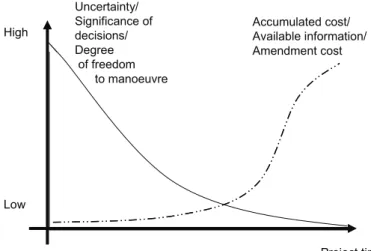
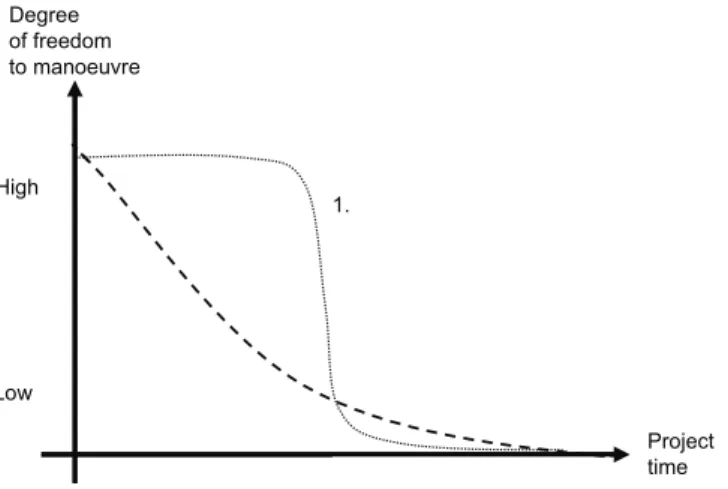
A time perspective on projectsMany textbooks on project management present models to illustrate how project attributes change during different project phases. Figure 2 is an attempt to summarise the different models. Even though the shapes of the curves vary between different authors, they have many similarities. Uncertainty, significance of decisions and the degree of freedom to manoeuvre are typically high at the beginning of the project, and low at the end. At the same time, variables such as the accumulated cost, available information and cost of changes begin at low levels and reach high levels at the end of a project.
Even though this type of figure as shown in Figure 2 is very common and appears logical, the models are primary illustrations, and appear to a lesser extent to be based directly on empirical evidence. There are obvious challenges in quantifying and measuring the different variables. One study in Miller & Lessard (2000: 34) shows that for one particular project, regulatory, political and financial risks were at their
High Low Project time Accumulated cost/ Available information/ Amendment cost Uncertainty/ Significance of decisions/ Degree of freedom to manoeuvre
Figure 2. Development of selected project characteristics in a time perspective. (Paper 3, fig. 1. Based on Christensen & Kreiner 1991: 40, Midler 1995: 369, Samset 2001: 33, Mikkelsen & Riis 2003: 47)
The ‘high to low’ curve may represent different variables, but the underlying message is similar. Christensen & Kreiner (1991: 40) use Galbraith’s (1973) definition of uncertainty as the difference between the required information and the information available. As the available information increases, the uncertainty decreases through the project. Samset (2001) uses a similar definition of uncertainty. Eikeland (2001), on the other hand, equalises ‘room for manoeuvring’ with the internal uncertainty of the project, related to internal decisions that will be, but are not yet taken. A decision is within the room for manoeuvring if it does not violate the consequences of previous decisions. Midler (1995) relates the decreasing degree of freedom to manoeuvre with an increasing degree of irreversibility in project decisions. Mahmoud-Jouini et al. (2004: 361) describe the descending curve as ‘possibilities of action in the project’. Mikkelsen & Riis, (2003: 47) let the ‘high to low’ curve represent the importance of decisions.
The ‘low to high’ curve usually represents either accumulated cost (Eikeland 2001), relative amount of information or knowledge available related to the project (Midler 1995, Mikkelsen & Riis 2003, Mahmoud-Jouini et al. 2004), or amendment cost (Samset 2001).
3.2
Quantifications of flexibility based on scope reduction optionsIn the quality assurance reports for major governmental investments, it is a part of the consultants’ assignment to identify potential project scope reductions. These are reductions that can be carried out if other parts of the project turn out to be more costly than planned. If necessary, these parts of the scope can be taken out of the projects without threatening the fundamental functionality of the delivery. These possible reductions are summarised as reduction lists, where the potential cost
reductions are described. In the studied projects, even though it was not a formal requirement, many of the consultants chosed to add due dates for the scope reductions, to indicate when decisions had to be made to realise any cost saving from the reductions.
Reductions in quality or functionality were proposed in almost half of the studied projects. These were reductions that lowered the quality, but the volume of core deliveries from projects remained the same as planned. For road projects, the length of the new road was not changed. A common type of reduction for roads was to reduce planned improvements of existing roads, in connection with the new construction. Adjustments of ambitions related to the aesthetic quality of the project deliveries were common. Examples of this category include planting fewer trees, establishing smaller lawns and reducing the aesthetic quality of concrete walls.
Reduction lists provide an illustration of the reductions that were judged to be manageable from a project management point of view. The need for fast decisions regarding possible reductions was very commonly emphasised. As a rule of thumb, reductions in system architecture and quality standards have to be made early in the projects. It is possible to make reductions in volume and visual impression at later stages, depending on the contract structure. Another comment was that the potential volume of the reductions was so small that it did not justify setting up a system to manage the reductions. Finally, it was frequently commented that the due dates for the reductions typically came before it was realistic for project management to have updated cost estimates that could indicate any potential overruns.
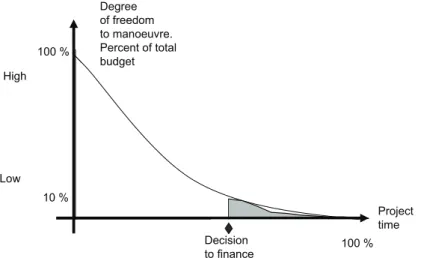
A quantitative analysis of flexibility in different project phases is included in Paper 3, using data from reduction lists in quality assurance reports for major governmental investments. For about half of the projects, the reduction lists also included due dates to define when the window of opportunity closed for each item on the reduction list. Based on the reduction lists and due dates, it was possible to illustrate how the due dates of the items on the reduction list expired as time passes. This means that a part of the curve for the freedom to manoeuvre in Figure 2 could be drawn based on the empirical data presented in Paper 3.The relative size of the remaining open reductions can be seen as an illustration of the ‘room for manoeuvring’. Figure 3 shows the curve generated from the reduction lists in relation to a whole project time span. The size of reduction list is indicated by the grey area in Figure 3. At the time of parliamentary approval, the total value of all possible reductions on the reduction lists was in the range of 5–7% of total project costs. It should be noted that the size of remaining items on the reduction lists drops relatively sharply after this point. The size and shape of the grey area in Figure 3 supports the illustrative models used in many textbooks, which were referred to in relation to Figure 2.
0,0 % 10,0 % 20,0 % 30,0 % 40,0 % 50,0 % 60,0 % 70,0 % 80,0 % 90,0 % 100,0 % 0 10 20 30 40 50 60 70 80 90 100 High Low Degree of freedom to manoeuvre. Percent of total budget Project time 10 % 100 % 100 % Decision to finance
Figure 3. The relative size of the reduction lists as a percentage of the total budget at different phases of the projects. N=19
Another way of quantifying the remaining flexibility options at the time of final approval of projects is to look at the reduction lists and allocated reserves in combination. On average, the reduction lists amounted to 6% of the total project budget. At the same time, an average of 8% of the project budgets was allocated as reserves, to cover unexpected expenses. Adding these two types of flexibility gives an approximate total remaining flexibility of 14% of the total budget at the time of parliamentary approval. The remaining flexibility options ranging between 10% and 15% of the total budget appeared to be manageable at the time of final project approval, measured by the relative size of reduction lists and allocated reserves.
The Norwegian building and civil engineering contract, NS 8405 (Norsk bygge- og anleggskontrakt NS 8405 2004), states that a project owner cannot demand changes exceeding 15% of the total contract value. This value corresponds fairly well with the results presented above.
3.3
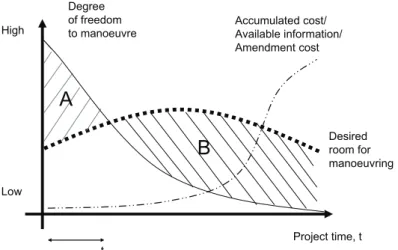
Flexibility visualisationsAccording to Eikeland (2001), a decision is within the room for manoeuvring if it does not violate the consequences of previous decisions. As shown in Figure 4, the need for room for manoeuvring is within the actual room for manoeuvring in the early phase of projects (area A), but not during later parts of projects (area B). Eikeland (2001) also points out that a major challenge in project management is that the need for room for manoeuvring is typically at its highest when the actual freedom for manoeuvring has already decreased significantly. Area B represents situations when some stakeholders (for example, users or project owners) have a desired room for manoeuvring that is larger than the actual room. To satisfy the desire for adjustments, changes have to be made, because the adjustments violate previous decisions.
High Low Project time, t Degree of freedom to manoeuvre Accumulated cost/ Available information/ Amendment cost Desired room for manoeuvring
A
B
t1Figure 4. Consequences of different values of the uncertainty, significance of decisions and the degree of freedom to manoeuvre compared to the desired room for manoeuvring in different project phases. (Paper 7, fig. 6. Based on Eikeland 2001: 40)
With regard to Figure 4, this thesis has addressed two aspects. First, an attempt was made to quantify curves in the figure, as described earlier. Second, the work on the thesis has been a search for project management strategies that utilise the area shown as A. It should be noted that the critical measure is not necessarily the size of area A and B, but the time t1, when the curves for actual and desired freedom to manoeuvre
cross. Area A actually represents a ‘flexibility surplus’ and area B a ‘flexibility undersupply’.
Based on product development projects, Midler (1995), Verganti (1999) and Bahrami & Evans (2005) identify strategies to increase area A and to reduce area B shown in Figure 4. The purpose is to avoid changes but to keep options open to satisfy as much as possible of the anticipated need for manoeuvring. Midler (1995) describes a management strategy for concurrent engineering projects. First, early commitment is prevented while as much information as possible is gathered on the project. In the second phase, the project is locked as precisely as possible. Finally, at the end of the project, speed is given maximum priority in order to solve the remaining technical obstacles.
Paper 1 and Paper 8 study observed flexibility in 18 projects. Most of these projects were subject to changes, extensions and iterations, i.e. they were in area B in Figure 4. When analysing project flexibility over time, there was also need to make a distinction between planned and actual approaches to flexibility. Approaches to flexibility changed during the projects and the actual approaches were not necessarily the same as the planned ones.
Earlier in this chapter, it was noted that different stakeholders have different perspectives on projects flexibility in different project phases. This leads to the next
4. Project stakeholders
This chapter analyses project flexibility from a stakeholder perspective. Project stakeholders are actively involved in a project, or their interests may be positively or negatively affected by a project. An analysis of flexibility in a stakeholder perspective called for a distinction between internal and external project flexibility. Project internal flexibility relates to flexibility within defined scope. Project external flexibility relates to adjustments of scope. The approach to flexibility held by the different stakeholders is closely related to the incentives open to the stakeholders. Flexible projects have a value for those who can align a project to their priorities, but flexibility represents a cost for those who have to adapt.
4.1
StakeholdersAccording to McElroy & Mills (2000), project stakeholders are persons or groups of people who have a vested interest in the success of a project and the environment within which the project operates. In a study of large engineering projects, Olander & Landin (2005) found that it is important for a project management team to identify stakeholders that can affect a project, and then manage their differing demands throughout the project stages. Stakeholders may be organisations or individuals. The following discussion is focused on four types of project stakeholders: owners, users, project management, and contractors.
It is the project ownerthat takes the risk related to the cost and future viability of a project. Both these risks can to a certain extent be transferred to other actors in a project.
Users can be described using a wide or a narrow definition. The wide definition of users includes all that use the result of the project (the hospital, railway companies, etc.). During the project preparation and execution, users are not easily identified. This means that projects usually interact with user representatives, who act on behalf of those who intend to use the result of the project. The narrow definition of ‘users’ refers to such user representatives.
The ‘project management’ stakeholder refers to the project manager acting on behalf of the project owner and the organisation supporting this function. Contractors are responsible for implementing the whole or part(s) of the project.
Results presented in Paper 4 indicate that project owners and users are more likely to be positive towards changes aimed at increasing the benefit side of the projects, or related to effectiveness. Stakeholders whose main responsibility lies on the cost side of the project, such as project management and contractors, are less likely to embrace changes. According to Kreiner (1995), the project management is made the guardian of efficiency. Müller & Turner (2005) claim that owners should impose medium levels of structure on project managers. Too much structure will not give the project manager sufficient flexibility to deal with any uncertainties that arise. Too little structure will lead to anarchy.
4.2
IncentivesIncentives for different project stakeholders are strongly related to the contracting structure of a project and other financial obligations. A common tool for achieving flexibility in projects is the use of option-based contracts, which enable a continuous locking of the projects. Mahmoud-Jouini et al. (2004) point out that a key factor in creating win-win situations between the stakeholders in Engineering, Procurement and Construction (EPC) contracts lies in the flexibility of contracts and the implicit relations that are created by the contracts. Garel & Midler (2001) studied contractual structures that enable front-loading and coherent incentives for manufacturers and suppliers in the automotive industry. Their analysis is based on a game theory approach, where dealing with flexibility can be a win-win or zero-sum game between the stakeholders. In the co-development of automotive parts, the supplier receives no additional payments for late identification of the need for modifications in the design phase. The supplier therefore has strong incentives to provide engineering expertise to work closely with the manufacturer in order to understand the needs and the production process (Garel & Midler 2001).
The users are a group of stakeholders that often do not have contracts related to the projects. Their incentives are more likely to be related to quality than project cost. Even though Paper 1 found that the users in the studied projects favoured flexibility in general, especially one case showed that the users preferred bold commitments and clear answers in the front-end phase because they wanted to know as precisely as possible what they could expect from the project.
Flexibility also has to do with politics. In general, stakeholders are less likely to favour a continued flexible decision process when an initial decision has been taken in their favour. Consequently, a continued flexible decision process is valued by those who do not prefer an initial decision. Flexibility options might be used as a tool for stakeholders who want decisions to be remade. Flexible decision processes can be used to justify that decisions do not need to be taken or can be revised, thus becoming a tool for irresoluteness.
4.3
Internal and external flexibilityA distinction can be made between internal and external project flexibility. Project internal flexibility relates to flexibility within a defined scope – how requirements will be met. Project external flexibility relates to adjustments of project scope – what requirements will be met.
Project internal flexibility has its roots in an efficiency perspective. In an engineering tradition, the objective of front-end management is to provide a well-defined framework for efficient project implementation. This does not mean that flexibility is undesirable, but that adjustments are held within the defined project scope. This perspective is often held by project managers and contractors. It is also the approach to flexibility that is taken by lean construction (including Koskela (2000) and Ballard & Howell (2003)). To illustrate the need for internal flexibility Koerckel et al. (2005) claim that work flow reliability historically has been c.50% in construction projects, based on a one-week planning horizon, i.e. only 50% of the tasks scheduled for one week can be expected to actually be completed during that particular week. As discussed in Paper 3 related to major Norwegian governmental projects, the
mandatory quality assurance aims at defining the projects as precisely as possible, but still provides project management with the freedom to decide how the specifications are to be met and budgets to be upheld. In a similar way, Turner (2004) claims that one of four necessary conditions for project success is that the project manager is empowered. The project owner should give guidance on how the project can be best achieved, but allow project managers flexibility to handle unforeseen circumstances. Note that Williams (1997) claims that project risk management and empowerment of teams within a project compete with each other in complex projects, because of interconnection between the tasks of different project teams.
Project external flexibility has its roots in an effectiveness perspective. Based on what is termed a social science tradition, an objective of the front-end phase is to align the content of the project to the objectives of the stakeholders. Objectives may be shifting; implying certain needs for flexibility. It is primarily the value of this type of flexibility that is quantified by real options (Amram & Kulatlaka 1999, Brennan & Trigeorgis 2000). This type of flexibility option appears particularly desirable to users and project owners.
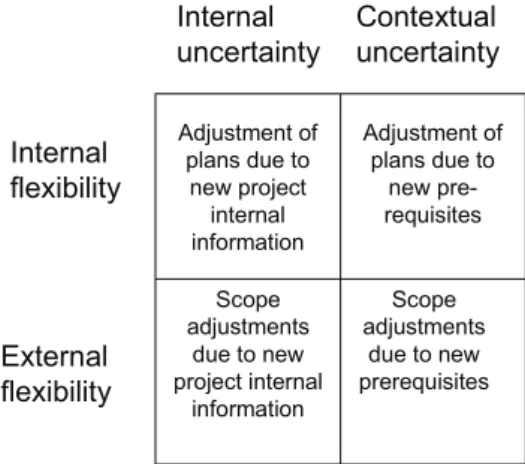
Internal and external flexibility, on the one hand, and internal and contextual uncertainty on the other hand, are related issues. However, internal flexibility is not necessarily a response to internal uncertainty, and external flexibility can, but does not have to, be a response to contextual uncertainty. Figure 5 shows that all combinations of the two dimensions can be found.
The empirical data that this thesis is based on provide mainly information about external flexibility. In-depth analysis of project internal flexibility would require different empirical sources. The distinction between project internal and external flexibility was made for two reasons. First, it is intended to clarify the flexibility approaches that have been the main focus in the thesis. Secondly, the distinction between project internal and external flexibility is intended as a contribution to the general framework for analysis of project flexibility.
Internal uncertainty Contextual uncertainty External flexibility Internal flexibility Adjustment of plans due to new project internal information Adjustment of plans due to new pre-requisites Scope adjustments due to new project internal information Scope adjustments due to new prerequisites
Figure 6 is a summary of the observed approach on external flexibility seen in a time perspective, as presented in Paper 1. Project management was the only type of stakeholder that showed the expected shift from promoting a flexible front-end, hesitating towards a flexible planning phase and finally being negative to a flexible execution phase. As a possible explanation, the project management might be the stakeholder that is most likely to see the effects of flexibility, both on the benefit and cost side.
In general, project owners appeared as advocates of flexible projects. Contractors were not observed as advocates of flexible projects. Figure 6 also shows that users and project management have different and potentially conflicting needs for external flexibility in different project phases. As long as the funding model for projects means that the users have nothing to lose from demanding changes and extensions, they have incentive to push for scope changes. This is typically, though not always, the case in the Norwegian public sector, which accounts for the majority of the projects in the analysis in Paper 1. -N/A Contractor - +/-+ Project management + + +/-Users + + + Owner Execution Planning Front-end -N/A Contractor - +/-+ Project management + + +/-Users + + + Owner Execution Planning Front-end
Figure 6. Stakeholder perspectives on external flexibility in project phases. + indicates that flexibility is advocated; - indicates a desire for flexibility
minimisation; +/- indicates that both approaches were observed. (Paper 1, fig. 2.)
Kreiner (1995) termed project management ‘the guardian of efficiency’. The results from Paper 1 indicate that this guardian role is dependent upon the organisational connection to the project owner. In cases where the project management was found to be in the same organisation as the owner, project management was more likely to be positive to flexibility, compared to cases where project management had a weaker organisational connection to the project owner and the guardian role could be exercised more freely.
Incentives open to the stakeholders is an explaining factor for the stakeholders’ perspective on project flexibility. Flexibility options have a value for stakeholders that benefit from changes and late locking of final scope. In the study presented in Paper 1, the stakeholders that had their incentives related to achieving the project’s purpose were the advocates of flexibility. Stakeholders that had their incentives related to delivering the project on time and within budget saw flexibility as a threat. External flexibility usually means that the contractors have to spend resources on adapting. However, contractors may also have incentives to embrace change because this gives them room to ask for additional payments. This is discussed by Garel & Midler (2001) in relation to contract structures.
Based on results presented in Paper 1 and Paper 3, Figure 7 indicates that the room for external flexibility decreases over time. As the project scope becomes clarified, the relative focus on internal flexibility increases. The analysis of scope reductions presented in Paper 3 can be seen as an illustration of external flexibility. The shape of the right half of Figure 7 is based on these results, where external flexibility decreases rapidly after the final approval of a project.
Front-end Execution Internal flexibility External flexibility Project time Relative share
5. Effectiveness and efficiency
Project success is often measured in terms of efficiency and effectiveness. In general, efficiency is related to producing direct outputs, and effectiveness is related to added value for owners and users. Changes usually reduce project efficiency. Flexible approaches in projects are frequently seen as enablers of effectiveness. One key purpose of project flexibility is to achieve flexible projects without creating a flow of scope changes. Cost of changes is a common argument against project flexibility. Changes are key issues when discussing flexibility, but project flexibility as discussed in this thesis is a wider concept than scope change management.
5.1
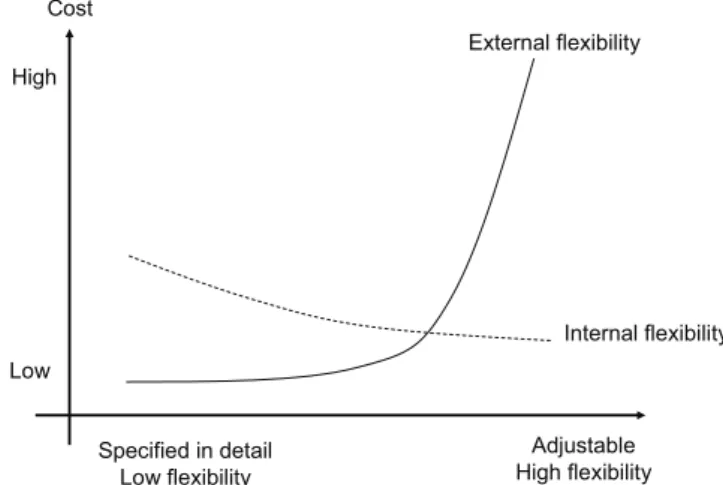
Cost implicationsFigure 8 shows the relative cost in relation to the degree of flexibility. Two curves are drawn: one for internal (how?) flexibility and one for external (what?) flexibility. Increasing cost for high external flexibility is primarily related to external changes. To be highly flexible causes, on average, a higher cost, compared to a project that is less flexible. Increased cost of high flexibility comes either from redundant resources to manage changes and decision iterations, or unintended change to cost if such redundancy was not available but changes came anyway. This relation is similar to the traditional curve with increasing cost of changes over time in a project. It should be noted that increased cost can be compensated for by increased benefits. On the other hand, the cost curve related to internal flexibility decreases with higher flexibility. The fewer restrictions, the better opportunities a contactor or project manager has to optimise the use of available resources. This is a part of the logic behind lean construction.
The results presented in this thesis have shown significant cost overruns for highly flexible projects. Cost overruns have ranged at c.100% for highly flexible projects, as shown in Paper 7. These results have justified a steep rising cost curve for external flexibility in Figure 8. In comparison, Jacobsen (2006) refers to cost reductions related to high internal flexibility (or more precisely, related to lean construction implementations in the USA and Denmark) at c.10%. Koerckel et al. (2005) report that a lean construction initiative resulted in a 6.4% budget underrun on a railway investment project (related to the railway tunnel between Britain and France). The relatively flat curve related to cost reduction for internal flexibility is drawn with these numbers in mind.
High Low Cost Adjustable High flexibility Specified in detail Low flexibility External flexibility Internal flexibility
Figure 8. Indications of cost in relation to the degree of flexibility for internal flexibility and external flexibility.
Changes are a source of major disagreements between different project stakeholders. This issue deserves some attention, and is addressed in the next section.
5.2
ChangesAs pointed out by Williams (2000), change control is an established part of project management. Many textbooks on project management, including those by the PMI (2004) and Samset (2001), include explanations and illustrations which show that the scope change cost is typically low in the front-end phase of projects, and becomes increasingly higher with time. This increase in scope change cost over time is widely accepted, and is a major challenge to project flexibility. Once a project has been decided upon and the planning or execution has begun, scope changes are likely to reduce the efficiency of the project, as shown by Hanna et al. (2002).
The PMI (2004) defines the management of both changes and extensions as scope change control. A wide range of authors (including Morris & Hough 1987, Eikeland 2001, Love et al. 2004) have pointed to scope changes as a key driver to cost overruns of projects. Based on a study of 448 projects, Dvir & Lechler (2004) showed that changes in both plans and goals of projects typically reduce both the efficiency and customer satisfaction of engineering projects. Scope changes are key issues when discussing flexibility, but project flexibility as discussed in this thesis is a wider concept than scope change management. A change requires that something already has been decided and a project baseline has been established (PMI 2004). One key purpose of project flexibility is to achieve flexible projects without creating scope changes in them.
Typically, a scope change is proposed because the users or project owner want to increase the effectiveness of the project. As shown by Ibbs et al. (2001), using benefit-to-cost ratio, the reduction in efficiency might be compensated by a higher increase in effectiveness, depending on the timing and type of change. Two sources of
conflicts related to scope changes can be identified. First, conflicts may arise regarding quantification of the increase in effectiveness and reduction in efficiency. This is related to the high and unpredictable cost of change orders. The second conflict source is linked to allocating responsibility for reductions in efficiency. Challenges in estimating the effect of changes orders are discussed by Eden, Williams & Ackermann (2005). They particularly point to problems in finding a reference point which describes the performance of a project in a period when the project was not disturbed by changes. Eden, Ackermann & Williams (2005) describes underlying mechanisms for how changes can cause cost overruns. They point to non-linear relations between changes and cost development.
Project internal processes can be simulated, either ex ante to predict the outcome of a particular project design or ex post to explain and illustrate causes and effects in projects. Kunz, Levitt & Jin (1998) and Christiansen (1993) describe how principles from general management research can be applied in a computer based simulation model. This type of simulation has been used as decision support to predict the outcome of a particular project, as shown by Kunz, Rivero & Levitt (2000) and DNV (2000). Williams (2003) proposes combined use of causal mapping and System Dynamics to analyse the effect of a delay upon a project.
To quantify the effect of changes, Cooper & Reichelt (2004) have performed simulations of the aggregated disruptions caused by changes. Their simulations predicted that a change equivalent to 10% of the total project budget would cause disruptions amounting to 2.8 times the estimated size of a change.
Løken (200