
Rapid Variations of the Static Data Transmitted within AIS Message 5 Paweł Banyś, Gregor Siegert, Frank Heymann
German Aerospace Center (DLR) Department of Nautical Systems
DLR.de/NAS Neustrelitz, DE Abstract
For over a decade now the Automatic Identification System (AIS) has been considered an important improvement of both the watchkeeping duties at sea and the vessel traffic surveillance activities worldwide. The on-board AIS equipment is used for broadcasting the dynamic data describing the vessel movement vector as well as the static parameters related to her voyage or hull dimension. The reporting intervals of the AIS transmissions depend on the data validity periods which are shorter for continuously changing dynamic AIS parameters and longer in case of less frequently altering static AIS variables. This work focuses on cases of static AIS parameters like the GNSS reference point which were detected to be changing at a high rate, despite the fact that the settings like this are only allowed to be modified during the configuration phase of an AIS transponder. The AIS data received at the DLR reference station in Rostock are analysed and provide a statistical overview of this phenomenon.
Keywords: AIS, static data, GNSS reference, variations Introduction
The key research activities of the DLR Department of Nautical Systems, related among others to the e-navigation strategy of the International Maritime Organisation [1], concentrate on the development of algorithms and methods, which are designed to provide integrity information on the usability of sensors, services and data used in the maritime world. In order to achieve this, various studies of the usability of data acquired from the Automatic Identification System (AIS) are necessary.
Since 2004 the usage of the AIS has been an active part of keeping watch aboard vessels and the shore-based vessel traffic observation. The main purpose of the system is the exchange of data between vessels to support the assessment of traffic conditions in the proximity of own vessel or in areas of responsibility controlled by vessel traffic services. The officers of the watch use their on-board AIS equipment to learn about overall intentions of other craft in their proximity and to better identify the vessels by their names or call signs. Thanks to the AIS a lot of confusion, especially in critical situations, can be avoided and the bridge-to-bridge or the bridge-to-shore communication becomes less complicated because there is often no need to verbally describe the called vessel by her relative or absolute position instead of her particulars.
Nowadays there are more than twenty different types of data messages which are broadcast by AIS transponders either on board vessels, at the base stations, from aids to navigation or SAR aircraft [2]. In case of commercial shipping regulated by the SOLAS Convention, two of them are especially important for assessment of the traffic situation. First, the Class A position report (ID:1,2,3) is a collection of dynamic parameters automatically acquired from the bridge equipment. It contains the variables defining the current position and the movement of a vessel, such as latitude, longitude, speed over ground, course over ground and true heading.
Second, the Class A static and voyage related message (ID:5) contains additional en route information about a vessel, like her destination harbour, estimated time of arrival and maximum draught. Furthermore, the AIS message 5 carries a set of internal parameters, such as name of vessel, IMO number, call sign, hull dimension, which only authorised personnel is allowed to alter. Under typical conditions these settings change only if a vessel undergoes hull modifications at the shipyard, relocates the GNSS reference antenna used by the on-board AIS transponder, changes her flag state or registers under the new owners who prefer a different name for their vessel.
The nominal reporting intervals of the AIS Class A messages are indicated in the system specification [2] and depend on the vessel movement characteristics, as well as the adjustments of the voyage data applied by the crew. The Class A position report may be broadcast at the rate of every 2 seconds, if a vessel is altering her heading or proceeding at high speed, up to every 3 minutes, when a vessel is made fast or at anchor. The Class A static and voyage message is transmitted either every 6 minutes or immediately after any of its variables has been amended.
The quality of AIS data has already been the subject of research at the DLR Department of Nautical Systems. The main attention was focused on the dynamic AIS position reports and the topics ranged from the impact of “unknown” values on the assessment of traffic situation to the plausibility of navigation-relevant AIS parameters and the validity of the traffic data shared between vessels over the AIS communication channel [3,4].
The study published in 2015 concentrated on the static AIS data and audited their usability to verify the GNSS reference by observing the turn manoeuvers. The results showed that a lot of vessels were broadcasting AIS message 5 with confusing parameters about their hull setup and the location of their AIS reference antenna [5]. Since those incorrect AIS variables could only be adjusted by certified marine electronics suppliers or service personnel, a possibility, that more static AIS data might be affected and not only human errors in the AIS configuration were to blame for the malfunctions, could not be ignored.
Following the housekeeping of AIS dataset acquired over the past three years by the DLR reference station in Rostock, numerous changes of the static AIS parameters broadcast from a single vessel have been spotted. Both the user-defined variables and the configuration-level ones transmitted inside AIS message 5 were often changing at high rate. For that reason the static AIS data received at the DLR reference station in Rostock are analysed to provide a statistical overview of this phenomenon. Special attention is paid to varying parameters which should never change during a voyage.
1. Concept
The AIS data used in this analysis was obtained by the DLR reference station in Rostock between June 2011 and February 2016. The station is equipped with an SLR-200NG AIS receiver manufactured by Comar Systems. Its data coverage extends about 25 M around the Petersdorf front light in the Harbour of Rostock. The AIS receiver is able to track vessel movements within Kadet Rinne including a leg of the Route T, which is one of the major links connecting Baltic Sea with the rest of the world.
The AIS data records stored in raw VDM data-link format [6] together with their reception timestamps were converted into JSON format in order to simplify data access and processing. Since the AIS message 5 carries no location information, alone it would not allow pinpointing the source of transmission. Therefore every static AIS message was accompanied by the chronologically closest available dynamic position report received from the same MMSI (Maritime Mobile Service Identity). This way a database of Class A static and dynamic messages ordered by time could be generated. During the final phase of the data selection process, all consecutive pairs of the AIS static data records, less than 6 minutes apart, were compared with each other in order to spot all the altered variables, the values of which were then stored together with their corresponding timestamp information and their location of occurrence. The static AIS parameters and their categories used in this study are shown in table 1.
Table 1. Static AIS parameters and their categories used during the analysis [own study] static parameter
(AIS message 5)
variable
name Category
estimated time of arrival eta
user-defined
draught draught
destination destination type of vessel shiptype reference distance from bow 𝐴
AIS transponder setup reference distance from stern 𝐵
reference distance from port 𝐶 reference distance from starboard 𝐷
vessel name shipname
IMO number imo
call sign callsign
The geographic position of the transmission sources gave some clue to whether the rapid changes of static AIS parameters were taking place on board a single vessel or whether two or more vessels, of
different type or size, far away from one another were sharing the same MMSI, which would be a violation of the rules governing the unique identification of radio stations.
2. Analysis
The AIS data under investigation covered a time span between 22 June 2011 and 25 February 2016. During that period a total of 12159 unique MMSI identifiers were acquired from the Class A transponders broadcasting the AIS message 5. Among them, 1847 unique AIS transponders (15% of all) were transmitting changes of any of the static parameters shown in table 1 at a rate higher than the aforementioned one message every 6 minutes. The structure of changes of the static AIS parameters in respect to their categories defined in table 1 is shown in figure 1.
Fig. 1. The occurrence of high-rate changes of the user-defined AIS static parameters and the AIS transponder setup ones [own study]
In most cases (58%) the high-rate variations of the parameters inside the AIS message 5 belonged to the user-defined category. The parameters used during the AIS transponder setup scored 42%, which is a relatively high result because they may be adjusted only during the configuration phase of AIS transponders. The counters showing the value changes of each static AIS parameter are presented in table 2.
Table 2. Static AIS parameters and the counters of their changes [own study] variable name change count change percentage
𝐷 49590 31.68% 𝐶 49218 31.45% 𝐵 17278 11.04% 𝐴 17275 11.04% eta 10968 7.01% draught 3941 2.52% shipname 3227 2.06% destination 2600 1.66% shiptype 1246 0.80% callsign 829 0.53% imo 341 0.22% Σ 156513 100%
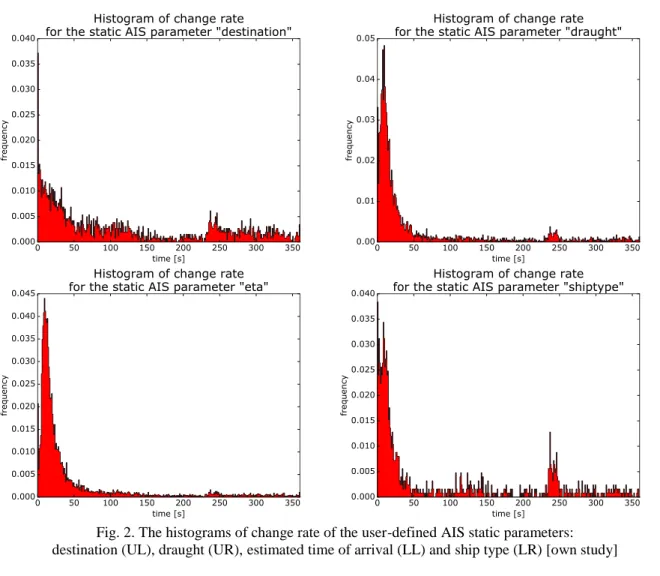
It can be noticed that the static AIS parameters which define the GNSS reference point of the AIS transponder produced the highest amount of value changes, reaching a total of 85% of all recorded value alterations. Compared to that, the other parameters seem to have had a minor impact on the overall variability of the values transferred by AIS message 5. The rate of change characteristics of the parameters which are allowed to be modified by the crew members is shown in figure 2.
Fig. 2. The histograms of change rate of the user-defined AIS static parameters: destination (UL), draught (UR), estimated time of arrival (LL) and ship type (LR) [own study]
The histograms indicate that in the majority of cases the values of those parameters were changing faster than once per minute. By observing the outstanding peaks on the plots of “draught” and “ETA” one might consider a possibility that there may has been some kind of automatic interface providing up-to-date information about the vessel draught and her estimated time of arrival at the destination harbour and feeding this data into the AIS transponder. However, in case of the static AIS parameters like “destination” and “ship type” the idea of an automatic update process seems to be far from reality and such high-rate changes might have been caused by an interference or a misconfiguration.
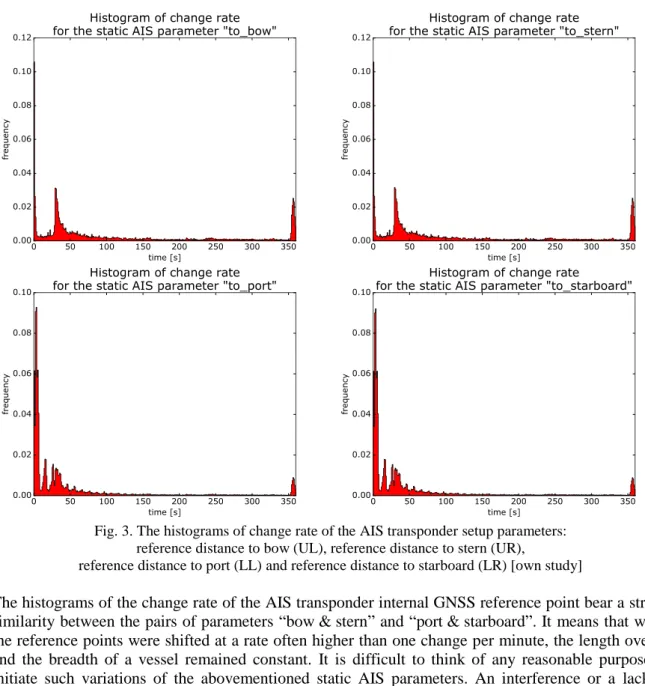
The rate of change characteristics of the parameters which may be adjusted only by the service personnel is shown in figure 3.
Fig. 3. The histograms of change rate of the AIS transponder setup parameters: reference distance to bow (UL), reference distance to stern (UR),
reference distance to port (LL) and reference distance to starboard (LR) [own study]
The histograms of the change rate of the AIS transponder internal GNSS reference point bear a strong similarity between the pairs of parameters “bow & stern” and “port & starboard”. It means that while the reference points were shifted at a rate often higher than one change per minute, the length overall and the breadth of a vessel remained constant. It is difficult to think of any reasonable purpose to initiate such variations of the abovementioned static AIS parameters. An interference or a lack of proper configuration might have caused such abnormal phenomenon, but it remains unclear whether the source was located on board vessels or away from them.
Among the aforementioned 1847 AIS transponders which were broadcasting changes in static parameters at a high rate, 831 (45%) were transmitting variations of the location of the GNSS reference point used by their AIS transponders. For each MMSI and its static variables 𝐴, 𝐵, 𝐶, 𝐷, listed in table 1, the sums of the absolute differences between consecutive values were computed using the formula 1.
∑𝑛𝑖=2𝐴|𝐴𝑖− 𝐴𝑖−1|+ ∑𝑛𝑖=2𝐵|𝐵𝑖− 𝐵𝑖−1|+ ∑𝑛𝑖=2𝐶 |𝐶𝑖− 𝐶𝑖−1| +∑𝑛𝑖=2𝐷|𝐷𝑖− 𝐷𝑖−1| (1)
where
𝑛𝐴, 𝑛𝐵, 𝑛𝐶, 𝑛𝐷 lengths of the time series containing static variables 𝐴, 𝐵, 𝐶, 𝐷
𝐴𝑖, 𝐵𝑖, 𝐶𝑖, 𝐷𝑖 current reference distance to bow, to stern, to port, to starboard
𝐴𝑖−1, 𝐵𝑖−1, 𝐶𝑖−1, 𝐷𝑖−1 previous reference distance to bow, to stern, to port, to starboard
𝑖 index of current element in the time series 𝑖 − 1 index of previous element in the time series
Using this approach a total distance travelled by the GNSS reference point wandering on board a vessel was calculated for every MMSI affected. The cumulative distribution of those distances is presented in figure 4.
Fig. 4. Cumulative distribution of the total distance travelled by the GNSS reference point aboard a vessel [own study]
Aboard 90% of vessels whose AIS transponders were displaying the symptoms of the GNSS reference point drifting around, the total distance travelled by the reference point reached at most 550 metres. On board eight vessels the GNSS reference point covered a total distance between 10 kilometres and 35 kilometres. The most extreme variations of the reference point used by the AIS transponders were observed in the static data obtained from two craft: a large cruise vessel scored 592 kilometres during one year and three months, followed by a small general cargo vessel which reached 174 kilometres after one year and ten months. It remains unknown what exactly caused that GNSS reference walk. There are at least two cases when the parameters of the AIS reference point are to be changed under normal circumstances by an authorised technician: relocating the on-board antenna serving as the AIS positioning source or vessel lengthening at a shipyard. Both operations cannot be completed underway, nor do they take only a few seconds. In order to investigate this matter deeper, a closer look at the AIS equipment used on both the vessel and the receiving station might be necessary which is beyond the scope of this work.
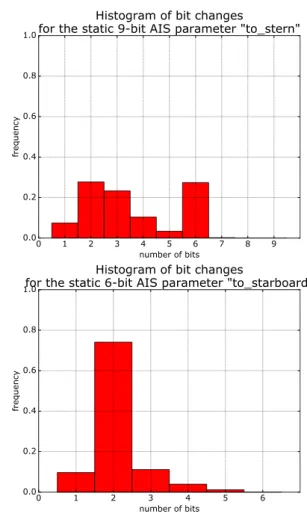
The high-rate value changes of the static AIS parameters were also analysed at bit level since the raw AIS transmissions use a binary representation of numbers. After converting every two consecutive values of a numeric static AIS parameter into their binary representation, it was possible to count how many bits were modified in order to replace the old value of the parameter with a new one. The histograms of bit changes in the static AIS parameters defining the GNSS reference are shown in figure 5.
Fig. 5. The histograms of bit changes inside the AIS transponder setup parameters: reference distance to bow (UL), reference distance to stern (UR),
reference distance to port (LL) and reference distance to starboard (LR) [own study]
During the high-rate variations of the GNSS reference distance to bow in about 50% of cases the numeric value change was caused by modifying 3 bits. In case of the reference distance to stern the most value changes of that parameter were a result of switching at the same time either 2 bits or 3 bits or 6 bits. In 60% of situations it took a total of 4 bits to alter the value of the GNSS reference distance to port. The high-rate changes of the reference distance to starboard were caused in over 70% of cases by 2 bits being modified over a short period of time. It can be observed that the histograms in figure 5 do not exhibit a uniform distribution and in case of three static AIS parameters a clearly visible mode exists.
In order to assess the relation between the variability of static AIS parameters transmitted by vessels and their distance from the AIS receiver in Rostock, the positions of the AIS transponders contributing to high-rate changes of the static AIS data were plotted on chart which is presented in figure 6.
Fig. 6. Positions of vessels which broadcast changes of static AIS data at high-rate around the DLR reference station in Rostock (range ring interval: 5 M) [own study]
It can be observed that there was no significant increase of density among reported vessel positions far away from the AIS receiver, which would have occurred if long range AIS transmissions had been more prone to interference affecting bit sequences within the AIS message 5 than the broadcasts in proximity of the AIS reference station in Rostock. A higher concentration of points in the harbour area of Rostock was caused by a possibility of maintaining a prolonged radio contact with AIS transponders on board vessels made fast, as opposed to vessels passing far away north of Rostock in the course of a few hours. This can furthermore be confirmed by the histogram of distances from the AIS receiver which is shown in figure 7.
Fig. 7. Histogram of distances measured from AIS receiver in Rostock along which high-rate changes of static AIS parameters occurred [own study]
About 65% of all transmissions of AIS message 5 triggering changes of static parameters at high-rate were located within the harbour area of Rostock. A lower percentage of AIS transponders spotted far away from the DLR reference station indicates that there was no direct radio interference disturbing the broadcasts of static AIS data with an impact directly proportional to the distance between a vessel and the receiver.
Conclusions
The analysis of AIS data collected during the last five years at the DLR reference station in Rostock has shown that 15% of all acquired Class A AIS transponders were broadcasting changes of static parameters encapsulated inside AIS message 5 at a rate higher than one message every 6 minutes. In 42% of the cases, the variability involved parameters which under normal conditions may only be modified by authorised technicians during the configuration phase of AIS transponder. Especially the location of the GNSS reference antenna used by on-board AIS equipment and described by four static parameters enclosed within AIS message 5 generated a total of 85% of all recorded value alterations. In the most extreme situation spotted during the analysis the variating GNSS reference point walked a total of 592 kilometres on board a cruise vessel. In case of the static AIS parameters modified by the crew and describing the current voyage such as destination and estimated time of arrival, their values were frequently changing faster than once per minute which may suggest a process without human interaction. The examination of distances between AIS transponders transmitting high-rate changes of static parameters and the AIS receiver in Rostock has not indicated that vessels located far away from the reference station had a tendency of being under significant influence of some radio interference. It is important to emphasise that it was not possible to define beyond reasonable doubt what was causing the abovementioned variability of static AIS data. An interference or a faulty equipment might be among main suspects. Human factor may perhaps be excluded. Otherwise at least one member of the crew would have to be assigned no other duties except for repeatedly changing static parameters in the AIS transponder interface. Further research might be worthwhile to determine whether similar data variability phenomenon affects other AIS messages, too.
References
1. IMO NAV54/25 Annex 12
2. ITU-R M.1371-4, Technical characteristics for an automatic identification system using time division multiple access in the VHF maritime mobile band, 2010
3. Banyś, Paweł and Noack, Thoralf and Gewies, Stefan (2012) Assessment of AIS vessel position report under the aspect of data reliability. ENC, Gdańsk
4. Heymann, Frank and Noack, Thoralf and Banyś, Paweł (2013) Plausibility analysis of navigation related AIS parameter based on time series. ENC, Wien
5. Banyś, Paweł und Heymann, Frank und Engler, Evelin und Noack, Thoralf (2015) Motion-based Consistency Audit of the Onboard GNSS Reference Reported by the Static AIS Data. MTE, Kołobrzeg
![Table 1. Static AIS parameters and their categories used during the analysis [own study]](https://thumb-us.123doks.com/thumbv2/123dok_us/1092537.2645148/2.892.202.692.820.1087/table-static-ais-parameters-categories-used-analysis-study.webp)
![Table 2. Static AIS parameters and the counters of their changes [own study]](https://thumb-us.123doks.com/thumbv2/123dok_us/1092537.2645148/3.892.257.637.733.993/table-static-ais-parameters-counters-changes-study.webp)
![Fig. 4. Cumulative distribution of the total distance travelled by the GNSS reference point aboard a vessel [own study]](https://thumb-us.123doks.com/thumbv2/123dok_us/1092537.2645148/6.892.254.620.243.523/cumulative-distribution-total-distance-travelled-reference-aboard-vessel.webp)
![Fig. 6. Positions of vessels which broadcast changes of static AIS data at high-rate around the DLR reference station in Rostock (range ring interval: 5 M) [own study]](https://thumb-us.123doks.com/thumbv2/123dok_us/1092537.2645148/8.892.277.617.101.394/positions-vessels-broadcast-changes-reference-station-rostock-interval.webp)
