University of Denver University of Denver
Digital Commons @ DU
Digital Commons @ DU
Electronic Theses and Dissertations Graduate Studies
1-1-2015
Facial Expression Analysis via Transfer Learning
Facial Expression Analysis via Transfer Learning
Xiao Zhang
University of Denver
Follow this and additional works at: https://digitalcommons.du.edu/etd
Part of the Artificial Intelligence and Robotics Commons, and the Graphics and Human Computer
Interfaces Commons
Recommended Citation Recommended Citation
Zhang, Xiao, "Facial Expression Analysis via Transfer Learning" (2015). Electronic Theses and Dissertations. 731.
Facial Expression Analysis via Transfer
Learning
A Dissertation Presented to
the Faculty of the Daniel Felix Ritchie School of Engineering and Computer Science
University of Denver
in Partial Fulfillment
of the Requirements for the Degree of Doctor of Philosophy
by Xiao Zhang March 2015
c
⃝Copyright by Xiao Zhang 2015. All Rights Reserved
Author: Xiao Zhang
Title: Facial Expression Analysis via Transfer Learning Advisor: Dr. Mohammad H. Mahoor
Degree Date: March 2015
Abstract
Automated analysis of facial expressions has remained an interesting and chal-lenging research topic in the field of computer vision and pattern recognition due to vast applications such as human-machine interface design, social robotics, and devel-opmental psychology. This dissertation focuses on developing and applying transfer learning algorithms – multiple kernel learning (MKL) and multi-task learning (MTL) – to resolve the problems of facial feature fusion and the exploitation of multiple facial action units (AUs) relations in designing robust facial expression recognition systems. MKL algorithms are employed to fuse multiple facial features with dif-ferent kernel functions and tackle the domain adaption problem at the kernel level within support vector machines (SVM). lp-norm is adopted to enforce both sparse
and non-sparse kernel combination in our methods. We further develop and apply MTL algorithms for simultaneous detection of multiple related AUs by exploiting their inter-relationships. Three variants of task structure models are designed and investigated to obtain fine depiction of AU relations. lp-norm MTMKL and
TD-MTMKL (Task-Dependent TD-MTMKL) are group-sensitive MTL methods that model the co-occurrence relations among AUs. On the other hand, our proposed hierarchical multi-task structural learning (HMTSL) includes a latent layer to learn a hierarchical structure to exploit all possible AU inter-relations for AU detection. Extensive
ex-periments on public face databases show that our proposed transfer learning methods have produced encouraging results compared to several state-of-the-art methods for facial expression recognition and AU detection.
Acknowledgements
First and foremost, I thank my research advisor, Dr. Mohammad H. Mahoor. Without his assistance and dedicated involvement in my research works, this disser-tation would have never been accomplished. I would like to thank you very much for your support and supervision over the past four and half years.
I would also like to show gratitude to my committee members, Dr. Kimon Vala-vanis, Dr. Nathan Sturtevant and Dr. Michael Kinyon. Thanks for your comments and suggestions on my comprehensive proposal and this dissertation.
Getting through my dissertation required more than the support from university faculty, and I have many, many people to thank for listening to and, at times, having to tolerate me over the past years. I cannot begin to express my gratitude and appreciation for their kindness and friendship. The colleagues in my lab, Ms. Saba Bakhshi, Dr. S. Mohammad Mavadati, Mr. Ali Mollahosseini and Mr. Howard Finn have been unwavering in their personal and professional support during the time I spent at the University of Denver.
Most importantly, none of these could have happened without my family. My parents offered their encouragement through phone calls every week. To my wife, it would be an understatement to say that, as a couple, we have experienced some ups and downs together in the past years. Every time I was ready to quit, she did not let me give up. This dissertation stands as a testament to your unconditional love and encouragement.
Table of Contents
Acknowledgements . . . iv
1 Introduction 1 2 Related work 6 2.1 Facial feature representation . . . 6
2.2 Facial expression recognition . . . 8
2.3 Facial action unit detection . . . 9
2.4 Transfer learning algorithms . . . 11
3 Face databases for facial expression analysis 15 3.1 The CK+ database . . . 16
3.2 The MMI database . . . 17
3.3 The GEMEP-FERA database . . . 19
3.4 The DISFA database . . . 20
4 lp-norm MKL-based multiclass-SVM for basic facial expression recog-nition 22 4.1 l1-norm MKL-based binary SVM . . . 23
4.2 lp-norm MKL-based binary SVM . . . 25
4.3 lp-norm MKL-based multiclass-SVM . . . 28
4.4 Facial expression recognition experiments . . . 30
4.4.1 Classifier Settings . . . 30
4.4.2 Experimental results on CK+ . . . 32
4.4.3 Experimental results on MMI . . . 38
4.4.4 Experimental results on GEMEP-FERA . . . 41
5 Group-sensitive MTL for facial action unit detection 45 5.1 MTL for AU inter-relation modeling . . . 46
5.2 lp-norm MTMKL . . . 48
5.3 TD-MTMKL . . . 50
5.4 Facial action unit detection experiments . . . 54
5.4.3 Reliability measurement . . . 57 5.4.4 Experimental results and discussions . . . 57 6 Hierarchial multi-task structure learning for facial action unit
de-tection 64
6.1 HMTSL . . . 65 6.2 Hierarchical model in HMTSL . . . 68 6.3 AU detection experiments and discussions . . . 69
7 Conclusion and future work 78
7.1 MKL for basic expression recognition . . . 78 7.2 MTL for AU detection . . . 80 7.3 Future recommendations . . . 81 A Proof of the superiority of MKL-based SVM over canonical binary
SVM with single kernel and single type of features 83
B Proof of the superiority of our proposed MKL-based multiclass-SVM
over the SimpleMKL-based multiclass-SVM 86
Chapter 1
Introduction
Facial expressions are the most important non-verbal visual channel used by hu-mans in face-to-face communication [1]. Psychologists believe that facial expressions complete and reinforce verbal messages, and agree upon six basic facial emotions: joy, anger, fear, sadness, disgust, and surprise [2, 3] that are considered to be fundamental and common among different cultures. Moreover, in order to describe and quantify facial expressions, Paul Ekman and Wallace Friesen proposed the Facial Action Cod-ing System (FACS) [2], which defines all possible and visually detectable facial muscle variations in terms of 44 action units (AUs). Table 1.1 lists the description of 12 AUs involved in our work.
Automated analysis of facial expressions in visual data is an interesting topic in the field of computer vision and pattern recognition. It has received great attention in recent years due to the vast number of applications including human machine interface design, robotics and developmental psychology. Although much progress has been made [4, 5], recognizing basic facial expressions and action units with a high accuracy still remained challenging due to the complexity, subtlety, and variations of human facial behaviors.
Table 1.1: AU description
AU Description Figure
AU1 Inner Brow Raiser
AU2 Outer Brow Raiser
AU4 Brow Lowerer
AU5 Upper Lid Raiser
AU6 Cheek Raiser
AU9 Nose Wrinkler
AU12 Lip Corner Puller
AU15 Lip Corner Depressor
AU17 Chin Raiser
AU20 Lip stretcher
AU25 Lips part
This dissertation focuses on applying transfer learning algorithms to resolve two major problems existed in facial expression analysis. One is the facial feature fu-sion problem. In the recognition of basic facial expresfu-sions, which is a multiclass classification problem, one type of facial features may not be distinguishable for all expressions whereas using another type of features may produce better results in sev-eral expressions. Since different features have different distributions, it is necessary to fuse multiple facial feature representations to increase the discriminative power of classifiers. However, it is usually difficult to represent a combination of features within the widely used single-kernel-based support vector machines (SVM) when considering the compatibility of different features domains. For the sake of this problem, we pro-pose to apply multiple kernel learning (MKL) in the transfer learning methodology to fuse multiple facial features at the kernel level with SVM. The “transferring skill” of MKL is to optimally combine different kernel matrices calculated base on multiple features with multiple kernels. Within this framework, the problem of feature data representation through single type of features with a single kernel function in the canonical SVM is transferred to set the optimal value of kernel combination weights for multiple kernel matrices.
The other challenge is how to properly exploit the relations among facial AUs and basic expressions during facial expression analysis. According to the description in the FACS manual [6], there are some relationships among different AUs such as simultaneous presence in basic facial expressions. For examples, AU4 (brow lowerer) is usually co-occurred with AU1 (inner brow raiser) and AU2 (outer brow raiser) to generate negative expressions such as fear and sadness. AU6 (cheek raiser) is usually co-occurred with AU12 (lip corner puller) in the case of Duchenne smile [7]. These relationships are by their nature good resources for AU detection. However,
dynamic modeling [11, 12, 13, 14], turn to recognize AUs or certain AU combinations separately without considering their inter-relations. In this dissertation, viewing the detection of each AU as a task, we apply multi-task learning (MTL) algorithms to simultaneously detection multiple AUs by properly modeling the AU inter-relations. As surveyed in [15], MTL encodes the idea of inductive transfer learning, and aims to learn one problem with the help of other related problems by properly modeling their related structures.
In summary the main contributions of our works are two-folded.
• We present a novel facial expression recognizer via MKL by extending the lp
-norm MKL algorithm into multiclass classification problem. Different types of facial features with multiple kernel functions are fused by adopting lp-norm
(p ≥ 1) to obtain both sparse and non-sparse kernel combinations. For solv-ing the optimization problem of our proposed method, we learn one kernel weight vector for each binary classifier in the multiclass-SVM. Compared to the SimpleMKL-based multiclass-SVM [16], which jointly learns the same kernel weight vector for all binary classifiers, our method has a better flexibility of selecting different kernel combinations and also reflects the contribution of each binary classifier to the whole objective function of MKL-based multiclass-SVM. We also comprehensively studied the impact of “p” on controlling the sparsity of the kernel combinations, and provide insight explanation of why our proposed method outperforms the state-of-the-art methods based on the discussion of the experimental results.
• We cast the AU detection problem into MTL frameworks, where given a specific facial image, multiple AUs are detected simultaneously by exploiting the rela-tions of their discriminative hyperplanes in SVM. Moreover, we take the
advan-tage of MKL to increase the discriminant power of the MTL classifiers by fusing different types of facial feature representations with multiple kernels. Three task structures are designed in our proposed methods to achieve proper modeling of AU inter-relations. lp-norm multi-task multiple kernel learning (MTMKL) and
task-dependent MTMKL (TD-MTMKL) are group-sensitive MTL methods for modeling AU inter-relations, where AUs are packaged into different groups via our pre-knowledge of AU co-occurrence relations. Whereas, hierarchical multi-task structure learning (HMTSL) is proposed to avoid of such pre-knowledge and utilize all possible AU inter-relations via a hierarchical model in HMTSL.
The remainder of this dissertation is organized as follows. Chapter 2 reviews the related works on facial expression analysis including feature representation and classi-fier design for basic expressions and AUs as well as the existing transfer learning algo-rithms including MKL and MTL. Chapter 3 introduces the public databases utilized in this dissertation for both basic expression recognition and AU detection. Chapter 4 presents the formulation of our proposed transfer learning framework, lp-norm
MKL-based Multiclass-SVM, for basic facial expression recognition. Experiments on three public face databases are presented and discussed based on the comparison with sev-eral state-of-the-art methods. Chapter 5 presents our proposed group-sensitive MTL methods for AU detection on four AU packages. Chapter 6 describes the designed hi-erarchical model and the optimization formulation for HMTSL. Experimental results on two face databases with posed and spontaneous AUs are shown and discussed in Chapter 5 and Chapter 6 based on the comparison with several state-of-the-art methods. Finally, Chapter 7 concludes the paper and envisions the future work.
Chapter 2
Related work
Automatic facial expression analysis has made good progresses in the last decade. For a detailed survey on the existing and state-of-the-art methods in this topic, we refer our reader to [4, 5]. Most recently, the Facial Expression Recognition and Anal-ysis Challenge (FERA 2011) [17] outlined the evaluation protocol, the data used, and the results of a baseline method for facial action unit (AU) detection and expression recognition. Here, we briefly review some previous works on two main aspects of this challenge, facial feature extraction and classifier design. The transfer learning algorithms including MKL and MTL methods are also introduced.
2.1
Facial feature representation
Facial images are represented by extracting a set of features from registered im-ages, where procrustes analysis is usually applied for image registration using several annotated facial landmark points such as in [18, 19]. Good features are those with small inner-class variations of facial expressions and large intra-class variations. Three
categories of features are commonly seen in the literatures: geometric features, ap-pearance features, and combination of geometric and apap-pearance features.
Geometric representations usually utilize shapes and locations of facial compo-nents to model the face geometry. Chang et al. [20] learned a specific active shape model (ASM) [21] defined by 58 fiducial points to avoid incorrect matching due to non-linear image variations. Pantic et al. [8, 22] tracked a set of facial characteristic points around the mouth, eyes, eyebrows, nose, and chin. Some approaches combined geometric and appearance features (i.e., active appearance models (AAM) [23]) and applied them for facial expression recognition [24, 25]. AAM are statistical models that can provide good spatial information of key facial landmark points for valid ex-amples. However, they are highly dependent of an accurate matching of the model to facial images, and usually need manual labor for their construction.
Appearance features are often used for representing facial textures such as wrin-kles, bulges and furrows exhibited in facial expressions. Gabor wavelet analysis [26, 27] is one of the first appearance-based features used to represent the facial appearance variations. These features are usually applied to either the entire face or specific face regions. The computation of Gabor-wavelet representation is both time and memory intensive [18]. LBP operator was introduced as an effective appearance feature for facial image analysis [28, 29]. Shan et al. [18] achieved better results for facial expression recognition using LBP features compared to Gabor features. The most important properties of LBP features are their tolerance against illumination changes and computational simplicity. HOG features were firstly described in [30] for pedestrian detection, which count occurrences of gradient orientations in local-ized portions of an image. It has further been determined in [31] that when HOG features are combined with LBP descriptors, detection performances are improved.
variations for facial expression recognition in [32, 33]. The invariance to geometric transformations and good description of edge orientations are the key advantages of HOG descriptor over other methods. In our work, we fuse the LBPH features with HOG features at kernel level within SVM classifiers and study its impact on facial expression recognition and AU detection.
2.2
Facial expression recognition
Several studies have evaluated different classifiers for facial expression recognition. Bartlett et al. [10] and Shan et al. [18] respectively performed systematic comparison of different techniques including AdaBoost, SVM and Linear Discriminant Analysis (LDA), and the best results were obtained by selecting a subset of facial features using AdaBoost and then sent to SVM for automatic expression labeling. Sebe et al. [34] evaluated 14 different classifiers like SVM, Bayesian Nets and Decision Trees and achieved the best classification results using k-nearest neighbor (kNN) algorithm. They also used voting algorithms such as bagging and boosting to improve the results of facial expression recognition.
In order to exploit the temporal information of facial behaviors, different methods have been presented for facial expression recognition in image sequences. Several early works [35, 36] attempted to track and recognize facial expressions over time based on optical flow methods. Hidden Markov Models (HMM) are widely used to model the temporal relations between consecutive facial behaviors [37, 38]. In [37], a multi-level HMM classifier was proposed to combine temporal information and automatically segment long video sequences. In their work, a Bayesian classifier was used for still images while a HMM classifier was applied to deal with emotion recognition in video sequences. However, as HMM can not model the dependencies among observed facial
features, some other research groups applied Dynamic Bayesian networks (DBN) for facial expression classification. Zhang and Ji [39] exploited DBN with a multi-sensory information fusion strategy while in [40] a novel Bayesian temporal model was formulated to capture the dynamic facial expression transition in a manifold.
Recently, MKL algorithms were proposed to combine multiple kernels instead of using a single one in training kernel-based classifiers such as SVM. These meth-ods, as surveyed in [41], have been applied to affective analysis and achieved better recognition results compared to single kernel SVM equipped with a single type of facial feature [42, 43]. The authors of [43] combined two types of facial features with two kernel functions, local Gabor binary pattern histograms (LGBPH) [44] with his-togram intersection kernel and AAM coefficients with RBF kernel, and tuned the parameters of kernel functions during experiments on facial action unit detection. The SimpleMKL algorithm [16] was applied for solving the optimization problem of MKL in their work, which is a binary classification task.
Since different types of features can represent different information in facial im-ages, by combining multiple features with different kernel functions in MKL frame-work, plenty of useful facial representations and kernel functions can be utilized simul-taneously during classification. In this work, a novel MKL framework is presented for multiclass classification using SVM, and comprehensive study is conducted to evaluate the effect of our method on the application in facial expression recognition.
2.3
Facial action unit detection
AU detection is a binary classification problem. There are mainly two approaches in the literatures: one is the static modeling as presented in [8, 9, 10], where each face image is recognized separately by solving a binary discriminative classification
problem; the other one is the dynamic modeling such as in [45, 12, 13], where video frames are segmented into subsequences to exploit the temporal behaviors based on a variant of dynamic models such as Hidden Markov Models (HMMs), and are usually described in terms of onset, apex and offset. However, almost all these methods turn to recognize AUs or certain AU combinations independently without considering the inter-relations among different AUs.
There are only a few studies in the literatures that exploit the relations among AUs in detecting them. The research group of Qiang Ji proposed to use Dynamic Bayesian Network (DBN) to model the AU inner-relations. In [46, 47, 48], a two-step processing technique was engaged, where the learned DBN model from training data was employed to infer the AU labels of video frames based on the output of adaboost SVM. In this framework, the DBN can be viewed as a reasoning module that post-processes the predicted AU labels from the previous module with adaboost classifiers. Thus, necessary theoretical discussions on how the two modules can cooperatively in-crease the overall detection performance and the impact of overfitting are needed. Further, unified frameworks [49, 50] were presented to learn more complete graphical models to combine the classification and inference steps together using probabilistic classifiers instead of SVM. However, the DBN-based classifiers and the Restricted Boltzmann Machines (RBMs) in [50] need some prior assumptions of samples’ proba-bility distribution models such as the Gaussian distribution function, which may not be accurate for real applications. In comparison, our proposed method is based on SVM classifiers, which are more robust since the convex optimization problems are defined to learn the maximum-margin hyperplanes between samples from different classes in the feature space. In contrast to the works in [46, 47, 48, 49], which model the AU relations based on probabilistic dependencies among the presence and absence of multiple AUs, our work aims to exploit the relations among the SVM classifiers
that detect different AUs. That is, in our approach the detection of multiple AUs and the utilization of their intrinsic relations are conducted simultaneously.
2.4
Transfer learning algorithms
In this section, we introduce the general idea of two topics in the transfer learning framework – MKL and MTL, and review some famous methods proposed in the literatures.
MKL is proposed to deal with the domain adaption problem, which minimizes the data distribution mismatch between feature domains. For a detailed survey of MKL algorithms, we refer our readers to [41]. Usually, the parameters of kernel functions in canonical SVM classifiers are tuned during the training-validation experiments, and the parameters that result in the best classification rate on validation samples are applied to recognize the test samples. However, it is known that different kernels with different parameters correspond to different representation of features. Instead of trying to find which works the best, MKL-based SVM use a combination of them and define automatic learning methods to pick the optimal parameters. It is defined to learn both the decision boundaries between data from different classes and the kernel combination weights in a single optimization problem [51]. Therefore, features in different domains are transferred and fused at the kernel level in SVM.
Lanckriet et al. [51] considered a linear combination of basis kernels. By restrict-ing the kernel combination weights to have nonnegative values, the authors formu-lated their algorithm to a Quadratically-Constrained Quadratic Program (QCQP), where the support vector coefficients and the kernel combination weights were jointly learned. Sonnenburg et al. [52] proposed a formulation of linearly combining ker-nels in the primal form of SVM. In their method, a l -norm restriction was used on
the regularizer of the SVM objective function to enforce sparse kernel combinations. Later on, Rakotomamonjy et al. [16] proposed a modified regularizer with explicit kernel combination weights in their primal formulation. The authors exploited the weighted l1-norm across different kernel spaces and the l2-norm within each kernel space. This formulation named as SimpleMKL was then proved to be equivalent to the optimization problem of [52].
Instead of constraining kernel weights via l1-norm regularization, Cortes et al. [53] studied the performance of l2-norm for MKL, and found that the l2-norm out-performed l1-norm when larger sets of basis kernels were utilized. Sun et al. [54] proposed a new kernel evaluation technology to utilize both l1 and l2 norms in their Selective Multiple Kernel Learning (SMKL) method. SMKL obtained a sparse solu-tion by a pre-selecsolu-tion procedure, and meanwhile preserved a subset of kernels with complementary information out of the entire set of basis kernels. Kloft et al. [55, 56] generalized these MKL algorithms and formulated lp-norm MKL with arbitrary p
(p ≥ 1) to regularize over kernel combination coefficients in a binary classification problem. In our paper, we proposedlp-norm MKL multiclass-SVM by extending the
original method to a multi-class classification problems. Recently, Yan et al. [57] compared the performance of l1-norm and l2-norm MKL in the applications of im-age and video classification tasks, and concluded that the l2-norm should be used as it carries complementary information resources. Following this idea, we apply our proposed method for facial expression recognition, and study the performance of nonsparse kernel combinations (p >1) versus sparse ones (p= 1).
Multi-task learning is a transfer learning approach that learns multiple related problems simultaneously using a common representation. It seeks to improve the performance of a task with the help of other related tasks by properly leveraging information across the involved tasks in the learning process. The multi-class
classi-fication problem can be viewed as a special case in the MTL framework. Koby et al. [58] proposed an MTL method to solve the one-vs-the-rest multi-class classification problem. Several works have extended the kernel-based classifier SVM to the case of MTL. One set of algorithms, such as [59, 60], propose to present the task relations via the classification hyperplanes of SVM and can make closer the parameters of the hyperplanes for similar tasks. Whereas, other methods aim to learn the common structure among data from all the tasks. For example, the authors of [61] model the task relations by assuming that there only exists a small set of features shared across multiple tasks. The approach in [62] learns a shared feature map across all the tasks that can projects the input features of classifiers into a low-dimensional space with higher discriminative power. Our work presents a unified framework of the above two categories of MTL approaches, where task relations are encoded based on both SVM classification functions and a set of shared kernels for feature representation across all the tasks.
Recent works also explored the utilization of multiple kernel learning (MKL) for classification with multiple tasks. The authors of [63] model the task relations by defining meta-tasks. Each meta-task corresponds to a subset of all tasks, represent-ing the common properties of the tasks within this subset. Without utilizrepresent-ing multiple kernel functions as usually done to fuse different types of features in MKL algorithms, a lp-norm MKL solver [55] is employed for solving the proposed MTL problem. In
[64, 65], multiple kernels are fused to enhance the discriminative power of MTL-based classifiers. However, these methods assume uniform kernel combinations and weight too much on the commonalities among multiple tasks without considering their diver-sities. Sharing exactly the same kernel combination weights might be too restrictive for weakly correlated tasks. Tang et al. [66] propose to simultaneously learn multiple
assigned for each task, but the relations of SVM classification functions are not uti-lized for task structure modeling. We will compare this work with our method in the experiment section, and confirm the importance of modeling the relations of SVM hyperplanes in the application of facial AU detection.
Chapter 3
Face databases for facial expression
analysis
In this chapter, we introduce the face databases utilized in this dissertation for basic expression recognition and action unit detection.
Facial expressions can be categorized into spontaneous expressions and posed ex-pressions. Spontaneous expressions are those that occur in real life. Whereas, posed facial expressions are assumed to be artificially behaved and can differ markedly in configuration, intensity, and timing from spontaneous expressions. Especially, some facial actions that usually co-occur or are highly correlated in posed facial behaviors may rarely be seen in spontaneous ones. Therefore, in order to investigate the robust-ness of our proposed methods for facial expression analysis, we used four databases in our experimental works: the extended Cohn-Kanade (CK+) [67] database, the MMI database [68, 69] and the GEMEP-FERA data [17, 70] with posed expressions and the Denver Intensity of Spontaneous Facial Action (DISFA) database [71] with spontaneous expressions.
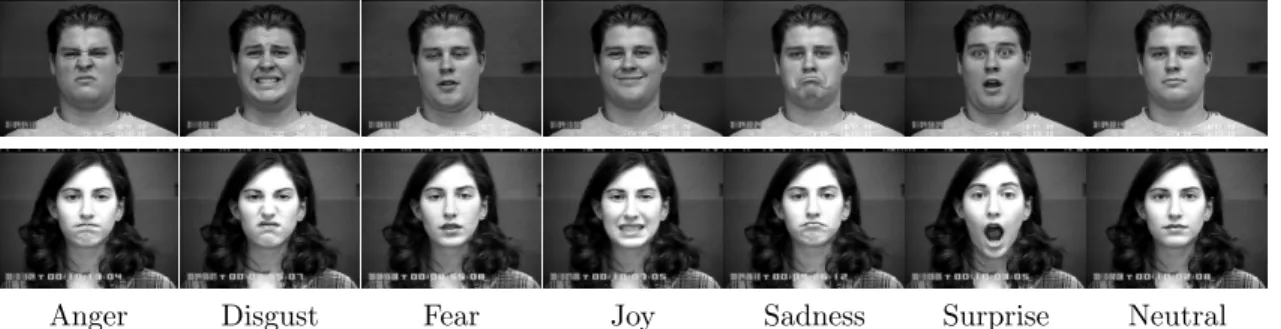
Anger Disgust Fear Joy Sadness Surprise Neutral
Figure 3.1: Sample images in the CK+ database
The three posed facial expression databases – CK+, MMI and GEMEP-FERA – were utilized for the experiments on basic facial expression recognition. Both within-database and cross-within-database tests were conducted to evaluate our proposed lp-norm
MKL-based multiclass-SVM. For AU detection, we used the CK+ database and the DISFA database to verify the performance of our proposed MTL-based methods in-cluding lp-norm MTMKL, TD-MTMKL and HMTSL, which simultaneously detect
multiple AUs by exploiting their inter-relations.
3.1
The CK+ database
The CK+ database is one of the most comprehensive face databases available in the research community. It consists of 593 image sequences from 123 subjects. The image sequences vary in duration from 10 to 60 frames and incorporate the neutral frame to peak formation including seven facial expressions: Anger, Disgust, Fear, Joy, Sadness, Surprise and Contempt as well as 30 AUs. All the images were digitized into 640×480 pixel arrays, and the X–Y coordinates of 68 landmark points were given for every image in the database. Figure 3.1 shows the sample images of the CK+ database with seven expressions.
In our work on AU detection, we used the first frame (neutral face) and the last three frames (peak frames) in each of the 593 image sequences, resulting in 2372 images. Since some of the image sequences do not necessarily represent six basic expressions and may just be a combination of various AUs, for basic facial expression recognition, we only used the images that are labeled as one of the six basic emotions including Anger, Disgust, Fear, Joy, Sadness and Surprise, resulting in 1236 images (135 Anger, 177 Disgust, 75 Fear, 207 Joy, 84 Sadness, 249 Surprise and 309 neutral faces). These images are selected from 309 image sequences with 106 subjects.
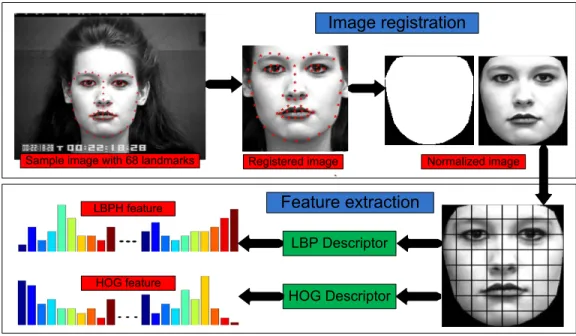
After converting the selected images to 8-bit gray-scale ones, we calculated the average X–Y coordinates of the located 68 landmark points among them. Then, each image was registered using a similarity transformation [72]. The transformation matrix was calculated between the X–Y coordinates of the 68 landmark points in that image and the average X–Y coordinates. Afterwards, we cropped the face region from each registered image based on the boundary described by its 68 landmark points, and resized them to 128×128 pixels. Histogram of oriented gradient (HOG) [30] and local binary pattern histogram (LBPH) [73] features with 8×8 windows and 59 bins in each window were separately extracted from each cropped facial image, and the size of each window is 16×16 pixels without overlap between windows. Further, for each feature category (LBPH and HOG) the PCA algorithm [74] was used for data dimensionality reduction to preserve 95% of the energy. The block diagram of our manipulation on image registration and feature extraction are shown in Figure 3.2.
3.2
The MMI database
The MMI facial expression database includes subjects from students and research staff members of both sexes aged 19-62 years old. It is a continually growing resource
Image registration
Feature extraction
LBP Descriptor
Sample image with 68 landmarks Registered image Normalized image
HOG Descriptor
LBPH feature
HOG feature
1.png 1.png
Figure 3.2: Facial feature extraction on the CK+ database
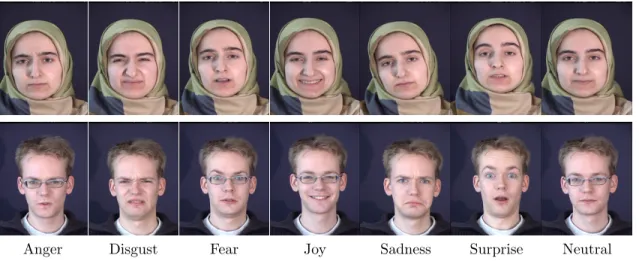
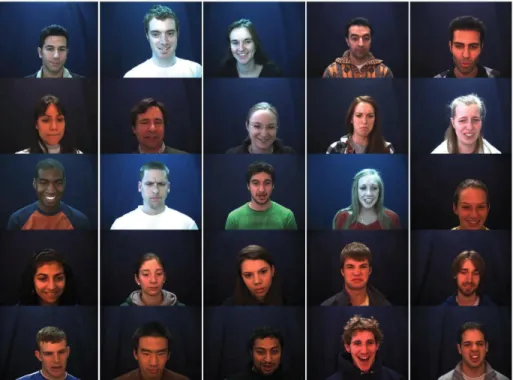
for AU and basic emotion recognition from face videos, of which the online search engine will facilitate researchers’ selection of samples by setting different criteria. Figure 3.3 shows the sample images of the MMI database with seven expressions.
In our work, 209 sessions were chosen from the database. Our selection criteria were that for each selected session it could be labeled as one of the six basic emotions and contains frontal or near-frontal view of the participant’s faces. The selected sessions were from 30 subjects. Facial images in each session were digitized into 720×576 pixels with 24-bit color values. Similar to our experiments on the CK+ database, for each selected session, the first frame and three peak frames were used for prototypic expression recognition resulting in 836 images (99 Anger, 96 Disgust, 87 Fear, 126 Joy, 96 Sadness, 123 Surprise and 209 neutral faces). Different from the CK+ databae, the locations of 68 landmark points on facial images are not provided in the MMI database. Therefore we apply the recently proposed facial feature tracking method in [75] to extract their geometric information (X–Y coordinates). Then,
Anger Disgust Fear Joy Sadness Surprise Neutral
Figure 3.3: Sample images in the MMI database
the image registration, LBPH and HOG feature extraction and data dimensionality reduction were conducted the same as on the CK+ database.
3.3
The GEMEP-FERA database
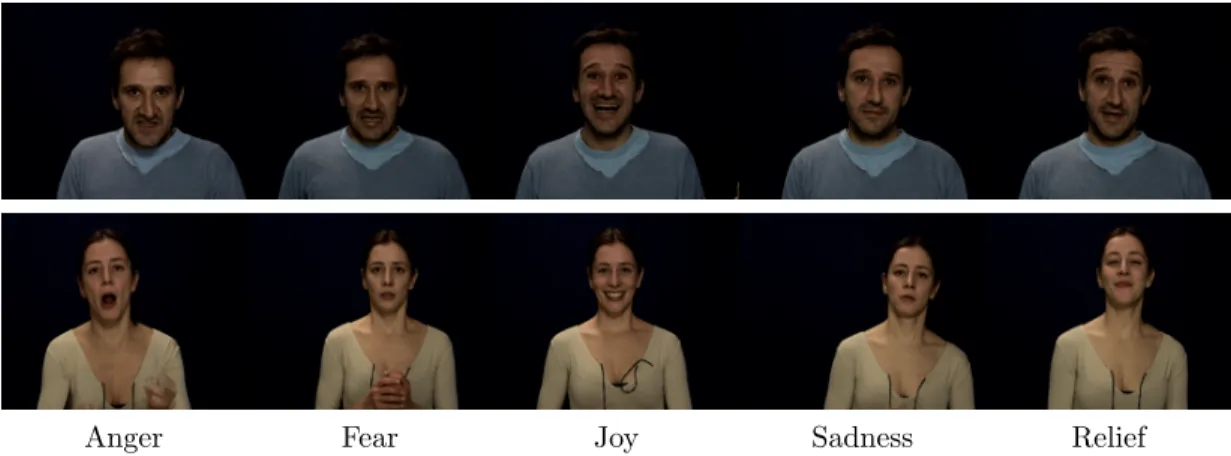
The GEMEP-FERA database is provided by the 2011 Facial Expression Recog-nition and Analysis Challenge (FERA2011). The emotion challenge of the GEMEP-FERA database [17, 70] contains 289 portrayals of five emotions: anger, fear, joy, sadness, and relief. Figure 3.4 shows the sample images of GEMEP-FERA with five expressions.
Of all the portrayals, 155 sessions are for training including seven subjects (three men) with three to five instances of each emotion for each subject. The remaining 134 sessions are provided for testing including six subjects (three men), where half of the subjects are not present in the training set. Each actor contributed three to ten instances per emotion in the test set. For this database, the facial feature extraction process were kept the same as on the MMI database including the face landmark
Anger Fear Joy Sadness Relief
Figure 3.4: Sample images in the GEMEP-FERA database
tracking, image registration, and HOG and LBPH feature extraction from all video frames.
3.4
The DISFA database
The DISFA database contains videos with facial activities from 27 adult subjects. Each subject was video-recorded using a high resolution camera (1024×768) at 20 frames per second (fps) while the subject was viewing a 4-minute stimulus video clip. The video clip was designed with the intent of eliciting subjects’ spontaneous facial expressions. For each video frame, the intensity of 12 AUs was manually annotated at a six-point ordinal scale (i.e, from 0 to 5). This database also provides 66 facial landmark points for all video frames of each subject. Figure 3.5 shows the sample images of the DISFA database.
In our experiments, to be consistent with the study on DISFA reported in [76], for each AU the video frames with intensity 0–1 were labeled as the absence of that AU while the frames with intensity 2–5 were labeled as the presence of that AU. Afterwards, the image registration, LBPH and HOG feature extraction and data
Figure 3.5: Sample images in the DISFA database
dimensionality reduction were conducted by following the same settings as on the CK+ database.
Chapter 4
l
p
-norm MKL-based
multiclass-SVM for basic facial
expression recognition
This chapter presents the formulation of our proposed transfer learning method to fuse different types of facial features with multiple kernel functions for facial ex-pression recognition. We first introduce the optimization problem of the MKL with sparse kernel combinations (l1-norm MKL) and the lp-norm MKL algorithm for
bi-nary classification problems, and then formulate our multiclass extension, lp-norm
MKL-based multiclass-SVM, via one-against-one and one-against-all techniques [77]. Experimental works on CK+, MMI and GEMEP-FERA databases are shown and discussed based the comparison with several state-of-the-art methods.
4.1
l
1-norm MKL-based binary SVM
Usually, the parameters of kernel functions in canonical SVM classifiers are tuned during the training-validation experiments, and the parameters that result in the best classification rate on validation samples are applied to recognize the test samples. However, it is known that different kernels with different parameters correspond to different representation of features. Instead of trying to find which works the best, MKL-based SVM use a combination of them and define automatic learning methods to pick the optimal parameters.
In this section, we present the formulation of the MKL optimization problem with sparse constraints and review some algorithms for solving it. Given a set of N training samples {(xi, yi)}iN=1, where xi is the ith feature vector of the training set
X with dimension D, and yi ∈ {−1,+1} is its corresponding class label, the MKL
optimization problem in [52] is formulated either by Equation 4.1.1 or in its equivalent form by Equation 4.1.2 as proposed in [16]:
min w,w0,ξ J(w, w0, ξ) = 1 2( M ∑ m=1 ∥wm∥2)2 +C N ∑ i=1 ξi s.t. yi( M ∑ m=1 wmTϕm(xi) +w0)≥1−ξi, i= 1,2, ..., N ξi ≥0, i= 1,2, ..., N (4.1.1)
Here ξ = (ξ1, ξ2, ..., ξN)T is known as the vector of slack variables in canonical SVM
for nonseparable classification problems, andCis a positive constant preset to control the relative influence of nonseparable samples. ϕm(·) is a map that maps the feature
domainX into themthreproducing kernel Hilbert space (RKHS)H
m, based on which
kernels in use. wm is the direction of hyperplane inHm,w denotes the set{wm} and
w0 is the exact in-space position of hyperplanes.
min w,w0,ξ,θ J(w, w0, ξ, θ) = 1 2 M ∑ m=1 1 θm ∥wm∥22+C N ∑ i=1 ξi s.t. yi( M ∑ m=1 wmTϕm(xi) +w0)≥1−ξi, i= 1,2, ..., N ξi ≥0, i= 1,2, ..., N M ∑ m=1 θm = 1, θm ≥0, m= 1,2, ..., M (4.1.2)
θ = (θ1, θ2, ..., θM)T is the kernel combination vector that controls the weight of the
squared form of wm in the objective function. When θm = 0, ∥wm∥2 should also be
equal to zero to yield a finite objective value.
Several MKL algorithms are proposed in [52, 16, 78] to solve the above two equiv-alent optimization problems. In [52], Equation 4.1.1 was transformed to be a semi-infinite linear program (SILP), and a chunking algorithm was proposed to solve the SILP by simultaneous optimization of SVM and kernel combination weights. This algorithm can be applied to large scale learning tasks. The SimpleMKL and Hessian-MKL algorithms are two other optimization techniques proposed to solve Equation 4.1.2. These techniques utilize two nested loops that iteratively learn the decision hyperplanes in C-SVM and the kernel combination vector. In the inner iteration, both algorithms solve the canonical binary SVM by fixing the kernel combination vector. In the outer iteration, the SimpleMKL utilizes a reduced gradient descent algorithm [79] with a 1D search algorithm – the golden section search method [80] – to update the combination weights, whereas the HessianMKL expands the weight updating problem to be a standard quadratic programming problem.
All these methods solve the same convex optimization problem and give the same optimum, though. The HessianMKL algorithm turns out to be the most efficient one as justified in [78, 16]. However, as presented in [81], the objective function in Equation 4.1.1 contains a l2,1-norm penalizer 12(
∑M
m=1∥wm∥2)2, which calculates the l1-norm of the squared hyperplane directions over multiple kernel spaces and will promote a sparse solution for the usage of kernel functions. Similarly, the l1-norm constraint on the vector θ in Equation 4.1.2 is a sparsity constraint that encourages sparse basis kernel combinations. Thereafter, very limited number of basis kernel functions (km(·,·), m = 1,2, ..., M) are used to represent the test samples during
classification tasks, which may reduce the discriminative power of MKL-based SVM.
4.2
l
p-norm MKL-based binary SVM
To allow for non-sparse kernel mixtures, the authors of [55, 56] extended MKL to arbitrary norms, that is lp-norm MKL with p ≥ 1. In this part, we present the
formulation and the solution of this generalized MKL optimization problem for binary classification tasks.
The lp-norm MKL is named from the novel regularizer of SVM as follows:
Ω(w) = 1 2∥w∥
2
2,p, p≥1,
where thel2,p-norm is defined as∥w∥2,p= (
∑M m=1∥wm∥ p 2) 1 p, andw m is the direction of
function of SVM, the primal form of lp-norm MKL-based binary SVM is obtained as: min w,ξ J(w, ξ) = 1 2∥w∥ 2 2,p+C N ∑ i=1 ξi, p≥1 s.t. yi ( M ∑ m=1 wTmϕm(xi) ) ≥1−ξi, i = 1,2, ..., N ξi ≥0, i= 1,2, ..., N (4.2.1)
which is a convex optimization problem as proved in [55, 56].
Note that when p= 1 the formulation is the same as the one defined in Equation 4.1.1, which enforces sparse kernel combinations. Equation 4.2.1 is solved based on its dual form shown as follows:
min θ maxα L(θ, α) =1 T α− 1 2α T Y KθY α, p∈[1,2) max θ maxα L(θ, α) =1 Tα−1 2α TY K θY α, p∈(2,+∞) s.t. Kθ = M ∑ m=1 θmK(m), N ∑ i=1 αiyi = 0, 0≤αi ≤C, M ∑ m=1 θp/m(2−p)≤1, θm ≥0 (4.2.2)
whereα= (α1, α2,· · · , αN)T is the vector of Lagrangian dual variables corresponding
to each training sample, and Y =diag(y1, y2,· · · , yN) is an N ×N diagonal matrix.
K(m) is the kernel matrix corresponding to the mth kernel function, and K(m) i,j =
km(xi, xj).
In [56], the authors proposed a simple macro-wrapper algorithm for solving Equa-tion 4.2.2, and proved its convergence in the case ofp >1. The macro-wrapper solver contains two nested steps for parameter updating. In the outer one, the kernel
com-bination weights are updated by fixing the variables of SVM. Whereas in the inner iteration, with fixed kernel combination weight vector the optimization problem is transformed to the canonical C-SVM problem, and can be solved by any SVM solver. Detailed steps are shown in Algorithm 1.
Algorithm 1 The simple macro-wrapper algorithm Require: p∈(1,+∞)\{2}, C and Y
for all m∈ {1,2,· · · , M} do initialize θm := (1/M)(2−p)/p
compute K(m) end for
while optimality conditions are not satisfieddo
compute Kθ based on the constraint in Equation 4.2.2
update α based on a canonical SVM solver for all m ∈ {1,2,· · · , M} do if p < 2then update θm := θm(α TY K(m)Y α)2−2p [∑M m′=1θm(αTY K(m ′)Y α)p2 ]2−p p else update θm := (αTY K(m)Y α)22p−−p2 [∑ M m′=1(αTY K(m ′)Y α)2pp−2 ]2−p p end if end for end while Ensure: α and θ
We implement Algorithm 1 for the case p > 1. The optimality conditions are set based on number of total iterations and the variations of updated θ between consecutive iterations. For the case of p = 1, we apply the HessianMKL algorithm due to its higher computational efficiency.
In the test phase, given a test sample x0 ∈ RD, the label of x0 (denoted by y0) can be calculated as follows.
y0 = sgn[ ∑M θm (∑N αiyikm(xi, x0) ) ] (4.2.3)
The formulation within the under bracket is the discriminant function used for classifying new samples in canonical binary SVM. In other words, by using MKL-based SVM the label of a sample is determined MKL-based on weighted summation of the results obtained from each RKHS, which enhances the discriminant power for classification. In Appendix A, we justify the superiority of MKL-based SVM to the canonical single kernel SVM by showing that the minimized the objective function in Equation 4.2.1 preserves the lower boundary of the one in canonical SVM.
4.3
l
p-norm MKL-based multiclass-SVM
In this section, we present our proposed MKL-based multiclass-SVM framework by extending the binarylp-norm MKL classifier described by Equation 4.2.2 for
multi-class multi-classification. Suppose we want to multi-classifyU classes using binary classifiers. Two techniques are commonly used in the literature: one-against-one and one-against-rest. In the one-against-one technique, U(U−1)/2 binary classifiers are built for all pairs of distinct classes, whereas in the one-against-rest technique U binary classifiers are built for each class of data.
The authors of [16] presented a structure of MKL-based multiclass-SVM using the SimpleMKL algorithm. In their structure, a single kernel combination weight vector is jointly learned for all binary classifiers in the multiclass-SVM as:
min
θ L(θ) =
∑
u∈Φ
Lu(θ) (4.3.1)
where Φ is the set of all pairs of distinct classes considered in the multiclass-SVM, and Lu(θ) denotes the objective function for optimizing kernel combination vector θ
loop of the SimpleMKL-based multiclass-SVM is to solve the multiclass-SVM while in the outer loop a single kernel weight vector is learned to minimize the summation of the objective functions from all binary classifiers. Therefore, the learned optimal kernel weight vector can be used for all binary classifiers, which generally increases the recognition result of multiclass-SVM.
However, only one kernel weight vector may not be good enough to reflect the contribution of each binary classifier in the whole objective function. Since features are projected into different spaces using different kernel functions, for a binary clas-sifier the values of kernel combination weights reflect the choice of optimal kernel functions and features used for distinguishing between two classes. Therefore, in the MKL-based multiclass-SVM it is most likely that different binary classifiers may have different optimal kernel weight vectors for classification. However, the structure of the SimpleMKL-based multiclass-SVM, which uses the same kernel weight vector for all binary classifiers, does not have a good resolution of selecting kernel combinations for different pairwise classifiers.
Based on the discussion above, we are looking for one combination weight vector θu to optimize each pairwise SVM’s objective function Lu as in Equation 4.3.2, and
the proof of the superiority of our method over SimpleMKL-based multiclass-SVM is shown in B. min θu ˆ L=∑ u∈Φ Lu(θu), if p∈[1,2) max θu ˆ L=∑ u∈Φ Lu(θu), if p∈(2,+∞) (4.3.2)
We implemented the structure of our MKL-based multiclass-SVM proposed in Equation 4.3.2 using thelp-norm MKL algorithm for thep > 1 case and the
Hessian-in the Hessian-inner loop the common multiclass-SVM is solved by a C-SVM solver – SVM-KM [82] with either the one-against-one rule or the one-against-rest rule while in the outer loop the two MKL algorithms for different cases are implemented to learn one kernel weight vector for each binary classifier. In our application for facial expression recognition, the one-against-rest rule is used and the classification of novel samples is done by a max-wins voting strategy. The pseudo code of our framework is shown in Algorithm 2.
Algorithm 2 The lp-norm MKL-Based Multiclass-SVM
Ensure: p(≥1), K(m)(m = 1,· · · , M),y
u and feasible θu(u∈Φ)
Require: if p= 1 then
for all u∈Φ do
run the HessianMKL for θ⋆u and α⋆u end for
else
for all u∈Φ do
run the Algorithm 1 for θ⋆
u and αu⋆
end for end if
4.4
Facial expression recognition experiments
This section illustrates the settings of the lp-norm MKL-based multiclass-SVM
for facial expression recognition. The experimental results on the CK+ and MMI databases are shown and discussed to evaluate the performance of our proposed method.
4.4.1
Classifier Settings
We used the following configuration for fusing LBPH and HOG features at the kernel level with different kernel function parameters based on our proposed MKL
framework. In the experiments, we used HtRBF and polynomial functions as defined in Equation 4.4.1. kHtRBF(x, y) = e−ρ ∑ i|xai−yia|b, ρ >0,0≤a ≤1,0≤b≤2 kpoly(x, y) =⟨x, y⟩r, r∈N (4.4.1)
wherea,bandρare the kernel parameters of the HtRBF kernel,xiis theithelement of
feature vector x, andr is the order of the polynomial function. The HtRBF was first defined in [83], where the commonly used Gaussian function or RBF [84] is a special case when a = 1, b = 2. As stated in [83], it achieves better classification results than polynomial function and Gaussian function for image classification within SVM classifiers.
In our experiments, we set different values for parameters of the above two ker-nel functions with the criterion that they fill a proper range of the defined do-main. For the HtRBF, we set a ∈ {0.1,0.3,0.7,1}, b ∈ {0.1,0.5,1,1.5,2} and ρ ∈ {0.01,0.1,0.5,1,10,50,100}; for the polynomial function, we set r ∈ {1,2,3}. Thereafter, we obtained 143 parameterized kernels from the two defined kernel func-tions (i.e., 4×5×7 + 3 = 143). Hence given any pair of samples (e.g., the ith and jth registered images), the fusion of extracted LBPH ({xi, xj}) and HOG features
({zi, zj}) at the kernel level within our framework is handled as follows:
Ki,j =
143
∑
m=1
[θmkm(xi, xj) +θm+143km(zi, zj)] (4.4.2)
where km(·,·) is one of the 143 parameterized kernels, and θ = (θ1, θ2, ..., θ286)T (∥θ∥2/(2−p)= 1, p≥1) is the kernel combination vector to be optimized during MKL.
4.4.2
Experimental results on CK+
We designed eight independent SVM classifiers in our experiments based on the CK+ database. A standard 10-fold cross-validation scheme was adopted to find the best values of the parameters for the classifiers while conducting person-independent experiments. We randomly separated subjects into 10 folds including training, valida-tion and test sets. In each round of our cross-validavalida-tion, one fold was left out as test set. Among the rest 9 folds, we use one as validation set and repeat 9 times to find the best classifier parameters for the test set. Hence, the samples in the test sets were never used in training or validating the algorithm. By comparing the experimental results of these classifiers, we empirically studied the advantage of our framework for the application of facial expression recognition. The detailed information of the designed classifiers is listed in Table 4.1.
Table 4.1: Information of designed eight SVM classifiers
# Classifier Feature # of Kernels Kernel Parameters C1 Canonical SVM LBPH 1 C, a, b, ρ, r C2 Canonical SVM HOG 1 C, a, b, ρ, r C3 SimpleMKL-based multiclass-SVM LBPH HOG 143 C C4 lp-norm MKL-based multiclass-SVM(p= 1) LBPH HOG 143 C C5 lp-norm MKL-based multiclass-SVM(p >1) LBPH HOG 143 C, p C6 lp-norm MKL-based multiclass-SVM(p≥1) LBPH HOG 1 C, p, a, b, ρ, r C7 Canonical SVM
with averaging kernels
LBPH
HOG 143 C
C8 Canonical SVM with product kernels
LBPH
HOG 143 C
In classifiers C1, C2 and C6, we tuned single kernel from the 143 parameterized kernels among the selected two kernel functions listed in Section 4.4.1 as well as
the parameter C (C ∈ {0.01,0.1,1,10,100,500,800,1000}) in C-SVM during the training and validation steps. However, by fusing the HtRBF and polynomial kernels in Equation 4.4.2, both the SimpleMKL-based multiclass-SVM (C3) and our proposed lp-norm MKL-based multiclass-SVM (C4, C5) can automatically learn the optimal
kernel combination weights, leaving onlyC or pto be tuned during cross-validation. In our work, we set p ∈ {1,1.05,1.2,1.35,1.5,1.65,1.8,1.95,2.1,4,8,16}. In order to further show the benefit of using MKL-based SVM, we evaluate two other kernel combination methods within C-SVM, averaging kernels (C7) and product kernels (C8), as other baseline classifiers. The kernel combination matrices in these two methods can be precalculated without learning, then their optimization problems for learning the discriminant hyperplanes are equivalent to only solving the canonical multiclass-SVM. Finally, for all the eight classifiers, the parameters that correspond to the highest overall recognition rates on the validation data were applied to predict the facial expressions of the test samples.
Figure 4.1 lists the overall recognition rate of the designed classifiers. Figure 4.2 shows the performance of the eight classifiers on each of the 7 expression classes (six basic facial expressions and the neutral faces), and Table 4.2 shows the confusion matrix of classifier C5, where we achieved the highest overall recognition rate using our MKL framework for the case p > 1.
In the following, we focus on comparing the performance of different SVM classi-fiers and empirically study the effect of MKL-based SVM classiclassi-fiers on facial expres-sion recognition. Our results using eight designed classifiers are compared from five aspects as follows.
a) Canonical SVM with single kernel vs. MKL-based SVM (C1, C2 vs. C3, C4, C5): Comparing the results shown in Figure 4.1, we can see that both the
C1 C2 C3 C4 C5 C6 C7 C8 80 85 90 95 Designed Classifiers O ve ra ll re co g n it io n ra te (% )
Figure 4.1: Overall recognition rate of designed classifiers
Table 4.2: Confusion matrix of classifier C5 using lp-norm MKL-based
multiclass-SVM with multiple kernels and features on CK+ (p > 1, overall recognition rate: 93.6%) % Ag Sp Dg Fr Jy Sd Nt Anger 97.8 0 1.5 0 0 0.7 0 Surprise 2.0 91.2 1.6 1.2 0.8 2.8 0.4 Disgust 1.7 0 96.0 0.6 0 0.6 1.1 Fear 0 0 2.7 93.3 0 1.3 2.7 Joy 0.5 1.0 1.9 1.4 92.3 0.5 2.4 Sadness 0 0 1.2 1.2 0 96.4 1.2 Neutral 0.3 1.3 0.6 1.0 2.3 1.9 92.6
SVM (C4, C5) can generally boost the accuracy of facial expression recognition by fusing different features with multiple kernels. Specifically, in Figure 4.2, the recog-nition rate of Anger has been increased from 82.2% (C1) and 71.9% (C2) to 88.2% (C3), 91.1% (C4) and 97.8% (C5), respectively. Moreover, both C3 and C4 increased the recognition rates of Surprise, Fear, and Sadness expressions from C1 and C2, and their recognition rates of Disgust, Joy, and neutral faces are comparable to the first two classifiers. Compared to C1 and C2, classifier C5 achieved higher recognition results of all classes except the classes of Surprise and Joy, which are kept comparable. b) SimpleMKL vs. lp-norm MKL (p = 1) in multiclass-SVM (C3 vs. C4): The
similarity of these two MKL methods lies in the fact that they share the same objective function and force the optimized kernel combination vectors to be sparse with l1 -norm. The only difference between them is that for multiclass classification tasks the SimpleMKL-based multiclass-SVM keeps the kernel weight vectors for all binary classifiers to be the same while our proposed multiclassi-SVM structure learns one kernel weight vector for each binary classifier. The advantage of our method is that it gives the system more flexibility in selecting optimal kernel weights for each binary classifier. Comparing the experimental results of these two methods shown in Figures 4.1 and 4.2, we can see that the overall recognition rate was increased from 89.4% (C3) to 91.3% (C4) using our proposed MKL-based multiclass-SVM framework. Especially, the recognition results of all classes are boosted by 1.5%∼3.9% expect the Fear and Sadness expressions, which are kept comparable.
c) Sparse case vs. Non-sparse case in lp-norm MKL (C4 vs. C5): This
compar-ison is between the p = 1 case and the p > 1 case within our proposed framework. In the case of p = 1, the MKL algorithm in our framework forces the kernel weight vectors to be sparse for all binary classifiers. Thereafter, only the activated
parame-Anger Suprise Disgust Fear Joy Sadness Neutral 50 60 70 80 90 100 R e co g n it io n r a te ( % ) C1:C-SVM,single kernel,LBPH C2:C-SVM,single kernel,HOG C3:SimpleMKL,2 kernels,LBPH+HOG C4:lpMKL(p=1),2 kernels,LBPH+HOG C5:lpMKL(p>1),2 kernels,LBPH+HOG C6:lpMKL(p>=1),single kernel,LBPH+HOG C7:C-SVM,averaging kernel,LBPH+HOG C8:C-SVM,product kernel,LBPH+HOG
Figure 4.2: The performance of designed classifiers on each of the 7 facial expressions
are used in the testing step. However, for the non-sparse case (p > 1), usually all fused features and parameterized kernels are activated. Table 4.3 reports the aver-age number of activated kernels associated with feature types and kernel functions after training-validation steps in our experiments. As we can see that, in the sparse case, for each type of feature, at most 3 out of 140 parameterized HtRBF kernels are activated whereas in the non-sparse case, almost all are utilized. Reviewing the experimental results in Figure 4.1 and Figure 4.2 show that the non-sparse classifier C5 in our framework generally achieved higher recognition rates than the sparse one C4 (increased by 2.5%). In addition, we also backtracked the values of the tuned parameter p in each round of the 10-fold cross-validation for testing samples, and found thatp∈[1.05,1.65]. Therefore, we conclude that the non-sparse MKL method is more suitable for facial expression recognition application.
Table 4.3: Number of activated parameterized kernels associated with features and kernel functions in lp-norm MKL
(a) Sparse case (C4)
# LBPH HOG HtRBF 3/140 2/140 poly 1/3 1/3 (b) Nonsparse case (C5) # LBPH HOG HtRBF 133/140 137/140 poly 3/3 3/3
d) Single kernel vs. Multiple kernels for fusing multiple features in MKL-based SVM (C6 vs. C4, C5): In our experiments, classifiers C4 and C5 used multiple kernels to fuse LBPH and HOG features, whereas C6 only applied single kernel function for both features. The overall recognition result of C6 was improved from 88.2% to 91.3% (C4) and to 93.6% (C5). Furthermore, C5 achieved higher recognition results than C6 for all 7 classes.
e) lp-norm based kernel combination vs. Other kernel combination methods (C4,
C5 vs. C7, C8): In order to justify the benefit of using lp-norm MKL, we provided
two extra kernel combination strategies proposed in [85] as baseline methods. One is the averaging kernels, a linear kernel combination method, which forces all kernel combination weight to be equal with their summation to be 1. The other is the prod-uct kernel, where kernel functions are non-linearly combined based on dot prodprod-uct. Viewing the experimental results from Figure 4.1 and Figure 4.2, we conclude that the lp-norm MKL based kernel combination generally outperform the kernel combination
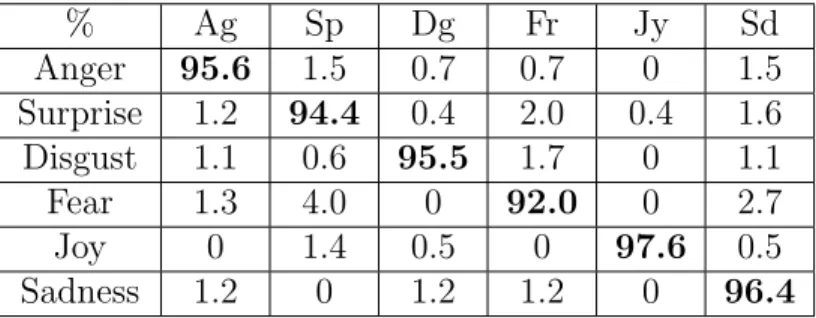
methods with averaging kernels and product kernels for facial expression recognition. We further recognized the six basic facial expressions excluding neutral faces (i.e., 6-class recognition) using our proposed MKL framework. The detailed results are shown in Table 4.4.
Table 4.4: Confusion matrix using lp-norm MKL-based multiclass-SVM for six basic
expressions on CK+ (overall recognition rate: 95.5%)
% Ag Sp Dg Fr Jy Sd Anger 95.6 1.5 0.7 0.7 0 1.5 Surprise 1.2 94.4 0.4 2.0 0.4 1.6 Disgust 1.1 0.6 95.5 1.7 0 1.1 Fear 1.3 4.0 0 92.0 0 2.7 Joy 0 1.4 0.5 0 97.6 0.5 Sadness 1.2 0 1.2 1.2 0 96.4
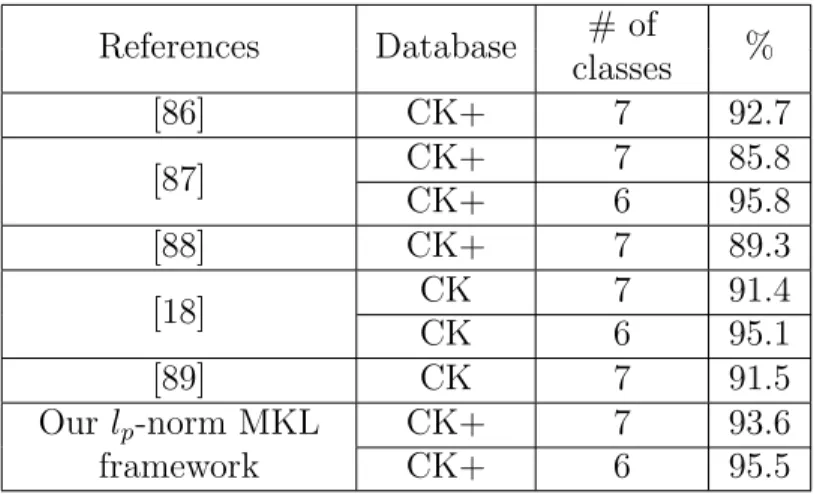
Compared with several state-of-the-art facial expression recognition methods listed in Table 4.5, we can see that our method achieves the best recognition rate for seven expressions and the second best accuracy for six basic expressions. On a personal computer with Intel i5 CPU (2.66 GHz) and 8 GB memory, the average computation time of our proposed lp-norm MKL multiclass-SVM with Matlab implementation is
13.5 minutes for classifier training and parameter tuning in each round of the 10-fold cross-validation scheme. It takes about 0.03 seconds in the recognition step given extracted LBPH and HOG features of each test sample.
Table 4.5: Recognition rate (%) of state-of-the-art methods on CK/CK+
References Database # of classes % [86] CK+ 7 92.7 [87] CK+ 7 85.8 CK+ 6 95.8 [88] CK+ 7 89.3 [18] CK 7 91.4 CK 6 95.1 [89] CK 7 91.5 Our lp-norm MKL framework CK+ 7 93.6 CK+ 6 95.5
4.4.3
Experimental results on MMI
Similar to the works on CK+, 10-fold cross-validation was applied for pruning C and p on MMI’s 30 subjects. Tables 4.6 and 4.7 show the confusion matrices for 6-class and 7-class recognition by lp-norm MKL-based multiclass-SVM.
It can be observed from Table 4.6 and Table 4.7 that besides the CK+ database, our proposed method can achieve promising recognition accuracies for each facial expression on the MMI database (i.e., all above or close to 90%), which implies its effectiveness. We also backtracked the value of p tuned in each round of the
cross-Table 4.6: Confusion matrix usinglp-norm MKL based multiclass-SVM with multiple
kernels and features for 6 expressions on the MMI database (overall recognition rate: 93.6%) % Ag Sp Dg Fr Jy Sd Anger 94.9 0 2.0 0 0 3.0 Surprise 1.6 95.1 0 0.8 2.4 0 Disgust 0 2.1 90.6 2.1 0 5.2 Fear 0 4.6 1.1 92.0 2.3 0 Joy 0.8 0.8 2.4 0.8 94.4 0 Sadness 4.2 0 0 2.1 0 93.8
Table 4.7: Confusion matrix usinglp-norm MKL-based multiclass-SVM with multiple
kernels and features for 7 expressions on the MMI database (overall recognition rate: 92.8%) % Ag Sp Dg Fr Jy Sd Nt Anger 93.0 2.0 1.0 1.0 1.0 2.0 0 Surprise 1.6 92.6 2.4 0.8 0.8 0.8 0.8 Disgust 0 3.1 91.7 0 1.0 2.1 2.1 Fear 0 2.3 0 95.4 0 2.3 0 Joy 0.8 0.8 3.1 0.8 89.7 2.4 2.4 Sadness 2.1 2.1 0 3.1 0 90.6 2.1 Neutral 0.5 0 1.4 1.9 0 1.0 95.2
validation process, and the tuned bestpfor test samples are within the range [1.2,1.8]. Therefore, similar to the results on the CK+ database, the non-sparse kernel weight vectors in our framework outperformed the sparse ones.
Table 4.8 compares our proposed lp-norm MKL framework with several
state-of-the-art methods on the MMI database. As listed below, our method achieved favorable experimental results. Especially we obtained a significant improvement in the recognition of seven facial expression compared to [18]. The results of six basic expressions are quite comparable with the best one among state-of-the-art methods. These confirm the effectiveness of our method. Nevertheless, as the techniques used for image registration, facial feature representation and experimental setup such as image sequence selection across these methods are not exactly the same, it is hard to hold a completely fair comparison with the CK+ and the MMI databases. Thus, this comparison could only be regarded as a reference to demonstrate that fusing feature with non-sparse MKL will help enhance the classification performance.
Table 4.8: Recognition rate (%) of state-of-the-art methods on the MMI database References # of sequences # of classes %
[18] 99 7 86.9 [88] 238 6 95.8 [90] 175 6 94.1 [91] 96 6 82.7 Our lp-norm MKL framework 209 7 92.8 209 6 93.6
We further performed cross-database evaluation of our proposed method. To be specific, we trained ourlp-norm MKL-based multiclass-SVM on one database and then
tested the classifier on the other one. During the classifier training phase, samples from each facial expression were randomly selected across subjects, and the number of training samples for each class (expression) was kept the same to conduct uniformly weighted classifiers. Table 4.9 shows detailed information of classifier settings and
the recognition results. The values of C and p for training classifiers were set based on their best tuned values obtained in the within-database experiments.
Table 4.9: Cross-database evaluation performance of our proposed lp-norm
MKL-based multiclass-SVM
Experiment Settings C p Overall [18] Train: CK+; Test: MMI 500 1.35 66.9% 51.1% Train: MMI; Test: CK+ 800 1.65 61.2% –
Compared to the result reported in [18] (51.1%), our method achieved better recognition performance (66.9%) when we trained on the CK+ database and tested on the MMI database. We further observed that the overall recognition results of cross-database experiments was much lower than those of within-database experi-ments. As the image registration, feature extraction and dimension reduction on two databases were conducted in the same way, one reason of such disparity may be due to different controlled environments during database collection. The paper [92] suggested that in order to obtain good cross-database evaluation environments, large training databases should be collected to cover variations of image and subject conditions. This statement can be reinforced by our experimental results. That is, when training classifiers on CK+ with more subjects and testing on MMI with less subjects, we achieved better results than training on MMI and testing on CK+.
4.4.4
Experimental results on GEMEP-FERA
The objective of the emotion recognition challenge in GEMEP-FERA is to classify each of the entire video session into one of the five emotion classes including anger, fear, joy, sadness, and relief. We apply our proposed lp-norm MKL multiclass-SVM
values of parameters C and p in our framework. Each of the seven subjects in the training set was associated with one fold. In our test phase, every frame in each test session was classified, and similar to [43] the emotion that was labeled in the largest number of the frames in one session was assigned to the class of that session.
The confusion matrices of our experimental results are shown in Tables 4.10, 4.11 and 4.12 with person-independent, person-specific and overall partitions respectively. Unlike CK+ and MMI databases that lack common protocols for experimental set-tings, the splitting of the training and test sets provided in this GEMEP-FERA database gives a benchmark setup for users to hold a fair comparison with others’ works in the literature. In Table 4.13, we compare our results with several state-of-the-art methods. Especially, the UCRiverside, UIUC and KIT are the best three groups among all the participants in the competition of emotion recognition challenge as reported in [70]. We can notice that our method obtained the best result on the person-independent experiment (1.1% better than UCRiverside) and the second best result on the entire test set (0.2% lower than UCRiverside); the performance of the person-specific partition is kept comparable with the state-of-the-art methods. These confirm the effectiveness of our proposed framework.
Table 4.10: Confusion matrix for person-independent emotion recognition on GEMEP-FERA (overall recognition rate: 76.3%)
% Anger Fear Joy Relief Sadness
Anger 85.7 0 0 0 14.3
Fear 13.3 66.7 6.7 13.3 0
Joy 0 5.0 85.0 10.0 0
Relief 12.5 6.3 0 75.0 6.3 Sadness 6.7 6.7 0 20.0 66.7
GEMEP-FERA is a very challenging da