The structure, development and
role of song in dippers.
Lucy Magoolagan
Thesis submitted for the degree of Doctor of Philosophy
This thesis is my own work, and has not been submitted in
substantially the same form for the award of a higher degree
elsewhere.
Contents
Acknowledgements
Chapter 1: General introduction ...1
1.1 Introduction ...1
1.1.1 Male song ...2
1.1.2 Female song ...3
1.2 Song development ...4
1.3 The developmental stress hypothesis ...6
1.3.1 Brood size ...7
1.3.2 Parental care ...7
1.3.3 Weather ...8
1.3.4 Parasite load ...8
1.3.5 Pollution ...9
1.3.6 Adaptations to stress ...9
1.4 Aims and thesis outline ...11
1.5 The dipper, Cinclus cinclus ...13
1.5.1 Introduction ...13
1.5.2 Adaptations to aquatic life ...14
1.5.3 Habitat and territory quality ...14
1.5.4 Breeding ecology ...15
1.5.5 Diet and foraging behavior ...16
1.5.6 An indicator of environmental quality ...17
1.5.7 Song ...19
Chapter 2: General methods ...20
2.1 Study site and population ...20
2.1.2 Age, sex and body size ...20
2.1.3 Breeding ecology ...22
2.1.4 Provisioning rate ...23
2.2 Song analyses ...24
2.2.1 Song recording and analyses ...24
2.2.2 Acoustic structure ...24
2.3 Territory quality ...27
2.3.1 Kick sampling ...27
2.3.2 Water chemistry ...27
Chapter 3: Structure and function of male and female song ...29
3.1 Abstract ...29
3.2 Introduction ...30
3.3 Methods ...33
3.3.1 Song recording and spectrogram production ...33
3.3.2 Acoustic structure ...34
3.3.3 Behavioural context ...34
3.3.4 Seasonal trends ...35
3.3.5 Statistical analyses ...35
3.4 Results ...36
3.4.1 Acoustic structure and sex ...36
3.4.1.1 Complexity characteristics ...36
3.4.1.2 Frequency characteristics ...36
3.4.1.3 Temporal characteristics ...39
3.4.2 Acoustic structure and behavioural context ...39
3.4.2.1 Complexity characteristics ...39
3.4.2.2 Frequency characteristics ...39
3.4.2.3 Temporal characteristics ...39
3.4.2 Female song context and seasonal trends ...42
3.5 Discussion ...45
3.6 Conclusion ...48
4.1 Abstract ...49
4.2 Introduction ...50
4.3 Methods ...53
4.3.1 Study site and species ...53
4.3.2 Song recordings ...53
4.3.3 Playback file construction ...53
4.3.4 Playback design ...54
4.3.5 Statistical analyses ...57
4.4 Results ...58
4.4.1 Responses by breeding stage ...58
4.4.2 Pre- versus post-incubation responses ...58
4.4.3 Pair responses ...58
4.4.4 Latency to respond ...59
4.5 Discussion ...59
4.6 Conclusion ...66
Chapter 5: The effect of early life conditions on song characteristics in males ...67
5.1 Abstract ...67
5.2 Introduction ...68
5.3 Methods ...70
5.3.1 Study population ...70
5.3.2 Song recording and analyses ...70
5.3.3 Statistical analyses ...70
5.4 Results ...72
5.5 Discussion ...72
5.5 Conclusion ...80
Chapter 6: Song characteristics and reproductive success in adult males ...81
6.1 Abstract ...81
6.3 Methods ...85
6.3.1 Study population ...85
6.3.2 Reproductive success ...85
6.3.3 Provisioning rate ...85
6.3.4 Territory quality ...86
6.3.5 Song recording and analyses ...86
6.3.6 Statistical analyses ...86
6.4 Results ...88
6.4.1 Male condition and song characteristics ...88
6.4.2 Song characteristics and reproductive success ...92
6.5 Discussion ...105
6.5.1 Male condition and song characteristics ...105
6.5.2 Song characteristics and reproductive success ...110
6.6 Conclusion ...113
Chapter 7: Dietary manipulation experiment and growth rates of nestlings ...114
7.1 Abstract ...114
7.2 Introduction ...115
7.3 Methods ...119
7.3.1 Study population ...119
7.3.2 Experimental procedure ...119
7.3.3 Growth rates ...121
7.3.4 Provisioning rates ...121
7.3.5 Territory quality measures ...121
7.3.6 Song recording and analyses ...122
7.3.7 Statistical analyses ...122
7.4 Results ...124
7.5 Discussion ...134
7.6 Conclusion ...136
8.1 Introduction ...138
8.2 Overview of results ...139
8.3 Conclusion ...142
References ...147
Appendices ...173
Appendix 1 ...173
Appendix 2 ...174
Appendix 3 ...176
Acknowledgements
My parents - without your contributions towards my education, I would probably still
have made it through university, but with a huge amount of debt and with my current job
prospects I will be eternally grateful. I would thank you for your contributions; however Mum,
only made it to Sedbergh for a spot of lunch and Dad, (just about) made it all the way into the
bird hide, only fall asleep and start snoring. Special thanks to the rest of my family (usually
Tricia) for messaging me as soon as a whiff of a dipper is mentioned in any medium or format,
even when it’s a sighting of one in a place that is definitely not my field site.
My sisters - who have just spent the last few hours thinking of dipper related puns for
me to use for the title of my thesis. My favourites including: “High on a hill with a lonely
dipper” and “Quit your dipper dabber”. Thank you all for being there for me despite attempting
to derail fieldwork efforts with things like hen dos, weddings and babies. Thank you, Amy, for
inspiring me to be a girly scientist to the Maxsch, helping with fieldwork, weekly pep talks,
writing motivational quotes in my field notebook and being the only person to can relate to the
endlessness of submitting.
Sally – my sister from another mister. Thank you for being the only person to come and
help with fieldwork all three seasons. You were great help, despite your inability to keep quiet
or still during hour long nest watches. You’ll always be the Samwise to my Frodo and the Robin
to my Batman. I guess we’ll never know why they aren’t called ‘bobbers’.
Jess – thank you for being the only person to offer to proof some chapters for me. I
really appreciate the time and effort you put in and the fact that you still wanted to see how it
ended up even after reading two chapters.
Team bird – whilst our time together has been short, you have managed to make up for
it in enthusiasm and hashtags. Thank you for making these last few months much less painful,
Mark for proofing so many chapters against his will. Also a big thank you to all glamorous field
assistants, particularly Flora for everything from nest watches to bread.
Peter – thank you for being the kind of person that decides to start collecting dipper
nests as a hobby. Without your birds, none of this would have been possible so I will be
eternally thankful. Also many thanks to your brother for supplying my posters and presentations
with what seems like an endless supply of stunning photos.
Selvino – thank you for getting me into dippers and song in the first place, and sending
me the advert for this PhD.
Stuart – sorry I have been a horrible person to you for the last two months, hopefully
when this is over you will still be speaking to me. I’m not sure I can find the words eloquent
enough to express how grateful I am for this opportunity and all you have taught me over the
last four years. I really do appreciate all your time and effort, and hope that some of the cake I
have made for you over the years has made up some of this debt.
Daniel – my darling husband and reluctant ‘best friend’. Sorry for all the moody months
of fieldwork, the tears and lack of income. Possibly one day I will earn a salary that will mean I
can treat you, but try not get ahead of yourself. Thank you for always diligently listening to me
rambling on about what my model outputs are and for regurgitating the ‘nutritional stress
hypothesis’ to anyone foolish enough to ask you what your wife does. I would not have
managed this without you, thank you.
To Granddad, wishing I could share with you everything I’ve learnt over the years, and
hoping that I’ve made you proud. Knowing that if you were here you’d be telling me to gi’oer
1
Chapter 1
General introduction
1.1
Introduction
A signal is defined as ‘any act or structure which alters the behaviour of other
organisms’ (Maynard Smith & Harper 2003). Animals use olfactory, visual and acoustic signals
to communicate state and condition of the signaller to a receiver. Individuals can also use a mix
of these sensory channels to produce multimodal signals; these additional components can
increase the success of the signal (Partan & Marler 2005). Biotic factors such as excessive
ambient noise, can encourage visual signalling over vocalisations and vice versa with abiotic
factors (Partan & Marler 2005). Evolution favours honest signalling, especially if the
production of a signal is dependent on physical characteristics that are impossible or costly to
fake (Krebs & Davies 2009).
The use of sound to communicate is beneficial when visual cues are unreliable, for
example in poor light or dense vegetation; sound travels in all directions, over long distances
and can rapidly transmit information efficiently (Catchpole & Slater 1995). In birds, song is one
of the primary forms of communication, conveying a range of information between individuals
but primarily functioning in mate attraction and territorial defence (Catchpole & Slater 1995).
Individuals that are able to express superior traits are more likely to possess high quality genes
and those in better condition are able to sustain song for longer (MacDougall-Shackleton &
Spencer 2012; Nowicki et al. 2000; Ritschard & Brumm 2012); most birds therefore use song to
2
therefore provide the listener with an indication of the singer’s current condition and
developmental history together with key information such as mating status and territory size
(Catchpole & Slater 1995; Nowicki et al. 2000).
1.1.1 Male song
It is thought that the evolution of complex song in male birds is driven by sexual
selection through female choice and competition between males; intersexual selection underpins
the use of song for mate attraction whereas intrasexual competition is the major force behind the
use of song for territorial defence (Catchpole 1980; Catchpole & Slater 1995). Occupying a
territory can be a prerequisite for mate attraction and therefore crucial for reproductive success
in many species (Armstrong 1963; Catchpole & Slater 1995). Within temperate regions, where
breeding occurs seasonally, there is an increase in the incidence of male song with aggression
and defence of territories (Catchpole & Slater 1995). Individual recognition is also an important
feature of song in this context, as territory owners keep track of their neighbours in order to
identify strangers, the latter often posing a greater threat in terms of territory ownership or
extra-pair mating (Catchpole & Slater 1995; Stoddard 1996).
In many species, territory size and quality are important determinants of reproductive
success and so are important factors in sexual selection (Dussord & Ritchison 2003). More
experienced males that sing longer songs with larger repertoires obtain higher quality territories
in the red-winged blackbird (Agelaius phoeniceus; Yasukawa et al. 1980), great reed warbler
(Acrocephalus arundinaceu; Catchpole 1986) and pied flycatcher (Ficedula hypoleuca; Lampe
& Espmark 2003). Moreover, males with better quality territories have been shown to attract
females more quickly in the sedge warbler (Acrocephalus schoenobaenus; Buchanan &
Catchpole 1997), song sparrow (Melospiza melodi; Hiebert et al. 1989), and Northern
mockingbird (Mimus polyglottos;Howard 1974). In the sedge warbler, the amount of time spent
in song flight, repertoire size and territory size were all found to have a significant negative
3
arrived earlier to the breeding site and obtained better quality territories also sang songs with
greater complexity, which further increased their likelihood of obtaining a mate sooner (Lampe
& Espmark 2003). Thus, song can convey crucial information regarding a male’s quality but
also the quality of his territory, and females can make mate selection decisions accordingly.
1.1.2 Female song
Although relatively understudied compared to males, females also sing in many species
(Langmore 1998; Odom et al. 2014). Female song is often overlooked because the songs can be
less frequent, limited to a specific period of the breeding cycle, or because a large number of the
relevant species are monomorphic and female birds can be mistaken for males (Langmore
1998). However, recent years have seen an increase in the number of studies of female song
which is now known to be widespread within the tropics and Australasia, and is considered by
some to be ancestral (Odom et al. 2014). It has also been suggested that female song is a
manifestation of the convergence of sex roles within the tropics, where there is a high
prevalence of permanent monogamous pair-bonds and year-round territoriality (Morton 1996).
In monomorphic, tropical or southern hemisphere species where the sex roles of a pair are
reversed, females contribute to a large proportion of the singing within a pair (Illes 2015).
Duetting is one of the commonest forms of female song in the tropics; pairs which sing
identical songs whilst duetting are thought to participate in cooperative defence against all
intruders (Hall 2004; Langmore 1998; Logue 2005), whereas those which sing different songs
are thought to be defending their own resources from same-sex individuals only (Hall 2004;
Morton 1996). In some species, duetting is thought to maintain contact between a pair and assist
in the coordination of breeding activities (McElroy & Ritchison 1996), enabling them to
communicate motivational state to each other (Hovekamp 1996).
Females of some species sing solo songs and this usually relates to social and ecological
conditions, such as the mating system or spacing between territories (Langmore 1998; Riebel et
4
including mate attraction, territorial defence, mate guarding, pair bond maintenance and the
coordination of breeding activities (Langmore 1998). The Alpine accentor (Prunella collaris) is
a polygynandrous species and because of the high levels of female-female competition, it is
thought that female song advertises fertility to attract a mate (Langmore et al. 1996). The use of
song for territorial defence in females has been found in European starlings (Sturnus vulgaris;
Sandell & Smith 1997), yellow warblers (Setophaga petechia; Hobson & Sealy 1990) and
Northern orioles (Icterus galbula; Beletsky 1982). Polygyny or extra-pair copulations can
increase the amount of time males spend away from their nest and so in order to defend their
own resources, females may use aggressive song to ward intruders away (Beletsky 1982b;
Hobson & Sealy 1990; Langmore & Davies 1997; Sandell & Smith 1997). Conversely, female
song is thought to have been lost in many species because it serves very little purpose where
there are low-levels of intra-sexual aggression, for example in most non-migratory,
monogamous species that reside in dispersed nest sites (Morton 1996).
1.2 Song development
Almost all songbirds learn their species-specific songs by copying tutors or models
heard during the early phases of their life (Catchpole & Slater 1995; Nowicki et al. 1998).
During the ‘learning phase’, birds first hear and memorise song and then reproduce these songs
in a gradual process until they have matched their own vocal output to that of their tutor
(Nowicki et al. 1998). This ‘memorisation phase’ is a short time period that typically occurs a
week or two after hatching (Bolhuis & Gahr 2006; Catchpole & Slater 1995; Nowicki et al.
1998). It is followed by the ‘motor phase’, in which birds sing their own sub-song for a number
5
1998). This pattern is widespread across passerines, but not all learning in passerines is
age-limited; in a small number of so-called 'open-ended learners', crystallisation does not occur and
adults continue to alter their songs throughout their lives (Bolhuis & Gahr 2006; Müller et al.
2010).
Song learning and production in birds is controlled by the ‘song system’, which consists
of a series of nuclei within the brain; the timing of song learning occurs parallel to the
development of these brain structures (Nowicki et al. 1998). During the first few weeks of life,
songbirds form auditory memories and rapidly develop brain regions such as the higher vocal
centre nucleus (HVc) and robust nucleus of the arcopallium (RA; MacDonald et al. 2006;
Spencer et al. 2003;). The HVc is a telencephic nucleus which is associated with the learning
and production of song in birds (Spencer & MacDougall-Shackleton 2011). The RA is thought
to be accountable for specifying the acoustic fine structure of individual notes or syllable types
(Nowicki, W A Searcy, et al. 2002). In some species, HVc and RA sizes have been found to
correlate with repertoire size (Nottebohm 1981; Spencer et al. 2003). These regions are separate
when chicks hatch, but as nestlings develop the HVc sends neuronal projections to the RA; the
connection of these nuclei also corresponds with an individual’s first versions of sub-song
(Nottebohm 1981; Spencer et al. 2003). Repertoire size links to the individual’s ability to invest
in brain tissue, and more energy invested enables better song learning in young birds (Nowicki,
W A Searcy, et al. 2002). Brain tissue is costly to build and maintain, so only high quality males
can invest and match the energetic demands required to produce a large song repertoire
(Gorissen et al. 2005).
It has been observed in a range of species, including swamp sparrows (Melospiza
georgiana) and song sparrows (Melospiza melodia), that individuals which have experienced
higher levels of stress during development grow smaller HVc and RA, and consequently
produce song with reduced complexity and show lower accuracy during song copying
(MacDonald et al. 2006; Nowicki, W A Searcy, et al. 2002; Schmidt et al. 2013). Juvenile
6
a less accurate imitation of their tutor’s song due to this shortening of the memorisation phase
(Nowicki, W A Searcy, et al. 2002). The song centre in the brain develops simultaneously with
the immune system and resources may therefore be interchanged depending on the priority for
fitness (Kvarnemo 2011). Early life stressors may also have the capacity to affect an
individual’s willingness and ability to practise, which reduces auditory output and neural
development (Spencer & MacDougall-Shackleton 2011).
1.3
The developmental stress hypothesis
Nowicki et al. (1998) developed the ‘nutritional stress hypothesis’, stating that periods
of food deprivation or malnutrition experienced during the early stages of development would
be represented in an individual’s adult phenotype, including song. Genetic and external factors
such as brood size, parasitism, disturbance, weather conditions and seasonality can also
influence development; Buchanan et al (2003) therefore proposed that the hypothesis be
broadened to the ‘developmental stress hypothesis’, encompassing any form of stressor to which
individuals may be exposed in the earliest stages of life when they are particularly vulnerable
(MacDougall-Shackleton & Spencer 2012).
The song control regions of the brain required for learning and production are very
costly to build and maintain, so only those individuals which fare well during development or
experience no stress have the required resources to invest heavily in such structures (Bonaparte
et al. 2011; Spencer & MacDougall-Shackleton 2011; Zann & Cash 2008). Individuals that have
been exposed to stress during early life often develop poorer quality song characteristics such as
lower repertoire size, syllable number, song type, or complexity, or a weaker ability to copy a
7
2002; Spencer & MacDougall-Shackleton 2011). Tarsus length, which provides a useful index
of the quality of nutrition received in early life, is positively correlated with dawn repertoire size
in male blue tits (Cyanistes caeruleus; Doutrelant et al. 2000). Similarly, in the great reed
warbler (Acrocephalus arundinaceus), it was found that the length of the innermost primary
feather predicted repertoire size in first year males (MacDougall-Shackleton & Spencer 2012;
Nowicki et al. 2000). Most studies of the effect of developmental stress on song production
have used captive birds; whilst effects detected in these studies can be meaningful, more field
studies of wild birds are urgently needed to assess the extent to which these effects are
biologically relevant (Byers & Kroodsma 2009).
1.3.1 Brood size
Nutritional stress can be caused by sibling competition in the nest which is strongly
influenced by brood size. In altricial species such as songbirds, all offspring depend on the finite
amount of resources that parents provide and these may be unevenly distributed due to the size,
sex and age of nestlings (Braasch et al. 2011). Older siblings dominate as they have the
competitive advantage of hatching first (Nilsson & Svensson 1996); they gain energy and
develop better locomotor skills faster and therefore starvation can be the most common form of
mortality in smaller chicks (Nilsson & Svensson 1996). In larger broods, each nestling receives
a smaller share of resources, leaving fewer available for processes such as song development.
These higher levels of stress from sibling competition in larger brood sizes have been shown to
reduce the ability of individuals to learn the syntactical structure of a tutor’s song in zebra
finches (Taeniopygia guttata;Holveck et al. 2008); decrease phrase syntactical complexity in
Bengalese finches (Lonchura striata domestica; Soma et al. 2006); and decrease strophe length
in blue tits (Dreiss et al. 2006).
1.3.2 Parental care
Parental care comes in many forms: predator defence, nest-building, incubation and
8
is one of the most commonly used measures of parental care and one way of measuring
nutritional stress in nestlings. Young birds of altricial species are completely dependent on
provisioning by their parents when in the nest, and also for a brief period after fledging (Spencer
& MacDougall-Shackleton 2011). When provisioning rates increase, this usually equates to an
increase in offspring mass and therefore the probability of survival once fledged (Martin 1987;
Schwagmeyer & Mock 2008). When parental care begins to cease, fledglings may not yet have
fully developed the required skills to forage for themselves and these are the periods when
fledglings are most susceptible to nutritional stress (Nowicki et al. 1998; Nowicki, W A Searcy,
et al. 2002; Searcy et al. 2004). In a study of sedge warblers by Buchanan and Catchpole (2000),
increased male provisioning rate was found to produce heavier nestlings. They also found a
direct positive relationship between nestling mass and repertoire size, indicating that parental
effort can have a major impact on a nestling’s future fitness (Buchanan 2000).
1.3.3 Weather
Weather can be a natural cause of stress in birds and adverse conditions can lead to
unpredictable food shortages (Quillfeldt et al. 2007) and reduce the time available for foraging
because individuals sometimes have to take shelter (King & Murphy 1985). Poor weather
conditions have been shown to cause rises in circulating corticosterone levels in birds, thereby
encouraging feeding behaviour (Møller & Swaddle 1997), but prolonged exposure to
corticosterone can have detrimental long-term effects (Buchanan 2000). Individuals that cope
better with unpredictable stress such as climatic factors will have a greater probability of
survival (Krause et al. 2009).
1.3.4 Parasite load
Parasite load has been found to affect song complexity in adult male canaries (Serinus
canaria); individuals infected with malaria (Plasmodium relictum) developed reduced HVc and
produced simpler songs (Spencer et al. 2005). This shows that developmental stress can
9
been observed to affect the immune system; European starlings that were exposed to endocrine
disruptors were found to have larger HVc volumes, repertoire sizes and longer song bouts, but
suffered from impaired immune function (Markman et al. 2008). In white-crowned sparrows
and song sparrows, immigrant birds are immunologically disadvantaged and were more
severely infected with blood-borne parasites (Macdougall-Shackleton et al. 2002; Stewart &
MacDougall-Shackleton 2008). These males are thought to lack experience in the local parasite
fauna and this results in lower reproductive success, as females prefer males that sing songs
with the local song dialect (Macdougall-Shackleton et al. 2002; Stewart &
MacDougall-Shackleton 2008).
1.3.5 Pollution
Gorissen et al. (2005) found that singing behaviour in great tits (Parus major) was
affected by environmental stress caused by pollution. Heavy metals are a frequent by-product of
agriculture and industry and they can enter the food chain through air, water, soil and biota;
bioaccumulation of these pollutants can occur with concentrations increasing further up the food
chain (Burger 1993). Males closer to the source of pollution were found to sing up to 35% less
and had a significantly smaller repertoire size (30%) than those further away from the site
(Gorissen et al. 2005). Pollution can decrease resource availability which in turn causes an
increase in time costs because males need to forage for longer and so have less time available
for singing (Gorissen et al. 2005).
1.3.6 Adaptations to stress
Individuals best able to endure stressors during early life should produce the most
attractive songs as adults (MacDonald et al. 2006). During periods of stress, the stress hormone
corticosterone is released and this has adaptive uses such as the mobilisation of stored energy
(Fokidis et al. 2012); however, prolonged exposure to corticosterone can lead to damaging
effects on neurological development and immunosupression (Buchanan 2000). This can result
10
2012; Kagawa & Soma 2013; Mountjoy & Lemon 1996), thereby affecting its lifetime
reproductive success (Nowicki et al. 1998).
Birds use a variety of mechanisms to adapt to stress as young: they can delay maturation
and fledging to avoid stressors affecting their adult phenotypes; use compensatory growth by
developing faster than usual; or invest resources in characteristics that are more important for
current condition and survival (Searcy et al. 2004; Spencer & MacDougall-Shackleton 2011).
Compensatory growth is often costly and can have consequences for adult phenotypes (Metcalfe
& Monaghan 2001). In a study of the zebra finch, metabolic rates, cognitive abilities, life
history stages and exploratory behaviour were all found to be affected by compensatory growth
(Krause & Naguib 2011). Given the above evidence, it is likely that compensatory growth
strategies will have an effect on song development and production but this requires further
study.
Most birds are close-ended learners which means that after crystallisation in their first
year, there are no additions to the song repertoire (Catchpole & Slater 1995). The adult song of
these close-ended learners is a clear reflection of how a bird managed during exposure to stress
in early life and indicates the outcome of his learning during postnatal development (Nowicki et
al. 1998). For open-ended learners, song can provide a useful index of their present condition in
light of environmental stressors, and those that have more resources available will invest more
11
1.4
Aims and thesis outline
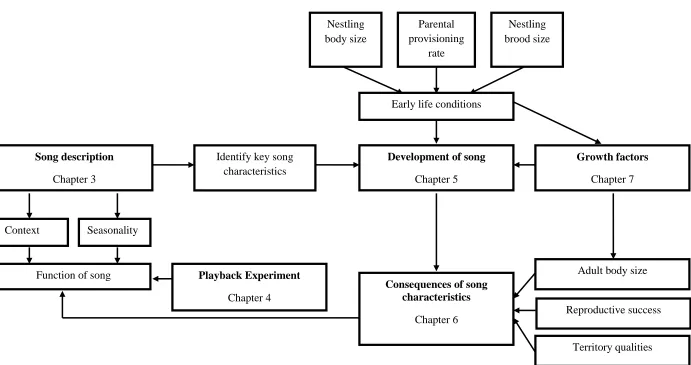
The aim of this project was to investigate the structure and function of male and female
song in dippers, and whether developmental stress plays a role in its development (Figure 1). I
begin by describing the differences between male and female song in terms of complexity,
frequency and temporal characteristics, and the seasonality with which each sex sings (Chapter
3). Male song structure is also compared between the different contexts in which singing was
recorded. I continue to investigate the use of song in both sexes in the context of territorial
defence, simulating unfamiliar intruders in a playback experiment (Chapter 4). I then investigate
how variation in early life conditions may influence the characteristics of song produced in
adulthood (Chapter 5) and the extent to which these song characteristics predict reproductive
success in males (Chapter 6). In a second experiment, I use dietary manipulation to investigate
variation in nestling growth and the long-term impacts on the development of adult song.
Finally, I discuss all of my findings in the context of previous studies, with suggestions for
Figure 1. A conceptual model of the relationship between the different elements of this project.
Development of song
Chapter 5
Song description
Chapter 3
Early life conditions
Identify key song characteristics
Parental provisioning
rate
Consequences of song characteristics
Chapter 6
Growth factors
Chapter 7
Adult body size
Reproductive success
Territory qualities
Function of song Playback Experiment
Chapter 4
Nestling body size
Nestling brood size
Context Seasonality
13
1.5
The dipper (
Cinclus cinclus
)
1.5.1 Introduction
The Cinclidae are a unique family of aquatic passerines found on fast flowing rivers
and streams (D’Amico & Hémery 2007; O’Halloran et al. 2003). They are widely recognised as
an avian bio-indicator for freshwater habitats because they are obligate predators of benthic
macro-invertebrates and small fish, and therefore sensitive to environmental quality (D’Amico
& Hémery 2007; Henny et al. 2005; Morrissey et al. 2010b; Morrissey et al. 2013; Vickery
1992). There are five species of dipper: white-throated (Cinclus cinclus), American (C.
mexicanus), brown (C. pallasii), white-capped (C. leucocephalus) and rufous-throated (C.
schulzi). These species are distributed across the world in freshwater habitats: from North
Western to Central America (American), Europe, the Middle East, Central Asia and the Indian
Subcontinent (white-throated), Southern and Central Asia (brown), Bolivia, Colombia, Ecuador,
Peru and Venezuela (white-capped) and Bolivia and Argentina (rufous-throated) (Ormerod &
Tyler 2005; Willson & Hocker 2008). Hereafter, any use of the words ‘dipper’ or ‘dippers’ will
refer to the white-throated dipper unless otherwise stated.
Dippers are rotund, chestnut brown birds with a white plumage on their throat and chest
and measure 16-20cm in length. They are sexually monomorphic in plumage but males are
larger, weighing 65-75g with wing lengths over 92mm long (Tyler & Ormerod 1994); females
weigh 55-60g and rarely have wing lengths over 92mm (Tyler & Ormerod 1994). Dippers live
on rivers and streams, building their nests close to fast flowing water, and pairs defend linear
territories during the breeding season (Ormerod & Tyler 1991; Nybø et al. 1997) and often over
winter (Crowther 2016; Tyler & Ormerod 1994). They forage by diving underwater and
manoeuvre themselves using their wings and feet (Tyler & Ormerod 1994), or by wading along
river margins and foraging between stones (Eguchi 1990; Tyler & Ormerod 1994). On average,
14
True to their name, dippers dip up and down, a behaviour usually reserved for
territorial, courtship or alarm purposes (Tyler & Ormerod 1994). This dipping behaviour is
commonly seen in other riverine species such as wagtails (Motacilla sp.) and is thought to make
the birds look less conspicuous against the ever-moving background of their environment (Tyler
& Ormerod 1994). The white plumage on the white-throated and white-capped dippers is also
thought to break up the outline of the body against the water, contributing to reduced detection
and predation (Ormerod & Tyler 2005). Frequent blinking is another behaviour dippers exhibit,
and this is thought to be part of their courtship or threat displays; it is made particularly obvious
by their white eyelids (Tyler & Ormerod 1994).
1.5.2 Adaptations to aquatic life
Dippers are highly adapted to their aquatic lifestyle as their size, shape and strength all
contribute to their ability to live on and under the water (Ormerod & Tyler 2005). All dipper
species have long legs with strong toes to grip onto the substrate below the water; they have
relatively short wings for a bird their size; and powerful musculature which gives them greater
manoeuvrability underwater (Tyler & Ormerod 1994). Dives can last up to 23 seconds long but
are usually around 3.2-3.6 seconds with an average of 5.1 dives per minute (Tyler & Ormerod
1994). Dippers have extremely dense plumage and a large preen gland for waterproofing their
feathers, and a sphincter muscle within their iris that can change the curvature of the lens,
giving them greater power of accommodation and better vision underwater (Tyler & Ormerod
1994). They also have a higher level of haemoglobin in their blood compared to other
passerines and can decrease their heart rate whilst diving, which enables them to increase their
oxygen storage and dive for longer (Tyler & Ormerod 1994).
1.5.3 Habitat and territory quality
Dippers are socially monogamous, and extrapair paternity is reportedly low in this
species (Øigarden et al. 2010). Territories can vary in length from 300-2500m and are usually
15
abundance of breeding pairs (Tyler & Ormerod 1994). Characteristics such as prey abundance,
water quality, riffle area, stream gradient and availability of suitable nest sites are all important
aspects of territory quality (Ormerod & Tyler 1989; Tyler & Ormerod 1994). Nests are usually
placed on rocky banks, cliffs, within fallen trees or roots, with the most popular locations being
man-made structures such as culverts, bridges or nest boxes (Tyler & Ormerod 1994). Nest and
fledging success of the American dipper have been positively correlated with an index of nest
site quality, so site selection is important for an individual’s fitness (Price & Bock 1983); the
height and location of the nest also determine the risk of flooding, a major source of nest failure
in these birds (Tyler & Ormerod 1994). Well-oxygenated water with stony beds provides the
perfect habitat for aquatic invertebrate prey, therefore patches of riffles that provide this aeration
are important and territories with larger areas of riffles are considered to be of greater quality
(Ormerod et al. 1986; Ormerod & Tyler 2005). Studies of American dipper populations have
found that territory quality and food abundance are key for fledging success and recruitment
into the breeding population; this does not always equate to territory length which may
sometimes be larger where good feeding sites are more scattered (Feck & Hall 2004; Price &
Bock 1983).
1.5.4 Breeding ecology
Most dippers remain on their breeding territories during the winter but in locations
where rivers freeze over or conditions become unfavourable, birds will undertake altitudinal
migration downstream or to the coast for other foraging opportunities (Tyler & Ormerod 1994).
This migration can cause large aggregations of dippers and during the autumn they roost
communally under bridges or in stone crevices (Tyler & Ormerod 1994). Territorial behaviour
starts between September and November after the moult period when individuals begin to
defend their winter territories (Tyler & Ormerod 1994). Dominant individuals benefit by
successfully gaining a high quality territory, granting access to high quality feeding sites and
16
breeding pairs remain together throughout the winter and defend their territory as a pair, but
single birds begin to pair up in later winter (Crowther, personal observations).
Pairs begin to build nests from the end of January (Tyler & Ormerod 1994) and do this
by repairing an old nest from a previous season or building a new one; whichever the case, the
lining for each nesting attempt is new each time (Nilsson et al. 2011). Dipper nests can take up
to 28 days to construct; they are dome shaped and approximately 13-22 cm in diameter, with an
external structure of moss, plant fibres and sometimes lichen, and a grass cup usually lined with
leaves (Tyler & Ormerod 1994). Bigamy can occur but usually only opportunistically; in these
instances, males defend longer stretches of river with a boundary line in the middle, and the two
females have a nest each in either half (Tyler & Ormerod 1994).
Dippers are early breeders compared to other bird species with laying generally starting
in March but later on higher ground; pairs can have two clutches within a season if they begin
the first in March or early April (Tyler & Ormerod 1985). One egg is laid per day with clutches
containing 4-6 eggs on average (Tyler & Ormerod 1994). Incubation begins once all eggs are
laid and lasts 16-18 days, with chicks fledging after approximately 20-22 days (Tyler &
Ormerod 1994). Breeding success improves with experience; pairs in Scotland had greater
success when both parents were adults than when at least one bird was a first-year (Wilson
1996). Adults remain with their offspring for up to two weeks after fledging to assist in feeding
which increases their chances of survival whilst they develop their foraging skills (Tyler &
Ormerod 1994). Causes of nest failure include: desertion, flooding, nests falling into the water,
human disturbance and predation by mammals or corvids (Smiddy et al. 1995; Tyler et al.
1990; Willson & Hocker 2008).
1.5.5 Diet and foraging behaviour
Dippers feed almost exclusively on aquatic macro-invertebrates and small fish
(Ormerod & Tyler 1991). Mayfly (Ephemeroptera), stonefly (Plecoptera) and caddis fly
17
items such as Baetid mayfly larvae are fed to newly hatched offspring due to their small gape
and gut sizes; as the chicks grow, their diet switches mostly to caddis fly larvae that supply a
higher rate of energy per delivery due to their size (Ormerod & Tyler 1991; Taylor &
O’Halloran 2001).
When foraging for themselves, juveniles specialise on small, stationary prey such as fly
larvae (Diptera; Yoerg 1998). They do not dive because they lack the coordination and strength
required, sticking to slow flowing, shallow patches of water from which to forage (Yoerg 1994).
Mastering the foraging skills of an adult takes time and practise, and capture rates by juveniles
are often low (Yoerg 1994). Juvenile mortality is high at this time due to increased predation
and high starvation risk (Yoerg 1994). Young which feed on smaller prey items and rely on a
more readily available food source have been shown to gain independence faster and disperse
sooner; individuals that leave the natal territory first benefit from having first access to
territories close by (Yoerg 1998).
During periods of spate, increased depth, velocity and turbidity can prevent dippers
from foraging underwater and they are often forced to forage terrestrially (Taylor & O’Halloran
2001). Prey type switching has also been observed during periods of spate when individuals of
an Irish population were seen to eat fewer caddis fly larvae and more mayfly nymphs (Taylor &
O’Halloran 2001). Caddis fly larvae are less available at these times and the high water levels
make them less energetically profitable to dive for (Taylor & O’Halloran 2001). Other dietary
shifts have been observed in females, for example supplementing their diets with fish (Cottidae)
to increase the calcium available prior to laying (Ormerod & Tyler 1991; Willson & Hocker
2008).
1.5.6 An indicator of environmental quality
Dippers are widely recognised as important indicators of water quality (Sorace et al.
2002). They are especially suited for bio-monitoring because they provide a useful index of
18
being year-round residents in discrete territories (Henny et al. 2005; Morrissey et al. 2004;
Nybø et al. 1996; Ormerod et al. 1988). Acidification of surface waters can be caused by acidic
precipitation, conifer afforestation or man-made releases of sulphur and nitrogen oxides
(Ormerod et al. 1988; Vickery 1992; Wilson 1996). Dipper population densities in Wales and
Scotland were found to be lower where the water was more acidic, or had lower mineral content
(Ormerod et al. 1985; Ormerod et al. 1986; Vickery 1992), and breeding success is also affected
negatively by acidity (Logie et al. 1996; Ormerod et al. 1985; Ormerod et al. 1986; Sorace et al.
2002). Acid deposition can cause a calcium shortage which creates eggshell defects, and food
stress (Logie et al. 1996; Morrissey et al. 2010b; Ormerod et al. 1985; Ormerod & Tyler 1989).
A decrease in invertebrate prey means there may be a calcium shortage for females laying eggs
(Wilson 1996). Eggs laid in acidified areas of Norway were 7% lighter and 6.1% thinner
compared to those in non-acidified areas; the eggs also had a thinner palisade layer due to an
impaired crystallisation of calcium carbonate (Nybø et al. 1997). A decrease in eggshell
thickness can increase the diffusion capacity of the egg causing large amounts of water loss and
desiccation of the embryos, dramatically reducing reproductive success (Nybø et al. 1997).
Invertebrates are pollution intolerant (Feck & Hall 2004; Morrissey et al. 2010a; Sorace et al.
2002) and changes to water quality not only affects the food web, but also affects a dipper’s
ability to meet its own energetic requirements and that of its offspring, causing a decrease in
condition and affecting future fitness (Logie et al. 1996).
Dipper eggs can also be a good source of information regarding water chemistry and
contamination; nutrients deposited into eggs are from recent dietary uptake as passerines are
unable to store sufficient nutrients on a daily basis in order to lay consecutively (Morrissey et al.
2004; Morrissey et al. 2010). This also enables the presence of contaminants to be linked to
specific locations; for instance concentrations of polychlorinated biphenyls (PCBs) in eggs and
local environments are frequently correlated (Nybø et al. 1997; Ormerod et al. 2000). Animals
19
pollutants such as dichlorodiphenyltrichloroethane (DDT) and PCBs (Kallenborn et al. 1998;
Tyler & Ormerod 1992).
1.5.7 Song
All five species have loud, musical songs and both sexes are thought to sing throughout
the year except when feeding young and moulting (Tyler & Ormerod 1994). In white-throated
dippers, a peak in singing takes place over September and October when they are establishing
winter territories and again from January to March to reinforce breeding territories (Ormerod &
Tyler 2005). They sing from conspicuous perches along their territory (personal observations)
and pairs will call and chatter to each other and alert one another to predators or other
disturbances with loud alarm calls (Ormerod & Tyler 2005). Male song is thought to be used to
attract a mate, communicate with partners and defend territories (Tyler & Ormerod 1994),
whereas females have been suggested to sing in order to communicate with their partner (Tyler
& Ormerod 1994). However, no formal analysis or experimentation has yet been performed on
20
Chapter 2
General methods
2.1 Study site and population
2.1.1 Study site
All of the fieldwork for this project was carried out in the River Lune catchment within
a four-mile radius of Sedbergh, Cumbria, UK (54⁰323’N, 2⁰528’W) between 2014 and 2016 (Figure 1). Within the area four rivers converge: the Dee, the Rawthey, the Clough and the Lune
itself. Each river has a number of streams and becks flowing into it from various hills within the
study site, and together these watercourses provide numerous territories within which dippers
can breed. All of the rivers and most of the streams were exploited by dippers, with only large
stretches of deep, slow flowing water, or areas with no conceivable nesting sites remaining
empty. The size and productivity of this population were monitored from 1958 to 1966 and
again from 2003 to 2012, during which time traditional nesting sites were identified and various
key life history events recorded. Then, in 2013, all birds in the population were fitted with
unique combinations of colour rings (see below) and an individual-based monitoring
programme has been carried out even since; a pedigree has been established from observational
and ringing data. Between 2014 and 2016, the population size ranged from 45-47 breeding
pairs.
2.1.2 Age, sex and body size
Each year, all unringed adults are caught in mist nets or in hand nets placed over the
22
combination of three plastic colour rings and a standard British Trust for Ornithology metal
ring. There is no evidence that ringing has an effect on nestling mortality or nest desertion by
the adults (females are not caught on the nest during the first week of incubation when the risk
of desertion is probably higher (Kania 1992). The following morphological measurements are
taken at capture from all full-grown individuals: (1) wing length (± 0.5 mm) taken from the
carpal joint to the end of the longest primary on a closed wing using a capped wing rule; (2)
tarsus length (± 0.1 mm) or ‘maximum tarsus’ is the length of the tarsometatarsus, measured
using dial callipers; and (3) body mass (± 0.1 g) using electronic scales. Individuals are also
aged and sexed at capture according to their wing moult and wing length, respectively
(Andersson & Wester 1971; Svensson 1992). For most individuals, sexing could be confirmed
from observations of reproductive behaviour (incubation is carried out by the female only; Tyler
& Ormerod 1994) and in no cases was there a discrepancy between the two methods.
2.1.3 Breeding ecology
All nests are found by following birds carrying nest material or by regularly inspecting
traditional sites, and once located they are closely monitored until fledging or failure. As all
stretches of river or stream are regularly monitored, it is very unlikely that any nests are missed
in any given year. One or two nests were inaccessible in some years, but if these nests were
successful then the fledglings were caught in mist nets soon after. Once a pair has been
observed lining their nest with leaves, the nest is visited every 3-4 days thereafter in order to
determine lay date (i.e. the date on which the first egg of the clutch was laid). Dippers lay one
egg per day and rarely start incubating until the final egg has been laid (Tyler & Ormerod
1994), so lay date can be back-calculated once an incomplete clutch of cold eggs has been
recorded. Clutch size is measured approximately one week after incubation has begun by
counting the total number of eggs present. After a typical incubation period of 16 days (Tyler &
Ormerod 1994), nests are checked daily for hatching; the date of hatching is occasionally
missed by up to two days but the nestlings can then be aged from their appearance. Nestlings
23
and measured in the same way as adults. Nests are then checked at least once per week until
fledging is due; from day 21 of the nestling period, daily checks are made to confirm fledging
and to inspect the nest for any dead nestlings. For all successful nests, the number of chicks
fledged was taken to be the brood size at ringing minus the number of dead nestlings found, as
mortality after day 9 is rare.
2.1.4 Provisioning rate
Offspring provisioning rates were measured during 1h nest observations conducted at
least 15 m from the nest and using a portable hide if no natural hiding place was available. In a
small number of cases, manual observations were not possible (e.g. if the nest was inside a
culvert) and so recordings were made using a Panasonic HC-V160 video camera placed at least
5 m from the nest. For both manual observations and video recordings, the 1 h observation
period did not begin until after the first time an adult visited the nest. This minimised the effect
of observer or camera presence on provisioning rates, although very few birds ever seemed
aware of the observer or camera and in the vast majority of cases offspring provisioning took
place within a few minutes of the observer hiding or leaving the camera in place. Provisioning
rates were measured by simply counting the total number of feeds made by the two parents
during the hour. For each nest, observations were conducted between dawn and noon once per
week during the 20-22 day nestling period, on day 2 (= ‘Week 1’), day 10/11 (= ‘Week 2’) and
24
2.2
Song analyses
2.2.1 Song recording
All of the recordings of dipper song in this study were made in the field between
January 2014 and June 2016. Recording sessions were conducted in daylight hours between
05:00 and 17:00. All recordings were made in approximately similar conditions, as high levels
of wind can affect the quality of the sound recorded and torrential rain had the potential to
damage the equipment as well as compromising the observer’s vision. Songs were recorded
from distances of 20-30 m using a Sennheiser ME66-K6 shotgun microphone, low frequency
cut off switch turned off, with a Rycote Softie windshield and a standard pistol grip connected
to a Marantz PMD661 MKII solid state recorder. Spectrograms were produced using Avisoft
SASlab Pro, version 5.2.08 (Specht 1993), with a 512-point fast Fourier transform length and
Hamming window function, 75% frame size, a 87.5% window overlap 86 Hz, frequency
resolution and 1.4512 ms time resolution. A range of frequency and temporal characteristics
were also measured using Luscinia version 2.02.10.15; spectrograms were produced using a fast
Fourier transformation with a Gaussian analysis window, 80% spectrogram overlap, 10 kHz
max frequency, 5 ms frame duration, 1 ms time step and 2 dB noise removal (Lachlan, 2007).
All measurements were based on peak frequency, and taken by syllable.
2.2.2 Acoustic structure
All measures of acoustic structure were obtained using ten songs from each of 34 males
and 11 females. Songs, by definition are longer and more complex than calls, and usually are
differentiated by function; songs can be associated with courtship and mating, whereas calls
function as alarms or for cohesion within a group (Ehrlich et al. 2008). Songs with a low signal
to noise ratio were excluded, but songs were otherwise selected at random from individuals for
25
available for any individual in the sample). In order to measure the size of each individual’s
repertoire, visual and auditory inspections of spectrograms were first used to identify elements
(the smallest continuous tracing on a spectrogram), which were then grouped into syllables
where appropriate (multiple elements made up a syllable, the pause between elements was less
than 0.1 s and these elements were never given in isolation; Figure 2). Each unique syllable was
catalogued by a method known as enumeration, for which the number of unique signal types
present within a sample are counted (Botero et al. 2008). Syllable repertoire size (hereafter,
simply ‘repertoire size’) was then calculated as the number of unique syllable types found
across 10 songs for each individual. For species with large repertoires, Botero et al. (2008)
found that simple enumeration was the best method when samples of songs are incomplete,
something that is usually unavoidable when working with wild birds. Standardising sample size
is recommended, in species with potentially large repertoires when estimating repertoire size
(Botero et al. 2008). It is unlikely that listeners are counting entire repertoires as listening to an
individual’s full repertoire would be extremely time costly (Botero et al. 2008), and other cues
26 Figure 2. Spectrograms of male dipper song: a) full song; followed by sections of that song b) and c), which represent the resolution at which songs were analysed (Avisoft settings as stated
in methods). Syllables are numbered, 1 and 5 showing how elements are grouped together to
form syllables. Syllables can be repeated straight away (e.g. 1) or appear later in the same song
27
2.3
Territory quality
2.3.1 Kick sampling
Primary feeding locations for each pair were identified during nest watches i.e. riffles
within each territory that the adults were seen visiting most frequently to forage. Three minute
kick samples were collected from these locations during the final week of the nestling period
using standard methodology (Freshwater Biological Association 2017). The observer stood in
the riffle to be sampled, placing a standard 1 mm mesh pond net on their downstream side. The
substrate was then disturbed by kicking and the debris lifted was collected in the hand net using
a sweeping motion. Samples were deposited into clear sealable polythene bags and preserved on
site in 50% methanol and 50% water. Prior to analysis, all samples were strained through 0.5
mm and 4 mm stacked sieves. All specimens were then counted, identified to family level and
weighed to give ‘invertebrate mass’ using an electronic balance (±0.01 g). Information on which
families each sample contained was then used to calculate a Biological Monitoring Working
Party (BMWP) water quality score. This index was designed to detect organic pollution by
assigning families a score between 1 and 10 based on their sensitivity to pollution levels (Wenn
2008). A site’s score is found by adding together all scores of the families present in the sample
(Armitage et al. 1983). The BMWP score is then divided by the number of scoring taxa present
in the sample to give Average Score per Taxa (ASPT). A larger ASPT value is considered
indicative of a cleaner site (Wenn 2008), and gives a finer scale of water quality than BMWP.
The altitude of each sampling (i.e. feeding) site was recorded to the nearest metre using a
Garmin GPS MAP64.
2.3.2 Water chemistry
In-situ chemical analyses were also carried out at primary feeding sites to assess water
28
µS) were measured using Hanna HI-98127 and HI-981311 probes, respectively; dissolved
oxygen content (in ppm) was measured using a YSI Pro20 dissolved oxygen meter. Previous
studies have shown pH to have a negative effect on dipper laying dates, egg shell thickness, egg
mass, clutch and brood sizes, nestling mass, growth and survival, provisioning rates, incidence
of second clutches and adult mass (Ormerod et al. 1988; Ormerod et al. 1991; Vickery 1992). At
least some of these effects arise from the impact water acidity has on the availability of food,
particularly calcium rich prey (Ormerod et al. 1988; Tyler & Ormerod 1992); therefore, pH
provides another index of territory quality. Electrical conductivity (EC) is also known as molar
conductivity and measured in Siemens (S), and can be affected by pollutants and inorganic
solids dissolved in the water; lower levels indicate the sample is cleaner and therefore the water
is of higher quality. Higher levels of dissolved oxygen content (DOC) also indicate better water
quality as there is more oxygen readily available for organisms to utilise; cases of
29
Chapter 3
Structure and function of male and female song
3.1 Abstract
Female song is more widespread than previously thought but remains poorly studied
outside the tropics. Relatively few studies have compared the structure and function of female
song with that of conspecific males, especially in non-duetting species. Here I investigate the
acoustic structure, behavioural context and seasonal production of song in male and female
dippers (Cinclus cinclus). The dipper is a highly territorial and socially monogamous passerine;
although it has been reported that both sexes possess a highly complex song, very little else is
known except they rarely sing during the late summer months whilst moulting (Tyler &
Ormerod 1994). The songs of individually marked birds from a wild UK breeding population
were recorded over a three-year period. The songs from females had similar acoustic
characteristics to males but, on average, contained fewer syllables per second and higher levels
of versatility, a measure of structural complexity. Unpaired males recorded early in the breeding
season sang more complex songs at a higher rate than males that were paired up and
nest-building or whose breeding attempts were underway, thus providing strong evidence that male
song is primarily used for mate attraction. By contrast, females sang most often during
aggressive encounters with birds from outside the territory. Furthermore, males sang throughout
the breeding season, whereas females rarely sang after laying had begun. These results clearly
show that song production and structure in dippers are highly dependent on the breeding stage
30
female song appears to primarily function in mate or territory defence. The wider implications
of these findings are discussed, particularly regarding the possible function of female song in
helping males and females to coordinate their breeding activities and thus maximise their
reproductive success.
3.2 Introduction
The two main functions of song in male birds are mate attraction and territorial defence
(Catchpole & Slater 1995). Song is thought to be an honest signal of male quality as it is
energetically costly to produce (Catchpole & Slater 1995; Gil & Gahr 2002; Nowicki et al.
1998; Searcy & Yasukawa 1996). In addition to the energetic costs incurred, time spent singing
represents time taken away from other activities like foraging (Oberweger & Goller 2001) and
song can increase an individual’s conspicuousness and therefore predation risk (Gil & Gahr
2002). Song complexity is a sexually selected trait in many species (Catchpole 1987;
Macdougall-Shackleton 1997; Searcy & Andersson 1986), and characteristics such as repertoire
size and song length have been shown to correlate with the size of song areas within the brain
(Garamszegi & Eens 2004). An increase in size of regions of the brain such as the higher vocal
centre (HVc) is associated with an increase in repertoire size and therefore the ability to learn a
larger quantity of song. Stress experienced during brain development may have a lasting effect
on song learning as only those individuals in better condition can afford the costs associated
with brain size (Devoogd et al. 1993; Nowicki, W. A. Searcy, et al. 2002). Singing therefore
allows males to relay their fitness, and by extension their territory quality or ability to provide a
31
alongside more fundamental information such as species and individual identity (Kroodsma &
Byers 1991).
Repertoire size is a measure of either the number of unique songs or syllable types
available to an individual (Gorissen et al. 2005; Hiebert et al. 1989; Potvin & Clegg 2015). In
many species, males and females are sensitive to the variability within song, and repertoire size
is thought to function in intrasexual selection, mate choice and reproductive stimulation
(Hiebert et al. 1989). Song has been found to correlate with a number of individual and life
history traits including condition, territory size and tenure, parental effort, reproductive success
and the timing of migration (Buchanan & Catchpole 2000; Hesler et al. 2012; Hiebert et al.
1989; Kipper et al. 2006). Furthermore, repertoire use can change with context, season or age
(Garamszegi et al. 2005). For example, comparisons of song in male bobolinks (Dolichonyx
oryzivorus) showed that males sang shorter, less complex and more repetitive songs when they
were presented with conspecific males than when presented with a female (Ammer & Capp
1999); male field sparrows (Spizella pusilla) sang songs of greater complexity during aggressive
interactions (Nelson & Croner 1991). These studies provide evidence that songs within different
behavioural contexts can reserve different structural features, often giving a clue to their
function (Catchpole 1983; Järvi et al. 1980; Nagle & Couroux 2000; Payne 1979). However,
further research on intraspecific variation in song structure across different behavioural contexts
is needed.
Female song was once thought to be rare but recent work has shown that it is
widespread across taxa, especially in the tropics and Australasia (Illes 2015; Odom et al. 2014).
Most research has focussed on duetting species (Hall & Peters 2008; Mennill & Rogers 2006;
Rogers et al. 2006; Topp & Mennill 2008) but far less is known about the function of solo
female song in other birds (Langmore 1998). In some cases there is evidence for a role in
territory defence, including monogamous species with year-round territoriality (Brunton & Li
2006; Price et al. 2008) and polygynous species such as red-winged blackbirds (Agelaius
32
(Beletsky 1982a). In other species it may reduce the incidence of polygyny, as females behave
aggressively towards other females that may look to mate with their partner (Langmore 1998);
coordinate breeding activities (Ritchison 1983); or maintain pair bonds (Hovekamp 1996). Mate
attraction has rarely been reported as the function of female song but has been observed in the
polygynandrous Alpine accentor (Prunella collaris; Langmore et al. 1996). However, female
song can be easily overlooked in species where individuals only sing for a small window of the
breeding season or in monomorphic species where it is difficult to distinguish between the sexes
(Hahn et al. 2013; Langmore 1998). Furthermore, relatively few studies have directly compared
the acoustic structure of male and female song, or the behavioural and seasonal contexts in
which the two sexes sing (Brunton & Li 2006; Illes 2015; Kroodsma et al. 1987; Price et al.
2008). Such comparisons may offer important insights into the function and evolution of female
song in non-duetting species.
Here I investigate the structure and function of song in male and female white-throated
dippers (Cinclus cinclus, hereafter ‘dippers’). The dipper is a sexually monomorphic, riverine
songbird that defends linear territories along water bodies such as rivers and streams (Tyler &
Ormerod 1994) and is one of relatively few passerines of the Northern temperate zone in which
both sexes sing complex songs. Dipper song has been described as ‘a very sweet rippling
warble’ with female song ‘a less sweet series of whistles and disconnected units’, but no formal
analysis has been carried out to date (Cramp & Simmons 1988). Crowther (2016) recently
reported that many individuals are territorial and highly vocal in the winter, often in pairs, and
most birds defend territories from late winter through to the end of the breeding season. In this
study, I recorded and analysed the songs of individually marked birds in a wild population of
dippers to compare: (1) the acoustic structure of male and female song; (2) the acoustic structure
of song given in different behavioural contexts; (3) the behavioural context in which female