Enhancing spectral unmixing by considering the point spread function effect
Qunming Wang, Wenzhong Shi, Peter M. Atkinson
PII: S2211-6753(17)30324-X
DOI: https://doi.org/10.1016/j.spasta.2018.03.003
Reference: SPASTA 286 To appear in: Spatial Statistics
Received date : 8 December 2017 Accepted date : 13 March 2018
Please cite this article as: Wang Q., Shi W., Atkinson P.M., Enhancing spectral unmixing by considering the point spread function effect.Spatial Statistics(2018),
https://doi.org/10.1016/j.spasta.2018.03.003
Enhancing spectral unmixing by considering the point spread
1
function effect
2 3
Qunming Wang a,b,*, Wenzhong Shi c, Peter M. Atkinson a,d,e,f
4 5
a Lancaster Environment Centre, Lancaster University, Lancaster LA1 4YQ, UK
6
b Centre for Ecology & Hydrology, Lancaster LA1 4YQ, UK
7
c Department of Land Surveying and Geo-Informatics, The Hong Kong Polytechnic University, Kowloon, Hong Kong
8
d Geography and Environment, University of Southampton, Highfield, Southampton SO17 1BJ, UK
9
e School of Geography, Archaeology and Palaeoecology, Queen's University Belfast, BT7 1NN, Northern Ireland, UK
10
f State Key Laboratory of Resources and Environmental Information System, Institute of Geographical Sciences and
11
Natural Resources Research, Chinese Academy of Sciences, Beijing 100101, China 12
*Corresponding author. E-mail: [email protected] 13
14
Abstract: The point spread function (PSF) effect exists ubiquitously in real remotely sensed data 15
and such that the observed pixel signal is not only determined by the land cover within its own
16
spatial coverage but also by that within neighboring pixels. The PSF, thus, imposes a fundamental
17
limit on the amount of information captured in remotely sensed images and it introduces great
18
uncertainty in the widely applied, inverse goal of spectral unmxing. Until now, spectral unmixing
19
has erroneously been performed by assuming that the pixel signal is affected only by the land cover
20
within the pixel, that is, ignoring the PSF. In this paper, a new method is proposed to account for
21
the PSF effect within spectral unmxing to produce more accurate predictions of land cover
22
proportions. Based on the mechanism of the PSF effect, the mathematical relation between the
23
coarse proportion and sub-pixel proportions in a local window was deduced. Area-to-point kriging
24
(ATPK) was then proposed to find a solution for the inverse prediction problem of estimating the
25
sub-pixel proportions from the original coarse proportions. The sub-pixel proportions were finally 26
upscaled using an ideal square wave response to produce the enhanced proportions. The
27
effectiveness of the proposed method was demonstrated using two datasets. The proposed method
28
has great potential for wide application since spectral unmixing is an extremely common approach
29
in remote sensing.
30 31
Keywords: Land cover, Spectral unmixing, Soft classification, Point spread function (PSF), 32
Area-to-point-kriging (ATPK).
33 34 35
1. Introduction 36
37
Mixed pixels exist unaviodably in remotely sensed images. Mixed pixels cover more than one
38
land cover class such that the observed spectrum is a composite of the individual spectra for the
39
constituent land cover classes (also termed endmembers). Spectral unmixing is the goal of
40
predicting the areal proportions of the land cover classes within mixed pixels and it has been
41
investigated over two decades. It is beyond the scope of this paper to review explicitly the existing
42
methods for spectral unmixing, but several reviews exist (Bioucas-Dias et al., 2012; Quintano et al.,
43
2012). The linear spectral mixture model (LSMM) (Heinz & Chang, 2001; Keshava & Mustard,
44
2002) underpins the development of most of the existing spectral unmixing methods, with benefits
45
including its clear physical interpretation and mathematical simplicity. LSMM assumes that the
46
spectrum of a mixed pixel is a linear weighted sum of the endmembers.
48 49 50 51 52 53 54 55 56 57 58 59 60 61 62 63 64 65 66 67 68 69 70 71 72 73 74 75 76 77 78 79 80 81 The p mainly b resampl function Radoux of contri pixels (T on the a Fig. 1 sh and quan in Fig. 1 brighten bright ob In the id between proporti however Therefor unmixin
0 0
0 0
0 0
0 0
0 0
0 0
0 0
[image:3.595.58.526.363.585.2]0
Fig. 1. An resolution of 56 by 5 (c) The 7 deviation and (c). (e boundary
It is o proporti pixels o importan
point spread by the optics
ing (Huang n (i.e., in bot et al., 2016 ibutions from Townshend amount of in hows an ex ntitative eva 1(c) are obv n dark objec bjects (e.g., deal coarse p n different la
ions whose r, the width re, the PSF ng.
(a)
.020 0.143 0 .143 1
.143 1
.143 1
.143 1
.143 1
.061 0.429 0
0 0
n example to n image of the 56 pixels). (b) m coarse spa is half of the c e) and (f) are th cells of the ob
of great inte ions in spect n the center nt in spectr
d function (P s of the instr g et al., 200 th the across
). Due to the m not only w
et al., 2000 nformation t ample illust aluation sho viously diffe cts (e.g., inc decrease th proportion im
and cover c width is on h of coarse b F can introd
(e)
0.143 0.041
1 0.286
1 0.286
1 0.286
1 0.286
1 0.286 0.429 0.122
0 0
illustrate the rectangle targ The ideal 7 m atial resolution coarse pixel si he correspond bject).
erest to deve tral unmixin
r pixel and ral unmixing
PSF) effect rument, the 02; Schowen
s-track and e PSF effect within the sp 0; Van der M that remote trating the P ows that wh
erent from t crease the a he actual pro mages, prod classes on th
nly one coa boundary c duce great u
(b) 0 0 0 0 0 0 0 0 0 0 0 0 0 0 0 0
PSF effect on get (with target m coarse spatial n proportion i ize). (d) The re ding matrices o
elop method ng. The meth eliminate it g and vario
exists ubiqu detector and ngerdt, 199 along-track t, the signal patial cover Meer, 2012) sensing ima PSF effect o en affected the actual c actual propo
oportion of duced with a he ground a arse pixel, a an be large uncertainty
0 0.
0 0.
0 0.
0 0.
0 0.
0 0.
0 0.
0
n observed lan t in pure white l resolution pr image observe elation betwee of the proporti
ds to consid hod needs to t. It is wide ous methods
uitously in r d electronic 97). The PS directions) attributed t rage of the p . Such an ef ages can con on observed
by the PSF oarse propo ortion of ze
one to a sm a square wav always resul as shown in er than one
in proporti
(c)
001 0.056 0 002 0.213 0 002 0.236 0 002 0.236 0 002 0.236 0 002 0.229 0 001 0.105 0
0 0.003 0
nd cover prop e and backgrou roportion imag ed using a sen en the ideal and
on images in (
der the PSF o consider th ely acknowl
s have been
remotely sen cs, atmosphe F is usually
(Campagno to a given pi pixel, but als ffect leads t ntain (Mans d coarse pro , the observ ortions in Fi ero to a larg maller value) ve response, lts in a boun n Fig. 1(e).
coarse pixe ion estimati
(f)
0.213 0.223 0 0.815 0.852 0 0.903 0.944 0 0.903 0.944 0 0.903 0.944 0 0.876 0.916 0 0.400 0.418 0 0.013 0.014 0
portions. (a) T und in pure bla ge for the targe nsor with a Ga d observed 7 m (b) and (c) (the
effect to pr he impact of ledged that n developed
nsed data. It eric effects,
y expressed olo & Monta ixel is a wei so that for ne to a fundam
slow & Nix oportions. B ved coarse p ig. 1(b). Th ger value) a ) (Huang et the original ndary of int Because of el, shown in
ion based o
(d) 0.079 0.001 0.301 0.006 0.333 0.006 0.333 0.006 0.333 0.006 0.323 0.006 0.148 0.003 0.005 0.001 The simulated ack) on the gro et (image of 8
aussian PSF ( m proportion i e blue values r
roduce mor f spatially ne
spatial info d on this ba
0 0. 0 0.5 1 Actual pro P red ic ted p ro p or ti o n s
t is caused and image d as a 2-D ano, 2014; ighted sum eighboring mental limit xon, 2002). Both visual roportions he PSF can and darken al., 2002). l boundary termediate f the PSF, n Fig. 1(f). on spectral 0 0 0 0 0 0 0 0 0 0 0 0 0 0 0 0
d 1 m spatial ound (image
by 8 pixels). (the standard images in (b) represent the
re accurate eighboring rmation is sis. Shi &
Wang (2014) provided a comprehensive review of existing methods that incorporate spatial
82
information in spectral unmixing. These methods mainly incorporate spatial information in
83
endmember extraction, selection of endmember combinations and abundance estimation. However,
84
very few methods consider the PSF effect from the viewpoint of the physical mechanism. That is,
85
very few studies focus on how the neighboring pixels affect the center coarse pixel based on the
86
PSF effect and consider how to eliminate such an effect. Townshend et al. (2000) and Huang et al.
87
(2002) proposed a deconvolution method to reduce the influence of the PSF in proportion
88
estimation. This method quantifies the contributions from neighbors on the basis of coarse
89
pixel-level information and treats all sub-pixels locations in a coarse neighbor equally. However,
90
different sub-pixel locations in the coarse neighbor have different spatial distances to the center
91
coarse pixel and can have different influences on the center coarse proportion. Therefore, it is
92
necessary to develop methods to consider the impact of neighbors at the sub-pixel scale.
93
In this paper, we propose a new method to account for the PSF effect in spectral unmixing and
94
produce more accurate proportion predictions. The method predicts the land cover proportions at a
95
finer spatial resolution inversely from the original coarse proportions before predicting the
96
enhanced proportions (i.e., the final predictions at the same coarse spatial resolution with the
97
original proportions, but the PSF effect is reduced). Section 2 first introduces the mechanism of the
98
PSF effect on spectral unmixing and deduces the mathematical relation between the coarse
99
proportions and sub-pixel proportions of both the coarse center pixel and its coarse neighbors.
100
Based on the deduced relation, the area-to-point kriging (ATPK) method is then introduced to
101
predict the sub-pixel proportions from the original coarse proportions. For validation of the method,
102
Section 3 provides and analyzes the experimental results for two datasets. The method is further
103
discussed with several open issues in Section 4. A conclusion is provided in Section 5.
104 105 106
2. Methods 107
108
2.1. The effect of the PSF on spectral unmixing 109
110
Suppose SV is the spectrum of coarse pixel V, R( )k is the spectrum of class endmember k (k=1, 111
2, …, K, where K is the number of land cover classes), and F kV( ) is the proportion of class k within 112
coarse pixel V. Based on the classical linear spectral mixture model, the spectrum of a coarse pixel 113
is a linearly weighted spectra of endmembers, where the weights are class proportions within the
114
coarse pixel:
115
1
( ) ( )
K
V V
k
k F k
S R . (1) 116
Due to the PSF effect, the spectrum of coarse pixel V can be considered as a convolution of the 117
spectra of sub-pixels
118
V vhV
S S (2)
119
in which Sv is the spectrum of sub-pixel v, * is the convolution operator and hV is the PSF. The 120
spectrum of sub-pixel v can be characterized as 121
1
( ) ( )
K
v v
k
k F k
S R (3) 122
where F kv( ) is the proportion of class k in sub-pixel v. Substituting Eq. (3) into Eq. (2), we have
1 1
( ) ( ) = ( ) ( )
K K
V v V v V
k k
k F k h k F k h
S R R . (4)
124
Comparing Eqs. (1) and (4), we can conclude
125
( ) ( )
V v V
F k F k h . (5)
126
This means that the predicted coarse proportion (e.g., based on the classical linear spectral mixture
127
model) within each coarse pixel, F kV( ), is a convolution of the sub-pixel proportions.
128
In theory, the true (i.e., ideal) coarse proportion (denoted as T kV( )) is identified as the average of
129
all sub-pixel class proportions ( )F kv within the center coarse pixel. That is, for ( )T kV , the PSF 130
(denoted as hV) is an ideal square wave filter 131
1
, if ( , ) ( , ) ( , )
0, otherwise
V
i j V i j h i j
. (6)
132
In Eq. (6), is the areal ratio between the pixel sizes of V and v, (i, j) is the spatial location of the 133
sub-pixel and V i j( , ) is the spatial coverage of the coarse pixel V in which each sub-pixel located 134
at (i, j) falls. Eq. (6) means that based on the square wave filter, only the sub-pixels within the 135
coarse pixel V will affect the coarse pixel and, moreover, all of them will exert the same effect. The 136
relation between ( )T kV and ( )F kv is expressed as 137
( ) ( )
V v V
T k F k h . (7) 138
In reality, the PSF hV in Eq. (5) is different to the ideal square wave PSF hV in Eq. (7) (i.e., 139
V V
h h ). The spatial coverage of hV is generally larger than a coarse pixel extent and different
140
sub-pixels may have different effects on the coarse pixel. For example, the PSF is often assumed to
141
be a Gaussian filter (Huang et al., 2002; Townshend et al., 2000; Van der Meer, 2012)
142
2 2
2 2
1
exp , if ( , ) ( , )
( , ) 2 2
0, otherwise
V
i j
i j V i j
h i j
(8)
143
where is the standard deviation (i.e., the width of the Gaussian PSF) and V i j( , ) is the spatial
144
coverage of the local window centered at coarse pixel V ( ( , )V i j is larger than V i j( , ) in Eq. (6)). 145
Based on the Gaussian PSF, F kV( ) is actually a convolution of the sub-pixel proportions in the
146
local window centered at the coarse pixel V, rather than being restricted to only the sub-pixel 147
proportions within the coarse pixel V. Moreover, the sub-pixels with different spatial distances to 148
the center coarse pixel will exert different effects on it. Thus, due to the PSF effect, F kV( ) is
149
actually contaminated by the sub-pixels surrounding the coarse pixel V. 150
Evidently, the difference between hV and hV makes the predicted coarse proportion F kV( )
151
different to the ideal coarse proportion ( )T kV . The spectral unmixing predictions ( )F kV can, 152
however, be enhanced by considering the PSF effect. To produce more accurate coarse proportions
153
(i.e., predictions that are as close to ( )T kV as possible), the sub-pixel proportions ( )F kv need to be 154
predicted. As seen from Eq. (5), just as F kV( ) is obtained from spectral unmixing, F kv( ) can be
155
157
2.2. Area-to-point kriging (ATPK) for enhancing the original coarse proportions 158
159
The key in the inverse prediction problem of estimating a sub-pixel proportion F kv( ) from
160
coarse proportion ( )F kV is to account for the PSF hV which introduces the contributions of 161
neighboring pixels to the coarse proportion of center pixel V. This process involves downscaling. 162
ATPK is a powerful choice for downscaling, which can account for the PSF effect explicitly in the
163
scale transformation (Kyriakidis, 2004). In this paper, it is used to downscale the coarse
164
proportions to the finer spatial resolution proportions F kv( ).
165
Based on ATPK, the sub-pixel proportion is calculated as a linear weighted sum of the
166
neighboring coarse proportions
167
1 1
ˆ ( ) ( ), s.t. 1
i
N N
v i V i
i i
F k F k
(9)168
in which i is the weight for the ith coarse neighbor Vi and N is the number of neighbors. The N 169
weights are calculated according to a kriging matrix, where the semivariograms at different spatial
170
resolutions account for the PSF in scale transformation. Details on the kriging matrix and
171
semivariograms can be found in Wang et al. (2015, 2016a).
172
ATPK has the appealing advantage of honoring the coarse data perfectly. This means that when
173
the ATPK predictions F kˆ ( )v are convolved with the PSF hV , exactly the original coarse
174
proportions F kV( ) are produced (Kyriakidis, 2004)
175
ˆ
( ) ( )
V v V
F k F k h . (10)
176
By comparing Eqs. (5) and (10), we can consider the ATPK predictions F kˆ ( )v as a reliable
177
solution to the inverse prediction problem of estimating the sub-pixel proportions F kv( ).
178
The final coarse proportion for class k is calculated as a convolution of ˆ ( )F kv with the ideal 179
square wave filter hV 180
ˆ ( ) ˆ ( )
V v V
T k F k h . (11) 181
That is, for each coarse pixel, the final proportion for class k is predicted as the average of ˆ ( )F vk 182
within it. Fig. 2 describes the process of predicting T kV( ) from the original coarse proportion
183
( )
V F k . 184
ˆ ( )v
F k
( )
V
F k
ˆ ( )V
T k
ˆ ( )v V V( )
F k h F k
ˆ ( ) ˆ( )
V v V
T k F k h
185
Fig. 2. Flowchart of transforming the original coarse proportion F kV( ) to T kV( ).
The implementation of the proposed ATPK-based method that accounts for the PSF in spectral
188
unmixing is not affected by the specific form of PSF and the method is suitable for any PSF. Once 189
the PSF is known or predicted, it can be used readily in the method.
190 191 192
3. Experiments 193
194
The proposed method for considering the PSF effect in spectral unmixing was demonstrated
195
using two datasets, including a land cover map and a multispectral image. As the estimation of the
196
PSF of sensors remains open and the proposed method is suitable for any PSF, the coarse data
197
(coarse proportions or multispectral image) were synthesized by convolving the available fine
198
spatial resolution land cover map or multispectral image, using the widely acknowledged Gaussian
199
PSF in Eq. (8) (Huang et al., 2002; Townshend et al., 2000; Van der Meer, 2012). The width of the
200
PSF was set to half of the coarse pixel size. The strategy can help to avoid the uncertainty in PSF
201
estimation and concentrate solely on the performance of proportion prediction. Moreover, the
202
coarse proportions are known perfectly and can be used as reference data for evaluation.
203
The root mean square error (RMSE) and correlation coefficient (CC) were used for quantitative
204
evaluation between the proportion predictions and real proportions. To emphasize the increase in
205
accuracy of the predictions of the proposed method over the original ones contaminated by the PSF,
206
an index called the reduction in remaining error (RRE) (Wang et al., 2015) was also used. Details
207
on the calculation of RRE can be referred to Wang et al. (2015).
208 209
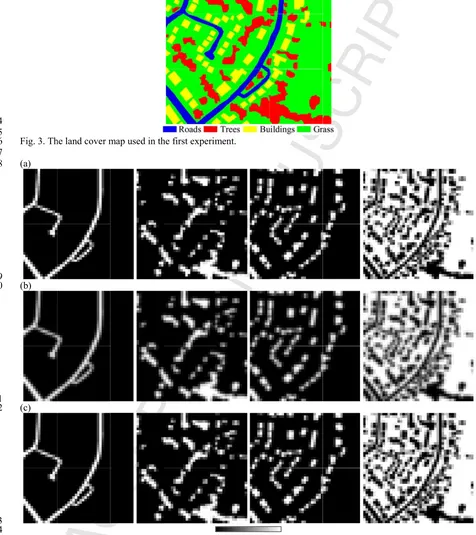
3.1. Experiment on the land cover map 210
211
A land cover map (with a spatial resolution of 0.6 m) covering an area in Bath, UK was used in
212
this experiment, as shown in Fig. 3. The map has a spatial size of 360 by 360 pixels. Four classes
213
were identified in the land cover map, including roads, trees, buildings and grass. The map was
214
degraded by a factor of 8 and a square wave PSF, generating four actual proportion images at a
215
spatial resolution of 4.8 m, as shown Fig. 4(a). Similarly, the four original coarse proportion
216
images produced by spectral unmixing were simulated using a factor of 8 and a Gaussian PSF (the
217
width of the PSF was set to 2.4 m), as shown Fig. 4(b).
218
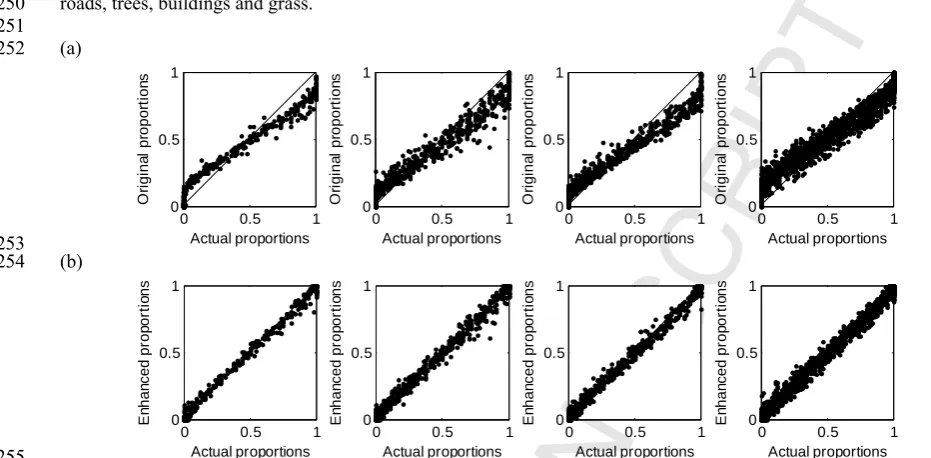
Fig. 5(a) shows the scatter plots between the actual proportions and original proportions
219
contaminated by the PSF. A visual check of both Figs. 4 and 5 reveals that due to the PSF effect,
220
the original proportions are obviously different from the actual proportions. For example, some
221
actual proportions of 0 are inaccurately predicted as a larger value (for grass, the value can reach
222
0.3, as shown in Fig. 5(a)) and some actual proportions of 1 are inaccurately predicted as a much
223
smaller value (e.g., some of the trees proportions are incorrectly predicted as 0.7, see Fig. 5(a)). Fig.
224
4(c) shows the enhanced proportions produced using the proposed method that considers the PSF
225
effect. Compared with the original proportion images in Fig. 4(b), the enhanced proportion images
226
in Fig. 4(c) are visually closer to the reference in Fig. 4(a). For example, the enhanced proportion
227
images are clearly much brighter than the original proportion images. The scatter-plots between the
228
actual proportions and enhanced proportions accounting for the PSF are shown in Fig. 5(b).
229
Compared with Fig. 5(a), the distribution of points for all four classes in Fig. 5(b) is more compact
230
and closer to the line of y =x, suggesting that the enhanced proportions are closer to the actual 231
proportions.
234 235 236 237 238
239 240
241 242
[image:8.595.49.525.147.682.2]243 244 245 246 247 248
Fig. 3. Th (a)
(b)
(c)
Fig. 4. Th map with convolvin
he land cover m
he proportion i h an ideal wav
ng the 0.6 m l
map used in th
images for the ve square PSF and cover ma
he first experim
0 e land cover m
F and a degra ap with a Gaus
ment.
0 map. (a) Refere adation factor ssian PSF and
1
ence produced r of 8. (b) Or d a degradation
by convolvin riginal propor n factor of 8.
ng the the 0.6 m rtion images p (c) Enhanced
using the proposed method that considers the PSF effect in spectral unmixing. From left to right are the results for 249
roads, trees, buildings and grass. 250
251 (a) 252
253 (b) 254
255
Fig. 5. (a) Relation between the actual proportions and original proportions in Fig. 4(b). (b) Relation between the actual 256
proportions and enhanced proportions in Fig. 4(c). From left to right are the results for roads, trees, buildings and grass. 257
258
Table 1 lists the accuracies of the proportions before and after considering the PSF effect. It is
259
seen that by considering the PSF effect, the enhanced proportions have larger CCs and smaller
260
RMSEs than the original proportions. More precisely, the RMSEs decrease by around 0.03, 0.04,
261
0.04 and 0.06 for roads, trees, buildings and grass, and the RREs are 69.55%, 61.11%., 65.14% and
262
63.53%. Correspondingly, the RREs for CCs of the four classes are 88.06%, 81.20%, 83.33% and
263
82.21%, revealing that the errors are greatly reduced by considering the PSF effect.
[image:9.595.39.505.121.350.2]264 265
Table 1 Accuracy of the proportions for the land cover map 266
Roads Trees Buildings Grass
RMSE
Original 0.0440 0.0576 0.0591 0.0924 Enhanced 0.0134 0.0224 0.0206 0.0337
RRE 69.55% 61.11% 65.14% 63.53% CC
Original 0.9866 0.9867 0.9844 0.9792 Enhanced 0.9984 0.9975 0.9974 0.9963
RRE 88.06% 81.20% 83.33% 82.21% 267
The performance of the proposed method for different PSF width (i.e., 0.25, 0.5, 0.75 and 1) is
268
shown in Fig. 6. It is clear that the enhanced proportions have consistently larger CCs than the
269
original proportions for all three cases and all four land cover classes. Moreover, the accuracy gains
270
become larger when the width increases. For the width of 0.25, the CCs of original and enhanced
271
proportions are very close (both close to 1, with difference about 0.001), but the difference increase
272
to be larger than 0.04 for the width of 1. It is worth noting that the accuracies of both original and
273
enhanced proportions decrease as the width increases.
274 275 276 277 278
0 0.5 1 0
0.5 1
Actual proportions
O
ri
g
in
a
l pr
opor
ti
on
s
0 0.5 1 0
0.5 1
Actual proportions
O
ri
g
in
a
l pr
opor
ti
on
s
0 0.5 1 0
0.5 1
Actual proportions
O
ri
g
in
a
l pr
opor
ti
on
s
0 0.5 1 0
0.5 1
Actual proportions
O
ri
g
in
a
l pr
opor
ti
on
s
0 0.5 1 0
0.5 1
Actual proportions
E
n
ha
n
c
e
d
pr
op
or
ti
o
n
s
0 0.5 1 0
0.5 1
Actual proportions
E
n
ha
n
c
e
d
pr
op
or
ti
o
n
s
0 0.5 1 0
0.5 1
Actual proportions
E
n
ha
n
c
e
d
pr
op
or
ti
o
n
s
0 0.5 1 0
0.5 1
Actual proportions
E
n
ha
n
c
e
d
pr
op
or
ti
o
n
[image:9.595.162.427.481.579.2]279
280 281 282
[image:10.595.141.468.103.458.2]283 284 285 286 287 288 289 290 291 292 293 294 295 296 297 298 299 300 301 302 303 304
Fig. 6. Th pixel). (a)
3.2. Exp
To en multispe six-band acquired pixels an Province Referrin original six-band the mea degrade
The ta m multis the 30 m Fig. 8 sh
he CC of the or )-(d) are result
periment on
nsure the p ectral image d (bands 1-d in August nd covers fa e, China. T ng to the lan six-band 30 d 30 m mult an and varia
d with a fact ask of this e spectral ima m land cover hows the 24
CC
CC
riginal and enh ts for roads, tr
the multisp
perfect relia e was used -5 and 7) 3 t 2001, as sh
armland wit The correspo nd cover map 0 m Landsat tispectral im ance of the tor of 8 and experiment i age. The actu
r map in Fig 40 m actual
(a)
(c)
hanced propor ees, buildings
ectral imag
ability of t d in this exp
0 m Lands hown in Fig th four main onding man
p in Fig. 7(b t image wer mage was sy e classes. F
a Gaussian is to predict ual 240 m p g. 7(b) with proportions
σ
σ
rtions in relatio
and grass, res
ge
the referenc periment. S at-7 Enhan g. 7(a). The n land cover nually digiti b), the mean re calculated ynthesized b
inally, the PSF to crea t the 240 m roportions ( an ideal squ s, the origina
CC
CC
(
(
on to the width spectively.
ce (i.e., act Specifically, ced Thema e study area
r classes (m ized land co n and varian
d. Accordin based on the synthesized ate a 240 m m
coarse prop (i.e., referen uare wave P al proportio
(b)
(d)
h of the Gauss
tual propor , the image atic Mapper
has a spati marked as C1
over map is nce of each l ng to the land
e random no d 30 m mul multispectra portions from nce) were pro PSF and a de ons produced
σ
σ
ian PSF (in un
rtions), a sy e was create plus (ETM al size of 2 1–C4) in the
s shown in land cover c d cover in F ormal distrib ltispectral i al image, see m the synthe oduced by c egradation f d without co
nits of coarse
305 306 307 308 309 310 311
312 313 314 315 316 317 318
319 320
321 322
323
[image:11.595.47.525.366.730.2]the PSF clear tha also sup consider 0.03, 0.0 and 52.2
Fig. 7. Th RGB). (b) C4). (c) 24 a degrada (a)
(b)
(c)
effect and at the enhan pported by th
ring the PSF 04, 0.03 and 27%, respec
he multispectra ) 30 m land co 40 m coarse im ation factor of
the enhanc nced proport he scatter-p F effect bas d 0.02, and ctively.
(a)
al image used over map prod mage produced
8.
ed proportio tions are clo plots in Fig. ed on the pr the RREs in
d in the second duced by draw d by degrading
ons produce oser to the re
9. The quan roposed me n terms of C
(b)
d experiment. wing manually g the synthesiz
ed using the eference than ntitative ass ethod, the R
CC for C1–C
(a) Original 3 from (a) (blue zed 30 m multi
e proposed n the origin sessment is RMSEs for C
C4 are 38.3
(c)
30 m multispe e, red, yellow ispectral imag
method. It al proportio shown in T C1–C4 are r 38%, 60.68%
ectral image (b and green rep e with a Gauss
is visually ons. This is able 2. By reduced by %, 76.92%
bands 432 as presents C1–
324 325 326 327 328 329 330 331 332 333 334 335 336 337 338 339 340 341 342 343 344 345 346 347 348 349 350 351 352 353 354
Fig. 8. Th map in Fig by spectra Enhanced are the res (a)
(b)
Fig. 9. (a) proportion results for 4. Discu After remote s climate c et al., 20 (Eckman (Weng e unmixin be enhan for enha example
he proportion i g. 7(b) with an al unmixing o d proportions u sults for C1–C
Relation betw ns and enhanc r C1–C4.
ussion
hard land co sensing, and change mon 008), precis nn et al., 2 et al., 2004 ng (indexed nced by con ancing the p e, the global
0 0 0 0.5 1 Actual p O ri g in a l p ropor ti on s 0 0 0 0.5 1 Actual p E n ha n c e d pr op or ti o n s
images for the n ideal square of the 240 m c using the propo C4.
ween the actua ed proportions
Table 2 A
RMSE O En CC O En over classifi d has been nitoring (Me sion agricult 2010), geolo 4). In the la
in Web of S nsidering the proportions l Vegetation 0.5 1 proportions O ri g in a l p ropor ti on s 0.5 1 proportions E n ha n c e d pr op or ti o n s 0 e multispectral
wave PSF and coarse multisp osed method t
l proportions a s in Fig. 8(c). F
ccuracy of the Original 0. nhanced 0. RRE 29 Original 0. nhanced 0. RRE 38 fication, spec applied wid elendez-Pas ture (Pachec ogical mapp ast five year Science). Th e PSF effect
is, thus, exp n Continuou 0 0.5 0 0.5 1 Actual prop 0 0.5 0 0.5 1 Actual prop 0 l image. (a) Re d a degradation pectral image that considers
and original pr From left to ri
e proportions f C1 C2 0873 0.09 0613 0.05 9.78% 43.1 9703 0.97 9817 0.99 8.38% 60.6 ctral unmixi dely in vari tor et al., 20 co and McN ping (Bedin rs, more tha he experime
through the pected to ha s Field (VC
1 portions 0 0.5 1 O ri g in a l p ropor ti on s 1 portions 0 0.5 1 E n ha n c e d pr op or ti o n s 1 eference produ n factor of 8. (
in Fig. 7(c), w the PSF effect
roportions in F ght are the res
for the multisp 2 C3 950 0.051 540 0.022 6% 55.71% 766 0.984 908 0.996 68% 76.92%
ing is one of ious domain 010), terrestr Nairn, 2010 ni, 2009), a an 1000 pa ntal results e proposed A
ave widespr CF) product h
0 0.5 0 5 1 Actual proport 0 0.5 0 5 1 Actual proport
uced by convo (b) Original pr without consi t in spectral un
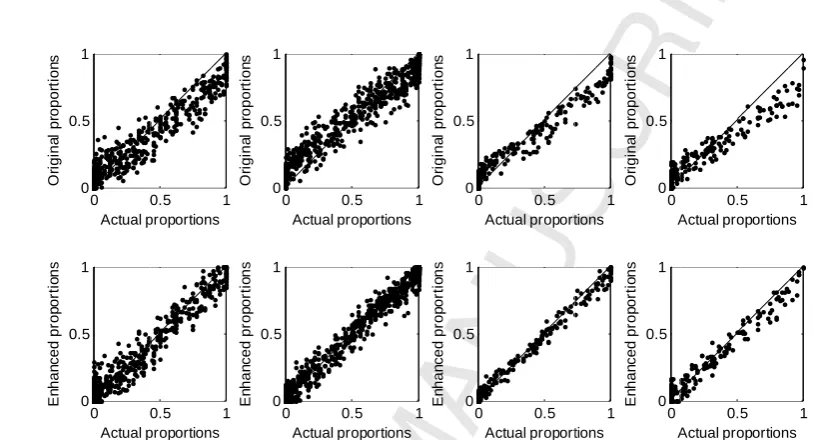
Fig. 8(b). (b) R sults for C1-C4
pectral image C4 7 0.0529 9 0.0331 % 37.43% 4 0.9692 4 0.9853 % 52.27%
f the most co ns (Somers
rial ecosyste ), natural ha and urban e apers were p
reveal that s ATPK-based read applica has been gen
1 tions 0 0 0.5 1 A O ri g in a l p ropor ti on s 1 tions 0 0 0.5 1 A E n ha n c e d pr op or ti o n s
olving the 30 m roportion imag
dering the PS nmixing. From
Relation betwe 4. From left to
ommon app et al., 2011 em monitori azard risk a environment published o spectral unm d method. T ations in pra
nerated annu
0.5 Actual proportion
0.5 Actual proportion
m land cover ges produced SF effect. (c) m left to right
en the actual right are the
proaches in 1), such as
[image:12.595.140.433.452.595.2] [image:12.595.137.435.455.595.2]the Moderate Resolution Imaging Spectroradiometer (MODIS) since 2000, which contains the
355
percentage of vegetative cover within each MODIS pixel (DiMiceli et al., 2011). MODIS data have
356
also been used for crop area estimation based on spectral unmixing (Pan et al., 2012). The VCF
357
products and crop area estimation can be potentially enhanced by accounting for the PSF effect.
358
Sub-pixel mapping (Atkinson 1997; Wang et al., 2016b) has been developed for decades, which
359
is a post-processing analysis of spectral unmixing. It creates a thematic map at a finer spatial
360
resolution based on the spectral unmixing predictions as inputs. Specifically, under the proportion
361
coherence constraint and starting with the coarse proportions, sub-pixel mapping divides each
362
mixed pixel into sub-pixels and predicts their land cover class. When the PSF effect is considered
363
in the coarse proportions, more reliable inputs and proportion constraints can be provided for
364
sub-pixel mapping to create more accurate finer spatial resolution land cover maps.
365
According to the relation in Eq. (5), the proposed ATPK-based method can predict sub-pixel
366
proportions (i.e., a by-product) inversely from the coarse proportions. The by-product has a finer
367
spatial resolution than the original proportions and is also expected to have great application value.
368
For example, Gu et al. (2008) produced finer spatial resolution proportion images from input
369
coarse proportion images and the results (e.g., Fig. 10(f) in Gu et al., 2008) showed that aircraft can
370
be observed more clearly from the sub-pixel proportion images. For sub-pixel mapping, the
371
by-product can be hardened to create a finer spatial resolution land cover map, under the proportion
372
coherence constraint from the enhanced coarse proportions. This is also the core idea of the
373
recently developed soft-then-hard sub-pixel mapping algorithm (Wang et al., 2014), which predicts
374
sub-pixel proportion images first and then hardens them to land cover maps. The by-product, along
375
with the enhanced proportions, opens new avenues for future research.
376
In our previous research, the PSF effect was considered directly in the post SPM process (Wang
377
and Atkinson, 2017) to produce more accurate sub-pixel resolution land cover maps. Alternatively,
378
this paper aims to produce more accurate coarse proportions. As discussed above, the coarse
379
proportions have more general applications, including not only in the post SPM process, but also in
380
practical applications such as in large scale crop area and VCF estimation. The by-product of
381
sub-pixel proportions also imposes extra value. It would be interesting to conduct a comparison for
382
SPM predictions based on the method in Wang and Atkinson (2017) and the enhanced coarse
383
proportions produced using the proposed method in this paper.
384
The PSF width (i.e., standard deviation of the Gaussian PSF in this paper) determines how
385
greatly the observed pixel signal is affected by its neighboring pixels. It is a crucial factor affecting
386
the accuracy of spectral unmixing predictions. When the width increases, more neighbors
387
contaminate the center pixel and the uncertainty in predicting the proportions increases as a result,
388
and vice versa. Thus, the accuracy of the proportions (either original or enhanced) decreases as the 389
width increases, as reported in Fig. 6. It is worth noting that in Fig. 6, the accuracies of both original
390
and enhanced proportions for the width of 0.25 are nearly the same and both values are close to the
391
ideal value. This reveals that a very narrow PSF (e.g., less than 0.5 pixel) on a discrete grid (i.e.,
392
pixel) has little effect. It should be noted that each senor has its own PSF width. For example, based
393
on the assumption of the Gaussian PSF, Radoux et al. (2016) found that the width for the Landsat 8
394
red band is 0.72 pixel and ranges from 0.71 to 0.94 pixel for the Sentinel-2 bands. The consistently
395
greater accuracy of the proposed method for different widths suggests its great application value
396
for different sensors.
397
In this paper, a Gaussian PSF was assumed for convenience in the experimental validation. It
398
should be noted that the PSF may not be the Gaussian filter in reality, especially for sensors with a
399
scanning mirror which will ensure that the shape has a directional component (Tan et al., 2006).
400
However, this paper aims to find a solution to account for the PSF effect to enhance spectral
unmixing predictions. We did not focus on the specific form of the PSF (e.g., specific form of the
402
function and related parameters), as the proposed method is suitable for any PSF. In practice, once
403
the PSF is available, it can be used readily in the proposed ATPK-based method.
404
It is assumed that the endmembers are scale-free and that the same endmembers can be
405
considered for the coarse and fine spatial resolution spectra in Eqs. (1) and (3). This assumption is
406
more reliable when the landscapes are homogeneous or the intra-class spectra variation is small,
407
such that slight differences exist between the endmembers at different spatial resolutions. However,
408
intra-class spectral variation is a common problem in spectral unmixing that remains open
409
(Drumetz et al., 2016; Somers et al., 2011). It would be worthwhile to investigate the relation
410
between the endmembers at different spatial resolutions, or to consider endmember extraction in a
411
local window and the use of multiple endmembers to characterize each land cover class.
412
The proposed ATPK-based method is shown to be effective in considering the PSF effect, based
413
on the assumption that the ATPK predictions F kˆ ( )v are a reliable solution to the inverse prediction
414
problem of estimating sub-pixel proportion ( )F kv from F kV( ). However, this inverse prediction 415
problem is ill-posed, and multiple solutions may meet the coherence constraint in Eq. (10). In
416
future research, it would be interesting to design an appropriate model to incorporate additional
417
information (e.g., prior spatial structure information for each land cover class at the fine spatial
418
resolution) into the ATPK method to reduce the solution space and produce more reliable sub-pixel
419
proportions.
420 421 422
5. Conclusion 423
424
A new method was proposed for considering the PSF in spectral unmixing and increasing the
425
accuracy of land cover proportion predictions. Based on the ubiquitous existence of the PSF effect
426
in real remotely sensed images, spectral unmixing predictions are made as a convolution of the
427
sub-pixel proportions of both the coarse center pixel and coarse neighbors. ATPK is proposed to
428
predict the sub-pixel proportions inversely from the coarse proportions and the sub-pixel
429
proportions are then convolved with the ideal square wave PSF to produce the final predictions.
430
The experimental results on two datasets suggest that the proposed method provides a satisfactory
431
solution for reducing the PSF effect in spectral unmixing.
432 433 434
Acknowledgment 435
436
This work was supported in part by the Research Grants Council of Hong Kong under Grant
437
PolyU 15223015 and in part by the National Natural Science Foundation of China under Grant
438
41331175.
439 440 441
References 442
443
Atkinson, P. M. (1997). Mapping sub-pixel boundaries from remotely sensed images. Innov. GIS 444
4, 166–180. 445
Bedini, E., van der Meer, F., van Ruitenbeek, F. (2009). Use of HyMap imaging spectrometer data
446
to map mineralogy in the Rodalquilar caldera, southeast Spain. International Journal of 447
Bioucas-Dias, J. M., Plaza, A., Dobigeon, N., Parente, M., Du, Q., Gader, P., Chanussot, J. (2012).
449
Hyperspectral unmixing overview: Geometrical, statistical and sparse regression-based
450
approaches. IEEE Journal of Selected Topics in Applied Earth Observations and Remote 451
Sensing, 5, 354–379. 452
Campagnolo, M. L., & Montano, E. L. (2014). Estimation of effective resolution for daily MODIS
453
gridded surface reflectance products. IEEE Transactions on Geoscience and Remote Sensing, 454
52, 5622–5632.
455
DiMiceli, C., Carroll, M., Sohlberg, R., et al. (2011). Annual global automated MODIS vegetation
456
continuous fields (MOD44B) at 250 m spatial resolution for data years beginning day 65,
457
2000-2010, collection 5 percent tree cover. USA: University of Maryland, College Park, MD. 458
Drumetz, L., Chanussot, J., Jutten, C., 2016. Variability of the endmembers in spectral unmixing:
459
recent advances. 8th Workshop on Hyperspectral Image and Signal Processing: Evolution in 460
Remote Sensing (WHISPERS 2016), Los Angeles, United States. 461
Eckmann, T. C., Still, C. J., Roberts, D.A., Michaelsen, J. C. (2010). Variations in subpixel fire
462
properties with season and land cover in Southern Africa. Earth Interactions, 14(6). 463
Gu, Y., Zhang, Y., Zhang, J. (2008). Integration of spatial–spectral information for resolution
464
enhancement in hyperspectral images. IEEE Transactions on Geoscience and Remote Sensing, 465
46, 1347–1358.
466
Heinz, D. C., Chang, C. I. (2001). Fully constrained least squares linear spectral mixture analysis
467
method for material quantification in hyperspectral imagery. IEEE Transactions on 468
Geoscience and Remote Sensing, 39, 529–545. 469
Hestir, E. L., Khanna, S., Andrew, M. E., Santos, M. J., Viers, J. H., Greenberg, J. A., et al. (2008).
470
Identification of invasive vegetation using hyperspectral remote sensing in the California Delta
471
ecosystem. Remote Sensing of Environment, 112, 4034−4047. 472
Huang, C., Townshend, R.G., Liang, S., Kalluri, S. N. V., DeFries, R. S. (2002). Impact of sensor’s
473
point spread function on land cover characterization: assessment and deconvolution. Remote 474
Sensing of Environment, 80, 203–212. 475
Keshava, N., Mustard, J. F. (2002). Spectral unmixing. IEEE Signal Processing Magazine, 19, 44– 476
57.
477
Kyriakidis, P. C. (2004). A geostatistical framework for area-to-point spatial interpolation.
478
Geographical Analysis, 36, 259–289. 479
Manslow J. F., & Nixon, M. S. (2002). On the ambiguity induced by a remote sensor's PSF. In
480
Uncertainty in Remote Sensing and GIS, 37–57. 481
Melendez-Pastor, I., Navarro-Pedreno, J., Gomez, I., Koch, M. (2010). Detecting drought induced
482
environmental changes in a Mediterranean wetland by remote sensing. Applied Geography, 30, 483
254−262.
484
Pacheco, A., McNairn, H. (2010). Evaluating multispectral remote sensing and spectral unmixing
485
analysis for crop residue mapping. Remote Sensing of Environment, 114, 2219−2228. 486
Pan, Y., Li, L., Zhang, J., Liang, S., Zhu, X., Sulla-Menashe, D., 2012. Winter wheat area
487
estimation from MODIS-EVI time series data using the Crop Proportion Phenology Index.
488
Remote Sensing of Environment, 119, 232–242.
489
Quintano, C., Fernandez-Manso, A., Shimabukuro, Y., 2012. Spectral unmixing. International 490
Journal of Remote Sensing, 33, 5307–5340. 491
Radoux, J., Chome, G., Jacques, D. C., Waldner, F., Bellemans, N., Matton, N., Lamarche, C.,
492
Andrimont, R., Defourny, P. (2016). Sentinel-2’s potential for sub-pixel landscape feature
493
Schowengerdt, R. A. (1997). Remote sensing: models and methods for image processing. San 495
Diego: Academic Press.
496
Shi, C., Wang, L., 2014. Incorporating spatial information in spectral unmixing: A review. Remote
497
Sensing of Environment, 149, 70–87.
498
Somers, B., Asner, G. P., Tits, L., Coppin, P. (2011). Endmember variability in Spectral Mixture
499
Analysis: A review. Remote Sensing of Environment, 115, 1603–1616. 500
Tan, B., Woodcock, C. E., Hu, J., Zhang, P., Ozdogan, M., Huang, D., Yang, W., Knyazikhin, Y.,
501
Myneni, R. B. (2006). The impact of gridding artifacts on the local spatial properties of MODIS
502
data: Implications for validation, compositing, and band-to-band registration across resolutions.
503
Remote Sensing of Environment, 105, 98–114. 504
Townshend, R. G., Huang, C., Kalluri, S. N. V., Defries, R. S., Liang, S. (2000). Beware of
505
per-pixel characterization of land cover. International Journal of Remote Sensing, 21, 839– 506
843.
507
Van der Meer, F. D. (2012). Remote-sensing image analysis and geostatistics. International 508
Journal of Remote Sensing, vol. 33, no. 18, pp. 5644–5676, 2012. 509
Wang, Q., Shi, W., Wang, L. (2014). Allocating classes for soft-then-hard subpixel mapping
510
algorithms in units of class. IEEE Transactions on Geoscience and Remote Sensing, 52, 2940– 511
2959.
512
Wang, Q., Shi, W., Atkinson, P. M., Zhao, Y. (2015). Downscaling MODIS images with
513
area-to-point regression kriging. Remote Sensing of Environment, 166, 191–204. 514
Wang, Q., Shi, W., Atkinson, P. M. (2016a). Area-to-point regression kriging for pan-sharpening.
515
ISPRS Journal of Photogrammetry and Remote Sensing, 114, 151–165. 516
Wang, Q., Shi, W., Atkinson, P. M. (2016b). Spatial-temporal sub-pixel mapping of time-series
517
images. IEEE Transactions on Geoscience and Remote Sensing, 54, 5397–5411. 518
Wang, Q., Atkinson, P. M. (2017). The effect of the point spread function on sub-pixel mapping.
519
Remote Sensing of Environment, 193, 127–137. 520
Weng, Q. H., Lu, D. S., Schubring, J. (2004). Estimation of land surface temperature-vegetation
521
abundance relationship for urban heat island studies. Remote Sensing of Environment, 89, 522
467−483.
523
Wenny, B. N., Helder, D., Hong, J., Leigh, L., Thome, K. J., Reuter, D. (2015). Pre- and
524
post-launch spatial quality of the Landsat 8 Thermal Infrared Sensor. Remote Sensing, 7, 1962– 525
1980.