warwick.ac.uk/lib-publications
Manuscript version: Published Version
The version presented in WRAP is the published version (Version of Record).
Persistent WRAP URL:
http://wrap.warwick.ac.uk/114479
How to cite:
The repository item page linked to above, will contain details on accessing citation guidance
from the publisher.
Copyright and reuse:
The Warwick Research Archive Portal (WRAP) makes this work by researchers of the
University of Warwick available open access under the following conditions.
Copyright © and all moral rights to the version of the paper presented here belong to the
individual author(s) and/or other copyright owners. To the extent reasonable and
practicable the material made available in WRAP has been checked for eligibility before
being made available.
Copies of full items can be used for personal research or study, educational, or not-for-profit
purposes without prior permission or charge. Provided that the authors, title and full
bibliographic details are credited, a hyperlink and/or URL is given for the original metadata
page and the content is not changed in any way.
Publisher’s statement:
Please refer to the repository item page, publisher’s statement section, for further
information.
Astronomy
&
Astrophysics
https://doi.org/10.1051/0004-6361/201832986
© ESO 2018
Diagnosing aerosols in extrasolar giant planets with
cross-correlation function of water bands
Lorenzo Pino
1,2, David Ehrenreich
1, Romain Allart
1, Christophe Lovis
1, Matteo Brogi
3, Matej Malik
4,
Valerio Nascimbeni
2,5, Francesco Pepe
1, and Giampaolo Piotto
21Observatoire astronomique de l’Université de Genève, Université de Genève, 51 chemin des Maillettes, 1290 Versoix, Switzerland
e-mail:[email protected]
2Dipartimento di Fisica e Astronomia “Galileo Galilei”, Université di Padova, Vicolo dell’Osservatorio 3, Padova 35122, Italy 3Department of Physics, University of Warwick, Coventry CV4 7AL, UK
4Center for Space and Habitability, University of Bern, Sidlerstrasse 5, 3012, Bern, Switzerland 5INAF – Osservatorio Astronomico di Padova, vicolo dell’Osservatorio 5, 35122, Padova, Italy
Received 9 March 2018 / Accepted 16 July 2018
ABSTRACT
Transmission spectroscopy with ground-based, high-resolution instruments provides key insight into the composition of exoplanetary atmospheres. Molecules such as water and carbon monoxide have been unambiguously identified in hot gas giants through cross-correlation techniques. A maximum in the cross-cross-correlation function (CCF) is found when the molecular absorption lines in a binary mask or model template match those contained in the planet. Here, we demonstrate how the CCF method can be used to diagnose broadband spectroscopic features such as scattering by aerosols in high-resolution transit spectra. The idea consists in exploiting the presence of multiple water bands from the optical to the near-infrared. We have produced a set of models of a typical hot Jupiter spanning various conditions of temperature and aerosol coverage. We demonstrate that comparing the CCFs of individual water bands for the models constrains the presence and the properties of the aerosol layers. The contrast difference between the CCFs of two bands can reach∼100 ppm, which could be readily detectable with current or upcoming high-resolution stabilized spectrographs spanning a wide spectral range, such as ESPRESSO, CARMENES, HARPS-N+GIANO, HARPS+NIRPS, SPIRou, or CRIRES+.
Key words. planets and satellites: atmospheres – planets and satellites: composition – techniques: spectroscopic
1. Introduction
High-resolution (R∼105), ground-based transmission spec-troscopy offers a unique insight into exoplanetary atmospheres. At such high-resolution, (1) telluric contamination, which dra-matically hampers lower resolution, ground-based observations (Sing et al. 2015; Gibson et al. 2017) is better removed (Astudillo-Defru & Rojo 2013; Allart et al. 2017); (2) the resolved cores of the alkali atoms sound up to the base of the thermosphere (P .10−9 bar; Wyttenbach et al. 2015, 2017); (3) individual absorption lines of molecular bands are spec-trally resolved and chemical species, such as H2O and CO, are uniquely identified (Snellen et al. 2010;de Kok et al. 2014;Brogi et al. 2018).
Single molecular bands have been detected with high-resolution transmission spectroscopy in the near-infrared (NIR) by exploiting cross-correlation techniques (e.g. Brogi et al. 2016).Hoeijmakers et al.(2015),Allart et al.(2017), andEsteves et al.(2017), have proposed an extension of this method to the optical bands. However, optical to NIR high-resolution spectro-graphs are only available from the ground1, thus the effective-ness of these techniques has been limited by the presence of Earth atmosphere.
1 The optical and NIR spectral range will be covered by JWST NIRSpec, which will provide a resolving power of R ∼ 103. This is by two orders of magnitude lower than the resolving power that ground-based facilities can provide.
One aspect of the problem is that high-resolution trans-mission spectroscopy requires a normalization of the flux of the spectra acquired during the night, that can vary due to air mass or instrumental effects (Snellen et al. 2008; Wyttenbach et al. 2015, 2017; Heng et al. 2015). During the process, the absolute level of the absorption of the planet is lost, and broadband features such as those due to aerosols could be removed from the spectra. Indeed, the presence of aerosols on exoplanets was inferred with space-borne Hubble Space Telescope (HST) observations (e.g. Charbonneau et al. 2002;
Ehrenreich et al. 2014; Kreidberg et al. 2014a;Wakeford et al. 2017, but see alsoSnellen 2004;Di Gloria et al. 2015) or lower resolution spectrophotometric observations (e.g. Bean et al. 2010;Nascimbeni et al. 2013;Lendl et al. 2016), revealing that they are very common on hot Jupiters (Sing et al. 2016;Barstow et al. 2017) and smaller Saturn- and Neptune-size planets.Brogi et al.(2017), who did not treat the effect of aerosols explicitly, and Pino et al.(2018) demonstrated that a combined analysis of ground-based, high-resolution and space-borne, low- to medium-resolution transmission spectra can better constrain the chemical and physical conditions of exoplanetary atmospheres.
Single spectral features such as the sodium doublet can be used to infer the presence of aerosols (Charbonneau et al. 2002;
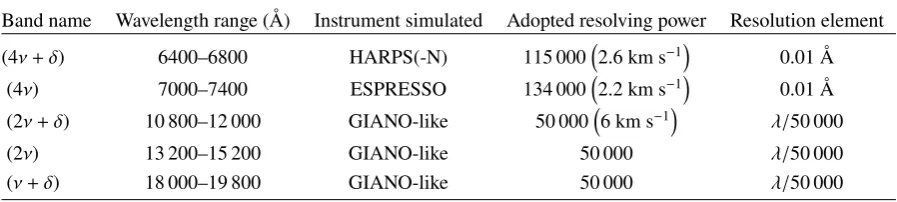
Table 1.Definition of the water absorption bands.
Band name Wavelength range (Å) Instrument simulated Adopted resolving power Resolution element
(4ν+δ) 6400–6800 HARPS(-N) 115 0002.6 km s−1 0.01 Å
(4ν) 7000–7400 ESPRESSO 134 0002.2 km s−1 0.01 Å
(2ν+δ) 10 800–12 000 GIANO-like 50 0006 km s−1 λ/50 000
(2ν) 13 200–15 200 GIANO-like 50 000 λ/50 000
(ν+δ) 18 000–19 800 GIANO-like 50 000 λ/50 000
Notes.Water absorption bands are named after the vibrational mode that determines their central frequency. Rotational fine structure broadens the
absorption bands around this frequency. The vibrational numberνindicates stretching (a combination of symmetric and asymmetric; both have similar frequencies, thus all their combinations overlap when rotational fine structure is included) andδindicates bending. With this naming, the strong water band observed with WFC3 G141 corresponds to the (2ν). We indicate the reference instrument for which we simulated a CCF for our analysis. In the last two columns, we indicate the resolving power and the resolution element of our simulated observations of each band. The simulated instruments are HARPS for the (4ν+δ) band; ESPRESSO for the (4ν) band; for the NIR bands, we study the performance of an instrument of similar characteristics to GIANO.
noted by de Kok et al. 2014). The technique exploits the fact that the opacities of water vapour and aerosols behave differently with wavelength: the former increases with wavelength, while the latter is usually constant or decreasing in the optical and NIR regions of the spectrum. The relative contrast of water bands can thus be used as a diagnostic of the presence of aerosols. At high resolution, the contrast of water bands can be measured through their cross-correlation functions (CCFs). This is obtained by cross-correlating each water band with a binary mask, and can thus be regarded as the average line profile within the band.
We used theπη code (Pino et al. 2018; see also Ehrenreich
et al. 2006,2012,2014) to build a grid of models representative of a hot Jupiter in different temperature conditions, containing aerosols at different altitudes; built the CCFs of the grid with a set of binary masks representing water bands of interest (fol-lowing the technique introduced byAllart et al. 2017); discuss how the relative contrast of different water absorption bands is an indicator of the cloudiness of an atmosphere.
Our technique is suitable for applications with the roster of current and next generation high-resolution (R & 50 000), stabilized, optical-to-NIR Echelle spectrographs with extended spectral coverage (∆λ & 2000 Å). A non-comprehensive list includes HARPS + NIRPS, GIARPS (GIANO + HARPS-N), ESPRESSO, CARMENES, SPIRou, ARIES, IGRINS, IRD, HPF, iLocater, PEPSI, EXPRES, NEID (McCarthy et al. 1998;
Mayor et al. 2003;Oliva et al. 2006;Pepe et al. 2010;Yuk et al. 2010; Cosentino et al. 2012; Thibault et al. 2012; Mahadevan et al. 2012;Quirrenbach et al. 2014;Kotani et al. 2014;Crepp et al. 2014;Strassmeier et al. 2015;Conod et al. 2016;Jurgenson et al. 2016;Schwab et al. 2016;Claudi et al. 2017). Of particular interest is the HIRES optical-to-NIR spectrograph for the E-ELT (Zerbi et al. 2014; Marconi et al. 2016), HROS (TMT Project 2013) for the TMT, and G-CLEF (Szentgyorgyi et al. 2012,2014) for the GMT. At longer wavelengths (λ&2µm), an extension of
our technique is possible and warranted in view of future instru-ments such as CRIRES+ (Follert et al. 2014), METIS (Brandl et al. 2014), NIRES-R, and GMTNIRS. See Crossfield (2014) andWright & Robertson(2017) for a description of most of these instruments.
2. Methods
First, we selected the relevant spectral bands. We considered two cases: without telluric contamination (ideal case) and with telluric contamination (realistic case). This yielded two sets of
bands listed in Tables1and2, respectively2(see also Fig.1). The ideal case informs on the potential of a high-resolution optical to NIR spectrograph mounted on a space-borne or stratospheric facility. While such an instrument will not be delivered within the next decade, similar concepts have already been developed (LUVOIR;France et al. 2017; HIRMES3; on-board SOFIA). On the other hand, from the ground,Allart et al.(2017) demonstrate how telluric lines can be efficiently corrected for in the optical. In the NIR, the contamination is more severe. Although telluric correction or self-calibration using time resolution and the measured flux variations (de Kok et al. 2013;Birkby et al. 2013) both work effectively for unsaturated telluric lines, portions of the spectrum completely saturated, for example at the centre of strong water lines, cannot be recovered. We thus selected regions where the features in the telluric transmittance spectrum, taken from Hinkle et al. (2003), remove less than 80% of the flux, and correction is possible. These bands roughly correspond to the windows of transparency of Earth atmosphere, and we named them accordingly (see Table 1, and orange regions in Fig.1).
We computed the expected CCF contrast in each band, fol-lowing three steps. Firstly, we simulated a theoretical template transmission spectrum of an exoplanet atR∼106; secondly, we simulated observations of each water band with a relevant spec-trograph (see Table1), by convolving at the appropriate resolving power and binning to the instrumental resolution; thirdly, we computed the CCF with a binary mask.
In the following, we describe these three steps (seePino et al. 2018for a more detailed description of the routines used in the first two steps).
2.1. High-resolution template
We first used the πη 1D line-by-line radiative transfer code (Pino et al. 2018) to compute high-resolution model transmis-sion spectra δ(λ) = 1− fin/fout, where fin/out are the stellar fluxes registered in- and out-of-transit. A line-by-line approach is necessary to apply the CCF technique, as the molecular lines need to be singularly resolved. The water cross section used in
2 A discussion of the theoretical water spectrum can be found at http://www1.lsbu.ac.uk/water/water_vibrational_ spectrum.htmland references therein.
Table 2.Definition of the water absorption bands in the presence of telluric absorption.
Band name Wavelength range (A) Instrument simulated Adopted resolving power Resolution element
(4ν+δ) 6400–6800 HARPS(-N) 115 0002.6 km s−1 0.01 Å
(4ν) 7000–7400 ESPRESSO 134 0002.2 km s−1 0.01 Å
Yband 9800–11 100 GIANO 50 0006 km s−1 λ/50 000
Jband 11 600–13 100 GIANO 50 000 λ/50 000
Hband 15 000–17 400 GIANO 50 000 λ/50 000
Notes.When we consider telluric contamination, the strongest NIR bands are not observable from the ground. We thus replace those by the Earth
transparency windows. We indicate the reference instrument for which we simulated a CCF for our analysis. In the last two columns, we indicate the resolving power and the resolution element of our simulated observations of each band. The simulated instruments are HARPS for the (4ν+δ) band; ESPRESSO for the (4ν) band; GIANO for the NIR bands.
Fig. 1.Bands used to compute the CCF of water, on top of the telluric transmittance (upper panel), and an exoplanet transmission spectrum model
(lower panel). Grey bands correspond to water vibrational band. Orange bands correspond to the windows of transparency of Earth atmosphere. The bands partially overlap, as indicated by toothed areas.Upper panel:the solid black line represents the transmittance of Earth atmosphere (Hinkle et al. 2003), ranging from 1 (all incident light transmitted) to 0 (all incident light absorbed). Besides water bands, corresponding to the bands in thebottom panel, molecular oxygen, carbon dioxide, and methane show the most prominent features.Lower panel:the solid black line represents a theoretical cloud-free isothermal model of HD189733b. Within each water vibrational band, the region of the spectrum in grey represents the spectrum seen through a selected instrument, thus convolved at the appropriate resolving power (see Table1).
the models was calculated from a high-resolution opacity table (∆ν= 0.01 cm−1,R ∼ 106). The table was obtained with the HELIOS-K routine applied to the HITEMP line-list (Grimm & Heng 2015), accurate up to the high temperatures expected in hot Jupiters (Teq&1000 K).
We assumed the planetary parameters of HD189733b, a typ-ical hot Jupiter (rp=10 bar = 1.108 RJ, Mp = 1.138 MJ, R? = 0.756R). Besides water (volume mixing ratio, VMR=10−3),
we added opacities from sodium (VMR = 10−6), potassium (VMR =10−7), and Rayleigh scattering and collision-induced absorption (CIA) by H2. Different parameters were varied to produce the templates:
1. Aerosol altitude. For illustrating the technique, a simple parametrization of the aerosol deck is sufficient. We set the atmosphere to be opaque at all wavelengths for pressures higher than a thresholdpc. In the spectral range considered (<2µm), this parametrization simulates aerosol particles of
size&2µm. We varypcbetween 10 and 10−7bar) in steps of 1 dex (i.e. equally spaced on a logarithmic scale).
2. Temperature of the atmosphere. We assumed isothermal temperature–pressure (T–p) profiles, at first order ade-quate to describe water absorption in transmission spectra (Heng & Kitzmann 2017). Temperature is varied between 1200 and 2300 K in steps of∼200 K.
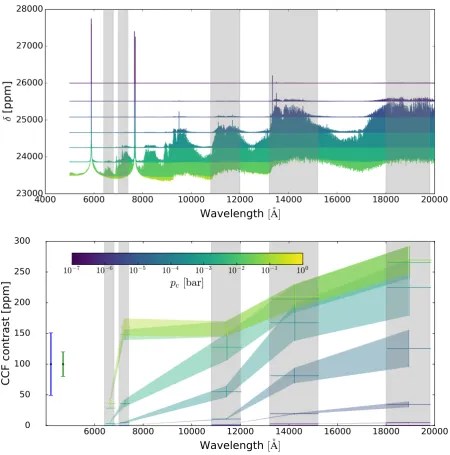
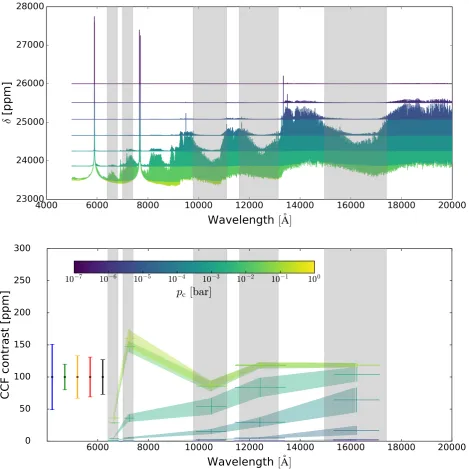
We show a set of templates built for a temperature ofT =1700 K in the upper panels of Figs.6and9. Grey vertical bands corre-spond to the regions that we analysed in the idealized case and in the realistic case that avoids the peak of telluric contamination, respectively.
2.2. Convolution with the LSF and binning
[image:4.595.47.539.267.498.2]11105 11106 11107 11108 11109 11110
Wavelength[˚A]
2.36
2.38
2.40
2.42
2.44
2.46
2.48
2.50
δ
[
%
[image:5.595.41.288.81.264.2]]
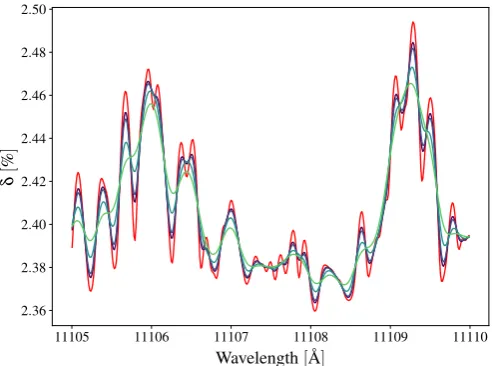
Fig. 2.Effect of finite resolving power on water lines. The red curve
corresponds to a line-by-line model (with a resolution of R∼106). From the light green curve to the purple curve, we show the same spectrum convolved with Gaussian LSF corresponding to the follow-ing resolvfollow-ing powers: atR=50 000 (GIANO), atR=75 000 (similar to CARMENES), at R=115 000 (HARPS/-N), and at R=134 000 (ESPRESSO). At the lowest resolving power, the individual molecular lines are not entirely resolved.
high-resolution instruments such as HARPS(-N) or ESPRESSO planetary molecular lines are narrower than the instrumen-tal LSF (∼2–3 km s−1 wide). Indeed, the Doppler width for water lines at typical temperatures of a planetary atmosphere (500–3000 K) ranges between 0.7 and 1.5 km s−1. This
convo-lution effect is strong for resolving powers<100 000, and needs to be taken into account when estimating the contrast of the CCF (see Fig.2). We convolved lines in each water band with a Gaussian LSF representative of an instrument covering that wavelength range. For illustration, we chose to simulate obser-vations with HARPS(-N), ESPRESSO, GIANO (see Tables 1
and 2), but the technique is applicable to any high-resolution spectrograph with enough spectral coverage (see Sect.1).
Transmission spectra are built by dividing out stellar spec-tra taken during the spec-transit and out-of-spec-transit, which are thus individually convolved with the instrumental LSF. Pino et al.
(2018) discuss how models should follow the same steps, since mathematically the order of division and LSF convolution can-not be interchanged (see also Deming & Sheppard 2017). In this paper, we assumed that the stellar host star has no water lines, a reasonable assumption for many cases (Brogi et al. 2016). Thus, the stellar spectrum on the background of planetary water absorption is on average flat, and the direct convolu-tion of the planetary absorpconvolu-tion and the instrumental LSF is possible.
As discussed inPino et al.(2018), a key ingredient of realis-tic simulations is binning the model to the correct resolution, that is the step with which the spectrum is sampled. For the various bands, we adopted the resolution elements reported in Tables1and2. For ESPRESSO, we assumed that the resolution element is the same as for HARPS(-N).
2.3. Cross-correlation
Individual molecular lines are weak and usually buried in the noise. However, we can enhance our detection capabilities by averaging the signal coming from hundreds or thousands of lines. This is achieved by building a cross-correlation function
(CCF4; Baranne et al. 1979,1996; Pepe et al. 2002). To com-pute the CCF, we followed the method developed by Allart et al.(2017) to search for water in the HARPS optical spectra of HD189733b. The cross-correlation function is defined as
CCFN,Tll(v)=
1 N
N
X
i=1
S(λi)·M
λi
1+v c
. (1)
A binary maskM(with an aperture of one pixel, i.e. 0.82 km s−1 in HARPS and ESPRESSO and 6.38 km s−1in GIANO) is pro-jected on the spectrumS. The binary mask corresponds to the theoretical wavelengthsλiof theNlines of the molecule we are
looking for, drawn from a line list at a temperatureTll. Doppler
shifting the mask in the radial velocity (v) domain with steps of one pixel,cbeing the speed og light, allows one to reconstruct the shape of the average molecular line. FollowingAllart et al.
(2017), we inspected the−80/+80 km s−1range. Since no
wave-length shift was introduced in the model, we expect a peak at 0 km s−1.
With reference to Eq. (1),S is one of the water bands defined in Table1(without considering telluric absorption) or Table2
(considering it), convolved with the appropriate LSF and binned at the instrumental resolution. We built a dedicated mask for each water band starting from the HITEMP line list. Within the wavelength range of each water absorption band, we selected the 800 lines with strongest spectral line intensity at a temperature Tll=1 200 K5, typical of the terminator region of hot Jupiters.
We note that the choice of the mask is not unique. However, the specific choice we made does not impact the conclusions of the study6.
The CCF of a water absorption band is rich in information, as it encodes the average line profile within the band. In this work, we are only interested in the line contrast. We thus fit a Gaussian profile f(v) to our computed CCF of the form
f(v)=C+B·v+ √A
2πσexp −
(v−v0)2 2σ2
!
, (2)
leavingC, B,A,σ, andv0 as free parameters. The contrast of the CCF (i.e. of the average line in the absorption band) is then
f(v0)−(B·v0+C).
We show examples of simulated CCFs in Fig. 3, for the (4ν) and (ν+δ) bands, observed with ESPRESSO and GIANO,
respectively. The different resolving power of the observations is clear from the different width of the CCFs. Furthermore, the sampling of the CCF is determined by the sampling of the instru-ment, which is higher for ESPRESSO (in order to oversample 4 More precisely, we perform cross-correlation as defined in the field of signal processing, which is a measure of similarity between two signals (the binary mask and the data, e.g.Press et al. 1989). The terminology in signal processing differs from the terminology in statistics, where the cross-correlation is normalized by the variance of the data. It should be noted that works by other groups, e.g. Snellen et al. (2010), adopt the CCF as defined in statistics, that is normalized by the variance of the two signals. The two definitions of CCF differ just by a normaliza-tion factor, and the adopnormaliza-tion of one or the other defininormaliza-tion should not impact our conclusions.
5 To rescale the lines intensity we used the partition function provided by HITRAN:http://hitran.iao.ru/partfun. We note also that the spectral line intensity parameter of HITEMP represents the area below the spectral line. If a strong line is also broadened it may be less optimal for the CCF analysis than a weaker but narrow line. We consider this effect negligible when selecting 800 lines.
Fig. 3.CCFs for the (4ν) and (ν+δ) bands as observed with ESPRESSO and GIANO, respectively. We arbitrarily offset the CCFs to place their continuum at 0. Solid lines of different colours from purple to light green show the CCF obtained for a grey aerosol deck located at the pressure indicated in the colour-matched label. A red dashed line shows the best Gaussian fit to thepc=0.01 mbar case. Red crosses indicate the best fit at the sampling corresponding to the simulation, finer for ESPRESSO, coarser for GIANO.
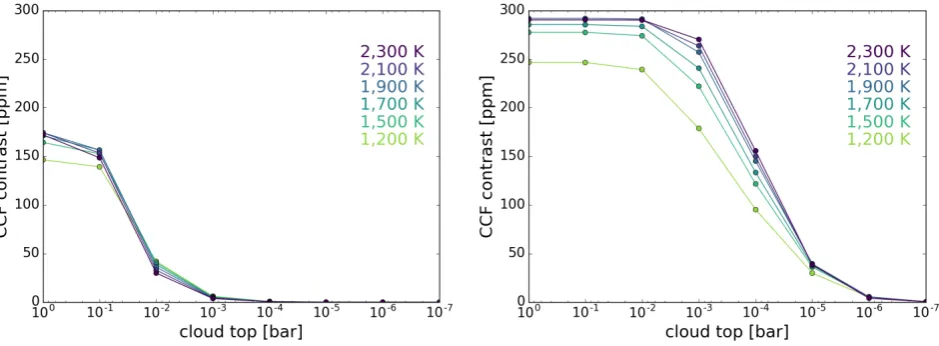
Fig. 4. Contrast of the CCF as a function of altitude of aerosols (expressed as pressure of the cloud top). Lighter colours indicate colder models,
darker colours indicate hotter models (between 1200 and 2300 K), as indicated by the colour-matched labels.Left panel:(4ν) band, as observed with ESPRESSO. A sharp decrease in the contrast of the CCF happens for aerosols higher than 10−1 barRight panel:(ν+δ) band, as observed with GIANO. A sharp decrease in the contrast of the CCF is caused by aerosols higher than 10−3bar, thus this water band is less muted by aerosols compared to the (4ν) band.
the narrower LSF). We stress that the contrast of the CCF is also dependent on the resolving power (since energy is conserved), and it is thus vital to know well the instrumental profile (hence the choice of stabilized spectrographs with oversampled LSFs). A red dashed line shows the fit to the case of pc =0.01 mbar
performed using Eq. 2. The fit is in good agreement with the simulations. Similar fits were performed for each simulated CCF (not shown).
3. Results and discussion 3.1. Ideal case
We first discuss the case of solar water abundance with an opaque, grey absorber found at a pressurepc, representing a pop-ulation of particles of size&2µm (see Sect.2.1) in the ideal case (telluric absorption neglected). In Fig.4, we showcase the con-trast of the CCF for models at various temperatures as a function of pc for two example bands ((4ν) and (ν+δ)). The following
conclusions drawn from this example hold also for the other bands. Firstly, the CCF of the redder bands have a stronger con-trast than the CCF of the bluer bands; secondly, the higher in
the atmosphere the aerosols are found, the more damped is the signal. A sharp drop in the signal is observed for aerosols higher than a critical pressure; thirdly, the precise value of this critical pressure depends on which band is considered; finally, the tem-perature dependence, represented by curves of different colours in Fig.4, is modest.
[image:6.595.64.534.305.478.2]5890.0 5890.5 5891.0 5891.5 5892.0 5892.5 5893.0
Wavelength [
Å
]
1000
0
1000
2000
3000
4000
δ
− R
P/R
® 2
[p
pm
]
2,300 K
2,100 K
1,900 K
1,700 K
1,500 K
1,200 K
11105
11106
11107
11108
11109
11110
Wavelength [
Å
]
500
[image:7.595.71.530.82.252.2]0
500
1000
1500
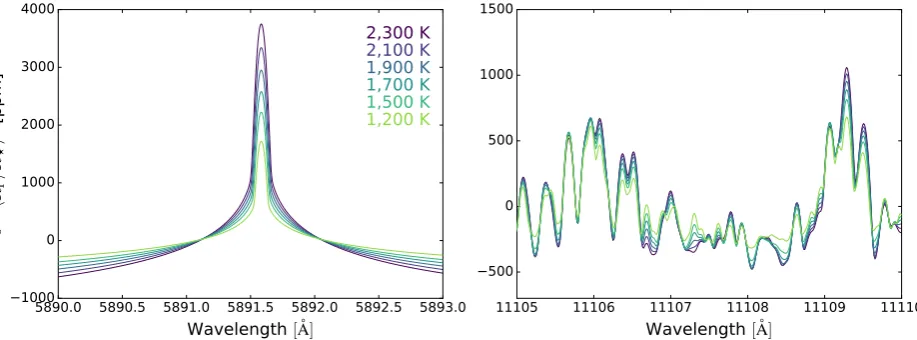
Fig. 5.Temperature dependence of the high-resolution transmission spectrum of a hot Jupiter. The temperature varies between 1200 and 2300 K
in steps of∼200 K (from light to dark).Left panel:zoom on one line of the sodium doublet. The contrast of the sodium feature in the hottest atmosphere (purple) is approximately twice its contrast in the coldest atmosphere (light green). This behaviour is explained through the linear dependence of atmospheric signal on temperature through the scale height.Right panel:zoom on a region of the (2ν+δ) water band. Even if in general the hottest transmission spectrum has a higher contrast compared to the coldest one, the dependence on temperature is non-linear. Some specific lines are actually stronger in a colder atmosphere (e.g. close to 11 107.5 Å).
techniques of molecular signatures through cross-correlation needs to properly account for this factor (Allart et al. 2017).
Figure6 shows the contrast of the CCF of all considered water bands in the ideal case. Here, each colour corresponds to a cloud deck at a given pressure, as shown in the upper panel. In the lower panel, the vertical error bar in each band repre-sents the CCF contrast values spun when temperature is varied between 1200 and 2300 K. The fact that curves corresponding to different values of pc do not overlap means it is possible to discriminate among the different cases. The models are best distinguished with a broad wavelength coverage. We indicate as vertical error bars the 1-pixel 1σ precision of HARPS and ESPRESSO, obtained with the respective exposure time calcula-tors (ETCs) and compatible withAllart et al.(2017), and valid for HD189733b. The CCF spans about 5 pixels (Allart et al. 2017), implying that the 1σphoton noise precision on the CCF is even
better. However, additional noise is introduced by telluric resid-uals (see AppendixA). In particular, the technique can only be used for targets with a combination of systemic velocities and BERV such that telluric lines are moved by a few resolution elements; otherwise, telluric absorption would contaminate, or even hinder, the planetary signal. The NIR bands investigated in this section are not accessible from the ground for the presence of telluric absorption, and we did not attempt an estimation of the precision of a hypothetical space-borne or stratospheric high-resolution spectrograph (see AppendixAand Sect.2). However, it is clear that a HARPS-like precision would suffice to detect the CCF of the NIR water bands at high confidence in the absence of telluric noise.
3.2. A metric to diagnose aerosols
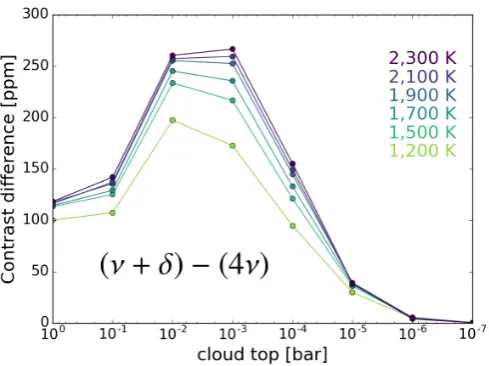
The fact that the critical pressure above which the CCF is damped differs from band to band is crucial to discriminate aerosol-free and aerosol-rich atmospheres. This is quantified by the difference between the CCF contrast of pairs of bands (∆C). In Fig.7, we showcase this difference for the bands (ν+δ) and (4ν). This difference is significantly higher when aerosols are
found around 1–10 mbar, high enough to conceal the (4ν) water band at 7200 Å but not the (ν+δ) water band at 19 000 Å. The contrast difference∆C between different pairs of bands peaks for
different pressures of the aerosols, depending on the value of the critical pressure of both bands. Furthermore, the maximum value of∆C indicates how much the pair of bands discriminates among models. We performed this analysis for every pair of bands, and show the results in Fig.8. Overall, combinations of bands cover-ing the optical to the NIR can discriminate at the 200 ppm level aerosol decks at 1 bar< pc <0.1 mbar, and for the considered instruments. This value of∆C is readily detectable with current or upcoming stabilized spectrographs in the optical, and with a space-borne or stratospheric NIR instrument of similar perfor-mance. Indeed, rescaling the precision obtained byAllart et al.
(2017) to a CCF built with 800 lines yields a 1-pixel precision of 62 ppm on the CCF contrast with HARPS, and of 24 ppm with ESPRESSO in a single transit (see also AppendixA). We summarize in Table3the maximum value of∆C and the pres-sure range where it is achieved for different pairs of water bands observed with HARPS-N, ESPRESSO and GIANO as detailed in Tables1and2. Higher resolving power, especially in the NIR, would provide even higher values of∆C.
3.3. Telluric contamination
We repeated the analysis focusing on the infrared transparency windows of Earth. These coincide with the transparency win-dows in the exoplanet. In transmission geometry, the loss in absorption is not so abrupt because the stellar light-rays cross transversely the atmosphere. The net result is that the analysis is still sensitive to the presence of aerosols, but at the reduced level of ∼100 ppm (see Table 4 and Fig. 10). This is likely already enough to detect the presence of aerosols with the sim-ulated GIARPS and ESPRESSO observations (see TableA.1). This is demonstrated by adding to our simulated observations the impact of telluric absorption, as described in AppendixA. We accounted for both the increase in the photon noise due to the reduced photon count in the core of telluric water lines, and for residuals of an imperfect telluric correction.
Moreover, at least two strategies to further increase the signal are possible:
6000
8000
10000
12000
14000
16000
18000
20000
Wavelength
[
Å
]
0
50
100
150
200
250
300
CCF contrast [ppm]
10
−710
−610
−510
−410
−310
−210
−110
0 [image:8.595.73.524.78.534.2]p
c[bar]
Fig. 6.Results in the ideal case.Upper panel:high-resolution models of a hot Jupiter withT =1700 K and different values ofpc, ranging between
10−7and 1 bar. Each colour corresponds to a different value ofpc, and the lightest colours correspond to condensates deeper in the atmosphere. Lower panel:CCF contrast as a function of wavelength. The colours are in correspondence with the models shown in theupper panel. For each value ofpc, the temperature range 1200–2300 K is explored. We indicate with a vertical error bar the induced variation in the contrast of the CCF. On the left, the 1-pixel, 1σprecision of HARPS (blue) and ESPRESSO (green) for a single transit are shown. These error bars only account for photon noise, but telluric residuals may introduce additional noise (see AppendixA). The NIR bands must be accessed from space or from the stratosphere. Such instruments do not yet exist, and we do not estimate an error bar.
telluric lines, thus likely accessible from the ground; GIANO is sensitive also to the K band, not considered here;
2. We simulated GIANO observations in the NIR. GIANO has a resolving power of ∼50 000, however instruments at higher resolving power are available (CARMENES) and several others will be in the near future (NIRPS, SPIRou, CRIRES+, etc.). A higher resolving power has the advantage that the CCF contrast is higher, because of the narrower LSF and because less molecular lines are blended in the spectrum (see Fig.2).
3.4. Non-grey aerosols
The assumption that aerosols have a grey scattering cross-section is only valid for particles of size larger than about 2µm, and up
toλ∼3µm. We discuss the more general scenario of non-grey aerosols, without performing full simulations that would require an implementation of the Mie theory of scattering.
At wavelengths longer than 3 µm, distinctive absorption
features of aerosols species such as water or silicates become prominent in transmission spectra (de Mooij et al. 2013;Mollière et al. 2017). These relatively narrow features uniquely iden-tify the composition of aerosols, making them probes of the chemistry of exoplanets. However, at wavelengths longer than 5 µm, where the majority of such features are located, the sky background is too bright for ground-based spectrographs to be effective (Snellen et al. 2013).
In the wavelength range <2 µm that we considered in this
Fig. 7.Difference in contrast between the CCF of the (ν+δ) and the (4ν) bands (both shown in Fig.4). The difference is highest when aerosols are found at pressures of 10−2–10−3bar. Thus, the measurement of the contrast of both CCFs constrains the presence of aerosols at that height. We note that this pair of water bands is partially sensitive to aerosols lower in the atmosphere as well.
section of aerosols that decreases with wavelength with a typi-cal slope, if they are present (e.g.Pinhas & Madhusudhan 2017; the precise particle size depends also on the wavelength of inci-dent light and is smaller in the optical). Several hot Jupiters host aerosols of this kind (Sing et al. 2016; Barstow et al. 2017). Compared to the grey aerosols considered heretofore, this sce-nario exacerbates the difference in contrast between the optical water bands, even more affected by scattering from this kind of aerosols, and the NIR water bands. ∆C is thus increased, and aerosols are readily detected also in this case. We tested this by simulating an atmosphere compatible with HD189733b, which hosts a marked optical slope attributed to this kind of particles (Pont et al. 2013;Pino et al. 2018). In this case∆C reaches up to 100 ppm, and aerosols are thus promptly detected.
The chromatic dependence of the cross section of small aerosols makes it more challenging to locate their height in the atmosphere. Yet, its slope and uniformity indicate the distribu-tion of the sizes of the scattering particles and their composidistribu-tion (Berta et al. 2012; Pont et al. 2013; Wakeford & Sing 2015;
Pinhas & Madhusudhan 2017). An extension of the technique that we presented has thus the potential to characterize the population of aerosols in the atmosphere. However, a detailed assessment requires detailed modelling of Mie scattering by aerosols, and is out of the scope of this paper.
Snellen (2004), Di Gloria et al. (2015), and Heng (2016) presented alternative techniques that are able to constrain the presence of chromatic scattering by aerosols through high-resolution spectrographs of the kind we considered. If chromatic scattering can be excluded using such techniques, ∆C can be used to infer the altitude of aerosols as discussed in Sect.3.2.
3.5. Water abundance
Throughout the paper we have assumed a solar VMR for water. This is broadly supported by equilibrium chemistry calcula-tions over a broad range of temperatures (e.g.Sharp & Burrows 2007;Miguel & Kaltenegger 2014) and by current observational evidence (e.g.Crossfield 2015; Todorov et al. 2016). However, determining the absolute abundance of water from observations is challenging (see, e.g.,Kreidberg et al. 2014b;Wakeford et al. 2018). We first discuss the observational strategy to measure the
water mixing ratio in transmission and its limitations. Then, we show that an uncertainty in the VMR of water directly trans-lates in an uncertainty in the altitude of aerosols inferred under the assumption of a grey aerosol deck (see Sect.3.2). A similar impact on the inferred properties of aerosols (particle size dis-tribution, composition, etc.) is expected in the more general case of chromatic scattering by aerosols (see Sect.3.4).
Measuring the VMR of atomic and molecular species with ground-based, high-resolution transmission spectroscopy. High-resolution spectra from the ground can only provide measure-ments of the difference between the transit depths at different wavelengths. We now consider two atomic/molecular atmo-spheric species 1 and 2, that are the dominating source of opacity at wavelengths λ1 andλ2, respectively. Lecavelier Des Etangs
et al. (2008) and Désert et al. (2009) first have shown how to relate the difference between the transit depths at these two wavelengths to the abundance ratio of the atmospheric species. The same result can be obtained by using Eq. (12) byHeng & Kitzmann(2017), valid in the isothermal, isobaric case. Indeed, by dividing by the stellar radius and differentiating this equation, the difference in the transit depth at the two wavelengths can be related to the volume mixing ratio and the cross section of the dominating spectral feature at the two wavelengths as
R(λ2) R? −
R(λ1) R?
= H R?
ln VMR2σ2 VMR1σ1
!
. (3)
The scale heightHcan be inferred by comparing the observed planet radius at different wavelengths where the cross-section is known (Benneke & Seager 2012). At high resolution, this is possible by using multiple bands of the same molecule where aerosols have a small impact. Unfortunately, water is not well suited to the task from the ground, since the contrast of the CCF in theY, J and H transparency windows is impacted by rela-tively low aerosols at the 10−1bar level. Other molecules such as methane and titanium monoxide, or atomic species such as the alkali doublets (Heng 2016), may be better suited, since they are less impacted by telluric absorption.
Without tellurics contamination, for example from a hypo-thetical space-borne or stratospheric high-resolution spectro-graph, the water bands (ν+δ) and (2ν) are ideally suited. Indeed, by rearranging Eq. (3) and evaluating it in the (ν+δ) and (2ν)
water bands, we can isolate the scale height: H
R?
= R(ν+δ)−R(2ν) R?ln
σH2O
(ν+δ)
σH2O
(2ν)
. (4)
From Fig.8, we see that the contrast difference between the two bands is constant for aerosols up to 10−4bar. In this region, the contrast difference is set by the intrinsic difference in contrast between the bands, and is thus a probe of scale height. Farther in the infrared, stronger molecular bands may be even better suited for the task.
Besides knowing the scale height, a second step is necessary to measure the volume mixing ratio VMR2of a given constituent using Eq. (3). Indeed, we need to compare the transit depth in a wavelength region where it is the dominating source of opacity to a region where the dominating source of opacity has a known VMR1. Then, we can invert Eq. (3) to get VMR2.
Fig. 8. Sensitivity of different combinations of water bands to the presence of aerosols. Each panel shows the difference between the band highlighted in the bottom rowand the band highlighted in the left column. The x- and y-axes are the same as for Fig.7, running between 1 and 10−7 bar and between 0 and 300 ppm, respectively. Orange and green horizontal dashed lines are put in correspondence to the 100 and 200 ppm levels.
Table 3.Typical CCF contrast difference (∆C) between pairs of water
bands and pressure range where this maximum difference is reached.
Water bands Cloud pressure (bar) ∆C (ppm)
(ν+δ)–(2ν) 1–10−4 50
(ν+δ)–(2ν+δ) 10−2–10−4 150–200 (ν+δ)–(4ν) 10−2–10−3 200
(ν+δ)–(4ν+δ) 1–10−3 250
(2ν)–(2ν+δ) 10−3 100
(2ν)–(4ν) 10−2–10−3 150–200
(2ν)–(4ν+δ) 1–10−3 150–200 (2ν+δ)–(4ν+δ) 1–10−2 120
(2ν+δ)–(4ν) 10−2 100
(4ν)–(4ν+δ) 1–10−1 100
Notes.See also Fig.8.
performed without directly measuring the transit depth but only comparing excesses in different bands. They are thus possible with ground-based high-resolution facilities. Yet, an hypothet-ical space-borne or stratospheric high-resolution spectrograph may be able to directly measure the transit depth, as the effect of Earth atmosphere is absent or severely limited. Already now, the transit depth can be measured from space, or with photomet-ric and multi-object spectroscopic techniques from the ground, albeit at lower resolution (up toR ∼103, too low to apply the CCF technique).
However, even a direct measurement of the transit depth within a molecular band is not sufficient to infer its VMR. Indeed, the pressure-radius7 pref(rref) at an arbitrary reference level must be known. This can be obtained by directly measuring
7 Either of the two can be arbitrarily fixed, and the other becomes a free parameter.
Table 4.Typical CCF contrast difference (∆C) between pairs of water
bands and pressure range where this maximum difference is reached when considering regions where telluric correction is possible.
Water bands Cloud pressure (bar) ∆C (ppm)
Hband–Jband 10−3 50
Hband–Yband 10−2–10−3 50 Hband–(4ν) 10−2–10−3 50–100
Hband-(4ν+δ) 1–10−2 100
Jband–Yband 1–10−2 25
Jband–(4ν) 10−2–10−3 50–25
Jband–(4ν+δ) 1–10−2 100
Yband–(4ν+δ) 1–10−2 50
Yband–(4ν) 10−2 <50
(4ν)–(4ν+δ) 1–10−1 100
Notes.See also Fig.10.
the transit depth in an absorption feature generated by a species of known VMR (Lecavelier Des Etangs et al. 2008).
Lecavelier Des Etangs et al.(2008) proposed Rayleigh scat-tering by H2 as such a comparison feature. However, the task of detecting the absorption feature of molecular hydrogen is hin-dered in the presence of Rayleigh scattering by aerosols that may contaminate the optical region of the spectrum. As discussed in Sect. (3.4) measuring the slope of the optical transmission spec-trum and its uniformity provides hints on whether aerosols of small size are present or not in the atmosphere.
[image:10.595.322.537.430.570.2]6000
8000
10000
12000
14000
16000
18000
20000
Wavelength
[
Å
]
0
50
100
150
200
250
300
CCF contrast [ppm]
10
−710
−610
−510
−410
−310
−210
−110
0 [image:11.595.64.534.81.550.2]p
c
[bar]
Fig. 9.CCF contrast as a function of wavelength in the case where telluric contamination is considered, in the presence of a grey opacity source
simulating large condensates at various pressure levels.Upper panel: high-resolution models of a hot Jupiter withT =1700 K. Each colour corresponds to a different value ofpc, ranging between 10−7and 1 bar, and the lightest colours correspond to condensates deeper in the atmosphere. Lower panel:CCF contrast as a function of wavelength. The colours are in correspondence with the models shown in theupper panel. For each value ofpc, the temperature range 1200–2300 K is explored. We indicate with a vertical error bar the induced variation in the contrast of the CCF. On the left, the 1σprecision of HARPS (blue), ESPRESSO (green), GIANO (orange, red, and black) for theY,J, andHbands for a single transit are shown. These error bars only account for photon noise, but telluric residuals may introduce additional noise (see AppendixA).
radius equal to the sum of the planetary radius andzeqproduces the same absorption depth as the planet and its translucent atmo-sphere. We can reformulate the concept as an equivalent pressure peqby
peq=prefexp
zeq/H
, (5)
whereprefis the pressure at the arbitrarily chosen reference level. Within a water bandn, water is the dominant source of opacity, thus we can write
peq,n= VMRH2OhσH2Oinp 2 ref
τeq
s
2πrp
kBTµg, (6)
where hσH2Oin is the average cross section of the water lines within the nth molecular band, τeq ∼ 0.56 is the equiva-lent optical depth (Lecavelier Des Etangs et al. 2008), T is the atmospheric temperature, µ is the mean molecular weight of the atmospheric constituents, and g is the surface
gravity.
At first order, to determine if a water band is occulted or not by aerosols, we can compare its equivalent pressure with the pressure where aerosols are located. Thus, the drop in the con-trast of the CCF shown in Fig.4is located around the equivalent pressure within the considered water band.
Fig. 10.Sensitivity to the presence of aerosols of different combinations of bands that are accessible from the ground even in the presence of tellurics. Each panel shows the difference between the band highlighted in thebottom rowand the band highlighted in theleft column. Thex- and y-axes are the same as for Fig.7, running between 1 and 10−7bar and between 0 and 300 ppm, respectively. Orange and green horizontal dashed lines are put in correspondence to the 100 and 200 ppm levels. We note that these values are arbitrary. Scatterers up to the 0.1 mbar level produce values of∆C up to 100 ppm.
follows that peq,n,
peq,n = 10−3
χH2O
, (7)
wherepeq,n,is the equivalent pressure when water is present in
the atmosphere at solar abundance.
We tested numerically our intuition, by repeating the full analysis with VMRH2O =10−4 (about 0.1 the solar value). In Fig.11we compare the contrast of the CCF of the (ν+δ) band for VMRH2O =10−3 (blue) and VMRH2O =10−4 (red). When VMRH2Ois decreased by a factor of 10, aerosols located at pres-sures of a factor of 10 higher, thus deeper in the atmosphere, are sufficient to occult the water band, confirming Eq. (7).
The conclusion that high-resolution transmission spec-troscopy of water over a broad wavelength range can be used to infer the presence and constrain the properties of aerosols, such as their altitude in the simulated case of grey scattering, still holds. However, an unknown water abundance introduces an uncertainty in the aerosols properties, which must be accounted for.
4. Conclusions and future prospects
High-resolution, ground-based transmission spectra are obtained using double-normalized data reduction techniques. These tech-niques remove broadband features such as those due to aerosols. Here, we have demonstrated that the contrast difference of the CCF of different absorption bands of water (∆C), accessible with this kind of measurements, can still be used as a probe of the presence of aerosols. A key factor for the success of this tech-nique is having a broad wavelength coverage, which is provided by current and forthcoming instrumentation (see Sect.1).
[image:12.595.309.554.392.571.2]We limited our analysis to the contrast of the CCF, and thus did not consider the full information encoded in the CCF. For example, the broadening of the CCF is a function of temperature,
Fig. 11. Contrast of the CCF of the (ν+δ) band, observable with
GIANO, as a function of altitude of aerosols, expressed as pressure of the cloud top. The shadowed area is spanned by the models when the temperature is varied between 1200 and 2300 K. A sharp decrease in the contrast of the CCF is caused by aerosols higher than a critical pressure. For solar water abundance, this threshold is located at about 10−3bar (blue curve). For 0.1 times solar abundance, this threshold is located at about 10−2bar (red curve), thus 10 times deeper in the atmosphere.
absorption bands in the J andK bands, at 1.56 and 2.34µm, potentially observable in transmission (e.g. Brogi et al. 2016) whose intensity can in principle be compared. They have the advantage that CO is not a strong telluric absorber and of being in the transparency window of Earth; however, with two bands, less information can be extracted by using our technique. On the hot end of the hot Jupiter spectrum (T >2 000 K), titanium
monoxide (TiO) is a good candidate for the same reasons.
Hoeijmakers et al.(2015) andBrogi et al.(2017) demonstrate that, at high-resolution, inaccuracies in molecular line lists prop-agate to models, introducing uncertainties both in line position and strength (see also a discussion inPino et al. 2018). While this aspect needs to be thoroughly tested, progress is being made. The ExoMol line list (Tennyson et al. 2016) that contains billions of lines is computationally challenging to use but may possess the required accuracy for this kind of studies (Yurchenko et al. 2008,
2011).
The presence of multiple molecular species with overlap-ping bands and blended lines might also change the continuum level, and possibly the value of ∆C. However, in the wave-length range considered (λ < 2 µm), only water and titanium
monoxide were detected. While other constituents are most likely present, they are undetected, indicating that their signals must be less than the precision of current instrumentation. For this rea-son, their effect on the continuum should be negligible compared to that of aerosols. Furthermore, TiO is only expected in the hottest atmospheres (Teq&2000 K). Our technique can thus be safely applied to hot Jupiters with temperatures between about 1000 and 2000 K, but for hotter planets care must be taken in the interpretation of ∆C, and TiO included in the analysis. However, fewer aerosols are expected on this kind of planets (e.g.Heng 2016;Stevenson 2016). In addition, the TiO line list is unreliable at the shortest wavelengths considered in this paper (Hoeijmakers et al. 2015), thus we do not simulate this case.
An extension of the technique to wavelengthsλ >2µm and
to include chromatic scattering by aerosols is warranted, as it may enable the characterization of the composition and size distribution of aerosol particles. Such an extension requires mod-elling Mie scattering from aerosols and modmod-elling molecular spectral features from multiple species at high resolution.
Acknowledgements.We thank the entire exoplanet atmospheres group of the Geneva Observatory and the Exoplanet and Stellar Populations Group of the University of Padova for insightful discussions. We also thank the anonymous referee, whose constructive critiques sensibly improved the quality of this paper. This work has been carried out in the frame of the National Centre for Compe-tence in Research “PlanetS” supported by the Swiss National Science Foundation (SNSF). L.P., R.A, D.E., C.L., and F.P. acknowledge the financial support of the SNSF. This project has received funding from the European Research Coun-cil (ERC) under the European Union’s Horizon 2020 research and innovation programme (grant agreement No. 724427).
References
Allart, R., Lovis, C., Pino, L., et al. 2017,A&A, 606, A144 Astudillo-Defru, N., & Rojo, P. 2013,A&A, 557, A56
Baranne, A., Mayor, M., & Poncet, J. L. 1979,Vistas Astron., 23, 279 Baranne, A., Queloz, D., Mayor, M., et al. 1996,A&AS, 119, 373 Barstow, J. K., Aigrain, S., Irwin, P. G. J., & Sing, D. K. 2017,ApJ, 834, 50 Bean, J. L., Miller-Ricci Kempton, E., & Homeier, D. 2010,Nature, 468, 669 Benneke, B., & Seager, S. 2012,ApJ, 753, 100
Berta, Z. K., Charbonneau, D., Désert, J.-M., et al. 2012,ApJ, 747, 35 Birkby, J. L., de Kok, R. J., Brogi, M., et al. 2013,MNRAS, 436, L35 Boisse, I., Moutou, C., Vidal-Madjar, A., et al. 2009, inTransiting Planets, eds.
F. Pont, D. Sasselov, & M. J. Holman,IAU Symposium, 253, 462
Brandl, B. R., Feldt, M., Glasse, A., et al. 2014,Ground-based and Airborne Instrumentation for Astronomy V, Proc. SPIE, 9147, 914721
Brogi, M., de Kok, R. J., Albrecht, S., et al. 2016,ApJ, 817, 106
Brogi, M., Line, M., Bean, J., Désert, J.-M., & Schwarz, H. 2017,ApJ, 839, L2 Brogi, M., Giacobbe, P., Guilluy, G., et al. 2018,A&A, 615, A16
Charbonneau, D., Brown, T. M., Noyes, R. W., & Gilliland, R. L. 2002,ApJ, 568, 377
Claudi, R., Benatti, S., Carleo, I., et al. 2017,Eur. Phys. J. Plus, 132, 364 Conod, U., Blind, N., Wildi, F., & Pepe, F. 2016,Adaptive Optics Systems V,
Proc. SPIE, 9909, 990941
Cosentino, R., Lovis, C., Pepe, F., et al. 2012,Ground-based and Airborne Instrumentation for Astronomy IV, Proc. SPIE, 8446, 84461V
Crepp, J. R., Bechter, A., Bechter, E., et al. 2014,American Astronomical Society Meeting Abstracts, 223, 348.20
Crossfield, I. J. M. 2014,A&A, 566, A130 Crossfield, I. J. M. 2015,PASP, 127, 941
de Kok, R. J., Brogi, M., Snellen, I. A. G., et al. 2013,A&A, 554, A82 de Kok, R. J., Birkby, J., Brogi, M., et al. 2014,A&A, 561, A150 de Mooij, E. J. W., Brogi, M., de Kok, R. J., et al. 2013,ApJ, 771, 109 Deming, D., & Sheppard, K. 2017,ApJ, 841, L3
Désert, J.-M., Lecavelier des Etangs, A., Hébrard, G., et al. 2009,ApJ, 699, 478
Di Gloria, E., Snellen, I. A. G., & Albrecht, S. 2015,A&A, 580, A84
Ehrenreich, D., Tinetti, G., Lecavelier Des Etangs, A., Vidal-Madjar, A., & Selsis, F. 2006,A&A, 448, 379
Ehrenreich, D., Vidal-Madjar, A., Widemann, T., et al. 2012,A&A, 537, L2 Ehrenreich, D., Bonfils, X., Lovis, C., et al. 2014,A&A, 570, A89
Esteves, L. J., de Mooij, E. J. W., Jayawardhana, R., Watson, C., & de Kok R. 2017,AJ, 153, 268
Follert, R., Dorn, R. J., Oliva, E., et al. 2014, Ground-based and Airborne Instrumentation for Astronomy V, Proc. SPIE, 9147, 914719
France, K., Fleming, B., West, G., et al. 2017, in Society of Photo-Optical Instrumentation Engineers (SPIE) Conference Series, 10397, 1039713 Gibson, N. P., Nikolov, N., Sing, D. K., et al. 2017,MNRAS, 467, 4591 Grimm, S. L., & Heng, K. 2015,ApJ, 808, 182
Heng, K. 2016,ApJ, 826, L16
Heng, K., & Kitzmann, D. 2017,MNRAS, 470, 2972 Heng, K., Wyttenbach, A., Lavie, B., et al. 2015,ApJ, 803, L9 Hinkle, K. H., Wallace, L., & Livingston, W. 2003,BAAS, 35, 1260
Hoeijmakers, H. J., de Kok, R. J., Snellen, I. A. G., et al. 2015,A&A, 575, A20 Jurgenson, C., Fischer, D., McCracken, T., et al. 2016, Ground-based and
Airborne Instrumentation for Astronomy VI, Proc. SPIE, 9908, 99086T Kotani, T., Tamura, M., Suto, H., et al. 2014, Ground-based and Airborne
Instrumentation for Astronomy V, Proc. SPIE, 9147, 914714 Kreidberg, L., Bean, J. L., Désert, J.-M., et al. 2014a,Nature, 505, 69 Kreidberg, L., Bean, J. L., Désert, J.-M., et al. 2014b,ApJ, 793, L27
Lecavelier Des Etangs, A., Pont, F., Vidal-Madjar, A., & Sing, D. 2008,A&A, 481, L83
Lendl, M., Delrez, L., Gillon, M., et al. 2016,A&A, 587, A67
Mahadevan, S., Ramsey, L., Bender, C., et al. 2012,Ground-based and Airborne Instrumentation for Astronomy IV, Proc. SPIE, 8446, 84461S
Marconi, A., Di Marcantonio, P., D’Odorico, V., et al. 2016,Ground-based and Airborne Instrumentation for Astronomy VI, Proc. SPIE, 9908, 990823 Mayor, M., Pepe, F., Queloz, D., et al. 2003,Messenger, 114, 20
McCarthy, D. W., Burge, J. H., Angel, J. R. P., et al. 1998,Infrared Astronomical Instrumentation, ed. A. M. Fowler,Proc. SPIE, 3354, 750
Miguel, Y., & Kaltenegger, L. 2014,ApJ, 780, 166
Mollière, P., van Boekel, R., Bouwman, J., et al. 2017,A&A, 600, A10 Nascimbeni, V., Piotto, G., Pagano, I., et al. 2013,A&A, 559, A32
Oliva, E., Origlia, L., Baffa, C., et al. 2006,Society of Photo-Optical Instrumen-tation Engineers (SPIE) Conference Series, Proc. SPIE, 6269, 626919 Pepe, F., Mayor, M., Galland, F., et al. 2002,A&A, 388, 632
Pepe, F. A., Cristiani, S., Rebolo Lopez, R., et al. 2010,Ground-based and Airborne Instrumentation for Astronomy III, Proc. SPIE, 7735, 77350F Pinhas, A., & Madhusudhan, N. 2017,MNRAS, 471, 4355
Pino, L., Ehrenreich, D., Wyttenbach, A., et al. 2018,A&A, 612, A53 Pont, F., Sing, D. K., Gibson, N. P., et al. 2013,MNRAS, 432, 2917
Press, W. H., Flannery, B. P., Teukolsky, S. A., & Vetterling, W. T. 1989, Numerical Recipes in C. The Art of Scientific Computing(Cambridge, UK: Cambridge University Press)
Quirrenbach, A., Amado, P. J., Caballero, J. A., et al. 2014,Ground-based and Airborne Instrumentation for Astronomy V, Proc. SPIE, 9147, 91471F Schwab, C., Rakich, A., Gong, Q., et al. 2016, Ground-based and Airborne
Instrumentation for Astronomy VI, Proc. SPIE, 9908, 99087H Sharp, C. M., & Burrows, A. 2007,ApJS, 168, 140
Sing, D. K., Wakeford, H. R., Showman, A. P., et al. 2015, MNRAS, 446, 2428
Sing, D. K., Fortney, J. J., Nikolov, N., et al. 2016,Nature, 529, 59 Snellen, I. A. G. 2004,MNRAS, 353, L1
Snellen, I. A. G., de Kok, R. J., de Mooij, E. J. W., & Albrecht, S. 2010,Nature, 465, 1049
Snellen, I. A. G., de Kok, R. J., le Poole, R., Brogi, M., & Birkby, J. 2013,ApJ, 764, 182
Stevenson, K. B. 2016,ApJ, 817, L16
Strassmeier, K. G., Ilyin, I., Järvinen, A., et al. 2015,Astron. Nachr., 336, 324 Szentgyorgyi, A., Frebel, A., Furesz, G., et al. 2012,Ground-based and Airborne
Instrumentation for Astronomy IV, Proc. SPIE, 8446, 84461H
Szentgyorgyi, A., Barnes, S., Bean, J., et al. 2014,Ground-based and Airborne Instrumentation for Astronomy V, Proc. SPIE, 9147, 914726
Tennyson, J., Yurchenko, S. N., Al-Refaie, A. F., et al. 2016,J. Mol. Spectr., 327, 73
Thibault, S., Rabou, P., Donati, J.-F., et al. 2012,Ground-based and Airborne Instrumentation for Astronomy IV, Proc. SPIE, 8446, 844630
TMT Project. 2013, TMT Science-based Requirements Document, TMT docu-ment number TMT.PSC.DRD.05.001.CCR19, Tech. Rep.
Todorov, K. O., Line, M. R., Pineda, J. E., et al. 2016,ApJ, 823, 14
Vidal-Madjar, A., Arnold, L., Ehrenreich, D., et al. 2010,A&A, 523, A57 Wakeford, H. R., & Sing, D. K. 2015,A&A, 573, A122
Wakeford, H. R., Stevenson, K. B., Lewis, N. K., et al. 2017, ApJ, 835, L12
Wakeford, H. R., Sing, D. K., Deming, D., et al. 2018,AJ, 155, 29 Wright, J. T., & Robertson, P. 2017,Res. Notes Am. Astron. Soc., 1, 51 Wyttenbach, A., Ehrenreich, D., Lovis, C., Udry, S., & Pepe, F. 2015,A&A, 577,
A62
Wyttenbach, A., Lovis, C., Ehrenreich, D., et al. 2017,A&A, 602, A36 Yuk, I.-S., Jaffe, D. T., Barnes, S., et al. 2010, Ground-based and Airborne
Instrumentation for Astronomy III, Proc. SPIE, 7735, 77351M
Yurchenko, S. N., Voronin, B. A., Tolchenov, R. N., et al. 2008,J. Chem. Phys., 128, 044312
Yurchenko, S. N., Barber, R. J., Tennyson, J., Thiel, W., & Jensen, P. 2011,J. Mol. Spectr., 268, 123
Appendix A: Estimate of photon and telluric noise in CCF observations
A complete assessment of noise sources in real observations of the water CCF is out of the scope of this paper. We do not sim-ulate systematic instrumental effects, since they are different for different instruments, and only partially understood. We stress that having a single instrument able to cover multiple bands such as CARMENES, or a combination of instruments sharing the optics such as HARPS-N + GIANO or HARPS + NIRPS, is generally preferable to combining non-simultaneous observa-tions from different instruments. Instead, we provide estimates of the impact of photon noise and imperfect telluric removal, which are shared by all observations provided by ground-based instrumentation.
A.1. Telluric contamination
In the next future, the kind of observations that we simulated will be carried out only from the ground. We thus estimated the impact of imperfect telluric correction on the simulated observations.
We adopted a telluric transmittance spectrumT1(λ) based on observations of the Sun (Hinkle et al. 2003). We scaled the telluric spectrum, given at air mass 1, at a generic air mass followingVidal-Madjar et al.(2010):
Ta(λ)=(T1)a(λ), (A.1)
where a is the target air mass. A transmission spectrum is built by taking the ratio of in- and out-of-transit spectra. We assumed that these are observed at typical air masses 1 and 1.2, respectively. The exact value chosen is not critical. We injected residuals of imperfect telluric correction in our transmission spectra according to
δtell(λ)=1−
(
1− C
"
1−TT1
1.2 ·λ 1+ BERV
c
!
1+vsyst c
#)
×(1−δ(λ)),
(A.2) where δ(λ) is the telluric-free model and the telluric spectrum
is injected to account for the non-zero systemic velocity of the target starvsystand the BERV (Barycentric Earth Radial Veloc-ity). For a typical case, we fix vsyst = −2.27 km s−1 as for HD189733b (Boisse et al. 2009) and take a BERV of about 30 km s−1. The constant C ranges between 0 and 1, and rep-resents the quality of the telluric correction. For C = 0 the correction is ideal, that is there are no telluric residuals, for
C=1 there is no correction. We tuned Cin order to have the telluric residual in the simulated HARPS CCF within the noise level on the CCF obtained byAllart et al.(2017) on HD189733b. This is obtained by setting C= 2%, and constitutes a worst-case scenario for the quality of telluric correction with their technique.
It is safe to assume that with ESPRESSO a better qual-ity telluric correction level will be achieved. On the other hand, GIANO data will always be obtained simultaneously to HARPS-N. With the exception of OH emission features, the strongest telluric bands in the NIR are due to the same species that produce them in the optical. Thus, the model transmission spectrum obtained in the optical can be extended to the GIANO wavelength range, and refined with the additional information, to correct for most of the telluric features. In the NIR range, other techniques that exploit the change in the radial velocity
of the planet are available (e.g.Brogi et al. 2018). Here, we do not simulate them.
In the (2ν+δ), (2ν) and (ν+δ) water bands telluric lines
sat-urate, leaving no flux for ground-based observations (see Fig.1). However, Fig.A.1shows that the CCF signal is recovered in the (4ν+δ), (4ν), J and H bands even in the presence of telluric residuals. We note that the (4ν) band is located within a stronger
telluric water band, which results in stronger residuals; however, as already mentioned, our estimate of the telluric correction in this region is likely pessimistic since based on HARPS data, of lower quality with respect to what ESPRESSO will provide. TheY band shows some strong telluric residuals that hinder the detection of the exoplanet water feature. However, the same band is accessible at higher resolving power (e.g. CARMENES), and weighted CCF methods (adapted fromBaranne et al. 1996;Pepe et al. 2002) may enhance the signal.
It may be surprising that a signal was recovered in theJand Hbands, considering the non-negligible absorption by molecu-lar oxygen, carbon dioxide and methane there. This is due to the different structure of the spectrum of these species compared to water. Water has a dense forest of lines, while oxygen, carbon dioxide, and methane have a more symmetrical structure which results in well-separated lines (see Fig.A.2). At the resolution of GIANO, it is thus possible to use the information in-between the lines of these molecules to detect water, even in the absence of any weighting or masking of the telluric lines.
A.2. Photon noise
To estimate the impact of photon noise on the retrieval of the contrast of the CCFs, we simulated observations of HD189733 with the ETCs of ESPRESSO8and of GIANO9. We assumed
– a K2V model for the host star, with magnitudesV=7.648
andK=5.541;
– seeing 1 arcsec, air mass 1.2, exposure time 300 s; – single HR 2×1 slow readout mode for ESPRESSO. The ETCs provide the signal-to-noise ratio (S/N) on a stellar spectrum in each resolution element, (S/N)res.elem.. We then mul-tiplied this value for the square root of the telluric absorption template from (Hinkle et al. 2003), interpolating on a common grid. By doing so, we accounted for the increased photon noise within the core of the telluric lines. The ETC of GIANO par-tially accounts for telluric absorption, thus our estimate of the SNR is pessimistic. Finally, the (S/N)(λobs) on each point of the simulated observations is obtained by
(S/N)(λobs)=(S/N)res.elem.
p
T1(λobs)
×
s
∆λobs ∆λres.elem.
r
6480·Ntransit 300
(A.3)
where∆λobsis the wavelength bin of the simulated observations (see Table 1), ∆λres.elem. is the size of the resolution element in wavelength (computed by the ESPRESSO ETC; 2.7 km s−1
for GIANO), andNtransit is the number of transits observed. We assumed that the transit duration is 6480 s and neglected over-heads. We also assumed that the baseline is observed at a much larger (S/N) than the transit. For HARPS, the (S/N) is lowered by √6.25 taking into account the different efficiency and size of the telescope.
These calculations take into account the spectral features of the host star and the decrease of flux in the cores of the individual 8 https://www.eso.org/observing/etc/bin/gen/form?INS. NAME=ESPRESSO+INS.MODE=spectro
Fig. A.1.Effect of telluric contamination on observations of an aerosol-free HD189733b with HARPS-N (upper left panel), ESPRESSO (upper right panel), and GIANO (lower left panel).Red solid line: contamination-free transmission spectrum.Blue solid line: transmission spectrum in the presence of telluric residualso consistent withAllart et al.(2017). If the systemic velocity and the Barycentric Earth Radial Velocity combine such that the exoplanetary signal is shifted away from the telluric residual (here: 30 km s−1), the signal is recovered in the (4ν+δ), (4ν),JandH bands. In theYband, a more careful analysis than what performed here is possible, and may lead to a detection (see main text). In the (2ν+δ), (2ν) and (ν+δ) bands, water absorbs all the incident light making detection impossible from the ground.
telluric lines. Not surprisingly, the signal disappears within the (2ν+δ), (2ν) and (ν+δ) bands. However, in the Y, J, and
Hbands the signal is confidently recovered (see Fig.A.4). Table A.1 summarizes the results of our simulations. For each simulated cross-correlation function, we computed
Fig. A.2. Water and molecular oxygen absorption have different properties because of the different structure of the molecules.Upper panel: transmittance of Earth in theJband. The deep telluric lines are from molecular oxygen. They are well separated, and the transmittance approaches 1 between them.Lower panel: an aerosol-free model of HD189733b in the same region. Water generates a dense forest of lines, such that the exoplanetary signal can be recovered from the ground from in-between the deep oxygen telluric lines.
Table A.1.Value of the dispersion on a single-resolution element in the wings of the CCF of all considered bands for observations of a single
transit.
Band name Instrument simulated Precision (1 transit) Notes
(4ν+δ) HARPS(-N) 51 ppm Allart et al.(2017) reported 34 ppm with three transits,
equivalent to 58 ppm with one transit, with a mask similar to that adopted in this paper
(4ν) ESPRESSO 20 ppm
(2ν+δ) GIANO – Accuracy limited by telluric contamination
(2ν) GIANO – Accuracy limited by telluric contamination
(ν+δ) GIANO – Accuracy limited by telluric contamination
Yband GIANO 33 ppm
Jband GIANO 31 ppm
Hband GIANO 27 ppm
Notes. The GIANO resolution element is larger, which is why the precision is higher. However, this results in a more poorly sampled CCF
(see Fig.3).
Overall, provided that the planet is observed at sufficiently high systemic velocity and BERV, our analysis can be carried out with current ground-based instrumentation. With forthcoming instrumentation mounted at larger telescopes and with a broad
[image:17.595.61.531.408.571.2]