The Automation of Bank Check Processing
· . . R. Hunt Brown Linear Programming and Computers
· . . Chandler Davis Justifying the-use of an Automatic Computer
· . . Net Chapin Charting an Automatic Data Processing System
Harry Eisenpress, James
l.
McPherson, and Julius Shiskin A Rotating Reading Head for Magnetic Tape and Wire· . . National Bureau of Standards Some Curiosities of Binary Arithmetic Useful in
Testing Binary Computers
The terminal with the right, connections
Looking for a special solder terminal? Your special is probably a standard at CTC. You'll find many terminals that you would normally consider specials included in CTC's 50 types of standard solder termi-nals. Whether you want regular size or miniature rivet type terminals for printed circuits to be dip soldered, CTC has a com-plete selection. Whatever your require-ments - standard or custom, you can de-pend on CTC's guaranteed components. And there are good reasons for this de-pendability.
Each manufacturing detail of every CTC terminal is double-checked for material and reliable performance. This quaUty con-trol enables us to offer you guaranteed com-ponents - whether to government stand-ards or your own.
Standard CTC solder. terminals are silver plated brass, coated with water dip lacquer to keep them chemically clean for soldering. Special order finishes include hot tin, electro-tin, electro-Iead, tin-zinc, cadmium plate, gold flashing or gold plate. All finishes go through a periodic mi-croscopic inspection for coating thickness
and adhesion. This is but one of many ways "CTC's quality control serves you.
In addition to terminals and boards, our quality control pays off for you in CTC ca-pacitors, swagers, insulated terminals, coil forms, coils and a wide variety of hard-ware. For complete specifications -and prices, write to Cambridge Thermionic Corporation, 430 Concord A venue, Cam-bridge 38, Mass. West Coast Manufac-turers contact: E. V. Roberts, 5068 West Washington Blvd., Los Angeles 16 and 988 Market St., San Francisco, California.
Standard eTe Terminal Boards as well as those
made to your own specifications by CTC are avail-able. Standard in cotton fabric phenolic, nylon phe-nolic or grade L-5 silicone impregnated ceramic. Custom made in cloth, paper phenolic, melamine, or silicone fibreglas laminates, imprinted as required and lacquered or varnished to specifications MIL-V-173 and JAN-T-152 or to commercial standards.
CAMBRIDGE THERMIONIC CORPORATION
makers
0/
guaranteed electronic components, custom or standard-COMPUTERS
AND
,CYBERNETICS
•
ROBOTS
•
AUTOMATION
AUTOMATIC CONTROL
Vol. 4,"No • 8
August, 1955
ESTABLISHED SEPTEMBER, 1951
ARTICLES
The Automation of Bank Check Processing
Justifying the Use of an Automatic Computer
A Rotating Reading Head for Magnetic Tape
and Wire
PAPERS
Linear Programmdng and Computers -- Part II
Charting on Automatic Data Processing Systems
Some Curiosities of Binary Arithmetic Useful
in Testing Binary Computers
REFERENCE INFORMATION
Books and Other Publications
FORUM
The Tale of a Cow
Electronic Computer Conference, Darmstadt,
Germany, Oct. 25-27, 1955
Additions and Revisions
The Editor's Notes
Index of Notices
Advertising Index
•••• R. Hunt Brown
•••• Ned Chapin
••
~.NatiQnalBureau of
Standards
•••• Chandler Davis
•••• Harry Eisenpress
James L. McPherson
Julius Shiskin
•••• Andrew D. Booth
•••• Jewell Bown,
Gordon Spenser, and
others
•••• M. E. Salveson
•••• A. Walther
6
17
24
10
21
33
28
20
4
34
4
4
42Editor: Edmund C. Berkeley
Assistant Editors: Eva DiStefano, Jewell Bown, Neil Macdonald Jack Moshman, Gordon Spenser, F. L. Walker
Advisory Committee: Samuel
B.
Williams, Herbert F. Mitchell, Jr., Justin OppenheimContributing Edi tors: Andrew D. Booth, John M. Breen, John W. ea:rr, III, Alston S. Householder, Fletcher Pratt
Publisher: Berkeley Enterprises, Inc.
36 West 11 St., New York 11, N. Y. - Algonquin 47675 815 Washington St., Newtonville 60, Mass. - Decatur 2 5453 or 2 3928
Advertising Representatives: San Francisco - W. A. Babcock 605 Market St., San Francisco 5, Calif. Los Angeles - Wentwo~th F. Green, 439 So. Western Ave., Los Angeles 5, Calif elsewhere -the Publ~sher
-OQMPUTERS AND AUTOMATION is published monthly. ~pyright, 1955 by Berkeley Enterprises, Inc. Subscription rates: $4. 50 for one year, $a. 50 for two years, in 'the Uni ted States: $5.00' for one year, $9. 50 for t.wo vears, in Canada; $5.50 for one year, $10.50 for two years elsewhere. Bulk subscription rates: see page 32. Adverti& ing rates: see page 40.
Entered as second class matter at the Post Office, New York, N. Y.
-THE
EDITOR~SNOTES
PAYMENT FOR PAPERS
Beginning with this issue, "Computers and Automation" will make payment for accepted pa-pers at half the rate of payment for articles -- (provided that the author wishes to be paidl This works out at $5 to $20 for 1000 to 4000 words. This token payment will help express our appreciation to those authors who prepare good papers for us to publish.
PATENTS
Hans Schroeder, who provided the informa-tion we ~ave published for many months about patents relating to computers, has entered the armed forces of the United States to fulfill his service requirements. If any reader of mrs is 'able and willing to survey the Patent G a-zette and report pertinent patents to us in the same style, we shall be glad to make an arrangement with him.
CORRECTION
In the story "The Book Reviewer" by Rose Orente in the July issue, the na~ of the psy-choanalyst whose theories are referred tosnouH be corrected to read "Edmund Bergler" instead of "Edward Bergler", since he is a real persm and not a fictitious character.
EMPLOYMENT REFERENCE SERVICE
Forum
ELECTRONIC COMPUTER CONFERENCE, DARMSTADT, GERMANY,
OCT. 25-27, 1955
A. Walther
Darlnstad~, Germany
Please let me annOWlce that according to the enclosed German circular there will be held an international conference on
"Elektronische Rechenmaschinen Wld InformationsverarbeitWlg"
(Electronic digital computers and in-formation processing)
at the
Institut fur Praktische Mathematik (lPM) Technische Hochschule, Darmstadt, Germany
on October 25-27, 1955, sponsored by GAMM (Ge-sellschaft fur Angewandte Mathematik Wld Mechan-ik) and NTG-VDE (Nachrichtentechnische Gesell-schaft im Verband Deutscher Elektrotechniker).
Would you please publish this annoWlcement in your journal "Computers and Automation"? Information on registration, which is open to all, may be obtained by writing:
Prof. Dr. A. Walther
Institut fur Praktische Mathematik (lPM) Technische Hochschule
Darmstadt, Germany
Every few days some man or some organiza-tion telephones us in regard to employment of computer people. The man says "Where are good places for me to seek employment in the compu-ter field?" The organizati on says "Do you mow of anybody who could fill this kind of a posi-tion •••• ?"
*---*---*
"Computers and Automation" will be glad1D act as a clearing house in this way, to the ex-tent of our knowledge; and we would s u g g est that classified advertising, as published fznm time to time in these pages, would be helpful. But the more that people tell us what they are looking for, the more we may be able to help.
INFORMATION AND REPORTERS
This brings us to the fact that a lot of the reference information we publish is depen-dent on what other people tell uSo We arevery grateful for the data that enables us to help computer people find out what they wany toknOW.
(continued on page 32)
4
-INDEX OF NOTICES
For information on:
Advertising Index Advertising Rates
Advertising Specifications Back Copies
Bulk Subscription Rates Manuscripts
Roster Entry Forms Special Issues
See Page:
42 40 40
38
16 34
36
33
Sylvania Tran,i'tor.
Sylvania
'Power
Transistors ...
- for military, industrial, and " commercia! applications.
Avail-able in commercial quantities.
" "BOW
w.itlz
increC31t
ratinds\
________ ,,.:' ...
_~_\' \,\ 1\
\'~\
dissipate
2Y2
watts i:n free air, \ ", "
I _. \
have
low
thermaf;~inertia
\~
'\ > NEw'Sylvania design developments achieve low thermal inertia and increased, ratings in the Sylvania Power Transistors 2N68 and 2N95. Dissipation of 2% watts in
free air reflects a full watt increase over previous ratings. Power dissipation up to 5 watts is possible with an external heat sink.
\
, ,High-Gain, Low Frequency-, 2N35 {NPN)-2N34
(PNP)-low to medium power-use as a high-gain audio . amplifier-gains up to 40 in ground-ed emitter circuit.
High-Power, Low Frequency-; 2N68 (PNP)-2N95 (NPN) in-l
creased power'ratings-use for high current, low voltage appTI. ; cations (6-24 volts power' supplies).
High Frequency-2N94 (NPN): -2N94A (NPN)-high alpha (over 0.95)-low base resistance: and collector capacitimce-typi- : cally 1500 ohms uufd-gains up ;
to 40 db. ' ;
~
Also available
in' commercial quantities
Silicon Jundion Diodas-1N137 A ; -lN138A and allied types-: high back resistance at high; opera ting temperatures.
Silicon Point-Contact Diodes-' IN19a, 1N194, INI95, 1N196- , 'specifically
de-signed for comput.. ' ,er and high
tem-perature general , purpose applica" tiC?ns. Excellent transient .response
(0.1 usee.)
For your semiconductor require-- ;
mants, check Sylvania
mst.
Use : this convenient form to indicate ; your interests and address it' to ;Department C20R. ;
\
:
With Sylvania's new design heat is conducted quickly away from active elements. Resulting low thermal inertia improves performance stability over a wider range of operating temperatures. Operated as a Class A
amplifier the 2N68 or 2N95 provides a minimum power
gain of 20 db.
..
-"-'-
-'-'_
...
-"'-Dept. F1SR
I
I
I
I
I
/I Another reason why it pays to specify .Sylvanla"
SYLVANIA ELECTRIC PRODUCTS INC.
1740 Broadway, New York 19, N. Y.
In Canada: Sylvania Electric (Canada) Ltd.,
University Tower Building, St. Catherine Street, Montreal, P. Q.
,~
SYLVANIA!
Sylvania Electric Products Inc.
1740 Broad~ay. New York 19. N. Y.
Gentlemen: Please forward additional in· formation on the items checked below: Transistors Silicon Diodes
o High Power 0 Point Contact
o High Gain 0 Junction'
o High Frequency
Nmne __________________________________ ___
AdWre~I __________________________________ _
City ___________________________________ _
Zone _ _ _ _ _ JoJState' __________ _
LIGHTING • RAD.IO • ~LECTRONICS • TELEVISION • ATOMIC ENERGY
-THE AUTOMATION OF BANK CHECK PROCESSING
R. Hunt Brown A utomation Cons~l tants
New York, N. Y.
An article by the author on the savings account problem was published in the July is-sue of "Computers and Automation". It refer-red to a report by the American Bankers Asso-ciation entitled "Automation of Bank ~erating
Procedure", in which both the checking and savings account problems are dealt with i n some detail. It is clear that new equipment and systems will need to be developed to solve these problems. Some excerpts from the ABA report are given below, to show the serious-ness of the situation:
"A study of the check collection system in 1954 by the Joint Commdttee on the Check Collection System of the American Bankers As-sociation, the Association of Reserve Cit Y Bankers, and the Federal Reserve System r e-vealed these interesting facts.
"The number of checking accounts in this country increased from 27 million to 47 m i I-lion between 1939 and 1952. In the same per-iod, the number of checks written annually grew from an estimated 3~ billion to nearly
R billion. About 7 billion of the checks writ-ten in 1952 were drawn on the more than 14,000 commercial banks throughout the country; 0 f
the balance, 450 million were checks drawn on Federal Reserve Banks.
n • • • should the trend of the past
thir-teen years continue, 14 bjllion checks would be written in 1960; and by 1970, check volume would be 22 billion. Although these levels may not be reached, an upward trend in volume is expected to continue.
"On an average day in 1952, about 29 mil-lion checks were written, and approximately the same number were deposited in or cashed at the average bank on that day; one in five was drawn on the bank and was charged to the drawer's account. The remaining four w ere drawn on other banks and were collected throujI
the check collection facilities provided by the banking system of the country.
"The average check deposited in or ca.smd at a bank passed through 2 1/3 banks in the process of collection from the drawee bank, and about 2 1/3 business days elapsed between the date it was deposited or cashed and the
-- ~ 6
-date it was presented for payment. Checks in process of collection through the banking sys-tem on an average day in 1952 numbered about 69 million, of which 29 million were present-ed to drawee banks for payment on that day.
Of the remaining 40 million, 15 million were payable at banks in the same cities as the collecting banks, 24 million were par items payable at out-of-town banks, and 1 million were nonpar items."
Here is a description, then, of a "pheno-menal increase in the volume of activity in the handling of checking accounts", with re-sulting "excessive manual work in processing checks", and "increase in personnel costs with attendant possibility of errors."
'"
Nonstandardization
One factor which complicates the issue is that there is no standardization of check sizes and formats. Despite efforts made in this direction for many years, little has ~
accomplished. Any proposed solution the re-' fore, which contemplates changing check sUes and formats must be carefully considered. An-other complication is the mutilation of checks in handling by the public. Also, a large in-vestment in check writing machines has been made by banks and depositors, and the maclrln~
will not be jettisoned overnight. Any major sudden attempt to change the banking habits of the customers might meet disastrous defeat.
Prequalification
The check problem may be divided i n to two categories, that of the travellers'~ks and that of commercial and personal checks. The former category does not offer as muc h difficulty as the latter, as there is roo m for "prequalification", or the entering of certain information on checks in a form that is qualified for later automatic processing. There are three required items of information that should be In acceptable form for auto-matic processing, drawer bank, drawer identi-fication, and amount:
BANK CHECK PROCESSING
be placed on checks when printed. The scheme used is rather straightforward. 2. The drawer's identification and check The feed is under control of the output punch
serial number may be imprinted on the and feeds a document to the reading station on check by the bank before issuance. demand. As each character is identified, it 3. The amount on the check may be imprin- is coded into a modified' binary code and stored,
ted at the time of writing the check one digit at a time, in the first register. in a form which can be automaticall y When the punch has punched the previous card, read. an emitter pulse causes information to be
tnil5-ferred to the second register ~ bloc. Since travellers' checks are issued by
only a few banks, standardization among them as to coding if desirable, should not be too difficul t. The issuance of travellers' checks to contain the above three essenti al piec e s of information, and any other fixed data such as date and place of issuance. should be easy of solution. The problem of identifying the person presenting the check and ascertaining that there is a sufficient balance to cover the check does not arise. In fact, three ma-chines have already been developed t.o re a d travellers' checks automatically, when th e y are returned to the head office of the issu-ing bank. These machines are in the proto-type or pilot plant stage.
Prototype Machines
One of these machines was made by Intel-ligent Machines Research Corp. of Arlington, Va., for the Bank of America. This reads se-rial numbers and amounts from the existing form of check in regular use, checks which have no special features to aid charactersen-sing. The speed of reading is 100 travellers' checks per minute, and the output is the same rate of IBM punched cards.
COOING
.'
T
...
I
INTERPRETER
,1/
T
--"It
The punch used is of the parallel type, punching all 80 columns at once, one level at a time.
This principle could be expanded to pro-duce a punched or magnetic tape for computer input.
The second type of travellers' check ~d
er was made by the Control Instrument Co. of Brooklyn, N. Y., a subsidiary of Burroughs Corp. It was placed in trial operation atilie First National City Bank of New York on June 15, 1955. The equipment consists of a cable-connected reader and punch, each unit approxi-mately the size of an office desk. By means of electronics and photo cells, the machine scans the printed serial number and denomina-tion, then punches 80 column cards at the r.ne of 120 per minute. The machine does the work about 8 times as fast as the previous manual method of key punching; errors are reduced by ninety percent.
The third type of machine is describedin a bdoklet issued in 1954 by the First Nationru Bank of Chicago, written by Mr. C.M. Weaver, Assistant Vice President. This system is one
~
.'(
I ~ :: REGISTER
-.11.1.1
Jlll
~EGISTER II
1
'-V J II J L J 1 I - 1.
---FEED READING
..
DOCUMENTI
PUNCH EMITTERSTATION , CONTROL I
1\
PUNCH
EIEQ~
i~&Ja:9 tC_~
I I
CARD,'"
j
-BANK CHECK PROCESSING
which again produces IBM punched cards as out-put. Experiments have been made with travel-lers' checks, money orders, and punched card checks as input. A Code-Printer is used to prequalify travellers' checks by a dual prin-ting operation; one type of ink is used for coding serial number and denomination; ano~r type, black ink, is used for writing the name of the issuing bank. The code consists o'f placing one or two dots in any of four verti-cal positions of a column to represent each digi t from zero to nine. The scanner consists of a feeding and sensing unit, which read s codes, converts, and checks itself in several ways. It makes certain that it is feeding on-ly one check; it sorts out checks with no-cod-ing or with illogical codno-cod-ing; and it counts the number of checks of each denomination. I~ output is fed to a Type 519 IBM Automaticfu~,
which punches at the rate of 100 cards per minute. There" is a reduction of 75% in the time required for manual processing.
First National of Chicago has two other ingenious machines, one the Chex-Ray for lo-cating staples, pins, and clips which would interfere with feeding checks to the sensor, and another the Chex-Press for restoration to proper flatness of checks mutilated by fold-ing. (The Cumrndns Business Machines Division of Cummins-Chicago Corp. also has a condition-er to reclaim mutilated cards.)
Qualification
These notable pioneering efforts m'a y solve the check problem in part, but only in part. They only serve where prequalification, or imprinting before issuance, can be use d, producing coded dots which can be read auto-matically. Now let us consider "qualification", which means putting this information on the check at some later stage because it is· not feasible to do so at the start.
Various ideas have been suggested for}JD-ducing data in the form necessary for automa-tic reading. One is placing the data on the face of the check. Another is attaching to the check a punched tape or card. A third is enclosing the check in an ~nv~lope which is coded for scanning; etc. (1) (2)
A bank could issue check forms to its in-dividual and commercial depositors who hav'e their account number printed on each check. This problem does not arise in the case of the savings bank, where each passbook alreadybe~
an account number. Even this simple stepwoWd require a change in depositors' banking habi~.
However painful such a change may be, it seems it must take place before checking accounts can be automated. For example, some fir m s prefer to print their own checks, and it may
8
-be difficult to persuade them to include an account number. Also, to have large firms adopt special check writers so that the amomtt and other data as well ClR be coded, will mean special inducements.
The problem of check size is less seri-ous. The coding~can be attached and andDIed to one side or one end of the check. The size of thp check should be within reason-able limits. Because of the close tolerance of punched card checks, standardization wi-thin such narrow limits would seem to be pre-cluded for use by all.
Suppose that we now have the accountnu~' ber on
a
majority of checks, in a position for automatic scanning. Missing information could be coded on the check manually, and the same automatic reading process employed as for travellers' checks above. In ca'ses where a blank is used when the account n~m ber does not appear on the check, it could be ascertained from a signature file. Such a scheme if workable might assist, but i t would not solve the automation problem.Large Rapid Memory
Manufacturers are beginning to announce large rapid or random access memory systems; storing up to 5 million characters per unit with an access time of one second maximum.
Let us consider again the large rapid access memory proposed for savings banks in the pre-vious article, storing billions of alphanu-meric characters at a cost of less than $0.0001 per decimal digit. This is an
essen-tial link still missing in bank automation. When this becomes available, the record 0 f
each checking account could be kept in the form of permanent magnet~c impressions. At the end of each month, a statement could be printed automatically. Let us follow a ch~
on its way through the banking channels un-der such a scheme.
Suppose that you present your own per-sonal check with account number to a bank teller at any branch of your bank, for"cash-ing it. From reference to a signature file he could identify you. If your check did not have your" account number, the 'teller co ul d find it in the signature book and handwrite it on your check. This signature file would be like the one used by the telephone compa-nies for obtaining information, such as the Flexoprint of Remington Rand, updated by the Xerography process.
-The teller would then key your account number into an inquiry set like the one des-cribed in the previous article. Your cur~
BANK CHECK PROCESSING
tors,which could display any number from 0 to a detailed monthly statement, as long as he 9 in each lamp nest. If there were checks de- has his cancelled checks and current balance. posited which had not yet cleared, or any If this is acceptable, the amount of memory other restrictions, warning lights would indi- required could be substantially reduced. cate this condition. The amount of the u
n-cleared checks could be ascertained by pu s h-ing the correspondh-ing button. If you were making a deposit, the amount would be similar-ly keyed in by the teller, to bring your ac-count into immediate balance.
The convenience to you as depositor is apparent. You do not need to go to your own branch to cash a check, and your balance is always current.
After cashing, your check would go to the file section for photostats or microfilm and later be returned with your monthly statement, as now happens. .
Consider the case where you cash a check outside your bank, or,mail it to a creditor' in payment of a bill. This check would fol-low the present course through clearing, for presentation at your branch and debit to your account. When the bundle of 'such checks is received at t,he bank from the clearing house, it would go to any machine operator. If the check is prequalified, it could be put thro~ an automatic reader, which would debit the
pm-per account. If it is not fully marked with the necessary coding, the missing data could be entered on the check by the operator for -subsequent machine reading.
Instead of punching cards, as with the' traveller's check scanners above, computing circuits associated with the automatic memory would add or subtract to th~ balance in the account. A printer would be included in the' equipment, to print out the account number and amount of check in a chronological sequence of processing. This would give a record of entries, in case data had to be reconstructed. At the end of the day, a record of entries serially by account numbers could be printed, for further record purposes. These 'records could be stored in a safe place, for any nec-essary reconstruction.
The inquiry sets at the different bran-ches would be connected to the memory and com-puter at a central location, over telephone tie lines. Tn case of line failure, the regu-lar telephone tie lines now used between bran-ches co~ld be automatically or manually cutin.
At the end of the month, statements could be prepared automatically in the same form as now used, each individual check amount being shown. The machine memory would then be er~:A! or cleared of the previous month's transactiOm, and made ready for the next month. There is some question as to whether a depositor needs
9
-This seems to be about as close to the automatic checking account as can now be rea-sonably expected. The teller is necessary for translation from human to machine I a n-guage." the degree of prequalifying checks will gradually increase; it will never reach
a full IOOYo.It is hardly conceivable that every depositor will eventually have a check writer which will put coding on his checks which can be read automatically. Therefore, operators or tellers will be needed at t he bank to put the necessary codes on some of the checks. But a great quantity of other bank clerical work in connection with check-ing accounts could thus be elimina,ted.
-One m3nufacturer is willing to build,a prototype of such a system, which would be the first step in a bank automation develop-ment program. The system would have to be engineered by a single supplier, to avoid di-vided responsibility for proper functioning and servicing. Clearly, some bank would have to launch the 'program in order to get it
star-tedi but at present only a few of the larger banks are actively pursuing the solution. of the checking account problem. Any first .in-stallation would have to be designed and built to special customer requirements, 'since' itis· doubtful that any manufacturer can yet pro-duce a system spplicable to all banks rega~d
less of size and other variati~ns.
The possibilities of'sQlving
the
bank-ing problems'by electronic dqta processbank-ing machinery are ~remendous. But it still is a pioneering proposition which most banks are unwilling .to take on individually.' Most of them are waiting for the manufacturers to'pro-duce soroothing ·they can usei a,nd that will take some time.(1) International 'Telemeter Corp. of Los An-geles is now building a new type of check handling syst~m~' The first ,experimental equip-ment will be delivered to a large bank for tes-ting in central proof-sortes-ting operations. The initial step in processing a check is to affix a small punched tab to its edge~ The data-on the check is punched into the tab in very much the same way' that data is punched into the cards used by conventional business machines. The check i~ then carried through the system with the tab affixed ~o it. Using the data on the tab, the sorting machine sorts checks and per-forms simultaneous proof operations on them. Since the machine holds the checks by the tab at every step, the shape and size of the check is not important. The checks are not da~aged
LINEAR PIlOGRAMMING AND COMPUTERS'
Part II
Chandler Davis New York, N. Y.
(Part I was published in the July, 1955, issue of "f:or:lputers and Automation ") The job at hand is to solve the
gin-sour-and-Collins problem of Part I by the simplex method.
It is embarrassing that the problem for which we haul out this medium-heavy artillery should be the simple gin-sour-and-Collins problem, which I solved handily before, you remember, by just fool-ing around with it a little. The point about the simplex method, of course, is that it systematbes that fooling-around into something that we k now always solves all linear programming problems. So why don't I illustrate it on a souewhat big g e r problem? I could do that, with not much more arith-metic. But I w~n't, because I want you to have a nice geometrical picture of the simplex metho d's operation to follow, for at least once in your life.
Restatement of the Problem
The problem, you will remember, was this: The first problem: Suppose we have a plan t equipped to produce bottled gin sour or Tom Collins in any amounts. The only materials whose supply is limited are gin, sugar and bottles. Enough sugar is available daily to allow producti 0 n 0 f
1200 bottles of gin sour, but a bottle of Collins uses twice as much sugar as a bottle of sour. E-nough gin is available daily to fill 225 bottles; the gin sour is 3/8 gin, ·the Collins 1/8 gin. Only 800 bottles are available daily. The profit per bottle of Collins is $1.00; per bottle of sour, $2.00. To maximh:e total daily profit, how many bottles of each should be produced daily?
Xl i~ hundreds of bottles of Collins per day. x2 is hundreds of bottles of gin sour per day. x3., X4, and X5 are artificial variables invent e d to throw the problem into standard form, as e x-plained in Part I.
I won't rework the problem from the beg i n-ning, but I will express it in the standard form. Faithful readers were to have put it in this form as an exercise at the end of Part I. Here~ what they should have got.
The unknowns xl, x2, x3, X4, and "5 are r e-quired to satisfy the equations
(5.1)
2xl
+
x2+
x3 xl+
3x2?'l + x2
=
12+
x4 = 18+"5
=
8.These variables are also required all to be non-negative:
(5.2) X.~ 0
1 for i = 1,2,3,4,5.
10
-The problem is to find that set of values, satisfying (5.1) and (5.2), which makes the f 0 1-lowing linear function come out as big as possible:
(5.3)
Phrased this way, the problem fits the stand-ard form given in Part I. The equations (5.l)can be written as in (4,1):
allxl + a12x2+ a13"3+ a14x4
+
a15x5 = bl (4.1 ') a2lx l+
a22x2+ a23x3+a24x4~ a25x5=
b2a3l Xl
+
a32"2 +a33x3+
a34x4+
a35xs
t:: b3 with all= 2,a12i= -1,a13= l,a14.;' a15= O;bl= 12;a2l= 1,a22= 3,a23= O,a24= 1,a25= 0;b2= l8;a3l= a3~ ... 1.~a3= a34 = 0,a35= l;~= 8.
The only inequali ties required are those that keep our variables non-negatiye (see (5.2) above). And finally, of course, the function to be maximi2ed is of the form (4.3):
(4.3 ')
with
f (x)
=
clxl + c2"2 +c3x3+ c4x4 -I- c5"5, cl=l, c2= 2, c3"= c4'= c5 -= O.Let me remind you 'also of the geomet ric a 1 procedure that's involved in the solution. The points in 5-space which satisfy (5.1) and (5.2) make up a convex figure X. The optimal points of X which we are looking for must include at 1 e a s t one extreme point. To find the optimal extr erne points we will start with any old extreme point; then we will want a way -- a systematic way -- to compute from an extreme point that we know, a new adj acent extreme point. Each time we find t hat the new adj acent extreme point is "higher" -- that is, gives larger f(x) -- we will quickly abandon the old one for it. However if we have an extreme point such that no adj acent extreme point is "high-er" we know we are at the top of the mo un tal n, because X is a convex mountain and so can't h a ve any companion peaks.
The First Extreme Point
Starting with any old extreme point mig h t not be something we can do as offhand as we can say it. How shall we find an extreme point of X? How shall we find any point of X?
Here my method is going to be a little less general than elsewhere, but still very often ap-plicable.
In
eq~~tions
(5 .. D you'll notice that there'sLINEAR PR~RAMMING AND COMPUTERS
PI: (2,1,1)
n,O,O)
Figure 2
[image:11.623.41.570.84.730.2]11"-LINEAR PPOGRAMMING AND COMPUTERS
in the second equation and Xs in the third. This Remember from the discussion of convexity in circumstance makes i t a snap to write down a set Part I (or from school, if you're that well e d u-of non-negative values for---Xl' x2, x3, x4, xswhich cated) that if we have several linear equations,
satisfy the equations. all with the same coefficients, we can conde n s e
Exercise: Do so.
,But the circumstance which facilitated t his step looks like a very fortuitous one. Why was I promising that what I was doing could be done 0 n many harder problems?
, Well, remember where those convenient va r i-abIes x3, "4, and x5 came from. They were the ones that were made up to convert complicated inequal-ities (1.1), (1.2), and 0.3) into equations. I'll ask you to look back at those inequalities in Part
I. Where (1.1) said that 2xl+ x2 had to be less than or equal to 12, the first equation of (5.1) says that 2xl+ x2 has to have something added to it (namely x3) to give 12. Since x3 can't be neg-~tive, this is equivalent. And x4 and
xs
came inJ~s~ the same way.
The generalization is obvious, isn't it? If all the equations required when the problem is in
st~ndard fo,rm came from inequalities,' then there must be one variable per equation that was made up artificially and appears only in that equation. Then we set all the "genuine" variables equal t 0
zero, give the artificial variables whatever val-ues appear on the right sides of the respec t i v'e equations, and we're in. 'Thus the answer to the exercise above was xl
=
x2=O, x3 :12, "4=18, x5=8j or briefly, x=
(0,0,12,18,8).This procedure always gives an extreme point, too:
Exercise (fairly hard): Prove this in the numer-ical problem we're doing out.
Granted, there will be some linear programs which do not have this neat property. For example, the transportation problem I set up in Part I does not have this property. (We could get i t t 0 b y replacing each of its equations by two in e quali-ties, then converting each of those inequalities to an equation by an artificial new variablej but this bit of razzle-dazzle would increase the num-ber of equations in the problem by seven, and the number of variables by the same amount, so you may justly be reluctant about it.) I will drop this particular subject here, and sunnnarize the first step in the ::;olution this way: Somehow, we fin d one extreme point of X.
Requirements Space
Now how do we travel to an adj acent extxe me point of X?
Look again at the equations (5.1). Bet t e r yet, if you don't mind being a little less numer-ical, look at the more general equations (4.1'). And forget, just for the m~m~nt, all about Xj be-cause nON, to answer our questions about it, we're going to need an astonishingly different geomet-rical interpretation of the same equations.
12
-them into a single vector equation. That was how (3.1) became (3.2). We can do that with (4.1 '). You may think when you look at (4.1') thatwecan't because the 'coefficients aren't the same in a l l the equations. AlI, but we will use xl, x 2 x 3, x4' x~, the variables in the problem, as 0 u'r
co-efficlents! So we write
Here PI' P2' etc. are the names of strings of num-bers, that is, points in a new space.
The coordinates of P1 are the numbers t hat multiply the variable xl In the equations: ~
=
(ctu \
"2., \
a..~I)· The coordinates of P2 are thenumbers that multiply x2 j and so forth. The co-ordinates of Po are the numbers on the rig h t :
Po
=
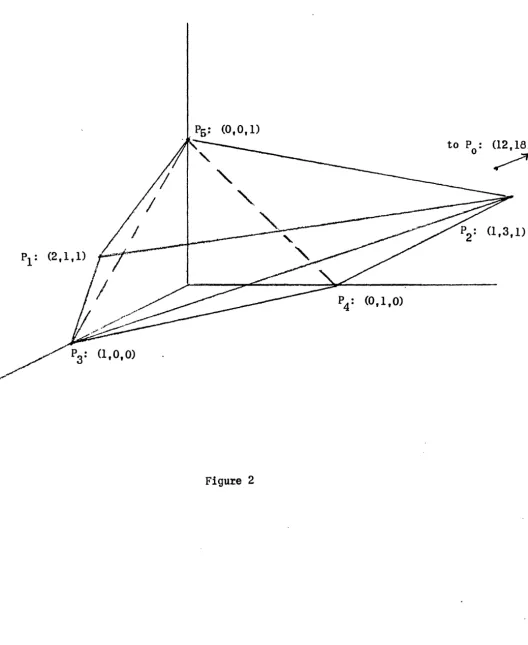
(!2r, ) ~~ ,,~:i)These numbers are all known, so t hat the points we are now considering are known points. In our numerical problem, the coordinates of the points can be read off in this way from (5.1). You can find the answers on Fig. 2, where the points are even plot ted (except Po, which w 0 u 1 d
be off the page) •
'. If we were doing a bigger pro b 1 e m -- any problem big enough to be difficult -- there would be more than three equations (4.1); therefore more than three coordinates for each point PI' P2, •• j therefore no nice 3-dimensional figurelikeFig. 2. The geometric ideas which Fig. 2 lets you see are just what you will use on harder problems, althougI there, without a figure, you will be flying blind.
Excuse me for repeating myself: The sp ace diagrammed in Fig. 2 in Part II, of which PI and the rest are points, is a~space, not the one we discussed before. Call the previous one solu-tion space, because the solusolu-tion we are look i n g for is one of its points. In our example, sol u-tion space is a 5-space. The newly introduc e d space is called requirements space. because so me of its points come from the equations stating the requirements of the problem. In our example, re-quirements space is a 3-space.
It could perfectly well happen that a p rob-lem would give a solution space and are~ements
space of the same number of dimensions. The y should still be kept distinct in your think in g. The numbers xl' x2, etc. are the coordinates 0 f
a (variable) point in solution space; but in re-quirements space they are not a point, 'they are jus t a s tri ng of numbers appearing in a cur i 0 u s
relation (6.1) between points.
Positive Combinations
LINEAR PROGRAMMING AND COMPUTERS
This is almost the same as an idea we encoun- of your intuition for a while, but I'll pursue it
tered in Part I in another connection. If we knew a little further and suggest that you try to get
that Xl
+
x2+
x3 + X4+
XS=
1, then (6.1) would used to it.say that Po was a "convex combination" of the rESt.
~ idea has a very simple intuitive translation:
it: means Po is "between" the others, that is, it is in the convex set which they determine.
But here we don't know that much, because ~
sum Xl t-X2 + X3 + x4
+
"5 can be any of variouspositIve numbers. WIth the numbers as we have
them in our particular problem, it's not even
pos-sible to choose the Xj so their_sum comes out 1.
We need a new definition. We say that the
rela-tion (6.1), with all XL non-negative but with their
sum unspecified, expresses point PQ as a positive
combination of points PI,
P2.
P3, P4,Ps.
It's reasonable to hope that the geometric interpretation will not be much trickier, and it's not.
To say that Po is a positive combination of the other points means that some point of the line
from the origin out through Po is a ~
combi-nation of them. That is. the line from (0,0,0,0,
0) out through Po passes between the other poin~.
Look back at Fig. 2. The convex set determined by PI' P2, P3, P4, P5 does not contain Po, but it
does contain some points of the line OPo'
Why is thi$ interpretation valid? A point
belongs to the line OPo on the same side of
°
asPo provided its coordinates are got from thosem Po by multiplying through by a positive factor.
(For example, since Po is (12 .. 18, I)J, ~o is {3,
4.5 ,2). This is the point at the base of the
arrow on Fig. ~.) Now if we have an equation
giving Po as a positive combination of the other points, we can multiply it through by the appro-priate positive number and get an equation giving a multiple of Po as a convex combination of the others. And the same argument works backward.
Exercises: 1. Show that any p~int in the
3-space whose coordinates are all positive, is a positive combination of P3, P4, P5.
2. Show this is consistent with the geomet-ric intetpretation of positive combinations.
3. In particular,· expre'ss Po as a positive
combination of P3, P4,
Ps.
4. Show that P3 is not a positive
combina-tion of PI' P4 , P5 •
Tie-up with Solution Space
Any set of non-negative Xi which gives Po ~
a positive combination of PI, P2. P3. P4. P5 sa-tisfies (6.1), that is it sasa-tisfies (4.1)j that
is, it gives the coordinates of a point of X
--and here we are back in solution space~ Any pnnt
of X, similarly, can be reinterpreted in
require-ments space as a way of expressing Po as a
posi-ti ve combination of Pl. P2. P3. P 4, P5.
This translation back and forth between the two spaces will almost certainly be out of reach
13
-There are lots of points of X, so there must
be lots of different ways to express Po as a po-sitive combination of the others. Now you
remem-ber there were certain points of X which we were
specially interested in, namely the extreme poinw. There is a way of spotting an extreme point, (xl,
x2, x3, X4, x5) after it has been translated into
requirements space. This important device will be the justification for introducing requirements space at all.
Spotting Extreme Points
If Po is given as a positive combination of Pl. P2. P3. P4. P5, with some of the coefficients
zero (say, Xl and X4). then it would be just as
correct to say that the equation gives Po as a positive combination of the remaining Pi (say, P2. P3, and P5).
Example: The expression of Po in terms of P3, P4, and P5 in Exercise 3 just above can just
as well be called an expression of Po as a posi~
tive combination of PI' P2. P3. P4' P5: (7.1.1):
P = OXI + OX2
+
l2P3+
l8P4 + BP5. This givesaOpoint of X, namely (0, 0, 12, 18, ~), the onewe
found before.
When the list of points that actually enter into the expression can't have any points struck
off it, then the coefficients give a point of X
that is extreme. I'm afraid the why of this would take a little too much explaining, but I'll illu-strate to make the meaning clear.
Examples: 1. I will use the criterion to
show (0, 0, 12, 18, 8) is an extreme point. It
corresponds to an expression of Po a~ a positive
combination of P3, P4, and P5, namely (7.1.1). There is no expression of Po as a positive com-bination of P4 and P5 (without P3)j or of P3 and P4 (without P5). Check this. This gives the
con-clusion that (0, 0, 12, 18, 8) is extreme. Let's
look at this in requirements space, i.e. Fig. 2.
The line OP does have a point in common with the
triangle P3~4P5j but it does not have a pOint in
common with any of the line-segments P4P5' P3P5, P3P4·
2. I pullout of the hat the following point of solution space: (0,4,8, 6,4). It is a point
of X, for these numbers satisfy (5.1).' It is not
an extreme point of X, as I show by the
require-ments-space criterion: It corresponds to an ex-pression for P
8
using P2, P3• P4• P5 (reflectingthe fact that PQ goes through the tetrahedron
P2P3P4P5in Fig. ~). But one of these points is
dIspensible, for we saw above that we could get along with just P3, P4. P5 (reflecting the fact
that OPo goes through the face P3P4P5 of the
te-trahedron). We will see below, actually, that there is an option here as to which Pi is dispen-sed with. We could get along instead with P2,P3, P5 (reflecting the fact that OPo also goes through the triangle P2P3P5, another face of the
LINEAR PROGRAMMING AND COMPUTERS
Exercise: Show directly from the definition I think you can see that this procedure can
that (O,4,A,6,4) is not an extreme point of X. be applied routinely and repetitively in all ~o~
Finding a New Extreme Point
Having one extreme point of X, to jump to
another adjacent one, this is the task in solu-tion space.
The translation, I ask you to believe, i s this: having one expression for Po with no dis-pensible points, to find another such expression which brings in as few new points as possible.
All right, we start with the easily-found
extreme point (0,0,12,18,8) 9 that is, we start
with (7.1.1). Let's choose at random a new P; to bring into the act: P2, say. We want to find systematically all ways Po can be expressed as a positive combination of P.2,P3,P4,P5.
This means altering the right-hand side of
(7.1.1) by adding a positive multiple of P2 while
the left side stays unchanged. Something equal
to this mUltiple of ~ must be subtracted fr om
the right-hand side, then, if the equation is to
be preserved. And it must be something invol~ng
only P3' P4, and P5, because we're bringing in new points one at a time.
Is there an expression for P.2 in terms of
P3,P4,P5? Certainly, and because P3,P4,P5 have such simple coordinates it's easy to find. I'll write down the analogous expression for PI atthe same time:
(7.1.2) PI = 2P3 + P4 +PS
(7.1.3)
Now we add yP2 t~ the right-hand side of
(7.1.1), where y is any positive number; and to keep the equation true we subtract y times the
right-hand side of (7.1.3). It's okay to ~up
the terms of the resulting vector equation. (Be-cause it's okay to do it for each of the numeri-cal equations wliich the vector equation sta n ds
for. If this .18 unfamiliar to you, try to
justi-fy it to yourself before going on.) The result is:
(7.1.4) Po
=
yP2 + (12 y)P3+ (18-3y)P4+(8-y)P5•This vector equation is valid no matter what y iSi but it's of little interest to us
un-less all its coefficients are non-negative. If
y is just a little bigger than 0, we're all right.
As y increases, though, we run into trouble
--just as soon as any of the coefficients becomes 0. Which of them gets there first? The coeffi-cient of P3 reaches zero when y= 12; of P4 when
y= 6; of Ps when y= 8. So y= 6 is as high as
we can go: if we went any higher, the coefficient
of P4 would be negative. .
If we go just that high, and substitute y= 6 in (7.1.4), P4 will be eliminated from the equation and yet no negative coefficients will appear:
(7.2.1> Po= 6P
2+ 6P3 +2P5
lerns. (The only thing that. can stop it is if
too few P. are used in,expressing Po. This
hap-pens if, ~hen a new one is added, more than one
drops out. This is called degeneracy; I ignore it for now.)
TIle procedure always gives extreme points, What's more: I will say why it does in the
pre-sent instance. (7.1.4) gives, for appropriate
values of y, all expressions of Po as a positive combination of P2,P3,P4,P5; of these, (7.2.1) is the only one that dispenses with P4; so there is no such expression which dispenses with P4 and one of the other three as well; so, by the cri-terion above, (0,6,6,0,2) is an extreme p oin t. Ynis reasoning generalizes.
Is This Progress?
We don't want jus t any old adj acent ec treme
point of Xi we want a "hi.gher" one: one giving
a larger value to f(x). Let's check that that~
what we got, recalling (4.3') or (5.3). Before:
f«0,0,12,18,8»-= OCl+Oc2+12c3+18c4+8cS =
0(1) + 0(2) + 12 (0) + 18(0) + 8 (0)=
°
After:
f «0,6,6,0,2»= 0(1) + 6 (2) + 6 (0) + 0(0) + 2 (0)=
12
This is a distinct improvement. (The first
ex-treme point corresponded to the unenterprising policy of producing nothing of anything; the one we have now found corresponds to the policy of producing as much gin sour as possible, with daily profit $1200.)
Perhaps you're content with the method for climbing up X which has now been sketched:start-ing from one extreme point, step to any adjacent
one at random, then see if f (x) has been i
m-proved.
The method is surely adequate, but it can be refined. It is not really necessary to go
all the way to the new extreme point in order
to find out whether it will be an improvement. Instead we could have found out, as soon as we contemplated introducing P2 on the right-hand side of (7.1.1), whether this would take us in the desired direction on X. The sophisticated reader will be able to figure out by consider-ing (7.1.4) how to make this test, but to save space I won't give details.
Solution of the Problem
Let us press onward from PQint (0,6,6,0,2). There are two new points that could conceivably be introduced on the right-hand side of (7.2.1), namely PI and P4. Now introducing P4 would give
us expressions for Po using P2,P3,P4,P
s•
Wewould have an equation which, though it would look different from (7.1.4), would be
LINEAR PROGRAMMWG ANQ co~rpUTEHS
where we haven't already been.
Detter try introducing Pl. No point in that. arrived at, and can be forgotten once a better ex-treme point has been found. (An exception mig ht be made to this; see below.)
As b~fore, a multiple of the new point will be added to our equation's right side and an ~ expression will be subtracted. Hence we need an expression for PI in terms of P,2, P3,· P5~
<7.2.2) P 4
=
3 1 P2 - 1 3 P3 - 1 3 P5'and from this and (7.1.2),
<7.2.3)
Using (7.2.3) to alter (7.2.1),
1 5 2
(7.2.4) Po=zPl + (6- 3z)I'2+(6 -:3 z)P3 + (2- 3z) P 5·
lIow high can z get before causing negative coefficients here? The coefficient of P2 vanimes when z= 1[1; and that of P3' when z = '] ; that of P5, when z
=
3. The last is the one ~hat stopsu~substitute z
=
3 in (7.2.4):<7.3.1)
The new extreme point does give an improved value of f(x):
f «3,5,1,0,0))
=
3(1) + 5(2)+
1(0)+
0(0) = 13. Now to finish the solution we should verify that no new extreme point adjacent to (3,5,1,0,0) gives higher f(x). Exercise: Do it. You should find that the only point you have to test is (4, 4,0,2,0), and that this makes f(x) equal only 12.We have arrived at the same conclusion that the rough-and-ready rapid solution did in Part I: The first activity is to be carried on at the levEl 5: bottle gin sour at 500 bottles per day. The fact that x3
=
1 .does not represent doing anything because x5 was one of our thrown-in variables; x3=
1 means only that not all the sugar is being used up. Finally, f(x)=
13 means the daily pro-fit is $1300.Computation
Here is the promised summary of the ari th -metic involved in a linear programming problem.
Assume the problem is in standard form. There are n variables, all required to be non-negative
(4.2), and the only other requirements are in lin-ear equations (4.1). A linlin-ear function (4.3) is to be maximi~d.
The following are needed repeatedly through-out the solution:
1. The coefficients of the equations. These are mn + m numbers, each associated with a row and a column index.
2. The coefficients of the function to be maximized. These are n numbers, singly indexed.
The other information need not be preserved throughout the solution. It pertains to the par-ticular extreme point of X which the solution h~
15
-At the stage where an extreme point of X has just been found, we have the following information:
1. The coordinates of the extreme point it-self. These can be recorded as a string of n n~
bers, n-m of which happen to be zero; or as m non-zero numbers associated with m chosen column in-dices (the m "included" inin-dices). I will assume the second alternative.
2. The n-m expressions, in terms of the "in-cluded" p., of the other Pi. (In our numeric n 1 problem, 17.1.2-3), or (7.2.2-3).) These involve
nm-~ numbers, each identified by two indices.
Next one index i among those not "included" must be picked. This can be done at random. Once
it is picked, the expression for the correspondlig Pi is consul ted. We compute
-1. Which of the included Pi is now t 0 be
dropped. This involves (see the numerical probHm solution) finding m quotients and selecting the smallest positive one.
2. The new extreme point of X. The quotient from the previous step is multiplied by each of m numbers; the results are added to the coordinates of the old extreme point. It's not quite this simple, butcall it m multiplications followed by m additions. Also we must record the change in what i are to be considered "included."
3. Whether the new extreme point is an im-provement. This is just a question of drawing ~ appropriate m from among the n coeffic ie n t s of f(x), multiplying them by the old extreme poinfs m coordinates, adding these m numbers, and com-paring the result with another number.
As hinted before, by a dodge,the last of thee three steps can be as good as done without the first two. It, therefore, will be repeated as often as necessary to find a direction in which f (x) can be increased; but the other steps will be done~, with reference to this progressive direction.
Finally we compute the expressions, in terms of the ~ set of included Piv for the other n-m of them. We use the n-m equations we started witJ1.
One equation is solved: m divisions and a little rearranging. In the others we substitute: essen-tially, m multiplications and m additions.
All these steps can be followed in our n u-merical problem above.
How ~mny Repetitions?
This description doesn't yet say how longthe computations must be, because it doesn't say how often the procedures must be repeated.
This is something we don't know at the o~et,
naturally. If the firs t extreme point we f 0 un d
happened to be optimal, well - but let's notdream~
LINEAR PROGRAMMING AND COMPU'rnRS
The total number of extreme points is always case, moving one of them ever so little, in almoa
between n-m-l and ~. Tha latter number, 'the ntllll'" any direction, will increase the number of extreme
ber of combinations of n things m at a time, i s points, but reduce the excess faces per ext r e me
large; but the number of extreme points is gen~r- point.) This is deceptive; degeneracy does ha~
ally well below it. Of course if there are many in practice. It can be handled. I won't discuss
extreme points, comparatively few of them willhave the tools that handle it, except to say that they
to be found, as I remarked in Part I. If X is a do not involve much extra computation.
roughly spherical diamond, our path to its optimal corner is a zigzag line across its face; translate
this image to n dimensions. Summary
A less important but easier question is this: At each extreme point, how many tties at adjacent extreme points will it take before one is reached
which is an improvement? It could be as low as 1
or as high as n-m. On the average, up is as
like-ly as down, so the average should be about 2. But toward the end this rises, as it grows harder and eventually impossible to improve the position.
If one has a record of which Pi have be e n dropped in earlier repetitions of the procedure, those can be tested last, since they are not such likely candidates for inclusion.
Short-cuts
It would be nice if the simplex method could be modified so that instead of inching over the
surface of X we could plunge through the center of
the set. But without taking up such radi~change~
let's look at some available short-cuts.
I. Often a lot of the coefficients of the
problem will be zero, for some reason which the
statement of the problem ma~es evident. If there
is a simple pattern to these zeros, it can be talel
advantage of to simplify_ the plan of the computa-tion.
2. Sometimes the problem can be replaced by a simpler one. Leaving the standard form for a
moment, think of X as having many facets, each
de-termined by an inequality. If fewer inequalities on the same variables were required, some of the
slices would be repaired, and X would be r~placed
by a larger convex set. Suppose we keep the same
expression for f (x), and maximize it on the new
set.. If we have an optimal extreme point of the
new set, it doesn't have to be in X at all,inwhich
case our scheme has fallen-through. But if it is
in X, it is not hard to see it is an optimal
ex-treme point of X.
Degeneracy
I have wriiten as if, each time a new Pi was adjoined, exactly one was dropped. When this fa 15 , that is when two or more of the Pi drop out in a
single step, it is called degeneracy. On X, this
means that more than n-m edges meet at a single
ex-treme point. \
It is not hard to prove, under s ee m i ng 1 y
reasonable assumptions, that the probability of
having any degeneracy at all is zero. (General
idea: When too many edges meet at a point, too
many faces must be meeting there too. In t hat
16
-I have tried to tell what kind of problem can
be set up as a linear program; what geometri c a I
ideas motivate, and "explain" the standard simplex
method of solution; and what kind and volume, 0 f
arithmetic is involved in working out a proble m by this method.
END
-*---~---*
BANK CHECK PROCESSING (continued from page 9)
by the process, and after a series of automatic sorting operations, may be sent through the pro-per channels to the banks on which they were drawn, for return to depositors.
(2) Another, different approach is represented
by the recently announced automatic bank book-keeping system being developed jointly by the Burroughs, Todd, and Addressograph-Multigraph companies. In that system, an invisible code is added to checks as a byproduct of other ne-cessary operations, and then the checks them-selves will automatically govern the operation of accounting machines.
END
-* --- -* ---*
BULK SUBSCRIPTION RATES
These rates apply to subscriptions coming in together direct to the publisher. For example,if 5 subscriptions come in together, the
sav-ing on each one-year subscription will be 25
percent, and on each J:wo-year subscription will
be 33 percent. The bulk subscription rate s ,
depending on the number of simul taneous s ub -scriptions received, are shown below:
Table 1 -- Bulk Subscription Rates
(Uni ted St.ates)
Number of Simultaneous Subscriptions
10 or m{}.te
5 to 9
4 3 2
Rate for Each Subscription,and Resulting Saving to Subscriber.
One Year Two Year
$ 3 . 00, 33;'~
3.31, 25
3.",5, 1"1
4.00, 11
4,25, 5
$5.40, 400/0
6.00, 33
7.00, 22
7.50, 17
8.00, 11
For Canada, add 50 cents for e~ch year;
out-s ide of the Uni ted Stateout-s and Canada, add $1.00
[image:16.631.311.563.101.698.2]