
Tidal range energy resource and optimization – past
1
perspectives and future challenges
2
Simon P. Neilla,∗, Athanasios Angeloudisb, Peter E. Robinsa, Ian
3
Walkingtonc, Sophie L. Warda, Ian Mastersd, Matt J. Lewisa, Marco 4
Pianoa, Alexandros Avdisb, Matthew D. Piggottb, George Aggidisf, Paul 5
Evansg, Thomas A. A. Adcockh, Audrius ˇZidonisf, Reza Ahmadiane, Roger
6
Falconere 7
aSchool of Ocean Sciences, Bangor University, Marine Centre Wales, Menai Bridge, UK
8
bDepartment of Earth Science and Engineering, Imperial College London, UK
9
cSchool of Natural Sciences and Psychology, Department of Geography, Liverpool John
10
Moores University, Liverpool, UK
11
dCollege of Engineering, Swansea University, Bay Campus, Swansea, UK
12
eSchool of Engineering, Cardiff University, The Parade, Cardiff, UK
13
fEngineering Department, Lancaster University, Lancaster, UK
14
gWallingford HydroSolutions, Castle Court, 6 Cathedral Road, Cardiff, UK
15
hDepartment of Engineering Science, University of Oxford, Oxford, UK
16
Abstract
17
Tidal energy is one of the most predictable forms of renewable energy.
Al-18
though there has been much commercial and R&D progress in tidal stream
19
energy, tidal range is a more mature technology, with tidal range power plants
20
having a history that extends back over 50 years. With the 2017 publication
21
of the “Hendry Review” that examined the feasibility of tidal lagoon power
22
plants in the UK, it is timely to review tidal range power plants. Here, we
23
explain the main principles of tidal range power plants, and review two main
24
research areas: the present and future tidal range resource, and the
opti-25
mization of tidal range power plants. We also discuss how variability in the
26
electricity generated from tidal range power plants could be partially offset
27
by the development of multiple power plants (e.g. lagoons) that are
comple-28
∗
mentary in phase, and by the provision of energy storage. Finally, we discuss
29
the implications of the Hendry Review, and what this means for the future
30
of tidal range power plants in the UK and internationally.
31
Keywords: Tidal lagoon, Tidal barrage, Resource assessment,
32
Optimization, Hendry Review, Swansea Bay
33
Contents
34
1 Introduction 3
35
2 A brief history of tidal range schemes 7
36
2.1 Commercial progress . . . 7
37
2.1.1 Current schemes . . . 7
38
2.1.2 Proposed schemes . . . 9
39
2.2 Engineering aspects of tidal range power plants . . . 10
40
3 Numerical simulations of tidal range power plants 12
41
3.1 0D modelling . . . 12
42
3.2 1D modelling . . . 14
43
3.3 2D and 3D models . . . 15
44
3.4 Observations and validation . . . 19
45
4 Tidal range resource 20
46
4.1 Theoretical global resource . . . 20
47
4.2 Theoretical resource of the European shelf seas . . . 22
48
4.3 Non-astronomical influences on the resource . . . 26
49
4.4 Long timescale changes in the tidal range resource . . . 27
4.5 Socio-techno-economic constraints on the theoretical resource . 28
51
5 Optimization 31
52
5.1 Energy optimization . . . 31
53
5.2 Economic optimization . . . 33
54
5.3 Implications of regional hydrodynamics for individual lagoon
55
resource . . . 34
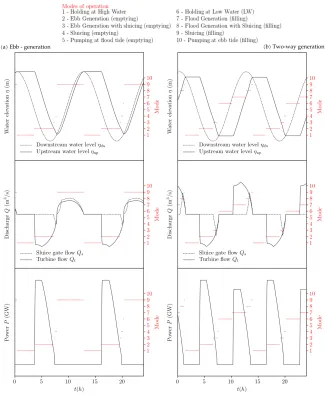
56
5.4 Multiple lagoon resource optimization . . . 35
57
6 Challenges and opportunities 37
58
6.1 Variability and storage . . . 37
59
6.2 Additional socio-economic benefits through multiple use of space 39
60
6.3 Implications of the Hendry Review . . . 40
61
7 Conclusions 42
62
1. Introduction
63
Much of the energy on Earth that is available for electricity generation,
64
particularly the formation of hydrocarbons, originates from the Sun. This
65
also includes renewable sources of electricity generation such as solar, wind
66
& wave energy, and hydropower (since weather patterns are driven, to a
67
significant extent, by the energy input from the Sun). However, one key
68
exception is the potential for electricity generation from the tides – a result
69
of the tide generating forces that arise predominantly from the coupled
Moon system1. The potential for converting the energy of tides into other 71
useful forms of energy has long been recognised; for example tide mills were
72
in operation in the middle ages, and may even have been in use as far back as
73
Roman times [1]. The potential for using tidal range to generate electricity
74
was originally proposed for the Severn Estuary in Victorian times [2], and
75
La Rance (Brittany) tidal barrage – the world’s first tidal power plant – has
76
been generating electricity since 1966 [3]. However, only very recently has the
77
strategic case for tidal lagoon power plants been comprehensively assessed,
78
with the publication of the “Hendry Review” in January 2017 [4].
79
Tidal range power plants are defined as dams, constructed where the
80
tidal range is sufficient to economically site turbines to generate electricity.
81
The plant operation is based on the principle of creating an artificial tidal
82
phase difference by impounding water, and then allowing it to flow through
83
turbines. The instantaneous potential power (P) generated is proportional
84
to the product of the impounded wetted surface area (A) and the square of
85
the water level difference (H) between the upstream and downstream sides
86
of the impoundment:
87
P ∝AH2 (1)
A tidal range power plant consists of four main components [5, 6]:
88
• Embankments form the main artificial outline of the impoundment, and
89
are designed to have a minimal length while maximizing the enclosed
90
plan surface area. A key factor in designing the embankment is to
91
1The Sun also has an important role in tides, but its contribution is around half that
minimise disturbance to the natural tidal flow.
92
• Turbines are located in water passages across the embankment, and
93
convert the potential energy created by the head difference into
rota-94
tional energy, and subsequently into electricity via generators.
95
• Openings are fitted with control gates, or sluice gates, to transfer flows
96
at a particular time, and with minimal obstruction.
97
• Locks are incorporated along the structure to allow vessels to safely
98
pass the impoundment.
99
Tidal range power plants can be either coastally attached (such as a
bar-100
rage) or located entirely offshore (such as a lagoon). The primary difference
101
between the two refers to their impoundment perimeter. There are also
102
coastally-attached lagoons, where the majority of the perimeter is artificial,
103
potentially enabling smaller developments with more limited environmental
104
impacts than barrages – the latter generally spanning the entire width of an
105
estuary.
106
Following construction, the manner and how much of the potential energy
107
is extracted from the tides largely depends on the regulation of the turbines
108
and sluice gates [7]. They can be designed to generate power one-way, i.e.
109
ebb-only or flood-only, or bi-directionally. In one-way ebb generation, the
110
rising tide enters the enclosed basin through sluice gates and idling turbines.
111
Once the maximum level in the lagoon is achieved, these gates are closed,
112
until a sufficient head (hmax) develops on the falling tide. Power is
subse-113
quently generated until a predetermined minimum head difference (hmin),
114
when turbines are no longer operating efficiently. For flood generation the
whole process is reversed to generate power during the rising tide. In two-way
116
power generation, energy is extracted on both the flood and ebb phases of the
117
tidal cycle, with sluicing occurring around the times of high and low water
118
[8, 9]. A schematic representation of ebb and two-way generation modes of
119
operation is shown in Fig. 1, highlighting the main trigger points during the
120
tidal cycle that dictate power generation. Nonetheless, there are other
pos-121
sible variations of these regimes (e.g. Section 5.1). For example, ebb/flood
122
generation can often be supplemented with pumping water through the
tur-123
bines to further increase the water head difference values, as considered in
124
studies by Aggidis and Benzon [10] and Yates et al. [11].
125
In this article, we provide a review of tidal range power plants, with a
fo-126
cus on resource and optimization. The following section provides an overview
127
of the history of tidal range schemes from pre-industrialization to present day,
128
including future proposed schemes. Section 3 compares the various modelling
129
approaches used to simulate tidal lagoon or barrage operation (e.g. 0D versus
130
2D models), and Section 4 examines the global tidal range resource, with a
131
particular focus on the northwest European continental shelf, and constraints
132
on the development of this resource. Section 5 examines ways in which tidal
133
range schemes can be optimised, e.g. flood or ebb generation, pumping, and
134
the benefits of concurrently developing multiple tidal range schemes. Finally,
135
in Section 6, we discuss future challenges and opportunities facing tidal range
136
power plants, including variability and storage, and the implications of the
137
Hendry Review.
2. A brief history of tidal range schemes
139
Tidal range technologies have a long history, especially when compared
140
with less mature ocean energy technologies such as tidal stream and wave
141
energy. Energy has been extracted from the tides for centuries. There is
142
evidence of a tide mill in Strangford Lough, Northern Ireland, which has been
143
dated to the early 6th Century [1], where an 8 m wide dam enclosed a 6500 m2 144
area of sea water. Such early tidal power plants worked much as modern tidal
145
range projects, but used only naturally-occurring tidal basins to impound
146
volumes of water, which would then be routed through a paddlewheel or
147
waterwheel during the ebb. The extracted energy was, of course, not used to
148
generate electricity, but to provide mechanical motion, for example to mill
149
grain.
150
2.1. Commercial progress 151
Locations around the world that are suitable for tidal range exploitation
152
are relatively limited, given a number of physical constraints, including tidal
153
range, grid connectivity, geomorphology, seabed conditions, and available
154
area for an impoundment. There are five tidal range power plants currently
155
in operation around the world, and a number of areas that have either been
156
identified for development, or which exhibit suitable characteristics to merit
157
consideration.
158
2.1.1. Current schemes 159
La Rance tidal barrage in Brittany was the world’s first fully operational
160
tidal power station [3, 12, 13]. The project, which comprises a 720 m long
161
over a six-year period, and was fully operational in 1966 (Table 1). The
163
barrage houses 24 Kaplan bulb turbines, which provide a combined rated
164
power output of 240 MW and an annual energy output of 480 GWh [15].
165
Since its inception, there have not been any major structural issues, and very
166
little downtime, although there have been significant environmental impacts
167
[16].
168
The Kislaya Guba tidal power plant in Russia was constructed in 1968
169
as a trial project by the government, with an initial installed capacity of 400
170
kW [14]. It is situated near Murmansk, a fjord on the Kola Peninsula [13].
171
The installed capacity of this power plant has grown to 1.7 MW, which is
172
relatively low compared with other worldwide schemes, making it the smallest
173
tidal range power plant in operation [17]. However, the success of this scheme
174
has motivated the government to explore other sites, including Mezan Bay in
175
the White Sea and Tugar Bay, with potential installed capacities of 15 GW
176
and 6.8 GW respectively [17]. The former of the two figures is particularly
177
impressive, since this would be the second largest power plant in the world,
178
the largest being the 22.5 GW Three Gorges Dam in China [18].
179
The Annapolis Royal Generating Station was constructed in 1984, and
180
is located on the Annapolis River, Nova Scotia, Canada. It harnesses the
181
head difference created in the Annapolis Basin, a sub-basin of the Bay of
182
Fundy, which has a spring tidal range of 16 m [19]. This scheme consists
183
of a single Straflo turbine, and produces a peak power output of 20 MW on
184
the ebb tide only [13]. As well as generating electricity, this power plant is
185
also used for flood defence and serves as an important transport link – the
186
latter being a particularly advantageous and unique feature of barrages, for
example compared to a tidal lagoon.
188
The Jiangxia tidal range power plant was opened in 1985, and is located in
189
Jiangxia Port, Wenling, China, an area that is characterised by tidal ranges
190
of up to 8.4 m [13]. The power plant operates bi-directionally, and houses six
191
bulb turbines, the last of which was installed in 2007, providing an installed
192
capacity of 3.9 MW.
193
The largest (by installed capacity) tidal range scheme currently in
exis-194
tence is Lake Sihwa, which is situated in the mid-eastern region of the Korean
195
Peninsula in the Kyeonggi Bay, South Korea. The power plant stemmed from
196
a disused dam constructed in 1994 to hold irrigation water for agricultural
197
land; however, industrial developments in its vicinity caused pollution issues
198
[20]. To help tackle the pollution problems, the dam was subsequently
con-199
verted to a flood-operating tidal power plant [13]. The power plant
incorpo-200
rates 10 bulb turbines, with an installed capacity of 254 MW. The success of
201
this scheme has motivated the Korean government to explore other potential
202
sites around the country, including Gerolim and Incheon [13].
203
2.1.2. Proposed schemes 204
There are a number of factors that preclude development in certain areas,
205
even if first-order theoretical appraisals of the resource suggest that there is
206
commercial potential. Apart from physical constraints, cost and
environmen-207
tal impacts are other major barriers to development. Environmental issues,
208
particularly for larger scale schemes, have prevented numerous developments
209
from being approved [13]. Without constructing a scheme, its true
environ-210
mental impact is difficult to quantify, and so governments are hesitant to
211
proceed with development at such scale. Table 2 summarises sites around
the world that have the potential for tidal range exploitation.
213
A relatively recent tidal range concept that addresses some of these
envi-214
ronmental concerns is the tidal lagoon. These tidal range power plants differ
215
from the more conventional barrage schemes, as they impound a smaller body
216
of water and are therefore less intrusive. One such scheme is the proposed
217
Swansea Bay Lagoon, located in the Bristol Channel, UK, an area that is
218
characterized by tidal ranges that exceed 10 m [21].
219
Although no tidal lagoons currently exist, the Swansea Bay Lagoon is
220
the closest scheme to commercial viability. The UK Government have
re-221
cently completed an independent review which considered the feasibility of
222
the power plant in terms of cost effectiveness, supply chain opportunities,
223
possible structures to finance this project, and scales of design [22]. Despite
224
the positive outcome of the “Hendry Review” [4], a marine licence is still
re-225
quired from Natural Resources Wales (NRW)2, and an agreement on the CfD
226
(Contracts for Difference) price, before the project can proceed to
construc-227
tion. There are a number of other areas in the UK that have been identified
228
for development, as summarized in Table 2. However, it is likely that these
229
will only be approved on the condition that the Swansea Bay “Pathfinder
230
Project” proceeds and is successful.
231
2.2. Engineering aspects of tidal range power plants 232
Bulb turbines are used for power takeoff in almost all current tidal range
233
schemes [13]. These are the same, or very similar, to the turbines that are
234
used for low head hydropower applications. When low head hydro was
con-235
sidered as an energy solution for the UK in 1927, the investigating team (the
236
Severn Barrage Committee) found the Kaplan turbine to be the most
effi-237
cient for low head applications [23]. In the following years, as more research
238
has been conducted in the field of turbines, the bulb turbine, a configuration
239
of a Kaplan turbine, has become the turbine of choice for low head hydro or
240
tidal range schemes. Furthermore, triple regulation (adjustable guide vanes,
241
blade pitch angle and variable speed) of turbines has become feasible in
re-242
cent years [4, 13, 21], which will accommodate the constant varying head
243
conditions that are inevitable in tidal range applications.
244
Tidal range schemes will likely utilise this relatively mature turbine
tech-245
nology, with specific adaptations to better suit tidal environments. It is most
246
certain that the largest share of the cost is in the civil engineering work [4].
247
A potential reduction of the civil costs is proposed, which is the usage of
248
caissons. This would enable the construction of the turbine housing
struc-249
ture on land, as opposed to using cofferdams. It has to be taken into account
250
that in tidal range applications a longer water passage is required, as the
251
bulb turbines may work in two-way generation, as opposed to classical
one-252
way generation [7, 24]. Therefore, a draft tube is required on both sides of
253
the turbine. Recent suggestions for impoundment designs include the use of
254
geotubes and sand [6, 13]. These impoundments would also act as
break-255
water and sea defence structures, helping protect neighbouring regions from
256
flooding [e.g. 25].
3. Numerical simulations of tidal range power plants
258
The assessment of tidal range schemes relies on the development of
nu-259
merical tools that can simulate their operation over time. These span from
260
simplified theoretical and zero-dimensional (0D) models [8, 10, 26, 27] to more
261
sophisticated depth-averaged (2D) and hydro-environmental tools [9, 20, 24,
262
28, 29, 30, 31, 32, 33, 34, 35, 36, 37] that often require High Performance
263
Computing (HPC) capabilities for practical application.
264
3.1. 0D modelling 265
Given (a) known tidal conditions, (b) plant operation sequence, and (c)
266
appropriate formulae that represent the performance of constituent hydraulic
267
structures, it is feasible to simulate the overall performance of a tidal range
268
scheme, and provide an informed resource assessment [24]. The operation can
269
be modelled using a water level time series as input, governed by the transient
270
downstream water elevations at the site location (Fig. 1). This is known as
271
0D modelling, and has been deemed sufficient under certain conditions, e.g.
272
for smaller lagoons and barrages, as explored in the literature [28, 34, 35, 38].
273
A multitude of 0D models have been reported for the estimation of tidal
274
power plant electricity outputs [e.g. 27, 34, 39]. However, one commonly used
275
technique is the backward-difference numerical model, developed according
276
to the continuity equation. Given the downstream ηdn,i and upstream ηup,i
277
water level at any point in time t (indicated by subscript i), the upstream
278
water level at t+δt (subscript i+ 1) can be calculated as [27]:
279
ηup,i+1 =ηup,i+
Q(Hi) +Qin,i
A(ηup,i)
where A(ηup) is the wetted surface area of the lagoon, assuming a constant
280
water level surface of ηup. Qin corresponds to the sum of inflows/outflows
281
through sources other than the impoundment, e.g. rivers or outflows. The
282
water head difference H is defined as ηup,i−ηdn,i, and feeds into Q(H); a
283
function for the total discharge contributions from turbines and sluice gates.
284
Theoretically, the flow through a hydraulic structure is calculated as [5]:
285
Q=CDAs
p
2gH (3)
where CD is a discharge coefficient, and As is the cross-sectional flow area.
286
In turn, the power P produced from a tidal range turbine for a given H can
287
be:
288
P =ρgQTHα (4)
where ρ is the fluid density, QT is the turbine flow rate and α is an
over-289
all efficiency factor associated with the turbines. In practice, the hydraulic
290
structure flow rates and power output should be represented by hill charts
291
specific to the individual characteristics of sluice gates and turbines, thus
292
incorporating their technical constraints. Examples of such charts for bulb
293
turbine designs can be found in the literature [e.g. 40, 41].
294
The flow rate Q and power P are also subject to the operation mode of
295
the plant (Fig. 1), which will accordingly restrict/allow flow through turbines
296
and sluice gates at certain times within the tidal cycle. Details of one-way
297
and two-way generation algorithms that dictate the modes of operation over
298
time have been presented in Angeloudis and Falconer [24], with variations
299
schematically represented in several studies [e.g. 28, 30, 34, 35].
300
Even though a 0D modelling approach is computationally efficient, it
of-301
ten assumes that the impact of the tidal impoundment itself on the localised
tidal levels is negligible. Such an assumption can yield over-optimistic
re-303
sults, as reported in Angeloudis and Falconer [27] and Yates et al. [11].
304
Consequently, the analysis should be expanded to account for the regional
305
hydrodynamic impacts through refined coastal modelling tools tailored to
306
the operation of tidal lagoons.
307
3.2. 1D modelling 308
Many candidate sites for tidal range schemes are on estuaries, where it
309
is possible to integrate the flow both vertically and across the width of the
310
estuary [e.g. 42]. Such models may be useful for modelling tidal lagoons and
311
barrages, as they are able to capture some of the changes to tidal
hydro-312
dynamics due to the presence and operation of the tidal range power plant
313
[38] without the computational demands of more complex models. There are
314
numerous examples of 1D modelling being used to simulate tidal barrages;
315
examples include semi-analytical models [43, 44, 45] and numerical modelling
316
[39, 46, 47, 48]. Upstream and downstream sections of a tidal range scheme
317
can be simulated independently as two coupled 1D models. For a barrage
318
scheme, the constituent sections are linked at the respective ends, whereas
319
tidal lagoons are treated as junctions to the main channel section [49].
320
However, conclusions drawn from 1D models need to be treated with
321
caution. Due to the simplifications inherent in a 1D model, the naturally
322
occurring amplitude (i.e. without the barrage present) at the barrage
loca-323
tion may be poorly represented (in comparison to 2D models). In general, it
324
has been demonstrated that the performance of 1D models is adequate for
325
simulating relatively small tidal projects (e.g. the Swansea Bay lagoon), but
326
insufficient for simulating larger schemes such as a large barrage [49].
fore, significant error bars should be placed on the output from such models.
328
Nevertheless, 1D models are useful qualitatively for assessing the scale of the
329
impact of placing barrages in estuaries, and also useful for analysing
operat-330
ing strategies where computationally efficient models are required to explore
331
or optimise multiple scenarios.
332
3.3. 2D and 3D models 333
Hydrodynamic simulations of coastal waters can provide valuable insight
334
into resource assessment, the quantification of the potential impacts from
335
planned coastal engineering projects, and the minimization of any
detri-336
mental effects through design optimization. In principle, the capability of
337
depth-averaged (2D) and three-dimensional (3D) numerical models to
pro-338
duce time-series approximations to primitive variable fields, such as velocity
339
and free-surface elevation, make them attractive tools for the study of the
340
extractable energy and potential impacts of coastal engineering structures.
341
However, a wide range of multi-scale processes must be either directly
simu-342
lated or parameterized in order to ensure the appropriate levels of accuracy
343
required to make them useful tools for impact assessment and optimization
344
studies within planning, operational and research contexts. In particular,
345
tidal, fluvial and wave dynamics, as well as biogeochemical and
sedimen-346
tological processes, can be considered in both the near- and far-fields. In
347
addition, engineering structures such as turbines, sluices and impoundments
348
need to be incorporated. A formally complete and accurate representation
349
(e.g. via direct numerical simulation) of all these processes is beyond present
350
computational capabilities. As a result, various approximations are employed
351
to study aspects of hydrodynamic flows and environmental impacts. The
fering levels of approximation used to model impoundments are outlined in
353
this section, ordered in terms of dimensionality of the solution space.
354
For the majority of research to-date, especially at larger regional scales,
355
the depth-averaged (2D) shallow water equations (SWE) have been adapted
356
to assess the potential resource and impacts of tidal range schemes. These
357
are obtained following the depth-integration of the Navier-Stokes equations
358
which govern fluid flow in 3D, under the assumptions that horizontal length
359
scales are much greater than vertical scales, and pressure is close to being
360
in hydrostatic balance. It is common for these equations to be considered in
361
both non-conservative, as well as the following conservative forms:
362 ∂U ∂t + ∂E ∂x + ∂G ∂y =
∂E˜ ∂x +
∂G˜
∂y +S (5)
whereU is the vector of conserved variables,E andGare the convective flux
363
vectors in the x and y direction respectively, ˜E and ˜G are diffusive vectors
364
in the x and y directions, and S is a source term that includes the effects of
365
bed friction, bed slope and the Coriolis force. The terms in Eq. 5 can be
366
expanded as [30]:
367 U = h hu hv
, E=
hu
hu2+ 1 2gh 2 huv
, G=
hv huv
hv2+1
2gh 2
, E˜ =
0 τxx τxy , . . . (6)
. . . G˜ =
0 τxy τyy
, S =
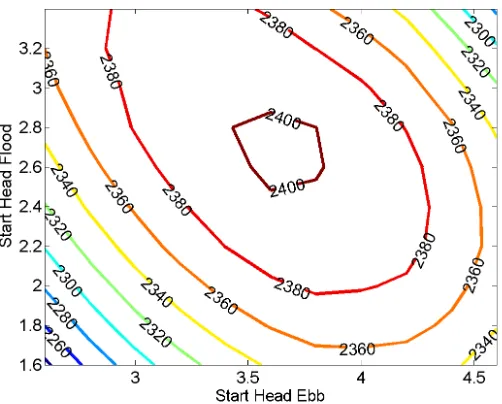
qs
+hf v+gh(Sbx−Sf x)
−hf u+gh(Sby−Sf y)
where u,v are the depth-averaged horizontal velocities in the xand y
direc-368
tion, respectively, h is the total water depth, and qs is the source discharge
369
per unit area. The variables τxx, τxy, τyx and τyy represent components of
370
the turbulent shear stresses over the plane, and f refers to the Coriolis
ac-371
celeration. Here the bed and friction slopes have been denoted for thex and
372
y directions as Sbx, Sby and Sf x,Sf y respectively.
373
For coastal ocean models, when solving either the 2D SWE or the
hydro-374
static or non-hydrostatic forms of the 3D Navier-Stokes equations, the first
375
decision generally made is whether the domain in question can be adequately
376
described at a discrete level using a structured mesh, or if the flexibility
af-377
forded by an unstructured mesh is desired. The latter is particularly useful
378
when accurate representation of complex geometries is required, and/or
dras-379
tically different spatial mesh resolution is desired within a single
computa-380
tional domain [50]. A key decision is then often whether open source versus
381
proprietary software is used, and in the case of unstructured meshes whether
382
a finite volume or finite element based discretization approach is employed.
383
For the solution of the governing equations, previous studies have applied
384
a variety of coastal models including ADCIRC [35], Telemac-2D [9], EFDC
385
[32, 51], as well as in-house research-focused software [24, 30].
386
A common aspect in all of these approaches is the manner in which water
387
bodies either side of the impoundment are linked numerically, given that at
388
different times of the lagoon operation they may be completely disconnected,
389
and at others linked through sluices and turbines. A domain decomposition
390
based technique has been the standard approach employed to simulate tidal
391
lagoon operation at a field-scale state [24, 29, 30, 32, 33, 37, 46, 51, 52].
This technique is implemented using two (or more in the case of multiple
393
impoundments) sub-domains: one upstream, and another downstream of the
394
impoundment. Open boundaries connecting the sub-domains are specified
395
in the region of flow control structures, i.e. turbines and sluice gates.
Sub-396
domains are then dynamically linked using available information regarding
397
the behaviour of hydraulic structures, such as tidal turbine hill charts as with
398
simplified 0D approaches (Section 3.1). Dedicated details for the
represen-399
tation of tidal lagoons in a SWE model and the conservation of mass and
400
momentum through hydraulic structures are expanded in Angeloudis et al.
401
[52].
402
Three-dimensional studies generally commence with an extension of the
403
2D approach to include a number of vertical layers which, while having been
404
applied to other coastal engineering applications, are yet to be applied to
405
the regional scale modelling of tidal range structures. An expansion to 3D
406
layered methods would produce an appreciation of the three-dimensional
con-407
ditions generated by the hydraulic structure-induced water jets. In turn, and
408
subject to the substantial growth in the required computational resources,
409
classical 3D hydrodynamic CFD (computational fluid dynamics) approaches
410
could yield even greater insight. At present, these are only generally
ap-411
plicable for smaller scale hydraulic engineering applications, due to current
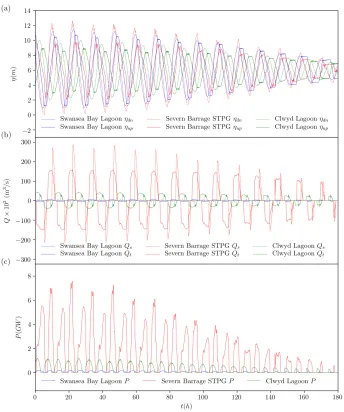
412
limitations of computational resources, including storage. The use of
multi-413
scale unstructured meshes can of course blur this distinction, but one needs
414
to keep in mind the variations in time scales and the need to parameterise
415
different turbulent processes. In fact, the expansion to fully 3D modelling of
416
tidal barrage/lagoon operations has been scarcely reported to date. At the
time of writing, this has been limited to the CFD modelling of
laboratory-418
scale flows expected downstream and upstream of barrages [e.g. 53, 54, 55].
419
However, 2D models are generally accurate for predicting water levels, and
420
so for most applications, particularly resource assessments, the complexity
421
offered by a 3D model is often not required.
422
3.4. Observations and validation 423
The main types of data used to parameterize and force numerical models
424
are bathymetry and boundary conditions. There are many online sources of
425
bathymetry that are suitable for model setup such as GEBCO (global 1/2
426
arc-minute grid) and EMODnet (European 1/8 arc-minute grid). However,
427
in many circumstances it may be necessary to complement such datasets
428
with local accurate high-resolution survey data, such as LiDAR or
multi-429
beam data, particularly in the inter-tidal. Although many tide gauges exist
430
around the world, providing accurate time series of water surface elevations
431
over many decades, often such datasets do not coincide with model
bound-432
aries, or are unsuitable for boundary forcing (e.g. if there are large changes
433
in amplitude and phase along a 2D boundary). Under such circumstances,
434
global or regional tidal atlases are therefore used to generate boundary
condi-435
tions. One such resource, FES2014 [56], provides both amplitude and phase
436
of surface elevations and tidal currents for 32 tidal constituents at a (global)
437
grid resolution of 1/16×1/16◦.
438
Although it is not possible to validate a model of a lagoon prior to
con-439
struction, it is possible to validate a hydrodynamic model in the absence of
440
a lagoon. Confidence in the hydrodynamic model, along with subsequent
441
rigorous parameterization of the tidal lagoon, therefore provides a tool that
can be used to explore various tidal range schemes and operating scenarios
443
prior to substantial financial investment.
444
Generally, a thorough understanding of the resource requires that a time
445
series of the free surface is analysed and split into its astronomical
compo-446
nents (e.g. principal semi-diurnal lunar (M2) and solar (S2) constituents),
447
and it is the amplitude and phase of these constituents that forms the
ba-448
sis of model validation. However, in many circumstances, for example for
449
regions or time periods that experience significant non-astronomical effects
450
(e.g. surges), the actual time series can be used to assess the skill and
accu-451
racy of the numerical simulation.
452
4. Tidal range resource
453
4.1. Theoretical global resource 454
The analysis described below estimates the global annual theoretical tidal
455
range resource to be around 25,880 TWh, based on reasonable thresholds for
456
energy output and water depth. However, the resource is confined to a few
457
coastal regions (covering 0.22% of the World’s oceans). In fact, the majority
458
of the resource is distributed across eleven countries.
459
Our global resource characterization is based solely on annual sea surface
460
elevations and water depths. The FES2014 tidal dataset was used, which
461
provides tidal elevations (amplitude and phase) at a consistent 1/16◦×1/16◦
462
global resolution. FES2014 is the latest iteration of the FES (Finite Element
463
Solution) tidal model, and is a considerable improvement on FES2012,
par-464
ticularly in coastal and shelf regions. Water depths were provided by the
465
GEBCO-2014 gridded bathymetry dataset (www.gebco.net), available on a
1/120◦ ×1/120◦ global grid (which was resampled here to a 1/16◦×1/16◦
467
grid to match the FES2014 grid points), and referenced to mean sea level.
468
For each 1/16◦×1/16◦ grid cell, an annual elevation time series was
con-469
structed (using T TIDE; [57]), based on the following 5 tidal constituents:
470
M2, S2, N2, K1, and O1. For each time series, the tidal range (H) of
consec-471
utive rising and falling tides were calculated, allowing the annual potential
472
energy (P E, per m2), to be calculated as follows: 473
P E =
n
X
i=1
1 2ρgH
2
i (7)
where the subscript idenotes each successive rising and falling tide in a year
474
(n ≈1411),ρ is the density of seawater, andg is acceleration due to gravity.
475
The resulting contour map of global potential energy density (in kWh/m2) 476
is shown in Fig. 2.
477
Some assumptions have been made about areas that are suitable for
la-478
goon developments, and we have calculated how much energy there is in just
479
these areas. The true limit of any development will be when the energy
480
yield does not increase the financial return sufficiently compared with the
481
development and running costs (Section 5.2). Here, we assume a minimum
482
acceptable annual energy yield of 50 kWh/m2 (based on the energy yield 483
from a constant tidal range of 5 m), and also a maximum water depth of 30
484
m (since construction costs of the embankment would likely be prohibitive in
485
deeper waters). Applying these criteria, the global annual potential energy is
486
approximately 25,880 TWh; distributed across the coastal regions of eleven
487
countries, as detailed in Table 3.
488
However, for the majority of the year, the largest theoretical resource,
the Hudson Bay area, contains substantial sea ice (http://nsidc.org/) and
490
steep bathymetric gradients (i.e., the resource in water depths less than 30 m
491
is constrained to the near coastal strip); and would therefore be impractical
492
to exploit. This region is also rather isolated from a demand perspective.
493
Sea ice is also prevalent in Alaska [58] and northern Russia [59], where we
494
calculated significant potential energy. However, lagoons can be designed to
495
take account of static and dynamic ice loads on the structures. Taking into
496
account the impracticality of Hudson Bay for tidal range energy exploitation,
497
the global annual potential energy is approximately 5,792 TWh. Generally,
498
regions with desirable characteristics, i.e. regions where the tidal wave is
499
amplified due to resonance, are limited, and indeed 90% of this resource is
500
distributed across the coastal regions of just five countries, as shown in Table
501
3: Australia, Canada, UK, France, and the US (Alaska).
502
4.2. Theoretical resource of the European shelf seas 503
For more detailed analysis, we focus on the resource of the northwest
504
European shelf seas (NWESS), since this is a region that includes existing
505
(La Rance) and proposed (Swansea Bay) tidal range schemes (Section 2),
506
in addition to hosting around a quarter of the global theoretical resource
507
(Table 3). In order to estimate the NWESS tidal range resource, the 3D
508
ROMS model (Regional Ocean Modeling System) was used to simulate tidal
509
elevations, and subsequently the potential energy in both the flood and ebb
510
phases of the tidal cycle. The model domain extends from 14◦ W to 11◦ E,
511
and 42◦ N to 62◦ N, but the region analysed is shown in Fig. 3. The domain
512
was discretised in the horizontal using a curvilinear grid, applying a variable
513
longitudinal resolution of 1/60◦(0.87-1.38 km), and a fixed latitudinal
tion of 1/100◦ (∼1.11 km). The bathymetric grid is based on GEBCO global
515
data (www.gebco.net) at 1/120◦ resolution. The vertical model grid consists
516
of 10 layers distributed according to the ROMS terrain-following coordinate
517
system. The open boundaries of the model were forced by tidal elevation
518
(Chapman boundary condition) and tidal velocities (Flather boundary
con-519
dition), generated by 10 tidal constituents (M2, S2, N2, K2, K1, O1, P1, Q1,
520
Mf, and Mm) obtained from TPX07 global tide dataset at 1/4◦ resolution
521
[60]. The validation procedure for elevations, based on harmonic analysis
522
performed at 20 tide gauges distributed throughout the domain, produced
523
scatter indices (SI)3 of <8% and <6% for M2 and S2 amplitudes,
respec-524
tively. Further information about the model set up and validation can be
525
found in Robins et al. [61]. Tidal analysis from a 30-day simulation was
526
used to calculate the following 5 dominant tidal constituents, which were
527
used to construct annual elevation time series at each model grid cell: M2,
528
S2, N2, K1, and O1. Following the method outlined in Section 4.1 and using
529
Eq. 7, the annual energy yield (in kWh/m2) over the northwest European
530
shelf was calculated (Fig. 3).
531
Here, we assume a range of minimally acceptable annual energy yields
532
and also a maximum water depth of 30 m. Based on Tidal Lagoon Power’s
533
planned scheme in Swansea Bay, the lagoon has a surface area of 11.7 km2
534
and a PE of approximately 84 kWh/m2 (i.e. a total PE of around 1 TWh)4. 535
Other lagoon schemes typically have an annual yield of 60 kWh/m2, and
536
the energy yield based on an M2 amplitude of 2.5 m is approximately 50
537
kWh/m2. 538
If we assume initially that exploitable areas are those with water depths
539
<30 m and an annual yield above 50 kWh/m2, then approximately 31,415 540
km2 of sea space (landward of the black contour lines in Fig. 3) is exploitable
541
throughout the NWESS, which equates to a total potential energy of 1,261
542
TWh per annum; 683 TWh per annum (54%) of which is found in UK
wa-543
ters, with the remaining 578 TWh per annum (46%) found in French waters.
544
These estimates are similar to those calculated from the global analysis
(Sec-545
tion 4.1), although the more detailed analysis here produces a 14% lower
546
resource than the global estimate, due to the improved model resolution. To
547
put these values into context, annual demand for electricity is around 309
548
TWh in the UK, and the UK theoretical tidal range resource is about double
549
this.
550
By increasing the threshold to 60 kWh/m2, the exploitable sea space
551
reduces by 18% (to 26,682 km2; areas landward of the red contour lines in Fig. 552
3), but the resource decreases only slightly to 1,154 TWh per annum; 53% of
553
which is found in UK waters, with the remaining 47% found in French waters.
554
Increasing the threshold yield further to 84 kWh/m2(the PE of Swansea Bay
555
lagoon) reduces the total resource to 832 TWh per annum (now with 44%,
556
i.e. 366 TWh, found in UK waters). Based on our criteria, the theoretical
557
resource is concentrated along the UK coasts of Liverpool Bay, the Severn
558
Estuary & Bristol Channel, the Wash, and southeast England. In France,
559
the resource is located along the northern coasts of Brittany and Normandy
560
(Fig. 3).
561
To put the above resource estimates into further context, the total M2
energy flux onto the European shelf has been estimated using models and
563
satellite altimetry to be approximately 250 GW [62, 63], which equates to an
564
annual energy yield of 2,190 TWh. However, the total potential energy might
565
be higher than this, because the potential energy is moving around the system
566
all the time and, hence, it is difficult to obtain a definitive theoretical value.
567
If we take energy out of the system via lagoons, it is presently unclear how
568
this will affect the energy dissipation on the shelf and the energy flux across
569
the shelf edge (i.e. influencing other energy systems globally). Further, since
570
discrete lagoons within the European shelf may interact with one another,
571
it is possible that the theoretical resource would alter from that calculated
572
above (Section 5.4).
573
Our resource estimates are based on theoretical energy yields, which are a
574
function of tidal range and water depths. In practice, the technical resource
575
will be considerably lower than the above theoretical estimates. For example,
576
Prandle [8] estimated that approximately 37% of the theoretical resource was
577
available for dual (flood and ebb) schemes.
578
Of course, not all areas with sufficient yield can be exploited, due to
prac-579
tical difficulties with development at this scale, together with political and
580
practical constraints regarding planning. It is also unlikely that, in the near
581
future, lagoon designs would consider water depths greater than
approxi-582
mately 20 m (Mike Case, Tidal Lagoon Power; Pers. Comm.), although
bar-583
rage designs might. Therefore, our resource calculations in regions suitable
584
for lagoons should be considered an over-estimate. Moreover, it is unlikely
585
that lagoon designs at this scale could maintain the high tidal amplification
586
near to shore. For instance, if a very large lagoon was developed, then the
tidal range within the lagoon would be reduced to approximately that at the
588
lagoon wall. Using models, lagoon optimization studies may reveal that
sev-589
eral smaller strategically sited lagoons within a region could lead to a greater
590
energy yield than one larger lagoon.
591
4.3. Non-astronomical influences on the resource 592
The previous analysis, and indeed most studies of tidal range resource,
593
assume only astronomical tides, and typically apply harmonic tide theory
594
to predict water levels. However, the tidal resource can be influenced by
595
non-astronomical effects, namely storm surge. Hence, potential reliability
596
problems within tidal range energy schemes could be due to storm surges
597
[64], as negative surge events reduce the tidal range, with the converse
oc-598
curring during positive surge events. Tide-surge interaction, which results
599
in positive storm surges being more likely to occur on a flooding tide [65],
600
may also reduce the annual tidal range energy resource estimate. In a recent
601
paper by Lewis et al. [64], water-level data at nine UK tide gauges suitable
602
for tidal-range energy development (i.e. where the mean tidal amplitude
ex-603
ceeds 2.5 m [23]) were used to predict tidal range power with a 0D model.
604
Storm surge affected the annual resource estimate by between -5% to +3%,
605
due to inter-annual variability in the 12 year tide gauge records. However,
in-606
stantaneous power output was significantly affected (Normalised Root Mean
607
Squared Error: 3−8%, Scatter Index: 15−41%) [64]. Therefore, a prediction
608
system [e.g. 66, 67] may be required for any future electricity generation
sce-609
nario that includes a high penetration of tidal-range energy; however, annual
610
resource estimation from astronomical tides alone appears sufficient for
re-611
source estimation, because uncertainties in resource assessment due to design
and modelling assumptions appears greater.
613
4.4. Long timescale changes in the tidal range resource 614
Mean sea-level rise, which occurs incrementally over decadal timescales,
615
results from variations in ocean mass and ocean water density (thermosteric
616
and halosteric changes) caused by global warming and subsequent ice melt,
617
due to changes in anthropogenic or natural land-water storage and from
618
changes in ocean circulation [68]. Global mean sea level is likely to rise by
619
0.44−0.74 m (above the 1986−2005 average) by 2100 [69]. However, there
620
remain large model uncertainties in sea-level rise projections, in particular
621
when predicting the volume contribution from melting ice sheets [69], and
622
projections could increase to 1.9 m [70].
623
Future mean sea-level rise is likely to affect tidal dynamics by
impact-624
ing on the position of amphidromic points and by changing resonant effects
625
on shelf seas [71, 72, 73, 74], with variation in regional (relative) sea-level
626
changes due to ongoing local and far-field isostatic effects [69, 75]. In the
627
UK, observed MSL rise is broadly consistent with global MSL rise [76]. A
628
study by Ward et al. [72] indicated that projected sea-level rise over the
629
21st century is likely to alter both tidal amplitudes and tidal phases. Such
630
changes in sea levels will influence the tidal range resource, although
uncer-631
tainties in modelling the potential impacts are significant. A preliminary
632
study by Robins et al. [77] investigated how these changes are likely to affect
633
the theoretical resource at the top eight tidal range sites around the UK.
634
There was generally an increase in tidal range at these sites (1 −3%,
re-635
sults not shown), causing the resource capacity to increase. However, when
636
the aggregated power density from multiple potential lagoon locations was
considered, tidal phase shifts tended to reduce the base-load capacity of the
638
aggregated system. In one example future scenario, simulated sea-level rise
639
clearly predicted an increased aggregated resource capacity, although the
cor-640
responding phase shifts led to reduced resource minima, which is a potential
641
consideration for firm power generation. This preliminary work can be
im-642
proved upon by considering how the feedbacks of a tidal energy extraction
643
site on the local tidal dynamics (i.e. on the resource itself) might vary with
644
changing sea levels [e.g. 72, 73].
645
4.5. Socio-techno-economic constraints on the theoretical resource 646
It is clear that not all potential tidal range sites will be developed to
647
their fullest extent. Large infrastructure projects of this type will always be
648
modified in societies where there is a democratic involvement in the planning
649
process by the local population. For example, a factor in the lack of progress
650
of the Severn barrage has been the concern of decision makers about the
pub-651
lic acceptability of the scheme. An important element of public acceptability
652
is the impact of a scheme on the local environment. This is part of planning
653
law in many countries, and within the EU is legislated by the overarching
654
Marine Strategy Framework Directive (MSFD) [78]. The most recent formal
655
review of the Severn Barrage examined environmental concerns, and
con-656
cluded there would be major impacts on migratory fish and other protected
657
species [79]. Therefore, if the UK government were to approve such a scheme,
658
it would be vulnerable to a legal challenge under the MSFD. Any lagoon in
659
the Severn would have to consider the same receptor species and habitats
660
as the barrage, and may have to provide compensatory habitat, increasing
661
the capital cost of the project. As an example of environmental concerns
limiting the resource capture of a project, even though the Swansea Bay
la-663
goon has gained (partial) planning consent, the shape is deliberately placed
664
to minimise interference with the Tawe and Neath rivers [80].
665
The coastal zone provides humans with extensive ecosystems services, and
666
include visual amenity, including coastal seascapes [81]. Swansea Bay lagoon
667
is an example of siting a structure to mitigate visual impacts; the structure is
668
located in the northern part of Swansea Bay, next to the dock infrastructure,
669
and away from the desirable residential areas and tourist seafront located to
670
the west of the bay [80].
671
Many European countries are developing Marine Spatial Plans [82], so
672
that they have a strategic long term oversight of economic activity in the
673
oceans. The shipping industry has an historic presumption of safe navigation
674
to port, and most coastal waters have navigational zones and marked shipping
675
channels. The large scale development of lagoons could interact with these
676
channels, and any perceived impediment to navigation would be contested
677
robustly. A Marine Spatial Plan attempts to resolve these differences at
678
an early stage; however, the consequences are that lagoon shapes and sizes
679
will evolve from the most economically desirable geometry due to harbour
680
access. When other uses of the sea are taken into account, including marine
681
aggregates, offshore wind, and aquaculture, the space available for lagoons
682
could be significantly constrained. One solution could be the Multiple Use
683
of Space (MUS), with the inside of the lagoon providing an area that is
684
protected from wave action and consequently suitable for a number of other
685
uses. The MarIBE project [83] considered a number of MUS projects, and
686
proposed suitable business models for future exploitation. In particular, the
combination of aquaculture and a lagoon was investigated [84].
688
A previous project [85] considered a number of factors related to
deploy-689
ment of tidal stream turbines in the Severn Estuary, including a preliminary
690
navigational risk assessment. Although the study is not directly applicable
691
to lagoon deployment, there were two key findings. Firstly, early engagement
692
with local pilots established that the “best” location for turbines from a
re-693
source perspective was co-incident with an area of sea that is key to vessel
694
logistics. Secondly, the majority of the channel is 20−30 m relative to LAT5,
695
and larger container vessels are routinely 16 m draft, making large areas of
696
the channel practically unusable for the largest vessels. Applying this result
697
to all areas with high tidal range, the application of good spatial planning
698
could lead to the deeper channels available for vessels, and shallower areas
699
designated for lagoon technology.
700
Building a lagoon is a significant item of infrastructure, and good port
fa-701
cilities are essential, in a similar way to the investments in round 3 wind farm
702
construction on the east coast of the UK [86]. Tidal Lagoon Power Plc
com-703
missioned a supply chain study that outlines the infrastructure requirements
704
[87]. Locations with theoretical resource but devoid of suitable ports in close
705
proximity may not be practical for this reason. The construction techniques
706
used also have a relevance to the port facilities required. La Rance barrage
707
made use of a Bund construction [88], and hence was effectively a
conven-708
tional land based civil engineering construction. However, such methods take
709
a considerable amount of time, and may not be suitable for larger lagoons.
710
Therefore, concrete caissons have been under consideration for a considerable
711
period of time. Clare [89] considered the caisson requirements for the 1980s
712
STPG Severn Barrage, which proposed the use of the majority of deep water
713
ports in the UK, together with towing large caissons over considerable
dis-714
tances. Finally, and importantly, a lagoon must of course be able to export
715
power to the grid, and so proximity to a suitable grid connection is a key
716
constraint.
717
5. Optimization
718
There are two main categories of tidal lagoon optimization. The first
719
is optimization of the operation of the turbines and sluices to maximize
720
the energy yield from the lagoon, and the second is optimizing the overall
721
economic design of the lagoon to minimize the cost of energy. The academic
722
literature has focused on energy optimization, while industry tends to focus
723
more on the economics.
724
5.1. Energy optimization 725
The optimization of lagoon operation has generally been achieved through
726
the application of 0D models (Section 3.1), although other approaches have
727
been attempted. Prandle [8] used an analytical approach to solve the 0D
728
model through a number of simplifications. These included the use of a
729
single tidal constituent, a constant lagoon bathymetry, and a constant turbine
730
discharge rate.
731
Numerical solution of the 0D model has been undertaken numerous times
732
[8, 10, 26, 27, 34, 39], and is the basis for most energy yield estimates. The
733
codes seek to find the optimal generation start and stop times, and in most
cases this is achieved through the use of fixed start head values for the ebb
735
and flood tides. By considering a wide range of start head values, the optimal
736
energy yield can be obtained, as shown in Fig. 4. This example plot was
737
obtained through solving the 0D conservation of mass equation using a 4th
738
order Runge-Kutta variable time-step method. Realistic turbine operation
739
paths, lagoon bathymetry and tides were used for illustrative purposes only;
740
however, the code has been applied to a range of commercial tidal energy
741
projects including the Mersey Tidal Power project and Swansea Bay Lagoon.
742
Fig. 4 clearly shows the optimal start heads for the ebb and flood phases at
743
around 3.7 m and 2.7 m, respectively.
744
Yates et al. [28] have shown that energy yields can be increased through
745
the use of pumping, and this tends to be in the region of about 10% of the
746
potential energy. Due to the increase in computational power, the approach
747
typically used in industry has moved away from fixed start heads to full
748
optimization of the operation path. In this approach, the basin water level is
749
discretised, and every possible path from the initial water level is calculated
750
through the required period, typically one year. The optimal path can then
751
be identified.
752
This approach is computationally expensive, and while the fixed start
753
head simulations can be run in several seconds, the full optimization
simu-754
lations can take significantly longer, with the exact time dependent on the
755
water level discretization and selected time-step. There has been very little
756
published on this approach [90], but the selection of these values is highly
757
significant in terms of energy yield estimates. More work is needed in this
758
area.
Prandle [91] and Rainey [44] used an electrical circuit analogy to model
760
the potential energy yield of a tidal power plant. Although this approach
761
takes into account some of the potential hydrodynamic effects, it does not
762
allow for the discrete operation of the lagoon, as in the standard numerical
763
approaches.
764
2D modelling tends to produce lower energy returns than 0D modelling
765
due to the impact of hydrodynamics on the system (e.g. see Section 5.3).
766
As the computational cost involved in running these models is high, few
767
optimization studies have been performed, and they tend to be used only to
768
provide an estimated correction to the 0D energy yield numbers.
769
5.2. Economic optimization 770
Economic optimization is an essential step for any realistic tidal lagoon
771
development. The operational optimization is part of this process, but a
772
much wider range of data regarding economics and other constraints (e.g.
773
environmental or practical) have to be accounted for. The basic approach is
774
to determine the Levelised Cost of Energy (LCoE) for a given lagoon design,
775
and to then vary the design to determine the minimum value [92]. The LCoE
776
is derived through:
777
LCoE =
CI+PNn=1
OMn
(1 +r)n
PN
n=1
En
(1 +r)n
(8)
whereCI is the capital investment, OMnrepresents the operation and
main-778
tenance costs in yearn,Enis the energy yield in yearn, andris the discount
779
rate. The design of the lagoon includes the cost of the embankment, which
determines the enclosed basin area, the number and size of turbines and
781
sluices. Each design affects the cost and energy yield. The optimal design
782
is found through varying all of these parameters, and yields the optimal
tur-783
bine design, number of turbines and sluices, and the optimal lagoon operation
784
path. The size and power rating of a turbine can have significant impacts on
785
the cost of energy for a scheme, and so should be thoroughly investigated. In
786
Fig. 5, the minimum LCoE has been calculated using Eq. 8 for a fixed wall
787
position for different turbine designs. For each turbine design, the optimal
788
number of turbines and sluice gates is determined, together with the optimal
789
operating heads. The capital costs for each design are calculated through
790
simple design assumptions, and the O&M costs are fixed percentages of the
791
capital. Fig. 5 shows that the optimal design, for this illustrative lagoon, is
792
a 6 m diameter 5 MW turbine. The exact number of sluices and turbines
793
and the operating heads for this turbine can then be extracted from the
794
calculated data.
795
5.3. Implications of regional hydrodynamics for individual lagoon resource 796
Lagoons act as obstructions to the otherwise undisturbed tidal dynamics
797
and will, therefore, alter natural flow conditions. Accurately quantifying
798
their local and far-field impact is crucial for ensuring their feasibility.
Hydro-799
environmental impact assessments of tidal range structures have been the
800
subject of several studies [6, 9, 24, 29, 36, 52], and it is now well established
801
that tidal impoundments can lead to changes in regional hydrodynamics,
802
with implications for existing water quality and sedimentary processes. By
803
extension, it must also be acknowledged that the presence of the lagoon may
804
impact regional tidal amplitudes and water levels.
The output of a tidal power plant is fundamentally proportional to the
806
downstream amplitude and the water head differences across the upstream
807
and downstream sides of the lagoon. Therefore, since the marine structures
808
themselves can sometimes interfere with these parameters, coastal modelling
809
tools (2D/3D) can be employed to account for the altered hydrodynamics on
810
the lagoon energy outputs. In contrast, generic 0D models assume no
inter-811
ference of the lagoon structure on regional hydrodynamics and are therefore
812
unsuitable for capturing potential losses, thereby making the expansion to
813
coupled hydrodynamic-operation models essential for accurate resource
as-814
sessment of advanced proposals. Previous studies demonstrate the disparity
815
between 0D and 2D predictions [24, 28, 52], with some indicative results
816
shown in Table 4. The general trend has been that as the project scale
817
increases, so does the hydrodynamic impact, as seen when comparing the
818
Severn Barrage and the two coastally attached tidal lagoons. However, this
819
is not an absolute; the Clwyd impoundment in the study is substantially
820
larger than the Swansea Bay lagoon, but features a lesser relative
hydrody-821
namic impact on its energy output. More factors also come into play, such
822
as the operational sequence (e.g. ebb-only, flood-only or two-way) as shown
823
by the Severn Barrage STPG simulations of the particular study.
824
5.4. Multiple lagoon resource optimization 825
The tidal range structures listed in Table 4 were assessed as discrete
826
projects, but the manner that power is generated over time (Fig. 6) illustrates
827
the advantage of concurrently developing multiple tidal energy schemes. For
828
example, tidal lagoons can be strategically developed in locations that have
829
complementary tidal phases, similar to the phasing that has been suggested



![Table 2: Tidal range locations around the world that have been identified as being tech-nically feasible [adapted from 13, 21, 108]](https://thumb-us.123doks.com/thumbv2/123dok_us/9342072.436227/65.612.112.505.269.564/table-tidal-range-locations-identied-nically-feasible-adapted.webp)

![Table 4: Typical Annual Energy Predictions of a number of tidal range scheme case studiesof different scales (adapted from [24] for lagoons and [52] for barrages)](https://thumb-us.123doks.com/thumbv2/123dok_us/9342072.436227/67.612.114.518.288.596/typical-annual-energy-predictions-studiesof-dierent-lagoons-barrages.webp)
