~.,.-:.:.~~--:--.. --
...
;~. - - ' , ... : " -. . . . '-~~~'--~'~~~":----'"---,---,-,,,:-~-{!la9!l 6956643 .389982. 475 '.
i·\JAMES PO 4GE/D IR '" . ' .
t'PRINCETON UNIVERSITY '."-<
~··COMPUTER: CENTER . . .. F
~'~'87 PROSPECT AVE . '
i
PRI N.CETON N J 0 8 5 4 4 \;:~ .'~~, .~' ~.~~ ' - ' - " .-;-:
... ZI ; ~x : ~ ~~ St~.T. ~~ t!) O!~!IT~Y ~~~ il~~." lWII~l
... ~ _dill' "'-" aUtOTl ___ wt... . , . . . Wi:i<. . . .
,,~.,.< '" :v*: -::. --~ ~ .",,, 1~~","~ ~ ~,*"'<-i~ ~~" ... : ~~,,>x<~~~.J;
@)(QJ~
.. __ .or.,"~ .... _ ... _~_""_~ _ _ _ _ _ _ " ___ "''' ___ '''~ .. ,-~ ... , .... " ... .
-~--.. ---.-.. --.... -...
-
..---
.. -,-~ .. -...-,.---.---
_ ... ---,-_
... --, ..-
~ ... -., .... ~ ...-
.... ~ ....""-.-'~I
t
~~
, ~
~.~
\1_ - SOLUTlotl ds boxes, etc.
THE. r;nCROBOO~es cables, power coo~ce~trator output elimlO<l dem to c
• Clean- atche s LSI 010 d equipment " PerfectlY m sts-lines an
• Minimizes all co
II'
J/II
I
\\
I'
I
!
Controlling INS Performance.
A rational approach to managing IMS-based
online systems - that
is
what Candle's family ofsoftware monitors for IMS offers-• Improved IMS Availability
• Improved Response Time for Online IMS Terminals • Improved SerVice Levels to End Users of IMS Systems
Exception Analysis
This is the first line of defense against IMS emergencies: IMS pool fragmentation, Program Isolation Lockouts, and dozens of other urgent problems. Because of Candle's unique architecture, the IMS product family is virtually immune to the problems that the Exception Analysis de-tects, so that they continue to work when they are needed most - during severe hardware or software problems.
Response Time Analysis
Once severe threats are averted, the next concern is user service levels. Are service level agreements being met-right now? Is response tiIrie getting better or worse? Are
certain work~oads (transactions; logical terminals,
scheduling classes) having problems?
Degradation Analysis
Typicaliy,
aO%
of the time to solve IMS performanceproblems is spent in diagnosis, while 20% is spent in cor-rection. Degradation Analysis eliIriinates most of the
80% by breaking down the response time for the
work-load of interest according to the resources that account
for the response time. It shows how much of the
response time each resource accounts for. Degradation Analysis will identify and quantify your IMS bottle-necks, thus prioritizing your tuning efforts.
Candle's Family of IMS Monitors
OMEGAMON@/IMS is a realtime monitor that
automatically detects and warns of IMS avail-ability and performance problems.
EPILOG@/IMS is an Installation Performance Manage-ment system designed to manage the capacity needs
and workload demands of a data center using IMS. It
monitors critical data about hardware, MVS, IMS, and application software.
DEXAN@/IMS provides a realtime analysis of the
perfor-mance of your IMS applications by identifying the causes of degraded response time and quantifying their impact.
RT ATM
liMs
monitors IMS performance froin the enduser's point of view, thereby allowing operational and system staff to determine how well IMS is serving the end users.
OMEGAMON/IMS, DEXAN/IMS, EPILOG/IMS and
RTA/IMS workfug together - a comprehensive set of
tools for you to manage your IMS network AND provide the best possible level of service to your users.
For more information, contact your Candle representative.
10880 Wilshire Boulevard, Suite 2404
Los Angeles, California 90024
(213) 207-1400
CIRCLE 30 ON READER CARD
-DATAMATION
SEPTEMBER 1 1984/$3.00 U.S.A.VOLUME 30 NUMBER 14 This issue, 183,838 copies
FEATURES
26
IN FOCUS
Edith Myers reports that major finan-cial institutions are "Banking on Pcs" to get into your home.
96
OUT OF THE LABS AND
INTO THE STREETS
Peter G. Balbus and Joseph L. Healey
Recent progress in fiber optics technology may make copper wire and coaxial cable obsolete.
111
NTH GENERATION
LANGUAGES
Richard L. Wexelblat
Pattern-matching, deductive retriev-ers, forward-chaining-it's all here in this peek at tomorrow's panoply of programming languages.
121
UNDERSTANDING
SUPERCOMPUTER
BENCHMARKS
Jack Worlton
They're not always what they seem. Here's help to put them in context.
134
WANTED: RENAISSANCE
PEOPLE
Andrew Friedman and Joan Greenbaum
New flexible project team structures require generalists, say dp managers in a new survey.
149
BEYOND PARTNERSHIP
Hesh Wiener
To stimulate a technology-driven economy, the government is attempt-ing to turn market competitors into R&D collaborators.
156
CROWNING EUROPE'S DP
ROYALTY
Revenues for the DATAMATION Top 25 in the European realm rose a royal 11 % in 1983. Reigning IBM's ration was a king's ransom.
166
NEW LIFE FOR FORTRAN
Gerald M. Berns
A recently developed diagnostic and documentation program might herald the second comir]gfor the popular language.
NEWS IN PERSPECTIVE
42
ANTITRUST
Under the gun.
52
EXPORTS
EAA bogged down. COCOM makes good.
71
DATA COMMUNICATIONS
LANS make headway.
80
MICROCOMPUTERS
Bullish on China.
92
BENCHMARKS
DEPARTMENTS
9
LOOK AHEAD
15
LEnERS
23
EDITORIAL
179
PEOPLE
181
HARDWARE
189
SOnwARE
195
SOURCE DATA
199
MARKETPLACE
200
ON THE JOB
206
ADVERTISERS' INDEX
207
READERS' FORUM
INTERNATIONAL 180-1
-5
NEW DIRECTIONS FOR THE
THIRD WORLD
-13
THE DANGERS OF
DEPENDENCE
-21
CHINA'S COMPUTER
COMMITMENT
COVER ILLUSTRATION BY ANDREA BARUFFI
IRSI
ONYEISION
CONVERSION
CONYERSION
CONYERSION
CONVERSION
CONVERSION
CONVERSION
CONVERSIONNO CONVERSION ][S TOO BIG
OR 1'00 SMALL.
Experience in conversions is improved technology in methods, generally the most important factor in translators, and other conversion tools success or failure when changing com- to help you avoid the many pitfalls puters or languages. present in any conversion process.
CAP GEMINI DASD has been We structure the plans and tech-in the conversion bustech-iness conttech-in- niques to secure the fast, high-risk uously since 1974. As a client, you environment of moving all of a com-enjoy over 10 years of constantly
0
pany's applications at one time._ _ _ _ _ _ _ ::2~ ,.
CAP GJEMINlI DASD
PEOPLE/PRODUCTS/RESULTS
For instant information callSOO-55S-514S; in Wisconsin, (414) 355-3405 or your local CAP GEMINI DASD branch.
Atlanta Denver Jacksonville Milwaukee Orlando Seattle Baltimore Edison, N.J. Los Angeles Minneapolis Philadelphia St. Louis Chicago Houston Miami New York Portland Tampa
Dallas Indianapolis San Francisco Washington, D.C.
CIRCLE 1 ON READER CARD
4 DATAMATION
CRTI=IMRTICN
Editor Rebecca S. Barna Senior Editor Larry Marion News Editor John W. Verity Features Editor Kenneth Klee Senior Staff Writer Parker Hodges Copy Editor Florence Lazar Assistant News Editor Michael Tyler Assistant Features Editor Deborah Sojka New Products Editor Robert J. Crutchfield Assistant Copy Editor Theresa Barry Assistant Editor Lauren D'Attiio
Editorial Assistants Donna Lyons, Mary Ann Hariton
Copy Assistant Eric Brand Bureau Managers
San Francisco Charles L. Howe Los Angeles Edith D. Myers Minneapolis Jan Johnson Boston R. Emmett Carlyle Washington Willie Schatz Advisory Board Lowell Amdahl,
Howard Bromberg, Philip H. Dorn, Joseph Ferreira, Bruce W. Hasenyager, David Hebditch, John ImlaY,'Terry G. Mahn, , Louis Nauges, Angeline Pantages,
Robert L. Patrick, Malcolm Peltu, Russell Pipe, Carl Reynolds, F.G. Withington, Amy Wohl. Contributing Editors Pamela Archbold,
Laton McCartney, Hesh Wiener International Editor Linda Runyan European Managing Editor Paul Tate Technology Editor, Europe Fred Lamond Foreign Correspondents John Lamb,
London; James Etheridge, Paris; Peter Hidas, Oslo; Norman Kemp, Sydney.
Art Director Kenneth Surabian Assistant Art Director Susan M. Rasco Art Assistant Catherine Kennedy Production Manager Anne Earley Publisher James M. Morris Executive Editor John L. Kirkley
Circulation Vice President Joseph J. Zaccaria Circulation Manager Mary Agnes Glenister Operations Manager Patricia Adamo Research Director Laurie Schnepf EDITORIAL OFFICES
Headquarters: 875 Third Ave., New York, NY 10022. Phone (212) 605-9400; telex 429073. New England: 1 Chaucer St. RFD 2, Sandwich, MA 02563, (617) 888-6312. Washington, D.C.: 4451 Albemarle St. NW, Washington, DC 20016, (202) 966-7100. Midwestern: 3607 Garfield Ave. S., Minneapolis, MN 55409, (612) 827-4664. Western: 1801 S. La Cienega Blvd., Los Angeles, CA 90035, (213) 559-5111; 2680 Bayshore Frontage Rd" Suite 401, Mountain View, CA 94043, (415) 965-8222. International: 130 Jermyn St., London SW14UJ, England, (441) 839-3916, tel-ex 914911; 13 Stanley Place, Budd Lake, NJ 07828, (201) 691-0592, telex 499-4308.
TechnICal pubhshlng·
DB
~~~g~~8~~dstrcctcorpor3tlonWBPA
AHP
DATAMATION (ISSN 0011-6963) Magazine is issued twice monthly on the 1 st and 15th of every month by Technical Publishing, a company of The Dun and Bradstreet Corp., John K. Abely, president. Executive, advertising, editorial of-fices, and subscription departments, 875 Third Ave., New York, NY 10022. Published at Lincoln, Nebr. Annual sub-scription rates: U.S. and possesions: $50; Canada: $75; Ja-pan, Australia, New Zealand: $140 air freight; Europe: $120 air freight, $225 air mail. All other countries: $120 surface, $225 air mail. Reduced rate for qualified U.S. students, pub-lic and school libraries: $30. Single copy: $3 in U.S. Special Datamation/Dataguide issue: $25. Sole agent for all sub-scriptions outside the U.S.A. and Canada is J.B. Tratsart, Ltd. 154 A Greenford Road, Harrow, Middlesex HA13QT, England, (01)422-8295 or 422-2456. No subscription agen-cy is authorized by us to solicit or take orders for subscrip-tions. Second-class postage paid at New York, NY 10001 and at additional mailing office. ©Copyright 1984 by Techni-cal Publishing Co., a Division of Dun-Donnelley Publishing Corp., a company of The Dun and Bradstreet Corp. All rights reserved. "Datamation" registered trademark of Technical Publishing Company. Microfilm copies of Datamation may be obtained from University Microfilms, A Xerox Company, 300 No. Zeeb Road, Ann Arbor, M148106. Printed by Foote
I,
OV,,'
0you want one' softwar, e system. . to meet all
of your Information Center needs? Look no
further. The
SAS~System can reduce the
. applications backlog and improve productivity
throughout your organization.
Discover ...
The SAS
Solution for
End Users
You can meet every computing need with the'
in-tegrated SAS System. Use it for prospect files, sales
reports, tracking systems, spreadsheets, mass
mail-ings, project schedules, product mix models,
fore-casts;
and presentations. All this. and more with the
SAS System.
Discover ...
TheSASSolution
for',
Programmers
The SAS System satisfies your programmers' needs
too. With a few simple statements, you can read files
from your production systems and
DL/I
data bases.
You'll' find the SAS System ideal for adhoc
report-ing, problem solvreport-ing, and prototyping.
SAS is the registered trademark of SAS Institute Inc .• Cary, NC. USA. VMS is the tradanark of Digital Equipment Corporation, Marlboro, MA. Copyright C 1984 by SAS Institute Inc. Printed in the USA.
Discover ...
The SAS Solution for' You
The SAS System helps you cope' with all your end
users' and programmers' needs. One system' gives
you the software tools for every application, on the
hardware you've already installed. The SAS System
runs on the IBM 370 family of machines , under'OS,
TSO, VMlCMS,
DOS/VSE,
SSX, and ICCF, and
under Digital, Equipment' Corporation's VMS
1Mand
Data General Corp.'s
AOS/VS
operating systems.
'Put the'SAS System
in your InfonnationCenter.
It
maY,be,the
best
decision, you
make
aU
year."
SAS Institute"
Inc~,Software Sales" Department,
SAS. Circle, Box 8000,
Cary,NC 27511-8000; USA.
Telephone (919) 467-8000. Telex 802505.
International customers,
call
the Institute's
Modem malfunctions, facility faults and streaming terminals can disrupt your data communications. You can't afford that kind of trouble.
AT&T Information Systems can help. Our DATAPHONE® II Service com-bines synchronous analog data transmission at speeds of 2400 to 9600 bps with a net-work management system on four upgrade-able levels.
And upgrading your system is easy.
As your needs grow, you can enhance
your system by adding new equipment to monitor and control what you already have.
And DATAPHONE II Service is compat-ible with any synchronous data processing system, regardless of host, terminal or line protocol. So, it can keep an eye on the data processing equipment you currently use.
WE'RE ALWAYS ON THE ALERT
DATAPHONE II Service provides con-tinuous real-time monitoring and testing while your network is in operation.Signals are monitored on a low-end frequency band to guarantee the integrity of your data. Malfunctions are detected automatically, isolated and repaired. This cuts outages significantly.
Monitoring is independent of your host
computer. It won't disrupt computer
func-tions and waste costly processing time.
RELIABLE
r,'Ar~AGEMUnON EVERY LEVEL
Level I data sets are the foundation of DATAPHONE II Service. Extensive tests and commands can be conducted from their front panel.Level II offers centralized control and management. A Diagnostic Console increases test, command and monitoring capabilities. Up to 256 control modems can be managed through this desk-top console.
Level
III
adds a Network Controller forenhanced monitoring and control. A CRT, using English commands, provides faster, easier access to diagnostic information. A printer generates hard-copy test reports. You can analyze reports thoroughly, make adjustments and avoid future faults.
Level IV manages more modems and performs more functions than any system on the market. A UNIX* based operating
system runs the System Controller. It
The System Controller provides fault and status reports of all eight channels. The color CRT and printer provide clear, graphic and tabular management reports.
User-customized English-language names and commands eliminate the need to memorize codes. System access is easy and trouble reports are quickly understood. Even the non-technical user will be able to interpret trouble tickets, follow trends and analyze the causes of downtime.
A unique benefit available with our DATAPHONE II Service is remote moni-toring at a nearby AT&T Data Maintenance and Operational Control Center.
All major faults are automatically re-ported to the nearest DATA MOCC-and often corrected there, too. Malfunctioning devices can be located and disconnected
from this remote center within minutes.
OVER 100 YEARS OF
COMMUNICATING BETTER
For over a century, AT&T products and
systems have set the standards for p~rform
ance and reliability. Today, 4,000 desIgners formerly at Bell Laboratories are working full time to develop and design new busi-ness products at Information Systems Laboratories. And, as always, we back our products with the most experienced sales and service force in the industry.
To learn how our DATAPHONE II Service can guard your profits and product-ivity, call1-S00-247-1212, Ext. 195.
WHfEN VCU'l/1S
GOY TO BIE RIGHT.
* Rpgistt'red trademark of AT&T Ilelll~lboratories
£u~u
Information Systems
"1984 Comshare
This is a p'icture
of
a company
heailed for disaster:
This picture is just too simple to show you what's Iyi ng I n the weeds. You know you r tota I profits, but can you get them by product? Can performance be analyzed by distribution channel? By geography? How are things really going? Why?
If your company uses an IBM computer, Comshare Decision Support Software can help fill in those blanks and more.
. Management needs relevant, timely data with depth and resolution to make informed, effective decisions. Now you can easily gather information and extract per-tinent data from other sites and sources in your com-pany. You can perform analyses, model alternative scenarios and format reports and charts to show results. If you can define the question you want to ask, System W can provide answers.
We think along your lines. Comshare has been in the
business of solving business information problems for 18 years. So System W has innovations like Model-by-Example ™ and WINDOW™ that make it very easy for managers to ask the hard questions.
System W is, quite simply, now the best decision support system for companies that use IBM
mainframes and PCs. Seventy-seven installations in 13 months attest to that.
If you'd like the big picture on us and how System W
can work fOr you; call Chris Kelly at Coms~are toll-free:
1-800-922-SYSW (in Michigan call: 313-994-4800). Or simply mail your business card to: Conishare, P.O. Box 1588, Ann Arbor, Michigan 48106.
SYSTEM W DECISION SUPPORTSOFTWARE
CO
~
liZ
For decision makers who need to knOw their options now.
IS IBM WAITING
FOR TI?
WALL ST. DOWN
.ON WANG?
ARKAY IS OK
TO CA
DOING THE IBM
SHUFFLE
THE EUROPEANS
STRIKE B.f\CK
LOOK AHEAD
IBM's local
ne~work ~roublesare said to stem from
continuing problems at Texas Instruments in
developing a
si~glechip
s~t ~ohandle both token
passing rings and buses.
IBM wants TI to support
both methods, but TI is said to have bit off more
than it·can currently chew.
Motorola
appa~entlydeclined to bid on the chips, perhaps seeing them
as too rough to build on time.
Despite strong growth in its stock price, Wang
Labs may be falling from grace on Wall Street.
Wang told analysts its order growth had slowed and
its margins had narrowed due to tougher IBM
competition in OA.
An~lystsare also
wo~riedthat
the Lowell, Mass., firm's line of minicomputers is
aging rapidly, given the price/performance
characteristics of
y~ar-oldmachines from Prime,
Data General, and DEC.
Volume shipments of the
~ew
high-end VS 300 are reportedly delayed up
~ofour months, to early
1985.
Analysts were buoyed,
however, by Wang's purchase of 20% of InteCom, the
Dallas PBX with which it is developing an
integrated LAN, cpu, and PBX
syste~.C6mputer Associates International is on the verge
of yet another acquisition
("CA
Goes Shopping
Again," Aug. 1, p. 50.) The Long Island software
house is set to bllY Arkay Computers Inc., Newton
Center, Mass., for an undisclosed sum. CA has its
eye on Focus, Arkay's DOS to MVS conversion
product, since CA has 27,000
prod~ctsinstalled on
DOS machines' worldwide, and is well aware that IBM
expects about 200 DOS
inst~llations
a year to
switch to either MVS or VM. Arkaypresident Bob
Kahn is expected to stay with CA in a consulting
role, but Arkay's employees may not be so lucky.
Word. is circulating in the industry that IBM may
reorganize its sales organizations once again.
Reports indicate that the company is considering a
return to the more traditional sales district
structure it abandoned three years ago.
Sources
say the current National Accounts Division isn't
working out as well as IBM had hoped, but it's not
clear when such
a
reshuffling might take place.
T~e
long-awaited decision by ,members of the
western export control 'organization, CoCom, on
high-tech trade with the Eastern Bloc (see p.
59)
have not completely cleared the air between the
U.S. and Europe.
West Germany is canvassing for
support among other western European nations to
BRAZIL CHASING
UNIX
TRILOGY'S NEXT
COMPUTER?
UNITING UNIX
AND UNIVAC
WHO WANTS
VALUE?
RUMORS AND RAW
RANDOM DATA
10 DATAMATION
LOOK AHEAD
pressure the U.s. over the extraterritoriality
clauses in the U.S. Export Administration Act. The
Bonn government released a study of cases where
U.S~
controls have affected west German high-tech
trade of products containing U.S. components or
technology to countries outside the Eastern Bloc.
West Germany is also considering legislation to
limit the local· effect of the U.S. policy.
The South American country, notorious for trying
to nurture its domestic information processing
industry at the expense of foreign firms, is
trying to gain exclusive rights to selling Unix
within its borders.
Rather than let AT&T come in
and sell the operating system, Brazil's
Associa-tion of Computer and Peripherals Manufacturers is
negotiating to become sole marketer. AT&T, not
surprisingly, isn't too thrilled.
Gene Amdahl is apparently still hoping to build a
32-MIPS mainframe at Trilogy Corp.
Even after
quitting the superchip effort, we hear he is
planning to build the processor and price it to
pay back the entire cost inside of three years.
Future revenues would fund other R&D projects.
Look for Sperry Computer Systems to introduce
later this year a 32-bit supermicro-based office
system that will run Unix.
The machine will most
likely come from Sequ·oia Systems, the Mar lboro,
Mass., startup in which Sperry has invested a
couple of million dollars in seed money.
Sequoia
has only just begun field
t~stingits machine and
is likely to sign the Blue Bell, Pa., mainframer
as a licensed manufacturer.
Value Computing, the Cherry Hill, N.J., systems
software developer, is on the selling block, after
its unsuccessful introduction of the Data Center
Distribution System (DCDS> last spring. No word
on who might be buying or for how much, but
president Vincent
J.
Bannon apparently won't stay
with the company.
Neither will marketing veep
Michael G. McMenamin, insiders
say~because his
sales force has experienced very rapid turnover
and instability. The privately held firm was
counting on DCDS, which prints only specified
excerpts of reports for each recipient of the
report, to bolster the firm's sagging revenues.
Daisy Systems Corp., the Sunnyvale, Calif.,
A PRINTER FOR EVERY NEED
AND
EVERY SPEED.
If
you're looking for a dependable
lineup of printers, look at Printronix.
We've got it all in the family.
From Word Processing at 80 LPM,
Graphics at 150 LPM, to high-volume
Data Printing at 2000 LPM, Printronix
printers do it all, without skipping a
MVP---~ Our MVP is the business printer that really means business. It's the world's first and only microcom-puter line printer which puts the dependability of our P-Series into a smaller package.
The MVP .is truly the Most Versa-tile Printer, with selectable speeds ranging from 80 LPM to 200 LPM, and full graphics capability. It's the perfect printer for all your multi-user, multi-application needs.
THE FIRST LINE IN PRINTERS.
PRIN-fRONIX
17500 Cartwright RoadP.O. Box 19559, Irvine, CA 92713 714/863-1900 TWX: 910-595-2535
Outside California: 800-556-1234, ext. 66 In California, 800-441-2345, ext. 66
beat. In fact, they're the only
print-ers built to take the pressure of
continuous duty processing in the
most rigorous environments.
And, in addition to industrial
durability, our unique hammerbank
technologies give you superior
P-Series
print quality and outstanding
graph-ics capability.
For printers for every need and
every speed, come to Printronix. The
best printer line for your bottom line.
For more information, please
write or call today.
The P-Series consists of our proven printer/plotters, the P300 and P600. At 300 LPM, the P300 can combine bar codes, OCR and alphanumerics all in one dependable package to
bring you the best in medium-speed line printer capabilities. And, with twice the throughput of our P300, the
extra-rugged P600 is truly an industrial printer, designed for all your heavy-duty processing tasks.
Plus, there's our new P-Series XQ. Enhanced versions of our P300 and P600, delivering high-speed draft print and compressed print in an office-quiet cabinet.
.
Our DataPrinter series gives you the most reliable band printer performance available, using a
pre-f
DataPrinter~
;';;)h; cision hammer;. J ; y ' . ' : ' : , . . .... . . . . actuator system
>
-"'c~'
. I
ct:~!~egrif~f~
The 4160 GraphicPrinter
-The 4160 GraphicPrinter com-bines the reliability and versatility of Printronix technology with higher dot density. Perfect for applications requiring high resolution graphics.
CIRCLE 34 ON READER CARD
technology. DataPrinter's fully-formed char-acter bands offer superior print quality for your super-mini and mainframe data processing needs,
at speeds from 600 LPM toa
blistering 2000
WE
HAVE
TROUBLE
LEl
v
IlNGGQ
The first ROLM@ CBXs left home nine years
ago, but we still call them. And, although
there are now more than 14,000 ROLM
busi-ness telephone systems, we call most of them
every single day. We want to know if they're
happy or if they're· having any problems ..
"Remote diagnostics" is our early warning
system. If our technicians don't like what
they hear from that system, they scramble.
So, more often than not, the problem is
tended to before our customers come to
work, before they know they have a problem.
So, you're not going to have a ROLM
technician around your place day in, day out.
({Good morning.
How are we
feeling today?"
full of specialists from over 150 nationwide
service centers to provide upgrade assistance,
on-going support and service follow-up.
It's no wonder that a recent survey of
telecommunications experts - asking which
PBX makers provide the best service and
support - reported a resounding,
over-whelming vote for
ROLM.
cJ
That commitment to service is just one
more compelling reason why
ROLM
is the
choice of more than two-thirds of the
Fortune 500
companies.
When you become a
ROLM
owner, you'll
understand. We know it
belongs to you.
.
RDbm
But it's still our baby.
4900 Old Ironsides Drive, MIS 626, Santa Clara, CA 95050 • 800-538-8154. (In Alaska, California and Hawaii, call 408-986-3025.)
INIEllECI~M
ROSOONERSAID
IHANDORE.
To
use
INTELLECT,
the
natural language
query system, all
y~u
have
to do is ask-in
everyday conversational, English---and
you'll retrieve.
Immediately, in either
texforfull-color graphics.'
INTELLECT, the world's only successful
true natural~language query system, is an ideal tool for
yourinfor-mationcenter. INTELLECT's powerful information
retrieval capabilities are so advanced that it
under-stands questions and' responds with answers as' if you
. were talking to a knowledgeable colleague.
Execu-tives access data themselves-more easily than ever
before~without
learning any technical jargonor
"computerese." It's soeasy to use, it doesn't even
have a training manual!
Whether you ·use INTELLECT as a retrieval system
or as an effective data analysis tool, it transforms raw
datainthedata base into information and presents
it in finished color graphics in a matterof seconds.
It's a live dynamic interface that fully integrates your
. existing database and graphic systems.
Already. hard at work in hundreds of organizations,
INTELLEO" is ideal for marketing, finance, personnel,
manufacturing,
and
banking applications.
.. INTELLEo" isan important technological
break-through. Youcan learn more about it by attending
one of our nationwide seminars. Or put
its
amazing'
power at your fingertips in minutes with one of our
demonstration tapes..
.
Call or write for more details. Look into INTELLECT,
and be an eyewitness to the future of computing.
O ·
ARTIFICIALINTELUGENCE
CORPORATION
100 Fifth Avenue, . Waltham,MA 02254
617-890-8400
MEA CULPA
I was amazed to see the opening sentence of the May 15 Look Ahead piece on ADP
(p .. 13).
We're a publicly owned company with a consistently high PIE ratio that is sensitive to our growth performance. We have that high PIE ratio because we have the longest uninterrupted growth record
of any listed company in the U.S. (24 years in a row).
Your comment about "sagging service bureau business" is most inaccu-rate and totally misleading. We have just completed our 88th straight quarter in which our earnings exceeded a 10% growth rate over the previous quarter. In fact, we're growing by over 15 % per year. And we have at least a dozen unmen-tioned new product areas that are each very much larger and more important than the videotex test you described.
JOSH S. WETSON
President & Ceo Automatic Data Processing Inc. Roseland, New Jersey
UnERLY CORRECT
A statement is either correct or incorrect (May 1, Letters, p.16).
To be very incorrect is like being very dead. It's a shame that Karen Elder's
good points are marred by bad logic.
HERBERT F. SPIRER
Professor of Information Management The University of Connecticut Stamford, Connecticut
ADA ALTERNATIVES
Edith Myers's well-written article, "Ada Fans Say Now's the Time" (May 15, News in Perspective, p. 38), notes the en-thusiasm of Ada's proponents with testi-monials such as:
• "Our programmers would fight if they were told they had to go to another lan-guage." (Ralph Crafts, vp, Intellimac.) ". "The use of Ada in a software develop-ment project can cut maintenance costs
LETTERS
by 60% beginning immediately and, in the long run, can reduce them further." (Rodger Smith, vp, EVB Consulting Inc.) • "Most of the better universities ... have Ada built into their reguiar curricu-lum .... " (Dr. Charles McKay, High Technology Laboratory, University of Houston.)
• And finally, Dr. Jean Ichbiah, Ada's de-veloper, simply states that Ada is "not the ideal but the best."
Before we non-Ada programmers abandon our present programming lan-guages and rush to the Ada bandwagon, we first should note an admission by Rodger Smith: "A mistake with Ada of-ten is to treat it as just a language. It's a methodology. We can teach a course in C in three days. It takes a minimum of 21 days to learn Ada." Therein is the clue: Ada programmers not only use this rath-er vrath-erbose, Pascal-like language in their coding, but they also simultaneously em-ploy a design methodology ·which re-stricts the programmer to the "proper" use of the language. It is the application of such a design methodology to the program development/implementation which results in highly maintainable pro-gram code. Thus, I maintain that well-structured, highiy maintainable code can be produced in any language, as long as the programmer works within the con-straints of an effective design methodology.
Proponents of the heavily struc-tured languages such as PL/l, Pascal, or Ada may well counter that they also achieve increased programmer productiv-ity. They would state that the extra exe-cution overhead resulting from the increased syntax of their languages can be ignored in favor of the increased pro-grammer productivity and decreased maintenance effort required. Of course, if one could achieve the same programming productivity and decreased maintanence effort with the use of a lightly structured, high-performance language such· as
FOR-TRAN, then one could have both de-creased execution overhead and decreased maintenance requirements.
We have developed a powerful' methodology for structuring standard
FORTRAN that does this very thing: per-mits coding directly from Warnier-Orr diagrams (or another suitable high-level design language), yields code as under-standable and maintainable as that from a structured language (e.g., Ada), and works directly with standard FORTRAN
(not a preprocessor).
Because the methodology, which I term fun·ctional blocks, forces a design template onto the language in use, it can in reality be used with any language! To date, however, I have employed it only with my favorite language, FORTRAN, and moreover have documented this method-ology in an 84-page brochure, "Structur-ing FORTRAN Modules by Functional Blocks: An Overview," which we sell for $15. Because this methodology does work directly with standard FORTRAN, one of its greatest assets is in the reclaiming of old, difficult to understand FORTRAN
modules, which it accomplishes in a quickly converging fashion.
RONALD C. WACKWITZ
Programming Director The COMP-AID Company New Braunfels, Texas
THOREAU IT OUT
This is my part of the "attempt to start a conversation" that Ben Ross Schneider Jr. invokes in "Programs as Essays" (May 15, p. 162). My part begins by ob-serving that the Schneider article docu- . ments neither that programmers aren't the best of writers nor that they are the worst of writers. I see no justification in the article for considering a field of study, computer science, synonymous with "programmer," nor for considering the latter synonymous with "computer professional." ,
The writing of manuals is a job for
LEnERS
the "professional" known as a "tech writ-er," not for the programmer, and no evi-dence is given verifying that a programmer wrote the cited "manual for a prominent text editor." The proverbial "aversion to documentation" among pro-grammers is well known. But, then, there is documentation and there is documenta-tion. There's the documentation of the systems analyst, the documentation of the programmer (such as it is), the documen-tation of the dp systems librarian, the documentation of the technical writer-all having differing end users-to name a few.
One sympathizes with the user of a disorganized user manual, but the de-vice of repeating some adde-vice "several times" can be an aid to the memory of the novice. It appears illogical, however, to say of the advice that "some of it doesn't agree," as everything agrees with itself. If 'I intend to convey th~t various pieces of advice are inconsistent with other pieces, then I should state it.
Regarding "scientific prose," why not go the extra mile with the poet and, being telegraphic, say "Point the tele-scope at Vega" or "The teletele-scope points at Vega"?
I started out as a "digital comput-er systems analyst" in 1961, and it was only in 1965 that I did any coding
(pro-gramming). When a programmer is "wearing a systems analyst hat," then, and only then, is he in the appropriate province for "imagining," or dreaming up, VisiCalc. Relatively good code, though "unstructured," was thrown to-gether in those days; witness today's time-ly arrival of social security checks, dividends, bank statements, etc., based on "old" code.
No, let's consider "Essays as Pro-grams" rather than vice versa.
ALFONSO L. STANDIFER
Computer Specialist Federal Equipment Data Center (KHEE)
Washington, D.C.
DIGITS RECOUNTED
In the last several issues I have been en-joying Digits by Roy Mengot. However, two of the strips in recent issues didn't seem to make much sense. Then I realized that the frames were out of order! You really should read these things before you print them up; after all, this is the most important part of your magazine.
DAVID M. CONLEY
Santee, California
ffit's the "most important part," we'd bet-ter rerun the strips in question for those readers who weren't so astute. Sorry for the switch.-Ed.
OFFICIAL DIGIT COUNTER
D.L. Gibbons (May 15, Letters, p. 23) errs in claiming that Prof. Thacher is wrong in asserting that 515 is a 35-bit integer.
I assume that the exponent of 10 intended by Gibbons was 29 and not 21 as printed in DATAMATION. If so, then Gib-bons is also incorrect in his claim that the product requires only 68 bits for exact precision. Neither writer mentions that floating point fractions require an extra bit to represent the sign, but do not neces-sarily require an explicit representation of the leading bit, which in a normalized bi-nary number is always a 1.
Prime Computer has prepared a report to its users on the original com-ment in Look Ahead (October 1983, p. 14), which fully explains why certain cal-culations produce very tiny errors. This matter would have been even tinier than - it is if Look Ahead had made it clear that the example cited does not reveal a micro-code problem, and that the new quad-pre-cision is not necessary for this example, ordinary double-precision arithmetic be-ing sufficient to eliminate even the tiny error that arises in single-precision.
Having already this year pointed out errors in counting the length of inte-gers in Science Il}agazine and Scientific
American, I have'been thinking of
apply-OUA fATHEftWHO ART IN COMEof{
BABY,
you
C,ANIT
HIrSN'T 5Oft16£0 YC7.'I THINK ITS G&1NNA MItKE
IT!
GO!
GO!
GO!
IT
WOI<KEO!
IT
WORI(EOf
HOT
DAMN
IT WORKED!!
HEAVEN, PLeASE LET THIS
Pfl"O~f{AM RUN THIS T/fIIf!_
Q(},rE A LINK ANO LO~Q JOtS
ON THIS ONE, 8tJT IT WU/lXffJ.
0
<>
0
:::l
A"-'''''''
<=-c:=...G-.~c... c-C-~OC>C=> c:-<=--=-<-C-c:...C>C>="- ... ~~c-'O~~OD~c:;:..c>oC7C>~ 0
WHAT~ THIS!? SOMEONe IS
T"YIN6 TO INcRE!I5( H/S
P",Ol<'TY
8Y
SID! HelPING MYSEc.uAITY SYSTEM!
16 DATAMATION
00
/T. COMEON,
{<UN!
~
... EFFICIENT 'oPE •••• • ali, ~OOO fI..~CVP.5/0N HU.t •••
-
"".,.
0)ffa1fff~~Z ""\ E~r.f/TI'N 6",Nj
/lEY.I
I KNOW THIS /P.' 7HIS GfJY 15 IN THE TOP 5 WHEN17 C.O~E5 TO OETO/fATING (j{1n
fMG""MS IN
(,o,,£!
EX o'fzg E)Oll'f (01"
£1 0 '21
p.",.,"u
lG(tOJ 011-"1
spo Ol!., l't L"At) JQ. {)f/lol/
t:NO o'tl'! Tfl.ft/ltUO
... Sl100TiI FIL
c
oIlTPcJT • ••• NO"ft1~L TEIl.MINATION ....
WELL, HIS C.OMMANDS Mit Y 8£
LEG,fl, 8t1T H£'5 NOT GETTING
AWAY WITH THI5! MY
INTEGRITY WILL NOT ~LLoWIT!
(ONr.M TrJLA TtONS. YOrJ WIN
A COOK/f.
!~:~
" .. /
'O:o~l
1
-HEY! WH£fl.t~ MY Pf.OGP.AM!~
.,
~
WOVLO YOrl HL/Eve
- BE AM!P INTO (JEEf 5flfC!
IL
--..
of{ WIOe ANGLE_. _. _ jD
I5PUSIDN1
PI
0
New from il"imep'elr:
lLOruC{/1
@)The quintessential
T-1
connection
Presenting
LINK/i.
A totally new facilitiesmanagement system lets you manage, multiplex and maintain combined data, voice and video networks sharing 1.54 Megabit T·1 transmission' facilities.
When you plug the big T-1 pipe into LlNK/1, you get single pOint control of a fault tolerant network ... with full redundancy and multiple data link capability.
LlNK/1 makes possible cost-effective, ultra-wideband networks and brings you closer to the true promise of future office services.
CIRCLE 37 ON READER CARD
For more information on how LlNK/1 can lead you to productive T-1 networking, write or call us'today: Timeplex, Inc'/400 Chestnut Ridge Road
Woodcliff Lake, N.J. 07675/Phone: 201-930-4600 Attention: Corporate Communications
LElTERS
ing for the designation "Official Digit Counter for the 1984 Summer Olym-pics," or, on second thought, maybe I should apply for an appointment to H.M. the Queen.
w
ALTER 1. NISSEN JR., CDPTakoma Park, Maryland
DISABLED CONSUMERS'
DILEMMAS
During the life of my career in data pro-cessing, I have been a loyal reader of DATAMATION. Admittedly, four years is not a long time, but I feel it is long enough to form a respectable observation-al base. Your publication has a strong tie to the industry, and could be considered. representative of current thoughts and ideas in computing. I would like to draw your attention to a subject that has been lacking in your coverage: disability and computers.
One recent example I can give you is on p. 185 ofthe May 15 issue, a product announcement for a replacement key-board for pcs, made by Key Tronic Corp. That's all, folks. The sum total of discussion and awareness, not just in DATAMATION, but also in the industry as a whole.
I am not talking about the use of computers to substitute for human
func-The business of America runs on information. However, the imple-mentation of information systems without interaction can bring business to a halt.
tions, such as speech or walking. Those are interesting, to be sure, but those appli-cations concern the disabled person as re-cipient of the technology. lam referring to the more active use of technology, p~r
ticularly as a means of employment. The Key Tronic people have ad-dressed one prominent problem of the motor disabled, namely, the difficulty of pressing more than one key simultaneous-ly. There are many more such problems, but very few manufacturers seem to be aware that they are creating and main-taining consumer goods that are not ac-cessible to a sizable percentage of consumers. My primary concern is that product inaccessibility will -lead directly to employment inaccessibility.
With the. tremendous growth of micro technology, and the presence of computers in virtually every type of workplace, there is no reason disabled workers should be kept from employ-ment. Right? Yet some of the simplest tasks, such as loading a floppy disk or turning on the power, can be difficult for someone with limited manual ability. And something as seemingly basic as a tty number for deaf customers is unavailable, although a company may have an 800 number for able-bodied customers to use. The manufacturing companies ll;re
unprepared for disabled customers at least in part because they are not accus-tomed to dealing with individual custom-ers, but rather with dp managers who buy ton-lots of equipment or software for their corporations. What happens to the disabled individual who wants to run her own business, doing accounting or word-processing or whatever, at home? Where does this person buy adapted equipment? How about training? And why must equipment be engineered for able-bodied people? - Why continue to manufacture pcs that require simultaneous key depres-sion? Does ergonomics apply only to the nondisabled? Computers aren't really user friendly; they are body friendl¥: so many eyes, hands, etc., required for use. And millions of disabled people are de-nied customerhood by those re-quirements.
There are efforts, such as that of Key Tronic, to remedy the situation, but you will look long and hard before you find
a
major producer with an organized policy toward the disabled consumer. I think it's time for a major discussion of the issue, and not in the rehabilitation journals, but in the mainstream of the computing industry.NANCY R. BURNETT Waldorf, Maryland
conference sessions, including a unique "Executive Enhancement" track, and in the exciting three-day
Rush me information on INTECH'84:
o
Conference Oct. 8-11o
Exposition Oct. 9-11Don't miss INTECH '84, the highly interactive conference and exposition com-mitted to the realization of functional, inte-grated information systems-that is, the integration of technology, functions, and
people. INTECH is designed for all key
decision makers including CEOs, operating, and technical management.
exposition" that showcases the latest from major suppliers of integrated systems, services, software, and equipment.
The selection of integrated systems is one of the most significant decisions you-as part of the decision-making team-will make
ill this decade. INTECH '84 will help you
make the right decision.
Naisbitt Featured
Speaker-The Pacesetter address will be delivered by John Naisbitt,author of
Megatrends.
N~e ________________ __
Title _ _ _ _ _ _ _ _ _ __
COmpany ______________ _ _
A~, ________________ _ "User involvement" is the key phrase in .
the INTECH program-in the 50 dynamic
18 DATAMATION
City State_Zip _ _
In business, class is measured
not by noise level, but by
perform-ance level. What work gets done.
And when. How work gets done.
How well. For how much.
By that standard, the ELAN
™System from Braegen is clearly
the class of 3270, delivering more
practical innovations. Innovations
that dramatically increase
through-put and flexibility, while
decreas-ing hard'Yare and support costs.
The ELAN System, for
exam-ple, gives you powerful LAN
capa-bilities, without your investing
in special LAN technologies. You
use existing coax. And thanks to
our multi-drop, station-to-station
format, Y9u use much less coax.
The ELAN System gives you
more intelligent controller
solu-tions. Solutions that let you switch
hosts, applications and
personal-ities. Solutions that let you build .
-ELAN is a trademark of The Braegen Corporation.
TEIjJ
CLASS
OF
3270
CIRCLE 38 ON READER CARD
local 3270 networks with up
to 120 devices, local and remote
attach, remote dial-in. Solutions
that let you combine three
work-station levels: Full edit/inquiry;
integrated multi-user IBM
per-sonal computing using shared
resources; and the direct attach of
IBM pes, and compatible micros.
The ELAN System gives you
more practical innovations, the
kind that do their work on your
company's front and bottom lines.
And behind the lines, perhaps
the most practical benefit of
all-a nall-ationwide Brall-aegen service
network.
The ELAN System. A tough
act to follow. Because it's the class
act of 3270.
BIV£GEN
The Braegen Corporation 525 Los Coches Street
Milpitas, CA 95035
Don't get us wrong. DayFIois as left-brained as any database around. It can handle structured information such as
cus-tomer
lists
and personnel'records. Keywords and field names are used to gain access to records.
Just like traditional databases.
However, solving tional problems in tradi-tional ways is jUst one side of DayFlo. Jts also flexible enough to handle today's new challenges in exciting new ways.
And that's where strictly left-brained databases get left behind. The First Free-Form Database.
In the real world, there's always an exception to the rule.
Which wreaks havoc on traditional databases. For example because of. fixed formats, enteringa new field such as a Telex number into a single cus..; tomer record is next to impOSSible. Unless you're prepareq to reprogram
and reformat your entire database.
DayFlo, on the other hand, eliminates these tedious operations. Word-Qriented Database.
Unlike traditional databases, DayFIo has integral word processing. For instance, you can store letters and memos along with customer lists in the same database.
Now you're free to manipulate data at will. Free to enter, retrieve, edit and shuffle information whenever and wherever you please.
Every fact you need,
from key client
lists
tospontaneously entered notes and ideas, is just a few keystrokes away. Power, Yes.
Programming, No. DayFlo is a powerful package that runs on an IBM PC with hard disk, Compaq Plus, or compatibles.
Yet, you don't have to be a programmer to use it.
So you
see,
DayFlo is amuch greater information management tool than any traditional database. Much more flexibility and power than pfs. Much easier to use than dBASE II.
ReportFlo.
With our R~portFlo
package, you can produce presentation-quality docu-ments, reports, letters, memos and so forth from the data stored in DayFlo. This potent report writer also performs calculations.
COMPARING DAYFLO TO TRADITIONAL DATABASES
TRADITIONAL DBMS
• Fixed record format. All records must look alike.
• No Word processing capabilities. • Fixed field length.
• Adding new fields requires remapping or reformatting of database.
• One value per field.
• Retrieves data based on pre-planned criteria only.
THE BENEFITS OF DAYFLO
• Free-Form record format. No two records need look alike. All record formats are stored in same database. • Integral word processing. Create and
store letters, memos, notes, ideas, etc.
• Variable field length. No counting character spaces.
• Instantly add new fields to existing records without reformatting the entire database.
• Multiple values per field. Information where you want it.
• Retrieves information based on content or key words.
WHAT YOU CAN 00 WITH DAYFLO
• Letters, Memos, Reports • Form Letters
• Project Management • Field Service Tracking • Note Taking • And much more • Purchase OrderTracking
Infodatas free MIS Executive Seminar
For all the talk about PC/mainframe issues, you'd think more people would have actually done something.
Well, Infodata has. It's called PC/INQUIRE, and it's just one of several exciting reasons to attend an Infodata MIS Executive Seminar.
Each Infodata seminar offers a range of powerful solutions to the problems facing MIS departments. PC/INQUIRE is one of those solutions: a relational DBMS that offers mainframe system features, yet fits perfectly on an IBM Pc. And while satisfying end users, PC/INQUIRE also meets corporate needs for security and data integrity.
Other seminar highlights include on-line . demonstration of the following products you'll want to know about: INQUIRE/Infor-mation Center with its exceptionally friendly 4GL for the Information Center and the
CIRCLE 40 ON READER CARD
Development Center; INQUIRE/Text, a unique system that transforms free-form text into an active on-line resource; and INQUIRE/DBMS, the relational mainframe model for PC/INQUIRE. And, each seminar attendee qualifies for a free PC/INQUIRE drawing!
Our seminars fill up fast. To be sure of a place, call today and register for the seminar nearest you. (800) 336-4939. In Virginia, call (703) 578-3430.
Infodata Systems Inc., 5205 Leesburg Pike, Falls Church, VA 22041. Offices in: Atlanta, Chicago, Dallas, Los Angeles, New York, Rochester, San Francisco, Tampa, Washington, D.C.
INFODAT~
SEMINAR LOCATIONS AND DATES
Anaheim Sept. 20 Milwaukee Nov. 7 Atlanta Sept. 20 Minneapolis Oct. 30 Baltimore Oct. 11 Montreal Oct. 17 Boston Sept. 25 New York City Sept. 11 Charlotte Oct. 31
Philadelphia Oct. IS Chicago Oct. 9
Pittsburgh Oct. 16 Cleveland Sept. 6
Rochester Nov. 1 Dallas Oct. 17
San Antonio Oct. 10 Denver Oct. 11
Detroit Sept. IS San Francisco Sept. IS Hartford Sept. 19 Tulsa Sept. 11 Hasbrouck Vancouver Oct. 9
Heights Nov. 14 Virginia Beach Sept. 5 Houston Sept. 26 Washington, DC Sept. 26
Distributors in: West Germany, Switzerland, Netherlands, Belgium, Luxembourg, England
a:
w
CD Z
S
(f)
a: o
o
>-III
Z
o
~
I-(f)
:::>
-.I
- - - --- --- -
._----Rebecca S. Barna, Editor
EDITORIAL
Lorenzo de' MediCi never saw a computer, but he had a lot in common with
today's dp manager. The ruler of Florence in the mid-fifteenth century, de'
Medici was a true Renaissance man: politician, banker, writer, poet, and
pa-tron of the arts.
'
Interestingly enough, that's just the kind of person now considered
the ideal programmer, analyst, project leader, or dp manager. According to
MIS
executives surveyed by 'Andrew Friedman of the University of Bristol in
England and Joan Greenbaum of LaGuardia Community College in New
York, executives running the largest domestic commercial dp ,centers show a
distinct preference for a well-rounded information processing professional
over a narrowly focused computer jock.
As Friedman and Greenbaum note in "Wanted: Renaissance People,"
a feature article in this issue, "While a computer science degree is still a big
favorite in corporate personnel departments, many managers said that, if
giv-en their own choice, they would seek out liberal arts graduates and people
in-terested in problem solving. Two to one, managers prefer degrees in subjects
other than computer science."
We increasingly hear the same refrain. Over the past few years, dp
managers have bewailed the limited horizons and interests of their computer
science types; they want their charges to have a broader view of the world.
Many
MISexecs who have taken the plunge into pursuing job applicants with
noncomputer backgrounds say the newcomers to dp make far better
employ-ees. Some even go so far as to claim these dp neophytes have more loyalty to
the parent organization; they certainly have less interest in writing code for
code's sake.
"
Take the case of a West Coast dp manager for a major retail chain,
who prefers to employ political science grads, artists, actors and actresses,
and other liberal arts types over the die-hard dp breed. "We're in the rag
business. We don't need a guy who wants to reinvent
MVS.The number one
question I ask job applicants is: 'Do you playa musical instrument, or do
you have such an interest?' I've found that a proficiency in music has the
highest correlation with excellence in programming-both require a person
to be creative within a structure."
Admitting nonbelievers into the computer priesthood may strike
tra-ditional dp managers as heresy, but it appears to be part of an epochal
change in the information processing function. The accessibility to computer
power that is now available-thanks to the microcomputer-gives these
Re-naissance people the opportunity to open up the dp department, just as
giv-ing 18-year-olds the right to vote helped make 'Gary Hart a household name
for a few months.
The arrival of a new generation of data processing people 40es indeed
concide with that other fundamental change in dp responsibilities: the
man-agement of microcomputers and the broadening this brings to end-user
com-puting. Friedman and Greenbaum note that the rise of microcomputers
within large organizations offers the dp manager the opportunity to further
involve end users ill the planning and development of new mainframe
appli-cations. Given time, this new trend can help relieve the dp department of
much of the handholding necessitated by the terminal and timesharing
ap-proach to end-user computing.
It
also can relieve the dp department of the need to hire only those
trained in computer science.
As data processing applications become more manageable by the
masses, the data processing function requires more good
managers-whatev-er their backgrounds and intmanagers-whatev-erests may be.
~ ~---~---.I
monstration. 2 tol/·free for a de ration.
e
O 1/1-800-334~112
. DATAPOINT.Corpo. 78284 ... ar send this .couponvt~4'1
.Dnve , San Antonio, Texas 9· 725 Datap0lnt .26 DATAMATION
BANKING·
ON
pes
Will personal computers save
home banking?
Edith Myers
It's different strokes for different folks from the people who are bringing us home banking.
For the newest wave of offerings you need a personal computer that com-municates. Together, more than 1 million people and small businesses have one or more pcs and a modem.
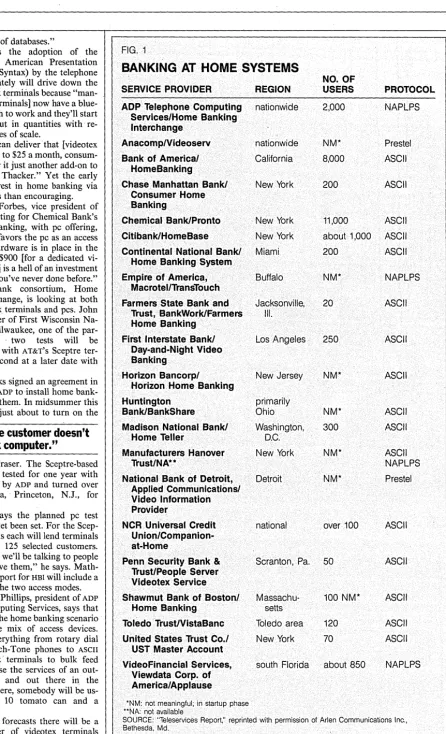
These people are ripe for the pick-ing by such home bankpick-ing institutions as Bank of America in San· Francisco and Chemical Bank in New York. Nineteen financial services organizations, anxious for ways to entice customers with elec-tronic services and simultaneously reduce back office processing costs, are flocking to join the pc bandwagon with bank-at-home offerings.
A host of software houses and ser-vice bureaus are also profiting from the pc banking trend. Among the firms who pro-vide bank systems that link up to personal computers are Periphonics Corp., Bohe-mia, N.Y.; Microperipheral Corp., Red-mond, Wash.; and ADP Telephone Computing Services, Seattle.
The bandwagon has its giveaway aspects. Madison National Bank of Washington, D.C., has a pc-based service, and it provides ihe pc-a Commodore 64 for now, but it plans to offer IBM pes as well, beginning this month. Broker E.F. Hutton will sell or lease the hardware to access your account.
Some home banking observers, however,· are skeptical of ihe potential in tying the cash vault to the home comput-er. "I don't believe what 1 hear about their [pcs] growth capacity," says Ken-neth Thacker, president of Strategic Di-mensions Ltd., a Toronto consulting firm that specializes in strategic planning for electronic banking. "I think the forecasts are made by the manufacturers." He be-lieves offerings like the Bank of America's will "get the early rush," but not the cus-tomer who's difficult to sell to.