Full Terms & Conditions of access and use can be found at
http://www.tandfonline.com/action/journalInformation?journalCode=khvi20
Human Vaccines & Immunotherapeutics
ISSN: 2164-5515 (Print) 2164-554X (Online) Journal homepage: http://www.tandfonline.com/loi/khvi20
Mainstreaming implementation science into
immunization systems in the decade of vaccines: A
programmatic imperative for the African Region
Abdu A. Adamu, Aishatu L. Adamu, Abdulkarim I. Dahiru, Olalekan A.
Uthman & Charles S. Wiysonge
To cite this article: Abdu A. Adamu, Aishatu L. Adamu, Abdulkarim I. Dahiru, Olalekan A. Uthman & Charles S. Wiysonge (2018): Mainstreaming implementation science into immunization systems in the decade of vaccines: A programmatic imperative for the African Region, Human Vaccines & Immunotherapeutics, DOI: 10.1080/21645515.2018.1473682
To link to this article: https://doi.org/10.1080/21645515.2018.1473682
© 2018 The Author(s). Published with license by Taylor & Francis
Accepted author version posted online: 17 May 2018.
Published online: 21 Jun 2018.
Submit your article to this journal
Article views: 269
View Crossmark data
COMMENTARY
Mainstreaming implementation science into immunization systems in the decade
of vaccines: A programmatic imperative for the African Region
Abdu A. Adamu a,b, Aishatu L. Adamuc,d, Abdulkarim I. Dahirue, Olalekan A. Uthman f, and Charles S. Wiysonge a,b,g
aCochrane South Africa, South African Medical Research Council, Tygerberg, South Africa;bCentre for Evidence-Based Health Care, Division of
Epidemiology and Biostatistics, Department of Global Health, Faculty of Medicine and Health Sciences, Stellenbosch University, Cape Town, South Africa;cDepartment of Community Medicine, College of Health Sciences, Bayero University Kano, Kano State, Nigeria;dDepartment of Community
Medicine, Aminu Kano Teaching Hospital, Kano, Nigeria;eDepartment of Health Planning, Research and Statistics, Nassarawa State Ministry of Health,
Nassarawa State, Nigeria;fWarwick-Centre for Applied Health Research and Delivery (WCAHRD), Division of Health Sciences, University of Warwick
Medical School, Coventry, United Kingdom;gSchool of Public Health and Family Medicine, University of Cape Town, Cape Town, South Africa
ARTICLE HISTORY
Received 10 April 2018 Accepted 27 April 2018
ABSTRACT
Several innovations that can improve immunization systems already exist. Some interventions target service consumers within communities to raise awareness, build trust, improve understanding, remind caregivers, reward service users, and improve communication. Other interventions target health facilities to improve access and quality of vaccination services among others. Despite available empirical evidence, there is a delay in translating innovations into routine practice by immunization programmes.
Drawing on an existing implementation science framework, we propose an interactive, and multi-perspective model to improve uptake and utilization of available immunization-related innovations in the African region.
It is important to stress that our framework is by no means prescriptive. The key intention is to advocate for the entire immunization system to be viewed as an interconnected system of stakeholders, so as to foster better interaction, and proactive transfer of evidence-based innovation into policy and practice.
KEYWORDS
implementation science; immunization; vaccine; Africa; evidence-based innovations
Introduction
Immunization has been lauded as one of the most successful public health interventions, both in terms of effectiveness and cost-effectiveness, for ensuring child survival.1 According to World Health Organization (WHO), about 3 million deaths are averted yearly because of childhood immunization.2 A recent study reported that the benefit in treatment cost and loss of pro-ductivity averted in the lifespan of immunized children is 16 times higher than the initial investment in immunization.3 Further analysis using a full-income approach showed that every dollar invested in immunization yields an estimated return which is 44 times higher than the initial cost.3 Thus indicating that immunizing a child contributes to overall national development.3 To ensure universal access to vaccines for all children, the WHO, in 1974, launched the Expanded Programme on Immuni-zation (EPI) as a framework for immuniImmuni-zation systems globally.4 To further advance equity in access, the World Health Assembly, in 2012, endorsed the Global Vaccine Action Plan (GVAP).5The GVAP, which is based on six principles, aims to prevent vaccine-preventable deaths.5
Although top-level policy makers in the African region take cognizance of the broad social and economic value of immu-nization, many countries within the region continue to fall
short on key targets in the GVAP.6,7 The 2017 assessment report of the GVAP revealed that the region achieved only 74% coverage level with third dose of diphtheria-tetanus-per-tussis containing vaccine (DTP3), which is the lowest com-pared to other regions of the world.6 According to recent estimates, 21 out of the 47 countries within the region have DTP3 coverage below 90%, with Equatorial Guinea, South Sudan and Nigeria reporting coverage levels as low as 35%, 45%, and 45% respectively.8 In addition, disease eradication and elimination targets in the region have been set back by the appearance of new cases of paralytic poliomyelitis due to wild-type polio virus, and persistence of measles, rubella, and maternal and neonatal tetanus.6These setbacks are a result of the suboptimal performance of the immunization system in the African region resulting from factors linked to challenges with regards maintenance of the vaccine cold chain, vaccine distribution and delivery practices, and vaccine demand and uptake within countries.9
Evidence based innovations
Several evidence-based innovations that can improve immuniza-tion systems already exist. In recent years, due to increasing
CONTACT Dr. Abdu A. Adamu, [email protected]; [email protected] Centre for Evidence-Based Health Care, Division of Epidemiology and Biostatis-tics, Department of Global Health, Faculty of Medicine and Health Sciences, Stellenbosch University, Cape Town, South Africa.
© 2018 The Author(s). Published with license by Taylor & Francis
This is an Open Access article distributed under the terms of the Creative Commons Attribution-NonCommercial-NoDerivatives License (http://creativecommons.org/licenses/by-nc-nd/4.0/), which permits non-commercial re-use, distribution, and reproduction in any medium, provided the original work is properly cited, and is not altered, transformed, or built upon in any way.
2018, VOL. 0, NO. 0, 1–4
mobile phone penetration and expansion of broadband internet access, the use of mobile health (mHealth) technology has evolved rapidly even in low- and middle-income countries.10, 11 A mobile based application; the electronic Vaccine Intelligence Network (eVIN), which enables real-time vaccine stock tracking and cold chain temperature monitoring is currently in use, with promising results.12 The success of this mHealth innovation has attracted the interest of some countries.13
Other interventions to improve delivery of immunization services that target different levels of the immunization system have also been tested in some communities. Some interventions target the immunisation service consumers within communi-ties to raise awareness, build trust, improve understanding, remind caregivers, reward service users, and improve commu-nication. For instance, monetary incentives have been used to improve immunization coverage.14 Studies have also shown that home visits and community health education are effective in improving immunization coverage rates.15, 16 Other inter-ventions target health systems to improve access and quality of vaccination services.17
Bridging the know-do gap
Despite available evidence, there is a delay in translating inno-vations into routine practice by immunization programmes. Fortunately, a growing body of literature in the nascentfield of implementation science on how to bridge this“know-do”gap now exist and can hasten the transfer of innovations with proven effectiveness into routine practice.18In fact, these con-cepts are already being applied in other health programmes to optimize service delivery.19
Considering the current performance of immunization sys-tems in the African region, it is imperative for national pro-grammes to review current strategies and incorporate new and existing evidence-based innovations. To sustain uptake of these evidence-based innovations, country-level immunization sys-tems would eventually need to be re-organized into knowledge translation systems that emphasize quick interaction between all stakeholders (from researchers to healthcare providers). Such systems would ensure that innovations are quickly trans-lated into practice for the immunization systems to benefit individuals and communities in a timely manner.
Moreover, fiscal allocation to communicable disease control (including immunization) are likely to reduce in response to com-peting demands for funding due to the rising burden of non-com-municable diseases. Thus, an efficient system is an exigent need.
A proposed model
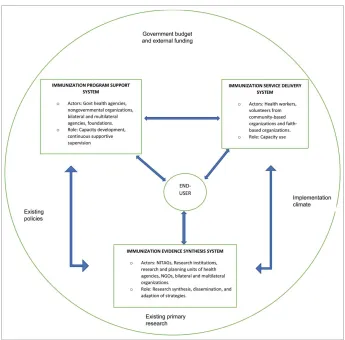
Drawing on an existing implementation science framework, we propose an interactive, and multi-perspective model.20 The proposed model (as shown in Fig. 1 would reduce the time taken for national immunization systems to become aware of potentially valuable interventions and strategies, hasten the incorporation of these strategies into national programs, and enhance communication between all stakeholders for continu-ous improvement. This model leverages on already existing structures within national immunization programmes.
The original framework from which the model is derived combines aspects of research-to-practice and community-cen-tered models.20It was developed by Wandersman and his col-leagues out of the dire need for new approaches to addressing know-do gap.20One of the key feature of the framework is the bidirectional communication between all stakeholders to ensure that they understand each other’s needs and perspectives.20The United States Center for Disease Control and Prevention (CDC) uses this framework in violence prevention program to bridge the gap between development of violence prevention strategies and application in thefield.21In addition to the three categories of stakeholders (evidence synthesis, program support and ser-vice delivery) specified in the original framework, we added a fourth one; end-users, in our proposed model. This is in recogni-tion of the value of client outcomes such as satisfacrecogni-tion, and implementation outcomes such as acceptability and appropri-ateness in informing how activities can be modified. We there-fore grouped immunization stakeholders into four;
a. Immunization evidence synthesis system b. Immunization program support system c. Immunization service delivery system d. Immunization service end-users
Immunization evidence synthesis system
The evidence synthesis system includes National Immunization Technical Advisory Groups (NITAGs) and other national entities with research capacity. Since NITAGS already have a formalized responsibility of providing evidence-based recom-mendations at national level, they should coordinate this system. Through a network of research entities, and in close collabora-tion with other stakeholders within the system, NITAGs should recommend strategies/innovations or packages of innovations that EPI leads can implement within their cultural and geo-graphic context. Using program data including client and imple-mentation indicators, this system should also recommend specific adaptation of innovations to attain best“fit”with cul-ture, organizational climate and geographic characteristics.
Immunization program support system
The role of the immunization program support system is to build the general and specific technical capacity of immuniza-tion stakeholders in the delivery system. This is to enable proper implementation of recommended strategies withfi del-ity. This system can employ various kinds of facilitation strate-gies to meet its objectives. Stakeholders include national government agencies primarily responsible for immunization; nongovernmental, bilateral and multilateral organizations involved in immunization programming; and the National Inter-Agency Co-ordinating Committee.
Immunization service delivery system
The service delivery system would comprise the general and specific individuals and capacities required by the support sys-tem to provide quality and safe immunization services to all children, adolescents and adults that require it in a timely man-ner. They include health workers in hospitals and clinics, and
volunteers from community and faith-based organizations among others. Example of general capacities include manage-rial and leadership skills, proper use of new and existing routine immunization recording and reporting tools, vaccine manage-ment among others.
Immunization service end-users
These stakeholders comprise of individual consumers of vac-cines which comprise targeted individuals and communities. Their role is to provide valuable feedback that can be used for adaptation and improvement of immunization service.
Feedback loop
A key feature of this framework is the bidirectional arrows between all stakeholders. This indicates the need for infor-mation sharing and communication between stakeholder. Such communication would promote better understanding among stakeholders and encourage them to support each other’s roles.
Similar to the original framework, budgetary allocation at all levels of government, external funding, routine immunization policies at national and state or provincial levels, implementa-tion climate and availability of existing primary research are recognized factors that can affect knowledge translation and should be kept in mind at all time.
Conclusion
Bridging the know-do gap in immunization would take coun-tries in the African Region closer to achieving immunization performance targets. It is important to stress that our frame-work is by no means prescriptive. The key intention is to advo-cate for the entire immunization system to be viewed as an interconnected system of stakeholders, so as to foster better interaction, and proactive transfer of evidence-based innova-tion into policy and practice in an iterative manner, using data from these stakeholders to continually adapt strategies to ensure equitable access to vaccines for all.
Disclosure of potential conflicts of interest
No potential conflicts of interest were disclosed.
Funding
The work of Abdu A. Adamu and Charles S. Wiysonge is supported by the South African Medical Research Council and the National Research Foun-dation of South Africa (Grant Number: 106035).
ORCID
Abdu A. Adamu http://orcid.org/0000-0003-3317-1319
Olalekan A. Uthman http://orcid.org/0000-0002-8567-3081
[image:4.594.134.479.49.389.2]Charles S. Wiysonge http://orcid.org/0000-0002-1273-4779
References
1. Ehreth J. The global value of vaccination. Vaccine. 2003;21(7):596– 600. doi:10.1016/S0264-410X(02)00623-0. PMID:12531324.
2. World Health Organization. Immunization 2018 [cited 2018 22nd January2018at 3:07pm SAST]. Available from:http://www.who.int/
topics/immunization/en/.
3. Ozawa S, Clark S, Portnoy A, Grewal S, Brenzel L, Walker DG. Return on investment from childhood immunization in low-and middle-income countries, 2011–20. Health Affairs. 2016;35(2):199–207. doi:10.1377/hlthaff.2015.1086. PMID:26858370.
4. Keja K, Chan C, Hayden G, Henderson RH. Expanded programme on immunization. World health statistics quarterly Rapport trimestriel de statistiques sanitaires mondiales.1987;41(2):59–63.
5. World Health Organization. Global Vaccine Action Plan 2011–2020. Geneva: World Health Organization;2013.
6. World Health Organization. 2017 Assessment Report of the Global Vaccine Action Plan. Strategic Advisory Group of Experts on Immunization. Geneva: World Health Organization; 2017. Licence: CC BYNC-SA 3.0 IGO.
7. World Health Organization and African Union Commission. The Addis Declaration on Immunization2016.
8. World Health Organization and United Nations Children’s Fund. WHO/UNICEF National Immunization Coverage.2017.
9. Hadler S, Dietz V, Okwo-Bele J, Cutts F. Immunization in developing countries. Vaccines 5th ed. Philadelphia: Saunders Elsevier; 2008. p. 1541–71.
10. Mechael PN. The case for mHealth in developing countries. innova-tions.2009;4(1):103–18. doi:10.1162/itgg.2009.4.1.103.
11. Kaplan WA. Can the ubiquitous power of mobile phones be used to improve health outcomes in developing countries? Globalization and health.2006;2(1):9. doi:10.1186/1744-8603-2-9. PMID:16719925. 12. United Nations Development Programme (UNDP). Improving Efficiency
of Vaccination Systems in Multiple States India2015 [Available from:
http://www.in.undp.org/content/dam/india/docs/GAVI-Factsheet.pdf.
13. Government of India. eVIN Project of Health Ministry becomes global best practise in immunisation Delhi: Press Information
Bureau; 2017 [Available from: http://pib.nic.in/newsite/PrintRe
lease.aspx?relidD161558.
14. Barham T. The impact of the Mexican conditional cash transfer on immunization rates [Unpublished manuscript]. (CA): Department of Agriculture and Resource Economics, University of California at Ber-keley;2005.
15. Brugha R, Kevany J. Maximizing immunization coverage through home visits: a controlled trial in an urban area of Ghana. Bull World Health Organ.1996;74(5):517. PMID:9002332
16. Andersson N, Cockcroft A, Ansari NM, Omer K, Baloch M, Foster AH, Shea B, Wells GA, Soberanis JL. Evidence-based discussion increases childhood vaccination uptake: a randomised cluster con-trolled trial of knowledge translation in Pakistan. BMC Int Health Hum Rights. 2009;9(1):S8. doi:10.1186/1472-698X-9-S1-S8. PMID: 19828066.
17. Wiysonge CS, Young T, Kredo T, McCaul M, Volmink J. Interven-tions for improving childhood vaccination coverage in low-and mid-dle-income countries. SAMJ: South African Medical Journal.2015;105 (11):892–3. doi:10.7196/SAMJ.2015.v105i11.10177.
18. Wilson PM, Petticrew M, Calnan MW, Nazareth I. Disseminating researchfindings: what should researchers do? A systematic scoping review of conceptual frameworks. Implement Sci. 2010;5(1):91. doi:10.1186/1748-5908-5-91. PMID:21092164.
19. Norton WE, Amico KR, Cornman DH, Fisher WA, Fisher JD. An agenda for advancing the science of implementation of evidence-based HIV prevention interventions. AIDS and Behavior.2009;13(3):424–9. doi:10.1007/s10461-009-9556-8. PMID:19360464.
20. Wandersman A, Duffy J, Flaspohler P, Noonan R, Lubell K, Still-man L, BlachStill-man M, Dunville R, Saul J. Bridging the gap between prevention research and practice: the interactive systems frame-work for dissemination and implementation. Am J Community Psychol. 2008;41(3–4):171–81. doi:10.1007/s10464-008-9174-z. PMID:18302018.
21. Saul J, Duffy J, Noonan R, Lubell K, Wandersman A, Flaspohler P, et al. Bridging science and practice in violence prevention: Addressing ten key challenges. Am J Community Psychol.2008;41(3–4):197–205. doi:10.1007/s10464-008-9171-2. PMID:18340524.