DOI: 10.1002/itl2.71 L E T T E R
Peer-assisted location authentication and access control
for wireless networks
Hu Yuan
Carsten Maple
Yi Lu
Tim Watson
WMG, University of Warwick, Coventry, UK
Correspondence
Hu Yuan, WMG, University of Warwick, Coventry CV4 7AL, UK.
Email: [email protected]
Funding Information
Engineering and Physical Reseach Council (EPSRC) PETRAS IoT Hub, EP/N02298X/1.
This paper presents the development and implementation of a location-based,
lightweight peer-assisted authentication scheme for use in wireless networks. The
notion of peer-assisted authentication is based upon some target user
equipment-(UE) seeking authentication and access to a network based upon its physical location.
The target UE seeks authentication through the UE of peers in the same network.
Compared with previous work, the approach in this paper does not rely on any
cryp-tographic proofs from a central authentication infrastructure, thus avoiding complex
infrastructure management. However, the peer-assisted authentication consumes
net-work channel resources which will impact on netnet-work performance. In this paper,
we also present an access control algorithm for balancing the location
authentica-tion, network quality of service (QoS), network capacity and time delay. The results
demonstrate that peer-assisted authentication considering location authentication
and system QoS through dynamic access control strategies can be effectively and
efficiently implemented in a number of use cases.
K E Y W O R D S
access control, location authentication, quality of service, wireless networks
1
I N T R O D U C T I O N
Driven by the proliferation of Wi-Fi hotspots and femtocells in public places, location-based services (LBSs) have experienced a surge in development in recent years.1In LBS systems, users can request a location-dependent service from LBS providers. However, to ensure appropriate use, and assist in the security, of
these services, authentication is important. Once mobile users are authenticated, it is possible to grant specific access permissions, such as multimedia-based tourism and nearby marketing.
1.1
Related work
There has been increased interest in LBS systems recently. To identify the location of a mobile user, one of the main methods employed is based on the visiting history of user equipments (UEs). By analyzing frequently visited locations of users in the past 6 months, for example, the validation of the current access location can be judged and a digital signature can be provided based on the result.2Similarly, in Reference,3the BSSID (Wi-Fi MAC address) and
RSSI (recovered Wi-Fi signal strength) are recorded while users log into Wi-Fi access points. This location profile is leveraged to generate an authentication questionnaire. The questions concern information about the user’s location, such as recently visited places and the order they visited.
However, using such a location authentication architecture, a trusted infrastructure is required to achieve a relatively high degree of confidence by using cryptographic protocols. This necessarily increases the complexity of authentication. In this paper, we present a peer-to-peer authentication system which does not require a central infrastructure but is still able to provide efficient authentication.
The authentication approach in this paper is based on thetrustedlocations of network utilities (such as cellular femtocells or Wi-Fi Access point [APs]),(4,5) and those utilities can be used to prove the location of nearby mobile devices. This overcomes the requirements in previous work such as certification authorities,6
cryptographic location proofs,7or trusted platform modules.8
This is an open access article under the terms of the Creative Commons Attribution License, which permits use, distribution and reproduction in any medium, provided the original work is properly cited.
© 2018 The Authors.Internet Technology Letterspublished by John Wiley & Sons, Ltd.
Internet Technology Letters. 2018;e71. wileyonlinelibrary.com/journal/itl2 1 of 6
IoT AP
xi
UE
①
②
③
④
⑥
Max. Transmission Range
R
x
[image:2.595.183.405.54.168.2]⑤
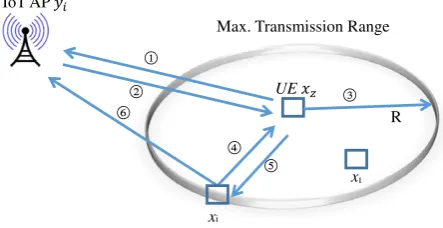
1FIGURE 1 Illustration of assistance authentication in the Internet of Things (IoT)
1.2
Contribution and organization
Our proposed approach overcomes previous limitations by authenticating the location of what we term target UEs, through the use of peer UE within the coverage area of the relevant AP. Our key contributions include: (1) A lightweight, noncryptographic method of using cooperating users to verify an entrusted user’s location. (2) An access control method that balances the strength of authentication and network QoS. This is needed since a network with a high volume of UEs, will have network resources that are tightly constrained. However, it must be noted that the peer UEs occupy the communication channel while they are authenticating the target UE’s location.
The remainder of this paper is organized as follows. The system model is presented in Section 2, and the authentication probability success based on the peer-assisted authentication is considered in Section 3 . In Section 4, the network QoS (eg, network capacity and time delay) is analyzed and a related access control method is introduced. The numerical results of the success authentication probability are analyzed in Section 5 before Section 6 presents the results and ongoing challenges.
2
S Y S T E M M O D E L
The system considered in this paper is a heterogeneous wireless Internet of Things (IoT) network. It contains a range of mobile IoT (MIoT) technologies standardized by the third Generation Partnership Project (3GPP).9As shown in Figure 1, IoT UEs (fromx
1toxi) access the IoT services through the IoT APyi.
When a new userxzwants to join the network, a peer-assisted location authentication scheme is employed. The scheme uses the existing UEs within the network to assist authenticating the target UE for LBS. It does not use a transitional mutual authentication with UEs through the evolved packet system Authentication and Key Agreement protocol.10
For the analysis, the assumptions in this paper are as follows: (1) The UEs within the existing cellular network are secured and authenticated; (2) The probability of UEs (xi) willing to assist the new UEs is modeled as a probabilityPvalued by a Normal distribution; iii) The traffic model is assumed to be a full buffer and the relaying protocol used is a time division duplex (TDD) network. The authentication success probability is defined as at least one UE being willing to assist.
2.1
Peer assistance authentication
As shown in Figure 1, when UExzrequests a LBS and UExiis used for peer-assisted location authentication of UExz. The operation details are:
1. The UExzsends an internet accesses request to IoT network AP. This includes the service type and QoS requirement (network capacity and time delay); 2. AP returns the authentication information identity frameD, which is a data frame containing the channel state information (CSI). Oncexzreceived frame
D, it executes the authentication scheme;
3. The UExz broadcasts an assistance signal to other UEs. Ifxi is within the transmission range ofxz, and is willing to help then it replies with an acknowledgment;
4. xzupdates and sends the authentication information packageDto the UExi; 5. xiupdates and relays the dataDto the AP for verification.
6. When the AP receives the data frameD, it compares the CSI of authentication participators for verifying the location ofxz.
3
S U C C E S S F U L A U T H E N T I C A T I O N P R O B A B I L I T Y
We assume the probabilitiesPiare independent and identically distributed. So the successful authentication probability is
P
=1−∏ Ni=1(1−Pi), whereNis
the total number of assisting UEs.
3.1
IoT UE distribution
A doubly Poisson cluster process is used for generating the UE distribution. The UEs are uniformly scattered on the circle centered at each AP. The APsyjare deployed using Poisson point processes (PPP)ΦAP={y1,y2, …,yj, …} with constant density ΛAP. The UEs are deployed from another PPP
ΦUE={x1,x2, …,xi, …} with the UE densityΛUE. The UE clusters are𝔑xi=𝔑+yifor eachyi∈ΦAPand random point process𝔑. The whole process ofΦUE isΦUE= ∪
y∈ΦAP
For any subset of a Euclidean spaceℬ,N(ℬ) is the number of points in the setℬ, the numberN(ℬ) has a Poisson distribution with the densityΛUEof a
space set ofℬ. Therefore the probability ofkrandom Poisson points in the setℬis11:
P
(N(ℬ) =k) =exp(
− ∫ℬ
Λ(x)dx
) (∫ ℬΛ(x)dx
)k
k! , (1)
where∫ℬΛ(x)dx=AΛUE, andAis the area of the spaceℬ.
So the probability of the number of random points in the two-dimensional setℬis,
P
(N(ℬ) =k) =exp(−ΛUEA)(ΛUEA)k
k! . (2)
3.2
The number of assisting UEs
In order to characterize the performance of successful authentication probability, it is necessary to determine the number of UEs participating in the peer-assisted authentication. This number depends on the UE density and maximum transmission range of UEs. As shown in Figure 1, each UE is capable of transmitting a signal of up to a distance ofR. For the requirement of the data communication, the required minimum signal-noise-ratio (SNR)𝛾 is𝜁. The maximum transmission distance is defined such that the SNR of the receiver is bigger than the SNR threshold𝜁.
R=arg max{𝛾≥𝜁} =arg max
{
𝐻𝑃UE𝜆UEr−𝛼
𝜎2 ≥𝜁
}
, (3)
whereHis the channel fading gain,PUEis the transmission power of UEs,𝜆UEis the frequency-dependent pathloss constant,𝛼is the pathloss distance exponent,
ris the distance between the transmitter and receiver UEs and𝜎2is the additive white Gaussian noise. Without considering the multichannel gain, the maximum
transmission distance is:
R=
(
PUE𝜆UE
𝜎2𝜁 )−1
𝛼
. (4)
The probability of the number of random points is shown in Equation (2), by applying Equation (4) the expectation of assisting UEs within the maximum transmission rangeRis given by:
E
(N) = k∑=+∞k=0
kexp(−ΛUEA)
(ΛUEA)k
k! =exp(−ΛUE𝜋R
2)
k∑=+∞
k=1
(ΛUE𝜋R2)k
(k−1)!
=exp
[
−ΛUE𝜋 (P
UE𝜆UE
𝜎2𝜁
)−2𝛼]k=+∞∑
k=1 [
ΛUE𝜋 (P
UE𝜆UE
𝜎2𝜁 )−2𝛼]k
(k−1)! , (5)
Applying Equation (5), the successful authentication probability is:
P
=1− ⌈E∏(N)⌉i=1
(1−Pi). (6)
where⌈
E
(N)⌉is rounded up.4
N E T W O R K P E R F O R M A N C E A N D A C C E S S C O N T R O L
Quality of Service (QoS) is a particularly important parameter for network performance. This is because network resources such as frequency bandwidth and available time slots are limited. In this section, the network capacity and time delay under the assisted authentication scheme are addressed.
During the peer-assisted authentication process, UEs are broadcasting both request signals and Acknowledgments (ACKs). Thus they would consume channel resources such as frequency bandwidth for the frequency division duplex (FDD) channel or available time slots for the TDD channel. Network performance is highly dependent on the channel resources available. We propose an access control protocol for managing LBS dependent on the network QoS and authentication requirement.
4.1
IoT UEs capacity
The first index is capacity, from the Shannon theory, the network capacity related to SNR isC=Blog2(1+𝛾i) whereBis the channel bandwidth. The expectation
of a nonnegative continuous random variableXis
E
[X] =∫t>0P
(X>t)dt. Therefore, expectation capacity of a single IoT UE is:E
(Ci) = ∫+∞
0
P
{
Blog2 [
1+𝐻𝑃AP𝜆r
−𝛼
𝜎2 ]
> 𝜁
}
d𝜁, (7)
The multipath fading has a pdf offH(h)∼exp(𝛽), where𝛽=1/PAP𝜆.
By a known spatial distribution of UEs, the definition of the mean capacity of the channel is given by:
C= ∫
+∞
0
E
(Ci)fR(r)dr= ∫
1
0
−e𝒜(y,𝛼)𝜎2 B
𝒜(y, 𝛼)𝜎2ln 2Γ(0,𝒜(y𝛼)𝜎
where𝒜(y, 𝛼)is given as12:
𝒜(y, 𝛼) =𝛽
⎛ ⎜ ⎜ ⎝
√
lny
−ΛAP𝜋 ⎞ ⎟ ⎟ ⎠ −𝛼
, 0≤y≤1. (9)
4.2
Average time delay
LetPk(k+1)(t) be the probability that given the processXis in statekat timet0, then at a timetlater, it will be in statek+1. This process can be modeled as13:
Pk(k+1)(t) =P[X(t0+t) = (k+1)|X(t0) =k], (10)
The steady-state probabilities are defined as,𝜑k+1= lim
t→∞Pk(k+1)(t)where𝜑k+1is the steady-state probability at statek+1. The global balance steady-state equations for theM/M/1/Kis obtained:𝜑k𝜏=𝜑k+1𝜇fork=0, 1, 2, 3, ...,K−1 whereK≥1,Kis the size of the system buffer. The normalizing equation is ∑K
k=0𝜑k=1.
Therefore, the probability that there is no UE in the IoT system is,
𝜑0=
1
1+
K
∑
k=1 ⎛ ⎜ ⎜ ⎝
𝑆𝑁Wi-Fi
C N∑IoT
i=0
Ti
⎞ ⎟ ⎟ ⎠
k=
⎧ ⎪ ⎨ ⎪ ⎩
1−𝜌K+1 1−𝜌 𝜌≠1
1
K+1 𝜌=1,
(11)
where𝜌= 𝑆𝑁IoT
C∑NIoT
i=0 Ti
,Sis the transmission data size,Nis the number of assistant UEs andCis from Equation (8). The IoT traffic confliction probability is the
probability that at least one UE is communicating in the system.
Pc=P{atleastone UE} = ⎧ ⎪ ⎨ ⎪ ⎩
1−1−1𝜌−K+𝜌1 𝜌≠1
1−K1+1 𝜌=1. (12)
The communication system is a TDD system, so only one UE can transmit at any one time. Therefore, the average time delay is:
E
(TD) =E
(TW) +E
(T𝑆𝑟), (13)where
E
(TW)is the mean data transmission time andE
(T𝑆𝑟)is the mean system severing time,S∕Cin the IoT system.The system limit isK, so whenKUEs are in the system there is no access for the next UE. Therefore, the mean waiting time is given by:
E
(TW) =⎧ ⎪ ⎨ ⎪ ⎩
[ 𝜌 1−𝜌−
(K+1)𝜌K+1 1−𝜌K+1
] 1
𝜏(1−𝜌K𝜑
0) 𝜌≠
1
K
2𝜏(1−𝜌K𝜑
0) 𝜌
=1. (14)
4.3
Access control algorithm
Algorithm 1Access Control Algorithm
1:functionIoT ACCESS(Pi,𝛼,S,ΛAP,ΛUE)
2: The defined parameters of LBS access required UE: success authentication P′, delay T′, and capacity C′ 3: Calculateprobability
P
(Pi,𝛼,ΛUE) from Equation (6)4: if(
P
≤P′)thenLBS access declined 5: else(P
…P′)
6: Calculate capacityC(𝛼,ΛAP)from Equation (8)
7: Calculate delay
E
(TD){𝛼,ΛAP,S}from Equation (13)8: ifC>C′ς
E
(TD)>T′then9: LBS access allowed
10: else
11: LBS access put on waiting list 12: end if
According to the QoS and authentication requirements, an access control algorithm is executed. When a new LBS call arrives: (1) If the authentication level is not satisfied based on the peer-assisted authentication, the service call is declined. (2) If the authentication level is satisfied then the scheme checks the QoS (capacity, delay) in the system. (i) If the QoS quality is met, the service call will be processed. (ii) If there is not enough network capacity or the delay is bigger than requested, when a new call arrives the call will be put on the waiting list. The processing of the algorithm is shown in Algorithm 1.
5
N U M E R I C A L R E S U L T S A N D A N A L Y S I S
50 100 150 200 250 300 350 400 UE density ( number per km2)
0.4 0.5 0.6 0.7 0.8 0.9 1
Success Probability
[image:5.595.180.419.50.169.2]=2 =3 =4
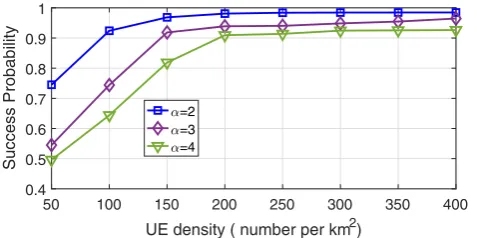
FIGURE 2 The probability of successful authentication with user equipments (UEs) density compared with different𝛼
1 3 5 7 9 11 13 15
The number of assistance UEs
0 10 20 30
(A) (B)
Network Capacity (Mbits/s)
Without Peer-assisted Peer-assisted ( =2) Peer-assisted ( =3) Peer-assisted ( =4)
1 3 5 7 9 11 13 15
The number of the assitance UEs
0 0.05 0.1 0.15 0.2 0.25 0.3 0.35 0.4
Time delay (s)
[image:5.595.74.523.208.334.2]Data size s=1 Mbits Data size s=2 Mbits Data sizes=3 Mbits
FIGURE 3 The network performance with different number of peer-assisted authentication UEs. A, Network capacity with different𝛼. B, Package delay with different traffic conditions
Λis 50 to 400 km2and the data communication threshold SNR is−6 dB. The IoT network radius is 500 m with eight APs providing the IoT access. The
system severing time is𝜏=0.05 seconds. Three different IoT traffic volumes are selected to analyze the performance: light traffic with data package size 1000 kbits; medium traffic with data package size 2000 kbits, and heavy traffic with data package size 3000 kbits. The pathloss distance exponents are 2, 3, and 4 representing different communication environments: suburban, rural, and dense urban, respectively.
5.1
Successful authentication probability
From the results shown in Figure 2, the assisted authentication can achieve an acceptable successful authentication level. The successful authentication proba-bility would climb to 75% with user density 50 or even to 97% with user density 400 where𝛼is 2. When the pathloss distance exponent increases from 2 to 4, the successful authentication probability decreases. Because the transmission range is decreasing, the number of available assistance UEs is less. When there are fewer UEs the successful authentication probability decreases.
The user density has a significant effect on success of peer-assisted authentication. As such the peer-assisted authentication is suitable for high UE density scenarios, such as multimedia tourism services, where the LBS can deliver the scenic spot location, city history, and traffic information-based locations of visitors. However, for a low UE density environment, such as a rural area, the peer-assisted authentication does not work efficiently. Under this situation, a different location authentication scheme is needed.
5.2
Network performance with peer-assisted authentication
As Figure 3A shows, without the peer-assisted authentication the network capacity is 27.1 Mbits/s but with assistance, the network capacity is reduced to 1.8 Mbits/s when the number of assistance UEs is over 13. The different values of𝛼show the same tendency.
Thus peer-assisted authentication is suitable for applications requiring lower capacity. However, for some high capacity network applications such as live video or online games, the peer-assisted authentication would seriously reduce the network performance.
When the assistance authentication is utilized, the IoT UEs have to wait a period for the UE identification. Figure 3B shows the average time delay of the different number of assistance UEs compared with different network traffic volumes. The delay time would climb from 0.01 to 0.4 seconds with a data package size of 3000 kbits. The system average time delay increases significantly when more UEs take part in the authentication. The impact is greater with bigger data sizes.
In this paper, a TDD network is considered for analysis. For an FDD network, the same tendency would be observed since the assisted UEs cause interference with other UEs. The interference leads to a greater bit error rate (BER) and reduces channel capacity.
5.3
Under QoS requirement constraint
Authentication ratio
QoS(Capacity, or Delay)
0.05s, 20Mbits/s 50%
70%
Large number assisted UEs
90%
Small number assisted UEs
No Assisted UE permitted
0.1s, 5Mbits/s 0.4s,
[image:6.595.201.395.47.192.2]1Mbits/s
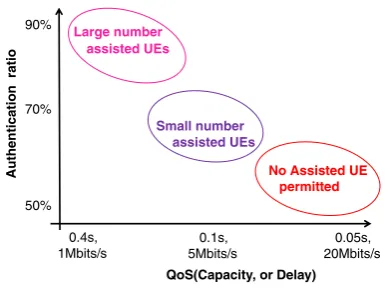
FIGURE 4 The balance in assistance authentication operations between network security and system quality of service (QoS)
UEs are allowed for assisted authentication. Conversely, when the requirement changes to 0.05 seconds and 20 Mbits/s, no UEs are allowed for assisted authentication.
6
C O N C L U S I O N A N D F U R T H E R W O R K
In this paper, a novel lightweight and noncryptographic location authentication scheme, which relies on decentralized peer to peer-assisted authentication, is implemented for wireless networks. The peer-assisted authentication can achieve a relatively high successful authentication probability. While UEs assist the AP to authenticate the target UE’s location, they occupy the channel resources. Thus, the network performance (channel capacity, time delay) is reduced, a QoS-based access control is executed to balance the network performance and authentication.
The security and privacy become big challenges in LBS applications.14In our approach, the location privacy of assisted UEs is leaked to the target UE.
Thus, our further work will be based on privacy aware LBS.15
A C K N O W L E D G M E N T S
This work has been supported by the EPSRC project PETRAS IoT Hub (EP/N02298X/1).
O R C I D
Hu Yuan
http://orcid.org/0000-0001-9833-5930
R E F E R E N C E S
1. Ryschka S, Murawski M, Bick M. Location-based services.Bus Inf Syst Eng. 2016;58(3):233-237.
2. Hongyan Z, Jinchun G, Yuan’an L, Xiaolei M. A digital signature with high security based on location information. Paper presented at: IEEE International Conference on Mechatronic Sciences, Electric Engineering and Computer (MEC); 2013; Shengyang, China:2607–2611.
3. Albayram Y, Khan MMH, Bamis A, Kentros S, Nguyen N, Jiang R. A location-based authentication system leveraging smartphones. Paper presented at: IEEE 15th International Conference on Mobile Data Management (MDM); 2014; Brisbane, Australia:83–88.
4. Saroiu S, Wolman A. Enabling new mobile applications with location proofs. Paper presented at: ACM The 10th Workshop on Mobile Computing Systems and Applications; 2009; California.
5. Aloudat A, Michael K, Chen X, Al-Debei MM. Social acceptance of location-based mobile government services for emergency management.Telematics Inform.
2014;31(1):153-171.
6. Wang W, Chen Y, Zhang Q. Privacy-preserving location authentication in Wi-fi networks using fine-grained physical layer signatures.IEEE Trans Wirel Commun.
2016;15(2):1218-1225.
7. Magkos E. Cryptographic approaches for privacy preservation in location-based services: A survey. Paper presented at: IGI Global 2012; Greece; 2012:273–297. 8. Gilbert P, Cox LP, Jung J, Wetherall D. Toward trustworthy mobile sensing. Paper presented at: ACM Proceedings of the Eleventh Workshop on Mobile Computing
Systems & Applications; 2010; Annapolis, MD:31–36.
9. Takehiro N, Satoshi N, Anass B, et al. Trends in small cell enhancements in LTE advanced.IEEE Commun Mag. 2013;51(2):98-105.
10. Muxiang Z, Yuguang F. Security analysis and enhancements of 3GPP authentication and key agreement protocol.IEEE Trans Wirel Commun. 2005;4(2):734-742.
11. Andrews JG, Francois B, Krishna GR. A tractable approach to coverage and rate in cellular networks.IEEE Trans Commun. 2011;59(11):3122-3134.
12. Yuan H, Guo W, Jin Y, Wang S, Ni M. Interference-aware multi-hop path selection for device-to-device communications in a cellular interference environment.IET
Commun. 2017;11(11):1741-1750.
13. Bose SK.An Introduction to Queueing Systems. New York, US: Springer Science & Business Media; 2013.
14. Maple C. Security and privacy in the internet of things.J Cyber Policy. 2017;2(2):155-184.
15. He X, Jin R, Dai H. Leveraging spatial diversity for privacy-aware location-based services in mobile networks.IEEE Trans Inf Forensic Secur. 2018;13(6):1524-1534.