© 2019, IRJET | Impact Factor value: 7.211 | ISO 9001:2008 Certified Journal | Page 5457
Time History Analysis of Masonry Infilled RC Frames with soft storey
and varying sizes of openings by Equivalent Diagonal Strut Method
using E-Tabs software
Ganesha B
1, Kiran Kuldeep K. N.
21
P.G. Student, Civil Engineering Department, S J B Institute of Technology, Bengaluru - 560060, Karnataka, India
2
Assistant Professor, Civil Engineering Department, S J B Institute of Technology, Bengaluru - 560060, Karnataka,
India
---***---Abstract -
Masonry infill walls are constructed forfunctional requirements in most of the multi-storey buildings. The masonry infill walls are considered as non-structural elements even though they provide strength and stiffness to reinforced concrete (RC) framed buildings. However, in many cities of India, it is very common to leave the ground storey of masonry infilled RC frame building, open primarily to generate parking space or any other usage in the ground storey. Such buildings are highly undesirable in seismically active regions.
In the present study, an attempt is made to assess the performance of masonry infilled RC frames with soft storey with and without openings. In this study, RC frame of ten storey (G+9) building located in seismic zone-V is considered. Equivalent Diagonal Strut Method is used to calculate the width of strut by using Mainstone formula. The time history analysis has been carried out on the various models such as bare frame, infill frame, ground soft storey infill frames and infill frames with 15, 30 & 45% central openings. Further, the infill models are replaced by equivalent diagonal Strut models. The analysis is performed using ETABS 2015 software from which various results are computed and compared such as story displacement, story drift, base shear, bending moment and lateral storey stiffness.
It is observed from the results that how infill panels increase the strength and stiffness of the structure. While, increase in the opening size leads to a decrease in the lateral stiffness of infilled and equivalent diagonal strut frames. The extent of decrease in lateral stiffness due to the presence of ground soft storey was also investigated.
Key Words: Masonry infilled frame, Soft story, Stiffness,
Equivalent Diagonal Strut, Seismic Effect, Opening percentage, etc.
1. INTRODUCTION
In multi storey buildings, maximum number of buildings in India are RC framed structures are constructed with masonry infills or brick infills for functional and architectural reasons. The masonry infilled reinforced concrete frame buildings are usually constructed for residential and commercial buildings in seismic regions. In masonry infills stiffness contributions are usually ignored in
practice and masonry infills are generally considered as architectural [non-structural] elements.
Infilled frame can be a composite structure made by the combination of infill walls and moment resisting plane frame. The infills are used as internal partition walls and external walls and also infills are protecting the building from outside environment to our requirements. Infill walls along with the column and beam when the structure is subjected to earthquake load and also exhibit-dissipation characteristics under lateral loads. The presence of masonry infill has a resisting affect on the lateral load of a reinforced concrete frame building, which increases the stiffness and strength of the structure. An appropriately designed infilled frame can enhance the lateral resistance, overall strength and energy dissipation of the structure. An infill wall reduces the lateral deflection and bending moment in the frame, therefore decreasing the displacement value and probability of failure of the structure.
2. OBJECTIVES OF THE STUDY
The main objectives of the study are as follows
1. To study the non-linear behavior of RC frame building with masonry infill by time history analysis and comparing the bare frame and infilled frame. 2. To study the behavior of infilled frame by replacing
the infill by equivalent diagonal strut.
3. To study the effect of soft storey infill frames subjected to seismic loads.
4. To study the effect of various sizes of openings subjected to seismic loads.
3. METHODLOGY
1. In the present thesis the non-linear behavior of RC frame building using the role of infill and equivalent diagonal strut are studied.
© 2019, IRJET | Impact Factor value: 7.211 | ISO 9001:2008 Certified Journal | Page 5458
3. The effect of soft storey on the ground floor andeffect of various sizes of opening on ten storey building is studied.
4. Time history analysis has been carried out using ETABS software.
4. REVIEW OF MACRO MODELS
4.1 EQUIVALENT DIAGONAL STRUT MODEL
The simplest equivalent strut model contains a single pin-jointed strut. Holmes (1961) who replaced the infill by an equivalent pin-jointed diagonal strut of same thickness and same material as that of infill panel and given from equation 4.1.The width of equivalent diagonal strut as suggested by Paulay and Priestley is shown in equation 4.2.
w = 0.25d ………...4.2
Where,
w = Equivalent diagonal strut depth. d = Diagonal span of infill panel
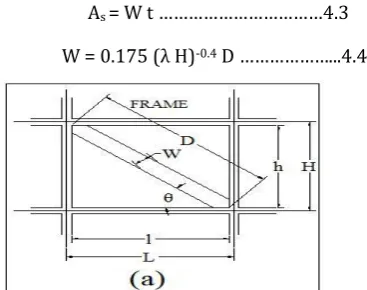
However, researchers later established that this model overestimates the actual stiffness of infilled frames and gives higher values. Further model for masonry infill panels was proposed by Mainstone in 1971, where the cross sectional area of strut was calculated in view of the sectional properties of the adjacent columns. The particulars of model are as shown in Fig. 4.1. The strut area As is specified by the following equation.
As = W t ………4.3
[image:2.595.65.249.529.674.2]W = 0.175 (λ H)-0.4 D ………...4.4
Fig 4.1 Brick Infill Panel as Equivalent Diagonal Strut
4
sin(2 )
...4.5 4
i
f c
E t E I h
Where,
Ei = The young’s modules of the infill material, N/mm2 Ef = The young’s modules of the frame material, N/mm2 Ic = The second moment area of column, mm.4
t = Thickness of infill panel, mm. H = Centre line height of the frames. h = Height of the infill wall.
L = Centre line length of frames. l = Length of infill wall.
D = Diagonal length of the infill panel.
θ = Slope of the infill panel diagonal to the horizontal.
Infill frame with Openings: Area of opening, Aop is normalized by means of area of infill panel, Ainfill and the fraction is termed as opening percentage (%).
op
infill
Area of opening (A )
Opening percentage (%) = .
Area of infill (A )
4.2 STRUT REDUCTION FACTOR
Fig 4.2 strut reduction curve Reduction factor (λ) is given by,
λ=1-2αw0.54 + αw1.14
Where,
αw = Opening percentage (%).
The above coefficient (ʎ) can be used to find the width of equivalent diagonal strut for the case of an infill with opening by multiplying the width of infill without opening for central openings.
Width of strut without opening (W) = 0.175 (λ H)-0.4 D
Width of strut with central opening,
(W') = Strut reduction factor × W
© 2019, IRJET | Impact Factor value: 7.211 | ISO 9001:2008 Certified Journal | Page 5459
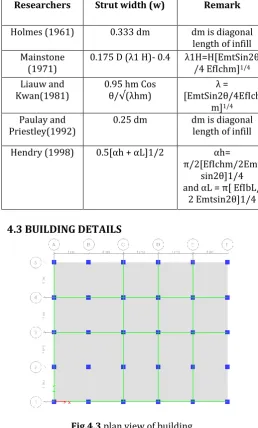
Researchers Strut width (w) RemarkHolmes (1961) 0.333 dm dm is diagonal length of infill Mainstone
(1971) 0.175 D (λ1 H)- 0.4 λ1H=H[EmtSin2θ/4 EfIchm]1/4 Liauw and
Kwan(1981) 0.95 hm Cos θ/√(λhm) [EmtSin2θ/4EfIchλ = m]1/4 Paulay and
Priestley(1992) 0.25 dm dm is diagonal length of infill
Hendry (1998) 0.5[αh + αL]1/2 αh= π/2[EfIchm/2Emt
sin2θ]1/4 and αL = π[ EfIbL/
2 Emtsin2θ]1/4
[image:3.595.29.288.101.530.2]4.3 BUILDING DETAILS
Fig.4.3 plan view of building
Table 4.2 Details of the model
Number of storey’s G+9
Height of each storey 3.0 m Material property
Grade of concrete M30
Grade of steel Fe 500
Density of concrete 25 KN/m3 Density of brick wall 20 KN/m3 Modulus of elasticity of
concrete, Ec 27386.12 Mpa Modulus of elasticity
masonry, Em 5500 Mpa
Poisson ratio of concrete 0.2 Poisson ratio of brick wall 0.15
Member property
Beam size 300 x 450 mm
Column size 500 x 500 mm
Thickness Slab 150 mm
Wall thickness 230 mm
Load intensities
Live load 4 KN/m2
Floor finish 1 KN/m2
Seismic zone V
Time history Bhuj, Ahmedabad
Zone factor (Z) 0.36
Response Reduction Factor,
R 5 (SMRF)
Importance factor, I 1.5
Type of soil Medium
Damping of structure 5%
4.4 DIFFERENT MODELS CONSIDERED
Model 1: Bare frame
Model 2: Complete infill frame
Model 3: Complete equivalent diagonal strut frame Model 4: Complete infill 15% opening
Model 5: Complete strut 15% opening Model 6: Complete infill 30% opening Model 7: Complete strut 30% opening Model 8: Complete infill 45% opening Model 9: Complete strut 45% opening Model 10: Soft storey infill frame Model 11: Soft storey strut frame Model 12: Soft storey infill 15% opening Model 13: Soft storey strut 15% opening Model 14: Soft storey infill 30% opening Model 15: Soft storey strut 30% opening Model 16: Soft storey infill 45% opening Model 17: Soft storey strut 45% opening
Table 4.3 Width of equivalent diagonal strut by various researches
Researchers Strut width (w)
Holmes (1961) 1665mm
Mainstone (1971) 575mm
Liauw and Kwan(1981) 1039mm Paulay and Priestley(1992) 1250mm
Hendry (1998) 1712mm
5. RESULTS AND DISCUSSION
5.1 Storey displacement
© 2019, IRJET | Impact Factor value: 7.211 | ISO 9001:2008 Certified Journal | Page 5460
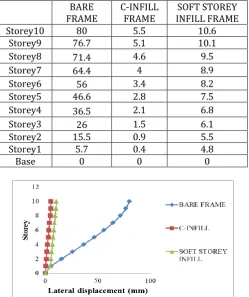
FRAME BARE C-INFILL FRAME INFILL FRAME SOFT STOREYStorey10 80 5.5 10.6
Storey9 76.7 5.1 10.1
Storey8 71.4 4.6 9.5
Storey7 64.4 4 8.9
Storey6 56 3.4 8.2
Storey5 46.6 2.8 7.5
Storey4 36.5 2.1 6.8
Storey3 26 1.5 6.1
Storey2 15.5 0.9 5.5
Storey1 5.7 0.4 4.8
Base 0 0 0
Fig 5.1 Variation of storey displacement of bare frame, infill frame and soft storey infill frame along x-direction
From Table 5.1 the maximum displacement in bare frame is 80mm and in complete infill frame is 5.5mm. Hence infill reduces the displacement along x-direction by 93% compared to the bare frame. The maximum displacement in ground soft storey infill frame is 10.6mm which is 48% high compared to the complete infill frame. Similarly the maximum displacement in complete equivalent diagonal strut frame is 15.3mm. From the results it is concluded that equivalent diagonal strut frame reduces the displacement by 80% compared to that of bare frame.
Table 5.2 Storey displacement of infill frames with various sizes of openings along x- direction
C-infill infill15% opening infill 30% opening infill 45% opening
Story10 5.5 7.3 10 13.8
Story9 5.1 6.7 9.4 13.1
Story8 4.6 6.1 8.6 12.1
Story7 4 5.4 7.6 10.8
Story6 3.4 4.6 6.6 9.4
Story5 2.8 3.8 5.5 7.8
Story4 2.1 3 4.3 6.2
Story3 1.5 2.2 3.2 4.6
Story2 0.9 1.4 2.1 3
Story1 0.4 0.7 1 1.5
[image:4.595.38.288.99.397.2]Base 0 0 0 0
Fig 5.2 Variation of storey displacement of infill frames with various sizes of openings along x- direction
From Table 5.2 the maximum displacement in case of complete infill and infill with 15, 30 and 45% openings are 5.5, 7.3, 10 and 13.8mm respectively. Similarly the displacement in case of equivalent diagonal strut frame and strut frame with 15, 30 and 45% openings are 15.3, 27.3, 38.5 and 51.7mm respectively. From the results it is concluded that as the opening size increases displacement also increases in both infill and equivalent diagonal strut frames.
Fig 5.3 Comparison of maximum storey displacement of infill and strut frames with various sizes of openings along x- direction
Fig 5.4 variation of maximum storey displacement of infill and strut frames with various sizes of openings
© 2019, IRJET | Impact Factor value: 7.211 | ISO 9001:2008 Certified Journal | Page 5461
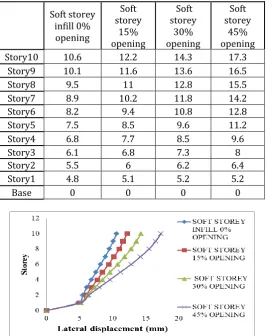
Soft storey infill 0%opening
Soft storey
15% opening
Soft storey
30% opening
Soft storey
45% opening
Story10 10.6 12.2 14.3 17.3
Story9 10.1 11.6 13.6 16.5
Story8 9.5 11 12.8 15.5
Story7 8.9 10.2 11.8 14.2
Story6 8.2 9.4 10.8 12.8
Story5 7.5 8.5 9.6 11.2
Story4 6.8 7.7 8.5 9.6
Story3 6.1 6.8 7.3 8
Story2 5.5 6 6.2 6.4
Story1 4.8 5.1 5.2 5.2
[image:5.595.29.302.98.435.2]Base 0 0 0 0
Fig 5.5 Variation of storey displacement of soft storey infill frames with various sizes of openings along x- direction
From Table 5.3 the displacement in case of ground soft storey infill frame with 15, 30 and 45% openings are 10.6, 12.2, 14.3 and 17.3mm respectively. Due to the presence of soft storey at first floor level there is drastic increase in storey displacement at first floor level. Similarly the displacement in case of soft storey equivalent diagonal strut frame with 0, 15, 30 and 45% openings are 18.5, 29.6, 40.3 and 52.9mm respectively. From the results it is concluded that as the opening size increases displacement also increases in both infill and equivalent diagonal strut frames. Due to the presence of soft storey at first floor level there is drastic increase in storey displacement at first floor.
Fig 5.6 Comparison of maximum storey displacement of soft storey infill and soft storey strut frames with various sizes of openings in x- direction.
Fig 5.7 variation of maximum storey displacement of soft storey infill and strut frames with various sizes of openings
5.2 STOREY DRIFT
Table 5.4 Storey drift of bare frame, infill frame and soft storey infill frame in x-direction
Bare frame C-infill frame Soft storey infill frame
Story10 0.0011 0.00014 0.00016
Story9 0.00175 0.00017 0.00019 Story8 0.00234 0.00019 0.00021
Story7 0.0028 0.00021 0.00023
Story6 0.00314 0.00021 0.00023 Story5 0.00337 0.00021 0.00023
Story4 0.0035 0.00021 0.00023
Story3 0.00351 0.00019 0.00021 Story2 0.00325 0.00017 0.00022
Story1 0.0019 0.00014 0.00161
[image:5.595.304.562.306.629.2]Base 0 0 0
Fig 5.8 Variation of storey drift of bare frame, infill frame and soft storey infill frame in x- direction
© 2019, IRJET | Impact Factor value: 7.211 | ISO 9001:2008 Certified Journal | Page 5462
compared to the bare frame. The maximum drift in soft [image:6.595.29.292.226.550.2]storey equivalent diagonal strut frame is 0.00144 which is 2.36 times high compared to the complete strut frame. The storey drift of soft storey strut frame is 3.34 times more than complete strut frame at first floor. Hence there is drastic increase in storey drift of structure due to the presence of soft storey at ground floor.
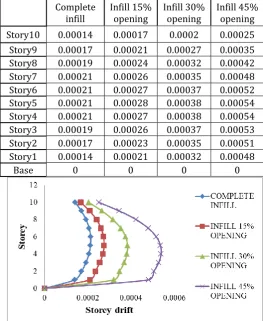
Table 5.5 Storey drift of infill frames with various sizes of openings along x-direction
Complete infill Infill 15% opening Infill 30% opening Infill 45% opening
Story10 0.00014 0.00017 0.0002 0.00025 Story9 0.00017 0.00021 0.00027 0.00035 Story8 0.00019 0.00024 0.00032 0.00042 Story7 0.00021 0.00026 0.00035 0.00048 Story6 0.00021 0.00027 0.00037 0.00052 Story5 0.00021 0.00028 0.00038 0.00054 Story4 0.00021 0.00027 0.00038 0.00054 Story3 0.00019 0.00026 0.00037 0.00053 Story2 0.00017 0.00023 0.00035 0.00051 Story1 0.00014 0.00021 0.00032 0.00048
Base 0 0 0 0
Fig 5.9 Variation of storey drift of infill frames with various sizes of openings along x- direction
From Table 5.5 the maximum storey drift in case of complete infill and infill with 15, 30 and 45% openings are 0.00021, 0.00028, 0.00038 and 0.00054 respectively. Similarly the storey drift in case of complete equivalent diagonal strut frame and strut with 15, 30 and 45% openings are 0.00061, 0.00112, 0.00162and 0.00222 respectively. From the results it is concluded that as the opening sizes increases storey drift also increases.
[image:6.595.29.293.228.550.2]Fig 5.10 Comparison of maximum storey drift of infill and strut frames with various sizes of openings along x- direction.
Fig 5.11 variation of maximum storey drift of infill and strut frames with various sizes of openings
Table 5.6 Storey drift of soft storey infill frames with various sizes of openings along x-direction
Soft storey infill 0% opening
Soft storey infill 15%
opening
Soft storey infill 30%
opening
Soft storey infill 45%
opening Story10 0.00016 0.00018 0.00021 0.00026 Story9 0.00019 0.00022 0.00027 0.00035 Story8 0.00021 0.00025 0.00032 0.00043 Story7 0.00023 0.00027 0.00036 0.00048 Story6 0.00023 0.00029 0.00038 0.00052 Story5 0.00023 0.00029 0.00039 0.00054 Story4 0.00023 0.00028 0.00039 0.00054 Story3 0.00021 0.00027 0.00038 0.00053 Story2 0.00022 0.0003 0.00043 0.0006 Story1 0.00161 0.00171 0.00173 0.00183
[image:6.595.303.566.467.718.2]© 2019, IRJET | Impact Factor value: 7.211 | ISO 9001:2008 Certified Journal | Page 5463
Fig 5.12 Variation of storey drift of soft storey infill frameswith various sizes of openings along x- direction
From Table 5.6 the storey drift in case of soft storey infill frames with 0, 15, 30 and 45% openings are 0.00161, 0.00171, 0.00173 and 0.00183 respectively. Due to the presence of soft storey, storey drift is maximum in first floor level compared to other floors. Similarly the storey drift in case of soft storey equivalent diagonal strut frame with 0, 15, 30 and 45% openings are 0.00144, 0.00147, 0.00176 and 0.00237 respectively. From the results it is concluded that as the opening sizes increases storey drift also increases. Due to the presence of soft storey, Storey drift is maximum in first floor compared to other floors.
Fig 5.13 Comparison of maximum storey drift of soft storey infill and strut frames with various sizes of openings along x- direction
Fig 5.14 variation of maximum storey drift of soft storey infill and strut frames with various sizes of openings
5.3 BASE SHEAR
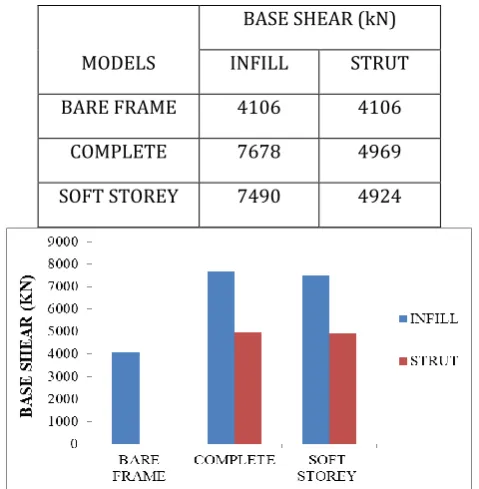
Table 5.7 Base shear of bare frame, infill frame and equivalent diagonal strut frame along x-direction
MODELS
BASE SHEAR (kN)
INFILL STRUT
BARE FRAME 4106 4106
COMPLETE 7678 4969
SOFT STOREY 7490 4924
Fig 5.15 Comparison of base shear of bare frame, infil frame and equivalent diagonal strut frame along x- direction
From the results it is concluded that Infill and equivalent diagonal strut increases the base shear of structure by 87% and 21% compared to bare frame respectively. Therefore, both infill and equivalent diagonal strut frame increases base shear of the structure. However, the base shear of infill frame is 54% more than equivalent diagonal strut frame. Hence the base shear is more in infill frame compared to equivalent diagonal strut frame. From the results it is also concluded that the base shear decreases in soft storey infill and soft storey equivalent diagonal strut frames by 2% and 1% respectively compared to complete infill and complete equivalent diagonal strut frame.
Table 5.8 Base shear of infill and strut frames with various sizes of openings along x-direction
OPENING PERCENTAGE
BASE SHEAR (kN) INFILL STRUT
0 7678 4969
15 7142 4448
30 6606 4287
45 6070 4195
[image:7.595.314.554.142.387.2]© 2019, IRJET | Impact Factor value: 7.211 | ISO 9001:2008 Certified Journal | Page 5464
Fig 2.16 Comparison of base shear of infill and strut frameswith various sizes of openings along x-direction
From the results it is concluded that as the opening sizes increases base shear decreases in both infill and equivalent diagonal strut frame. However, the base shear of infill frame with 0, 15, 30, and 45% openings is 54, 60, 54 and 45% higher than equivalent diagonal strut frame respectively. Hence the base shear is more in infill frame compared to equivalent diagonal strut frame.
Fig 5.17 variation of base shear of infill and strut frames with various sizes of openings
Table 5.9 Base shear of soft storey infill and strut frames with various sizes of openings along x-direction.
OPENING PERCENTAGE
BASE SHEAR (KN) INFILL STRUT
0 7490 4924
15 6982 4430
30 6475 4278
45 5967 4190
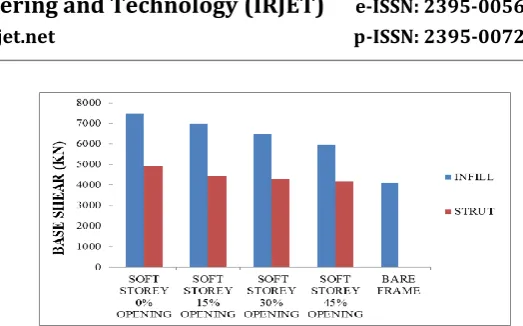
[image:8.595.296.558.53.216.2]BARE FRAME 4106 4106
Fig 5.18 Comparison of base shear of soft storey infill and strut frames with various sizes of openings along x-direction
From the results it is concluded that as the opening sizes increases base shear is decrease in both infill and equivalent diagonal strut frame. However, the base shear of soft storey infill frame with 0, 15, 30, and 45% openings is 52, 57, 51 and 42% higher than soft storey equivalent diagonal strut frame respectively. Hence the base shear is more in soft storey infill frame compared to soft storey equivalent diagonal strut frame.
Fig 5.19 variation of base shear of soft storey infill and soft storey strut frames with various sizes of openings
5.4 TIME PERIOD
Table 5.10 Time period of bare frame, infill frame and equivalent diagonal strut frame
TIME PERIOD (sec)
INFILL STRUT
BARE FRAME 1.141 1.141
COMPLETE 0.307 0.544
© 2019, IRJET | Impact Factor value: 7.211 | ISO 9001:2008 Certified Journal | Page 5465
Fig 5.20 Comparison of time period of bare frames, infillframe and equivalent diagonal strut frames
[image:9.595.308.565.168.304.2]From the results it is concluded that Infill and equivalent diagonal strut frames reduces the time period of structure compared to that of bare frame. The time period of complete infill frame is 43% less compared to complete equivalent diagonal strut frame. From the results it is also concluded that the time period increases in soft storey infill and soft storey equivalent diagonal strut frames compared to complete infill and complete equivalent diagonal strut frame. However, time period in case of soft storey infill frame is 22% less compared to soft storey equivalent diagonal strut frame.
Table 5.11 Time period of infill and strut frame with various sizes of openings
OPENING PERCENTAGE
TIME PERIOD (sec)
INFILL STRUT
0 0.307 0.544
15 0.343 0.694
30 0.392 0.811
45 0.446 0.93
BARE FRAME 1.141 1.141
Fig 5.21 Comparison of time period of infill and strut frame with various sizes of openings
From the results it is concluded as the opening sizes increases time period also increases in both infill and strut frames. However, the time period of infill frame with 0, 15, 30, and 45% openings is 38, 47, 49 and 50% less compared to equivalent diagonal strut frame respectively
[image:9.595.309.559.367.671.2]Fig 5.22 variation of time period of infill and strut frames with various sizes of openings
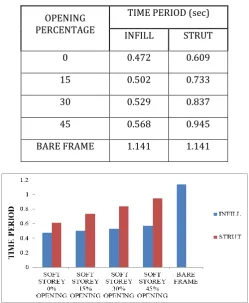
Table 5.12 Time period of soft storey infill and strut frame with various sizes of openings
OPENING PERCENTAGE
TIME PERIOD (sec)
INFILL STRUT
0 0.472 0.609
15 0.502 0.733
30 0.529 0.837
45 0.568 0.945
BARE FRAME 1.141 1.141
Fig 5.23 Comparison of time period of soft storey infill and strut frames with various sizes of openings
[image:9.595.37.288.435.728.2]© 2019, IRJET | Impact Factor value: 7.211 | ISO 9001:2008 Certified Journal | Page 5466
Fig 5.24 variation of time period of soft storey infill and softstorey strut frames with various sizes of openings
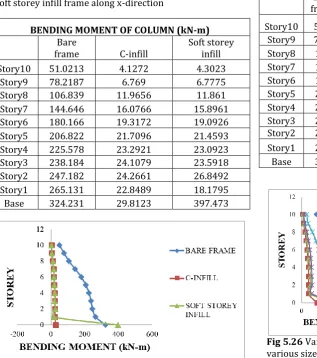
5.5 BENDING MOMENT OF COLUMN
Table 5.13 Bending moment of bare frame, infill frame and soft storey infill frame along x-direction
BENDING MOMENT OF COLUMN (kN-m)
frame Bare C-infill Soft storey infill
Story10 51.0213 4.1272 4.3023
Story9 78.2187 6.769 6.7775
Story8 106.839 11.9656 11.861
Story7 144.646 16.0766 15.8961
Story6 180.166 19.3172 19.0926
Story5 206.822 21.7096 21.4593
Story4 225.578 23.2921 23.0923
Story3 238.184 24.1079 23.5918
Story2 247.182 24.2661 26.8492
Story1 265.131 22.8489 18.1795
Base 324.231 29.8123 397.473
Fig 5.25 Variation of bending moment of bare frame, infill frame and soft storey infill frame along x-direction
From the results it is concluded that infill reduces the bending moment of column by 91% compared to the bare frame. The maximum bending moment in soft storey infill frame is 397.473kN-m which is 92% high compared to the complete infill frame. In case of soft storey infill frame
[image:10.595.287.564.275.643.2]bending moment of first floor is 95% less compared to ground floor. Hence there is a drastic increase in bending moment of the column due to the presence of soft storey at ground level. It is also concluded from the result that equivalent diagonal strut frame reduces the bending moment of column by 81% compared to the bare frame. The maximum bending moment in soft storey equivalent diagonal strut frame is 299.947KN-m which is 79% high compared to the complete equivalent diagonal strut frame. In case of soft storey frame the bending moment of first floor is 88% less compared to ground floor.
Table 5.14 Bending moment of infill frames with various sizes of openings along x-direction
BENDING MOMENT OF COLUMN (KN-m)
frame Bare infill C-
Infill 15% opening
Infill 30% opening
Infill 45% opening
Story10 51.0 4.1 4.2 7.03 17.7
Story9 78.2 6.7 8.2 10.5 22.6
Story8 106 11.9 15.6 17.8 37.2
Story7 144 16.0 18.2 23.8 49.4
Story6 180 19.3 22.2 28.5 58.7
Story5 206 21.7 24.8 31.9 65.4
Story4 225 23.2 28.0 34.2 69.7
Story3 238 24.1 30.8 35.3 71.8
Story2 247 24.2 30.2 35.6 72.5
Story1 265 22.8 31.6 35.2 71.1
[image:10.595.41.359.311.670.2]Base 324 52.4 101.4 132.1 157.6
Fig 5.26 Variation of bending moment of infill frames with various sizes of openings along x-direction
© 2019, IRJET | Impact Factor value: 7.211 | ISO 9001:2008 Certified Journal | Page 5467
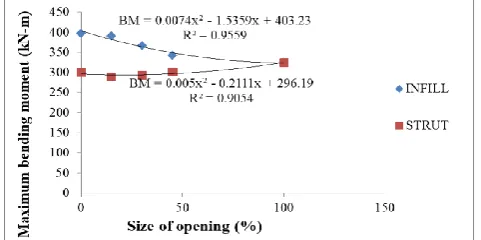
concluded that as the opening sizes increases bending [image:11.595.309.559.70.230.2]moment of column also increases in both infill and equivalent diagonal strut frames.
Fig 5.27 comparison of maximum bending moment of infill and strut frame with various sizes of openings along x-direction
[image:11.595.42.284.142.253.2]Fig 5.28 variation of maximum bending moment of infill and strut frame with various sizes of openings along x-direction
Table 5.15 Bending moment of soft storey infill frames with various sizes of openings along x-direction
BENDING MOMENT OF COLUMN (kN-m)
Soft storey infill 0%
opening
Soft storey
15% opening
soft storey
30% opening
Soft storey 45% opening Story10 4.3023 3.1718 7.2464 18.1196 Story9 6.7775 8.1058 10.5182 23.6017 Story8 8.861 10.6546 17.6895 37.0236 Story7 11.4922 15.8961 23.6337 48.974 Story6 13.7154 19.0926 28.2426 58.1763 Story5 15.361 21.4593 31.6056 64.7975 Story4 16.4621 23.0923 33.8016 69.0134 Story3 23.5918 23.4297 34.981 71.2496 Story2 19.8492 25.7604 34.3512 70.8446 Story1 13.1795 128.053 124.875 111.197 Base 397.473 390.809 366.657 341.956
Fig 5.29 Variation of bending moment of soft storey infill frames with various sizes of openings along x-direction
[image:11.595.45.277.299.408.2]From the results it is concluded that as the opening sizes increases bending moment of column also increases in both infill and equivalent diagonal strut frames. Due to presence of soft storey the bending moment value are higher at ground floor level compared to other floors.
Fig 5.39 comparison of maximum bending moment of infill and strut frame with various sizes of openings along x-direction
[image:11.595.314.555.381.501.2] [image:11.595.29.294.479.700.2]© 2019, IRJET | Impact Factor value: 7.211 | ISO 9001:2008 Certified Journal | Page 5468
5.6 Lateral storey stiffness
Table 5.16 Storey stiffness of bare frame, infill frame and soft storey infill frame along x-direction
frame Bare C-infill Soft storey infill Storey 10 300432 3612372 3048001
Storey 9 356553 6429111 5566150 Storey 8 366647 8093604 7113711 Storey 7 370066 9246701 8193564 Storey 6 372091 10174434 9046291 Storey 5 374013 11051605 9823291 Storey 4 376951 12019566 10624374 Storey 3 384916 13246810 11774460 Storey 2 419548 14912038 11319643 Storey 1 719715 18545965 1554776
Fig 5.31 Variation of storey stiffness of bare frame, infill frame and soft storey infill frame along x-direction
[image:12.595.40.284.154.495.2]The storey stiffnessin an infill frame is increasesd by 25 times compared to bare frame. The storey stiffnessin soft storey infill frame is 12 times less compared to the complete infill frame. Similarly The storey stiffness of equivalent diagonal strut frame is 4.26 times higher compared to that of bare frame. The storey stiffnessin soft storey strut frame is 2 times less compared to the complete equivalent diagonal strut frame at ground floor. From the results it is concluded that infill and diagonal strut increases stiffness of the structure and there is a drastic decrease in storey stiffness due to the presence of soft storey at ground floor level.
Table 5.17 Storey stiffness of infill frames with various sizes of openings along x-direction
Storey C-infill
Infill 15% opening
Infill 30% opening
Infill 45% opening 10 3612372 2617644 1972709 1457450
9 6429111 4616304 3303288 2313223 8 8093604 5818508 4042061 2758072 7 9246701 6659979 4536310 3044768 6 10174434 7348343 4924054 3260317 5 11051605 7990653 5278190 3453061 4 12019566 8664394 5634166 3642602 3 13246810 9522209 6075957 3866424 2 14912038 10454312 6464930 4025963 1 18545965 11680632 6989099 4258128
Fig 5.32 Variation of storey stiffness of infill frames with various sizes of openings along x-direction
From Table 5.17 the maximum storey stiffnessin case of complete infill frame and infill with 15, 30 and 45% openings are 18545965, 11680632, 6989099 and 4258128 kN/m respectively. Similarly the maximum storey stiffness in case of complete equivalent diagonal strut frame and strut with 15, 30 and 45% openings are 3071371, 1725894, 1276224 and 1003612 kN/m respectively. From the result it is concluded that as the opening sizes increases storey stiffness decreases.
[image:12.595.40.282.155.493.2] [image:12.595.314.554.577.713.2]© 2019, IRJET | Impact Factor value: 7.211 | ISO 9001:2008 Certified Journal | Page 5469
Fig 5.34 variation of storey stiffness of infill and strut frame [image:13.595.312.552.271.402.2]with various sizes of openings along x-direction
Table 5.18 Storey stiffness of soft storey infill frames with various sizes of openings along x-direction
Storey
Soft storey
infill
Soft storey infill 15%
opening
soft storey infill 30%
opening
Soft storey infill 45%
opening 10 3048001 2378200 1859737 1412425
9 5566150 4258093 3149459 2257464 8 7113711 5413129 3877575 2701335 7 8193564 6224352 4366079 2987764 6 9046291 6880187 4746688 3202608 5 9823291 7480549 5087821 3391748 4 10624374 8096185 5422378 3574093 3 11774460 9613476 5686271 3530761 2 11319643 7852000 5062715 3323167 1 1554776 1359604 1326153 1299629
Fig 5.35 Variation of storey stiffness of soft storey infill frames with various sizes of openings along x-direction
From Table 5.18 the maximum storey stiffness in case of soft storey infill frames with 0, 15, 30 and 45% openings are 1554776, 1359604, 1326153 and 1299629 kN/m respectively. From the result it is concluded that as the opening sizes increases storey stiffness is decreases in both infill and equivalent diagonal strut frames. Due to presence of soft storey, the storey stiffness is decreases in ground floor compared to above floor level.
Fig 5.36 comparison of storey stiffness of soft storey infill and strut frames with various sizes of openings along x-direction
Fig 5.37 variation of storey stiffness of soft storey infill and strut frame with various sizes of openings
CONCLUSIONS
From the time history analysis of ten storey RC building following conclusions are obtained.
a) Storey displacement
1. Infill and equivalent diagonal strut reduces the displacement of the structure by 93% and 80% compared to bare frame.
2. Due to the presence of soft storey at first floor, displacement at soft storey is 12 and 3.3 times greater than complete infill and complete diagonal strut frames respectively.It can be concluded from the above results that, displacement in case of soft storey is increased drastically.
3. It can be concluded from the above results that as the opening sizes increases, displacement also increases in both infilled and equivalent diagonal strut frames.
b) Storey drift
[image:13.595.32.292.291.619.2] [image:13.595.29.292.292.624.2]© 2019, IRJET | Impact Factor value: 7.211 | ISO 9001:2008 Certified Journal | Page 5470
above results that, infill and diagonal strutdecreases the storey drift value of the structure.
2. The maximum storey drift of soft storey infill and soft storey diagonal strut frames are 7.6 and 2.36 times greater compared to complete infill and complete strut frames respectively.
3. It can be concluded from the above results that, as the opening sizes increases storey drift also increases.
c) Base shear
1. The base shear of infill and equivalent diagonal strut frames are 87 and 21% greater compared to bare frame respectively.It can be concluded from the above results that, infill and equivalent diagonal strut frames increases base shear of the structure compared to bare frame.
2. It can be concluded from the above results that, due to the presence of soft storey, base shear is decreases in both infill and strut frames.
3. It can be concluded from the above results that, as the opening size increases base shear decreases in both infill and diagonal strut frames.
d) Time period
1) Infill and diagonal strut reduces the time period of the structure compared to that of bare frame.
2) Time period of soft storey infill and soft storey diagonal strut frames are 0.472 and 0.609s respectively. From the results it is concluded that time period for ground soft storey frame is increases in both infill and diagonal strut frames.
3) It can be concluded from the results that as the opening size increases time period also increases.
e) Bending moment of column
1. It can be concluded from the above results that, infill and equivalent diagonal strut frames reduces the bending moment of column by 91 and 81% compared to that of bare frame respectively.
2. The bending moment of soft storey infill and soft storey equivalent diagonal strut frames are 92 and 79% greater compared to complete infill and complete diagonal strut frames respectively. From the results it is concluded that soft storey increases the bending moment of the structure.
3. It can be concluded from the above results that, as the opening size increases bending moment of column also increases and beyond 45% opening bending moment of column behaves like bare frame.
f) Lateral storey stiffness
1) The lateral stiffness of infilled frame and equivalent diagonal strut frames are 25 and 4.26 times greater compared to that of bare frame respectively. It can be concluded from the above results that, infill and equivalent diagonal strut frames increases the lateral stiffness of the structure.
2) It can be concluded from the above results that, soft storey decreases the lateral stiffness of the structure.
3) The increase in opening sizes leads to the decrease on lateral stiffness of both infilled frame and equivalent diagonal strut frame and it is found that stiffness increases in fully infilled frame compared to the infilled frame with openings.
Studying the above all parameters we concluded that, infilled and diagonal strut frames increases the strength and stiffness of the structure compared to bare frame structure.
REFERENCES
[1] Charan chikka javaregowda K S and Mahadev Prasad “Seismic Analysis on bare frame, infilled frame and soft storey RC framed buildings”, International Research Journal of Engineering and Technology (IRJET), Volume: 04, Issue: 08, Aug -2017, e-ISSN: 2395-0056. [2] Danish Khan and Aruna Rawat “Non-linear seismic
analysis of masonry infill RC building with eccentric bracings at soft storey level”, Science direct (ELSEVEIR), 2016.
[3] Demetrios J. Kakaletsis and Christos G. Karayannis “Experimental Investigation of Infilled Reinforced Concrete Frames with Openings”, ACI Structural Journal, Vol.106, March-April 2009.
[4] G.V. Sai Himaja, Ashwini .L.K, and N. Jayaramappa “Comparative Study on Non-Linear Analysis of Infilled Frames for Vertically Irregular Buildings”, International Journal of Engineering Science Invention, Volume 4, Issue: 6, June 2015, ISSN (Online): 2319 – 6734.
© 2019, IRJET | Impact Factor value: 7.211 | ISO 9001:2008 Certified Journal | Page 5471
[6] Hasan, M.M, and Bhuiyan, A.R, “seismic analysis of infillreinforced concrete building frames”, Academia journal of scientific research (AJSR), 6th August 2017, ISSN: 2315-7712.
[7] J. Dorji and D.P. Thambiratnam “Modelling and Analysis of Infilled Frame Structures Under Seismic Loads”, The Open Construction and Building Technology Journal, 2009, Pp 119-126.
[8] Kumbhar S. S and Rajguru R.S “Seismic Analysis of Masonry Infill in Multi-Storey RC Buildings”, IJSETR, Vol.4, Issue 6, June 2015, ISSN: 2278-7798.
[9] Majid Mohammadi and Farzad Nikfar “Strength and stiffness of masonry infilled frames with central openings based on experimental results”, Journal of Structural Engineering (ASCE), June 2013.
[10] Mohammad H. Jinya, and V. R. Patel “ Analysis of RC Frame with and without Masonry Infill wall with different stiffness with outer central opening”, International Journal of Research in Engineering and Technology (IJRET), Vol.03, Issue 06, Jun 2014, e-ISSN: 2319-1163.
[11] Nikhil S. Agrawal, and Prof. P. B Kulkarni “ Static Analysis of Masonry InfilledR.C. Frame With & Without Opening Including Soft Storey of Symmetric Building”, IJAERD, Vol.1, Issue 8, August 2014 e-ISSN: 2348-4470. [12] P. G Asteris “Lateral stiffness of brick masonry infilled plane frames”, Journal of Structural Engineering (ASCE), Vol.129, August 2003. ISSN 0733-9445. [13] P. M. Pradhan, P. L. Pradhan, and R. K. Maskey “ A
Review On Partial Infilled Frames Under Lateral Loads”, Kathmandu University Journal Of Science, Engineering And Technology Vol.8, February, 2012, Pp 142-152.
[14] Rahul P Rathi and Dr. P. S. Pajgade “Study of masonry in filled RC frame with and without opening”, International Journal of Scientific and Engineering Research, Vol.3 Issue 6, June 2012, ISSN: 2229-5518. [15] S. Karuna, and Dr B.P Annapurna “Study of Linear and
Non Linear Behavior of In filled Frame”, Journal of Engineering Research and Applications Vol.5, Issue: 9, September 2015, ISSN: 2248-9622.
BIOGRAPHIES
Ganesha B (M. Tech)
Department of Civil Engineering, SJB Institute of Technology Bengaluru, Karnataka, India.
Kiran Kuldeep K. N. Assistant Professor