Daniel Richards and Martyn Amos
IEEE Transactions on Evolutionary Computation.
http://dx.doi.org/10.1109/TEVC.2016.2606040
Abstract—Shape optimization techniques are becoming increasingly important in design and engineering. This growing significance reflects the need to exploit advances in digital fabrication technologies, and the desire to create new types of surface designs for various engineering applications. Evolutionary algorithms offer several key advantages for shape optimization, but they can also be restricted, especially as design problems scale up in size. A key challenge for evolutionary shape optimization is to overcome these challenges in order to apply evolutionary algorithms to large-scale, "real-world" engineering problems. This paper presents a new evolutionary approach to shape optimization using what we call “surface-mapped CPPNs”. Our method outperforms a state-of-the-art gradient-based method on a simple benchmark problem, and scales well as degrees of freedom are added to the design problem. Our results demonstrate that surface-mapped CPPNs offer practical ways of approaching large-scale, real-world engineering problems with evolutionary algorithms, opening up exciting new opportunities for engineering design.
Index Terms—Shape optimization, engineering design, generative encodings, optimization methods, CPPN-NEAT.
I.
INTRODUCTION
The recent proliferation of digital fabrication technologies
(such as 3-D printing) has generated growing interest in
high-performance
shell structures
and mechanically motivated
surface designs [1]-[7].
Shape optimization
techniques are a
central component of this research field, and are used to
produce high-performance designs according to precise
requirements.
Shape optimization consists of three key elements. First,
geometry
of a 2-D or 3-D design is modeled so that all degrees
of freedom are identified and parameterized. Second, the
design is
meshed
(i.e., discretized) to ensure it is suitable for
analysis and simulation (e.g. flow solver or structural
analysis). Finally, an
optimization
process is used to
manipulate the parameterized mesh design according to some
objective function. Today, both gradient-based treatments and
evolutionary algorithms are used in shape optimization.
Manuscript received April 22, 2016. This work was supported in part by funding from Manchester Metropolitan University.
D. Richards is with Imagination Lancaster and the Data Science Institute at Lancaster University, LA1 4YW, UK. He was previously with the Department of Computing, Mathematics, and Digital Technology, Manchester Metropolitan University. (e-mail: [email protected]).
M. Amos is with the Informatics Research Centre, Manchester Metropolitan University, M1 5GD, UK. (e-mail: [email protected]).
Gradient-based methods are used across a wide range of
structural optimization problem domains, including shape
optimization, [1], [2], [8], [14], [34]-[38]. The general
principle is to iteratively simulate the mechanical performance
of an object, perform a gradient sensitivity analysis, and
determine a series of geometric adaptations that will improve
the engineering design in relation to the objective function [8].
When the design problem is (or can be made) convex,
gradient-based methods work well, and converge to
optimal
solutions in good time.
Evolutionary algorithms
(EAs) are also applied to shape
and structural optimization, particularly in fields such as
aeronautical and aerospace engineering (see [9] for an
extensive review). Aeronautical applications of shape
optimization techniques include next-generation airplane
wings [10] and structurally robust monocoque shells [4], but
these methods are also now being applied to architectural
design in order to create large-scale, efficient, free-form
structures [2]. This broadening in application is largely due to
the increased availability of easy-to-use software packages,
combined with affordable new fabrication processes [11].
As outlined in [9], EAs offer several key advantages for
shape and structural optimization, compared to gradient-based
numerical optimization methods. Two key advantages are (A)
the ability to deal with
complex multimodal design spaces
and
highly nonlinear objective functions
(which are common in
real-world problems), and (B)
ease-of-use
by designers and
non-specialist engineers.
However, these advantages come at a cost. EAs are more
computationally expensive than gradient-based methods, due
to the bottleneck imposed by having to evaluate populations of
solutions. Additionally, EAs do not
guarantee
convergence to
optimal solutions and they often scale poorly. Consequently,
evolutionary approaches are often limited to exploring
relatively trivial benchmark problems with coarse
discretization (i.e., with few degrees of freedom) and
described using relatively few design variables.
This inability of EAs to deal with large-scale structural
optimization problems and generate useful solutions within
acceptable timeframes has led to criticism [12]. Consequently,
state-of-the-art
shape optimization methods generally
comprise
gradient-based
approaches that employ a variety of
sophisticated filtering techniques that help to convexify noisy
search spaces and ensure successful convergence to optimal
solutions [1], [2], [12]-[14].
In both gradient-based and evolutionary approaches, the
way that geometry is modeled and
parameterized
plays a
crucial role in the optimization process. Specifically, designs
described by too few
parameters
(i.e. degrees of freedom),
Shape Optimization with
Surface
-
Mapped CPPNs
tend to converge quickly to sub-optimal solutions, due to the
low-resolution nature of the parameterization. On the other
hand, designs defined by relatively many parameters (i.e. more
degrees of freedom) can often converge to superior solutions,
due to the expanded space of possible shapes. However, in
order to do so, they usually require many more evaluations,
and thus use significantly more computational resource in the
process.
In order to address this challenge in practice, designers
often
manually test various different parameterizations of
problems in order to find the best solutions [13]. However,
this process is time consuming and labor intensive, and is
further compounded for evolutionary models, which typically
need many more evaluations to solve similar problems.
Indeed, this scalability challenge usually renders evolutionary
methods unusable when shape optimization problems are
described by many degrees of freedom [9], [12]. One route
towards scaling up EAs for large-scale shape optimization
problems
may lie in alternative chromosome encodings
[9],
but further work is required.
In this paper, we present a new (gradient-free) evolutionary
method, which we call surface-mapped CPPNs, and which is
able to deal with large shape optimization problems with many
degrees of freedom.
We first show that our approach can produce solutions with
mechanical performance that is superior to that of solutions
produced with state-of-the-art gradient-based methods, and
then demonstrate that our method eliminates the mathematical
challenge of scalability. To support these claims, our first
experiment uses a well-known benchmark problem to compare
the physical properties of solutions found by both
state-of-the-art gradient-based methods and surface-mapped CPPNs. We
validate these results to show that our evolved solutions are
both reliable and mesh-independent. The second experiment
then tests our surface-mapped CPPN on the same benchmark
problem, but this time uses eight different parameterizations.
This demonstrates that instances do not become more difficult
to solve as more degrees of freedom are added to the design
problem. When combined, these results demonstrate a
powerful new approach to shape and shell optimization that is
especially well-suited for exploiting digital fabrication
technologies in high-performance engineering design.
The paper is organized as follows: we begin by discussing
related work. We then outline our new method, describe the
base experiment and validate these results, before presenting a
second experiment to demonstrate the scalability of our
approach. Finally, we conclude with a discussion of our
results, and highlight further opportunities for development.
II.
BACKGROUND
EAs offer several key advantages for engineering domains, but
further work is needed to develop
alternative chromosome
encodings
if they are to be competitive with state-of-the-art
gradient-based methods [9]. Typically, chromosomes used in
shape optimization consist of vectors of either real or binary
numbers that describe transformations of individual vertex
positions in 2-D or 3-D geometries (e.g. [1], [4], and [15]).
The problem with this approach is that as designs increase in
size and complexity, the chromosome encodings also become
much larger (due to the direct nature of the one-to-one
mapping) and this significantly expands the search space,
making it harder to find good solutions. Real-world shape
optimization problems can easily comprise thousands of
vertices, and encoding schemes are needed that allow for more
effective search of these vast spaces. This scalability challenge
is well-known in in the evolutionary computing community
[16] and is the subject of much research. To improve how EAs
perform on large-scale problems, several techniques may be
employed.
Firstly, to limit computational expense of simulating large
populations of possible solutions, variants of
Evolutionary
Strategies are often used [9], [17]. These techniques
demonstrate good convergence speed with small population
sizes, and in doing so significantly improve how EAs scale.
However, they do not
eliminate the underlying problem, and
are thus still susceptible to scalability challenges on
large-scale problems [12].
A second approach to improving scalability is to limit the
dimensionality of the search space. This may be achieved by
exploiting
a priori domain-specific knowledge of the design
problem, and thus identifying only the important parameters to
use in the shape optimization procedure. For example, when
optimizing solutions that require fine-grained meshes, a
common approach used by both EAs and gradient-based
methods is to apply a series of
control points to the original
geometry, and define the position of each individual mesh
vertex in relation to changes to a smaller number of specific
control points. In this way, the shape optimization algorithm
manipulates the positions of only the control points, allowing
for a significant reduction in the dimensionality of the search
space [18], [19]. The benefit of optimizing compact
parameterizations lies in the fact that the system generally
converges quickly. However, for this approach to work, the
correct identification and parameterization of all control
points are crucial. Consequently, for problems where
comprehensive domain knowledge is not available in advance
(which is usually most of them) this method has limited
practical value.
required in order to manually test and calibrate this new
system parameter for each new problem, which is time
consuming, labor intensive, and impossible for non-specialists.
(B) It is unclear how well this approach works on highly
non-convex
problems, which are characterized by deceptive
design spaces.
(C) The ability of this approach to scale up to extremely
large problems has yet to be demonstrated. To date, existing
work using this approach has been limited to the addition of
20-30 parameters to solutions over the course of an
optimization process [17], [20]-[21]. But real-world problems
can easily contain thousands of degrees-of-freedom, and this
number is growing alongside the geometric freedom offered
by advanced fabrication technologies [2], [5], [9].
Ultimately, adaptive parameterizations provide a trade-off
whereby a designer may make an educated initial guess as to
which parameters are critical, and then use the algorithm to
adjust this identified parameterization throughout the
optimization process. However, as we argue throughout this
paper, significant progress in this area can only be made when
the parameterization of geometry is
independent
of the
dimensionality of the search space.
Outside the scope of typical shape optimization methods,
the area broadly defined as
generative and developmental
systems
focuses on the capacity to evolve complex solutions
from extremely compact encodings [22]. This paper will
demonstrate that specific ideas, which have emerged from this
area in recent years [23]-[28], have the potential to
significantly advance engineering design through powerful
new shape optimization techniques.
Our central insight involves changing the way that shape
optimization problems are
conceptualized
. The key is thinking
in terms of
patterns
instead of
points
. The traditional view of
shape optimization problems is to view solutions as large
collections of
points
that are individually adjusted in order to
improve the performance of a design. The problem with this
perspective is that each point is usually described by an
individual optimization variable, and this means that solutions
with
many
points are required to solve high-dimensional
problems.
However, if we step back and view solutions as
functional
patterns
painted across surface-conformed canvases, then the
problem becomes conceptually much easier to solve. Indeed,
from this perspective, the resolution of the canvas (i.e. number
of vertices on the surface) may be independent of the
functional
description of the pattern (i.e. a mathematical
function). This means that the traditional scalability problem
can be eliminated, because the
parameterization
of the
problem and the
dimensionality
of the search space are no
longer explicitly linked.
To shift our thinking from the manipulation of individual
points to instead
painting
functional patterns across geometry,
we build on a rich body of work relating to the
NEAT
(Neuroevolution of Augmented Topologies) model [23] and
CPPNs
(Compositional Pattern Producing Networks) [24]
[25], [26].
In 2007, Stanley [24] demonstrated that CPPNs can paint
functional patterns across 2-D (pixel-based) canvases and be
evolved with NEAT [23] to discover novel pictures. This idea
is perhaps best demonstrated with Picbreeder [25], an online
tool where users collaboratively evolve populations of 2-D
images. Following these 2-D demonstrations, Clune and
Lipson [26] extended the idea of Picbreeder to evolve 3-D
objects that can be fabricated with 3D printing technologies.
In recent years, CPPN-NEAT has been used for a variety of
applications, including evolving virtual [29], [30] and physical
[31] creatures with diverse locomotive behaviors and dynamic
properties [32], topology optimization [33], simulation of
multi-material objects that that exhibit higher-level behaviors
such as specific deformations of 3-D beams [34] and
vibrational frequencies [35], and evolution of efficient truss
designs [36].
We suggest that CPPN-NEAT methods offer vast potential
for shape optimization. However, in order to unlock the power
of CPPNs for real-world optimization problems, it is necessary
to resolve a key limitation of existing approaches. 3-D CPPN
models have, to date, been almost exclusively used to control
properties of volumetric pixels (or “voxels”) within traditional
Cartesian (x,y,z) grids. From an engineering perspective, this
approach has limited
practical
value. This is because
real-world engineering problems typically require manipulation of
pre-defined
shapes and geometries, which are also subject to
various physical constraints.
To address this challenge, Clune
et al
. [37] created a novel
method of “seeding CPPNs” with geometric information
associated with predefined shapes. The approach begins with a
normal 3-D CPPN setup, whereby a 3-D array of voxels is set
within a Cartesian grid, and a CPPN defines the property of
each voxel as a function of its Cartesian (x,y,z) coordinate
values. The key innovation of this approach (as described
[37]) is to place a 3-D shape within the Cartesian voxel grid,
and to then add an additional input to the CPPN, which inputs
the distance between each voxel and the nearest point of the
3-D shape. By seeding a CPPN with geometric information
about a predefined shape, Clune
et al
. show that it is possible
to upload a voxelized version of the original 3-D shape, and
then evolve it using the NEAT algorithm.
This approach to
seeding CPPNs
is potentially valuable for
exploring conceptual 3-D designs. However, from an
engineering design perspective, we argue that it is limited in
specific ways.
A major problem is that designs produced with this method
are often impossible to build (for example, featuring
disconnected parts that "float" in space). Critically, most
engineering design problems demand that specific constraints
are enforced, e.g. all points on the surface of an object might
need to be constrained to only move in one direction, or by a
maximum distance. To our knowledge, seeded CPPNs are
unable to deal with this sort of design constraint.
Another issue specific to shape optimization is that the
geometric patterns and regularities, which feature in many
solutions, are probably expressed much more easily as 2-D
patterns mapped across curved surfaces than as 3-D patterns
which define all solid and void voxels within a larger (and
computationally expensive) 3-D array of voxels. Indeed, the
ability to exploit a
surface-mapped
coordinate system may
provide more useful compositional information relating to the
design problem.
relates to an object in Cartesian space, our approach may be
conceptualized as wrapping a volume around a 3-D object and
then
mapping
all inputs of the CPPN to suit a new
object-based coordinate system.
The first major contribution of this paper is to show how
our approach can unlock the power of CPPNs for real-world
shape optimization problems. The second main contribution is
to show how surface-mapped CPPNs can
scale up
and deal
with truly large-scale problems, thereby eliminating the
long-standing scalability challenge associated with evolving shapes
with many degrees of freedom.
III.
BASE
EXPERIMENT
A.
Methods
CPPN-NEAT has been previously described in detail
[22]-[37] so here we provide only a brief summary, and focus on
how our proposed method differs from existing versions.
CPPNs are similar to neural networks, but the neurons in a
network may contain a
variety
of different activation
functions, and may be evolved with NEAT [23]. CPPNs query
a discretized spatial domain by inputting the
positional
information
(e.g. (x,y,z) coordinates) of each element and
returning values that determine specific
properties
of that
element (e.g. color). Through this process CPPNs can control
grids of pixels and voxels to create 2-D and 3-D patterns.
CPPNs can create a vast array of diverse patterns using
compact encodings, and the patterns produced display
geometric regularities, symmetries and even imperfect
symmetries due to periodic activation functions within the
CPPN (e.g.
cosine
) [24].
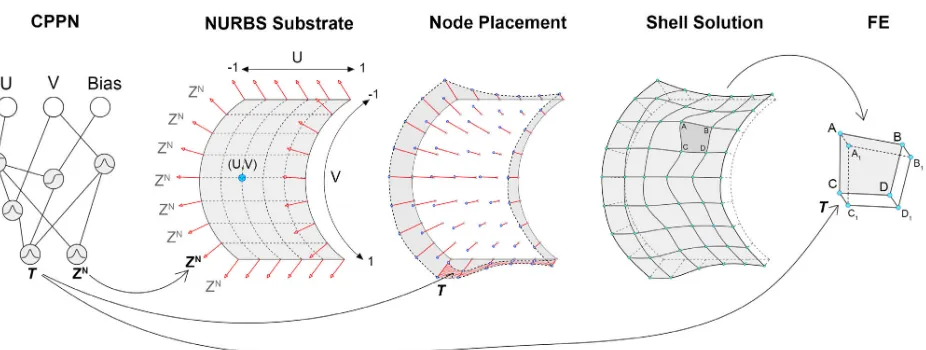
The key difference in our model is that we use CPPNs to
paint patterns across
Non-uniform Rational Basis Spline
(NURBS [38]) surface domains (Fig 1). NURBS surfaces are
commonly used to model geometry in design and engineering
software packages. A useful property of NURBS surfaces is
that any point can be located on the surface using a
relative
(
U, V
) coordinate system that extends from (0, 0) to (1, 1). As
shown in Figure 1, we can exploit this relative coordinate
system to build a new
surface-mapped
domain that is
"clamped" between (-1, -1) and (1, 1). We can then discretize
any NURBS surface, query each point by feeding its (
U, V
)
coordinates into a CPPN, and then use the output value (
Z
N) as
the distance by which to move the queried (U,V) point relative
to its surface normal. Following placement of surface nodes,
we mesh the solution to create a shell with specific thickness,
and export this information for structural analysis using a
commercial
finite element analysis
(FEA) solver.
We refer to this approach as
mapping
a CPPN to a
predefined NURBS surface. Our choice of terminology is
intended to provoke analogies with conceptually similar
techniques in computer graphics - specifically, techniques
such as
texture mapping, bump mapping, normal mapping
and
displacement mapping
that are used to
paint
textures across
geometry in computationally efficient ways. Indeed, our
surface-mapped CPPNs operate in a similar manner, allowing
us to paint geometric and material transformations across
geometry, yet they can also be evolved with NEAT to discover
mechanically motivated surface designs.
1)
Benchmark Setup
To test our
surface-mapped CPPNs
, we use the simple
benchmark problem originally proposed in [39], and more
recently extended by [13], to demonstrate the performance of
their sophisticated FE-based parameterization scheme in
combination with the state-of-the-art gradient-based method:
SIMP
(Solid Isotropic Material with Penalization) [40].
We choose this benchmark problem for three key reasons.
First, as discussed by [41], this problem is “highly
non-convex”, and state-of-the-art shape optimization methods
reach local optima defined by an engineer’s initial choice of a
“sensitivity filter size” [13]. Second, this problem has been
widely published in recently years [13], [41]-[44], and
consequently we have good data with which to make
comparative analyses. Finally, this benchmark problem has
over 1,000 finite elements (FE) and comprises 1,736 degrees
of freedom, which makes it challenging to solve with
traditional
gradient-free
methods [12].
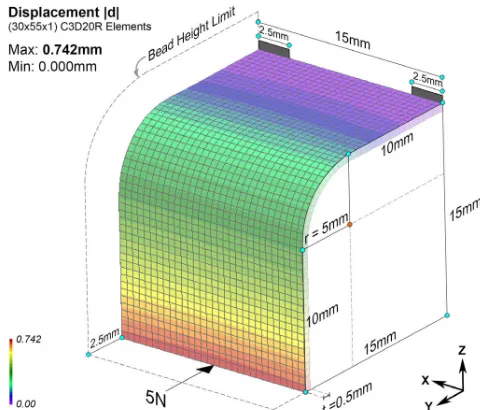
The goal of the benchmark problem is to stiffen a bending
dominated L-shaped cantilever (Fig 2). Stiffening is achieved
by moving FE-nodes relative to the surface normal and
creating structural beads that are subject to a maximum bead
height. The cantilever is made of steel (E=210GPa and v=0.3)
and has a thickness of 0.5mm. The structure is fixed at the top
left and right corners, and is loaded with a single load of 5N,
as shown in Fig. 2. The optimization variables are the set of
heights
of all FE-nodes relative to the surface normal. These
variables are continuous, yet clamped between zero and the
maximum bead height of 2.5mm. The objective is to minimize
displacement experienced at the point on the L-shaped
structure where the 5N load is applied (see Fig 2).
[image:5.595.305.545.446.651.2]We perform our finite element calculations using the
open-source solver CalculiX, and use C3D20R elements, which are
common across a variety of commercial FEA packages and
perform well in bending. For the shape functions of C3D20R
elements, see [45].
2)
NEAT Setup
We perform 10 independent runs, each with a population of
100, evolved for 160 generations. We use our own Java
implementation of NEAT with the following activation
functions:
Gaussian, Sigmoid, Sine, Cosine
and
Linear,
all
with an equal probability of being selected. We promote 25%
of the population using mutations (i.e. no crossover), and for
the remaining 75% of the population there is an 80% chance
of mutating individuals after crossover. Mutation rates are
0.03 for adding a new node, 0.05 for adding a new link, 0.8 for
perturbing a connection weight, and the probability of
interspecies mating is 0.001. We use a dynamic compatibility
threshold, the target number of species is 8, the initial species
delta is 4, the niche size required for elitism is 5. Finally, the
compatibility coefficients are c1 = 1.0, c2 = 1.0, c3 = 0.5. For
a full description of the NEAT parameters see [23].
3)
Fitness Function
To maximize stiffness of the cantilever, we minimize
displacement experienced at the loading node. We calculate
the magnitude of displacement as:
!
=
(!"
!+
!
!"
!+!
!"
!)
!!!!!!!!!!!!!!!!!!!!!!!!!!!!!!!!!!!!!!!!!!!!!!!!!!!!!!!
1
Where:
|d|
is the magnitude of displacement,
ux
is absolute
displacement in the x-axis,
uy
is absolute displacement in the
y-axis, and
uz
is absolute displacement in the z-axis. NEAT is
a maximization algorithm, so we define our fitness function
as:
!"#
1
|
!
|
!!!!!!!!!!!!!!!!!!!!!!!!!!!!!!!!!!!!!!!!!!!!!!!!!!!!!!!!!!!!!!!!!!!!!!!!!!!!!!!!!!!!!!!!!!!
(2
)
B.
Results
1)
Comparative Analysis
We compare our results with those described in [13], which
uses the (current) state-of-the-art (gradient-based)
Solid
Isotropic Material with Penalization
(SIMP) method with a
sophisticated FE-based parameterization scheme and
sensitivity filter to address the same problem. This method
produces high-performance solutions within about 30
optimization steps. Importantly, by varying the size of the
sensitivity filter radius, the method converges to
different
local
optima. This allows designers and engineers to run the model
several times using a variety of different filter sizes in order to
pinpoint the best performing solutions. The authors of [13]
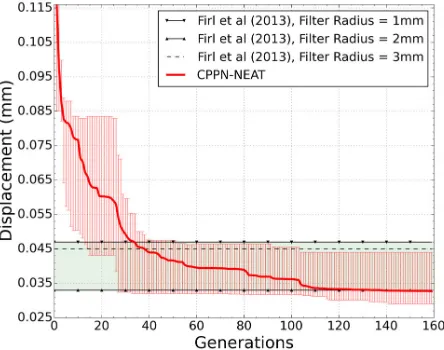
present results using three different filter sizes: 1mm, 2mm
and 3mm, recording optimized |d| values of 0.047mm,
0.033mm and 0.045mm respectively. These solutions
represent significant improvements over the original geometry
(0.742mm, as shown in Fig. 2). However, we now
demonstrate that our surface-mapped CPPN method produces
solutions with superior mechanical properties.
[image:6.595.307.528.89.267.2]Figure 3. Performance of 10 runs of our model over 160 generations. Each line shows the best solution in the population at each generation (indicated by a point). 90% of our test runs discovered solutions, which outperformed designs created by Firl et al. [13] with state-of-the-art gradient-based methods.
Figure 4. Mean convergence of the best solution in the population at each generation, over 10 runs. Also shown are the range of best solutions discovered at each generation over the 10 runs.
[image:6.595.308.530.317.492.2]2)
Model Validation
We argue that our method is able to outperform
state-of-the-art gradient-based methods in this problem domain because
conventional sensitivity filters do not hamper our designs.
Specifically, we think that the sensitivity filters, applied
during gradient-based methods to (uniformly) smooth designs,
actually
prevent
methods from discovering potentially useful
geometric features
. Since our evolutionary (i.e. gradient-free)
approach does not need to calculate sensitivity gradients, it is
not limited in the same way, and can therefore access and
exploit geometric features that gradient-based approaches
cannot. However, it is important to note that sensitivity filters
are a well-established component of shape optimization, and
fulfill multiple functions [14]. Consequently, to support the
claim that our
unfiltered
solutions have superior performance,
we first show that our solutions are valid.
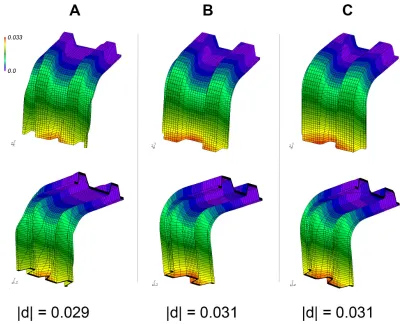
As shown in Fig. 5A, when our FE-nodes move relative to
the surface normal they cause our elements to stretch and
produce slightly irregular meshes. Sensitivity filters are
traditionally applied at this point to smooth mesh geometry
and redistribute nodes, so that the size and shape of all mesh
elements remain as uniform as possible.
This filtering process plays three key roles in gradient-based
methods. Firstly, smoothing helps eliminate noise and ensures
that gradient sensitivities are accurate during sensitivity
analysis calculations. Secondly, the smoothed meshes help
reduce numerical anomalies that can occur in FEA
calculations due to distorted mesh elements. Finally,
smoothing helps produce solutions that are
mesh independent
(i.e. that are not exploiting specific attributes of the
discretization) and return the equivalent physical performance
when simulated with finer meshes [13].
Since our evolutionary method does not require gradient
information, we validate our solutions by showing that they
are (A) not exploiting numerical errors caused by mesh
distortion (i.e. not displaying deceptive physical performance),
and (B) are mesh-independent.
Our FEA calculations use C3D20R elements, which are
common quadratic brick elements with reduced integration
points (2x2x2). C3D20R is a reliable and robust
general-purpose element, and is not susceptible to numerical
instabilities such as hour-glassing and locking phenomena.
Consequently, a simple method of demonstrating validity of
our method is to re-evaluate our final solutions with finer and
more regular meshes (i.e. greater discretization of well-shaped
C3D20R elements), and demonstrate equivalent results.
A novel property of the CPPN encoding is that the solutions
theoretically obtain
infinite resolution
. That is, because CPPNs
paint functional patterns across a NURBS-based substrate, the
designs they encode are not limited to a fixed resolution. In
order to increase the resolution of evolved solutions, we may
simply increase the discretization of the NURBS substrate (in
this case, the L-shaped cantilever shown in Fig 2), and
re-query the CPPN to create high-resolution meshes. However, in
contrast to sensitivity filters, which have a tendency to
“over-smooth” geometric features, increasing the resolution of
solutions discovered with surface-mapped CPPNs can have
the inverse effect of “under-smoothing” evolved features and
revealing geometric properties that were not apparent at the
resolution originally used to optimize the design.
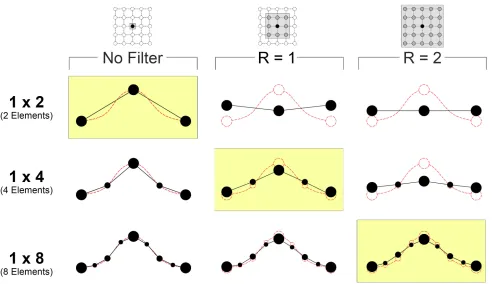
For example, consider a 2-D beam that has been evolved
using our method, and is composed of only two horizontal
finite elements. If the (continuous) CPPN output describes a
Gaussian curve, then the discretized 2-D beam design (1x2
elements) will form an upside down “V” shape (Fig. 6).
However, as we increase the resolution of the design by
subdividing the domain and adding extra elements (e.g. 1 x 4
and 1 x 8), the solution begins to approximate the
CPPN-generated Gaussian distribution, and thus the evolved
upside-down “V” shape is lost.
To counteract the tendency to
under-smooth
solutions as
mesh resolution is increased, we can apply a simple Laplacian
smoothing filter (see [46] for an extended description of
Laplacian smoothing). This has two significant effects. Firstly,
the smoothing filter dramatically improves mesh regularity (as
is known from traditional sensitivity filters), but secondly, it
ensures that higher resolution designs closely approximate the
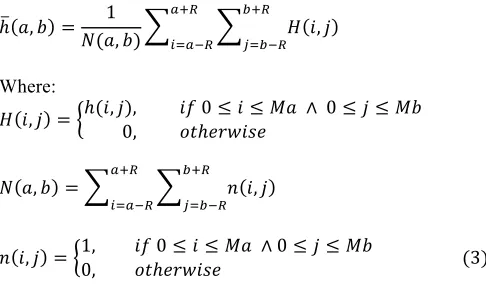
original evolved design. To perform Laplacian smoothing, we
re-query our evolved CPPN and define the height of each node
using the average output of surrounding nodes within a Moore
neighborhood of range,
R
:
ℎ
!,
!
=
1
!
(!,
!
)
!
!,
!
!!! !!!!! !!! !!!!!Where:
!
!,
!
=
ℎ(!,
!
0,
)
,
!!!!!!!!!!
!!!!!!!!!!
!"ℎ!"#$%!
!"
!
0
≤
!
≤
!"
!
∧
!
0
≤
!
≤
!"
!!!!!!!
!
!,
!
=
!!!!
!,
!
!!!!!
!!!
!!!!!
!
!,
!
=
0,
1
,
!"
!"ℎ!"#$%!
!
0
≤
!
≤
!"
!
∧
0
≤
!
≤
!"
!!!!!!!!!!!!!!!!!!!!
(
3
)
Where:
ℎ
!,
!
is the average (Laplacian smoothed) height,
h
, of node
(!,
!
)
,
R
is the Moore neighborhood range, and
Ma
and
Mb
are the maximum number of nodes in the
a
and
b
dimensions of the mesh grid, respectively.
As shown in Fig. 6, the success of this method, when
applied to CPPN generated outputs, relies on careful
coordination between the Moore neighborhood range,
R
, of
the Laplacian smoothing filter and the increased resolution
size. For example, if we apply the Laplacian filter directly to
the initial (1 x 2) 2D beam design (i.e. without increasing the
mesh resolution) the shape quickly begins to approximate a
flat line due to over-smoothing. However, if the Moore
neighborhood is incremented each time the mesh resolution
doubles, then we can avoid
over-smoothing
and
under-smoothing
(Fig. 6). This method allows us to produce finer
resolution meshes that have significantly more uniform
elements, yet - critically - they remain close approximations of
the original evolved designs.
[image:7.595.305.548.330.475.2]%
!
!""#"
!
=
!
|
!"
−
!"
|
!"
!!!!!!!!!!!!!!!!!!!!!!!!!!!!!!!!!!!!!!!!!!!!!!!!!!!!!!!!!!!!!!!!
(
4
)
Where:
!"
is |d| experienced at the loaded node in the
[image:8.595.349.504.463.602.2]evolved solution (30 x 55 resolution, no filter), and
!"
is the
|d| experienced by the updated solution.
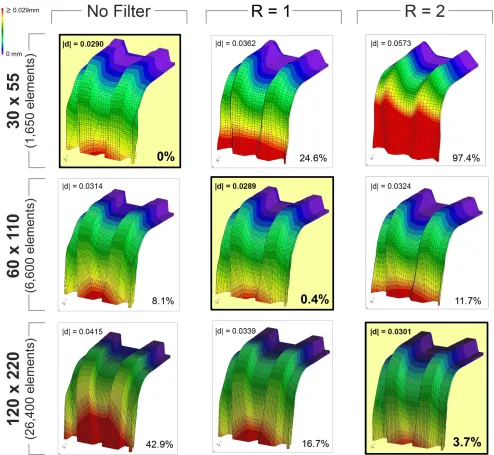
As shown in Fig. 7, applying Laplacian smoothing directly
to the evolved design has the effect of over-smoothing the
evolved features, and altering mechanical performance. Note
that while mechanical performance is worse, the shape and
size of the mesh elements are significantly improved and made
more regular. The central image in Fig. 7 shows the effect of
doubling the resolution from (30 x 55) elements to (60 x 110)
elements and applying a Laplacian smoothing filter with R =
1. Here we see a FE-mesh with significantly more uniform
elements and only 0.4% difference in simulated performance.
Similarly, we achieve a relatively small 3.7% error even as we
multiply the number of mesh elements by a factor of 16 times
(Fig. 8).
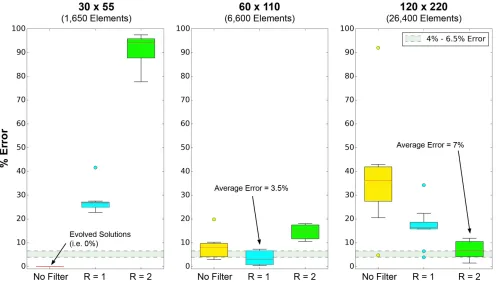
Figure 9 shows the results of testing all of our evolved
solutions at differing resolutions and with different filter
ranges. To compare our results we show our percentage error
in relation to the results of [13]. The authors show that their
solutions are
mesh independent
by altering the resolution of
their mesh between 1,650 and 6,600 elements and re-running
their gradient-based method to show that they converge on
equivalent solutions with about 4 – 6.5% error. In comparison,
we show an average error of 3.5% and 7% when increasing
resolution to
6,600
elements and
26,400
elements respectively.
By showing that the mechanical performance of our
evolved designs (Fig 5A) can be replicated using significantly
finer and more regular meshes (Fig 7-9) and - importantly -
using reliable C3D20R elements, we show that our method of
evolving surface-mapped CPPNs is not exploiting mesh
irregularities to produce deceptive results, and is indeed
improving on state-of-the-art gradient-based methods for
shape optimization. Specifically, we show that our method can
consistently discover mechanical designs that are better than
existing state-of-the-art methods [13].
IV.
SCALABILITY
EXPERIMENT
A.
Modifications to Methods
To test the scalability of our method, we explore eight
different parameterizations of the previous benchmark
problem (Fig. 2), and use two different surface
transformations. Firstly, we evolve designs with a uniform
shell thickness. Secondly, we evolve designs where shell
thickness is allowed to vary (locally) across the surface.
To build designs with
uniform
shell thickness, we use a
CPPN (as before) with three inputs, and one output (see Fig
1). To build designs with
variable
shell thickness, we use the
same CPPN method, but add an extra output,
T,
to control
shell thickness
. As shown in Figure 10,
Z
Ncontinues to define
a surface extrusion relative to the surface normal, but now
T
defines the thickness of the shell across the surface. Here, T
defines the thickness of the shell at each (u,v) coordinate on
the NURBS substrate by locally extruding the shell in the
opposite direction of the surface normal, ensuring that the
minimum shell thickness at any point is 0.01mm and the
maximum is 1.0mm (Fig 10). The solution is then meshed and
subjected to FEA as the uniform shell. Note that a key
difference between the
uniform
and
variable
shell designs is
the number of degrees-of-freedom.
1)
Modifications to the Benchmark Setup
We add additional
degrees of freedom
(DoF) to the original
benchmark problem in order to demonstrate that, unlike
similar methods [4], [15], [17], the problem does not become
more difficult to solve as more DoF are added to the system.
To demonstrate this scalable behavior, we increase the
dimensionality of the problem in two specific ways, and test
eight different parameterizations of the benchmark problem.
Firstly, we vary the
discretization
of the FE-mesh. Our base
experiment used a fixed mesh resolution of 30 x 55 elements
(i.e. 1736 different DoF). In this paper we test four different
mesh resolutions: 6 x 12 elements (91 DoF), 12 x 24 elements
(325 DoF), 24 x 48 elements (1225 DoF), and 48 x 96
elements (4753 DoF). Here each
uniform
shell has a fixed
thickness of 0.3mm.
Secondly, we allow solutions to vary their discretization
and
shell thicknesses across the surface domain, subject to a
maximum volume constraint. Here the local shell thickness is
a continuous value between 0.01mm and 1.0mm. If the
volume of the final shell solution,
sV
, is greater than a
maximum volume,
mV
, the CPPN is re-queried and the
thickness,
T,
of each point is scaled linearly to meet
mV
.
We calculate the volume of each shell solution by taking
each finite element block (as shown in Fig 10), and splitting it
into twelve irregular tetrahedrons. Each tetrahedron is defined
by six edges:
a, b, c, A, B, C
, where the pairs (
a,A
), (
b,B
), and
(
c,C
) are opposite edges that do not share common vertices
(Fig. 11).
Figure 11. Irregular tetrahedron defined by six edges: a,b,c,A,B,C. The volume of each finite element block, as shown by the dotted bounding box, is calculated by summing the volume of 12 irregular tetrahedrons.
We calculate the volume of each tetrahedron,
tV
, as:
!"
=
(
4
!
!
!
!!
!−
!
!!
!!−
!
!
!!
!!−
!
!
!!
!!+
!
!
′
!
′
!
′
)
!!
12
Where:
!
!=
!
!
!+!
!
!−
!
!
!!
!=
!
!
!+!
!
!−
!
!
!We then calculate the volume of each shell by summing over
all tetrahedrons:
!"
=
!"
!" !"!!!
!
!!!
!!!!!!!!!!!!!!!!!!!!!!!!!!!!!!!!!!!!!!!!!!!!!!!!!!!!!!!!!!!!!!!!!!!!!!!!!!!
(
6)
where:
tVij is the volume of the
jth tetrahedron within the ith
finite element in a collection of N FE blocks.
To constrain sV of each shell to mV, we re-query the CPPN
and linearly scale the shell thickness, T, to meet mV using:
!
(
!
!"!"
!!!
,
!",
!")
!"!!!
Where:
!
!
∈
[0.01
∶
1]
!
!,
!",
!"
=
!
!,!!!!!!!!!!!!!!!!!!!!!!!!!!!!!!!!!!!!!!!!"!!"
!!
×
!
1
−
!
!"
≤
!"!
!"
,!!!!!!"!!"!
>
!"
!!!!!!!!!
(
7)
where: Tuv is the local shell thickness generated by querying
the CPPN at point (u,v) on the NURBS surface, and Ut and Vt
are the total number of points on the NURBS surface in the u,
and v dimensions respectfully. Tuv can have a minimum value
of 0.01 and a maximum value of 1.0. In these experiments we
set
mV to 130mm
3. Notably, shells with uniform shell
thickness of 0.3mm have a volume that is between 124.2mm
3and 141.9mm
3(depending on how points are extruded to form
structural beads).
The important consequence of using variable shell thickness
is that it
doubles the number of DoF in each parameterization
of the benchmark problem. This creates eight different
parameterizations with increasing DoF:
91 and
182 (uniform
and variable shell thickness of discretization: 6 x 12), 325 and
650 (12 x 24), 1225 and
2450 (24 x 48), and 4753 and
9506
(48 x 96). These eight parameterizations allow us to test how
our surface-mapped CPPN approach performs across a range
of different scales.
As in our base experiment, we perform our finite element
calculations using the open-source solver
CalculiX, but this
time we use
C3D8 elements. Our base experiment used
C3D20R elements, which are robust and reliable FE brick
elements, in order to compare our solutions with a
state-of-the-art gradient-based approach [13]. C3D20R elements more
accurately simulate physical behavior, but the trade-off for
fine-grained analysis is increased computation time [45]. In
this experiment we use C3D8 elements, which are less
accurate, but much faster to simulate and therefore allow us to
explore the scalability of our approach in a reasonable
timeframe.
2)
Modifications to the NEAT Setup
We perform 20 independent runs of each of our 8
parameterizations, each run using a population of 100
solutions, evolved for 200 generations. All other details of the
NEAT setup and fitness function are the same as in the base
experiment.
Since we use different finite element bricks in this
benchmark setup, our results are not directly comparable to
solutions found in the base experiment. Consequently, our
decision to increase the number of runs and generations is due
to a desire to exploit the reduced runtimes of our simulations
(when using D3D8 elements) in order to provide a better
picture of
average convergence behavior across different
parameterizations of the benchmark problem.
A.
Results
We now present the results from eight different
parameterizations of the benchmark problem. Our focus is on
how designs converge as the benchmark problem increases in
scale. Our results show that, in contrast to traditional shape
optimization techniques, the benchmark problem
does not
become more difficult to solve as we increase the number of
degrees of freedom. Indeed, our results show that the
benchmark problem actually becomes
easier to solve with
higher resolution parameterizations.
We first test solutions with uniform thickness and varying
mesh resolution. Figure 12 shows the mean convergence of
the best solution in each population over 20 runs of the model.
As shown, the lowest resolution FE-mesh (i.e. 6 x 12
elements) converges to a displacement, |d|, of 0.073mm after
200 generations. We then see that for each successive increase
in scale, i.e. 12 x 24 elements, followed by 24 x 48 elements,
we converge to better solutions, and this trend continues as we
reach our highest resolution of 48 x 96 elements (4753 DoF),
which achieved an average |d| of 0.041mm.
Secondly, we test solutions with variable thickness and
varying mesh resolution. Figure 13 shows the mean
convergence of the best solution in each population over 20
runs. In a similar fashion to Figure 12, we see that higher
resolution FE-meshes converge to solutions with mechanically
superior performance (i.e. less displacement at the loaded
node). On first sight, this finding is perhaps not completely
surprising, as it is well-known that designs defined by more
degrees of freedom can often discover better solutions, due to
the increased opportunity for fine-tuning [21]. However, the
key point is that this ability typically comes at a cost of many
more evaluations and thus increased computational expense.
Indeed, designs with low resolution FE-meshes typically
converge quickly to sub-optimal solutions, whereas whilst
higher resolution FE-meshes can often find superior solutions,
they require many more evaluations to converge [9], [10].
Figures 12 and 13 illustrate that solutions evolved with
surface-mapped CPPNs are
not subject to this behavior. In
fact, we find that solutions controlled by more optimization
variables discover superior solutions in fewer evaluations.
parameterizations with both uniform and variable shell
thicknesses converge to the threshold of 0.0609mm in fewer
generations as more DoF are added to the solution. The
significance of this plot is that traditional shape optimization
methods produce the
inverse
effect – that is, as DoF increase,
so do the number of generations required to converge [9],
[21].
It is important to note that, in these experiments, higher
resolution parameterizations take fewer
evaluations
to
converge, yet do take more
time
to solve than lower-resolution
designs, due to the increased computational expense of the
FEA. This might initially appear to be an obvious limitation of
our approach. However, in practice, approaches which employ
strategies to reduce the dimensionality of the problem in order
to improve speed of convergence do not change the resolution
of the FEA mesh, but simply change the number of control
points that define DoF in the model [2], [4], [17], [18]-[21].
Consequently, our finding that parameterizations with more
DoF can discover superior solutions in fewer evaluations is
potentially significant for shape optimization.
Next, we compare how uniform and variable shell solutions
with identical mesh resolutions converge (Fig 15). We observe
that more DoF lead to better solutions (i.e. less displacement)
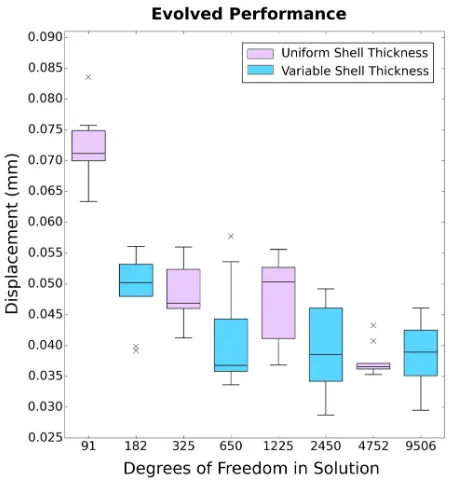
and faster convergence. Finally, Figure 16 shows the spread of
mechanical performance achieved across the eight different
parameterizations. This plot emphasizes our key finding, that
evolving surface-mapped CPPNs for shape optimization does
not become more difficult as more degrees of freedom are
added to the system. In contrast, we find that problems defined
by more DoF are consistently easier to solve and also
converge to superior solutions in fewer evaluations. For raw
convergence data collected from both experiments see:
https://dx.doi.org/10.6084/m9.figshare.3795888.v1.
These results, in parallel with the findings from our base
experiment, suggest significant potential for tackling complex
and large-scale shape optimization problems using
surface-mapped CPPNs.
V.
DISCUSSION
Our results demonstrate that surface-mapped CPPNs offer
practical improvements over state-of-the-art methods to shape
optimization. In this section we discuss (A) the advantages of
our approach in terms of the superior physical properties of
solutions; (B) the ability to scale up and solve design problems
with many degrees of freedom, and (C) exciting opportunities
for further exploration.
A.
Advantages Relating to Physical Performance
A significant feature of our method is that it does not
explicitly
define sensitivity filters. As evidenced by [13],
[41]-[44], different filter sizes constrain state-of-the-art
gradient-based methods to converge to specific local optima.
Consequently,
filter size
becomes an important design variable
that designers must experiment with to access different
solutions within the search space. But once the filter size is
set, it is
uniformly
applied to the mesh to smooth the design.
We claim that a key limitation of these state-of-the-art
approaches is that a
combination
of different filter sizes,
applied simultaneously across the design may conceivably
produce even better solutions than existing uniform filters.
This insight is the key to understanding
why
our
surface-mapped CPPNs improve on state-of-the-art methods.
Specifically, our approach uses CPPNs to paint functional
patterns across NURBS geometry to create coordinated mesh
transformations. Recall that the CPPN-generated patterns
exhibit useful features such as geometric regularities with
repeating motifs; symmetries and even imperfect symmetries;
and thus the capacity to create both smooth gradations and
more abrupt angular transitions between parts of the design.
This means that our encoding can
implicitly
control
smoothness
of geometric features during evolution, and,
critically, does so in a non-uniform manner that is not limited
in the same way as existing state-of-the-art gradient-based
methods.
A common criticism of
gradient-free
methods for shape
and structural optimization is that is that they cannot
guarantee
that the solutions converge to the global optimum.
This remains true with our approach. However as we have
discussed, in state-of-the-art shape optimization methods,
parameterization decisions involved in setting up sensitivity
filters actively define which “optimum” is discoverable.
Consequently, while our model cannot
guarantee
convergence
to an optimal solution, we seem better able to approximate the
true
global optima than state-of-the-art methods, and in doing
so, can discover solutions that have superior performance on
highly non-convex, real-world problems.
A.
Advantages Relating to Scalability
The results of our scalability experiment suggest that
surface-mapped CPPNs enable a powerful and
scalable
approach to shape optimization. Critically, our choice of
FE-mesh resolutions (6x12), (12x24), (24x48), (48x96) allow us
to test our benchmark problem at a variety of significantly
different scales, ranging from 91 to 9506 degrees of freedom.
This increase in scale is
substantial
compared to related
studies [2], [4], [9], [10], [17], [21], and also
significantly
exceeds
the 1,000 DoF threshold which is known to be
currently challenging for gradient-free methods due to the
need to individually parameterize and manipulate each DoF
[12]. However, we consistently discover superior solutions, in
fewer evaluations, when using parameterizations with more
degrees of freedom.
Figure 12. Convergence of uniform shell solutions with different DoF over 200 generations. Mean convergence,and variation of the best solution in each population across 20 runs are shown. Solutions defined by more DoF converge to better performing designs.
Figure 14. Convergence behavior of different parameterizations. Mean number of generations required to hit the threshold over 20 runs of the model is shown for each parameterization. Range of maximum and minimum generations required to converge to the threshold is also shown. Solutions with uniform shell thickness are plotted in red, and variable shell thickness in blue.
Critically, the shell designs with variable thickness do
not
use more material than those with uniform thickness (in fact,
in some cases they use less); rather, they are afforded the
capacity to
control where material is distributed whilst
defining how geometry is transformed. This type of
parameterization would traditionally be fraught with
scalability problems, especially when using EAs, yet our
surface-mapped
CPPNs
easily
coordinate
geometric
transformations to find good solutions.
[image:11.595.309.529.86.278.2]Another useful property of our approach is that it is
conceptually relatively simple, and therefore (unlike adaptive
parameterizations) does not require specialist knowledge to
Figure 13. Convergence of variable shell solutions with different DoF over 200 generations. Mean convergence and variation,of the best solution in each population across 20 runs are shown. Solutions defined by more DoF converge to better performing designs.
Figure 16. Spread of best evolved solutions from all 20 runs, over 200 generations each time, using different parameterizations. As the number of DoF increases, better solutions (i.e. those showing less displacement at the loaded node) are discovered more regularly.
tune newly introduced problem specific parameters. In terms
of commercial application and use in industry, we suggest that
this is a major advantage. Future work will explore this
further.
[image:11.595.306.531.330.570.2] [image:11.595.56.275.337.549.2]shape optimization methods ignore this fact, instead choosing
to treat designs as collections of points, which are individually
parameterized, manipulated and then post-processed to
achieve smooth transitions and coordinated transformations.
By evolving surface-mapped CPPNs, we completely
re-frame the problem, and in doing so make high-resolution
geometric problems just as easy to solve as low-resolution
geometric problems. That is, instead of conceptualizing shape
optimization as a high-dimensional combinatorial optimization
problem, where the exact value of each parameter is sought,
our approach uses CPPNs to discover underlying geometric
and spatial relationships that are often (if not always) present
in these types of problems.
Critically, previous work relating to CPPN-based methods
of generating 3-D objects has also demonstrated this ability to
exploit free compositional information to create scale free
geometric transformations. However, by mapping the spatial
domain to specific surfaces – rather than using Cartesian
volumes – we are able to exploit free compositional
information relating to predefined geometries, while
simultaneously enforcing much-needed constraints on
engineering design problems.
In this paper we show that our approach is conceptually
easier to use than similar methods (i.e. adaptive
parameterizations), can produce superior mechanical solutions
compared to state-of-the-art gradient-based approaches on a
well-known benchmark problem, exploit the core benefits of
evolutionary methods in terms of addressing complex
multi-modal problem domains, and - perhaps most importantly -
operate well at large scales.
B.
Opportunities for Further Work
We now discuss several key benefits and opportunities for
progress in this area, as well as ongoing challenges that
require further work.
Advanced digital fabrication technologies (e.g. additive
manufacturing) are transforming construction. Not only do
these technologies offer vast geometric freedom to designs,
but also they allow us to combine
different materials within
single objects, and thereby construct complex composites with
bespoke physical properties and behaviors. These technologies
are opening up exciting possibilities for large-scale shell
structures in design and engineering domains [2], bio-inspired
composites [3], resilient high-performance shell designs [4],
next-generation robotics [31], exotic compliant mechanisms
and morphing structures [47], [48]. Evolutionary approaches,
such as surface-mapped CPPNs, that can deal with large
numbers of design variables and approximate optimal designs,
will offer significant benefits for exploiting these new
fabrication technologies by exploring highly non-convex and
disjoint search spaces in response to ill-defined and
multi-objective goals.
We conclude by outlining three areas for future research
that we think will be valuable in leveraging surface-mapped
CPPNs to advance engineering design.
Firstly, an ongoing challenge with our current setup is that it
is computationally expensive. That is, while our model
requires roughly the same number of
generations as
optimization steps required by [13] (i.e. to test all three filter
sizes), in order to discover superior solutions each generation
requires an additional 99 FEA evaluation calls, due to the need
to simulate populations of solutions. Consequently our
simulation time is about 100 times that of [13]. For example,
our base experiment, with 1,736 degrees of freedom, requires
about 17 hours run time to process 160 generations, which is
impractical for use within industry. However, we are currently
running our model on a single PC. Further work is required to
utilize cloud-based systems and evaluate individual solutions
from each generation in parallel. This would drastically reduce
the time required to solve design problems, make our method
much more suitable for commercial application, and render it
potentially comparable to gradient-based methods in terms of
time required to generate solutions.
Secondly, as we demonstrate in our base experiment, in
order to increase the resolution of evolved surface-mapped
CPPNs and produce similar solutions, it is necessary to
employ strategies that prevent under-smoothing and
over-smoothing (Fig 6). In this paper we demonstrate a simple
Laplacian smoothing operator in order to demonstrate that our
solutions are mesh independent. However, further work is
needed in this area to ensure that surface-mapped CPPNs can
be reliably recreated at any resolution without further
evolution. Additionally, while we show that surface-mapped
CPPNs eliminate the need for adaptive parameterizations on
large-scale problems, we suggest that there may be cases
where designs benefit from mesh solutions that feature
non-uniform discretization, or which perhaps feature adaptive
mesh strategies [49]. Specifically, there may be times when it
is easier to produce high-performance solutions with
FE-meshes, which are subdivided and discretized differently.
Notably, ES-HyperNEAT approaches [50] have proven useful
in other domains, and may provide useful insights for further
research in this area. Additionally, alternative methods of
exploiting CPPN outputs may enable high-performance
surface conformed truss and lattice structures [36], which may
be advantageous in specific problem domains.
Finally, this paper demonstrates shape optimization on one
benchmark problem only. To progress this proof-of-concept
study, further work is needed to test this approach on a variety
of different benchmark problems. Notably, the real benefit of
using EAs, rather than state-of-the-art gradient-based methods,
is that they can be applied to non-trivial design problems that
are characterized by deceptive search spaces, for example,
exotic compliant mechanisms, multi-material composites and
shape changing structures. Further work will explore material
maps as a method of addressing these sorts of
non-trivial
design problems, and fully exploit the benefits of evolutionary
methods to advance engineering design.
REFERENCES
[1] K. U. Bletzinger, M. Firl, J. Linhard, and R. Wüchner. "Optimal shapes of mechanically motivated surfaces." Computer methods in applied mechanics and engineering, vol. 199, no. 5, 2010, pp. 324-333. [2] S. Adriaenssens, P. Block, D. Veenendaal and C. Williams. Shell
structures for architecture: form finding and optimization. Routledge, 2014.