Language to Code:
Learning Semantic Parsers for If-This-Then-That Recipes
Chris Quirk
Microsoft Research Redmond, WA, USA
Raymond Mooney∗
UT Austin Austin TX, USA
Michel Galley
Microsoft Research Redmond, WA, USA
Abstract
Using natural language to write programs is a touchstone problem for computational linguistics. We present an approach that learns to map natural-language descrip-tions of simple “if-then” rules to executable code. By training and testing on a large cor-pus of naturally-occurring programs (called “recipes”) and their natural language de-scriptions, we demonstrate the ability to effectively map language to code. We compare a number of semantic parsing ap-proaches on the highly noisy training data collected from ordinary users, and find that loosely synchronous systems perform best.
1 Introduction
The ability to program computers using natural lan-guage would clearly allow novice users to more effectively utilize modern information technology. Work insemantic parsinghas explored mapping natural language to some formal domain-specific programming languages such as database queries (Woods, 1977; Zelle and Mooney, 1996; Berant et al., 2013), commands to robots (Kate et al., 2005), operating systems (Branavan et al., 2009), smart-phones (Le et al., 2013), and spreadsheets (Gulwani and Marron, 2014). Developing such language-to-code translators has generally required specific dedicated efforts to manually construct parsers or large corpora of suitable training examples.
An interesting subset of the possible program space is if-then “recipes,” simple rules that allow users to control many aspects of their digital life including smart devices. Automatically parsing
∗Work performed while visiting Microsoft Research.
these recipes represents a step toward complex nat-ural language programming, moving beyond single commands toward compositional statements with control flow.
Several services, such as Tasker and IFTTT, al-low users to create simple programs with “triggers” and “actions.” For example, one can program their Phillips Hue light bulbs to flash red and blue when the Cubs hit a home run. A somewhat complicated GUI allows users to construct these recipes based on a set of information “channels.” These chan-nels represent many types of information. Weather, news, and financial services have provided constant updates through web services. Home automation sensors and controllers such as motion detectors, thermostats, location sensors, garage door openers, etc. are also available. Users can then describe the recipes they have constructed in natural language and publish them.
Our goal is to build semantic parsers that al-low users to describe recipes in natural language and have them automatically mapped to exe-cutable code. We have collected 114,408 recipe-description pairs from the http://ifttt.com website. Because users often provided short or incomplete English descriptions, the resulting data is extremely noisy for the task of training a semantic parser. Therefore, we have constructed semantic-parser learners that utilize and adapt ideas from several previous approaches (Kate and Mooney, 2006; Wong and Mooney, 2006) to learn an effective in-terpreter from such noisy training data. We present results on our collected IFTTT corpus demonstrat-ing that our best approach produces more accurate programs than several competing baselines. By exploiting such “found data” on the web, seman-tic parsers for natural-language programming can potentially be developed with minimal effort.
2 Background
We take an approach to semantic parsing that directly exploits the formal grammar of the tar-get meaning representation language, in our case IFTTT recipes. Given supervised training data in the form of natural-language sentences each paired with their corresponding IFTTT recipe, we learn to introduce productions from the formal-language grammar into the derivation of the target program based on expressions in the natural-language input. This approach originated with the SILT system (Kate et al., 2005) and was further developed in the WASP (Wong and Mooney, 2006; Wong and Mooney, 2007b) and KRISP (Kate and Mooney, 2006) systems.
WASP casts semantic parsing as a syntax-based statistical machine translation(SMT) task, where asynchronous context-free grammar(SCFG) (Wu, 1997; Chiang, 2005; Galley et al., 2006) is used to model the translation of natural language into a formal meaning representation. It uses statistical models developed for syntax-based SMT for lexical learning and parse disambiguation. Productions in the formal-language grammar are used to construct synchronous rules that simultaneously model the generation of the natural language. WASP was sub-sequently “inverted” to use the same synchronous grammar to generate natural language from the for-mal language (Wong and Mooney, 2007a).
KRISP uses classifiers trained using a Support-Vector Machine (SVM) to introduce productions in the derivation of the formal translation. The productions of the formal-language grammar are treated like semantic concepts to be recognized from natural-language expressions. For each pro-duction, an SVM classifier is trained using astring subsequence kernel(Lodhi et al., 2002). Each clas-sifier can then estimate the probability that a given natural-language substring introduces a production into the derivation of the target representation. Dur-ing semantic parsDur-ing, these classifiers are employed to estimate probabilities on different substrings of the sentence to compositionally build the most probable meaning representation for the sentence. Unlike WASP whose synchronous grammar needs to be able to directly parse the input, KRISP’s ap-proach to “soft matching” productions allows it to produce a parse foranyinput sentence. Conse-quently, KRISP was shown to be much more robust to noisy training data than previous approaches to semantic parsing (Kate and Mooney, 2006).
Since our “found data” for IFTTT is extremely noisy, we have taken an approach similar to KRISP; however, we use a probabilistic log-linear text clas-sifier rather than an SVM to recognize productions. This method of assembling well-formed pro-grams guided by a natural language query bears some resemblance to Keyword Programming (Lit-tle and Miller, 2007). In that approach, users en-ter natural language queries in the middle of an existing program; this query drives a search for programs that are relevant to the query and fit within the surrounding program. However, the function used to score derivations is a simple match-ing heuristic relymatch-ing on the overlap between query terms and program identifiers. Our approach uses machine learning to build a correspondence be-tween queries and recipes based on parallel data.
There is also a large body of work applying Com-binatory Categorical Grammars to semantic pars-ing, starting with Zettlemoyer and Collins (2005). Depending on the set of combinators used, this ap-proach can capture more expressive languages than synchronous context-free MT. In practice, however, synchronous MT systems have competitive accu-racy scores (Andreas et al., 2013). Therefore, we have not yet evaluated CCG on this task.
3 If-this-then-that recipes
The recipes considered in this paper are diverse and powerful despite being simple in structure. Each recipe always contains exactly one trigger and one action. Whenever the conditions of the trigger are satisfied, the action is performed. The resulting recipes can perform tasks such as home automation (“turn on my lights when I arrive home”), home security (“text me if the door opens”), organization (“add receipt emails to a spreadsheet”), and much more (“remind me to drink water if I’ve been at a bar for more than two hours”). Triggers and actions are drawn from a wide range of channels that must be activated by each user. These channels can represent many entities and services, including devices (such as Android devices or WeMo light switches) and knowledge sources (such as ESPN or Gmail). Each channel exposes a set of functions for both trigger and action.
parameters for both trigger and action. After the recipe is authored, the user must provide a descrip-tion and opdescrip-tional set of notes for this recipe and publish the recipe. Other users can browse and use these published recipes; if a user particularly likes a recipe, they can mark it as a favorite.
As of January 2015, we found 114,408 recipes on http://ifttt.com. Among the available recipes we encountered a total of 160 channels. In total, we found 552 trigger functions from 128 of those chan-nels, and 229 action functions from 99 chanchan-nels, for a total of 781 functions. Each recipe includes a number of pieces of information: description1,
note, author, number of uses, etc. 99.98% of the entries have a description, and 35% contain a note. Based on availability, we focused primarily on the description, though there are cases where the note is a more explicit representation of program intent.
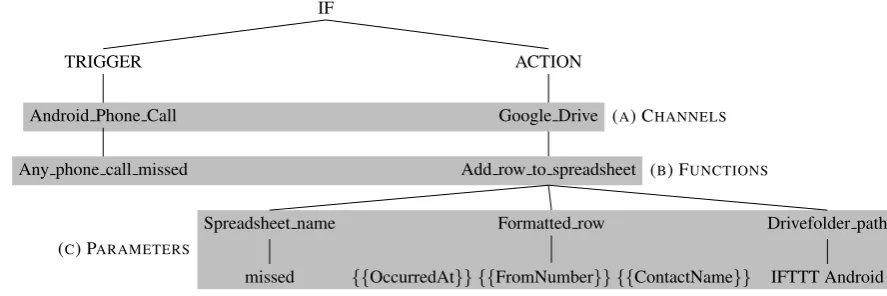
The recipes at http://ifttt.com are represented as HTML forms, with combo boxes, inline maps, and other HTML UI components allowing end users to select functions and their parameters. This is convenient for end users, but difficult for automated approaches. We constructed aformal grammarof possible program structures, and from each HTML form we extracted an abstract syntax tree (AST) conforming to this grammar. We model this as a context-free grammar, though this assumption is violated in some cases. Consider the program in Figure 1, where some of the parameters used the action are provided by the trigger.
This data could be used in a variety of ways. Recipes could be suggested to users based on their activities or interests, for instance, or one could train a natural language generation system to give a readable description of code.
In this paper, the paired natural language descrip-tions and abstract syntax trees serve as training data for semantic parsing. Given a description, a system must produce the AST for an IFTTT recipe. We note in passing that the data was constructed in the opposite direction: users first implemented the recipe and then provided a description afterwards. Ideal data for our application would instead start with the description and construct the recipe based on this description. Yet the data is unusually large and diverse, making it interesting training data for mapping natural language to code.
1The IFTTT site refers to this as “title”.
4 Program synthesis methods
We consider a number of methods to map the natu-ral language description of a problem into its for-mal program representation.
4.1 Program retrieval
One natural baseline is retrieval. Multiple users could potentially have similar needs and therefore author similar or even identical programs. Given a novel description, we can search for the closest description in a table of program-description pairs, and return the associated program. We explored several text-similarity metrics, and found that string edit distance over the unmodified character se-quence achieved best performance on the devel-opment set. As the corpus of program-description pairs becomes larger, this baseline should increase in quality and coverage.
4.2 Machine Translation
The downside to retrieval is that it cannot general-ize. Phrase-based SMT systems(Och et al., 1999; Koehn et al., 2003) can be seen as an incremental step beyond retrieval: they segment the training data and attempt to match and assemble those seg-ments at runtime. If the phrase length is unbounded, retrieval is almost a special case: it could return whole programs from the training data when the description matches exactly. In addition, they can find subprograms that are relevant to portions of the input, and assemble those subprograms into whole programs.
As a baseline, we adopt a recent approach (An-dreas et al., 2013) that casts semantic parsing as phrasal translation. First, the ASTs are converted into flat sequences of code tokens using a pre-order left-to-right traversal. The tokens are annotated with their arity, which is sufficient to reconstruct the tree given a well formed sequence of tokens using a simple stack algorithm. Given this paral-lel corpus of language and code tokens, we train a conventional statistical machine translation sys-tem that is similar in structure and performance to Moses (Koehn et al., 2007). We gather the k-best translations, retaining the first such output that can be successfully converted into a well-formed pro-gram according to the formal pro-grammar. Integration of the well-formedness constraint into decoding would likely produce better translations, but would require more modifications to the MT system.
(A) CHANNELS
(B) FUNCTIONS
(C) PARAMETERS
IF
ACTION
Google Drive
Add row to spreadsheet
Drivefolder path
IFTTT Android Formatted row
{{OccurredAt}} {{FromNumber}} {{ContactName}} Spreadsheet name
missed TRIGGER
Android Phone Call
Any phone call missed
[image:4.595.71.515.65.213.2]Archive your missed calls from Android to Google Drive
Figure 1: Example recipe with description, with nodes corresponding to (a) Channels, (b) Functions, and (c) Parameters indicated with specific boxes. Note how some of the fields in braces, such as OccurredAt, depend on the trigger.
data is very parallel. In the IFTTT dataset, however, the available pairs are not particularly clean. Word alignment quality suffers, and production extrac-tion suffers in turn. Descripextrac-tions in this corpus are often quite telegraphic (e.g., “Instagram to Face-book”) or express unnecessary pieces of informa-tion, or are downright unintelligible (“ 2Mrl14”). Approaches that rely heavily on lexicalized infor-mation and assume a one-to-one correspondence between source and target (at the phrase, if not the word level) struggle in this setting.
4.3 Generation without alignment
An alternate approach is to treat the source lan-guage as context and a general direction, rather than a hard constraint. The target derivation can be pro-duced primarily according to the formal grammar while guided by features from the source language. For each production in the formal grammar, we can train a binary classifier intended to predict whether that production should be present in the derivation. This classifier uses general features of the source sentence. Note how this allows produc-tions to be inferred based on context: although a description might never explicitly say that a pro-duction is necessary, the surrounding context might strongly imply it.
We assign probabilities to derivations by looking at each production independently. A derivation ei-ther uses or does not use each production. For each production used in the derivation, we multiply by the probability of its inclusion. Likewise for each productionnotused in the derivation, we multiply by one minus the probability of its inclusion.
Let G = (V,Σ, R, S) be the formal grammar
with non-terminalsV, terminal vocabularyΣ, pro-ductions R and start symbol S. E represents a source sentence, andD, a formal derivation tree for that sentence. R(D)is the set of productions in that derivation. The score of a derivation is the following product:
P(D|E) = Y r∈R(D)
P(r|E) Y r∈R\R(D)
P(¬r|E)
The binary classifiers are log-linear models over features, F, of the input string: P(r|E) ∝ exp θ>
rF(E)
.
4.3.1 Training
For each production, we train a binary classifier predicting its presence or absence. Given a train-ing set of parallel descriptions and programs, we create|R| binary classifier training sets, one for each classifier. We currently use a small set of simple features: word unigrams and bigrams, and character trigrams.
4.3.2 Inference
When presented with a novel utterance,E, our sys-tem must find the best code corresponding to that utterance. We use a top-down, left-to-right gener-ation strategy, where each search node contains a stack of symbols yet to be expanded and a log prob-ability. The initial node ish[S],0i; and a node is complete when its stack of non-terminals is empty.
derivation score:
h[X, α], pi (X →β)∈R h[β, α], p+ logP(X →β|E)ii
If the first stack item is a terminal, it is scanned:
h[a, α], pi a∈Σ h[α], pi
Using these inference rules, we utilize a simple greedy approach that only accounts for the produc-tions included in the derivation. To account for the negative Qr∈R\R(D)P(¬r|E) factors, we use a beam search, and rerank then-best final outcomes from this search based on the probability of all pro-ductions that are not included. Partial derivations are grouped into beams according to the number of productions in that derivation.
4.4 Loosely synchronous generation
The above method learns distributions over pro-ductions given the input, but treats the sentence as an undifferentiated bag of linguistic features. The syntax of the source sentence is not leveraged at all, nor is any correspondence between the language syntax and the program structure used. Often the pairs are not in sufficient correspondence to sug-gest synchronous approaches, but some loose corre-spondence to maintain at least a notion of coverage could be helpful.
We pursue an approach similar to KRISP (Kate and Mooney, 2006), with several differences. First, rather than a string kernel SVM, we use a log-linear model with character and word n-gram features.2
Second, we allow the model to consider both span-internal features and contextual features.
This approach explicitly models the correspon-dence between nodes in the code side and tokens in the language. Unlike standard MT systems, word alignment is not used as a hard constraint. Instead, this phrasal correspondence is induced as part of model training.
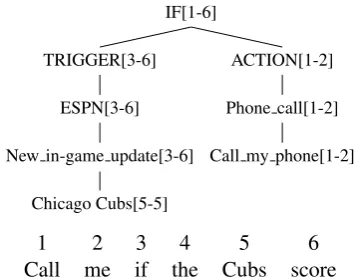
We define a semantic derivation D of a natu-ral language sentenceEas a program AST where each production in the AST is augmented with a span. The substrings covered by the children of a production must not overlap, and the substring covered by the parent must be the concatenation of the substrings covered by the children. Figure 2 shows a sample semantic derivation.
2We have a preference for log-linear models given their robustness to hyperparameter settings, ease of optimization, and flexible incorporation of features. An SVM trained with similar features should have similar performance, though.
IF[1-6]
ACTION[1-2]
Phone call[1-2]
Call my phone[1-2] TRIGGER[3-6]
ESPN[3-6]
New in-game update[3-6]
Chicago Cubs[5-5]
1 2 3 4 5 6
[image:5.595.326.504.63.203.2]Call me if the Cubs score
Figure 2: An example training pair with its semantic deriva-tion. Note the correspondence between formal language and natural language denoted with indices and spans.
The core components of KRISP are string-kernel classifiers P(r, i..j|E) denoting the probability that a production r in the AST covers the span of wordsi..j in the sentence E. Here, i < j are positions in the sentence indicating the span of tokens most relevant to this production. In other words, the substringE[i..j]denotes the production
rwith probabilityP(r, i..j|E). The probability of a semantic derivationDis defined as follows:
P(D|E) = Y
(r,i..j)∈D
P(r, i..j|E)
That is, we assume that each production is indepen-dent of all others, and is conditioned only on the string to which it is aligned. This can be seen as a refinement of the above production classification approach using a notion of correspondence.
Rather than using string kernels, we use logis-tic regression classifiers with word unigram, word bigram, and character trigram features. Unlike KRISP, we include features from both inside and outside the substring. Consider the production “Phone call→Call my phone” with span 1-2 from Figure 2. Word unigram features indicate that “call” and “me” are inside the span; the remaining words are outside the span. Word bigram features indicate that “call me” is inside the span, “me if” is on the boundary of the span, and all remaining bigrams are outside the span.
4.4.1 Training
to the set of positive instances. Otherwise, it is added to the set of negative instances, and the best derivation constrained to match the gold standard AST is found and added to the positive instances. Given this revised training data, the classifiers are retrained. After each pass through the training data, we evaluate the current model on the development set. This procedure is repeated until development-set performance begins to fall.
4.4.2 Inference
To find the most probable derivation according to the grammar, KRISP uses a variation on Earley parsing. This is similar to the inference method from Section 4.3.2, but each item now additionally maintains a position and a span. Inference proceeds left-to-right through the source string. The natural language may present information in a different order than the formal language, so all permutations of rules are considered during inference.
We found this inference procedure to be quite slow for larger data sets, especially because wide beams were needed to prevent search failure. To speed up inference, we used scores from the position-independent classifiers as completion-cost estimates.
The completion-cost estimate for a given sym-bol is defined recursively. Terminals have a cost of zero. Productions have a completion cost of the log probability of the production given the sentence, plus the completion cost of all non-terminal sym-bols. The completion cost for a non-terminal is the max cost of any production rooted in that non-terminal. Computing this cost requires traversing all productions in the grammar for each sentence.
Given a partial hypothesis, we use exact scores for the left-corner subtree that has been fully con-structed, and completion estimates for all the sym-bols and productions whose left and right spans are not yet fully instantiated.
5 Experimental Evaluation
Next we evaluate the accuracy of these approaches. The 114,408 recipes described in Section 3 were first cleaned and tokenized. We kept only one recipe per unique description, after mapping to low-ercase and normalizing punctuation.3 Finally the
recipes were split by author, randomly assigning each to training, development, or test, to prevent
3We found many recipes with the same description, likely copies of some initial recipe made by different users. We selected one representative using a deterministic heuristic.
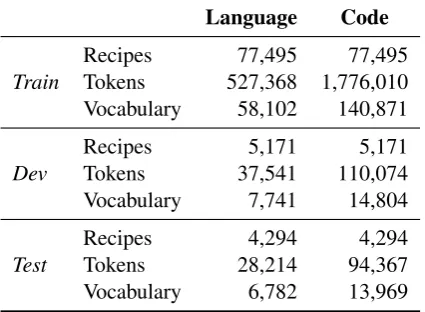
Language Code Recipes 77,495 77,495 Train Tokens 527,368 1,776,010 Vocabulary 58,102 140,871
Recipes 5,171 5,171
Dev Tokens 37,541 110,074 Vocabulary 7,741 14,804
Recipes 4,294 4,294
[image:6.595.311.524.64.220.2]Test Tokens 28,214 94,367 Vocabulary 6,782 13,969
Table 1: Statistics of the data after cleaning and separating into training, development, and test sets. In each case, the number of recipes, tokens (including punctuation, etc.) and vocabulary size are included.
overfitting to the linguistic style of a particular au-thor. Table 1 presents summary statistics for the resulting data.
Although certain trigger-action pairs occur much more often than others, the recipes in this data are quite diverse. The top 10 trigger-action pairs account for 14% of the recipes; the top 100 account for 37%; the top 1000 account for 72%.
5.1 Metrics
To evaluate system performance, several different measures are employed. Ideally a system would output exactly the correct abstract syntax tree. One measure is to count the number of exact matches, though almost all methods receive a score of 0.4
Alternatively, we can look at the AST as a set of productions, computing balanced F-measure. This is a much more forgiving measure, giving partial credit for partially correct results, though it has the caveat that all errors are counted equally.
Correctly assigning the trigger and action is the most important, especially because some of the pa-rameter values are tailored for particular users. For example, “turn off my lights when I leave home” requires a “home” location, which varies for each user. Therefore, we also measure accuracy at iden-tifying the correct trigger and action, both at the channel and function level.
5.2 Human comparison
One remaining difficulty is that multiple programs may be equally correct. Some descriptions are very difficult to interpret, even for humans. Second,
multiple channels may provide similar functional-ity: both Phillips Hue and WeMo channels provide the ability to turn on lights. Even a well-authored description may not clarify which channel should be used. Finally, many descriptions are underspec-ified. For instance, the description “notify me if it rains” does not specify whether the user should receive an Android notification, an iOS notification, an email, or an SMS. This is difficult to capture with an automatic metric.
To address the prevalence and impact of under-specification and ambiguity in descriptions, we asked humans to perform a very similar task. Human annotators on Amazon Mechanical Turk (“turkers”) were presented with recipe descriptions and asked to identify the correct channel and func-tion (but not parameters). Turkers received careful instructions and several sample description-recipe pairs, then were asked to specify the best recipe for each input. We requested they try their best to find an action and a trigger even when presented with vague or ambiguous descriptions, but they could tag inputs as ‘unintelligible’ if they were unable to make an educated guess. Turkers created recipes only for English descriptions, applying the label ’non-English’ otherwise. Five recipes were
gath-ered for each description. The resulting recipes are not exactly gold, as they have limited training at the task. However, we imposed stringent qualification requirements to control the annotation quality.5
Our workers were in fair agreement with one an-other and the gold standard, producing high quality annotation at wages calibrated to local minimum wage. We measure turker agreement with Krippen-dorff’sα(Krippendorff, 1980), which is a statis-tical measure of agreement between any number of coders. Unlike Cohen’sκ(Cohen, 1960), theα
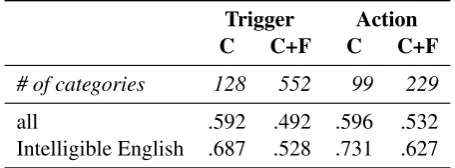
statistic does not require that coders be the same for each unit of analysis. This property is particularly desirable in our case, since turkers generally differ across HITs. A value ofα = 1indicates perfect agreement, whileα ≤ 0suggests the absence of agreement or systematic disagreement. Agreement measures on the Mechanical Turk data are shown in Table 2. This shows encouraging levels of agree-ment for both the trigger and the action, especially considering the large number of categories. Krip-pendorff (1980) advocates a 0.67 cutoff to allow
5Turkers must have 95% HIT approval rating and be native speakers of English (As an approximation of the latter, we required Turkers be from the U.S.). Manual inspection of an-notation on a control set drawn from the training data ensured there was no apparent spam.
Trigger Action
C C+F C C+F
# of categories 128 552 99 229
all .592 .492 .596 .532
[image:7.595.305.533.64.148.2]Intelligible English .687 .528 .731 .627
Table 2: Annotator agreement as measured by Krippendorff’s αcoefficient (Krippendorff, 1980). Agreement is measured on either channel (C) or channel and function (C+F), and on either the full test set (4294 recipes) or its English and intelligible subset (2262 recipes).
“tentative conclusion” of agreement, and turkers are relatively close to that level for both trigger and action channels. However, it is important to note that the coding scheme used by turkers is not mutu-ally exclusive, as several triggers and actions (e.g., “SMS” vs. “Android SMS” actions) accomplish similar effects. Thus, our levels of agreement are likely to be greater than suggested by measures in the table. Finally, we also measured agreement on the English and intelligible subset of the data, as we found that confusion between the two labels “non-English” and “unintelligible” was relatively high. As shown in the table, this substantially increased levels of agreement, up to the point whereα for both trigger and action channels are above the 0.67 cutoff drawing tentative conclusion of agreement.
5.3 Systems and baselines
deriva-tion structure from the data.
The human annotations are used to establish the mturkhuman-performance baseline by taking the majority selection of the trigger and action over 5 HITs for each description and comparing the result to the gold standard. Theoracleturk human-performance baseline shows how often at least one of the turkers agreed with the gold standard.
In addition, we evaluated all systems on a sub-set of the test data where at least three human-generated recipes agreed with the gold standard. This subset represents those programs that are easily reproducible by human workers. A good method should strive to achieve 100% accuracy on this set, and we should perhaps not be overly concerned about the remaining examples where humans disagree about the correct interpretation.
5.4 Results and discussion
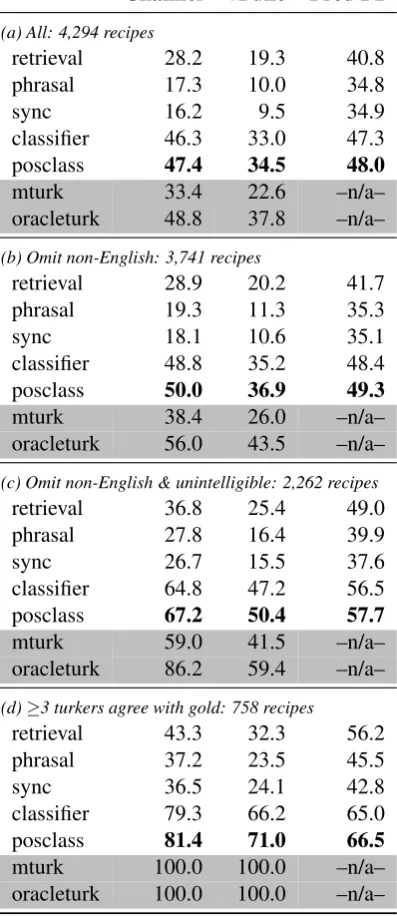
Table 3 summarizes the main evaluation results. Most of the measures are in concordance.
Interestingly, retrieval outperforms the phrasal MT baseline. With a sufficiently long phrase limit, phrasal MT approaches retrieval, but with a few crucial differences. First, phrasal requires an exact match of some substring of the input to some sub-string of the training data, where retrieval can skip over words. Second, the phrases are heavily depen-dent on word alignment; we find the word align-ment techniques struggle with the noisy IFTTT descriptions. Sync performs similarly to phrasal. The underspecified descriptions challenge assump-tions in synchronous grammars: much of the target structure is implied rather than stated.
In contrast, the classification method performs quite well. Some productions may be very likely given a prior alone, or may be inferred given other productions and the need for a well-formed deriva-tion. Augmenting this information with positional information as in posclass can help with the attri-bution problem. Consider the input “Download Facebook Photos you’re tagged in to Dropbox”: we would like the token “Facebook” to invoke only the trigger, not the action. We believe further gains could come from better modeling of the correspon-dence between derivation and natural language.
We find that semantic parsing systems have ac-curacy nearly as high or even higher than turkers in certain conditions. There are several reasons for this. First, many of the channels overlap in func-tionality (Gmail vs. email, or Android SMS vs. SMS); likewise functions may be very closely
re-Channel +Func Prod F1 (a) All: 4,294 recipes
retrieval 28.2 19.3 40.8
phrasal 17.3 10.0 34.8
sync 16.2 9.5 34.9
classifier 46.3 33.0 47.3 posclass 47.4 34.5 48.0
mturk 33.4 22.6 –n/a–
oracleturk 48.8 37.8 –n/a– (b) Omit non-English: 3,741 recipes
retrieval 28.9 20.2 41.7
phrasal 19.3 11.3 35.3
sync 18.1 10.6 35.1
classifier 48.8 35.2 48.4 posclass 50.0 36.9 49.3
mturk 38.4 26.0 –n/a–
oracleturk 56.0 43.5 –n/a– (c) Omit non-English & unintelligible: 2,262 recipes
retrieval 36.8 25.4 49.0
phrasal 27.8 16.4 39.9
sync 26.7 15.5 37.6
classifier 64.8 47.2 56.5 posclass 67.2 50.4 57.7
mturk 59.0 41.5 –n/a–
oracleturk 86.2 59.4 –n/a– (d)≥3 turkers agree with gold: 758 recipes
retrieval 43.3 32.3 56.2
phrasal 37.2 23.5 45.5
sync 36.5 24.1 42.8
[image:8.595.317.516.76.535.2]classifier 79.3 66.2 65.0 posclass 81.4 71.0 66.5 mturk 100.0 100.0 –n/a– oracleturk 100.0 100.0 –n/a–
Table 3: Evaluation results. The first column measures how often the channels are selected correctly for both trigger and action (e.g. Android Phone Call and Google Drive in Fig-ure 1). The next column measFig-ures how oftenboththe channel andfunction are correctly selected for both trigger and ac-tion (e.g. Android Phone Call::Any phone call missed and Google Drive::Add row to spreadsheet). The last column shows balanced F-measure against the gold tree over all pro-ductions in the proposed derivation, from the root production down to the lowest parameter. We show results on (a) the full test data; (b) omitting descriptions marked as non-English by a majority of the crowdsourced workers; (c) omitting de-scriptions marked as either non-English or unintelligible by the crowd; and (d) only recipes where at least three of five workers agreed with the gold standard.
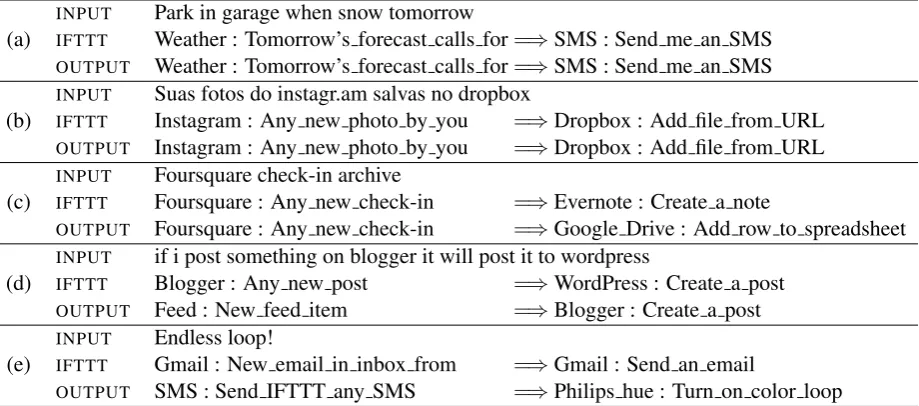
INPUT Park in garage when snow tomorrow
(a) IFTTT Weather : Tomorrow’s forecast calls for=⇒SMS : Send me an SMS OUTPUT Weather : Tomorrow’s forecast calls for=⇒SMS : Send me an SMS INPUT Suas fotos do instagr.am salvas no dropbox
(b) IFTTT Instagram : Any new photo by you =⇒Dropbox : Add file from URL OUTPUT Instagram : Any new photo by you =⇒Dropbox : Add file from URL INPUT Foursquare check-in archive
(c) IFTTT Foursquare : Any new check-in =⇒Evernote : Create a note
OUTPUT Foursquare : Any new check-in =⇒Google Drive : Add row to spreadsheet INPUT if i post something on blogger it will post it to wordpress
(d) IFTTT Blogger : Any new post =⇒WordPress : Create a post OUTPUT Feed : New feed item =⇒Blogger : Create a post INPUT Endless loop!
(e) IFTTT Gmail : New email in inbox from =⇒Gmail : Send an email
[image:9.595.75.535.64.267.2]OUTPUT SMS : Send IFTTT any SMS =⇒Philips hue : Turn on color loop
Table 4: Example output from the posclass system. For each input instance, we show the original query, the recipe originally authored through IFTTT, and our system output. Instance (a) demonstrates a case where the correct program is produced even though the input is rather tricky. Even the Portuguese query of (b) is correctly predicted, though keywords help here. In instance (c), the query is underspecified, and the system predicts that archiving should be done in Google Drive rather than evernote. Instance (d) shows how we sometimes confuse the trigger and action. Certain queries, such as (e), would require very deep inference: the IFTTT recipe sets up an endless email loop, where our system assembles a strange interpretation based on keyword match.
instance, more effectively break such ties by learn-ing a prior over which channels are more likely. Turkers, on the other hand, have neither specific training at this job nor a background corpus and more frequently disagree with the gold standard. Second, there are a number of non-English and unintelligible descriptions. Although the turkers were asked to skip these sentences, the machine-learning systems may still correctly predict the channel and action, since the training set also con-tains non-English and cryptic descriptions. For the cases where humans agree with each other and with the gold standard, the best automated system (posclass) does fairly well, getting 81% channel and 71% function accuracy.
Table 4 has some sample outputs from the posclass system, showing both examples where the system is effective and where it struggles to find the intended interpretation.
6 Conclusions
The primary goal of this paper is to highlight a new application and dataset for semantic pars-ing. Although if-this-then-that recipes have a lim-ited structure, many potential recipes are possible. This is a small step toward broad program synthe-sis from natural language, but is driven by real user data for modern hi-tech applications. To en-courage further exploration, we are releasing the
URLs of recipes along with turker annotations at http://research.microsoft.com/lang2code/.
The best performing results came from a loosely synchronous approach. We believe this is a very promising direction: most work inspired by pars-ing or machine translation has assumed a strong connection between the description and the opera-ble semantic representation. In practical situations, however, many elements of the semantic representa-tion may only be implied by the descriprepresenta-tion, rather than explicitly stated. As we tackle domains with greater complexity, identifying implied but neces-sary information will be even more important.
Underspecified descriptions open up new inter-face possibilities as well. This paper considered only single-turn interactions, where the user de-scribes a request and the system responds with an interpretation. An important next step would be to engage the user in an interactive dialogue to confirm and refine the user’s intent and develop a fully-functional correct program.
Acknowledgments
References
Jacob Andreas, Andreas Vlachos, and Stephen Clark. 2013. Semantic parsing as machine translation. In
Proceedings of the 51st Annual Meeting of the As-sociation for Computational Linguistics (Volume 2: Short Papers), pages 47–52, Sofia, Bulgaria, August. Association for Computational Linguistics.
Jonathan Berant, Andrew Chou, Roy Frostig, and Percy Liang. 2013. Semantic parsing on Freebase from question-answer pairs. In Proceedings of Confer-ence on Empirical Methods in Natural Language Processing (EMNLP-13).
Taylor Berg-Kirkpatrick, Alexandre Bouchard-Cˆot´e, John DeNero, and Dan Klein. 2010. Painless un-supervised learning with features. In Human Lan-guage Technologies: The 2010 Annual Conference of the North American Chapter of the Association for Computational Linguistics, pages 582–590, Los Angeles, California, June. Association for Computa-tional Linguistics.
S.R.K. Branavan, Harr Chen, Luke S. Zettlemoyer, and Regina Barzilay. 2009. Reinforcement learning for mapping instructions to actions. InJoint Conference of the 47th Annual Meeting of the Association for Computational Linguistics and the 4th International Joint Conference on Natural Language Processing of the Asian Federation of Natural Language Pro-cessing (ACL-IJCNLP), Singapore.
David Chiang. 2005. A hierarchical phrase-based model for statistical machine translation. In Pro-ceedings of the 43nd Annual Meeting of the Asso-ciation for Computational Linguistics (ACL), pages 263–270, Ann Arbor, MI.
J. Cohen. 1960. A coefficient of agreement for nomi-nal scales. Educational and Psychological Measure-ment, 20(1):37 – 46.
Michel Galley, Jonathan Graehl, Kevin Knight, Daniel Marcu, Steve DeNeefe, Wei Wang, and Ignacio Thayer. 2006. Scalable inference and training of context-rich syntactic translation models. In Pro-ceedings of the 21st International Conference on Computational Linguistics and 44th Annual Meet-ing of the Association for Computational LMeet-inguistics (COLING/ACL), pages 961–968, Sydney, Australia, July.
Sumit Gulwani and Mark Marron. 2014. Nlyze: Inter-active programming by natural language for spread-sheet data analysis and manipulation. InSIGMOD.
Rohit J. Kate and Raymond J. Mooney. 2006. Us-ing strUs-ing-kernels for learnUs-ing semantic parsers. In
Proceedings of the 21st International Conference on Computational Linguistics and 44th Annual Meet-ing of the Association for Computational LMeet-inguistics, pages 913–920, Sydney, Australia, July. Association for Computational Linguistics.
R. J. Kate, Y. W. Wong, and R. J. Mooney. 2005. Learning to transform natural to formal languages. In Proceedings of the Twentieth National Confer-ence on Artificial IntelligConfer-ence (AAAI-05), pages 1062–1068, Pittsburgh, PA, July.
Philipp Koehn, Franz Josef Och, and Daniel Marcu. 2003. Statistical phrase-based translation. In Pro-ceedings of the 2003 Conference of the North Amer-ican Chapter of the Association for Computational Linguistics on Human Language Technology - Vol-ume 1, NAACL ’03, pages 48–54, Stroudsburg, PA, USA. Association for Computational Linguistics.
Philipp Koehn, Hieu Hoang, Alexandra Birch, Chris Callison-Burch, Marcello Federico, Nicola Bertoldi, Brooke Cowan, Wade Shen, Christine Moran, Richard Zens, Chris Dyer, Ondrej Bojar, Alexan-dra Constantin, and Evan Herbst. 2007. Moses: Open source toolkit for statistical machine transla-tion. InAnnual Meeting of the Association for Com-putational Linguistics (ACL), demonstration session, Prague, Czech Republic, June.
Klaus Krippendorff. 1980. Content Analysis: an In-troduction to its Methodology. Sage Publications, Beverly Hills, CA.
Vu Le, Sumit Gulwani, and Zhendong Su. 2013. Smartsynth: Synthesizing smartphone automation scripts from natural language. InMobiSys.
Greg Little and Robert C. Miller. 2007. Keyword pro-gramming in java. In Proceedings of the Twenty-second IEEE/ACM International Conference on Au-tomated Software Engineering, ASE ’07, pages 84– 93, New York, NY, USA. ACM.
Huma Lodhi, Craig Saunders, John Shawe-Taylor, Nello Cristianini, and Chris Watkins. 2002. Text classification using string kernels. Journal of Ma-chine Learning Research, 2:419–444.
Franz Josef Och, Christoph Tillmann, and Hermann Ney. 1999. Improved alignment models for statisti-cal machine translation. InProc. of the Conference on Empirical Methods in Natural Language Process-ing and Very Large Corpora, pages 20–28, Univer-sity of Maryland, College Park, MD, June.
Yuk Wah Wong and Raymond Mooney. 2006. Learn-ing for semantic parsLearn-ing with statistical machine translation. InProceedings of the Human Language Technology Conference of the NAACL, Main Confer-ence, pages 439–446, New York City, USA, June. Association for Computational Linguistics.
Yuk Wah Wong and Raymond J. Mooney. 2007b. Learning synchronous grammars for semantic pars-ing with lambda calculus. In Proceedings of the 45th Annual Meeting of the Association for Compu-tational Linguistics (ACL), pages 960–967, Prague, Czech Republic, June.
William A. Woods. 1977. Lunar rocks in natural English: Explorations in natural language question answering. In Antonio Zampoli, editor, Linguistic Structures Processing. Elsevier North-Holland, New York.
Dekai Wu. 1997. Stochastic inversion transduction grammars and bilingual parsing of parallel corpora.
Computational Linguistics, 23(3):377–403.
John M. Zelle and Raymond J. Mooney. 1996. Learn-ing to parse database queries usLearn-ing inductive logic programming. InProceedings of the Thirteenth Na-tional Conference on Artificial Intelligence (AAAI-96), pages 1050–1055, Portland, OR, August. Luke S. Zettlemoyer and Michael Collins. 2005.