6033
Unsupervised Paraphrasing without Translation
Aurko Roy Google Research
David Grangier Google Research
Abstract
Paraphrasing exemplifies the ability to abstract semantic content from surface forms. Recent work on automatic paraphrasing is dominated by methods leveraging Machine Translation (MT) as an intermediate step. This contrasts with humans, who can paraphrase without be-ing bilbe-ingual. This work proposes to learn paraphrasing models from an unlabeled mono-lingual corpus only. To that end, we propose a residual variant of vector-quantized variational auto-encoder.
We compare with MT-based approaches on paraphrase identification, generation, and training augmentation. Monolingual para-phrasing outperforms unsupervised translation in all settings. Comparisons with supervised translation are more mixed: monolingual para-phrasing is interesting for identification and augmentation; supervised translation is supe-rior for generation.
1 Introduction
Many methods have been developed to generate paraphrases automatically (Madnani and J. Dorr,
2010). Approaches relying on Machine Transla-tion (MT) have proven popular due to the scarcity of labeled paraphrase pairs (Callison-Burch,2007;
Mallinson et al.,2017;Iyyer et al.,2018). Recent progress in MT with neural methods (Bahdanau et al.,2014;Vaswani et al.,2017) has popularized this latter strategy. Conceptually, translation is ap-pealing since it abstracts semantic content from its linguistic realization. For instance, assigning the same source sentence to multiple translators will result in a rich set of semantically close sen-tences (Callison-Burch,2007). At the same time, bilingualism does not seem necessary to humans to generate paraphrases.
This work evaluates if data in two languages is necessary for paraphrasing. We consider three
settings: supervised translation (parallel bilin-gual data is used), unsupervised translation (non-parallel corpora in two languages are used) and monolingual (only unlabeled data in the para-phrasing language is used). Our comparison devises comparable encoder-decoder neural net-works for all three settings. While the litera-ture on supervised (Bahdanau et al., 2014; Cho et al., 2014; Vaswani et al., 2017) and unsuper-vised translation (Lample et al., 2018a; Artetxe et al., 2018; Lample et al., 2018b) offer solu-tions for the bilingual settings, monolingual neural paraphrase generation has not received the same attention.
We consider discrete and continuous auto-encoders in an unlabeled monolingual setting, and contribute improvements in that context. We in-troduce a model based on Vector-Quantized Auto-Encoders, VQ-VAE (van den Oord et al., 2017), for generating paraphrases in a purely monolin-gual setting. Our model introduces residual con-nections parallel to the quantized bottleneck. This lets us interpolate from classical continuous auto-encoder (Vincent et al.,2010) to VQ-VAE. Com-pared to VQ-VAE, our architecture offers a better control over the decoder entropy and eases opti-mization. Compared to continuous auto-encoder, our method permits the generation of diverse, but semantically close sentences from an input sen-tence.
to purely monolingual training.
2 Related Work
Paraphrase GenerationParaphrases express the same content with alternative surface forms. Their automatic generation has been studied for decades: rule-based (McKeown,1980;Meteer and Shaked, 1988) and data-driven methods ( Mad-nani and J. Dorr, 2010) have been explored. Data-driven approaches have considered different source of training data, including multiple trans-lations of the same text (Barzilay and McKeown,
2001; Pang et al., 2003) or alignments of com-parable corpora, such as news from the same pe-riod (Dolan et al.,2004;Barzilay and Lee,2003).
Machine translation later emerged as a domi-nant method for paraphrase generation. Bannard and Callison-Burch(2005) identify equivalent En-glish phrases mapping to the same non-EnEn-glish phrases from an MT phrase table.Kok and Brock-ett (2010) performs random walks across multi-ple phrase tables. Translation-based paraphrasing has recently benefited from neural networks for MT (Bahdanau et al.,2014;Vaswani et al.,2017). Neural MT can generate paraphrase pairs by trans-lating one side of a parallel corpus (Wieting and Gimpel,2018;Iyyer et al.,2018). Paraphrase gen-eration with pivot/round-trip neural translation has also been used (Mallinson et al., 2017;Yu et al.,
2018).
Although less common, monolingual neural se-quence models have also been proposed. In su-pervised settings, Prakash et al. (2016); Gupta et al. (2018) learn sequence-to-sequence models on paraphrase data. In unsupervised settings,
Bowman et al.(2016) apply a VAE to paraphrase detection whileLi et al.(2017) train a paraphrase generator with adversarial training.
Paraphrase Evaluation Evaluation can be per-formed by human raters, evaluating both text flu-ency and semantic similarity. Automatic evalu-ation is more challenging but necessary for sys-tem development and larger scale statistical anal-ysis (Callison-Burch,2007;Madnani and J. Dorr,
2010). Automatic evaluation and generation are actually linked: if an automated metric would reli-ably assess the semantic similarity and fluency of a pair of sentences, one would generate by search-ing the space of sentences to maximize that met-ric. Automated evaluation can report the over-lap with a reference paraphrase, like for
transla-tion (Papineni et al.,2002) or summarization (Lin,
2004). BLEU, METEOR and TER metrics have been used (Prakash et al., 2016; Gupta et al.,
2018). These metrics do not evaluate whether the generated paraphrase differs from the input sen-tence and large amount of input copying is not penalized. Galley et al. (2015) compare over-lap with multiple references, weighted by qual-ity; whileSun and Zhou(2012) explicitly penalize overlap with the input sentence.Grangier and Auli
(2018) alternatively compare systems which have first been calibrated to a reference level of overlap with the input. We follow this strategy and cali-brate the generation overlap to match the average overlap observed in paraphrases from humans.
In addition to generation, probabilistic mod-els can be assessed through scoring. For a sen-tence pair(x, y), the model estimate ofP(y|x)can be used to discriminate between paraphrase and non-paraphrase pairs (Dolan and Brockett,2005). The correlation of model scores with human judg-ments (Cer et al.,2017) can also be assessed. We report both types of evaluation.
Finally, paraphrasing can also impact down-stream tasks, e.g. to generate additional training data by paraphrasing training sentences (Marton et al., 2009; Zhang et al., 2015; Yu et al., 2018). We evaluate this impact for classification tasks.
3 Residual VQ-VAE for Unsupervised Monolingual Paraphrasing
Auto-encoders can be applied to monolingual
paraphrasing. Our work combines
connection around the quantization module. We modify the Transformer encoder (Vaswani et al.,2017) as depicted in Figure1. Our encoder maps a sentence into a fixed size vector. This is simple and avoids choosing a fixed length com-pression rate between the input and the latent rep-resentation (Kaiser et al.,2018). Our strategy to produce a fixed sized representation from trans-former is analogous to the special token employed for sentence classification in (Devlin et al.,2018). At the first layer, we extend the input sequences with one or more fixed positions which are part of the self-attention stack. At the output layer, the encoder output is restricted to these special po-sitions which constitute the encoder fixed sized-output. As in (Kaiser et al.,2018), this vector is split into multiple heads (sub-vectors of equal di-mensions) which each goes through a quantization module. For each headh, the encoder outputehis
quantized as,
qh(eh) =ck, wherek= argmin i
keh−cik2
where{ci}K
i=0denotes the codebook vectors. The codebook is shared across heads and training com-bines straight-through gradient estimation and ex-ponentiated moving averages (van den Oord et al.,
2017). The quantization module is completed with a residual connection, with a learnable weightα,
zh(eh) =αeh+ (1−α)qh(eh).One can observe
that residual vectors and quantized vectors always have similar norms by definition of the VQ mod-ule. This is a fundamental difference with classi-cal continuous residual networks, where the net-work can reduce activation norms of some mod-ules to effectively rely mostly on the residual path. This makesαan important parameter to trade-off continuous and discrete auto-encoding. Our learn-ing encourages the quantized path with a squared penaltyα2.
After residual addition, the multiple heads of the resulting vector are presented as a matrix to which a regular transformer decoder can attend. Models are trained to maximize the likelihood of the training set with Adam optimizer using the learning schedule from (Vaswani et al.,2017).
4 Experiments & Results
We compare neural paraphrasing with and with-out access to bilingual data. For bilingual set-tings, we consider supervised and unsupervised translation using round-trip translation (Mallinson
Token + Position Embeddings Fixed Position
Embeddings
Self Attention N Quantization
Self Attention 1 Fixed Truncated
[image:3.595.328.508.64.239.2]Encoding
Figure 1: Encoder Architecture
et al., 2017;Yu et al., 2018) with German as the pivot language. Supervised translation trains the transformer base model (Vaswani et al.,2017) on the WMT’17 English-German parallel data ( Bo-jar et al., 2017). Unsupervised translation con-siders a pair of comparable corpora for training, German and English WMT-Newscrawl corpora, and relies on the transformer models from Lam-ple et al. (2018b). Both MT cases train a model from English to German and from German to En-glish to perform round-trip MT. For each model, we also distill the round-trip model into a single artificial English to English model by generating a training set from pivoted data. Distillation relies on the billion word corpus, LM1B (Chelba et al.,
2013).
Monolingual Residual VQ-VAE is trained only on LM1B withK = 216, with2 heads and fixed window of size 16. We also evaluate plain VQ-VAEα = 0to highlight the value of our residual modification. We further compare with a monolin-gual continuous denoising auto-encoder (DN-AE), with noising fromLample et al.(2018b).
Paraphrase Identification For classification of sentence pairs (x, y) over Microsoft Research Paraphrase Corpus (MRPC) from Dolan and Brockett (2005), we train logistic regression on
P(y|x) and P(x|y) from the model, comple-mented with encoder outputs in fixed context set-tings. We also perform paraphrase quality regres-sion on Semantic Textual Similarity (STS) from
Cer et al. (2017) by training ridge regression on the same features.
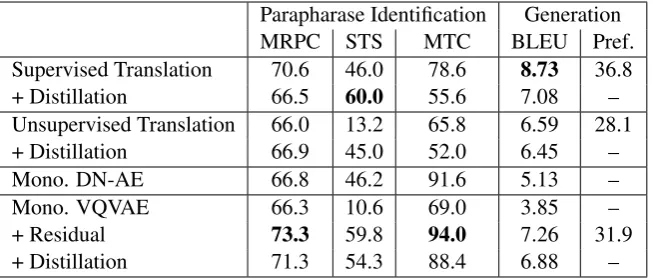
Parapharase Identification Generation
MRPC STS MTC BLEU Pref.
Supervised Translation 70.6 46.0 78.6 8.73 36.8
+ Distillation 66.5 60.0 55.6 7.08 –
Unsupervised Translation 66.0 13.2 65.8 6.59 28.1
+ Distillation 66.9 45.0 52.0 6.45 –
Mono. DN-AE 66.8 46.2 91.6 5.13 –
Mono. VQVAE 66.3 10.6 69.0 3.85 –
+ Residual 73.3 59.8 94.0 7.26 31.9
[image:4.595.137.464.62.201.2]+ Distillation 71.3 54.3 88.4 6.88 –
Table 1: Paraphrase Identification & Generation. Identification is evaluated with accuracy on MRPC, Pearson Correlation on STS and ranking on MTC. Generation is evaluated with BLEU and human preferences on MTC.
SST-2 TREC
Acc. F1 Acc F1
NB-SVM (trigram) 81.93 83.15 89.77 84.81
Supervised Translation 81.55 82.75 90.78 85.44
+ Distillation 81.16 66.59 90.38 86.05
Unsupervised Translation 81.87 83.18 88.17 83.42
+ Distillation 81.49 82.78 89.18 84.41
Mono. DN-AE 81.11 82.48 89.37 84.08
Mono. VQ-VAE 81.98 82.95 89.17 83.64
+ Residual 82.12 83.23 89.98 84.31
[image:4.595.165.436.245.399.2]+ Distillation 81.60 82.81 89.78 84.31
Table 2: Paraphrasing for Data Augmentation: Accuracy and F1-scores of a Naive Bayes-SVM classifier on sentiment (SST-2) and question (TREC) classification.
(2002). MTC contains English paraphrases col-lected as translations of the same Chinese sen-tences from multiple translators (Mallinson et al.,
2017). We pair each MTC sentence x with a paraphrase y and 100 randomly chosen non-paraphrasesy0. We compare the paraphrase score
P(y|x)to the100non-paraphrase scoresP(y0|x)
and report the fraction of comparisons where the paraphrase score is higher.
Table 1 (left) reports that our residual model outperforms alternatives in all identification set-ting, except for STS, where our Pearson correla-tion is slightly under supervised translacorrela-tion.
Paraphrases for Data Augmentation We aug-ment the training set of text classification tasks for sentiment analysis on Stanford Sentiment Tree-bank (SST-2) (Socher et al., 2013) and ques-tion classificaques-tion on Text REtrieval Conference (TREC) (Voorhees and Tice,2000). In both cases, we double training set size by paraphrasing each sentence and train Support Vector Machines with Naive Bayes features (Wang and Manning,2012). In Table 2, augmentation with monolingual
models yield the best performance for SST-2 sen-timent classification. TREC question classifica-tion is better with supervised translaclassifica-tion augmen-tation. Unfortunately, our monolingual training set LM1B does not contain many question sentences. Future work will revisit monolingual training on larger, more diverse resources.
Paraphrase Generation Paraphrase generation are evaluated on MTC. We select the 4 best trans-lators according to MTC documentation and para-phrase pairs with a length ratio under 1.2. Our evaluation prevents trivial copying solutions. We select sampling temperature for all models such that their generation overlap with the input is 20.9 BLEU, the average overlap between humans on MTC. We report BLEU overlap with the target and run a blind human evaluation where raters pick the best generation among supervised translation, un-supervised translation and monolingual.
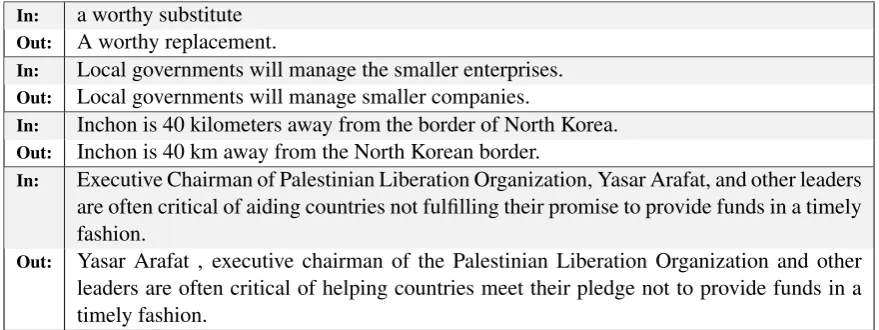
high-In: a worthy substitute Out: A worthy replacement.
In: Local governments will manage the smaller enterprises. Out: Local governments will manage smaller companies.
In: Inchon is 40 kilometers away from the border of North Korea.
Out: Inchon is 40 km away from the North Korean border.
In: Executive Chairman of Palestinian Liberation Organization, Yasar Arafat, and other leaders are often critical of aiding countries not fulfilling their promise to provide funds in a timely fashion.
[image:5.595.79.519.62.227.2]Out: Yasar Arafat , executive chairman of the Palestinian Liberation Organization and other leaders are often critical of helping countries meet their pledge not to provide funds in a timely fashion.
Table 3: Examples of generated paraphrases from the monolingual residual model (Greedy search).
lights the value of parallel data for paraphrase gen-eration.
5 Discussions
Our experiments highlight the importance of the residual connection for paraphrase identifica-tion. From Table 1, we see that a model with-out the residual connection obtains66.3%,10.6%
and 69.0% accuracy on MRPC, STS and MTC. Adding the residual connection improves this to
73.3%,59.8%and94.0%respectively.
The examples in Table3show paraphrases gen-erated by the model. The overlap with the input from these examples is high. It is possible to gen-erate sentences with less overlap at higher sam-pling temperatures, we however observe that this strategy impairs fluency and adequacy. We plan to explore strategies which allow to condition the de-coding process on an overlap requirement instead of varying sampling temperatures (Grangier and Auli,2018).
6 Conclusion
We compared neural paraphrasing with and with-out access to bilingual data. Bilingual settings considered supervised and unsupervised trans-lation. Monolingual settings considered auto-encoders trained on unlabeled text and introduced continuous residual connections for discrete auto-encoders. This method is advantageous over both discrete and continuous auto-encoders. Overall, we showed that monolingual models can outper-form bilingual ones for paraphrase identification and data-augmentation through paraphrasing. We also reported that generation quality from mono-lingual models can be higher than model based on
unsupervised translation but not supervised trans-lation. Access to parallel data is therefore still advantageous for paraphrase generation and our monolingual method can be a helpful resource for languages where such data is not available.
Acknowledgments
We thanks the anonymous reviewers for their suggestions. We thank the authors of the Tensor2tensor library used in our experi-ments (Vaswani et al.,2018).
References
Mikel Artetxe, Gorka Labaka, Eneko Agirre, and Kyunghyun Cho. 2018. Unsupervised neural ma-chine translation. InProceedings of the Sixth
Inter-national Conference on Learning Representations.
Dzmitry Bahdanau, Kyunghyun Cho, and Yoshua Bengio. 2014. Neural machine translation by jointly learning to align and translate. CoRR, abs/1409.0473.
Colin Bannard and Chris Callison-Burch. 2005. Para-phrasing with bilingual parallel corpora. In Pro-ceedings of the 43rd Annual Meeting on Association
for Computational Linguistics, pages 597–604.
As-sociation for Computational Linguistics.
Regina Barzilay and Lillian Lee. 2003. Learning to paraphrase: an unsupervised approach using multiple-sequence alignment. InProceedings of the 2003 Conference of the North American Chapter of the Association for Computational Linguistics on
Human Language Technology-Volume 1, pages 16–
23. Association for Computational Linguistics.
Regina Barzilay and Kathleen R McKeown. 2001. Ex-tracting paraphrases from a parallel corpus. In Pro-ceedings of the 39th annual meeting on Association
for Computational Linguistics, pages 50–57.
Ondˇrej Bojar, Rajen Chatterjee, Christian Federmann, Yvette Graham, Barry Haddow, Shujian Huang, Matthias Huck, Philipp Koehn, Qun Liu, Varvara Logacheva, Christof Monz, Matteo Negri, Matt Post, Raphael Rubino, Lucia Specia, and Marco Turchi. 2017. Findings of the 2017 conference on machine translation (wmt17). In Proceedings of the Second Conference on Machine Translation,
Volume 2: Shared Task Papers, pages 169–214,
Copenhagen, Denmark. Association for Computa-tional Linguistics.
Samuel R. Bowman, Luke Vilnis, Oriol Vinyals, An-drew M. Dai, Rafal J´ozefowicz, and Samy Ben-gio. 2016. Generating sentences from a continuous space. InProceedings of the SIGNLL’16, pages 10– 21.
Christopher Callison-Burch. 2007. Paraphrasing and
translation. Ph.D. thesis, University of Edinburgh
Edinburgh.
Daniel Cer, Mona Diab, Eneko Agirre, Inigo Lopez-Gazpio, and Lucia Specia. 2017. Semeval-2017 task 1: Semantic textual similarity-multilingual and cross-lingual focused evaluation. arXiv preprint
arXiv:1708.00055.
Ciprian Chelba, Tomas Mikolov, Mike Schuster, Qi Ge, Thorsten Brants, Phillipp Koehn, and Tony Robin-son. 2013. One billion word benchmark for mea-suring progress in statistical language modeling. CoRR, abs/1312.3005.
Kyunghyun Cho, Bart Van Merri¨enboer, Dzmitry Bah-danau, and Yoshua Bengio. 2014. On the properties of neural machine translation: Encoder-decoder ap-proaches. arXiv preprint arXiv:1409.1259.
Jacob Devlin, Ming-Wei Chang, Kenton Lee, and Kristina Toutanova. 2018. Bert: Pre-training of deep bidirectional transformers for language understand-ing.
Bill Dolan, Chris Quirk, and Chris Brockett. 2004. Unsupervised construction of large paraphrase cor-pora: Exploiting massively parallel news sources.
InProceedings of the 20th international conference
on Computational Linguistics, page 350.
Associa-tion for ComputaAssocia-tional Linguistics.
William B Dolan and Chris Brockett. 2005. Automati-cally constructing a corpus of sentential paraphrases.
InProceedings of the Third International Workshop
on Paraphrasing (IWP2005).
Michel Galley, Chris Brockett, Alessandro Sordoni, Yangfeng Ji, Michael Auli, Chris Quirk, Mar-garet Mitchell, Jianfeng Gao, and Bill Dolan. 2015. deltableu: A discriminative metric for genera-tion tasks with intrinsically diverse targets. arXiv
preprint arXiv:1506.06863.
David Grangier and Michael Auli. 2018. Quickedit: Editing text & translations by crossing words out.
InProc. of NAACL.
Ankush Gupta, Arvind Agarwal, Prawaan Singh, and Piyush Rai. 2018. A deep generative framework for paraphrase generation. InThirty-Second AAAI
Con-ference on Artificial Intelligence.
Irina Higgins, Loic Matthey, Arka Pal, Christopher Burgess, Xavier Glorot, Matthew Botvinick, Shakir Mohamed, and Alexander Lerchner. 2016. beta-vae: Learning basic visual concepts with a constrained variational framework.
Shudong Huang, David Graff, and George Doddington. 2002. Multiple-translation Chinese corpus. Lin-guistic Data Consortium, University of Pennsylva-nia.
Mohit Iyyer, John Wieting, Kevin Gimpel, and Luke Zettlemoyer. 2018. Adversarial example generation with syntactically controlled paraphrase networks.
InProceedings of NAACL-HLT, pages 1875–1885.
Łukasz Kaiser, Aurko Roy, Ashish Vaswani, Niki Pa-mar, Samy Bengio, Jakob Uszkoreit, and Noam Shazeer. 2018. Fast decoding in sequence mod-els using discrete latent variables. arXiv preprint
arXiv:1803.03382.
Stanley Kok and Chris Brockett. 2010. Hitting the right paraphrases in good time. In Human Lan-guage Technologies: The 2010 Annual Conference of the North American Chapter of the Association
for Computational Linguistics, pages 145–153.
As-sociation for Computational Linguistics.
Guillaume Lample, Alexis Conneau, Ludovic Denoyer, and Marc’Aurelio Ranzato. 2018a. Unsupervised machine translation using monolingual corpora only.
InInternational Conference on Learning
Represen-tations (ICLR).
Guillaume Lample, Myle Ott, Alexis Conneau, Lu-dovic Denoyer, and Marc’Aurelio Ranzato. 2018b. Phrase-based & neural unsupervised machine trans-lation.arXiv preprint arXiv:1804.07755.
Zichao Li, Xin Jiang, Lifeng Shang, and Hang Li. 2017. Paraphrase generation with deep reinforce-ment learning. arXiv preprint arXiv:1711.00279.
Chin-Yew Lin. 2004. Rouge: A package for auto-matic evaluation of summaries. Text Summarization
Branches Out.
J. B. Macqueen. 1967. Unified techniques for vec-tor quantization and hidden markov modeling using semi-continuous models.
Nitin Madnani and Bonnie J. Dorr. 2010. Generat-ing phrasal and sentential paraphrases: A survey of data-driven methods.Computational Linguistics, 36:341–387.
for Computational Linguistics: Volume 1, Long Pa-pers, volume 1, pages 881–893.
Yuval Marton, Chris Callison-Burch, and Philip Resnik. 2009. Improved statistical machine trans-lation using monolingually-derived paraphrases. In Proceedings of the 2009 Conference on Empirical Methods in Natural Language Processing: Volume
1-Volume 1, pages 381–390. Association for
Com-putational Linguistics.
Kathleen R McKeown. 1980. Paraphrasing using given and new information in a question-answer system.
Technical Reports (CIS), page 723.
Marie Meteer and Varda Shaked. 1988. Strategies for effective paraphrasing. InProceedings of the 12th
conference on Computational linguistics-Volume 2,
pages 431–436. Association for Computational Lin-guistics.
A¨aron van den Oord, Oriol Vinyals, and Koray Kavukcuoglu. 2017. Neural discrete representation learning.CoRR, abs/1711.00937.
Bo Pang, Kevin Knight, and Daniel Marcu. 2003. Syntax-based alignment of multiple translations: Extracting paraphrases and generating new sen-tences. In Proceedings of the 2003 Human Lan-guage Technology Conference of the North Ameri-can Chapter of the Association for Computational
Linguistics.
Kishore Papineni, Salim Roukos, Todd Ward, and Wei-Jing Zhu. 2002. Bleu: a method for automatic eval-uation of machine translation. In Proceedings of the 40th annual meeting on association for
compu-tational linguistics, pages 311–318. Association for
Computational Linguistics.
Aaditya Prakash, Sadid A Hasan, Kathy Lee, Vivek Datla, Ashequl Qadir, Joey Liu, and Oladimeji Farri. 2016. Neural paraphrase generation with stacked residual lstm networks. arXiv preprint
arXiv:1610.03098.
Aurko Roy, Ashish Vaswani, Arvind Neelakantan, and Niki Parmar. 2018. Theory and experiments on vector quantized autoencoders. arXiv preprint
arXiv:1805.11063.
Richard Socher, Alex Perelygin, Jean Wu, Jason Chuang, Christopher D Manning, Andrew Ng, and Christopher Potts. 2013. Recursive deep models for semantic compositionality over a sentiment tree-bank. In Proceedings of the 2013 conference on
empirical methods in natural language processing,
pages 1631–1642.
Hong Sun and Ming Zhou. 2012. Joint learning of a dual smt system for paraphrase generation. In Pro-ceedings of the 50th Annual Meeting of the Associ-ation for ComputAssoci-ational Linguistics: Short
Papers-Volume 2, pages 38–42. Association for
Computa-tional Linguistics.
Ashish Vaswani, Samy Bengio, Eugene Brevdo, Fran-cois Chollet, Aidan N Gomez, Stephan Gouws, Llion Jones, Łukasz Kaiser, Nal Kalchbrenner, Niki Parmar, et al. 2018. Tensor2tensor for neural ma-chine translation. arXiv preprint arXiv:1803.07416.
Ashish Vaswani, Noam Shazeer, Niki Parmar, Jakob Uszkoreit, Llion Jones, Aidan N. Gomez, Lukasz Kaiser, and Illia Polosukhin. 2017. Attention is all you need.CoRR.
Pascal Vincent, Hugo Larochelle, Isabelle Lajoie, Yoshua Bengio, and Pierre-Antoine Manzagol. 2010. Stacked denoising autoencoders: Learning useful representations in a deep network with a local denoising criterion. Journal of Machine Learning
Research, 11:3371–3408.
Ellen M Voorhees and Dawn M Tice. 2000. Building a question answering test collection. InProceedings of the 23rd annual international ACM SIGIR confer-ence on Research and development in information
retrieval, pages 200–207. ACM.
Sida Wang and Christopher D Manning. 2012. Base-lines and bigrams: Simple, good sentiment and topic classification. In Proceedings of the 50th Annual Meeting of the Association for Computational
Lin-guistics: Short Papers-Volume 2, pages 90–94.
As-sociation for Computational Linguistics.
John Wieting and Kevin Gimpel. 2018. Paranmt-50m: Pushing the limits of paraphrastic sentence embed-dings with millions of machine translations. In Pro-ceedings of the 56th Annual Meeting of the Associa-tion for ComputaAssocia-tional Linguistics (Volume 1: Long
Papers), volume 1, pages 451–462.
Adams Wei Yu, David Dohan, Minh-Thang Luong, Rui Zhao, Kai Chen, Mohammad Norouzi, and Quoc V Le. 2018. Qanet: Combining local convolution with global self-attention for reading comprehen-sion.arXiv preprint arXiv:1804.09541.
Xiang Zhang, Junbo Zhao, and Yann LeCun. 2015. Character-level convolutional networks for text clas-sification. In Advances in neural information