Proceedings of the 55th Annual Meeting of the Association for Computational Linguistics, pages 784–792 Vancouver, Canada, July 30 - August 4, 2017. c2017 Association for Computational Linguistics Proceedings of the 55th Annual Meeting of the Association for Computational Linguistics, pages 784–792
Vancouver, Canada, July 30 - August 4, 2017. c2017 Association for Computational Linguistics
Polish evaluation dataset
for compositional distributional semantics models
Alina Wróblewska Katarzyna Krasnowska-Kiera´s
Institute of Computer Science, Polish Academy of Sciences [email protected] [email protected]
Abstract
The paper presents a procedure of building an evaluation dataset1. for the validation of compositional distributional semantics models estimated for languages other than English. The procedure generally builds on steps designed to assemble the SICK corpus, which contains pairs of English sentences annotated for semantic related-ness and entailment, because we aim at building a comparable dataset. However, the implementation of particular building steps significantly differs from the orig-inal SICK design assumptions, which is caused by both lack of necessary extra-neous resources for an investigated lan-guage and the need for lanlan-guage-specific transformation rules. The designed proce-dure is verified on Polish, a fusional lan-guage with a relatively free word order, and contributes to building a Polish evalu-ation dataset. The resource consists of 10K sentence pairs which are human-annotated for semantic relatedness and entailment. The dataset may be used for the evaluation of compositional distributional semantics models of Polish.
1 Introduction and related work
1.1 Distributional semantics
The basic idea of distributional semantics, i.e. de-termining the meaning of a word based on its co-occurrence with other words, is derived from the empiricists – Harris (1954) and Firth (1957). John R. Firth drew attention to the context-dependent nature of meaning especially with his
1The dataset is obtainable at:
http://zil.ipipan.waw.pl/Scwad/CDSCorpus
famous maxim “You shall know a word by the company it keeps” (Firth,1957, p. 11).
Nowadays, distributional semantics models are estimated with various methods, e.g. word em-bedding techniques (Bengio et al., 2003, 2006;
Mikolov et al., 2013). To ascertain the purport of a word, e.g. bath, you can use the context of other words that surround it. If we assume that the meaning of this word expressed by its lexical context is associated with a distributional vector, the distance between distributional vectors of two semantically similar words, e.g bathandshower, should be smaller than between vectors represent-ing semantically distinct words, e.g.bathandtree.
1.2 Compositional distributional semantics Based on empirical observations that distribu-tional vectors encode certain aspects of word meaning, it is expected that similar aspects of the meaning of phrases and sentences can also be represented with vectors obtained via composi-tion of distribucomposi-tional word vectors. The idea of se-mantic composition is not new. It is well known as theprinciple of compositionality:2“The mean-ing of a compound expression is a function of the meaning of its parts and of the way they are syntactically combined.” (Janssen,2012, p. 19).
Modelling the meaning of textual units larger than words using compositional and distribu-tional information is the main subject of compo-sitional distributional semantics (Mitchell and La-pata,2010;Baroni and Zamparelli,2010; Grefen-stette and Sadrzadeh,2011;Socher et al.,2012, to name a few studies). The fundamental principles of compositional distributional semantics, hence-forth referred to as CDS, are mainly propagated with papers written on the topic. Apart from the papers, it was the SemEval-2014 Shared Task 1
2As the principle of compositionality is attributed to Got-tlob Frege, it is often calledFrege’s principle.
(Marelli et al., 2014) that essentially contributed to the expansion of CDS and increased an interest in this domain. The goal of the task was to evaluate CDS models of English in terms of semantic relat-edness and entailment on proper sentences from the SICK corpus.
1.3 The SICK corpus
The SICK corpus (Bentivogli et al., 2014) con-sists of 10K pairs of English sentences contain-ing multiple lexical, syntactic, and semantic phe-nomena. It builds on two external data sources – the 8K ImageFlickr dataset (Rashtchian et al.,
2010) and SemEval-2012 Semantic Textual Simi-larity dataset (Agirre et al., 2012). Each sentence pair is human-annotated for relatedness in mean-ing and entailment.
The relatedness score corresponds to the degree of semantic relatedness between two sentences and is calculated as the average of ten human rat-ings collected for this sentence pair on the 5-point Likert scale. This score indicates the extent to which the meanings of two sentences are related.
The entailment relation between two sentences, in turn, is labelled with entailment, contradic-tion, orneutral. According to the SICK guidelines, the label assigned by the majority of human anno-tators is selected as the valid entailment label.
1.4 Motivation and organisation of the paper Studying approaches to various natural language processing (henceforth NLP) problems, we have observed that the availability of language re-sources (e.g. training or testing data) stimulates the development of NLP tools and the estimation of NLP models. English is undoubtedly the most prominent in this regard and English resources are the most numerous. Therefore, NLP methods are mostly designed for English and tested on English data, even if there is no guarantee that they are universal. In order to verify whether an NLP al-gorithm is adequate, it is not enough to evaluate it solely for English. It is also valuable to have high-quality resources for languages typologically different to English. Hence, we aim at building datasets for the evaluation of CDS models in lan-guages other than English, which are often under-resourced. We strongly believe that the availability of test data will encourage development of CDS models in these languages and allow to better test the universality of CDS methods.
We start with a high-quality dataset for Pol-ish, which is a completely different language than English in at least two dimensions. First, it is a rather under-resourced language in contrast to the resource-rich English. Second, it is a fusional language with a relatively free word order in con-trast to the isolated English with a relatively fixed word order. If some heuristics is tested on e.g. Pol-ish, the evaluation results can be approximately generalised to other Slavic languages. We hope the Slavic NLP community will be interested in de-signing and evaluating methods of semantic mod-elling for Slavic languages.
The procedure of building an evaluation dataset for validating compositional distributional seman-tics models of Polish generally builds on steps de-signed to assemble the SICK corpus (described in Section1.3) because we aim at building an eval-uation dataset which is comparable to the SICK corpus. However, the implementation of particular building steps significantly differs from the orig-inal SICK design assumptions, which is caused by both lack of necessary extraneous resources for Polish (see Section 2.1) and the need for Polish-specific transformation rules (see Section
2.2). Furthermore, the rules of arranging sentences into pairs (see Section2.3) are defined anew tak-ing into account the characteristic of data and bi-directional entailment annotations, since an entail-ment relation between two sentences must not be symmetric. Even if our assumptions of annotating sentence pairs coincide with the SICK principles to a certain extent (see Section3.1), the annotation process differs from the SICK procedure, in par-ticular by introducing an element of human verifi-cation of correctness of automatically transformed sentences (see Section 3.2) and some additional post-corrections (see Section3.3). Finally, a sum-mary of the dataset is provided in Section4.1and the dataset evaluation is given in Section4.2.
2 Procedure of collecting data
2.1 Selection and description of images The first step of building the SICK corpus con-sisted in the random selection of English sentence pairs from existing datasets (Rashtchian et al.,
2010;Agirre et al.,2012). Since we are not aware of accessibility of analogous resources for Polish, we have to select images first and then describe the selected images.
dataset (Rashtchian et al., 2010). At first we wanted to take only these images the descriptions of which were selected for the SICK corpus. How-ever, a cursory check shows that these images are quite homogeneous, with a predominant number of dogs depictions. Therefore, we independently extract 1K images and split them into 46 thematic groups (e.g. children, musical instruments, mo-torbikes,football, dogs). The numbers of images within individual thematic groups vary from 6 im-ages in the volleyball andtelephoning groups to 94 images in the various people group. The sec-ond largest groups arechildrenanddogswith 50 images each.
The chosen images are given to two authors who independently of each other formulate their descriptions based on a short instruction. The au-thors are instructed to write one single sentence (with a sentence predicate) describing the ac-tion in a displayed image. They should not de-scribe an imaginable context or an interpretation of what may lie behind the scene in the picture. If some details in the picture are not obvious, they should not be described either. Furthermore, the authors should avoid multiword expressions, such as idioms, metaphors, and named entities, because those are not compositional linguistic phenomena. Finally, descriptions should contain Polish diacrit-ics and proper punctuation.
2.2 Transformation of descriptions
The second step of building the SICK corpus consisted in pre-processing extracted sentences, i.e. normalisation and expansion (Bentivogli et al.,
2014, p. 3–4). Since the authors of Polish descrip-tions are asked to follow the guidelines (presented in Section2.1), the normalisation step is not essen-tial for our data. The expansion step, in turn, is im-plemented and the sentences provided by the au-thors are lexically and syntactically transformed in order to obtain derivative sentences with sim-ilar, contrastive, or neutral meanings. The follow-ing transformations are implemented:
1. dropping conjunction concerns sentences with coordinated predicates sharing a sub-ject, e.g.Rowerzysta odpoczywa i obserwuje morze.(Eng. ‘A cyclist is resting and watch-ing the sea.’). The finite form of one of the co-ordinated predicates is transformed into:
• an active adjectival participle, e.g. Odpoczywaj ˛acy rowerzysta obserwuje
morze.(Eng. ‘A resting cyclist is watch-ing the sea.’) or Obserwuj ˛acy morze rowerzysta odpoczywa.(Eng. ‘A cyclist, who is watching the sea, is resting.’), • a contemporary adverbial participle,
e.g. Rowerzysta, odpoczywaj ˛ac, obser-wuje morze. (Eng. ‘A cyclist is watch-ing the sea, while restwatch-ing.’) or Row-erzysta odpoczywa, obserwuj ˛ac morze. (Eng. ‘A cyclist is resting, while watch-ing the sea.’).
2. removing conjunct in adjuncts, i.e. the dele-tion of one of coordinated elements of an ad-junct, e.g. Mały, ale zwinny kot miauczy. (Eng. ‘A small but agile cat miaows.’) can be changed into either Mały kot miauczy. (Eng. ‘A small cat miaows.’) orZwinny kot miauczy.(Eng. ‘An agile cat miaows.’). 3. passivisation, e.g. Człowiek uje˙zd˙za byka.
(Eng. ‘A man is breaking a bull in.’) can be transformed intoByk jest uje˙zd˙zany przez człowieka.(Eng. ‘A bull is being broken in by a man.’).
4. removing adjuncts, e.g. Dwa białe króliki siedz ˛a na trawie. (Eng. ‘Two small rabbits are sitting on the grass.’) can be changed intoKróliki siedz ˛a.(Eng. ‘The rabbits are sit-ting.’).
5. swapping relative clause for participles, i.e. a relative clause swaps with a participle (and vice versa), e.g. Kobieta przytula psa, którego trzyma na smyczy. (Eng. ‘A woman hugs a dog which she keeps on a leash.’). The relative clause is interchanged for a par-ticiple construction, e.g. Kobieta przytula trzymanego na smyczy psa.(Eng. ‘A woman hugs a dog kept on a leash.’).
7. constrained mixing of dependents from var-ious sentences, e.g. Dwoje dzieci siedzi na wielbł ˛adach w pobli˙zu wysokich gór. (Eng. ‘Two children are sitting on camels near high mountains.’) can be changed into Dwoje dzieci siedzi przy zastawionym stole w pobli˙zu wysokich gór.(Eng. ‘Two children are sitting at the table laid with food near high mountains.’).
The first five transformations are designed to pro-duce sentences with a similar meaning, the sixth transformation outputs sentences with a contra-dictory meaning, and the seventh transformation should generate sentences with a neutral (or unre-lated) meaning. All transformations are performed on the dependency structures of input sentences (Wróblewska,2014).
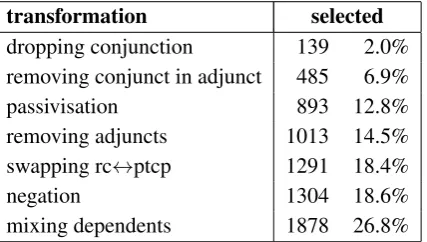
Some of the transformations are very produc-tive (e.g. mixing dependents). Other, in turn, are sparsely represented in the output (e.g. dropping conjunction). The number of transformed sen-tences randomly selected to build the dataset is in the second column of Table1.
transformation selected dropping conjunction 139 2.0% removing conjunct in adjunct 485 6.9% passivisation 893 12.8% removing adjuncts 1013 14.5% swapping rc↔ptcp 1291 18.4%
negation 1304 18.6%
[image:4.595.77.291.398.519.2]mixing dependents 1878 26.8%
Table 1: Numbers of transformed sentences se-lected for annotation.
2.3 Data ensemble
The final step of building the SICK corpus consisted in arranging normalised and expanded sentences into pairs. Since our data diverges from SICK data, the process of arranging Pol-ish sentences into pairs also differs from pair-ing in the SICK corpus. The general idea be-hind the pair-ensembling procedure was to intro-duce sentence pairs with different levels of relat-edness into the dataset. Apart from pairs connect-ing two sentences originally written by humans (as described in Section2.1), there are also pairs in which an original sentence is connected with
a transformed sentence. For each of the 1K im-ages, the following 10 pairs are constructed (for
Abeing the set of all sentences originally written
by the first author,Bbeing the set of all sentences originally written by the second author,a∈Aand
b ∈ B being the original descriptions of the
pic-ture):
1. (a,b)
2. (a,a1), wherea1 ∈ t(a), andt(a) is the set
of all transformations of the sentencea
3. (b,b1), whereb1 ∈t(b)
4. (a,b2), whereb2 ∈t(b)
5. (b,a2), wherea2∈t(a)
6. (a,a3), wherea3 ∈ t(a0),a0 ∈ A,T(a0) =
T(a),a0 6= a, for T(a) being the thematic group3ofa
7. (b,b3), whereb3 ∈t(b0),b0 ∈B,T(b0) =
T(b),b06=b
8. (a,a4), wherea4 ∈A,T(a4)6=T(a)4
9. (b,b4), whereb4 ∈B,T(b4)6=T(b)
10. (a,a5), where a5 ∈ t(a),a5 6= a1 for
50% images,(b,b5)(analogously) for other
50%.5
For each sentence pair(a,b)created according to this procedure, its reverse(b,a)is also included in our corpus. As a result, the working set consists of 20K sentence pairs.
3 Corpus annotation
3.1 Annotation assumptions
The degree of semantic relatedness between two sentences is calculated as the average of all human ratings on the Likert scale with the range from 0 to 5. Since we do not want to excessively influence
3The thematic group of a sentenceacorresponds to the thematic group of an image being the source ofa(as de-scribed in Section 2.1).
4The pairs (a,a4) of the same authors’ descriptions of two images from different thematic groups are expected to be unrelated. The same applies to(b,b4).
the annotations, the guidelines given to annotators are mainly example-based:6
• 5 (very related): Kot siedzi na płocie. (Eng. ‘A cat is sitting on the fence.’) vs.Na płocie jest du˙zy kot.(Eng. ‘There is a large cat on the fence.’),
• 1–4 (more or less related):
Kot siedzi na płocie. (Eng. ‘A cat is sitting on the fence.’) vs. Kot nie siedzi na płocie. (Eng. ‘A cat is not sitting on the fence.’); Kot siedzi na płocie.(Eng. ‘A cat is sitting on the fence.’) vs. Wła´sciciel dał kotu chrupki. (Eng. ‘The owner gave kibble to his cat.’); Kot siedzi na płocie. (Eng. ‘A cat is sitting on the fence.’) vs.Kot miauczy pod płotem. (Eng. ‘A cat miaows by the fence.’).
• 0 (unrelated): Kot siedzi na płocie. (Eng. ‘A cat is sitting on the fence.’) vs. Zacz ˛ał pada´c deszcz. (Eng. ‘It started to rain.’).
Apart from these examples, there is a note in the annotation guidelines indicating that the de-gree of semantic relatedness is not equivalent to the degree of semantic similarity. Semantic sim-ilarity is only a special case of semantic related-ness, semantic relatedness is thus a more general term than the other one.
Polish entailment labels correspond directly to the SICK labels (i.e. entailment, contradiction, neutral). The entailment label assigned by the ma-jority of human judges is selected as the gold label. The entailment labels are defined as follows:
• a wynika z b (b entails a) – if a situation or an event described by sentenceb occurs, it is recognised that a situation or an event described by a occurs as well, i.e. a and b refer to the same event or the same situation,
• a jest zaprzeczeniem b (a is the negation of b) – if a situation or an event described byb occurs, it is recognised that a situation or an event described byamay not occur at the same time,
6We realise that the boundary between semantic percep-tion of a sentence by various speakers is fuzzy (it depends on speakers’ education, origin, age, etc.). It was thus our well-thought-out decision to draw only general annotation frames and to enable annotators to rely on their feel for language.
• ajest neutralne wobecb(ais neutral tob) – the truth of a situation described byacannot be determined on the basis ofb.
3.2 Annotation procedure
Similar to the SICK corpus, each Polish sentence pair is human-annotated for semantic relatedness and entailment by 3 human judges experienced in Polish linguistics.7 Since for each annotated pair (a,b), its reverse (b,a) is also subject to anno-tation, the entailment relation is in practice deter-mined ‘in both directions’ for 10K sentence pairs. For the task of relatedness annotation, the order of sentences within pairs seems to be irrelevant, we can thus assume to obtain 6 relatedness scores for 10K unique pairs.
Since the transformation process is fully auto-matic and to a certain extent based on imperfect dependency parsing, we cannot ignore errors in the transformed sentences. In order to avoid anno-tating erroneous sentences, the annotation process is divided into two stages:
1. a sentence pair is sent to a judge with theleader role, who is expected to edit and to correct the transformed sentence from this pair before annotation, if necessary,
2. the verified and possibly enhanced sentence pair is sent to the other two judges, who can only annotate it.
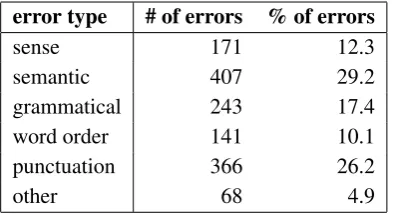
The leader judges should correct incomprehen-sible and ungrammatical sentences with a mini-mal number of necessary changes. Unusual sen-tences which could be accepted by Polish speakers should not be modified. Moreover, the modified sentence may not be identical with the other sen-tence in the pair. The classification and statistics of distinct corrections made by theleader judges are provided in Table2.
A strict classification of error types is quite hard to provide because some sentences contain more than one error. We thus order the error types from the most serious errors (i.e. ‘sense’ errors) to the redundant corrections (i.e. ‘other’ type). If a sen-tence contains several errors, it is qualified for the higher order error type.
In the case of sentences with ‘sense’ errors, the need for correction is uncontroversial and
error type # of errors % of errors
sense 171 12.3
semantic 407 29.2
grammatical 243 17.4
word order 141 10.1
punctuation 366 26.2
other 68 4.9
Table 2: Classification and statistics of correc-tions.
arises from an internal logical contradiction.8 The sentences with ‘semantic’ changes are syn-tactically correct, but deemed unacceptable by the leaderannotators from the semantic or pragmatic point of view.9 The ‘grammatical’ errors mostly concern missing agreement.10 The majority of ‘word order’ corrections are unnecessary, but we found some examples which can be classified as actual word or phrase order errors.11 The correc-tion of punctuacorrec-tion consists in adding or deleting a comma.12The sentences in the ‘other’ group, in turn, could as well have been left unchanged be-cause they are proper Polish sentences, but were apparently considered odd by the leader annota-tors.
8An example of ‘sense’ error: the sentence Chłopak w
zielonej bluzie i czapce zje˙zd˙za na rolkachna le˙z ˛aco.(Eng. ‘A boy in a green sweatshirt and a cap roller-skates down-hillin a lying position.’) is corrected intoChłopak w zielonej bluzie i czapce zje˙zd˙za na rolkach.(Eng. ‘A boy in a green sweatshirt and a cap roller-skates downhill.’).
9An example of ‘semantic’ correction: the sentence
Dziewczyna trzyma wpyskupatyk.(Eng. ‘A girl holds a stick in hermuzzle.’) is corrected intoDziewczyna trzyma w us-tachpatyk.(Eng. ‘A girl holds a stick in hermouth.’).
10An example of ‘grammatical’ error: the sentence
Grupasg.nom u´smiechaj ˛acych si˛e ludzi ta´ncz ˛apl. (Eng.
*‘A group of smiling people are dancing.’) is corrected intoGrupasg.nom u´smiechaj ˛acych si˛e ludzita´nczysg. (Eng.
‘A group of smiling people is dancing.’).
11An example of word order error: the sentenceSamochód,
który jest uszkodzony,koloru białegostoi na lawecie du˙zego auta.(lit. ‘A car that is damaged,of the white colorstands on the trailer of a large car.’, Eng. ‘Awhitecar that is dam-aged is standing on the trailer of a large car.’) is corrected intoSamochódkoloru białego, który jest uszkodzony, stoi na lawecie du˙zego auta.
12An example of punctuation correction: the wrong comma in the sentenceNad brzegiem wody, stoj ˛a dwaj m˛e˙zczy´zni z w˛edkami.(lit. ‘On the water’s edge, two men are standing with rods.’; Eng. ‘Two men with rods are standing on the wa-ter’s edge.’) should be deleted, i.e.Nad brzegiem wody stoj ˛a dwaj m˛e˙zczy´zni z w˛edkami.
3.3 Impromptu post-corrections
During the annotation process it came out that sen-tences accepted by some human annotators are un-acceptable for other annotators. We thus decided to garner annotators’ comments and suggestions for improving sentences. After validation of these suggestions by an experienced linguist, it turns out that most of these proposals concern punctuation errors (e.g. missing comma) and typos in 312 dis-tinct sentences. These errors are fixed directly in the corpus because they should not impact the an-notations of sentence pairs. The other suggestions concern more significant changes in 29 distinct sentences (mostly minor grammatical or seman-tic problems overlooked by theleaderannotators). The annotations of pairs with modified sentences are resent to the annotators so that they can verify and update them.
4 Corpus summary and evaluation
4.1 Corpus statistics
Tables 3 and 4 summarise the annotations of the resulting 10K sentence pairs corpus. Table
3aggregates the occurrences of 6 possible related-ness scores, calculated as the mean of all 6 indi-vidual annotations, rounded to an integer.
relatedness # of pairs
0 1978
1 1428
2 1082
3 2159
4 2387
5 966
Table 3: Final relatedness scores rounded to inte-gers (total: 10K pairs).
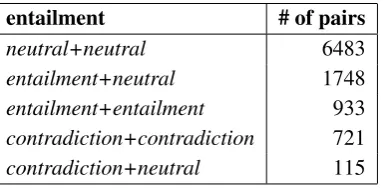
Table4shows the number of the particular en-tailment labels in the corpus. Since each sentence pair is annotated for entailment in both directions, the final entailment label is actually a pair of two labels:
• entailment+neutral points to ‘one-way’ en-tailment,
• contradiction+neutral points to ‘one-way’ contradiction,
[image:6.595.84.281.62.169.2]While the actual corpus labels are ordered in the sense that there is a difference between e.g. entailment+neutral and neutral+entailment (the entailment occurs in different directions), we treat all labels as unordered for the purpose of this summary (e.g. entailment+neutral covers neutral+entailmentas well, representing the same type of relation between two sentences).
entailment # of pairs
neutral+neutral 6483
entailment+neutral 1748
[image:7.595.88.280.182.276.2]entailment+entailment 933 contradiction+contradiction 721 contradiction+neutral 115
Table 4: Final entailment labels (total: 10K pairs).
4.2 Inter-annotator agreement
The standard measure of inter-annotator agree-ment in various natural language labelling tasks is Cohen’s kappa (Cohen,1960). However, this coef-ficient is designed to measure agreement between two annotators only. Since there are three annota-tors of each pair of ordered sentences, we decided to apply Fleiss’ kappa13 (Fleiss, 1971) designed for measuring agreement between multiple raters who give categorical ratings to a fixed number of items. An additional advantage of this measure is that different items can be rated by different hu-man judges, which doesn’t impact measurement. The normalised Fleiss’ measure of inter-annotator agreement is:
κ= P¯−P¯e 1−P¯e
where the quantity P¯ −P¯e measures the degree of agreement actually attained in excess of chance, while “[t]he quantity 1 − P¯e measures the
de-gree of ade-greement attainable over and above what would be predicted by chance” (Fleiss, 1971, p. 379).
We recognise Fleiss’ kappa as particularly use-ful for measuring inter-annotator agreement with respect to entailment labelling in our evaluation dataset. First, there are more than two raters. Sec-ond, entailment labels are categorically. Measured
13As Fleiss’ kappa is actually the generalisation of Scott’s π(Scott,1955), it is sometimes referred to as Fleiss’multi-π, cf. Artstein and Poesio (2008).
with Fleiss’ kappa, there is an inter-annotator agreement of κ = 0.734for entailment labels in Polish evaluation dataset, which is quite satisfac-tory as for a semantic labelling task.
Relative to semantic relatedness, the distinc-tion in meaning of two sentences made by human judges is often very subtle. This is also reflected in the inter-annotator agreement scores measured with Fleiss’ kappa. Inter-annotator agreement measured for six semantic relatedness groups corresponding to points on the Likert scale is quite low: κ = 0.337. If we measure inter-annotator agreement for three classes correspond-ing to the three relatedness groups from the an-notation guidelines (see Section 3.1), i.e. <0>, <1, 2, 3, 4>, and <5>, the Fleiss’ score is sig-nificantly higher: κ = 0.543. Hence, we con-clude that Fleiss’ kappa is not a reliable measure of inter-annotator agreement in relation to related-ness scores. Therefore, we decided to use Krippen-dorff’sαinstead.
Krippendorff’sα(Krippendorff,1980,2013) is
a coefficient appropriate for measuring the inter-annotator agreement of a dataset which is anno-tated with multiple judges and characterised by different magnitudes of disagreement and miss-ing values. Krippendorff proposes distance met-rics suitable for various scales: binary, nominal, interval, ordinal, and ratio. In ordinal measure-ment14the attributes can be rank-ordered, but dis-tances between them do not have any meaning. Measured with Krippendorff’s ordinal α, there is
an inter-annotator agreement ofα = 0.780for re-latedness scores in the Polish evaluation dataset, which is quite satisfactory as well. Hence, we con-clude that our dataset is a reliable resource for the purpose of evaluating compositional distribu-tional semantics model of Polish.
5 Conclusions
The goal of this paper is to present the proce-dure of building a Polish evaluation dataset for the validation of compositional distributional se-mantics models. As we aim at building an
tion dataset which is comparable to the SICK pus, the general assumptions of our procedure respond to the design principles of the SICK cor-pus. However, the procedure of building the SICK corpus cannot be adapted without modifications. First, the Polish seed-sentences have to be written based on the images which are selected from 8K ImageFlickr dataset and split into thematic groups, since usable datasets are not publicly available. Second, since the process of transforming sen-tences seems to be language-specific, the linguistic transformation rules appropriate for Polish have to be defined from scratch. Third, the process of ar-ranging Polish sentences into pairs is defined anew taking into account the data characteristic and bi-directional entailment annotations. The discrepan-cies relative to the SICK procedure also concern the annotation process itself. Since an entailment relation between two sentences must not be sym-metric, each sentence pair is annotated for entail-ment in both directions. Furthermore, we intro-duce an element of human verification of correct-ness of automatically transformed sentences and some additional post-corrections.
The presented procedure of building a dataset was tested on Polish. However, it is very likely that the annotation framework will work for other Slavic languages (e.g. Czech with an excellent de-pendency parser).
The presented procedure results in building the Polish test corpus of relatively high quality, confirmed by the inter-annotator agreement coeffi-cients ofκ= 0.734(measured with Fleiss’ kappa) for entailment labels and ofα= 0.780(measured with Krippendorff’s ordinal alpha) for relatedness scores.
Acknowledgments
We would like to thank the reliable and tena-cious annotators of our dataset: Alicja Dziedzic-Rawska, Bo˙zena Itoya, Magdalena Król, Anna La-tusek, Justyna Małek, Małgorzata Michalik, Ag-nieszka Norwa, Małgorzata Szajbel-Keck, Alicja Walichnowska, Konrad Zieli´nski, and some other. The research presented in this paper was supported by SONATA 8 grant no 2014/15/D/HS2/03486 from the National Science Centre Poland.
References
Eneko Agirre, Daniel Cer, Mona Diab, and Aitor Gonzalez-Agirre. 2012. SemEval-2012 Task 6: A Pilot on Semantic Textual Similarity. In Proceed-ings of the First Joint Conference on Lexical and Computational Semantics (*SEM). pages 385–393.
Ron Artstein and Massimo Poesio. 2008. Inter-Coder Agreement for Computational Linguistics. Compu-tational Linguistics34:557–596.
Marco Baroni and Roberto Zamparelli. 2010. Nouns are vectors, adjectives are matrices: Representing adjective-noun constructions in semantic space. In
Proceedings of the 2010 Conference on Empirical Methods in Natural Language Processing. pages 1183–1193.
Yoshua Bengio, Réjean Ducharme, Pascal Vincent, and Christian Jauvin. 2003. A Neural Probabilistic Lan-guage Model. Journal of Machine Learning Re-search3:1137–1155.
Yoshua Bengio, Holger Schwenk, Jean-Sébastien Senécal, Fréderic Morin, and Jean-Luc Gauvain. 2006. Neural Probabilistic Language Models. In D.E. Holmes and L.C. Jain, editors, Innovations in Machine Learning. Theory and Applications, Springer-Verlag, Berlin Heidelberg, volume 194 of
Studies in Fuzziness and Soft Computing, pages 137–186.
Luisa Bentivogli, Raffaella Bernardi, Marco Marelli, Stefano Menini, Marco Baroni, and Roberto Zam-parelli. 2014. SICK through the SemEval Glasses. Lesson learned from the evaluation of composi-tional distribucomposi-tional semantic models on full stences through semantic relatedness and textual en-tailment. Journal of Language Resources and Eval-uation50:95–124.
Jacob Cohen. 1960. A coefficient of agreement for nominal scales. Educational and Psychological Measurement20:37–46.
John Rupert Firth. 1957. A synopsis of linguistic the-ory, 1930-1955. Studies in Linguistic Analysis. Spe-cial volume of the Philological Societypages 1–32.
Joseph L. Fleiss. 1971. Measuring nominal scale agreement among many raters. Psychological Bul-letin75:378–382.
Edward Grefenstette and Mehrnoosh Sadrzadeh. 2011. Experimental Support for a Categorical Composi-tional DistribuComposi-tional Model of Meaning. In Pro-ceedings of the 2011 Conference on Empirical Methods in Natural Language Processing (EMNLP 2011). pages 1394–1404.
Zellig Harris. 1954. Distributional structure. Word
Theo M. V. Janssen. 2012. Compositionality: its his-toric context. In Wolfram Hinzen, Edouard Mach-ery, and Markus Werning, editors,The Oxford Hand-book of Compositionality, Oxford University Press, Studies in Fuzziness and Soft Computing, pages 19– 46.
Klaus Krippendorff. 1980. Content Analysis: An In-troduction to Its Methodology. Sage Publications, Beverly Hills.
Klaus Krippendorff. 2013.Content Analysis: An Intro-duction to Its Methodology. Sage Publication, Thou-sand Oaks, 3rd edition.
Marco Marelli, Luisa Bentivogli, Marco Baroni, Raf-faella Bernardi, Stefano Menini, and Roberto Zam-parelli. 2014. SemEval-2014 Task 1: Evaluation of Compositional Distributional Semantic Models on Full Sentences through Semantic Relatedness and Textual Entailment. In Proceedings of the 8th In-ternational Workshop on Semantic Evaluation (Se-mEval 2014). pages 1–8.
Tomas Mikolov, Ilya Sutskever, Kai Chen, Greg Cor-rado, and Jeffrey Dean. 2013. Distributed Represen-tations of Words and Phrases and their Composition-ality. InAdvances in Neural Information Processing Systems 26. Proceedings of Neural Information Pro-cessing Systems 2013. pages 3111–3119.
Jeff Mitchell and Mirella Lapata. 2010. Composition in Distributional Models of Semantics. Cognitive Science34:1388–1429.
Cyrus Rashtchian, Peter Young, Micah Hodosh, and Julia Hockenmaier. 2010. Collecting Image Anno-tations Using Amazon’s Mechanical Turk. In Pro-ceedings of the NAACL HLT 2010 Workshop on Cre-ating Speech and Language Data with Amazon’s Mechanical Turk. pages 139–147.
William A. Scott. 1955. Reliability of Content Anal-ysis: The Case of Nominal Scale Coding. Public Opinion Quarterly19:321–325.
Richard Socher, Brody Huval, Christopher Manning, and Andrew Ng. 2012. Semantic Compositionality through Recursive Matrix-Vector Spaces. In Pro-ceedings of the 2012 Joint Conference on Empiri-cal Methods in Natural Language Processing and Computational Natural Language Learning. pages 1201–1211.