Proceedings of the 55th Annual Meeting of the Association for Computational Linguistics, pages 1273–1283 Vancouver, Canada, July 30 - August 4, 2017. c2017 Association for Computational Linguistics
Proceedings of the 55th Annual Meeting of the Association for Computational Linguistics, pages 1273–1283 Vancouver, Canada, July 30 - August 4, 2017. c2017 Association for Computational Linguistics
Multi-Task Video Captioning with Video and Entailment Generation
Ramakanth Pasunuru and Mohit Bansal UNC Chapel Hill
{ram, mbansal}@cs.unc.edu
Abstract
Video captioning, the task of describing the content of a video, has seen some promising improvements in recent years with sequence-to-sequence models, but accurately learning the temporal and log-ical dynamics involved in the task still re-mains a challenge, especially given the lack of sufficient annotated data. We im-prove video captioning by sharing knowl-edge with two related directed-generation tasks: a temporally-directed unsuper-vised video prediction task to learn richer context-aware video encoder representa-tions, and a logically-directed language entailment generation task to learn bet-ter video-entailing caption decoder rep-resentations. For this, we present a many-to-many multi-task learning model that shares parameters across the encoders and decoders of the three tasks. We achieve significant improvements and the new state-of-the-art on several standard video captioning datasets using diverse au-tomatic and human evaluations. We also show mutual multi-task improvements on the entailment generation task.
1 Introduction
Video captioning is the task of automatically gen-erating a natural language description of the con-tent of a video, as shown in Fig. 1. It has various applications such as assistance to a visually im-paired person and improving the quality of online video search or retrieval. This task has gained re-cent momentum in the natural language process-ing and computer vision communities, esp. with the advent of powerful image processing features as well as sequence-to-sequence LSTM models. It
Figure 1: A video captioning example from the YouTube2Text dataset, with the ground truth captions and our many-to-many multi-task model’s predicted caption.
is also a step forward from static image captioning, because in addition to modeling the spatial visual features, the model also needs to learn the tempo-ral across-frame action dynamics and the logical storyline language dynamics.
Previous work in video captioning (Venu-gopalan et al., 2015a; Pan et al., 2016b) has shown that recurrent neural networks (RNNs) are a good choice for modeling the temporal information in the video. A sequence-to-sequence model is then used to ‘translate’ the video to a caption. Venu-gopalan et al. (2016) showed linguistic improve-ments over this by fusing the decoder with external language models. Furthermore, an attention mech-anism between the video frames and the caption words captures some of the temporal matching re-lations better (Yao et al., 2015; Pan et al., 2016a). More recently, hierarchical two-level RNNs were proposed to allow for longer inputs and to model the full paragraph caption dynamics of long video clips (Pan et al., 2016a; Yu et al., 2016).
Despite these recent improvements, video cap-tioning models still suffer from the lack of suffi-cient temporal and logical supervision to be able to correctly capture the action sequence and story-dynamic language in videos, esp. in the case of short clips. Hence, they would benefit from incor-porating such complementary directed knowledge, both visual and textual. We address this by jointly training the task of video captioning with two related directed-generation tasks: a
directed unsupervised video prediction task and a logically-directed language entailment generation task. We model this via many-to-many multi-task learning based sequence-to-sequence models (Lu-ong et al., 2016) that allow the sharing of param-eters among the encoders and decoders across the three different tasks, with additional shareable at-tention mechanisms.
The unsupervised video prediction task, i.e., video-to-video generation (adapted from Srivas-tava et al. (2015)), shares its encoder with the video captioning task’s encoder, and helps it learn richer video representations that can predict their temporal context and action sequence. The entail-ment generation task, i.e., premise-to-entailentail-ment generation (based on the image caption domain SNLI corpus (Bowman et al., 2015)), shares its de-coder with the video captioning dede-coder, and helps it learn better video-entailing caption representa-tions, since the caption is essentially an entailment of the video, i.e., it describes subsets of objects and events that are logically implied by or follow from the full video content). The overall many-to-many multi-task model combines all three tasks.
Our three novel multi-task models show statis-tically significant improvements over the state-of-the-art, and achieve the best-reported results (and rank) on multiple datasets, based on several au-tomatic and human evaluations. We also demon-strate that video captioning, in turn, gives mutual improvements on the new multi-reference entail-ment generation task.
2 Related Work
Early video captioning work (Guadarrama et al., 2013; Thomason et al., 2014; Huang et al., 2013) used a two-stage pipeline to first extract a subject, verb, and object (S,V,O) triple and then generate a sentence based on it. Venugopalan et al. (2015b) fed mean-pooled static frame-level visual features (from convolution neural networks pre-trained on image recognition) of the video as input to the lan-guage decoder. To harness the important frame sequence temporal ordering, Venugopalan et al. (2015a) proposed a sequence-to-sequence model with video encoder and language decoder RNNs.
More recently, Venugopalan et al. (2016) ex-plored linguistic improvements to the caption de-coder by fusing it with external language models. Moreover, an attention or alignment mechanism was added between the encoder and the decoder
to learn the temporal relations (matching) between the video frames and the caption words (Yao et al., 2015; Pan et al., 2016a). In contrast to static visual features, Yao et al. (2015) also considered tem-poral video features from a 3D-CNN model pre-trained on an action recognition task.
To explore long range temporal relations, Pan et al. (2016a) proposed a two-level hierarchical RNN encoder which limits the length of input in-formation and allows temporal transitions between segments. Yu et al. (2016)’s hierarchical RNN generates sentences at the first level and the sec-ond level captures inter-sentence dependencies in a paragraph. Pan et al. (2016b) proposed to simul-taneously learn the RNN word probabilities and a visual-semantic joint embedding space that en-forces the relationship between the semantics of the entire sentence and the visual content. Despite these useful recent improvements, video caption-ing still suffers from limited supervision and gen-eralization capabilities, esp. given the complex action-based temporal and story-based logical dy-namics that need to be captured from short video clips. Our work addresses this issue by bringing in complementary temporal and logical knowledge from video prediction and textual entailment gen-eration tasks (respectively), and training them to-gether via many-to-many multi-task learning.
Multi-task learning is a useful learning paradigm to improve the supervision and the generalization performance of a task by jointly training it with related tasks (Caruana, 1998; Argyriou et al., 2007; Kumar and Daum´e III, 2012). Recently, Luong et al. (2016) combined multi-task learning with sequence-to-sequence models, sharing parameters across the tasks’ encoders and decoders. They showed improve-ments on machine translation using parsing and image captioning. We additionally incorporate an attention mechanism to this many-to-many multi-task learning approach and improve the multimodal, temporal-logical video captioning task by sharing its video encoder with the encoder of a video-to-video prediction task and by sharing its caption decoder with the decoder of a linguistic premise-to-entailment generation task.
propos-LSTM
LSTM LSTM
LSTM LSTM
LSTM LSTM
LSTM LSTM
LSTM LSTM
LSTM LSTM
LSTM LSTM
LSTM LSTM
LSTM LSTM
LSTM LSTM
LSTM LSTM
[image:3.595.330.496.59.243.2]LSTM
Figure 2: Baseline sequence-to-sequence model for video captioning: standard encoder-decoder LSTM-RNN model. ing unsupervised video representation learning via sequence-to-sequence RNN models, where they reconstruct the input video sequence or predict the future sequence. We model video generation with an attention-enhanced encoder-decoder and har-ness it to improve video captioning.
The task of recognizing textual entailment (RTE) is to classify whether the relationship be-tween a premise and hypothesis sentence is that of entailment (i.e., logically follows), contradic-tion, or independence (neutral), which is help-ful for several downstream NLP tasks. The re-cent Stanford Natural Language Inference (SNLI) corpus by Bowman et al. (2015) allowed training end-to-end neural networks that outperform ear-lier feature-based RTE models (Lai and Hocken-maier, 2014; Jimenez et al., 2014). However, di-rectly generating the entailed hypothesis sentences given a premise sentence would be even more ben-eficial than retrieving or reranking sentence pairs, because most downstream generation tasks only come with the source sentence and not pairs. Re-cently, Kolesnyk et al. (2016) tried a sequence-to-sequence model for this on the original SNLI dataset, which is a single-reference setting and hence restricts automatic evaluation. We modify the SNLI corpus to a new multi-reference (and a more challenging zero train-test premise over-lap) setting, and present a novel multi-task training setup with the related video captioning task (where the caption also entails a video), showing mutual improvements on both the tasks.
3 Models
We first discuss a simple encoder-decoder model as a baseline reference for video captioning. Next, we improve this via an attention mechanism. Fi-nally, we present similar models for the unsuper-vised video prediction and entailment generation tasks, and then combine them with video caption-ing via the many-to-many multi-task approach.
3.1 Baseline Sequence-to-Sequence Model
Our baseline model is similar to the stan-dard machine translation encoder-decoder RNN
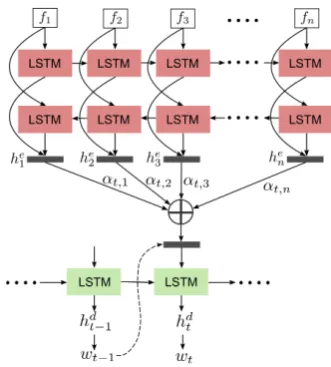
Figure 3: Attention-based sequence-to-sequence baseline model for video captioning (similar models also used for video prediction and entailment generation).
model (Sutskever et al., 2014) where the final state of the encoder RNN is input as an initial state to the decoder RNN, as shown in Fig. 2. The RNN is based on Long Short Term Memory (LSTM) units, which are good at memorizing long se-quences due to forget-style gates (Hochreiter and Schmidhuber, 1997). For video captioning, our input to the encoder is the video frame features1 {f1, f2, ..., fn}of lengthn, and the caption word
sequence{w1, w2, ..., wm} of length mis
gener-ated during the decoding phase. The distribution of the output sequence w.r.t. the input sequence is:
p(w1, ..., wm|f1, ..., fn) = m Y
t=1
p(wt|hdt) (1)
wherehdt is the hidden state at thetthtime step of
the decoder RNN, obtained from hd
t−1 andwt−1 via the standard LSTM-RNN equations. The dis-tributionp(wt|hdt)is given bysoftmaxover all the
words in the vocabulary.
3.2 Attention-based Model
Our attention model architecture is similar to Bah-danau et al. (2015), with a bidirectional RNN as the encoder and a unidirectional LSTM-RNN as the decoder, see Fig. 3. At each time step
t, the decoder LSTM hidden state hdt is a
non-linear recurrent function of the previous decoder hidden statehd
t−1, the previous time-step’s gener-ated wordwt−1, and the context vectorct:
hdt =S(hdt−1, wt−1, ct) (2)
1We use several popular image features such as VGGNet,
[image:3.595.74.287.65.116.2]UNSUPERVISED
VIDEO PREDICTION VIDEO CAPTIONING
ENTAILMENT GENERATION
Video Encoder Language Encoder
Video Decoder Language Decoder
LSTM LSTM LSTM LSTM LSTM LSTM LSTM LSTM
LSTM LSTM LSTM LSTM
[image:4.595.78.518.63.249.2]LSTM LSTM LSTM LSTM
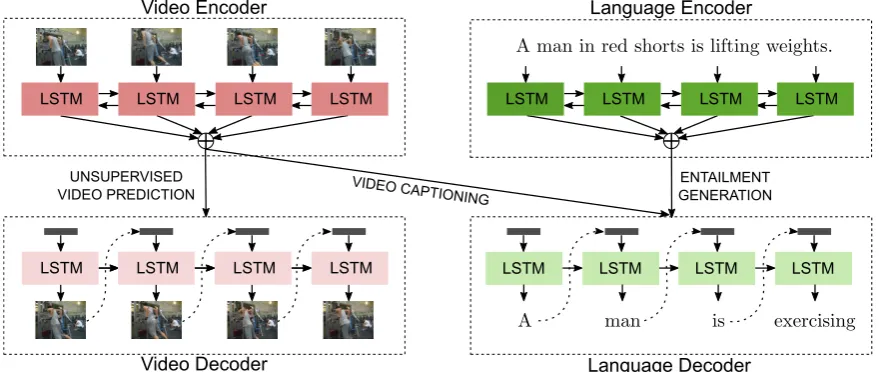
Figure 4: Our many-to-many multi-task learning model to share encoders and decoders of the video captioning, unsupervised video prediction, and entailment generation tasks.
where ct is a weighted sum of encoder hidden
states{hei}:
ct= n X
i=1
αt,ihei (3)
These attention weights{αt,i}act as an alignment
mechanism by giving higher weights to certain en-coder hidden states which match that deen-coder time step better, and are computed as:
αt,i =
exp(et,i)
Pn
k=1exp(et,k) (4)
where the attention functionet,iis defined as:
et,i=wTtanh(Waehei +Wadhdt−1+ba) (5)
wherew,We
a,Wad, andbaare learned parameters.
This attention-based sequence-to-sequence model (Fig. 3) is our enhanced baseline for video caption-ing. We next discuss similar models for the new tasks of unsupervised video prediction and entail-ment generation and then finally share them via multi-task learning.
3.3 Unsupervised Video Prediction
We model unsupervised video representation by predicting the sequence of future video frames given the current frame sequence. Similar to Sec. 3.2, a bidirectional LSTM-RNN encoder and an LSTM-RNN decoder is used, along with at-tention. If the frame level features of a video of length n are {f1, f2, ..., fn}, these are
di-vided into two sets such that given the current frames{f1, f2, .., fk} (in its encoder), the model
has to predict (decode) the rest of the frames {fk+1, fk+2, .., fn}. The motivation is that this
helps the video encoder learn rich temporal rep-resentations that are aware of their action-based context and are also robust to missing frames and varying frame lengths or motion speeds. The opti-mization function is defined as:
minimize
φ
n−k X
t=1
||ftd−ft+k||22 (6)
whereφare the model parameters,ft+kis the true
future frame feature at decoder time steptandftd
is the decoder’s predicted future frame feature at decoder time stept, defined as:
ftd=S(hdt−1, ftd−1, ct) (7)
similar to Eqn. 2, with hd
t−1 and ftd−1 as the previous time step’s hidden state and predicted frame feature respectively, andctas the
attention-weighted context vector.
3.4 Entailment Generation
Given a sentence (premise), the task of entail-ment generation is to generate a sentence (hypoth-esis) which is a logical deduction or implication of the premise. Our entailment generation model again uses a bidirectional LSTM-RNN encoder and LSTM-RNN decoder with an attention mech-anism (similar to Sec. 3.2). If the premise sp is
a sequence of words{w1p, wp2, ..., wnp}and the
hy-pothesis sh is {wh
1, w2h, ..., whm}, the distribution
of the entailed hypothesis w.r.t. the premise is:
p(wh1, ..., wmh|w1p, ..., wpn) =
m Y
t=1
p(wht|hdt) (8)
where the distributionp(wht|hdt)is again obtained via softmax over all the words in the vocabulary and the decoder statehd
3.5 Multi-Task Learning
Multi-task learning helps in sharing information between different tasks and across domains. Our primary aim is to improve the video captioning model, where visual content translates to a tex-tual form in a directed (entailed) generation way. Hence, this presents an interesting opportunity to share temporally and logically directed knowledge with both visual and linguistic generation tasks. Fig. 4 shows our overall many-to-many multi-task model for jointly learning video captioning, unsu-pervised video prediction, and textual entailment generation. Here, the video captioning task shares its video encoder (parameters) with the encoder of the video prediction task (one-to-many setting) so as to learn context-aware and temporally-directed visual representations (see Sec. 3.3).
Moreover, the decoder of the video caption-ing task is shared with the decoder of the textual entailment generation task (many-to-one setting), thus helping generate captions that can ‘entail’, i.e., are logically implied by or follow from the video content (see Sec. 3.4).2 In both the one-to-many and the one-to-many-to-one settings, we also allow the attention parameters to be shared or separated. The overall many-to-many setting thus improves both the visual and language representations of the video captioning model.
We train the multi-task model by alternately op-timizing each task in mini-batches based on a mix-ing ratio. Let αv, αf, and αe be the number
of mini-batches optimized alternately from each of these three tasks – video captioning, unsuper-vised video future frames prediction, and entail-ment generation, resp. Then the mixing ratio is de-fined as αv
(αv+αf+αe) :
αf (αv+αf+αe) :
αe (αv+αf+αe).
4 Experimental Setup
4.1 Datasets
Video Captioning Datasets We report results
on three popular video captioning datasets. First, we use the YouTube2Text or MSVD (Chen and Dolan, 2011) for our primary results, which
con-2Empirically, logical entailment helped captioning more
than simple fusion with language modeling (i.e., partial sen-tence completion with no logical implication), because a cap-tion also entails a video in a logically-directed sense and hence the entailment generation task matches the video cap-tioning task better than language modeling. Moreover, a multi-task setup is more suitable to add directed information such as entailment (as opposed to pretraining or fusion with only the decoder). Details in Sec. 5.1.
tains1970 YouTube videos in the wild with sev-eral different reference captions per video (40 on average). We also use MSR-VTT (Xu et al., 2016) with 10,000 diverse video clips (from a video search engine) – it has200,000video clip-sentence pairs and around 20captions per video; and M-VAD (Torabi et al., 2015) with 49,000 movie-based video clips but only1or2 captions per video, making most evaluation metrics (except paraphrase-based METEOR) infeasible. We use the standard splits for all three datasets. Further details about all these datasets are provided in the supplementary.
Video Prediction Dataset For our unsupervised
video representation learning task, we use the UCF-101 action videos dataset (Soomro et al., 2012), which contains13,320video clips of 101 action categories, and suits our video captioning task well because it also contains short video clips of a single action or few actions. We use the stan-dard splits – further details in supplementary.
Entailment Generation Dataset For the
entail-ment generation encoder-decoder model, we use the Stanford Natural Language Inference (SNLI) corpus (Bowman et al., 2015), which contains human-annotated English sentence pairs with clas-sification labels of entailment, contradiction and neutral. It has a total of 570,152sentence pairs out of which 190,113 correspond to true entail-ment pairs, and we use this subset in our multi-task video captioning model. For improving video cap-tioning, we use the same training/validation/test splits as provided by Bowman et al. (2015), which is183,416training,3,329validation, and3,368 testing pairs (for the entailment subset).
hy-pothesis and we make this the training set, and the rest of them (10,076) have more than one
hy-pothesis, which we randomly shuffle and divide equally into test and validation sets, so that each of these two sets has approximately the same distri-bution of the number of reference hypotheses per premise.
These new validation and test sets hence con-tain premises with multiple entailed hypotheses as ground truth references, thus allowing for auto-matic metric evaluation, where differing genera-tions still get positive scores by matching one of the multiple references. Also, this creates a more challenging dataset for entailment generation be-cause of zero premise overlap between the training and val/test sets. We will make these split details publicly available.
Pre-trained Visual Frame Features For the
three video captioning and UCF-101 datasets, we fix our sampling rate to 3f ps to bring
unifor-mity in the temporal representation of actions across all videos. These sampled frames are then converted into features using several state-of-the-art pre-trained models on ImageNet (Deng et al., 2009) – VGGNet (Simonyan and Zisserman, 2015), GoogLeNet (Szegedy et al., 2015; Ioffe and Szegedy, 2015), and Inception-v4 (Szegedy et al., 2016). Details of these feature dimensions and layer positions are in the supplementary.
4.2 Evaluation (Automatic and Human)
For our video captioning as well as entailment generation results, we use four diverse auto-matic evaluation metrics that are popular for im-age/video captioning and language generation in general: METEOR (Denkowski and Lavie, 2014), BLEU-4 (Papineni et al., 2002), CIDEr-D (Vedan-tam et al., 2015), and ROUGE-L (Lin, 2004). Par-ticularly, METEOR and CIDEr-D have been jus-tified to be better for generation tasks, because CIDEr-D uses consensus among the (large) num-ber of references and METEOR uses soft match-ing based on stemmmatch-ing, paraphrasmatch-ing, and Word-Net synonyms. We use the standard evaluation code from the Microsoft COCO server (Chen et al., 2015) to obtain these results and also to compare the results with previous papers.3
We also present human evaluation results based
3We use avg. of these four metrics on validation set to
choose the best model, except for single-reference M-VAD dataset where we only report and choose based on METEOR.
on relevance (i.e., how related is the generated caption w.r.t. the video contents such as actions, objects, and events; or is the generated hypothesis entailed or implied by the premise) and coherence (i.e., a score on the logic, readability, and fluency of the generated sentence).
4.3 Training Details
We tune all hyperparameters on the dev splits: LSTM-RNN hidden state size, learning rate, weight initializations, and mini-batch mixing ra-tios (tuning ranges in supplementary). We use the following settings in all of our models (un-less otherwise specified): we unroll video en-coder/decoder RNNs to 50 time steps and lan-guage encoder/decoder RNNs to 30 time steps. We use a 1024-dimension RNN hidden state size and512-dim vectors to embed visual features and word vectors. We use Adam optimizer (Kingma and Ba, 2015). We apply a dropout of0.5. See
subsections below and supp for full details.
5 Results and Analysis
5.1 Video Captioning on YouTube2Text
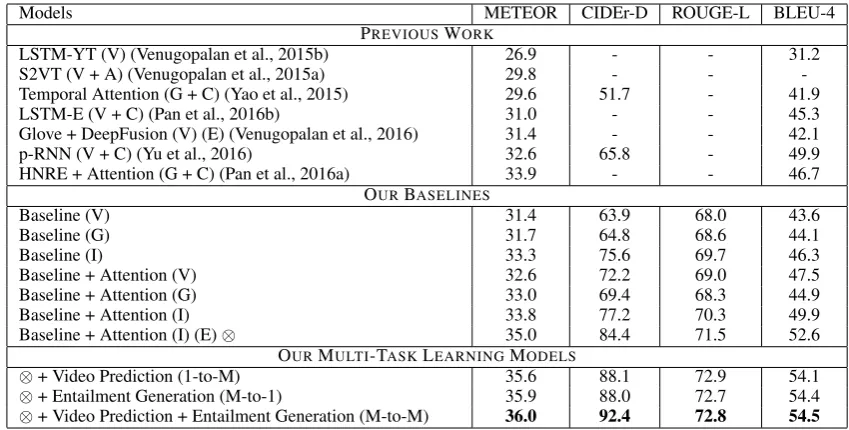
Table 1 presents our primary results on the YouTube2Text (MSVD) dataset, reporting several previous works, all our baselines and attention model ablations, and our three multi-task models, using the four automated evaluation metrics. For each subsection below, we have reported the im-portant training details inline, and refer to the sup-plementary for full details (e.g., learning rates and initialization).
Baseline Performance We first present all our
baseline model choices (ablations) in Table 1. Our baselines represent the standard sequence-to-sequence model with three different visual feature types as well as those with attention mechanisms. Each baseline model is trained with three random seed initializations and the average is reported (for stable results). The final baseline model⊗instead uses an ensemble (E), which is a standard denois-ing method (Sutskever et al., 2014) that performs inference over ten randomly initialized models, i.e., at each time steptof the decoder, we generate
Models METEOR CIDEr-D ROUGE-L BLEU-4 PREVIOUSWORK
LSTM-YT (V) (Venugopalan et al., 2015b) 26.9 - - 31.2
S2VT (V + A) (Venugopalan et al., 2015a) 29.8 - -
-Temporal Attention (G + C) (Yao et al., 2015) 29.6 51.7 - 41.9
LSTM-E (V + C) (Pan et al., 2016b) 31.0 - - 45.3
Glove + DeepFusion (V) (E) (Venugopalan et al., 2016) 31.4 - - 42.1
p-RNN (V + C) (Yu et al., 2016) 32.6 65.8 - 49.9
HNRE + Attention (G + C) (Pan et al., 2016a) 33.9 - - 46.7
OURBASELINES
Baseline (V) 31.4 63.9 68.0 43.6
Baseline (G) 31.7 64.8 68.6 44.1
Baseline (I) 33.3 75.6 69.7 46.3
Baseline + Attention (V) 32.6 72.2 69.0 47.5
Baseline + Attention (G) 33.0 69.4 68.3 44.9
Baseline + Attention (I) 33.8 77.2 70.3 49.9
Baseline + Attention (I) (E)⊗ 35.0 84.4 71.5 52.6
OURMULTI-TASKLEARNINGMODELS
⊗+ Video Prediction (1-to-M) 35.6 88.1 72.9 54.1
⊗+ Entailment Generation (M-to-1) 35.9 88.0 72.7 54.4
[image:7.595.85.510.61.276.2]⊗+ Video Prediction + Entailment Generation (M-to-M) 36.0 92.4 72.8 54.5
Table 1: Primary video captioning results on Youtube2Text (MSVD), showing previous works, our several strong baselines, and our three multi-task models. Here, V, G, I, C, A are short for VGGNet, GoogLeNet, Inception-v4, C3D, and AlexNet visual features; E = ensemble. The multi-task models are applied on top of our best video captioning baseline⊗, with an ensemble. All the multi-task models are statistically significant over the baseline (discussed inline in the corresponding results sections).
well (and is better than all previous state-of-the-art), and so we next add all our novel multi-task models on top of this final baseline.
Multi-Task with Video Prediction (1-to-M)
Here, the video captioning and unsupervised video prediction tasks share their encoder LSTM-RNN weights and image embeddings in a one-to-many multi-task setting. Two important hyperparam-eters tuned (on the validation set of caption-ing datasets) are the ratio of encoder vs decoder frames for video prediction on UCF-101 (where we found that80%of frames as input and20%for prediction performs best); and the mini-batch mix-ing ratio between the captionmix-ing and video pre-diction tasks (where we found 100 : 200 works well). Table 1 shows a statistically significant im-provement4in all metrics in comparison to the best baseline (non-multitask) model as well as w.r.t. all previous works, demonstrating the effectiveness of multi-task learning for video captioning with video prediction, even with unsupervised signals.
Multi-Task with Entailment Generation
(M-to-1) Here, the video captioning and
entail-ment generation tasks share their language de-coder LSTM-RNN weights and word embeddings in a many-to-one multi-task setting. We observe
4Statistical significance of p < 0.01for CIDEr-D and
ROUGE-L,p <0.02for BLEU-4,p <0.03for METEOR, based on the bootstrap test (Noreen, 1989; Efron and Tibshi-rani, 1994) with 100K samples.
that a mixing ratio of100 : 50 alternating mini-batches (between the captioning and entailment tasks) works well here. Again, Table 1 shows statistically significant improvements5 in all the metrics in comparison to the best baseline model (and all previous works) under this multi-task set-ting. Note that in our initial experiments, our en-tailment generation model helped the video cap-tioning task significantly more than the alternative approach of simply improving fluency by adding (or deep-fusing) an external language model (or pre-trained word embeddings) to the decoder (us-ing both in-domain and out-of-domain language models), again because a caption also ‘entails’ a video in a logically-directed sense and hence this matches our captioning task better (also see results of Venugopalan et al. (2016) in Table 1).
Multi-Task with Video and Entailment
Gener-ation (M-to-M) Combining the above
one-to-many and one-to-many-to-one multi-task learning mod-els, our full model is the 3-task, many-to-many model (Fig. 4) where both the video encoder and the language decoder of the video caption-ing model are shared (and hence improved) with that of the unsupervised video prediction and en-tailment generation models, respectively.6 A mix-ing ratio of100 : 100 : 50alternate mini-batches
5Statistical significance ofp <0.01for all four metrics. 6We found the setting with unshared attention parameters
Models M C R B Venugopalan (2015b)? 23.4 - - 32.3
Yao et al. (2015)? 25.2 - - 35.2
Xu et al. (2016) 25.9 - - 36.6
Rank1: v2t navigator 28.2 44.8 60.9 40.8
Rank2: Aalto 26.9 45.7 59.8 39.8
[image:8.595.308.525.61.94.2]Rank3: VideoLAB 27.7 44.1 60.6 39.1 Our Model (New Rank1) 28.8 47.1 60.2 40.8
Table 2: Results on MSR-VTT dataset on the 4 metrics.
?Results are reimplementations as per Xu et al. (2016).
We also report the top 3 leaderboard systems – our model achieves the new rank 1 based on their ranking method.
Models METEOR
Yao et al. (2015) 5.7
Venugopalan et al. (2015a) 6.7
Pan et al. (2016a) 6.8
[image:8.595.72.290.61.146.2]Our M-to-M Multi-Task Model 7.4
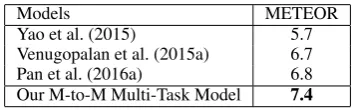
Table 3: Results on M-VAD dataset.
of video captioning, unsupervised video predic-tion, and entailment generapredic-tion, resp. works well. Table 1 shows that our many-to-many multi-task model again outperforms our strongest baseline (with statistical significance of p < 0.01 on all metrics), as well as all the previous state-of-the-art results by large absolute margins on all met-rics. It also achieves significant improvements on some metrics over the one-to-many and many-to-one models.7 Overall, we achieve the best results to date on YouTube2Text (MSVD) on all metrics.
5.2 Video Captioning on MSR-VTT, M-VAD
In Table 2, we also train and evaluate our fi-nal many-to-many multi-task model on two other video captioning datasets (using their standard splits; details in supplementary). First, we eval-uate on the new MSR-VTT dataset (Xu et al., 2016). Since this is a recent dataset, we list pre-vious works’ results as reported by the MSR-VTT dataset paper itself.8 We improve over all of these significantly. Moreover, they maintain a leader-board9on this dataset and we also report the top 3 systems from it. Based on their ranking method, our multi-task model achieves the new rank 1 on this leaderboard. In Table 3, we further eval-uate our model on the challenging movie-based M-VAD dataset, and again achieve improvements over all previous work (Venugopalan et al., 2015a;
7Many-to-many model’s improvements have a statistical
significance ofp < 0.01on all metrics w.r.t. baseline, and p <0.01on CIDEr-D w.r.t. both one-to-many and many-to-one models, andp <0.04on METEOR w.r.t. one-to-many.
8In their updated supplementary at https:
//www.microsoft.com/en-us/research/wp-content/ uploads/2016/10/cvpr16.supplementary.pdf
9http://ms-multimedia-challenge.com/leaderboard
Models M C R B
Entailment Generation 28.0 108.4 59.7 36.6 +Video Caption (M-to-1) 28.7 114.5 60.8 38.9
Table 4: Entailment generation results with the four metrics. Pan et al., 2016a; Yao et al., 2015).10
5.3 Entailment Generation Results
Above, we showed that the new entailment gener-ation task helps improve video captioning. Next, we show that the video captioning task also inversely helps the entailment generation task. Given a premise, the task of entailment generation is to generate an entailed hypothesis. We use only the entailment pairs subset of the SNLI corpus for this, but with a multi-reference split setup to al-low automatic metric evaluation and a zero train-test premise overlap (see Sec. 4.1). All the hyper-parameter details (again tuned on the validation set) are presented in the supplementary. Table 4 presents the entailment generation results for the baseline (sequence-to-sequence with attention, 3-ensemble, beam search) and the multi-task model which uses video captioning (shared decoder) on top of the baseline. A mixing ratio of100 : 20 al-ternate mini-batches of entailment generation and video captioning (resp.) works well.11 The multi-task model achieves stat. significant (p < 0.01)
improvements over the baseline on all metrics, thus demonstrating that video captioning and en-tailment generation both mutually help each other.
5.4 Human Evaluation
In addition to the automated evaluation metrics, we present pilot-scale human evaluations on the YouTube2Text (Table 1) and entailment genera-tion (Table 4) results. In each case, we compare our strongest baseline with our final multi-task model by taking a random sample of 200 gener-ated captions (or entailed hypotheses) from the test set and removing the model identity to anonymize the two models, and ask the human evaluator to choose the better model based on relevance and coherence (described in Sec. 4.2). As shown in Table 5, the multi-task models are always better than the strongest baseline for both video caption-ing and entailment generation, on both relevance
10Following previous work, we only use METEOR
be-cause M-VAD only has a single reference caption per video.
11Note that this many-to-one model prefers a different
[image:8.595.91.268.201.256.2](a) (b) (c)
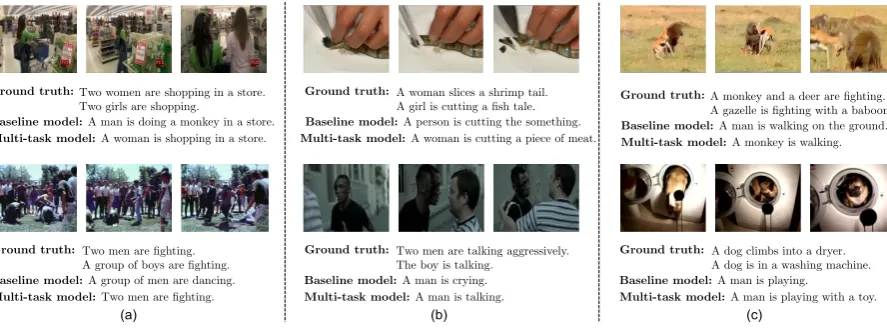
Figure 5: Examples of generated video captions on the YouTube2Text dataset: (a) complex examples where the multi-task model performs better than the baseline; (b) ambiguous examples (i.e., ground truth itself confusing) where multi-task model still correctly predicts one of the possible categories (c) complex examples where both models perform poorly.
[image:9.595.72.290.276.327.2]YouTube2Text Entailment Relev. Coher. Relev. Coher. Not Distinguish. 65.0% 93.0% 73.5% 94.5% Baseline Wins 14.0% 1.0% 12.5% 1.5% Multi-Task Wins 21.0% 6.0% 15.0% 4.0%
Table 5: Human evaluation on captioning and entailment.
Given Premise Generated
Entailment a man on stilts is playing a tuba for
money on the boardwalk a man is playingan instrument a girl looking through a large
tele-scope on a school trip a girl is lookingat something several young people sit at a table
playing poker people are play-ing a game the stop sign is folded up against the
side of the bus the sign is notmoving a blue and silver monster truck
mak-ing a huge jump over crushed cars a truck is beingdriven Table 6: Examples of our multi-task model’s generated en-tailment hypotheses given a premise.
and coherence, and with similar improvements (2-7%) as the automatic metrics (shown in Table 1).
5.5 Analysis
Fig. 5 shows video captioning generation re-sults on the YouTube2Text dataset where our fi-nal M-to-M multi-task model is compared with our strongest attention-based baseline model for three categories of videos: (a) complex examples where the multi-task model performs better than the baseline; (b) ambiguous examples (i.e., ground truth itself confusing) where multi-task model still correctly predicts one of the possible categories (c) complex examples where both models perform poorly. Overall, we find that the multi-task model generates captions that are better at both temporal action prediction and logical entailment (i.e., cor-rect subset of full video premise) w.r.t. the ground truth captions. The supplementary also provides
ablation examples of improvements by the 1-to-M video prediction based multi-task model alone, as well as by the M-to-1 entailment based multi-task model alone (over the baseline).
On analyzing the cases where the baseline is better than the final M-to-M multi-task model, we find that these are often scenarios where the multi-task model’s caption is also correct but the base-line caption is a bit more specific, e.g., “a man is holding a gun” vs “a man is shooting a gun”.
Finally, Table 6 presents output examples of our entailment generation multi-task model (Sec. 5.3), showing how the model accurately learns to pro-duce logically implied subsets of the premise.
6 Conclusion
We presented a multimodal, multi-task learning approach to improve video captioning by incor-porating temporally and logically directed knowl-edge via video prediction and entailment genera-tion tasks. We achieve the best reported results (and rank) on three datasets, based on multiple au-tomatic and human evaluations. We also show mu-tual multi-task improvements on the new entail-ment generation task. In future work, we are ap-plying our entailment-based multi-task paradigm to other directed language generation tasks such as image captioning and document summarization.
Acknowledgments
[image:9.595.73.289.352.480.2]References
Andreas Argyriou, Theodoros Evgeniou, and Massim-iliano Pontil. 2007. Multi-task feature learning. In
NIPS.
Dzmitry Bahdanau, Kyunghyun Cho, and Yoshua Ben-gio. 2015. Neural machine translation by jointly learning to align and translate. InICLR.
Samuel R Bowman, Gabor Angeli, Christopher Potts, and Christopher D Manning. 2015. A large anno-tated corpus for learning natural language inference. InEMNLP.
Rich Caruana. 1998. Multitask learning. InLearning to learn, Springer, pages 95–133.
David L Chen and William B Dolan. 2011. Collect-ing highly parallel data for paraphrase evaluation. In
Proceedings of the 49th Annual Meeting of the Asso-ciation for Computational Linguistics: Human Lan-guage Technologies-Volume 1. Association for Com-putational Linguistics, pages 190–200.
Xinlei Chen, Hao Fang, Tsung-Yi Lin, Ramakr-ishna Vedantam, Saurabh Gupta, Piotr Doll´ar, and C Lawrence Zitnick. 2015. Microsoft COCO cap-tions: Data collection and evaluation server. arXiv preprint arXiv:1504.00325.
Jia Deng, Wei Dong, Richard Socher, Li-Jia Li, Kai Li, and Li Fei-Fei. 2009. ImageNet: A large-scale hierarchical image database. InCVPR. IEEE, pages 248–255.
Michael Denkowski and Alon Lavie. 2014. Meteor universal: Language specific translation evaluation for any target language. InEACL.
Bradley Efron and Robert J Tibshirani. 1994. An intro-duction to the bootstrap. CRC press.
Sergio Guadarrama, Niveda Krishnamoorthy, Girish Malkarnenkar, Subhashini Venugopalan, Raymond Mooney, Trevor Darrell, and Kate Saenko. 2013. Youtube2text: Recognizing and describing arbitrary activities using semantic hierarchies and zero-shot recognition. InCVPR. pages 2712–2719.
Sepp Hochreiter and J¨urgen Schmidhuber. 1997. Long short-term memory. Neural computation
9(8):1735–1780.
Haiqi Huang, Yueming Lu, Fangwei Zhang, and Songlin Sun. 2013. A multi-modal clustering method for web videos. InInternational Conference on Trustworthy Computing and Services. pages 163– 169.
Sergey Ioffe and Christian Szegedy. 2015. Batch nor-malization: Accelerating deep network training by reducing internal covariate shift. InICML.
Sergio Jimenez, George Duenas, Julia Baquero, Alexander Gelbukh, Av Juan Dios B´atiz, and Av Mendiz´abal. 2014. UNAL-NLP: Combining soft cardinality features for semantic textual similarity, relatedness and entailment. In In SemEval. pages 732–742.
Diederik Kingma and Jimmy Ba. 2015. Adam: A method for stochastic optimization. InICLR.
Vladyslav Kolesnyk, Tim Rockt¨aschel, and Sebastian Riedel. 2016. Generating natural language inference chains. arXiv preprint arXiv:1606.01404.
Abhishek Kumar and Hal Daum´e III. 2012. Learning task grouping and overlap in multi-task learning. In
ICML.
Alice Lai and Julia Hockenmaier. 2014. Illinois-LH: A denotational and distributional approach to seman-tics. Proc. SemEval2:5.
Chin-Yew Lin. 2004. ROUGE: A package for auto-matic evaluation of summaries. In Text Summa-rization Branches Out: Proceedings of the ACL-04 workshop. volume 8.
Minh-Thang Luong, Quoc V. Le, Ilya Sutskever, Oriol Vinyals, and Lukasz Kaiser. 2016. Multi-task se-quence to sese-quence learning. InICLR.
Eric W Noreen. 1989. Computer-intensive methods for testing hypotheses. Wiley New York.
Pingbo Pan, Zhongwen Xu, Yi Yang, Fei Wu, and Yuet-ing Zhuang. 2016a. Hierarchical recurrent neural encoder for video representation with application to captioning. InCVPR. pages 1029–1038.
Yingwei Pan, Tao Mei, Ting Yao, Houqiang Li, and Yong Rui. 2016b. Jointly modeling embedding and translation to bridge video and language. InCVPR. pages 4594–4602.
Kishore Papineni, Salim Roukos, Todd Ward, and Wei-Jing Zhu. 2002. BLEU: a method for automatic evaluation of machine translation. In ACL. pages 311–318.
Karen Simonyan and Andrew Zisserman. 2015. Very deep convolutional networks for large-scale image recognition. InICLR.
Khurram Soomro, Amir Roshan Zamir, and Mubarak Shah. 2012. UCF101: A dataset of 101 human ac-tions classes from videos in the wild. arXiv preprint arXiv:1212.0402.
Nitish Srivastava, Elman Mansimov, and Ruslan Salakhutdinov. 2015. Unsupervised learning of video representations using lstms. InICML. pages 843–852.
Christian Szegedy, Sergey Ioffe, and Vincent Van-houcke. 2016. Inception-v4, inception-resnet and the impact of residual connections on learning. In
CoRR.
Christian Szegedy, Wei Liu, Yangqing Jia, Pierre Sermanet, Scott Reed, Dragomir Anguelov, Du-mitru Erhan, Vincent Vanhoucke, and Andrew Ra-binovich. 2015. Going deeper with convolutions. In
CVPR. pages 1–9.
Jesse Thomason, Subhashini Venugopalan, Sergio Guadarrama, Kate Saenko, and Raymond J Mooney. 2014. Integrating language and vision to generate natural language descriptions of videos in the wild. InCOLING.
Atousa Torabi, Christopher Pal, Hugo Larochelle, and Aaron Courville. 2015. Using descriptive video ser-vices to create a large data source for video annota-tion research.arXiv preprint arXiv:1503.01070.
Ramakrishna Vedantam, C Lawrence Zitnick, and Devi Parikh. 2015. CIDEr: Consensus-based image de-scription evaluation. InCVPR. pages 4566–4575.
Subhashini Venugopalan, Lisa Anne Hendricks, Ray-mond Mooney, and Kate Saenko. 2016. Improving lstm-based video description with linguistic knowl-edge mined from text. InEMNLP.
Subhashini Venugopalan, Marcus Rohrbach, Jeffrey Donahue, Raymond Mooney, Trevor Darrell, and Kate Saenko. 2015a. Sequence to sequence-video to text. InCVPR. pages 4534–4542.
Subhashini Venugopalan, Huijuan Xu, Jeff Donahue, Marcus Rohrbach, Raymond Mooney, and Kate Saenko. 2015b. Translating videos to natural lan-guage using deep recurrent neural networks. In
NAACL HLT.
Jun Xu, Tao Mei, Ting Yao, and Yong Rui. 2016. Msr-vtt: A large video description dataset for bridging video and language. InCVPR. pages 5288–5296.
Li Yao, Atousa Torabi, Kyunghyun Cho, Nicolas Bal-las, Christopher Pal, Hugo Larochelle, and Aaron Courville. 2015. Describing videos by exploiting temporal structure. InCVPR. pages 4507–4515.