88
Selecting NLP Techniques to Evaluate Learning Design Objectives in
Collaborative Multi-perspective Elaboration Activities
Aneesha Bakharia
Institute of Teaching and Learning Innovation The University of Queensland
Brisbane, Australia
Abstract
PerspectivesX is a multi-perspective elab-oration tool designed to encourage learner submission and curation across a range of collaborative learning activities. In this paper, it is shown that the learning design objectives of collaborative learn-ing activities can be evaluated uslearn-ing NLP techniques, but that careful analysis of learner impact and pedagogical intent are required in order to select appropriate techniques. In particular, this paper fo-cuses on the NLP techniques required to deliver an instructor dashboard, personal-ized learner feedback and content recom-mendation within multi-perspective elabo-ration activities. Key NLP techniques con-sidered for inclusion include summariza-tion, topic modeling, paraphrase detection and diversified content recommendation.
1 Introduction
PerspectivesX is a multi-perspective elaboration tool that allows instructors to create grid activities where students are able to both submit their own ideas and curate diverse ideas from other learn-ers (i.e., add ideas submitted by other learnlearn-ers to their own list) using a declarative user interface. PerspectivesX allows instructors to either select a multi-perspective elaboration template such as Strengths Weaknesses Threats and Opportunities (SWOT) analysis, Six Thinking Hats (De Bono and Pandolfo,1999) or define a custom template. PerspectivesX incorporates ideas from Computer Supported Collaborative Learning (CSCL) and the Knowledge Community of Inquiry (KCI) model (Slotta and Najafi,2013). The tool adheres to the key principles of KCI by providing a knowledge base of student perspective submissions (Principle
1), including curation mechanics (Principle 2&3) and facilitating instructor moderation (Principle 4) (Slotta and Najafi, 2013). The tool develop-ment has been directed by clear design guidelines (Bakharia and Lindley,2018).
NLP techniques have the potential to play an important role in collaborative learning activities, particularly at scale when a large number of learn-ers are participating (i.e., in MOOCs or within large on-campus courses with enrollments exceed-ing a thousand students). In this paper, the do-main of multi-perspective elaboration is used to illustrate that while Natural Language Processing (NLP) techniques are able to aid in the evaluation and implementation of key tool learning design objectives, that principled and critical analysis of learner impact is required in order to select appro-priate techniques.
2 PerspectivesX Functionality
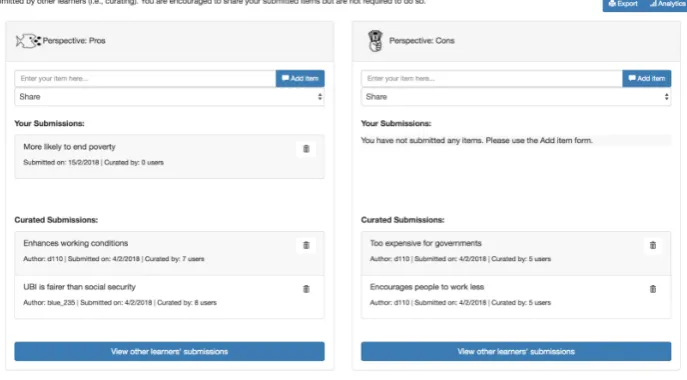
The PerspectivesX learner interface is shown in Figure 1. Each perspective is displayed as a grid element. Learners are able to submit new items and specify whether the item is shared with other learners, submitted as an anonymous submission or not shared. Learners are also able to view a full list of submissions for a perspective from all other learners and are able to curate items for in-clusion in their own grid (i.e., perspective). On each perspective grid, the items that a learner has submitted are clearly distinguished from their list of curated items. PerspectivesX encourages ac-tive participation, idea sharing and learner knowl-edge growth. In particular curation, should lead to learner knowledge diversification.
Figure 1: The learner multi-perspective activity submission interface.
systems via the LTI specification (LTI,2015).
3 Learning Design Objectives
Learning design objectives are targeted statements about the expected student performance when par-ticipating in a learning activity. In the case of multi-perspective elaboration, the learning design objectives define the pedagogical intent of learner interaction within the PerspectivesX tool. The aim of the PerspectivesX tool is to support the follow-ing learnfollow-ing design objectives:
1. Encourage students to submit ideas across all perspectives
2. Encourage students to curate a list of diverse ideas within and across perspectives
3. Trigger discussion among learners in a post-activity forum
4. Encourage students to start sharing ideas (even if they initially submit ideas as anony-mous or choose not to share ideas)
At scale when hundreds of learners are partic-ipating in a learning activity, it becomes difficult for instructors and learning designers to evaluate whether more complex learning design objectives are being met. NLP techniques may therefore be required to serve as computational aids. Learning Design Objectives 1, 3 and 4 are clearly able to be evaluated using simple statistical clickstream anal-ysis. The evaluation of Learning Design Objective
2, however, requires the use of NLP techniques. In the sections that follow, NLP techniques will be discussed and selected to assist both instructors in evaluating learning design objectives and learners in meeting the desired learning design objectives.
4 Learner Item Recommendation
The curation of diverse, original and innovative items is an intrinsic requirement of learner partic-ipation in a multi-perspective elaboration activity. NLP techniques are required to help the learner navigate the knowledge base consisting of ideas submitted by other learners.
Multiple learners may submit the same ideas but use slightly different phrases. Within the MOOC context where a cohort may reach sizes exceeding 100,000, the submission of similar items presents an information retrieval issue. The learner may need to read multiple pages of similar learner submissions. Either paraphrase detection (Socher et al.,2011) or clustering algorithms can be used in PerspectivesX. Similar student responses can be grouped together, with only the centroid submis-sion shown to learners.
activity too easy and not require any effort from the learner. The activity only becomes beneficial to learners if they are able to view others submis-sions and actively decide on the items that need to be curated. Curation in itself is a key 21st-century literacy that depends on critical inquiry and explo-ration (Mihailidis and Cohen,2013).
The use of a new algorithm that uses the out-put of a topic modeling algorithm provides a good solution to suggest a topic that a learner needs to curate items on, without suggesting the exact item. Topic modeling algorithms such as Latent Dirich-let Allocation (Blei et al.,2003) and Non Negative Matrix Factorization (Xu et al., 2003) are able to find the topics within a document collection. An item to word matrix needs to be created from stu-dent submissions and passed to the topic modeling algorithm. The output of the topic modeling algo-rithm is a topic defined by the top words and top documents that belong to the topic.
The algorithm implemented in PerspectivesX, matches a learners submissions to topics and sug-gests topics that the learner has not submitted or curated items on. As only a few top words in a topic are shown to the learner, the learner is still required to explore the knowledge base. For a fu-ture release, a topic labeling technique (Mei et al., 2007) will be included as some topics can be hard to interpret from only the top words.
5 The Instructor Dashboard
Submission count distributions are included for each perspective to support the evaluation of Learning Design Objective 1. The instructor dash-board currently includes a timeline chart with a series for each sharing option (i.e., shared with other learners, shared anonymously or not shared). The timeline gives the instructor an indication of learner sharing behavior over time to support the evaluation of Learning Design Objective 4. NLP techniques are however required to aid in the eval-uation of Learning Design Objective 2 (i.e., “En-courage students to curate a list of diverse ideas within and across perspectives”). In order to eval-uate Learning Design Objective 2, instructors re-quire the ability to gain a high-level overview of student submissions.
Summarization, either abstractive (Luo et al., 2016) or subtractive (Rush et al.,2015), was ini-tially considered to provide a high-level overview of learner contributions and curated items.
Sum-marization techniques were however found to be inappropriate because usually only a top sentence is returned. Instructors need an indication of how learners as a group are contributing and the top-ics that are being covered. Topic modeling was selected as the high-level overview of topics was found to be more conducive to the aims of instruc-tors.
Topic modeling algorithms, by returning the key topics in a collection of documents, provide a high-level overview of the topics encapsulating the items submitted by learners to a perspective. As topic modeling algorithms return both the top words and top documents (i.e., items) in a topic, the instructor is given an indication of the number of learner submissions per topic. As the top words in a topic may be hard for the instructor to inter-pret, the topnitems are displayed wherencan be specified.
While providing a high-level overview of the topics covered by learner submissions, the topic modeling algorithms (both NMF and LDA) are not able to directly return the number of students that have contributed to a topic. This is, however, de-termined by linking the top documents in a topic to the author (i.e., learner) of the item. Once the top-ics that a learner has contributed to has been deter-mined, a distribution of the number of topics learn-ers have contributed to, can be calculated. The distribution of learner submissions to topics pro-vides useful insight to the instructor on whether a diverse range of topics is being addressed by learn-ers for each plearn-erspective.
Topic modeling can also be applied to curated items as well. In particular, the topics of submitted items can be compared to the topics that are being curated. The comparison of topics gives a good indication of the level of originality in learner sub-missions and how ideas have diversified after cu-ration.
6 Instructor Provided Feedback
ei-ther be displayed on the learner’s submission grid or sent via email.
Instructor feedback also needs to address mis-conceptions. Topic modeling algorithms, how-ever, will include both the correct and incorrect items in the same topic if they use similar words. Providing keyword-in-context functionality will help the instructor to inspect word usage. The inclusion of keyword-in-context functionality has been shown to aid in the interpretation of topic models and allow the user to gather supporting ev-idence (Bakharia, 2018). Instructors are able to view and click on top words in a topic with the top words highlighted within the text of student sub-mitted items. Paraphrase detection and clustering can also be used to group similar learner submit-ted items within a topic, making it easier for in-structors to gain an overview of the range of items that are placed in the topic. Once misconceptions are identified, they can be linked back to contribut-ing or curatcontribut-ing learners, with appropriate feedback provided.
Instructor feedback can either direct learners to submit additional items for a perspective or pro-vide guidance on the types of items that must be curated.
7 Discussion
While NLP techniques are able to support key learning design objectives, critical analysis of ped-agogical intent must be conducted. The exam-ples presented in this paper have shown that con-tent (i.e., item) recommendation distracts from the purpose of curation (i.e., critical inquiry and ex-ploration) and that a hybrid topic modeling and recommendation algorithm is instead able to meet pedagogical intent.
Both abstractive and subjective summarization were also considered as NLP options to provide instructors with a high-level overview of learner submissions per perspective. Summarization algo-rithms, however, produce a single sentence which would not provide the instructor with an overview of all topics being discussed and a count of learner contributions across topics. Topic modeling algo-rithms were selected for inclusion on the instructor dashboard but required enhancements. The output of topic modeling algorithms in particular, need to link items (i.e., documents) back to their authors (i.e., learners) to enable learner contribution and curation distribution counts per perspective to be
calculated.
Topic modeling was also found to be useful in helping the instructor identify student misconcep-tions but only if the keyword-in-context function-ality was included.
8 Conclusion
In this paper, the rationale underpinning the selec-tion of NLP techniques for PerspectivesX, a col-laborative multi-perspective elaboration and cura-tion tool were discussed. NLP techniques were re-quired to support and aid in the evaluation of a key learning design objective (“Encourage students to curate a list of diverse ideas within and across per-spectives”). NLP techniques were considered for inclusion in an instructor dashboard, to help the in-structor provide feedback and to recommend con-tent items for learners to curate. Paraphrase de-tection and clustering were able to be used to help group together similar student submissions. A hy-brid topic modeling algorithm was found to pro-vide a viable solution for providing a high level overview of the topics learners were contributing to within a perspective for instructors. Diversified content recommendation algorithms were found to detract from the pedagogical intent of curation by making the selection of items too simplistic for learners. A hybrid topic modeling and recommen-dation algorithm was selected instead to recom-mend topics that the learner had to curate item on rather than the actual items to curate. Summariza-tion algorithms were not selected as their single sentence output did not provide instructors with an appropriate high-level overview for analysing student contributions.
References
Aneesha Bakharia. 2018. Designing interactive topic discovery systems for research and decision making. InIntelligent Decision Technologies.
Aneesha Bakharia and Marco Lindley. 2018. Perspec-tivesx: A collaborative multi-perspective elabora-tion learning tool. InSmart Education and eLearn-ing Conference ProceedeLearn-ings.
David M Blei, Andrew Y Ng, and Michael I Jordan. 2003. Latent dirichlet allocation. Journal of ma-chine Learning research, 3(Jan):993–1022.
IMS LTI. 2015. Learning tools interoperability specifi-cation. IMS Global Learning Consortium.
Wencan Luo, Fei Liu, Zitao Liu, and Diane Litman. 2016. Automatic summarization of student course feedback. InProceedings of the 2016 Conference of the North American Chapter of the Association for Computational Linguistics: Human Language Tech-nologies, pages 80–85.
Qiaozhu Mei, Xuehua Shen, and ChengXiang Zhai. 2007. Automatic labeling of multinomial topic models. InProceedings of the 13th ACM SIGKDD international conference on Knowledge discovery and data mining, pages 490–499. ACM.
Paul Mihailidis and James Cohen. 2013. Exploring cu-ration as a core competency in digital and media lit-eracy education. Journal of Interactive Media in Ed-ucation, 2013(1).
Alexander M Rush, Sumit Chopra, and Jason We-ston. 2015. A neural attention model for ab-stractive sentence summarization. arXiv preprint arXiv:1509.00685.
James D. Slotta and Hedieh Najafi. 2013. Supporting Collaborative Knowledge Construction with Web 2.0 Technologies. Springer New York, New York, NY.
Richard Socher, Eric H Huang, Jeffrey Pennin, Christo-pher D Manning, and Andrew Y Ng. 2011. Dy-namic pooling and unfolding recursive autoencoders for paraphrase detection. InAdvances in neural in-formation processing systems, pages 801–809.