946
Transformation Networks for Target-Oriented Sentiment Classification
∗Xin Li1, Lidong Bing2, Wai Lam1and Bei Shi1
1Department of Systems Engineering and Engineering Management
The Chinese University of Hong Kong, Hong Kong
2Tencent AI Lab, Shenzhen, China
{lixin,wlam,bshi}@se.cuhk.edu.hk [email protected]
Abstract
Target-oriented sentiment classification aims at classifying sentiment polarities over individual opinion targets in a sen-tence. RNN with attention seems a good fit for the characteristics of this task, and indeed it achieves the state-of-the-art per-formance. After re-examining the draw-backs of attention mechanism and the ob-stacles that block CNN to perform well in this classification task, we propose a new model to overcome these issues. Instead of attention, our model employs a CNN layer to extract salient features from the trans-formed word representations originated from a bi-directional RNN layer. Between the two layers, we propose a component to generate target-specific representations of words in the sentence, meanwhile in-corporate a mechanism for preserving the original contextual information from the RNN layer. Experiments show that our model achieves a new state-of-the-art per-formance on a few benchmarks.1
1 Introduction
Target-oriented (also mentioned as “target-level” or “aspect-level” in some works) sentiment clas-sification aims to determine sentiment polarities over “opinion targets” that explicitly appear in the sentences (Liu, 2012). For example, in the sen-tence“I am pleased with the fast log on, and the long battery life”, the user mentions two targets
∗
The work was done when Xin Li was an intern at Ten-cent AI Lab. This project is substantially supported by a grant from the Research Grant Council of the Hong Kong Special Administrative Region, China (Project Code: 14203414).
1Our code is open-source and available at https://
github.com/lixin4ever/TNet
“log on” and “better life”, and expresses positive sentiments over them. The task is usually formu-lated as predicting a sentiment category for a (tar-get, sentence) pair.
Recurrent Neural Networks (RNNs) with at-tention mechanism, firstly proposed in machine translation (Bahdanau et al., 2014), is the most commonly-used technique for this task. For ex-ample, Wang et al. (2016); Tang et al. (2016b);
Yang et al. (2017); Liu and Zhang (2017); Ma et al.(2017) andChen et al.(2017) employ atten-tion to measure the semantic relatedness between each context word and the target, and then use the induced attention scores to aggregate contex-tual features for prediction. In these works, the attention weight based combination of word-level features for classification may introduce noise and downgrade the prediction accuracy. For example, in “This dish is my favorite and I always get it and never get tired of it.”, these approaches tend to involve irrelevant words such as “never” and “tired” when they highlight the opinion modifier “favorite”. To some extent, this drawback is rooted in the attention mechanism, as also observed in machine translation (Luong et al., 2015) and im-age captioning (Xu et al.,2015).
Another observation is that the sentiment of a target is usually determined by key phrases such as “is my favorite”. By this token, Convolu-tional Neural Networks (CNNs)—whose capabil-ity for extracting the informative n-gram features (also called “active local features”) as sentence representations has been verified in (Kim, 2014;
meth-ods (Tang et al., 2016a).2 Moreover, it is hard for vanilla CNN to differentiate opinion words of multiple targets. Precisely, multiple active local features holding different sentiments (e.g., “great food” and “service was dreadful”) may be cap-tured for a single target, thus it will hinder the pre-diction.
We propose a new architecture, named Target-Specific Transformation Networks (TNet), to solve the above issues in the task of target senti-ment classification. TNet firstly encodes the con-text information into word embeddings and gener-ates the contextualized word representations with LSTMs. To integrate the target information into the word representations, TNet introduces a novel Target-Specific Transformation (TST) component for generating the target-specific word representa-tions. Contrary to the previous attention-based ap-proaches which apply the same target representa-tion to determine the attenrepresenta-tion scores of individual context words, TST firstly generates different rep-resentations of the target conditioned on individual context words, then it consolidates each context word with its tailor-made target representation to obtain the transformed word representation. Con-sidering the context word “long” and the target “battery life” in the above example, TST firstly measures the associations between “long” and in-dividual target words. Then it uses the association scores to generate the target representation con-ditioned on “long”. After that, TST transforms the representation of “long” into its target-specific version with the new target representation. Note that “long” could also indicate a negative senti-ment (say for “startup time”), and the above TST is able to differentiate them.
As the context information carried by the rep-resentations from the LSTM layer will be lost after the non-linear TST, we design a context-preserving mechanism to contextualize the gen-erated target-specific word representations. Such mechanism also allows deep transformation struc-ture to learn abstract feastruc-tures3. To help the CNN feature extractor locate sentiment indicators more accurately, we adopt a proximity strategy to scale the input of convolutional layer with positional rel-evance between a word and the target.
2One method could be concatenating the target represen-tation with each word represenrepresen-tation, but the effect as shown in (Wang et al.,2016) is limited.
3Abstract features usually refer to the features ultimately useful for the task (Bengio et al.,2013;LeCun et al.,2015).
In summary, our contributions are as follows:
•TNet adapts CNN to handle target-level senti-ment classification, and its performance dominates the state-of-the-art models on benchmark datasets.
•A novel Target-Specific Transformation com-ponent is proposed to better integrate target infor-mation into the word representations.
•A context-preserving mechanism is designed to forward the context information into a deep transformation architecture, thus, the model can learn more abstract contextualized word features from deeper networks.
2 Model Description
Given a target-sentence pair (wτ,w), where wτ = {wτ
1, wτ2, ..., wmτ} is a sub-sequence of
w = {w1, w2, ..., wn}, and the corresponding word embeddingsxτ ={xτ
1, xτ2, ..., xτm}andx= {x1, x2, ..., xn}, the aim of target sentiment clas-sification is to predict the sentiment polarityy ∈ {P, N, O}of the sentencew over the target wτ, whereP,N andO denote “positive”, “negative” and “neutral” sentiments respectively.
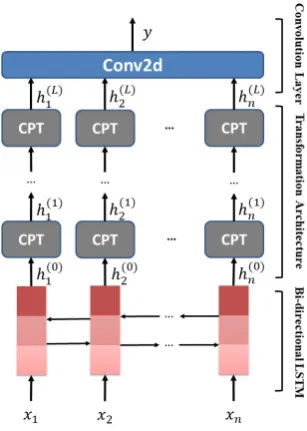
The architecture of the proposed Target-Specific Transformation Networks (TNet) is shown in Fig.1. The bottom layer is a BiLSTM which transforms the inputx={x1, x2, ..., xn} ∈
Rn×dimw into the contextualized word
represen-tationsh(0) = {h(0)1 , h2(0), ..., h(0)n } ∈ Rn×2dimh
(i.e. hidden states of BiLSTM), where dimw
anddimhdenote the dimensions of the word
em-beddings and the hidden representations respec-tively. The middle part, the core part of our TNet, consists ofLContext-Preserving Transfor-mation (CPT) layers. The CPT layer incorporates the target information into the word representa-tions via a novel Target-Specific Transformation (TST) component. CPT also contains a context-preserving mechanism, resembling identity map-ping (He et al., 2016a,b) and highway connec-tion (Srivastava et al.,2015a,b), allows preserving the context information and learning more abstract word-level features using a deep network. The top most part is a position-aware convolutional layer which first encodes positional relevance between a word and a target, and then extracts informative features for classification.
2.1 Bi-directional LSTM Layer
Figure 1: Architecture of TNet.
effective way to represent a word in convolution-based architectures. TNet also employs a BiL-STM to accumulate the context information for each word of the input sentence, i.e., the bottom part in Fig.1. For simplicity and space issue, we denote the operation of an LSTM unit on xi as LSTM(xi). Thus, the contextualized word
repre-sentationh(0)i ∈R2dimhis obtained as follows:
h(0)i = [−LSTM−−−→(xi); ←−−−−
LSTM(xi)], i∈[1, n]. (1)
2.2 Context-Preserving Transformation
The above word-level representation has not con-sidered the target information yet. Traditional attention-based approaches keep the word-level features static and aggregate them with weights as the final sentence representation. In contrast, as shown in the middle part in Fig. 1, we intro-duce multiple CPT layers and the detail of a sin-gle CPT is shown in Fig. 2. In each CPT layer, a tailor-made TST component that aims at better consolidating word representation and target rep-resentation is proposed. Moreover, we design a context-preserving mechanism enabling the learn-ing of target-specific word representations in a deep neural architecture.
2.2.1 Target-Specific Transformation
[image:3.595.105.259.67.283.2]TST component is depicted with the TST block in Fig.2. The first task of TST is to generate the rep-resentation of the target. Previous methods (Chen
Figure 2: Details of a CPT module.
et al.,2017;Liu and Zhang,2017) average the em-beddings of the target words as the target repre-sentation. This strategy may be inappropriate in some cases because different target words usually do not contribute equally. For example, in the tar-get “amd turin processor”, the word “processor” is more important than “amd” and “turin”, because the sentiment is usually conveyed over the phrase head, i.e.,“processor”, but seldom over modifiers (such as brand name “amd”). Ma et al.(2017) at-tempted to overcome this issue by measuring the importance score between each target word repre-sentation and the averaged sentence vector. How-ever, it may be ineffective for sentences expressing multiple sentiments (e.g.,“Air has higher resolu-tion but the fonts are small.”), because taking the average tends to neutralize different sentiments.
We propose to dynamically compute the impor-tance of target words based on each sentence word rather than the whole sentence. We first employ another BiLSTM to obtain the target word repre-sentationshτ ∈Rm×2dimh:
hjτ = [−LSTM−−−→(xτj);LSTM←−−−−(xτj)], j ∈[1, m]. (2)
Then, we dynamically associate them with each wordwiin the sentence to tailor-make target
rep-resentationriτ at the time stepi:
riτ =
m X
j=1
hτj ∗ F(h(il), hτj), (3)
thei-th word-level representationh(il):
F(h(il), hτj) = exp (h (l)>
i hτj) Pm
k=1exp (h (l)>
i hτk)
. (4)
Finally, the concatenation ofrτi andh(il)is fed into a fully-connected layer to obtain the i-th target-specific word representationhi˜(l):
˜
hi(l)=g(Wτ[hi(l):riτ] +bτ), (5)
whereg(∗)is a non-linear activation function and “:” denotes vector concatenation. Wτ andbτ are the weights of the layer.
2.2.2 Context-Preserving Mechanism
After the non-linear TST (see Eq. 5), the con-text information captured with concon-textualized rep-resentations from the BiLSTM layer will be lost since the mean and the variance of the features within the feature vector will be changed. To take advantage of the context information, which has been proved to be useful in (Lai et al., 2015), we investigate two strategies: Lossless Forward-ing (LF) and Adaptive ScalForward-ing (AS), to pass the context information to each following layer, as de-picted by the block “LF/AS” in Fig. 2. Accord-ingly, the model variants are namedTNet-LFand
TNet-AS.
Lossless Forwarding. This strategy preserves context information by directly feeding the fea-tures before the transformation to the next layer. Specifically, the inputh(il+1)of the(l+ 1)-th CPT layer is formulated as:
hi(l+1) =h(il)+ ˜hi(l), i∈[1, n], l∈[0, L], (6)
where h(il) is the input of the l-th layer and h˜(il)
is the output of TST in this layer. We unfold the recursive form of Eq.6as follows:
h(il+1) =h(0)i +TST(hi(0))+· · ·+TST(h(il)). (7)
Here, we denote˜h(il) asTST(h(il)). From Eq. 7, we can see that the output of each layer will con-tain the contextualized word representations (i.e.,
h(0)i ), thus, the context information is encoded into the transformed features. We call this strat-egy “Lossless Forwarding” because the contex-tualized representations and the transformed rep-resentations (i.e., TST(h(il))) are kept unchanged during the feature combination.
Adaptive Scaling. Lossless Forwarding intro-duces the context information by directly adding back the contextualized features to the trans-formed features, which raises a question: Can the weights of the input and the transformed fea-tures be adjusted dynamically? With this motiva-tion, we propose another strategy, named “Adap-tive Scaling”. Similar to the gate mechanism in RNN variants (Jozefowicz et al.,2015), Adaptive Scaling introduces a gating function to control the passed proportions of the transformed features and the input features. The gatet(l)as follows:
ti(l)=σ(Wtranshi(l)+btrans), (8)
wheret(il)is the gate for the i-th input of thel-th CPT layer, andσ is thesigmoid activation func-tion. Then we perform convex combination ofh(il)
and˜h(il)based on the gate:
h(il+1) =t(il)h˜i(l)+ (1−ti(l))h(il). (9)
Here,denotes element-wise multiplication. The non-recursive form of this equation is as follows (for clarity, we ignore the subscripts):
h(l+1) = [
l Y
k=0
(1−t(k))]h(0)
+[t(0) l Y
k=1
(1−t(k))]TST(h(0)) +· · ·
+t(l−1)(1−t(l))TST(h(l−1)) +t(l)TST(h(l)).
Thus, the context information is integrated in each upper layer and the proportions of the contex-tualized representations and the transformed rep-resentations are controlled by the computed gates in different transformation layers.
2.3 Convolutional Feature Extractor
# Positive # Negative # Neutral
LAPTOP Train 980 858 454
Test 340 128 171
REST Train 2159 800 632
Test 730 195 196
TWITTER Train 1567 1563 3127
Test 174 174 346
Table 1: Statistics of datasets.
Specifically, we first calculate the position rel-evancevi between the i-th word and the target4:
vi =
1−(k+mC−i) i < k+m
1−i−Ck k+m≤i≤n
0 i > n
(10)
wherekis the index of the first target word,Cis a pre-specified constant, andm is the length of the targetwτ. Then, we usevto help CNN locate the correct opinion w.r.t. the given target:
ˆ
h(il)=h(il)∗vi, i∈[1, n], l ∈[1, L]. (11)
Based on Eq.10 and Eq. 11, the words close to the target will be highlighted and those far away will be downgraded. v is also applied on the in-termediate output to introduce the position infor-mation into each CPT layer. Then we feed the weightedh(L) to the convolutional layer, i.e., the top-most layer in Fig. 1, to generate the feature mapc∈Rn−s+1as follows:
ci= ReLU(w>convh
(L)
i:i+s−1+bconv), (12)
whereh(i:Li+)s−1∈Rs·dimhis the concatenated
vec-tor of ˆh(iL),· · ·,hˆ(i+L)s−1, ands is the kernel size.
wconv ∈ Rs·dimh and bconv ∈ R are learnable
weights of the convolutional kernel. To capture the most informative features, we apply max pool-ing (Kim,2014) and obtain the sentence represen-tationz∈Rnk by employingn
kkernels:
z= [max(c1),· · · ,max(cnk)]>. (13)
Finally, we pass z to a fully connected layer for sentiment prediction:
p(y|wτ,w) = Softmax(Wfz+bf). (14)
whereWf andbf are learnable parameters.
4As we perform sentence padding, it is possible that the indexiis larger than the actual lengthnof the sentence.
3 Experiments
3.1 Experimental Setup
As shown in Table 1, we evaluate the proposed TNet on three benchmark datasets: LAPTOPand
REST are from SemEval ABSA challenge ( Pon-tiki et al.,2014), containing user reviews in laptop domain and restaurant domain respectively. We also remove a few examples having the “conflict label” as done in (Chen et al., 2017); TWITTER
is built byDong et al. (2014), containing twitter posts. All tokens are lowercased without removal of stop words, symbols or digits, and sentences are zero-padded to the length of the longest sentence in the dataset. Evaluation metrics are Accuracy and Macro-Averaged F1 where the latter is more appropriate for datasets with unbalanced classes. We also conduct pairwise t-test on both Accuracy and Macro-Averaged F1 to verify if the improve-ments over the compared models are reliable.
TNet is compared with the following methods.
• SVM (Kiritchenko et al., 2014): It is a tra-ditional support vector machine based model with extensive feature engineering;
• AdaRNN(Dong et al., 2014): It learns the sentence representation toward target for sen-timent prediction via semantic composition over dependency tree;
• AE-LSTM, andATAE-LSTM(Wang et al.,
2016): AE-LSTM is a simple LSTM model incorporating the target embedding as input, while ATAE-LSTM extends AE-LSTM with attention;
• IAN (Ma et al., 2017): IAN employs two LSTMs to learn the representations of the context and the target phrase interactively;
• CNN-ASP: It is a CNN-based model imple-mented by us which directly concatenates tar-get representation to each word embedding;
• TD-LSTM(Tang et al., 2016a): It employs two LSTMs to model the left and right con-texts of the target separately, then performs predictions based on concatenated context representations;
Hyper-params TNet-LF TNet-AS
LAPTOP REST TWITTER LAPTOP REST TWITTER
dimw 300 300
dimh 50 50
dropout rates (plstm,psent) (0.3, 0.3) (0.3, 0.3)
L 2 2
batch size 64 25 64 64 32 64
s 3 3
nk 50 100
[image:6.595.86.513.63.199.2]C 40.0 30.0
Table 2: Settings of hyper-parameters.
based on the top-most sentence representa-tions;
• BILSTM-ATT-G (Liu and Zhang, 2017): It models left and right contexts using two attention-based LSTMs and introduces gates to measure the importance of left context, right context, and the entire sentence for the prediction;
• RAM(Chen et al.,2017): RAM is a multi-layer architecture where each multi-layer consists of attention-based aggregation of word fea-tures and a GRU cell to learn the sentence representation.
We run the released codes of TD-LSTM and BILSTM-ATT-G to generate results, since their papers only reported results on TWITTER. We also rerun MemNet on our datasets and evaluate it with both accuracy and Macro-Averaged F1.5
We use pre-trained GloVe vectors (Pennington et al., 2014) to initialize the word embeddings and the dimension is 300 (i.e., dimw = 300).
For out-of-vocabulary words, we randomly sam-ple their embeddings from the uniform distribu-tionU(−0.25,0.25), as done in (Kim,2014). We only use one convolutional kernel size because it was observed that CNN with single optimal ker-nel size is comparable with CNN having multiple kernel sizes on small datasets (Zhang and Wallace,
2017). To alleviate overfitting, we apply dropout on the input word embeddings of the LSTM and the ultimate sentence representationz. All weight matrices are initialized with the uniform distribu-tionU(−0.01,0.01)and the biases are initialized
5The codes of TD-LSTM/MemNet and BILSTM-ATT-G are available at:http://ir.hit.edu.cn/˜dytang andhttp://leoncrashcode.github.io. Note that MemNet was only evaluated with accuracy.
as zeros. The training objective is cross-entropy, and Adam (Kingma and Ba, 2015) is adopted as the optimizer by following the learning rate and the decay rates in the original paper.
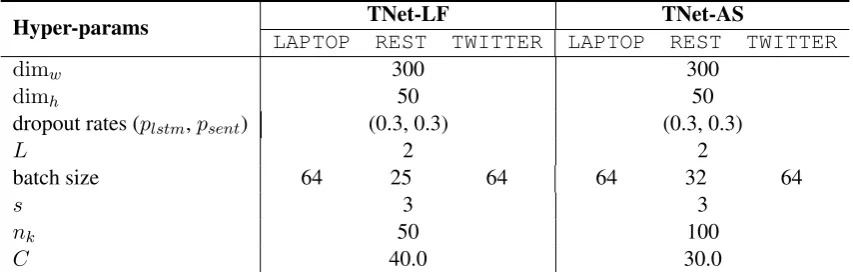
The hyper-parameters of LF and TNet-AS are listed in Table 2. Specifically, all hyper-parameters are tuned on 20% randomly held-out training data and the hyper-parameter collection producing the highest accuracy score is used for testing. Our model has comparable number of parameters compared to traditional LSTM-based models as we reuse parameters in the transforma-tion layers and BiLSTM.6
3.2 Main Results
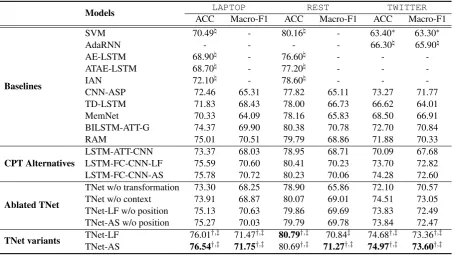
As shown in Table3, both TNet-LF and TNet-AS consistently achieve the best performance on all datasets, which verifies the efficacy of our whole TNet model. Moreover, TNet can perform well for different kinds of user generated content, such as product reviews with relatively formal sentences inLAPTOPandREST, and tweets with more un-grammatical sentences in TWITTER. The reason is the CNN-based feature extractor arms TNet with more power to extract accurate features from ungrammatical sentences. Indeed, we can also ob-serve that another based baseline, i.e., CNN-ASP implemented by us, also obtains good results onTWITTER.
On the other hand, the performance of those comparison methods is mostly unstable. For the tweet in TWITTER, the competitive BILSTM-ATT-G and RAM cannot perform as effective as they do for the reviews inLAPTOPandREST, due to the fact that they are heavily rooted in LSTMs and the ungrammatical sentences hinder their
Models LAPTOP REST TWITTER
ACC Macro-F1 ACC Macro-F1 ACC Macro-F1
Baselines
SVM 70.49\ - 80.16\ - 63.40∗ 63.30∗
AdaRNN - - - - 66.30\ 65.90\
AE-LSTM 68.90\ - 76.60\ - -
-ATAE-LSTM 68.70\ - 77.20\ - -
-IAN 72.10\ - 78.60\ - -
-CNN-ASP 72.46 65.31 77.82 65.11 73.27 71.77
TD-LSTM 71.83 68.43 78.00 66.73 66.62 64.01
MemNet 70.33 64.09 78.16 65.83 68.50 66.91
BILSTM-ATT-G 74.37 69.90 80.38 70.78 72.70 70.84
RAM 75.01 70.51 79.79 68.86 71.88 70.33
CPT Alternatives
LSTM-ATT-CNN 73.37 68.03 78.95 68.71 70.09 67.68
LSTM-FC-CNN-LF 75.59 70.60 80.41 70.23 73.70 72.82
LSTM-FC-CNN-AS 75.78 70.72 80.23 70.06 74.28 72.60
Ablated TNet
TNet w/o transformation 73.30 68.25 78.90 65.86 72.10 70.57
TNet w/o context 73.91 68.87 80.07 69.01 74.51 73.05
TNet-LF w/o position 75.13 70.63 79.86 69.69 73.83 72.49
TNet-AS w/o position 75.27 70.03 79.79 69.78 73.84 72.47
TNet variants TNet-LF 76.01
†,‡ 71.47†,‡ 80.79†,‡ 70.84‡ 74.68†,‡ 73.36†,‡
[image:7.595.73.527.62.317.2]TNet-AS 76.54†,‡ 71.75†,‡ 80.69†,‡ 71.27†,‡ 74.97†,‡ 73.60†,‡
Table 3: Experimental results (%). The results with symbol“\” are retrieved from the original papers, and those starred (∗) one are fromDong et al.(2014). The marker†refers top-value<0.01 when comparing with BILSTM-ATT-G, while the marker‡refers top-value<0.01 when comparing with RAM.
pability in capturing the context features. Another difficulty caused by the ungrammatical sentences is that the dependency parsing might be error-prone, which will affect those methods such as AdaRNN using dependency information.
From the above observations and analysis, some takeaway message for the task of target sentiment classification could be:
• LSTM-based models relying on sequential information can perform well for formal sen-tences by capturing more useful context fea-tures;
• For ungrammatical text, CNN-based mod-els may have some advantages because CNN aims to extract the most informative n-gram features and is thus less sensitive to informal texts without strong sequential patterns.
3.3 Performance of Ablated TNet
To investigate the impact of each component such as deep transformation, context-preserving mech-anism, and positional relevance, we perform com-parison between the full TNet models and its abla-tions (the third group in Table3). After removing the deep transformation (i.e., the techniques intro-duced in Section 2.2), both LF and TNet-AS are reduced to TNet w/o transformation (where
position relevance is kept), and their results in both accuracy and F1 measure are incomparable with those of TNet. It shows that the integration of tar-get information into the word-level representations is crucial for good performance.
Comparing the results of TNet and TNet w/o context (where TST and position relevance are kept), we observe that the performance of TNet w/o context drops significantly on LAPTOP and
REST7, while on TWITTER, TNet w/o context performs very competitive (p-values with TNet-LF and TNet-AS are 0.066 and 0.053 respec-tively for Accuracy). Again, we could attribute this phenomenon to the ungrammatical user gen-erated content of twitter, because the context-preserving component becomes less important for such data. TNet w/o context performs consistently better than TNet w/o transformation, which veri-fies the efficacy of the target specific transforma-tion (TST), before applying context-preserving.
As for the position information, we conduct statistical t-test between LF/AS and TNet-LF/AS w/o position together with performance comparison. All of the produced p-values are less than 0.05, suggesting that the improvements brought in by position information are significant.
3.4 CPT versus Alternatives
The next interesting question is what if we replace the transformation module (i.e., the CPT layers in Fig.1) of TNet with other commonly-used compo-nents? We investigate two alternatives: attention mechanism and fully-connected (FC) layer, result-ing in three pipelines as shown in the second group of Table3(position relevance is kept for them).
LSTM-ATT-CNN applies attention as the al-ternative8, and it does not need the context-preserving mechanism. It performs unexception-ally worse than the TNet variants. We are sur-prised that LSTM-ATT-CNN is even worse than TNet w/o transformation (a pipeline simply re-moving the transformation module) onTWITTER. More concretely, applying attention results in neg-ative effect on TWITTER, which is consistent with the observation that all those attention-based state-of-the-art methods (i.e., TD-LSTM, Mem-Net, BILSTM-ATT-G, and RAM) cannot perform well onTWITTER.
LSTM-FC-CNN-LF and LSTM-FC-CNN-AS are built by applying FC layer to replace TST and keeping the context-preserving mechanism (i.e., LF and AS). Specifically, the concatena-tion of word representaconcatena-tion and the averaged tar-get vector is fed to the FC layer to obtain tartar-get- target-specific features. Note that LSTM-FC-CNN-LF/AS are equivalent to TNet-LSTM-FC-CNN-LF/AS when pro-cessing single-word targets (see Eq.3). They ob-tain competitive results on all datasets: compara-ble with or better than the state-of-the-art methods. The TNet variants can still outperform LSTM-FC-CNN-LF/AS with significant gaps, e.g., on
LAPTOP and REST, the accuracy gaps between TNet-LF and LSTM-FC-CNN-LF are 0.42% (p <
0.03) and 0.38% (p <0.04) respectively.
3.5 Impact of CPT Layer Number
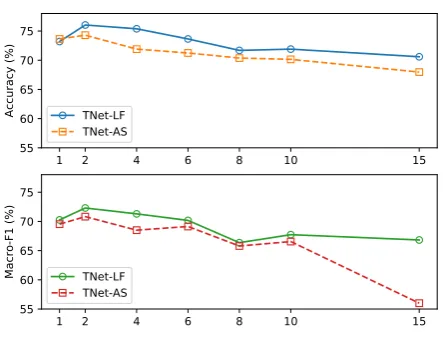
As our TNet involves multiple CPT layers, we in-vestigate the effect of the layer numberL. Specif-ically, we conduct experiments on the held-out training data of LAPTOP and vary L from 2 to 10, increased by 2. The casesL=1 andL=15 are also included. The results are illustrated in Fig-ure 3. We can see that both LF and TNet-AS achieve the best results whenL=2. While in-creasingL, the performance is basically becoming worse. For largeL, the performance of TNet-AS
8We tried different attention mechanisms and report the best one here, namely,dotattention (Luong et al.,2015).
1 2 4 6 8 10 15
55 60 65 70 75
Accuracy (%) TNet-LF TNet-AS
1 2 4 6 8 10 15
55 60 65 70 75
[image:8.595.309.531.62.242.2]Macro-F1 (%) TNet-LF TNet-AS
Figure 3: Effect ofL.
generally becomes more sensitive, it is probably because AS involves extra parameters (see Eq 9) that increase the training difficulty.
3.6 Case Study
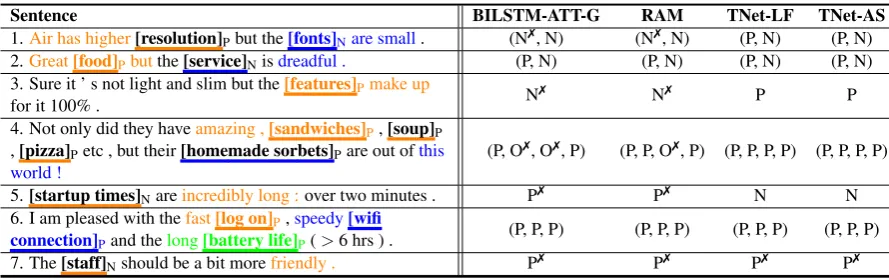
Table4shows some sample cases. The input tar-gets are wrapped in the brackets with true labels given as subscripts. The notations P, N and O in the table represent positive, negative and neu-tral respectively. For each sentence, we under-line the target with a particular color, and the text of its corresponding most informative n-gram feature9 captured by TNet-AS (TNet-LF captures very similar features) is in the same color (so color printing is preferred). For example, for the target “resolution” in the first sentence, the captured fea-ture is “Air has higher”. Note that as discussed above, the CNN layer of TNet captures such tures with the size-three kernels, so that the fea-tures are trigrams. Each of the last feafea-tures of the second and seventh sentences contains a padding token, which is not shown.
Our TNet variants can predict target sentiment more accurately than RAM and BILSTM-ATT-G in the transitional sentences such as the first sen-tence by capturing correct trigram features. For the third sentence, its second and third most infor-mative trigrams are “100% . PAD” and “’ s not”, being used together with “features make up”, our models can make correct predictions. Moreover, TNet can still make correct prediction when the explicit opinion is target-specific. For example,
9
Sentence BILSTM-ATT-G RAM TNet-LF TNet-AS
1.Air has higher[resolution]Pbut the[fonts]Nare small. (N7, N) (N7, N) (P, N) (P, N)
2.Great[food]Pbutthe[service]Nisdreadful . (P, N) (P, N) (P, N) (P, N)
3. Sure it ’ s not light and slim but the[features]Pmake up
for it 100% . N
7 N7 P P
4. Not only did they haveamazing ,[sandwiches]P,[soup]P
,[pizza]Petc , but their[homemade sorbets]Pare out ofthis world !
(P, O7, O7, P) (P, P, O7, P) (P, P, P, P) (P, P, P, P)
5.[startup times]Nareincredibly long :over two minutes . P7 P7 N N
6. I am pleased with thefast[log on]P,speedy[wifi
connection]Pand thelong[battery life]P(>6 hrs ) . (P, P, P) (P, P, P) (P, P, P) (P, P, P)
[image:9.595.74.519.61.201.2]7. The[staff]Nshould be a bit morefriendly . P7 P7 P7 P7
Table 4: Example predictions, color printing is preferred. The input targets are wrapped in brackets with the true labels given as subscripts.7indicates incorrect prediction.
“long” in the fifth sentence is negative for “startup time”, while it could be positive for other targets such as “battery life” in the sixth sentence. The sentiment of target-specific opinion word is con-ditioned on the given target. Our TNet variants, armed with the word-level feature transformation w.r.t. the target, is capable of handling such case.
We also find that all these models cannot give correct prediction for the last sentence, a com-monly used subjunctive style. In this case, the dif-ficulty of prediction does not come from the de-tection of explicit opinion words but the inference based on implicit semantics, which is still quite challenging for neural network models.
4 Related Work
Apart from sentence level sentiment classifica-tion (Kim, 2014; Shi et al., 2018), aspect/target level sentiment classification is also an impor-tant research topic in the field of sentiment analy-sis. The early methods mostly adopted supervised learning approach with extensive hand-coded fea-tures (Blair-Goldensohn et al., 2008; Titov and McDonald, 2008; Yu et al., 2011; Jiang et al.,
2011; Kiritchenko et al., 2014; Wagner et al.,
2014;Vo and Zhang,2015), and they fail to model the semantic relatedness between a target and its context which is critical for target sentiment anal-ysis. Dong et al.(2014) incorporate the target in-formation into the feature learning using depen-dency trees. As observed in previous works, the performance heavily relies on the quality of de-pendency parsing. Tang et al.(2016a) propose to split the context into two parts and associate tar-get with contextual features separately. Similar to (Tang et al.,2016a),Zhang et al.(2016) develop a three-way gated neural network to model the
in-teraction between the target and its surrounding contexts. Despite the advantages of jointly mod-eling target and context, they are not capable of capturing long-range information when some crit-ical context information is far from the target. To overcome this limitation, researchers bring in the attention mechanism to model target-context as-sociation (Tang et al.,2016a,b;Wang et al.,2016;
Yang et al.,2017;Liu and Zhang,2017;Ma et al.,
2017;Chen et al.,2017;Zhang et al., 2017;Tay et al.,2017). Compared with these methods, our TNet avoids using attention for feature extraction so as to alleviate the attended noise.
5 Conclusions
We re-examine the drawbacks of attention mecha-nism for target sentiment classification, and also investigate the obstacles that hinder CNN-based models to perform well for this task. Our TNet model is carefully designed to solve these issues. Specifically, we propose target specific transfor-mation component to better integrate target infor-mation into the word representation. Moreover, we employ CNN as the feature extractor for this classification problem, and rely on the context-preserving and position relevance mechanisms to maintain the advantages of previous LSTM-based models. The performance of TNet consistently dominates previous state-of-the-art methods on different types of data. The ablation studies show the efficacy of its different modules, and thus ver-ify the rationality of TNet’s architecture.
References
Dzmitry Bahdanau, Kyunghyun Cho, and Yoshua
learning to align and translate. In Proceedings of ICLR.
Yoshua Bengio, Aaron Courville, and Pascal Vincent. 2013. Representation learning: A review and new
perspectives. IEEE Transactions on Pattern
Analy-sis and Machine Intelligence, 35(8):1798–1828.
Sasha Blair-Goldensohn, Kerry Hannan, Ryan McDon-ald, Tyler Neylon, George A Reis, and Jeff Reynar. 2008. Building a sentiment summarizer for local
service reviews. InWWW workshop on NLP in the
information explosion era, pages 339–348.
Peng Chen, Zhongqian Sun, Lidong Bing, and Wei Yang. 2017. Recurrent attention network on mem-ory for aspect sentiment analysis. InProceedings of EMNLP, pages 463–472.
Li Dong, Furu Wei, Chuanqi Tan, Duyu Tang, Ming Zhou, and Ke Xu. 2014. Adaptive recursive neural network for target-dependent twitter sentiment clas-sification. InProceedings of ACL, pages 49–54.
Kaiming He, Xiangyu Zhang, Shaoqing Ren, and Jian Sun. 2016a. Deep residual learning for image
recog-nition. InProceedings of CVPR, pages 770–778.
Kaiming He, Xiangyu Zhang, Shaoqing Ren, and Jian Sun. 2016b. Identity mappings in deep residual
net-works. InProceedings of ECCV, pages 630–645.
Long Jiang, Mo Yu, Ming Zhou, Xiaohua Liu, and Tiejun Zhao. 2011. Target-dependent twitter
senti-ment classification. InProceedings of ACL, pages
151–160.
Rie Johnson and Tong Zhang. 2015. Semi-supervised convolutional neural networks for text categoriza-tion via region embedding. InProceedings of NIPS, pages 919–927.
Rafal Jozefowicz, Wojciech Zaremba, and Ilya
Sutskever. 2015. An empirical exploration of recur-rent network architectures. InProceedings of ICML, pages 2342–2350.
Yoon Kim. 2014. Convolutional neural networks for
sentence classification. InProceedings of EMNLP,
pages 1746–1751.
Diederik Kingma and Jimmy Ba. 2015. Adam: A
method for stochastic optimization. InProceedings
of ICLR.
Svetlana Kiritchenko, Xiaodan Zhu, Colin Cherry, and Saif Mohammad. 2014. Nrc-canada-2014: Detect-ing aspects and sentiment in customer reviews. In
Proceedings of SemEval, pages 437–442.
Siwei Lai, Liheng Xu, Kang Liu, and Jun Zhao. 2015. Recurrent convolutional neural networks for text classification. InProceedings of AAAI, volume 333, pages 2267–2273.
Yann LeCun, Yoshua Bengio, and Geoffrey Hinton.
2015. Deep learning. Nature, 521(7553):436.
Xin Li and Wai Lam. 2017. Deep multi-task learning for aspect term extraction with memory interaction. InProceedings of EMNLP, pages 2876–2882.
Bing Liu. 2012. Sentiment analysis and opinion min-ing. Synthesis Lectures on Human Language Tech-nologies, 5(1):1–167.
Jiangming Liu and Yue Zhang. 2017. Attention model-ing for targeted sentiment. InProceedings of EACL, pages 572–577.
Thang Luong, Hieu Pham, and Christopher D.
Man-ning. 2015. Effective approaches to
attention-based neural machine translation. In Proceedings
of EMNLP, pages 1412–1421.
Dehong Ma, Sujian Li, Xiaodong Zhang, and Houfeng
Wang. 2017. Interactive attention networks for
aspect-level sentiment classification. In
Proceed-ings of IJCAI, pages 4068–4074.
Jeffrey Pennington, Richard Socher, and Christopher Manning. 2014. Glove: Global vectors for word
representation. In Proceedings of EMNLP, pages
1532–1543.
Maria Pontiki, Dimitris Galanis, John Pavlopoulos, Harris Papageorgiou, Ion Androutsopoulos, and Suresh Manandhar. 2014. Semeval-2014 task 4: As-pect based sentiment analysis. InProceedings of Se-mEval, pages 27–35.
Bei Shi, Zihao Fu, Lidong Bing, and Wai Lam.
2018. Learning domain-sensitive and
sentiment-aware word embeddings. InProceedings of ACL.
Rupesh K Srivastava, Klaus Greff, and J¨urgen
Schmid-huber. 2015a. Training very deep networks. In
Pro-ceedings of NIPS, pages 2377–2385.
Rupesh Kumar Srivastava, Klaus Greff, and J¨urgen
Schmidhuber. 2015b. Highway networks. arXiv
preprint arXiv:1505.00387.
Duyu Tang, Bing Qin, Xiaocheng Feng, and Ting Liu. 2016a. Effective lstms for target-dependent
senti-ment classification. In Proceedings of COLING,
pages 3298–3307.
Duyu Tang, Bing Qin, and Ting Liu. 2016b. Aspect level sentiment classification with deep memory
net-work. InProceedings of EMNLP, pages 214–224.
Yi Tay, Anh Tuan Luu, and Siu Cheung Hui. 2017. Learning to attend via word-aspect associative
fu-sion for aspect-based sentiment analysis. arXiv
preprint arXiv:1712.05403.
Ivan Titov and Ryan McDonald. 2008. Modeling on-line reviews with multi-grain topic models. In Pro-ceedings of WWW, pages 111–120.
Duy-Tin Vo and Yue Zhang. 2015. Target-dependent twitter sentiment classification with rich automatic
features. In Proceedings of IJCAI, pages 1347–
Joachim Wagner, Piyush Arora, Santiago Cortes, Utsab Barman, Dasha Bogdanova, Jennifer Foster, and Lamia Tounsi. 2014. Dcu: Aspect-based polarity classification for semeval task 4. InProceedings of SemEval, pages 223–229.
Yequan Wang, Minlie Huang, xiaoyan zhu, and Li Zhao. 2016. Attention-based lstm for aspect-level sentiment classification. InProceedings of EMNLP, pages 606–615.
Kelvin Xu, Jimmy Ba, Ryan Kiros, Kyunghyun Cho, Aaron Courville, Ruslan Salakhudinov, Rich Zemel, and Yoshua Bengio. 2015. Show, attend and tell: Neural image caption generation with visual
atten-tion. InProceedings of ICML, pages 2048–2057.
Min Yang, Wenting Tu, Jingxuan Wang, Fei Xu, and Xiaojun Chen. 2017. Attention based lstm for target
dependent sentiment classification. InProceedings
of AAAI, pages 5013–5014.
Jianxing Yu, Zheng-Jun Zha, Meng Wang, and Tat-Seng Chua. 2011. Aspect ranking: identifying im-portant product aspects from online consumer
re-views. InProceedings of ACL, pages 1496–1505.
Meishan Zhang, Yue Zhang, and Duy-Tin Vo. 2016. Gated neural networks for targeted sentiment analy-sis. InProceedings of AAAI, pages 3087–3093.
Ye Zhang and Byron Wallace. 2017. A sensitivity
analysis of (and practitioners guide to) convolutional neural networks for sentence classification. In Pro-ceedings of IJCNLP, pages 253–263.
Yue Zhang, Zhenghua Li, Jun Lang, Qingrong Xia, and Min Zhang. 2017. Dependency parsing with partial
annotations: An empirical comparison. In