8
Restricted Recurrent Neural Tensor Networks: Exploiting Word
Frequency and Compositionality
Alexandre Salle1 Aline Villavicencio1,2
1Institute of Informatics, Federal University of Rio Grande do Sul (Brazil)
2School of Computer Science and Electronic Engineering, University of Essex (UK)
[email protected] [email protected]
Abstract
Increasing the capacity of recurrent neu-ral networks (RNN) usually involves aug-menting the size of the hidden layer, with significant increase of computational cost. Recurrent neural tensor networks (RNTN) increase capacity using distinct hidden layer weights for each word, but with greater costs in memory usage. In this pa-per, we introduce restricted recurrent neu-ral tensor networks (r-RNTN) which re-serve distinct hidden layer weights for fre-quent vocabulary words while sharing a single set of weights for infrequent words. Perplexity evaluations show that for fixed hidden layer sizes, r-RNTNs improve lan-guage model performance over RNNs us-ing only a small fraction of the parameters of unrestricted RNTNs. These results hold for r-RNTNs using Gated Recurrent Units and Long Short-Term Memory.
1 Introduction
Recurrent neural networks (RNN), which com-pute their next output conditioned on a previously stored hidden state, are a natural solution to se-quence modeling. Mikolov et al. (2010) applied RNNs to word-level language modeling (we refer to this model as s-RNN), outperforming traditional n-gram methods. However, increasing capacity (number of tunable parameters) by augmenting the size H of the hidden (or recurrent) layer — to model more complex distributions — results in a significant increase in computational cost, which isO(H2).
Sutskever et al. (2011) increased the perfor-mance of a character-level language model with a multiplicative RNN (m-RNN), the factored ap-proximation of a recurrent neural tensor network
(RNTN), which maps each symbol to separate hid-den layer weights (referred to as recurrence matri-ces from hereon). Besides increasing model ca-pacity while keeping computation constant, this approach has another motivation: viewing the RNN’s hidden state as being transformed by each new symbol in the sequence, it is intuitive that dif-ferent symbols will transform the network’s hid-den state in different ways (Sutskever et al.,2011). Various studies on compositionality similarly ar-gue that some words are better modeled by matri-ces than by vectors (Baroni and Zamparelli,2010; Socher et al., 2012). Unfortunately, having sepa-rate recurrence matrices for each symbol requires memory that is linear in the symbol vocabulary size (|V|). This is not an issue for character-level models, which have small vocabularies, but is pro-hibitive for word-level models which can have vo-cabulary size in the millions if we consider surface forms.
In this paper, we propose the Restricted RNTN (r-RNTN) which uses only K < |V|recurrence matrices. Given that|V|words must be assigned
K matrices, we map the most frequent K − 1
words to the first K −1 matrices, and share the
K-th matrix among the remaining words. This mapping is driven by the statistical intuition that frequent words are more likely to appear in di-verse contexts and so require richer modeling, and by the greater presence of predicates and function words among the most frequent words in standard corpora like COCA (Davies,2009). As a result, adding K matrices to the s-RNN both increases model capacity and satisfies the idea that some words are better represented by matrices. Re-sults show that r-RNTNs improve language model performance over s-RNNs even for smallK with no computational overhead, and even for small
exper-iment with r-RNTNs using Gated Recurrent Units (GRU) (Cho et al., 2014) and Long Short-Term Memory (LSTM) (Hochreiter and Schmidhuber, 1997), obtaining lower perplexity for fixed hidden layer sizes. This paper discusses related work (§2), and presents r-RNTNs (§3) along with the evalua-tion method (§4). We conclude with results (§5), and suggestions for future work.
2 Related Work
We focus on related work that addresses lan-guage modeling via RNNs, word representation, and conditional computation.
Given a sequence of words (x1, ..., xT), a
lan-guage model gives the probability P(xt|x1...t−1) fort∈[1, T]. Using a RNN,Mikolov et al.(2010) created the s-RNN language model given by:
ht=σ(Whxt+Uhht−1+bh) (1)
P(xt|x1...t−1) =xTtSof tmax(Woht+bo) (2)
wherehtis the hidden state represented by a
vec-tor of dimensionH,σ(z)is the pointwise logistic function,Whis theH×V embedding matrix,Uh
is theH×Hrecurrence matrix, Wois theV×H
output matrix, andbhandboare bias terms.
Com-putation is O(H2), so increasing model capacity by increasingHquickly becomes intractable.
The RNTN proposed bySutskever et al.(2011) is nearly identical to the s-RNN, but the recurrence matrix in eq. (1) is replaced by a tensor as follows:
ht=σ(Whxt+Uhi(xt)ht−1+bh) (3)
where i(z) maps a hot-one encoded vector to its integer representation. Thus the Uh tensor
is composed of |V| recurrence matrices, and at each step of sequence processing the matrix cor-responding to the current input is used to trans-form the hidden state. The authors also proposed m-RNN, a factorization of the Ui(xt)
h matrix into
Ulhdiag(vxt)Urh to reduce the number of
param-eters, where vxt is a factor vector of the current
inputxt, but like the RNTN, memory still grows
linearly with|V|. The RNTN has the property that input symbols have both a vector representation given by the embedding and a matrix representa-tion given by the recurrence matrix, unlike the s-RNN where symbols are limited to vector repre-sentations.
The integration of both vector and matrix rep-resentations has been discussed but with a focus
on representation learning and not sequence mod-eling (Baroni and Zamparelli,2010;Socher et al., 2012). For instance,Baroni and Zamparelli(2010) argue for nouns to be represented as vectors and adjectives as matrices.
Irsoy and Cardie (2014) used m-RNNs for the task of sentiment classification and obtained equal or better performance than s-RNNs. Methods that use conditional computation (Cho and Bengio, 2014;Bengio et al.,2015;Shazeer et al.,2017) are similar to RNTNs and r-RNTNs, but rather than use a static mapping, these methods train gating functions which do the mapping. Although these methods can potentially learn better policies than our method, they are significantly more complex, requiring the use of reinforcement learning (Cho and Bengio, 2014; Bengio et al., 2015) or addi-tional loss functions (Shazeer et al., 2017), and more linguistically opaque (one must learn to in-terpret the mapping performed by the gating func-tions).
Whereas our work is concerned with updating the network’s hidden state, Chen et al. (2015) introduce a technique that better approximates the output layer’s Softmax function by allocating more parameters to frequent words.
3 Restricted Recurrent Neural Tensor Networks
To balance expressiveness and computational cost, we propose restricting the size of the recurrence tensor in the RNTN such that memory does not grow linearly with vocabulary size, while still keeping dedicated matrix representations for a subset of words in the vocabulary. We call these Restricted Recurrent Neural Tensor Networks (r-RNTN), which modify eq. (3) as follows:
ht=σ(Whxt+Uhf(i(xt))ht−1+bfh(i(xt))) (4)
whereUhis a tensor ofK < |V|matrices of size
H×H,bhis aH×Kbias matrix with columns
indexed byf. The functionf(w) maps each vo-cabulary word to an integer between1andK.
We use the following definition forf:
f(w) =min(rank(w), K) (5)
where rank(w) is the rank of word w when the vocabulary is sorted by decreasing order of uni-gram frequency.
130 140 150 160
Test PPL r-RNTNf
r-RNTNfmod
RNTN s-RNNH= 100
s-RNNH= 150
101 102 103 104
87 90 93
K
[image:3.595.76.281.64.193.2]r-GRU r-LSTM
Figure 1: PTB test PPL as K varies from 1 to
10000(100for gated networks). AtK = 100, the r-RNTN withf mapping already closely approxi-mates the much bigger RNTN, with little gain for biggerK, showing that dedicated matrices should be reserved for frequent words as hypothesized.
variable contexts, so it makes sense to dedicate a large part of model capacity to them. A second ar-gument is that frequent words tend to be predicates and function words. We can imagine that predi-cates and function words transform the meaning of the current hidden state of the RNN through matrix multiplication, whereas nouns, for exam-ple, add meaning through vector addition, follow-ingBaroni and Zamparelli(2010).
We also perform initial experiments with r-RNTNs using LSTM and GRUs. A GRU is de-scribed by
rt=σ(Whrxt+Uhrht−1+brh) (6)
zt=σ(Whzxt+Uhzht−1+bzh) (7) ˜
ht= tanh(Whhxt+Uhh(rtht−1) +bhh) (8)
ht=ztht−1+ (1−zt)˜ht (9)
and an LSTM by
ft=σ(Whfxt+Uhfht−1+bfh) (10)
it=σ(Whixt+Uhiht−1+bih) (11)
ot=σ(Whoxt+Uhoht−1+boh) (12) ˜
ct= tanh(Whcxt+Uhcht−1+bch) (13)
ct=it˜ct+ftct−1 (14)
ht=ottanh(ct) (15)
We create r-RNTN GRUs (r-GRU) by makingUhh
andbh
h input-specific (as done in eq. (4)). For
r-RNTN LSTMs (r-LSTM), we do the same forUhc
andbch.
4 Materials
We evaluate s-RNNs, RNTNs, and r-RNTNs by training and measuring model perplexity (PPL) on the Penn Treebank (PTB) corpus (Marcus et al., 1994) using the same preprocessing as Mikolov et al.(2011). Vocabulary size is 10000.
For an r-RNTN withH= 100, we vary the ten-sor size K from 1, which corresponds to the s-RNN, all the way up to10000, which corresponds to the unrestricted RNTN. As a simple way to eval-uate our choice of rank-based mapping functionf, we compare it to a pseudo-random variant:
fmod(w) =rank(w) modK (16)
We also compare results to 1) an s-RNN with
H = 150, which has the same number of parame-ters as an r-RNTN withH = 100andK = 100. 2) An m-RNN with H = 100 with the size of factor vectors set to100to match this same num-ber of parameters. 3) An additional r-RNTN with
H = 150 is trained to show that performance scales withHas well.
We split each sentence into 20 word sub-sequences and run stochastic gradient descent via backpropagation through time for 20 steps with-out mini-batching, only reseting the RNN’s hid-den state between sentences. Initial learning rate (LR) is0.1and halved when the ratio of the valida-tion perplexity between successive epochs is less than1.003, stopping training when validation im-provement drops below this ratio for 5 consecu-tive epochs. We use Dropout (Srivastava et al., 2014) withp =.5on the softmax input to reduce overfitting. Weights are drawn from N(0, .001); gradients are not clipped. To validate our pro-posed method, we also evaluate r-RNTNs using the much larger text81corpus with a 90MB-5MB-5MB train-validation-test split, mapping words which appear less than 10 times tohunkifor a to-tal vocabulary size of37751.
Finally, we train GRUs, LSTMs, and their r-RNTN variants using the PTB corpus and parame-ters similar to those used byZaremba et al.(2014). All networks use embeddings of size 650 and a single hidden layer. Targeting K = 100, we set
H = 244 for the r-GRU and compare with a GRU with H = 650 which has the same num-ber of parameters. The r-LSTM has H = 254
to match the number of parameters of an LSTM
PTB text8 PTB
Method H # Params Test PPL # Params Test PPL Method H # Params Test PPL
s-RNN 100 2M 146.7 7.6M 236.4 GRU 244 9.6M 92.2
r-RNTNf 100 3M 131.2 11.4M 190.1 GRU 650 15.5M 90.3
RNTN 100 103M 128.8 388M - r-GRUf 244 15.5M 87.5
m-RNN 100 3M 164.2 11.4M 895.0 LSTM 254 10M 88.8
s-RNN 150 3M 133.7 11.4M 207.9 LSTM 650 16.4M 84.6
[image:4.595.76.522.61.172.2]r-RNTNf 150 5.3M 126.4 19.8M 171.7 r-LSTMf 254 16.4M 87.1
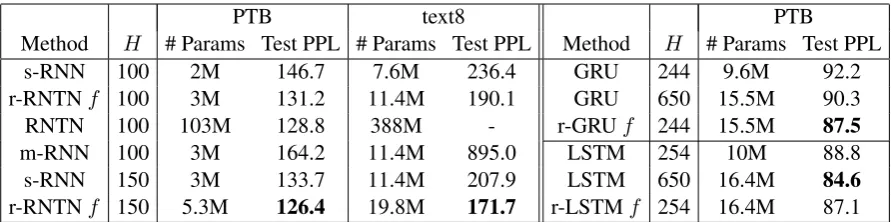
Table 1: Comparison of validation and test set perplexity for r-RNTNs withf mapping (K = 100for PTB, K = 376for text8) versus s-RNNs and m-RNN. r-RNTNs with the same H as corresponding s-RNNs significantly increase model capacity and performance with no computational cost. The RNTN was not run on text8 due to the number of parameters required.
with H = 650. The training procedure is the same as above but with mini-batches of size 20, 35 timestep sequences without state resets, initial LR of 1, Dropout on all non-recurrent connections, weights drawn from U(−.05, .05), and gradients norm-clipped to5.
5 Results
Results are shown in fig.1and table1.
Comparing the r-RNTN to the baseline s-RNN with H = 100(fig. 1), as model capacity grows with K, test set perplexity drops, showing that r-RNTN is an effective way to increase model ca-pacity with no additional computational cost. As expected, thef mapping outperforms the baseline
fmod mapping at smallerK. AsK increases, we
see a convergence of both mappings. This may be due to matrix sharing at largeKbetween frequent and infrequent words because of the modulus op-eration in eq. (16). As infrequent words are rarely observed, frequent words dominate the matrix up-dates and approximate having distinct matrices, as they would have with thefmapping.
It is remarkable that even with K as small as
100, the r-RNTN approaches the performance of the RNTN with a small fraction of the parameters. This reinforces our hypothesis that complex trans-formation modeling afforded by distinct matrices is needed for frequent words, but not so much for infrequent words which can be well represented by a shared matrix and a distinct vector embed-ding. As shown in table1, with an equal number of parameters, the r-RNTN with f mapping out-performs the s-RNN with a bigger hidden layer. It appears that heuristically allocating increased model capacity as done by the f based r-RNTN is a better way to increase performance than
sim-ply increasing hidden layer size, which also incurs a computational penalty.
Although m-RNNs have been successfully em-ployed in character-level language models with small vocabularies, they are seldom used in word-level models. The poor results shown in table 1 could explain why.2
For fixed hidden layer sizes, r-RNTNs yield significant improvements to s-RNNs, GRUs, and LSTMs, confirming the advantages of distinct rep-resentations.
6 Conclusion and Future Work
In this paper, we proposed restricted recurrent neural tensor networks, a model that restricts the size of recurrent neural tensor networks by map-ping frequent words to distinct matrices and infre-quent words to shared matrices. r-RNTNs were motivated by the need to increase RNN model capacity without increasing computational costs, while also satisfying the ideas that some words are better modeled by matrices rather than vec-tors (Baroni and Zamparelli,2010;Socher et al., 2012). We achieved both goals by pruning the size of the recurrent neural tensor network described by Sutskever et al. (2011) via sensible word-to-matrix mapping. Results validated our hypothesis that frequent words benefit from richer, dedicated modeling as reflected in large perplexity improve-ments for low values ofK.
Interestingly, results for s-RNNs and r-GRUs suggest that given the same number of parame-ters, it is possible to obtain higher performance by increasingK and reducingH. This is not the
2It should be noted thatSutskever et al.(2011) suggest
case with r-LSTMs, perhaps to due to our choice of which of the recurrence matrices to make input-specific. We will further investigate both of these phenomena in future work, experimenting with different combinations of word-specific matrices for r-GRUs and r-LSTMs (rather than onlyUhhand
Uhc), and combining our method with recent im-provements to gated networks in language model-ing (Jozefowicz et al., 2016;Merity et al., 2018; Melis et al.,2018) which we believe are orthogo-nal and hopefully complementary to our own.
Finally, we plan to compare frequency-based and additional, linguistically motivated f map-pings (for example different inflections of a verb sharing a single matrix) with mappings learned via conditional computing to measure how exter-nal linguistic knowledge contrasts with knowledge automatically inferred from training data.
Acknowledgments
This research was partly supported by CAPES and CNPq (projects 312114/2015-0, 423843/2016-8, and 140402/2018-7).
References
Marco Baroni and Roberto Zamparelli. 2010. Nouns are vectors, adjectives are matrices: Representing adjective-noun constructions in semantic space. In Proceedings of the 2010 Conference on Empirical Methods in Natural Language Processing. Associ-ation for ComputAssoci-ational Linguistics, pages 1183– 1193.
Emmanuel Bengio, Pierre-Luc Bacon, Joelle Pineau, and Doina Precup. 2015. Conditional computation in neural networks for faster models. arXiv preprint arXiv:1511.06297.
Welin Chen, David Grangier, and Michael Auli. 2015. Strategies for training large vocabulary neural lan-guage models. arXiv preprint arXiv:1512.04906.
Kyunghyun Cho and Yoshua Bengio. 2014. Exponen-tially increasing the capacity-to-computation ratio for conditional computation in deep learning. arXiv preprint arXiv:1406.7362.
Kyunghyun Cho, Bart van Merrienboer, aglar G¨ulehre, Dzmitry Bahdanau, Fethi Bougares, Holger Schwenk, and Yoshua Bengio. 2014. Learning phrase representations using rnn encoder-decoder for statistical machine translation. InEMNLP.
Mark Davies. 2009. The 385+ million word corpus of contemporary american english (1990–2008+): De-sign, architecture, and linguistic insights. Interna-tional journal of corpus linguistics14(2):159–190.
Sepp Hochreiter and J¨urgen Schmidhuber. 1997. Long short-term memory. Neural computation9 8:1735– 80.
Ozan Irsoy and Claire Cardie. 2014. Modeling compo-sitionality with multiplicative recurrent neural net-works. arXiv preprint arXiv:1412.6577.
Rafal Jozefowicz, Oriol Vinyals, Mike Schuster, Noam Shazeer, and Yonghui Wu. 2016. Exploring the limits of language modeling. arXiv preprint arXiv:1602.02410.
Mitchell P. Marcus, Beatrice Santorini, and Mary A. Marcinkiewicz. 1994. Building a large annotated corpus of English: The Penn Treebank. Computa-tional Linguistics19(2):313–330.
Gbor Melis, Chris Dyer, and Phil Blunsom. 2018. On the state of the art of evaluation in neural language models. In International Conference on Learning Representations.
Stephen Merity, Nitish Shirish Keskar, and Richard Socher. 2018. Regularizing and optimizing LSTM language models. In International Conference on Learning Representations.
T. Mikolov, A. Deoras, S. Kombrink, L. Burget, and J. Cernock´y. 2011. Empirical evaluation and com-bination of advanced language modeling techniques. InINTERSPEECH. pages 605–608.
Tomas Mikolov, Martin Karafi´at, Lukas Burget, Jan Cernock`y, and Sanjeev Khudanpur. 2010. Recur-rent neural network based language model. In IN-TERSPEECH 2010, 11th Annual Conference of the International Speech Communication Association, Makuhari, Chiba, Japan, September 26-30, 2010. pages 1045–1048.
Noam Shazeer, Azalia Mirhoseini, Krzysztof Maziarz, Andy Davis, Quoc Le, Geoffrey Hinton, and Jeff Dean. 2017. Outrageously large neural networks: The sparsely-gated mixture-of-experts layer. arXiv preprint arXiv:1701.06538.
Richard Socher, Brody Huval, Christopher D Manning, and Andrew Y Ng. 2012. Semantic compositional-ity through recursive matrix-vector spaces. In Pro-ceedings of the 2012 Joint Conference on Empirical Methods in Natural Language Processing and Com-putational Natural Language Learning. Association for Computational Linguistics, pages 1201–1211.
Nitish Srivastava, Geoffrey E Hinton, Alex Krizhevsky, Ilya Sutskever, and Ruslan Salakhutdinov. 2014. Dropout: a simple way to prevent neural networks from overfitting. Journal of Machine Learning Re-search15(1):1929–1958.