419
Using Intermediate Representations to Solve Math Word Problems
Danqing Huang1∗, Jin-Ge Yao2, Chin-Yew Lin2, Qingyu Zhou3, and Jian Yin1
{huangdq2@mail2,issjyin@mail}.sysu.edu.cn {Jinge.Yao,cyl}@microsoft.com
1 The School of Data and Computer Science, Sun Yat-sen University.
Guangdong Key Laboratory of Big Data Analysis and Processing, Guangzhou, P.R.China 2Microsoft Research3 Harbin Institute of Technology
Abstract
To solve math word problems, previous statistical approaches attempt at learning a direct mapping from a problem descrip-tion to its corresponding equadescrip-tion system. However, such mappings do not include the information of a few higher-order op-erations that cannot be explicitly repre-sented in equations but are required to solve the problem. The gap between nat-ural language and equations makes it dif-ficult for a learned model to generalize from limited data. In this work we present an intermediate meaning representation scheme that tries to reduce this gap. We use a sequence-to-sequence model with a novel attention regularization term to gen-erate the intermediate forms, then execute them to obtain the final answers. Since the intermediate forms are latent, we propose an iterative labeling framework for learn-ing by leveraglearn-ing supervision signals from both equations and answers. Our experi-ments show using intermediate forms out-performs directly predicting equations.
1 Introduction
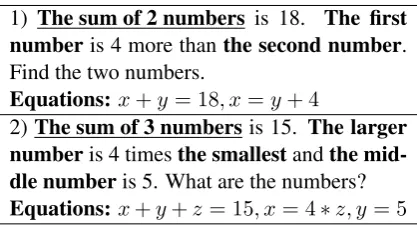
There is a growing interest in math word problem solving (Kushman et al.,2014;Koncel-Kedziorski et al., 2015; Huang et al., 2017; Roy and Roth, 2018). It requires reasoning with respect to sets of numbers or variables, which is an essential capa-bility in many other natural language understand-ing tasks. Consider the math problems shown in Table1. To solve the problems, one needs to know how many numbers to be summed up (e.g. “2 numbers/3 numbers”), and the relation between
∗
Work done while this author was an intern at Microsoft Research.
1) The sum of 2 numbers is 18. The first numberis 4 more than the second number. Find the two numbers.
Equations: x+y= 18, x=y+ 4
2)The sum of 3 numbersis 15. The larger numberis 4 timesthe smallestandthe mid-dle numberis 5. What are the numbers?
[image:1.595.312.521.220.343.2]Equations: x+y+z= 15, x= 4∗z, y= 5
Table 1: Math word problems. Equations have lost the information ofcount, max, ordinaloperations.
variables (“the first/second number”). However, an equation system does not encode these infor-mation explicitly. For example, an equation repre-sents “the sum of 2 numbers” as(x+y)and “the sum of 3 numbers” as(x +y+z). This makes it difficult to generalize to cases unseen from data (e.g. “the sum of 100 numbers”).
This paper presents a new intermediate meaning representation scheme for solving math problems, aiming at closing the semantic gap between natu-ral language and equations. To generate the inter-mediate forms, we adapt a sequence-to-sequence (seq2seq) network following recent work that tries to generate equations from problem descriptions for this task. Wang et al. (2017) have shown that seq2seq models have the power to generate equations of which problem types do not exist in training data. In this paper, we propose a new method which adds an extra meaning representa-tion and generate an intermediate form as output. Additionally, we observe that the attention weights of the seq2seq model repetitively concentrates on numbers in the problem description. To address the issue, we further propose to use a form of at-tention regularization.
la-beling framework to leverage signals from both equations and their solutions. We first derive possible intermediate forms with ambiguity using the gold-standard equation systems, and use these forms for training to get a pre-trained model. Then we iteratively refine the intermediate forms using the learned model and the signals from the gold-standard answers.
We conduct experiments on two publicly avail-able math problem datasets. Our experimental re-sults show that using the intermediate forms for training performs significantly better than directly mapping problems to equation systems. Further-more, our iterative labeling framework creates bet-ter labeled data with inbet-termediate forms for train-ing, which leads to improved performance.
To summarize, our contributions include:
• We present a new intermediate meaning rep-resentation scheme for solving math prob-lems.
• We design an iterative labeling framework to automatically augment training data with in-termediate meaning representation.
• We propose using attention regularization in training to address the issue of incorrect at-tention in the seq2seq model.
• We verify the effectiveness of our proposed solutions by conducting experiments and analysis on real-world datasets.
2 Meaning Representation
In this section, we will compare meaning repre-sentations for solving math problems and intro-duce the proposed intermediate meaning represen-tation.
2.1 Meaning Representations for Math Problem Solving
We first discuss two meaning representation schemes for math problem solving.
An equation system is a collection of one or more equations involving the same set of vari-ables, which should be considered as highly ab-stractive symbolic representation.
TheDolphin Languageis introduced byShi et al. (2015). It contains about 35 math-related classes and over 200 math-related functions, with addi-tional classes and functions automatically mined from Freebase.
Unfortunately, these representation schemes do not generalize well. Consider the two problems listed in Table2. They belong to the same type of problems asking about the summation of consec-utive integers. However, their meaning represen-tations are very different in the Dolphin language and in equations. On one hand, the Dolphin lan-guage aligns too closely with natural utterances. Since the math problem descriptions are diverse in using various nouns and verbs, Dolphin lan-guage may represent the same type of problems differently. On the other hand, an equation system does not explicitly represent useful problem solv-ing information such as “number of variables” and “numbers are consecutive”
2.2 Intermediate Meaning Representation
To bridge the semantic gap between the two mean-ing representations, we present a new intermedi-ate meaning representation scheme for math prob-lem solving. It consists of 6classesand 23 func-tions. Here a class is the set of entities with the same semantic properties and can be inher-ited (e.g. 2 ∈ int, int v num). A functionis comprised of a name, a list of arguments with cor-responding types, and a return type. For exam-ple, there are two overloaded definitions for the function math#sum (Table 3). These forms can be constructed by recursively applying joint opera-tions on funcopera-tions with class type constraints. Our representation scheme attempts to borrow the ex-plicit use of higher-order functions from the Dol-phin language, while avoiding to be too specific. Meanwhile, the intermediate forms are not as con-cise as the equation systems (Table2). We leave more detailed definitions to the supplement mate-rial due to space limit.
3 Problem Statement
Given a math word problemp, our goal is to pre-dict its answerAp. For each problem we have
an-notations of both the equation systemEp and the
answerApavailable for training. The latent
inter-mediate form will be denoted asLFp.
Problem 1:Find three consecutive integers with a sum of 267.
Dolphin Language:vf.find(cat(‘integers’), count:3, adj.consecutive, (math#sum(pron.that, 267, det.a)))
Equation: x+ (x+ 1) + (x+ 2) = 267
This work: math#consecutive(3), math#sum(cnt: 3) = 267
Problem 2:What are 5 consecutive numbers total 95?
Dolphin Language:wh.vf.math.total((cat(‘numbers’), count:5, pron.what, adj.consecutive), 95)
Equation: x+ (x+ 1) + (x+ 2) + (x+ 3) + (x+ 4) = 95
This work: math#consecutive(5), math#sum(cnt: 5) = 95
Table 2: Different representations for math problems. Dolphin language is detailed (’all words’). Equa-tion system is coarse that it represents many funcEqua-tions implicitly, such as “count”, “consecutive”.
Classes
int, float, num, unk, var, list
Functions
ret:int count($1:list): number of variables in $1 ret:var max($1:list): variable of max value in $1 ret:var math#product($1,$2:var): $1 times $2 ret:var math#sum($1:list): sum of variables in $1 ret:var math#sum(cnt:$1:int): sum of $1 unks
Example
Four times the sum of three and a number is 10. ->math#product(4, math#sum(3, m))=10
Table 3: Examples of classes and functions in our intermediate representation. “ret” stands for return type. $1, $2 are arguments with its types.
available math word problem datasets1:
•Number Word Problem (NumWord) is cre-ated byShi et al. (2015). It contains 1,878 number word problems (verbally expressed number problems, such as the examples in Table1). Its linear subset (subset of problems that can be solved by linear equation systems) has 986 problems, only involving four basic operations{+,−,∗, /}.
•Dolphin18K is created byHuang et al.(2016). It contains 18,711 math word problems col-lected from Yahoo! Answers2. Since it con-tains some problems without equations, we only use the subset of 10,644 problems which are paired with their equation systems.
1
Other small datasets with 4 basic operations{+,−,∗, /}
and only one unknown variable are considered as subsets of our datasets.
2https://answers.yahoo.com/
4 Model
In this section, we describe (1) the basic sequence-to-sequence model, and (2) attention regulariza-tion.
4.1 Sequence-to-Sequence RNN Model
Our baseline model is based on sequence-to-sequence learning (Sutskever et al.,2014) with at-tention (Bahdanau et al., 2015) and copy mecha-nism (Gulcehre et al.,2016;Gu et al.,2016).
Encoder:The encoder is implemented as a single-layer bidirectional RNN with gated recurrent units (GRUs). It reads words one-by-one from the input problem, producing a sequence of hidden states
hi = [hFi , hBi ]with:
hFi =GRU(φin(xi), hFi−1), (1)
hBi =GRU(φin(xi), hBi+1), (2)
where φin maps each input word xi to a
fixed-dimensional vector.
Decoder with Copying: At each decoding step
j, the decoder receives the word embedding of the previous word, and an attention function is applied to attend over the input words as follows:
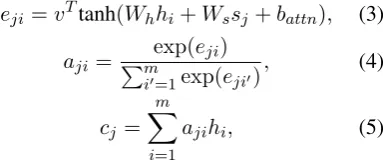
eji =vTtanh(Whhi+Wssj+battn), (3)
aji=
exp(eji)
Pm
i0=1exp(eji0), (4)
cj = m
X
i=1
ajihi, (5)
wheresj is the decoder hidden state. Intuitively,
ajidefines the probability distribution of attention
over the input words. They are computed from the unnormalized attention scoreseji.cjis the context
[image:3.595.333.525.597.677.2]At each step, the model has to decide whether to generate a word from target vocabulary or to copy a numberfrom the problem description. The generation probabilitypgenis modeled by:
pgen =σ(wcTcj+wTssj+bptr), (6)
where wc, ws and bptr are model parameters.
Next, pgen is used as a soft switch: with
proba-bilitypgenthe model decides to generate from the
decoder state. The probability distribution over all words in the vocabulary is:
PRN N =softmax(W[sj, cj] +b); (7)
with probability1−pgenthe model decides to
di-rectly copy an input word according to its attention weight. This leads to the final distribution of de-coder state outputs:
P(wj =w|·) =pgenPRN N(w) + (1−pgen)aji
(8)
4.2 Attention Regularization
In preliminary experiments, we observed that the attention weights in the baseline model repeti-tively concentrate on the numbers in the math problem description (will be discussed in later sec-tions with Figure 1(a)). To address this issue, we regularize the accumulative attention weights for each input token using a rectified linear unit (ReLU) layer, leading to the regularization term:
AttReg=X i
ReLU( T
X
j=0
aji−1), (9)
where ReLU(x) = max(x,0). This term penal-izes the accumulated attention weights on specific locations if it exceeds 1. Adding this term to the primary loss to get the final objective function:
Loss=−X i
logp(yi|xi;θ) +λ∗AttReg (10)
whereλis a hyper-parameter that controls the con-tribution of attention regularization in the loss.
The format of our attention regularization term resembles the coverage mechanism used in neural machine translation (Tu et al.,2016;Cohn et al., 2016), which encourages the coverage or fertility control for input tokens.
5 Iterative Labeling
Since explicit annotations of our intermediate forms do not exist, we propose an iterative label-ing framework for trainlabel-ing.
5.1 Deriving Latent Forms From Equations
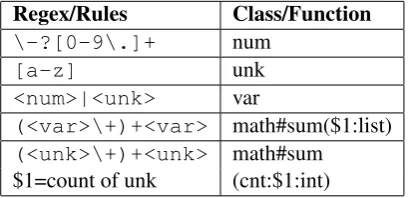
We use the annotated equation systems to derive possible latent forms. First we define some simple rules that map an expression to our intermediate form. For example, we use regular expressions to match numbers and unknown variables. Example rules are shown in Table 4 (see Section 2 of the Supplement Material for all rules).
[image:4.595.315.521.187.286.2]Regex/Rules Class/Function
\-?[0-9\.]+ num
[a-z] unk
<num>|<unk> var
(<var>\+)+<var> math#sum($1:list) (<unk>\+)+<unk> math#sum
$1=count of unk (cnt:$1:int)
Table 4: Example rules for deriving latent forms from equation system.
5.2 Ambiguity in Derivation
For one equation system, several latent form derivations are possible. Take the following math problem as an example:
Find3consecutive integers that3times the sum of the first and the third is 79.
Given the annotation of its equation
3 ∗ (x + (x + 2)) = 79, there are two pos-sible latent intermediate forms:
1) math#consecutive(3), math#product(3, math#sum(ordinal(1), ordinal(3)))=79
2) math#consecutive(3), math#product(3, math#sum(min(), max()))=79
There exist two types of ambiguities: a) opera-tor ambiguity.(x+ 2)may correspond to the op-erator “ordinal(3)” or “max()”; b)alignment am-biguity. For each “3” in the intermediate form, it is unclear which “3” in the input to be copied. Therefore, we may derive multiple intermediate forms with spurious ones for a training problem.
We can see from Table 5 that both datasets we used have the issue of ambiguity, containing about 20% of problems with operator ambiguity and 10% of problems with alignment ambiguity.
5.3 Iterative Labeling
Dataset Ambiguous Ambig. #LF oper align (per prob)
NumWord
28.0% 10.2% 3.67
(Linear) NumWord
26.9% 9.5% 4.29
(All)
[image:5.595.74.294.346.618.2]Dolphin18K 35.9% 9.6% 3.86
Table 5: Statistics of latent forms on two datasets. The percentage of problems with operator and alignment ambiguity is shown in the 2nd and 3rd columns respectively. We also show the average number of intermediate forms of problems with derivation ambiguity in the rightmost column.
intuition is that a better model will lead to more correct latent form outputs, and more correct latent forms in training data will lead to a better model.
Algorithm 1Iterative Labeling
Require:
(1) Tuples of (math problem description, equa-tion system, answer)Dn={(pi, Epi, Api)} (2) Possible latent forms PLF = {(p0, LFp10),
(p0, LFp20), ...,(pn, LF
m pn)} (3) Beam sizeB
(4) training iterations Niter, pre-training
itera-tionsNpre Procedure:
foriter= 1toNiterdo ifiter < Nprethen
θ←MLE withPLF else
for(p,LF) inPLF do
C = DecodeB latent forms givenp
forj in 1...Bdo
ifAns(Cj) is correctthen
LF ⇐Cj break
θ←MLE with relabeledPLF
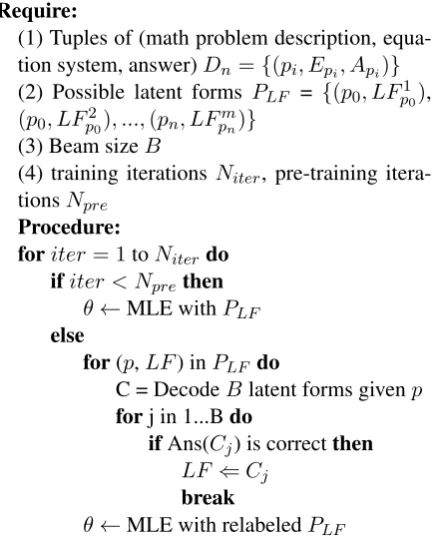
Algorithm 1 describes our training procedure. As pre-training, we first update our model by max-imum likelihood estimation (MLE) with all possi-ble latent forms for Npre iterations. Ambiguous
and wrong latent forms may appear at this stage. This pre-training is to ensure faster convergence and a more stable model. After Npre iterations,
iterative labeling starts. We decode on each train-ing instance with beam search. We declareCj to
be theconsistent formin the beam if it can be
ex-ecuted to yield the correct answer. Therefore we can relabel the latent formLF withCj for
prob-lemp and use the new pairs for training. If there is no consistent form in the beam, we keep it un-changed. With iterative labeling, we update our model by MLE with relabeled latent forms. There are two conditions ofNpreto consider:
(1)Npre = 0, the training starts iterative labeling
without pre-training.
(2)Npre =Niter, the training is pure MLE
with-out iterative labeling.
6 Experiments
In this section, we compare our method against several strong baseline systems.
6.1 Experiment Setting
Following previous work, experiments are done in 5-fold cross validation: in each run, 20% is used for testing, 70% for training and 10% for valida-tion.
RepresentationTo make the task easier with less auxiliary nuisances (e.g. bracket pairs), we repre-sent the intermediate forms in Polish notation.3
Implementation details The dimension of en-coder hidden state, deen-coder hidden state and em-beddings are 100 in NumWord, 512 in Dol-phin18K. All model parameters are initialized ran-domly with Gaussian distribution. The hyper-parameterλfor the weight of attention regulariza-tion is set to 1.0 on NumWord and 0.4 on Dol-phin18K. We use SGD optimizer with decaying learning rate initialized as 0.5. Dropout rate is set to 0.5. The stopping criterion for training is vali-dation accuracy with the maximum number of iter-ations no more than 150. The vocabulary consists of words observed no less thanNtimes in training set. We setN = 1for NumWord andN = 5for Dolphin18K. The beam size is set to 20 in the de-coding stage. For iterative training, we first train a model forNpre = 50iterations for pre-training.
We tune the hyper-parameters on a separate dev set.
We consider the following models for compar-isons:
•Wang et al.(2017): a seq2seq model with at-tention mechanism. As preprocessing, it re-places numbers in the math problem with tokens {n1, n2, ...}. It generates equation
3https://en.wikipedia.org/wiki/Polish_
as output and recovers{n1, n2, ...} to
corre-sponding numbers in the post-processing.
•Seq2Seq Equ: we implement a seq2seq model with attention and copy mechanism. Differ-ent fromWang et al.(2017), it has the ability to copy numbers from problem description.
•Shi et al.(2015): a rule-based system. It parses math problems into Dolphin language trees with predefined grammars and reasons across trees to get the equations with rules. We re-port numbers from their paper as the Dolphin language is not publicly available.
•Huang et al.(2017): the current state-of-the-art model on Dolphin18K. It is a feature-based model. It generates candidate equa-tions and find the most probable equation by ranking with predefined features.
6.2 Results
Overall results are shown in Table 6. From the table, we can see that our final model (Seq2Seq LF+AttReg+Iter) outperforms the neural-based baseline models (Wang et al. (2017)4 and Seq2Seq Equ). On Number word problem dataset, our model already outperforms the state-of-the-art feature-based model (Huang et al., 2017) by 40.8% and is comparable to the ruled-based model (Shi et al.,2015)5.
Advantage of intermediate forms: From the first two rows, we can see that the seq2seq model which is trained to generate interme-diate forms (Seq2Seq LF) greatly outperforms the same model trained to generate equations (Seq2Seq Equ). The use of intermediate forms helps more on NumWord than on Dolphin18K. This result is expected as the Dolphin18K dataset is more challenging, containing many other types of difficulties discussed in Section6.3.
Effect of Attention Regularization: Attention regularization improves the seq2seq model on the two datasets as expected. Figure1shows an exam-ple. The attention regularization does meet the ex-pectation: the alignments in Fig1(b) are less con-centrated on the numbers in the input and more importantly and alignments are more reasonable. For example, when generating “math#product” in
4
We re-implement this since it is not publicly available.
5The system reports precision and recall. Since all the
problems have answers, its recall equals to our accuracy.
the output, the attention is now correctly focused on the input token “times”.
Effect of Iterative Labeling: We can see from Table6that iterative labeling clearly contributes to the accuracy increase on the two datasets. Now we compare the performance with and without pre-training in Table 7. When Npre = 0 in
Algo-rithm1, the model starts iterative labeling from the first iteration without pre-training. We find that training with pre-training is substantially better, as the model without pre-training can be unstable and may generate misleading spurious candidate forms.
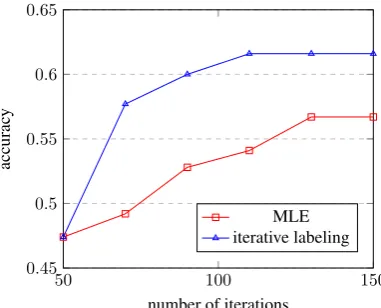
Next, we compare the performance with pure MLE training on NumWord (Linear) in Figure2. The difference is that after 50 iterations of MLE training, iterative labeling would refine the latent forms of training data. In pure MLE training, the accuracy converges after 130 iterations. By using iterative labeling, the model achieves the accuracy of 61.6% at 110thiterations, which is faster to con-verge and leads to better performance.
Furthermore, to check whether iterative label-ing actually resolves ambiguities in the intermedi-ate forms of the training data, we manually sam-ple 100 math problems with derivation ambigu-ity. 78%of them are relabeled with correct latent forms as we have checked. From Table8, we can see the latent form of one training problem is iter-atively refined to the correct one.
6.3 Model Comparisons
To explore the generalization ability of the neu-ral approach and better guide our future work, we compare the problems solved by our neural-based model with the rule-based model (Shi et al.,2015) and the feature-based model (Huang et al.,2017).
Neural-based v. Rule-based: On NumWord (ALL),41.6%of problems can be solved by both models. 15.5%can only be solved by our neural model, while the rule-based model generates an empty or a wrong semantic tree due to the lim-itations of the predefined grammar. The neural model is more consistent with flexible word or-der and insertion of lexical items (e.g. rule-based model cannot handle the extra word ‘whole’ in “Find two consecutivewholenumbers”).
Models NumWord NumWord Dolphin18K
(Linear) (ALL) (Linear)
Wang et al.(2017) 19.7% 14.6% 10.2%
Seq2Seq Equ 26.8% 20.1% 13.1%
Seq2Seq LF 50.8% 45.2% 13.9%
Seq2Seq LF+AttReg 56.7% 54.0% 15.1%
Seq2Seq LF+AttReg+Iter 61.6% 57.1% 16.8%
Shi et al.(2015) 63.6% 60.2% n/a
[image:7.595.145.454.61.193.2]Huang et al.(2017) 20.8% n/a 28.4%
Table 6: Performances on two datasets. “LF” means that the model generates latent intermediate forms instead of equation systems. “AttReg” means attention regularization. “Iter” means iterative labeling. “n/a” means that the model does not run on the dataset.
(a)seq2seq LF (b)seq2seq LF+AttReg
Figure 1: Example alignments for one problem (darker color represents higher attention score).
NumWord NumWord Dolphin18K
(Linear) (ALL) (Linear)
-pre 58.1% 54.9% 14.9%
[image:7.595.83.478.258.409.2]+pre 61.6% 57.1% 16.8%
Table 7: Performance with and without pre-training in iterative labeling.
50 100 150
0.45 0.5 0.55 0.6 0.65
number of iterations
accurac
y
MLE iterative labeling
Figure 2: Accuracy with different iterations of training on NumWord (Linear).
can capture novel features that the feature-based model is missing.
While our neural model is complementary to the above mentioned models, we observe two main types of errors (more examples are shown in the supplementary material):
1. Natural language variations: Same type of problems can be described in different scenarios. The two problems: (1) “What is 10 minus 2?” and (2) “John has 10 apples. How many apples does John have after giving Mary 2 apples”, lead to the same equationx= 10−2but with very different descriptions. With limited size of data, we could not be expected to cover all possible ways to ask the same underlining math problems. Although the feature-based model has considered this with some features (e.g. POS Tag), the challenge is not well-addressed.
[image:7.595.74.265.566.720.2]Training Problem:
Find2 0consecutive integers which the first number is2 1more than2 2times the second number.
Intermediate form in 1stiteration
(7) math#consecutive(2 0), ordinal(1) = math#sum(“2 0”, math#product(“2 0”, “max()”)
Intermediate form in 51stiteration
(7) math#consecutive(2 0), ordinal(1) = math#sum(2 1, math#product(“2 0”, ordinal(2))
Intermediate form in 101stiteration
(3) math#consecutive(2 0), ordinal(1) = math#sum(2 1, math#product(2 2, ordinal(2))
Table 8: Instance check of intermediate form for one math problem in several training iterations. 2 0
means the the first ‘2’ in the input and so on. Tokens with quote marks mean that they are incorrect.
7 Related Work
Our work is related to two research areas: math word problem solving and semantic parsing.
7.1 Math Word Problem Solving
There are two major components in this task: (1) meaning representation; (2) learning framework.
Semantic Representation With the annotation of equation system, most approaches attempt at learning a direct mapping from math problem description to an equation system. There are other approaches considering an intermediate rep-resentation that bridges the semantic gap between natural language and equation system. Bakman (2007) defines a table of schema (e.g. Transfer-In-Place, Transfer-In-Ownership) with associated formulas in natural utterance. A math problem can be mapped into a list of schema instantiations, then converted to equations. Liguda and Pfeiffer (2012) use augmented semantic network to repre-sent math problems, where nodes reprerepre-sent con-cepts of quantities and edges represent transition states. Shi et al. (2015) design a new meaning representation language called Dolphin Language (DOL) with over 200 math-related functions and more additional noun functions. With predefined rules, these approaches accept limited well-format input sentences. Inspired by these representations, our work describes a new formal language which is more compact and is effective in facilitating bet-ter machine learning performance.
Learning Framework In rule-based ap-proaches (Bakman, 2007; Liguda and Pfeiffer, 2012; Shi et al., 2015), they map math prob-lem description into structures with predefined grammars and rules.
Feature-based approaches contain two stages: (1) generate equation candidates; They either
re-place numbers of existing equations in the training data as new equations (Kushman et al.,2014;Zhou et al., 2015;Upadhyay et al., 2016), or enumer-ate possible combinations of math operators and numbers and variables (Koncel-Kedziorski et al., 2015), which leads to intractably huge search space. (2) predict equation with features. For ex-ample, Hosseini et al. (2014) design features to classify verbs to addition or subtraction. Roy and Roth (2015); Roy et al. (2016) leverage the tree structure of equations. Mitra and Baral (2016); Roy and Roth (2018) design features for a few math concepts (e.g. Part-Whole, Comparison). Roy and Roth (2017) focus on the dependencies between number units. These approaches requires manual feature design and the features may be dif-ficult to be generalized to other tasks.
Recently, there are a few works trying to build an end-to-end system with neural models. Ling et al.(2017) consider multiple-choice math prob-lems and use a seq2seq model to generate rationale and the final choice (i.e. A, B, C, D).Wang et al. (2017) apply a seq2seq model to generate equa-tions with the constraint of single unknown vari-able. Similarly, we use the seq2seq model but with novel attention regularization to address incorrect attention weights in the seq2seq model.
7.2 Semantic Parsing
reinforcement learning (Guu et al., 2017; Liang et al.,2017) has also been considered, which max-imizes the expected reward over all possible logi-cal forms. Different from them, we only consider one single consistent latent form per training in-stance by leveraging training signals from both the answer and the equation system, which should be more efficient for our task.
8 Conclusion
This paper presents an intermediate meaning rep-resentation scheme for math problem solving that bridges the semantic gap between natural lan-guage and equation systems. To generate inter-mediate forms, we propose a seq2seq model with novel attention regularization. Without explicit annotations of latent forms, we design an iterative labeling framework for training. Experimental re-sult shows that using intermediate forms is more effective than directly using equations. Further-more, our iterative labeling effectively resolves ambiguities and leads to better performances.
As shown in the error analysis, same types of problems can have different natural language ex-pressions. In the future, we will focus on tackling this challenge. In addition, we plan to expand the coverage of our meaning representation to support more mathematic concepts.
Acknowledgments
This work is supported by the
Na-tional Natural Science Foundation of China (61472453, U1401256, U1501252, U1611264,U1711261,U1711262). Thanks to the anonymous reviewers for their helpful comments and suggestions.
References
Yoav Artzi and Luke Zettlemoyer. 2011. Bootstrapping semantic parsers from conversations. In Proceed-ings of the 2011 Conference on Empirical Methods in Natural Language Processing.
Yoav Artzi and Luke Zettlemoyer. 2013. Weakly su-pervised learning of semantic parsers for mapping instructions to actions. InTransactions of the Asso-ciation for Computational Linguistics.
Dzmitry Bahdanau, Kyunghyun Cho, and Yoshua Ben-gio. 2015. Neural machine translation by jointly learning to align and translate. InInternational Con-ferene on Learning Representation.
Yefim Bakman. 2007. Robust understanding of word problems with extraneous information. Http://arxiv.org/abs/math/0701393.
Jonathan Berant, Andrew Chou, Roy Frostig, and Percy Liang. 2013. Semantic parsing on freebase from question-answer pairs. In Proceedings of the 2013 Conference on Empirical Methods in Natural Lan-guage Processing.
James Clarke, Dan Goldwasser, Ming-Wei Chang, and Dan Roth. 2010. Driving semantic parsing from the worlds response. In Proceedings of the Four-teenth Conference on Computational Natural Lan-guage Learning.
Trevor Cohn, Cong Duy Vu Hoang, Ekaterina Vy-molova, Kaisheng Yao, Chris Dyer, and Gholamreza Haffari. 2016. Incorporating structural alignment biases into an attentional neural translation model. InProceedings of the 2016 Conference of the North American Chapter of the Association for Computa-tional Linguistics: Human Language Technologies.
Jiatao Gu, Zhengdong Lu, Hang Li, and Victor O.K. Li. 2016. Incorporating copying mechanism in sequence-to-sequence learning. In Proceedings of the 52nd Annual Meeting of the Association for Computational Linguistics.
Caglar Gulcehre, Sungjin Ahn, Ramesh Nallapati, Bowen Zhou, and Yoshua Bengio. 2016. Pointing the unknown words. InProceedings of the 52nd An-nual Meeting of the Association for Computational Linguistics.
Kelvin Guu, Panupong Pasupat, Evan Zheran Liu, and Percy Liang. 2017. From language to pro-grams: Bridging reinforcement learning and max-imum marginal likelihood. In Proceedings of the 53rd Annual Meeting of the Association for Com-putational Linguistics.
Mohammad Javad Hosseini, Hannaneh Hajishirzi, Oren Etzioni, and Nate Kushman. 2014. Learning to solve arithmetic word problems with verb catego-rization. InProceedings of the 2014 Conference on Empirical Methods in Natural Language Process-ing.
Danqing Huang, Shuming Shi, Chin-Yew Lin, and Jian Yin. 2017. Learning fine-grained expressions to solve math word problems. InProceedings of the 2017 Conference on Empirical Methods in Natural Language Processing.
Danqing Huang, Shuming Shi, Chin-Yew Lin, Jian Yin, and Wei-Ying Ma. 2016. How well do comput-ers solve math word problems? large-scale dataset construction and evaluation. In Proceedings of the 52nd Annual Meeting of the Association for Compu-tational Linguistics.
2015. Parsing algebraic word problems into equa-tions. Transactions of the Association for Computa-tional Linguistics, 3:585–597.
Nate Kushman, Yoav Artzi, Luke Zettlemoyer, and Regina Barzilay. 2014. Learning to automatically solve algebra word problems. InProceedings of the 52nd Annual Meeting of the Association for Compu-tational Linguistics.
Tom Kwiatkowski, Eunsol Choi, Yoav Artzi, and Luku Zettlemoyer. 2013. Scaling semantic parsers with on-the-fly ontology matching. InProceedings of the 2013 Conference on Empirical Methods in Natural Language Processing.
Chen Liang, Jonathan Berant, Quoc Le, Kennet D.Forbus, and Ni Lao. 2017. Neural symbolic ma-chines: Learning semantic parsers on freebase with weak supervision. InProceedings of the 53rd An-nual Meeting of the Association for Computational Linguistics.
Percy Liang, Michael Jordan, and Dan Klein. 2011. Learning dependency-based compositional seman-tics. InProceedings of the 49th Annual Meeting of the Association for Computational Linguistics: Hu-man Language Technologies.
Christian Liguda and Thies Pfeiffer. 2012. Modeling math word problems with augmented semantic net-works. InNatural Language Processing and Infor-mation Systems. International Conference on Appli-cations of Natural Language to Information Systems (NLDB-2012), pages 247–252.
Wang Ling, Dani Yogatama, Chris Dyer, and Phil Blun-som. 2017. Program induction by rationale genera-tion: Learning to solve and explain algebraic word problems. InProceedings of the 53rd Annual Meet-ing of the Association for Computational LMeet-inguis- Linguis-tics.
Arindam Mitra and Chitta Baral. 2016. Learning to use formulas to solve simple arithmetic problems. In Proceedings of the 52nd Annual Meeting of the Association for Computational Linguistics.
Panupong Pasupat and Percy Liang. 2016. Inferring logical forms from denotations. In Proceedings of the 52nd Annual Meeting of the Association for Computational Linguistics.
Subhro Roy and Dan Roth. 2017. Unit dependency graph and its application to arithmetic word prob-lem solving. InProceedings of the 2017 Conference on Association for the Advancement of Artificial In-telligence.
Subhro Roy and Dan Roth. 2018. Mapping to declara-tive knowledge for word problem solving. In Trans-actions of the Association for Computational Lin-guistic.
Subhro Roy and Subhro Roth. 2015. Solving general arithmetic word problems. In Proceedings of the 2015 Conference on Empirical Methods in Natural Language Processing, pages 1743–1752. The Asso-ciation for Computational Linguistics.
Subhro Roy, Shyam Upadhyay, and Dan Roth. 2016. Equation parsing: Mapping sentences to grounded equations. In Proceedings of the 2016 Conference on Empirical Methods in Natural Language Pro-cessing.
Shuming Shi, Wang Yuehui, Chin-Yew Lin, Xiaojiang Liu, and Yong Rui. 2015. Automatically solving number word problems by semantic parsing and rea-soning. InProceedings of the 2015 Conference on Empirical Methods in Natural Language Process-ing.
Ilya Sutskever, Oriol Vinyals, and Quoc Le. 2014. Se-quence to seSe-quence learning with neural networks. InAdvances in Neural Information Processing Sys-tems 27.
Zhaopeng Tu, Zhengdong Lu, Yang Liu, Xiaohua Liu, and Hang Li. 2016. Modeling coverage for neural machine translation. InProceedings of the 52nd An-nual Meeting of the Association for Computational Linguistics.
Shyam Upadhyay, Ming-Wei Chang, Kai-Wei Chang, and Wen tau Yih. 2016. Learning from explicit and implicit supervision jointly for algebra word prob-lems. In Proceedings of the 2016 Conference on Empirical Methods in Natural Language Process-ing.
Yan Wang, Xiaojiang Liu, and Shuming Shi. 2017. Deep neural model for math word problem prob-lems. In Proceedings of the 2017 Conference on Empirical Methods in Natural Language Process-ing.