J. Range Manage.
56: 577-584 November 2003
An evaluation of the federal grazing fee formula
L. ALLEN TORELL, NEIL R. RIMBEY, LARRY W. VAN TASSELL, JOHN A. TANAKA, AND E. TOM BARTLETT
Authors are Professor, Department of Agricultural Economics and Agricultural Business, New Mexico State University, Las Cruces, N. M. 88003; Professor, Department of Agricultural Economics and Rural Sociology, University of Idaho, Caldwell, Ida. 83605; Professor and Head, Department of Agricultural Economics and Rural Sociology, University of Idaho, Moscow, Ida., 83844; Associate Professor, Eastern Oregon Agricultural Research Center - Union
Station, Union, Ore. 97883; and Professor Emeritus, Department of Rangeland Ecosystem Science, Fort Collins, Colo. 80523.
Abstract
The federal grazing fee is currently set using the Public Rangeland Improvement Act (PRIA) fee formula established in 1978 and modified in 1986. The formula is adjusted annually using indices of private land grazing lease rates (Forage Value Index, FVI), prices received for beef cattle (Beef Cattle Price Index, BCPI), and costs of beef production (Prices Paid Index, PPI). The FVI tracks price movement in the private forage mar- ket and was the only index originally proposed to be included in the fee formula. Public land ranchers and the Interdepartmental Grazing Fee Technical Committee assigned to study grazing fee alternatives in the 1960s questioned the ability of the FVI to account for short-term demand, supply, and price equilibrium, and, for this reason, the BCPI and PPI were added to the fee for- mula. Nearly 40 years of data are now available to evaluate whether adding the BCPI and PPI did, in fact, help explain short-term market fluctuations. Analysis shows that if tracking the private forage market is the primary objective, the fee for- mula should have included only the FVI. Including the BCPI and the PPI has caused calculated grazing fees to fall further and fur- ther behind private land lease rates. Had the $1.23 base fee in the PRIA formula been indexed by only the FVI, the federal grazing fee would have been $4.36 AUM'1 instead of $1.43 AUM'1 in 2002.
It is time to consider the feasibility of a competitive bid system for public lands, or, at the very least, drop the BCPI and PPI indices and adopt a new fee formula that generates more equi- table grazing fees.
Key Words: grazing leases, forage value, public lands, public land grazing, grazing permits, Public Rangeland Improvement Act (PRIA)
Resumen
El pago de pastoreo federal es actualmente determinado usan- do la formula de page del Acta de Mejoramiento de Pastizales Publicos (AMPP) establecida en 1978 y modificada en 1986. La formula es ajustada anualmente usando indices de tasas de arrendamiento de pastizales privados (Indice de Valor Forrajero, IVF), precios recibidos para ganado de carne (Indice de Precios de Ganado de Carne, IPGC), y costos de production de la carne (Indice de Precios Pagados, IPP). El IVF monitorea el movimiento de precio del forraje en el mercado privado y fue el unico Indice originalmente propuesto para ser incluido en la formula de pago. Rancheros de tierras publicas y un Comite Tecnico de Pago de Pastoreo asignado para estudiar alternativas en el pago de pastoreo en los 1960s, cuestionaron la habilidad del IVF para contabilizar por la demanda de corto plazo, oferta, y equilibrio del precio, y por esta razon el IPGC y el IPP fueron agregados a la formula de pago. Cerca de 30 ai os de datos estan ahora disponibles para evaluar si el agregar el IPGC y el IPP en efecto ayudo a explicar las fluctuaciones del mercado en el corto plazo. Analisis muestran que si monitorear el mercado privado de forraje es el objetivo primario, entonces la formula de page deberia haber incluido solamente el IVF. La inclusion del IPGC, y especialmente del IPP, ha causado que los precios de pastoreo calculado caigan cada vez mas por debajo de las tasas de arren- damiento de tierras privadas. Si el page base de $1.23 dolares en la formula de la AMPP fuera indexado solamente per el IVF, el pago de pastoreo federal hubiera side $4.36 UAM, en vez de
$1.43 UAM'1 en e12002. Es tiempo de considerar la factibilidad de un sistema competitive de licitamiento para tierras federales, o al menos adoptar una nueva formula de pago que genere pages de pastoree mas equitativos, y destilar los indices de IPGC y IPP.
A long and interesting history of conflict preceded implementa- tion of the current federal grazing fee formula (USDI/USDA 1977, USDA/USDI 1986, 1992). Some of the major areas of con- tention included the amount charged, how grazing fees were to be adjusted through time, and whether fees should vary in different areas of the West. All of these issues were part of the debate when the Public Rangeland Improvement Act (PRIA) fee formula was adopted in the late 1970s, and the debate continues.
A detailed historical review of grazing fee policy is provided by Backiel and Rogge (1985), while Dutton (1953) concentrated on grazing fee issues within the structure and history of the Forest
Manuscript accepted 15 Feb. 03.
Service. Table 1 briefly reviews what we feel are the key policy decisions and legislation surrounding the grazing fee issue. This historical progression covers the time from the inception of the Forest Service in 1906 through the passage of PRIA in 1978 and subsequent formula modifications after a 1986 Executive Order (EO) was signed by President Reagan. The political negotiation, debate, and legislation, as detailed, resulted in the PRIA fee for- mula that is used to set grazing fees on Bureau of Land Management (BLM) and Forest Service (FS) lands today.
Recognizing this history is important for assessing whether PRIA has met the objectives of Congress and others that proposed and adopted the fee formula.
In this paper, we review the relevant history and legislation associated with the PRIA fee formula. We discuss the original fee
JOURNAL OF RANGE MANAGEMENT 56(6) November 2003 577
Table 1. An abbreviated history of grazing fees and the PRIA fee formula.
Grazing Fee Study and Legislation Description
1906 Forest Service Fees Implemented Forest Service fees were imposed on ranchers and settlers accustomed to free and unrestricted grazing use. Average fees were about $0.05 AUM 1 (Dutton 1953, USDI/USDA 1977, p. 2-4).
1916 Comparable Forest Service Lease Rate Study In 1916 the U.S. Forest Service attempted to determine fair compensation for national-forest range by studying the rental value of 900 tracts of private land similar to U.S. Forest Service ranges (Dutton 1953).
1924 Rachford Appraisal
1966 Grazing Cost Study
1969 Grazing Fee Proposal
Based largely on an appraisal of supposedly comparable privately owned land (Rachford 1924) and the recommendation of Dan Casement, a Kansas livestock producer assigned by the Secretary of Agriculture to review the appraisal, variable fees and the practice of basing fees on the price of beef and lamb was adopted and prevailed in the FS from 1928 until the mid-1960s (Backiel and Rogge 1985, USDI/USDA 1977, p. 2-2). After passage of the Taylor Grazing Act in 1934, the Grazing Service began charging a $0.05 AUM 1 fee on BLM land in 1936. This fee had no specific economic rationale except to cover administrative costs of the land agencies and was a politically negotiated compromise (USD1/USDA 1977, p. 2-3).
In 1959-1960, an Interdepartmental Task Force was formed to undertake a joint grazing fee study that would be used to develop a uniform approach to grazing fees between the federal land agen- cies. One of the major responsibilities of the task force was the 1966 Western Livestock Grazing Survey that provided a total grazing cost comparison of nearly 10,000 public land permittees and private land forage lessors. This total cost comparison indicated that, if interest on the permit investment was excluded (which was controversial), a weighted average base grazing fee of
$1.23 AUM 1 would make total grazing costs on public and private lands equal. This base rate was a weighted average for both BLM and FS lands, and for cattle and sheep operations (USD1/USDA 1977, p. 2-22). Because total grazing costs were as variable within ranching areas of the West as they were between areas, no statistical basis could be found for differentiating fees between grazing districts or areas (Arthur D. Little 1967, 1968).The weighted average $1.23 AUM 1 cost differential became the base value used in PRIA. Further, the task force proposed to adjust the base fee annually by an index of private grazing land lease rates, the Forage Value Index, or FVI (Backiel and Rogge 1985).
In 1969, a new fee schedule for FS and BLM lands was announced that adapted the proposed fee increases to the $1.23 AUM 1 base rate (USD1/USDA 1977, p. 2-27). The 1969 fee schedule and formula would use the FVI to adjust fees through time. Implementation of the 1969 fee schedule proceeded with controversy and various legal delays and fee moratoriums.
1973 American National Cattlemen's Association proposal In October 1973, the American National Cattlemen's Association (now the National Cattlemen's Beef Association, NCBA) proposed a new fee formula to the Secretaries of Interior and Agriculture that would use indices of beef prices and prices paid to adjust grazing fees. The 1964- 1968 period would serve as the base period for both indices, and, as noted by Backiel and Rogge (1985), the new formula would have shifted the basis for fee adjustment from a private land lease rate equivalency, based on the FYI, to an ability-to-pay basis using the Beef Cattle Price Index (BCPI) and Prices Paid Index (PPI). The new formula was not accepted by the land agencies.
1976 Federal Land Policy and Management Act The 1976 Federal Land Policy and Management Act (FLPMA) set out major, overall public land management and policy objectives and mandated that a grazing fee study be submitted to Congress within one year. The resulting 1977 Grazing Fee Study evaluated seven alternative pro- cedures for determining grazing fees, including the fee formula proposed by the NCBA and another formula, which eventually became PRIA, proposed by a Technical Committee assigned to review public land grazing fees by the Senate Interior and Insular Affairs committees (USD1/USDA 1977). The technical committee fee formula was supported by livestock interests because, similar to their own proposal, it included livestock prices and production costs as adjust- ment factors. Inclusion of these price and cost factors was of primary concern to livestock inter- ests and they maintained that severe hardships to thousands of individual ranchers could be avoided by including these indices in the fee formula (Backiel and Rogge 1985, p. 28).
The Grazing Fee Technical Committee argued that the FYI would adequately measure the long- term trend grazing fee and forage values. However, they questioned the ability of the index to capture short-term instabilities that result during periods of disequilibrium (USD1/USDA 1977, p.
3-34). They suggested that, by adding the BCPI and PPI, the fee formula would be better able to account for short-term fluctuations in forage demand and supply. It also provided a compromise between the land agencies that wanted to use only the FVI and public land ranchers who wanted to use only the BCPI and PPI. Including all three indices was criticized because beef prices and production costs should already be included when ranchers formulate lease bids based on live- stock production value. Research has since shown this to be the case (Van Tassell and McNeley
1997, McCarl and Brokken 1985).
578 JOURNAL OF RANGE MANAGEMENT 56(6) November 2003
Grazing Fee Study and Legislation
1978 Public Rangeland Improvement Act
Description
House Report 10587, which eventually became PRIA, was introduced in January 1978 and fees were set using the new PRIA fee formula in 1979. Using the PRIA formula, grazing fees increased in both 1979 and 1980. In both years, the 25-percent limit of change that was included in the legislation kept fees below the calculated value. The $2.36 AUM' fee in 1980 was the highest fee ever reached, and PRIA-generated fees have trended downwards ever since.
The PRIA fee formula is calculated as Feet = $1.23 x (FVIt_i + BCPIt_1- PPIt_1) The data used 100
to estimate the indices are described in detail in USDIIUSDA (1977) and USDA/USDI (1992).
Kearl (1989) provides a critical review of the data collection procedures and the index compo- nents. Historical values for the indices are provided in Appendix A.
1986 Executive Order 12548
proposal supported by the BLM and FS that precluded the Beef Cattle Price Index (BCPI) and Prices Paid Index (PPI), and then evaluate whether the addition of these 2 "ability-to-pay" indices help track and explain the movement of grazing lease rates over time, as was originally project- ed. Similar studies conducted 15 years ago also evaluated the validity of including the ability-to-pay indices in the PRIA fee for- mula (Brokken and McCarl 1987, McCarl and Brokken 1985). This study provides an update of the analysis and demonstrates the continued problems that adding these indices to the fee formula have created.
Finally, we review the policy implications and alternatives available for setting graz- ing fees on public lands in the future.
Methods
Nearly 40 years of data are available to evaluate whether adding the Beef Cattle Price Index (BCPI) and Prices Paid Index (PPI) to the PRIA fee formula improved the formula's predictive ability as envi- sioned by a 1977 Grazing Fee Technical Committee. However, changes in data col- lection and policies have altered how PRIA-generated fees are computed. The data used to compute the Forage Value Index (FVI) was redefined with a 1986 Executive Order (EO) issued by President Ronald Reagan (Table 1). The Executive Order further directed that a minimum fee of $1.35 AUM' would be charged under the PRIA fee formula. Only the first
change, the redefinition of the FVI index from a $ AUM' to $ head' was consid-
The PRIA fee formula expired on December 31, 1985, but was indefinitely extended by Executive Order 12548 (2/14/86) with an imposed minimum fee of $1.35 AUM'. The Executive Order also included a ?rovision that changed the data series used to compute the FVI from a
$ AUM' to a $ head basis. We understand that this change occurred not because of a per- ceived need for a different data series, but rather the loose language used in the Executive Order, i.e. those writing the order did not recognize that $ head' and $ AUM' values are not the same and specified $ head' instead of the $ AUM' index that had historically been used (Personal communication, Mr. Don Waite, former BLM economist, Washington, D.C.). The changes pro- posed in the Executive Order were implemented with the 1986 fee year.
erect in this analysis. The analysis consid- ers grazing fees that would be generated by the unrestricted Public Rangeland Improvement Act (PRIA) formula, ignor- ing the grazing fee floor set by EO 12548.
Additional regressions were done to deter- mine whether results were different when the FVI was calculated on an AUM basis (FVIAUM in Appendix A), as originally structured.
The analysis is conducted with recogni- tion that the data used to compute PRIA indices has been criticized on numerous accounts. Major criticisms include: a rela- tively small amount of data is collected to represent all of the western states; the FVI is based on hearsay as people are asked to recall or speculate on lease rates in the area; the BCPI is computed for cattle weighing over 227 kg (500 lbs) and does not include the lighter feeder calves pro- duced on many western ranches; and the PPI excludes major feed expenses for western ranches. Kearl (1989), Brokken and McCarl (1987) and USDA/USDI (1986, 1992) provided additional detail about these and other criticisms and evalu- ated ways the indices could be changed and improved.
We start with the earlier statistical model defined by McCarl and Brokken (1985):
FVIt+1 = 10 + R1FVIt + 12 BCPIt +
PPIt + ut. (1)
The beta coefficients are estimated regres- sion parameters. Using this regression equation an estimate of the private land lease rate index during the next period (FVIt+1) based on indexed values of pri- vate land lease rates, beef prices, and pro-
duction costs during the current period can be made. As noted by McCarl and Brokken (1985, p. 775), the regression of current and lagged values is based on a normalization (indexing) of private land lease rate data. Predicting lease rates at year t +1 is equivalent to predicting
FVIt+1 with normalization of the data. The error term (ut) captures random differ- ences in the FYI between years.
Dividing the predicted FVIt+1 (from equation 1) by 100 and multiplying by the 1964-1968 base lease rate used to esti- mate the FVI index ($3.65 AUM') gives the estimated private land lease rate at time t + 1. Similarly, because public land grazing fees should be less than private land lease rates when higher non-fee graz- ing costs for public lands are considered, equation 1 tracks public land grazing fees when the base fee rate is reduced.
Multiplying by the $1.23 AUM' Public Rangeland Improvement Act (PRIA) base (Table 1), for example, provides a grazing fee estimate during year t + 1 when the beta coefficients of equation 1 are not restricted. The PRIA formula implies the restrictions 1o = 0, 12 = 1, and 13 Several alternative statistical results are possible if the beta coefficients in equation
1 are varied and estimated using regres- sion techniques. First, it may be that an equal unitary weighting should not be attached to each index, but with all 3 indices statistically important in predicting forage value. Second, the appropriate weighting for any particular index may not be statistically different from 1 and some indices may be statistically insignificant.
As noted by Brokken and McCarl (1987,
JOURNAL OF RANGE MANAGEMENT 56(6) November 2003 579
p. 63), justification for PRIA would be evident if the implied restrictions of PRIA are not statistically significant (i.e., impos- ing the above restrictions does not signifi- cantly decrease the explanatory power of the model as measured by R2).
The statistical significance of the PRIA restrictions was tested using restricted least squares regression. Using the resid- ual sum of squares from the restricted (RSSR) and unrestricted (RSSUR) models, the appropriate test statistic is given by an F-distribution with m and n-k degrees of freedom. The test statistic can also be for- mulated in terms of model R2 values. The number of restrictions imposed, the num- ber of observations and the number of parameters estimated in the unrestricted model are denoted by m, n, and k, respec- tively. The appropriate F-statistic can be computed as follows (Green 1993):
F = (RSSR - RSSUR)/m or (RUR2 )/m
RSSUR /(n - k) R2 In - k).
UR
(2) Statistical significance of the F-statistic would suggest that at least 1 of the imposed model restrictions does not hold.
Using data defining annual values of the PRIA indices (Appendix A), equation 1 was first estimated with no restrictions imposed on the beta coefficients. This unrestricted model resulted in equations similar to those estimated by McCarl and Brokken (1985), Torell et al. (1989), Rimbey (1990), and Bartlett et al. (1993) to evaluate what parameter weighting should be attached to the PRIA indices to best predict forage value on a West-wide and state-level basis. These unrestricted regressions are now used to index state land grazing fees in Idaho and New Mexico (Rimbey 1990, Torell et al. 1989).
To test various restrictions on the esti- mated parameters, additional restricted models were evaluated using the TEST statement within PROC REG of SAS (Freund and Littell 1991). The first set of restrictions tested were that PRIA is an appropriate model formulation, or the null hypothesis of the first test, H0: = 0, R 1
=1, R2 = 1, and = -1. A second test specified H0 as 1 =1,
2
= 0, and 3 = 0and was used to test whether the BCPI and PPI jointly added explanatory power to the model. This further tested whether only the lagged FYI variable should be used to predict FYI during the current period, sim- ilar to the original fee adopted in 1969 (USDI/USDA 1977).
Results
Using data from 1964-2001, the unre- stricted Public Rangeland Improvement Act (PRIA) equation was estimated to be:
%J = 4.5561 + 0.906* FYIt-1 (10.572) (0.164)
+ 0.085 BCPIt_1 + 0.0085 PPIt_i (3) (0.0476) (0.08475)
R2 = 0.985, R2 = 0.984, n = 37.
The standard error of the estimate is in parentheses, with * signifying that the esti- mated parameter is individually statistical- ly significant at the a = 0.05 level. Only the lagged Forage Value Index (FYI) is statistically significant in the equation.
Durbin's h statistic was estimated to be -11.28, indicating autocorrelation (P <
0.001). White's test for heteroscedasticity did not indicate a significant problem (P <
0.086). Multicollinearity was a problem in the model. Data for the FYI, Prices Paid Index (PPI), and Beef Cattle Price Index (BCPI) variables were highly correlated (r
> 0.90), which was not an unexpected result. As noted by McCarl and Brokken (1985), the FYI conceptually includes the other 2 variables because lessors of forage should consider livestock prices and pro- duction costs when formulating forage lease prices.
Testing the restrictions imposed by PRIA, using equation 2, resulted in a high- ly significant F-statistic (F = 1,526, P <
0.0001). This suggests that at least one of the restrictions implied by PRIA does not hold. The second test, H0: i 1= 1, 2 = 0,
and 33 = 0, resulted in an insignificant F- statistic (F = 1.17, P < 0.34), suggesting that the PRIA restrictions that did not hold in the first test were the inclusion of the BCPI and PPI.
The equation suggested by the second statistical test is not exactly equal to the 1969 fee formula (i.e., FYIt = 1 x FYIt-1) Rather, the equation includes a statistically insignificant intercept:
FYIt = 6.6361 + 1.00 FYIt-1
(4.88) (0.022) (4)
R2 = 0.984, = R 2 = 0.983
Additional restricted least squares analy- sis indicated that if the second test is mod- ified to H0: 10 = 0, R2 = 0, and 13 = 0, such that the intercept is forced to 0 and the slope coefficient on lagged FYI is not fixed at 1, then the estimated slope coeffi- cient for R 1 is 1.0285, and this slope coef- ficient is statistically different from one (F
= 1.82, P < 0.16). This suggests that the nominal FYI grew by 2.85% per year over
the study period', and should be consid- ered when predicting annual changes in forage value:
FYIt = 1.0285 x FYIt_ 1 (5) (0.0075)
R2 = 0.998, but redefined when forced through the origin
The results did not change when the AUM definition contained in the Executive Order (EO) was used to calcu- late FYI for all years (Appendix A).
Conclusions of all statistical tests were identical. The estimated beta coefficients were slightly different, but statistically unchanged. The slope coefficient of equa- tion 5, for example, increased to 1.0286 while the intercept term in equation 4 changed to 6.391. Similarly, the conclu- sions of the statistical tests and implica- tions of the analysis remain unchanged relative to the earlier findings of McCarl and Brokken (1985).
Discussion
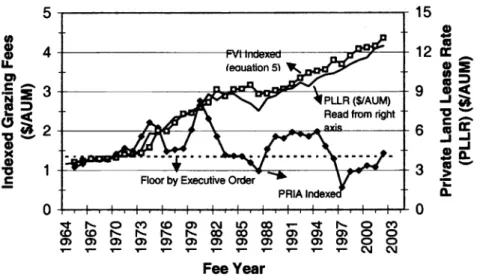
Adding the Beef Cattle Price Index (BCPI) and Prices Paid Index (PPI) to the Public Rangeland Improvement Act (PRIA) formula did not improve the fee formula's ability to predict annual forage values. In fact, adding these 2 indices ruined the predictive ability of the formula and PRIA-generated grazing fees have fall- en further and further behind private land lease rates through time (Fig. 1). Similar to the earlier findings of McCarl and Brokken (1985), our results show that these 2 indices did not improve the ability of the fee formula to predict forage value and did not help explain short-term market imper- fections as envisioned by the 1977 Grazing Fee Technical Committee. Including these 2 indices in the PRIA formula, especially with a weighting of 1, was a mistake if pre- dictive power and tracking of the private forage market are important. Using a uni- tary weighting, while intuitive in a practi- cal sense, does not give the correct coeffi-
cient in a statistical sense. The 1977 Grazing Fee Study stated that a desirable fee formula should prevent future discrep- ancies and adjust so that fair market value is charged in future years as well as the present (USDI/USDA 1977, p. 1-8). By this standard the PRIA formula has not been a desirable fee formula.
Had only the Forage Value Index (FYI) been used to adjust grazing fees (the 1969 fee formula), the federal grazing fee would have been $4.15 AUM' during the 2002 grazing season. If equation 5 had been
580 JOURNAL OF RANGE MANAGEMENT 56(6) November 2003
used, whereby growth in the FVI is recog- nized and expected, the 2002 fee would have been $4.36 AUM' (Fig. l). Fair mar- ket value of public land forage was esti- mated to be about 113 the private land lease rate (PLLR) during the 1964-1968 base period of PRIA ($1.23 AUM-' = $3.65 AUM' = 0.337). The $4.36 AUM'' fee obtained from equation 5 would represent nearly the same ratio of value in 2002 ($4.36 AUM' = $12.30 AUM'' average 2002 PLLR = 0.354). The fee would now be in the $3 to $5 AUM' range that was estimated to be "fair market value" during 1992 as part of a Grazing Fee Task Group assigned to advise BLM and FS on graz- ing fees (Bartlett et al. 1993). But, even with adjustment in the updating mecha- nism of the fee formula, value estimates for public land forage will remain contro- versial. There is no general agreement about the comparability of private and public land forage, nor is there agreement about what allowances and deductions should be credited to compensate for dif- ferences in forage quality, location, invest- ments, and non-fee grazing costs (Kearl
1989).
On the criterion of equity, the PRIA fee formula has been increasingly beneficial to public land ranchers if the historical precedent of not including interest on the grazing permit investment as a grazing cost is continued (USD1/USDA 1977, p.
3-8). It has been unfair to livestock pro- ducers that do not hold public land grazing permits, when judged against the criterion that an equitable fee should charge a simi- lar amount as if the resource was used pri- vately (USDI/USDA 1977, p. 1-8). If PRIA continues on the same general trend (Fig. 1), it is likely that the federal grazing fee will continue to be primarily deter- mined by the $1.35 AUM 1 floor set by Executive Order 12548, as it was for the 1995 through 2001 fee years.
One can only speculate about why the PRIA grazing fee formula has persisted for over 20 years. Economists pointed out problems of double counting with the for- mula even before it was implemented (Backiel and Rogge 1985). The poor tracking ability of the formula was identi- fied before PRIA expired in 1985 (McCarl and Brokken 1985). Yet, the PRIA fee for- mula with Executive Order modification continues.
According to Darwin Nielsen, an agri-
'Over the same study period the rate of inflation averaged 4.8% and average lease rates fell in real terms. McCarl and Brokken (1985) reported a similar regression coefficient for the earlier 1964-1983 period.
5
C)
0
+--
OC)COO)
ONO 0LC)0
rn rn 0) 0) Q) 0) 0) a)
r
1 ¶ -r
r r r15
12 oC
Read from right
6
JJ
PRIA Index Q.
0
00 r d' O M
0) 0) 0) 4 0
1 - t- - N N
Fee Year
Fig. 1. Private land lease rates ($ AUM'1) compared with indexed grazing fees computed using the unrestricted Public Rangeland Improvement Act (PRIA) index and the Forage Value Index (FVI) from equation 5.
cultural economist actively involved with the grazing fee discussions as PRIA was adopted, political influence and pressure from public land ranchers played a signifi- cant role in the decision to include the BCPI and PPI in the PRIA fee formula (personal communication, Darwin B.
Nielsen, Utah State University, retired, 10 October, 2000). Public land ranchers have actively lobbied to maintain the fee formu- la and perhaps the persistence of the for- mula can be attributed to their continued political activity and support.
Numerous grazing fee proposals have surfaced since the PRIA formula expira- tion date in 1985, including fee proposals studied in 1986 and updated in 1992 (USDA/USDI 1986, 1992). This was fol- lowed by the Incentive-Based Grazing Fee System in 1993 (USDI/USDA 1993), which was a study of grazing costs in Idaho, New Mexico, and Wyoming.
The Incentive-Based Fee Study was completed just as the Clinton administra- tion came to Washington, D.C. The new administration started with an enthusiasm and desire to do something positive for the environment. Public lands were perceived to be in bad shape (USDI/USDA 1994, p.
5) and the new administration planned to reform grazing and mining regulations, and moved in a new direction that was called Rangeland Reform `94. Grazing fees and alternatives to improve rangeland
health were considered in the draft Environmental Impact Statement (EIS) document (USDI/USDA 1994), but the focus eventually moved to rangeland health and fee reform was eliminated.
Grazing fee and management alterna- tives proposed in Rangeland Reform '94
were extremely controversial. The BLM and FS received over 20,000 comments to the draft EIS (USDI/USDA 1995). Efforts to change grazing fee policy under Rangeland Reform '94 were never com- pleted. According to Lee Oteni, special
assistant to the BLM Director and project leader for Rangeland Reform '94, BLM did not believe pursuing Rangeland Reform '94 management initiatives and increasing the grazing fee would be worth the necessary political capital (personal communication, 25 October, 2000).
Policy Implications and Alternatives
Differences in private land lease rates between states and regions (Tittman and Brownell 1984, Van Tassel! and McNeley 1997, LaFrance and Watts 1995) and the widening difference between lease rates and public land grazing fees generated by using the PRIA grazing fee formula, have led researchers and policy analysts to dif- ferent conclusions about how grazing fee policy should proceed. Nielsen (1972, p.
6) suggested that a competitive bid system would come closest to collecting full mar- ket value. Gardner (1963, 1983, 1989, 1997) argued that permittees should be given permanent rights to their grazing allotments. They should then be allowed to sell those rights to the highest bidder with- out restriction. He proposed that this dis- posal program might start with long-term competitive leases on an experimental basis and felt that the eventual privatiza- tion of the public lands would improve the efficiency of resource allocation (Gardner
JOURNAL OF RANGE MANAGEMENT 56(6) November 2003 581
1983, p. 227). Similarly, LaFrance and Watts (1995) concluded public lands should be permanently transferred to the private sector. Whittlesey et al. (1993) would base grazing fees on the public cost of providing grazing in a multiple use framework. Fees would differ by grazing unit as acceptable stocking rates, grazing practices, and administrative costs vary.
While no uniform grazing fee recom- mendation has been made, perhaps a uni- form message from this and previous research does emerge-the current PRIA- generated fee is inadequate. The fee for- mula has not met the objective of adjust- ing grazing fees through time so as to charge fair market value in current and future years (USDI/USDA 1977, p. 1-8).
A growing disparity has arisen between private land lease rates and the public land grazing fee.
The $1.35 AUM' grazing fee floor is where PRIA-generated grazing fees will likely remain in the future. It is a minimal grazing fee. But, there is no evidence that public land ranchers are subsidized and make an inflated rate of return because of low grazing fees. As noted by Martin and Jeffries (1966), Pope and Goodwin (1984), Workman (1988), Torell and Bailey (2000) and Bartlett et al. (2002), ranch properties are overpriced relative to their livestock earning potential. Private and public land ranchers have paid too much for western ranches and grazing permits based on the value of livestock production.
At current grazing fee rates, or even with no grazing fees, public land ranchers will continue to make a rate of return below what could be made from alternative investments of similar risk (Torell and Bailey 2000, Torell et al. 2001, Bartlett et al. 2002). Inflated ranch prices and graz- ing permit investments demonstrate that public land ranchers are willing to pay more than the current grazing fee to graze public lands.
There seems to be general agreement that, to discover allotment-specific forage values, we must either establish a market for public land grazing through privatiza- tion of public lands or by determining lease prices with a competitive bid system.
A competitive bid system has strong theo- retical appeal, and it has been proposed and studied numerous times in the past (Nielsen 1972, Martin and Jeffries 1966, USD1/USDA 1977, USDA/USDI 1992).
However, the option of moving to a com- petitive bid system has been repeatedly rejected by the federal land agencies. They believe it would be disruptive to the stabil- ity of permittees and rural communities
APPENDIX A
Indices used to compute PRIA grazing fees Reporting
Year Fee Year
1964 1965 96
1965 1966 98
1966 1967 102
1967 1968 102
1968 1969 102
1969 1970 105
1970 1971 111
1971 1972 111
1972 1973 114
1973 1974 125
1974 1975 159
1975 1976 158
1976 1977 175
1977 1978 193
1978 1979 195
1979 1980 206
1980 1981 216
1981 1982 242
1982 1983 229
1983 1984 242
1984 1985 243
1985 1986 230
1986 1987 222
1987 1988 207
1988 1989 233
1989 1990 238
1990 1991 252
1991 1992 253
1992 1993 266
1993 1994 258
1994 1995 274
1995 1996 282
1996 1997 285
1997 1998 293
1998 1999 304
1999 2000 312
2000 2001 318
2001 2002 337
Source: USDA/USDI (1992, p. 18) and updated values reported in USDA-MASS Agricultural Prices (Various Issues).
'/The PRIA fee formula expired with the 1986 fee year, and Executive Order 12548 mandated that the FVI be defined as the per head per month rate for pasturing cattle on private rangelands in the 11 western states. This was a redefinition relative to the per AUM definition previously used. The FVIPRIA column includes this redefinition, beginning with the 1986 fee year.
582 JOURNAL OF RANGE MANAGEMENT 56(6) November 2003