J. Range Manage.
49:174-178
Draft requirements to fell junipers
H. T. WIEDEMANN AND B. T. CROSS
Authors are Professor of Agricultural Engineering and Research Associate, Texas Agricultural Experiment Station, P.O.
Box 1658, Vernon, Tex. 76385.
Abstract
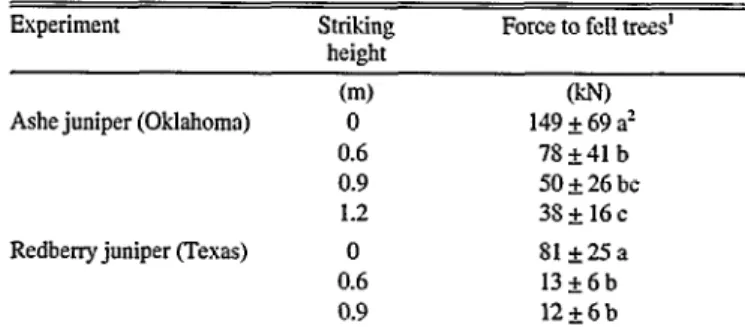
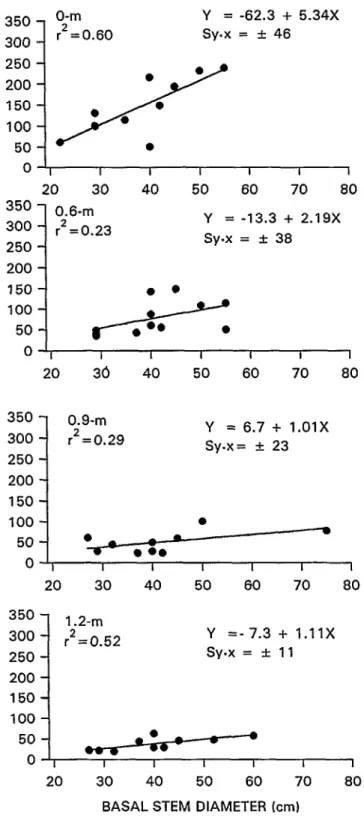
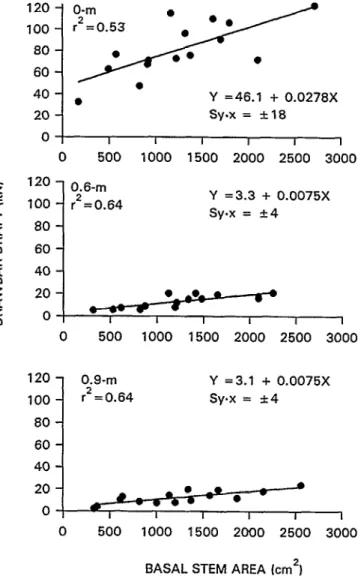
An inexpensive method of tree felling is needed to precondition dense stands of mature junipers &miperus spp.) for the effective use of prescribed burning. The purpose of this research was to determine draft requirements to fell individual juniper trees at different striking heights. These baseline data are necessary to design an elevated chaining technique. Sites in Oklahoma with single-stemmed Ashe juniper (Juniperus mhei Buchholz) (N=40) and Texas with multi-stemmed redberry juniper (hziperus pin- ch&ii Sudw.) (N=45) were selected for evaluation. A horizontal breaking bar was cabled to au instrumented tractor drawbar for draft force determinations. Data from the drawbar loadcell were stored in a laptop computer data acquisition system. Maximum force to fell junipers was determined at striking heights of 0,0.6, 0.9, and 1.2 m in Oklahoma and striking heights of 0,0.6, and 0.9 m in Texas. Force to fell Ashe juniper trees at striking heights of 0,0.6,0.9, and 1.2 m averaged 149,78,50, and 38 kN, respective- ly. Striking trees at 0.9 m compared to 0 m (ground level) reduced the felling force by 67% and still uprooted 50% and sev- ered 50% at ground level. With redberry junipers, felling force at striking heights of 0, 0.6, and 0.9 m averaged 81, 14, and 12 kN, respectively. At the striking height of 0.6 m, required draft was reduced by 84% compared to ground level striking, and 67% of the trees were severed at ground level and the remainder were uprooted. To predict force to fell a given size tree, draft was regressed on basal stem diameter in Ashe juniper or total basal stem area in redberry juniper. Based on these data, we concluded an anchor chain modified for elevated striking heights could sub- stantially reduce the tractor drawbar draft for preconditioning of dense stands of juniper by chaining.
Key Words: brush control, mechanical, burning, Juniperus, force measurements, data acquisition system, Texas, Oklahoma.
Approved as Technical Article TA 31684 from the Texas Agricultural Experiment Station. Mention of a trade name is for identification only and does not imply an endorsement or preference over other products not mentioned.
The authors are grateful for the cooperation and funding provided in part by E.
Paul and Helen Buck Waggoner Foundation and W.T. Waggoner Estate, Vernon, Tex.: Brush Control and Range Improvement Association, Albany, Tex.: Fun Country Resource Conservation and Development, Pauls Valley, Okla.; Nobel Foundation, Ardmore, Olda.; the Butterly Estate, Davis Olda.; and Standley Dozer Service, Pauls Valley. Okla. We wish to thank Jim Ahom and Nelson Mueller, SCS. Pauls Valley and Sulphur, OLda. for their assistance; Aaron Campbell and Gerral Schultz (who fabricated equipment), Texas Agricultural Experiment Station, Vernon, Tex.: and Costas Kotmbassis (who wrote software), Agricuhural Engineering Dept., Texas A&M University.
hkmuscript approved 28 May 199.5.
Junipers (Juniperus spp.) have encroached upon 10.2 million ha of rangeland in Texas and Oklahoma and negatively influ- enced land use (SCS 1983, SCS 1988, Engle 1985). This range- land is basic to the livestock, wildlife, and recreation industries of both states. Herbaceous plant production has been doubled and even tripled by juniper removal (Arnold et al. 1964, Steuter and Wright 1983). Prescribed burning for control of juniper has been validated by Wright and Bailey (1982) in Texas and Rollins (1985) in Oklahoma. However, moderate to dense stands of juniper must be mechanically treated to release herbage produc- tion necessary for successful bums (Rasmussen et al. 1986). The mortality achieved by burning is high when trees are less than 1.8 m in height, but fire is seldom effective when Ashe juniper (Juniperus ashei Buchholz) and eastern redcedar (Juniperus vir- giniana L.) are over 2.4-m tall (Dalrymple 1969, Martin and Crosby 1955, Owensby et al. 1973). Mortality of redberry juniper (Juniperus pinchotii Sudw.), a sprouting species, is high (70%) when trees are less than l-m tall and the bud zone is still above ground (Steuter and Britton 1983). J. Altom (personal communi- cation) found that large Ashe and eastern redcedar could be killed by fire if the limbs were trimmed and the tree was cut off about 1 m above ground. Engle et al. (1988) and Engle and Strizke (1991) in Oklahoma and M.K. Owens (personal communication) in Texas have used paraquat (1 ,l ‘-dimethyl-4,4’-bipyridiniumion) to precondition large junipers with varied results when later attempting to bum dense stands. The environmental movement has changed public opinion concerning the use of chemicals in agriculture and their use may be severely restricted (Farrell 1990).
Chaining is the felling of trees by an anchor chain pulled between large crawler tractors and is normally cost effective (Fisher et al. 1973). However, in dense stands of large junipers on rocky sites, chaining can be very expensive because of low chain- ing productivity. A low cost method of tree felling is needed as a pre-treatment for burning. We believe au elevated anchor chain could be designed that would reduce draft, and therefore costs, to fell juniper trees. The objective of this research was to determine draft requirements to fell individual juniper trees and the felling efficacy at different striking heights. This information is needed for basic design considerations to modify an anchor chain for ele- vated chaining.
Study Sites
Sites with mature Ashe juniper and scattered eastern redcedar in south central Oklahoma near Ardmore, and mature redberry juniper in northwest central Texas near Vernon were selected for
174 JOURNAL OF RANGE MANAGEMENT 49(2), March 1996
Breaking Bar and Instrumentation
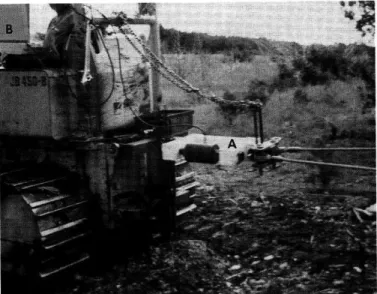
The horizontal breaking bar was a reinforced, 20 x lO-cm
(depth x width) H-beam mounted on wheels so that above ground -
striking height could be set at 0.6, 0.9, 01 1.2 m (Fig. 1). Two, 8- Fig. 3 d Arowhor mnnntml 270.kN lnadrdl I*) --.- ..L _^I.,^^ ^.&, ,a
_ . R ” . “ . . “ “ . . . . - _ . . . - _ _ . _ _ I . _ _ _ _ . . . . , . . ,