Transition-Based Neural Word Segmentation
Meishan Zhang1 and Yue Zhang2 and Guohong Fu1
1. School of Computer Science and Technology, Heilongjiang University, Harbin, China 2. Singapore University of Technology and Design
[email protected], yue [email protected],
Abstract
Character-based and word-based methods are two main types of statistical models for Chinese word segmentation, the for-mer exploiting sequence labeling models over characters and the latter typically ex-ploiting a transition-based model, with the advantages that word-level features can be easily utilized. Neural models have been exploited for character-based Chi-nese word segmentation, giving high accu-racies by making use of external character embeddings, yet requiring less feature en-gineering. In this paper, we study a neu-ral model for word-based Chinese word segmentation, by replacing the manually-designed discrete features with neural fea-tures in a word-based segmentation frame-work. Experimental results demonstrate that word features lead to comparable per-formances to the best systems in the litera-ture, and a further combination of discrete and neural features gives top accuracies.
1 Introduction
Statistical word segmentation methods can be cat-egorized character-based (Xue, 2003; Tseng et al., 2005) and word-based (Andrew, 2006; Zhang and Clark, 2007) approaches. The former casts word segmentation as a sequence labeling problem, us-ing segmentation tags on characters to mark their relative positions inside words. The latter, in con-trast, ranks candidate segmented outputs directly, extracting both character and full-word features.
An influential character-based word segmenta-tion model (Peng et al., 2004; Tseng et al., 2005) uses B/I/E/S labels to mark a character as the be-ginning, internal (neither beginning nor end), end and only-character (both beginning and end) of a
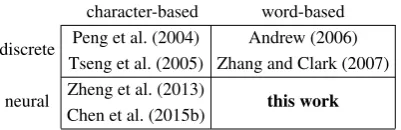
character-based word-based discrete Peng et al. (2004) Andrew (2006)
Tseng et al. (2005) Zhang and Clark (2007) neural Zheng et al. (2013) this work
[image:1.595.319.520.223.288.2]Chen et al. (2015b)
Figure 1: Word segmentation methods.
word, respectively, employing conditional random field (CRF) to model the correspondence between the input character sequence and output label se-quence. For each character, features are extracted from a five-character context window and a two-label history window. Subsequent work explores different label sets (Zhao et al., 2006), feature sets (Shi and Wang, 2007) and semi-supervised learn-ing (Sun and Xu, 2011), reportlearn-ing state-of-the-art accuracies.
Recently, neural network models have been in-vestigated for the character tagging approach. The main idea is to replace manual discrete features with automatic real-valued features, which are de-rived automatically from distributed character rep-resentations using neural networks. In particular, convolution neural network1(Zheng et al., 2013),
tensor neural network (Pei et al., 2014), recur-sive neural network (Chen et al., 2015a) and long-short-term-memory (LSTM) (Chen et al., 2015b) have been used to derive neural feature represen-tations from input word sequences, which are fed into a CRF inference layer.
In this paper, we investigate the effectiveness of word embedding features for neural network seg-mentation using transition-based models. Since it is challenging to integrate word features to the CRF inference framework of the existing
1The term in this paper is used to denote the neural
net-work structure with convolutional layers, which is different from the typical convolution neural network that has a pool-ing layer upon convolutional layers (Krizhevsky et al., 2012).
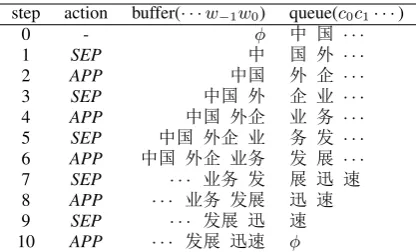
step action buffer(· · ·w−1w0) queue(c0c1· · ·)
0 - φ 中 国 · · ·
1 SEP 中 国 外 · · ·
2 APP 中国 外 企 · · ·
3 SEP 中国 外 企 业 · · ·
4 APP 中国 外企 业 务 · · ·
5 SEP 中国 外企 业 务 发 · · ·
6 APP 中国 外企 业务 发 展 · · ·
7 SEP · · · 业务 发 展 迅 速
8 APP · · · 业务 发展 迅 速
9 SEP · · · 发展 迅 速
[image:2.595.77.287.61.187.2]10 APP · · · 发展 迅速 φ
Figure 2: Segmentation process of “中国
(Chi-nese) 外企 (foreign company) 业务 (busi-ness) 发展(develop) 迅速(quickly)”.
character-based methods, we take inspiration from word-based discrete segmentation instead. In par-ticular, we follow Zhang and Clark (2007), using the transition-based framework to decode a sen-tence from left-to-right incrementally, scoring par-tially segmented results using both character-level and word-level features. Beam-search is applied to reduce error propagation and large-margin train-ing with early-update (Collins and Roark, 2004) is used for learning from inexact search.
We replace the discrete word and character fea-tures of Zhang and Clark (2007) with word and character embeddings, respectively, and change their linear model into a deep neural network. Following Zheng et al. (2013) and Chen et al. (2015b), we use convolution neural networks to achieve local feature combination and LSTM to learn global sentence-level features, respectively. The resulting model is a word-based neural seg-menter that can leverage rich embedding features. Its correlation with existing work on Chinese seg-mentation is shown in Figure 1.
Results on standard benchmark datasets show the effectiveness of word embedding features for neural segmentation. Our method achieves state-of-the-art results without any preprocess based on external knowledge such as Chinese idioms of Chen et al. (2015a) and Chen et al. (2015b). We re-lease our code under GPL for research reference.2
2 Baseline Discrete Model
We exploit the word-based segmentor of Zhang and Clark (2011) as the baseline system. It in-crementally segments a sentence using a transition system, with a state holding a partially-segmented 2https://github.com/SUTDNLP/NNTransitionSegmentor.
sentence in a buffersand ordering the next incom-ing characters in a queueq. Given an input Chi-nese sentence, the buffer is initially empty and the queue contains all characters of the sentence, a se-quence of transition actions are used to consume characters in the queue and build the output sen-tence in the buffer. The actions include:
• Append (APP), which removes the first character from the queue, and appends it to the last word in the buffer;
• Separate (SEP), which moves the first character of the queue onto the buffer as a new (sub) word.
Given the input sequence of characters “中国
外企业务发展迅速” (The business of foreign
company in China develops quickly), the correct output can be derived using action sequence “SEP APP SEP APP SEP APP SEP APP SEP APP”, as shown in Figure 2.
Search. Based on the transition system, the de-coder searches for an optimal action sequence for a given sentence. Denote an action sequence as
A = a1· · ·an. We define the score ofA as the
total score of all actions in the sequence, which is computed by:
score(A) =X a∈A
score(a) =X a∈A
w·f(s, q, a),
wherewis the model parameters,fis a feature ex-traction function,sandqare the buffer and queue of a certain state before the actionais applied.
The feature templates are shown in Table 1, which are the same as Zhang and Clark (2011). These base features include three main source of information. First, characters in the front of the queue and the end of the buffer are used for scor-ing both separate and append actions (e.g. c0).
Second, words that are identified are used to guide
separateactions (e.g. w0). Third, relevant
infor-mation of identified words, such as their lengths and first/last characters are utilized for additional features (e.g.len(w−1)).
Feature templates Action
c−1c0 APP, SEP
w−1,w−1w−2,w−1c0,w−2len(w−1)
SEP start(w−1)c0,end(w−1)c0
start(w−1)end(w−1),end(w−2)end(w−1) w−2len(w−1),len(w−2)w−1
[image:3.595.310.522.62.190.2]w−1, wherelen(w−1) = 1
Table 1: Feature templates for the baseline model, where wi denotes the word in the buffer, ci
de-notes the character in the queue, as shown in Fig-ure 2,start(.),end(.)andlen(.)denote the first, last character and length of a word, respectively.
Algorithm 1Beam-search decoding.
functionDECODE(c1· · ·cn,Θ)
agenda← {(φ,c1· · ·cn, score=0.0)}
fori in 1· · ·n beam← { }
forcandinagenda new←SEP(cand,ci,Θ) ADDITEM(beam,new) new←APP(cand,ci,Θ) ADDITEM(beam,new) agenda←TOP-B(beam, B) best←BESTITEM(agenda)
w1· · ·wm←EXTRACTWORDS(best)
used as the beam states for the next step. The same process replaces until all input character are pro-cessed, and the highest-scored state in the beam is taken for output. Online leaning with max-margin is used, which is given in section 4.
3 Transition-Based Neural Model
We use a neural network model to replace the discrete linear model for scoring transition action sequences. For better comparison between dis-crete and neural features, the overall segmentation framework of the baseline is used, which includes the incremental segmentation process, the beam-search decoder and the training process integrated with beam-search (Zhang and Clark, 2011). In ad-dition, the neural network scorer takes the simi-lar feature sources as the baseline, which includes character information over the input, word infor-mation of the partially constructed output, and the history sequence of the actions that have been ap-plied so far.
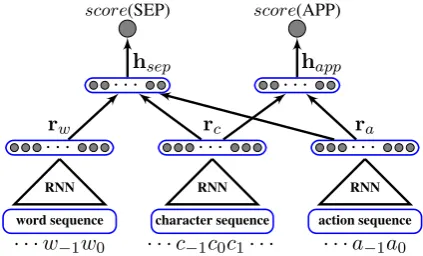
The overall architecture of the neural scorer is shown in Figure 3. Given a certain state
score(SEP) score(APP)
· · ·hsep · · ·happ
· · ·rc
· · ·rw · · ·ra
word sequence character sequence action sequence RNN RNN RNN
· · ·w−1w0 · · ·c−1c0c1· · · ·a−1a0
Figure 3: Scorer for the neural transition-based Chinese word segmentation model. We denote the last word in the buffer as w0, the next incoming
character asc0in the queue in consistent with
Fig-ure 2, and the last applied action asa0.
configuration (s, q), we use three separate re-current neural networks (RNN) to model the word sequence · · ·w−1w0, the character
se-quence · · ·c−1c0c1· · ·, and the action sequence · · ·a−1a0, respectively, resulting in three dense
real-valued vectors {rw,rcandra}, respectively.
All the three feature vectors are used scoring the
SEPaction. For APP, on the other hand, we use only the character and action features rc and ra
because the last wordw0 in the buffer is a partial
word. Formally, givenrw,rc,ra, the action scores
are computed by:
score(SEP) =wsephsep score(APP) =wapphapp
where
hsep = tanh(Wsep[rw,rc,ra] +bsep)
happ= tanh(Wapp[rc,ra] +bapp)
Wsep, Wapp,bsep,bapp,wsep,wappare model
pa-rameters.
The neural networks take the embedding forms of words, characters and actions as input, for ex-tractingrw,rcandra, respectively. We exploit the
LSTM-RNN structure (Hochreiter and Schmidhu-ber, 1997), which can better capture non-local syn-tactic and semantic information from a sequential input, yet reducing gradient explosion or dimin-ishing during training.
In general, given a sequence of input vectors x0· · ·xn, the LSTM-RNN computes a sequence
of hidden vectors h0· · ·hn, respectively, with
eachhi being determined by the inputxi and the
[image:3.595.76.289.63.151.2]... wi ... wi−1 ...
... xw
i ...
(a) word representation
... ai ... ai−1 ...
... xa
i ...
(b) action representation
... ⊕ ...
ci, ci−1ci ... ⊕ ...
ci−1, ci−2ci−1
... ⊕ ...
ci+1, ci+1ci ... ...
... xc i
... ...
[image:4.595.86.276.61.214.2](c) character representation
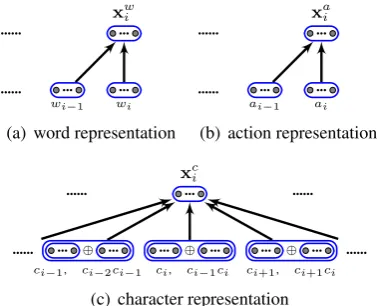
Figure 4: Input representations of LSTMS forra
(actions)rw(words) andrc(characters).
used to carry long-term memory information over the historyh0· · ·hi for calculatinghi, and
infor-mation flow is controlled by an input gateig, an output gateogand a forget gatefg. Formally, the calculation ofhiusinghi−1 andxiis:
igi =σ(Wigxi+Uighi−1+Vigcei−1+big)
fgi=σ(Wfgxi+Ufghi−1+Vfgcei−1+bfg)
cei =fgicei−1+
igitanh(Wcexi+Ucehi−1+bce)
ogi =σ(Wogxi+Uoghi−1+Vogcei+bog)
hi=ogitanh(cei),
whereU, V, W,bare model parameters, and de-notes Hadamard product.
When used to calculaterw,rcandra, the
gen-eral LSTM structure above is given different input sequencesx0· · ·xn, according to the word,
char-acter and action sequences, respectively.
3.1 Input representation
Words.Given a wordw, we use a looking-up ma-trixEw to obtain its embeddingew(w). The
ma-trix can be obtained through pre-training on large size of auto segmented corpus. As shown in Fig-ure 4(a), we use a convolutional neural layer upon a two-word window to obtain · · ·xw
−1xw0 for the
LSTM forrw, with the following formula:
xwi = tanh Ww[ew(wi−1),ew(wi)] +bw
Actions. We represent an action a with an em-bedding ea(a) from a looking-up table Ea, and
apply the similar convolutional neural network to obtain· · ·xa
−1xa0 forra, as shown in Figure 4(b).
Given the input action sequence· · ·a−1a0, thexai
is computed by:
xai = tanh Wa[ea(ai−1),ea(ai)] +ba
Characters. We make embeddings for both char-acter unigrams and bigrams by looking-up ma-trixes Ec and Ebc, respectively, the latter being
shown to be useful by Pei et al. (2014). For each characterci, the unigram embedding ec(ci)
and the bigram embedding ebc(ci−1ci) are
con-catenated, before being given to a CNN with a convolution size of 5. For the character sequence
· · ·c−1c0c1· · · of a given state(s, q), we compute
its input vectors· · ·xc
−1xc0xc1· · · for the LSTM for
rcby:
xc
i = tanh Wc[ec(ci−2)⊕ebc(ci−3ci−2), · · · ,ec(ci)⊕ebc(ci−1ci),· · ·,
ec(ci+2)⊕ebc(ci+1ci+2)] +bc
For all the above input representations, the looking-up tables Ew, Ea , Ec, Ebc and the
weightsWw,Wa, Wc,bw, ba, bcare model
pa-rameters. For calculatingrwandra, we apply the
LSTMs directly over the sequences· · ·xw
−1xw0 and · · ·xa
−1xa0 for words and actions, and use the
out-puts hw
0 andha0 forrw andra, respectively. For
calculatingrc, we further use a bi-directional
ex-tension of the original LSTM structure. In partic-ular, the base LSTM is applied to the input char-acter sequence both from left to right and from right to left, leading to two hidden node sequences
· · ·hcL
−1hcL0 hcL1 · · · and · · ·hcR−1hcR0 hcR1 · · ·,
re-spectively. For the current character c0, hcL0 and
hcR
0 are concatenated to form the final vectorrc.
This is feasible because the character sequence is input and static, and previous work has demon-strated better capability of bi-directional LSTM for modeling sequences (Yao and Zweig, 2015).
3.2 Integrating discrete features
Our model can be extended by integrating the baseline discrete features into the feature layer. In particular,
score(SEP) =w0
sep(hsep⊕fsep) score(APP) =w0
app(happ⊕fapp),
wherefsep andfapp represent the baseline sparse
vector forSEPandAPPfeatures, respectively, and
Algorithm 2 Max-margin training with early-update.
functionTRAIN(c1· · ·cn,ag1· · ·agn,Θ) agenda← {(φ,c1· · ·cn, score=0.0)}
fori in 1· · ·n beam← { }
forcandinagenda new←SEP(cand,ci,Θ)
if{agi 6=SEP}new.score +=η ADDITEM(beam,new)
new←APP(cand,ci,Θ)
if{agi 6=APP}new.score +=η ADDITEM(beam,new)
agenda←TOP-B(beam, B)
if{ITEM(ag1· · ·agi)∈/agenda} Θ = Θ−f BESTITEM(agenda) Θ = Θ +f ITEM((ag1· · ·agi)
return
if{ITEM(ag1· · ·ang)6=BESTITEM(agenda)} Θ = Θ−f BESTITEM(agenda) Θ = Θ +f ITEM((ag1· · ·agn)
4 Training
To train model parameters for both the discrete and neural models, we exploit online learning with early-update as shown in Algorithm 2. A max-margin objective is exploited,3which is defined as:
L(Θ) = K1 XK k=1
l(Agk,Θ) + λ2 kΘk2
l(Agk,Θ) = max
A score(Ak,Θ) +η·δ(Ak, A g k)
−score(Agk,Θ),
whereΘis the set of all parameters,{Agk}K n=1are
gold action sequences to segment the training cor-pus,Akis the model output action sequence,λis a
regularization parameter andηis used to tune the loss margins.
For the discrete models, f(·) denotes the fea-tures extracted according to the feature templates in Table 1. For the neural models, f(·) denotes the corresponding hsep andhapp. Thus only the
output layer is updated, and we further use back-propagation to learn the parameters of the other layers (LeCun et al., 2012). We use online Ada-3Zhou et al. (2015) find that max-margin training did not
yield reasonable results for neural transition-based parsing, which is different from our findings. One likely reason is that when the number of labels is small max-margin is effective.
CTB60 PKU MSR
Training #word#sent 641k23k 1,010k17k 2,122k78k Development #word#sent 2.1k60k 100k1.9k 246k8.7k
[image:5.595.312.522.61.134.2]Test #word#sent 2.8k82k 104k1.9k 106k4.0k
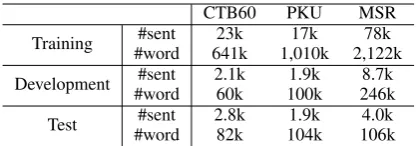
Table 2: Statistics of datasets.
Type hyper-parameters Network d(hsep) = 100,d(happ) = 80 structure d(ha
i) = 20,d(xai) = 20 d(hw
i) = 50,d(xwi) = 50 d(hcL
i ) =d(hcRi ) = 50,d(xci) = 50 d(ew(wi)) = 50,d(ea(ai)) = 20 d(ec(ci)) = 50,d(ebc(ci−1ci)) = 50
[image:5.595.318.515.165.255.2]Training λ= 10−8,α= 0.01,η= 0.2 Table 3: Hyper-parameter values in our model.
Grad (Duchi et al., 2011) to minimize the objec-tive function for both the discrete and neural mod-els. All the matrix and vector parameters are ini-tialized by uniform sampling in(−0.01,0.01).
5 Experiments
5.1 Experimental Settings
Data. We use three datasets for evaluation, namely CTB6, PKU and MSR. The CTB6 corpus is taken from Chinese Treebank 6.0, and the PKU and MSR corpora can be obtained from Bake-Off 2005 (Emerson, 2005). We follow Zhang et al. (2014), splitting the CTB6 corpus into train-ing, development and testing sections. For the PKU and MSR corpora, only the training and test datasets are specified and we randomly split 10% of the training sections for development. Table 1 shows the overall statistics of the three datasets.
Embeddings. We use word2vec4 to pre-train
word, character and bi-character embeddings on Chinese Gigaword corpus (LDC2011T13). In or-der to train full word embeddings, the corpus is segmented automatically by our baseline model.
Hyper-parameters. The hyper-parameter values are tuned according to development performances. We list their final values in Table 3.
5.2 Development Results
To better understand the word-based neural mod-els, we perform several development experiments.
All the experiments in this section are conducted on the CTB6 development dataset.
5 10 15 20 86
88 90 92 94 96
(a) discrete
5 10 15 20
b16 b8 b4 b2 b1
(b) neural(-tune)
5 10 15 20
[image:6.595.330.506.60.150.2](c) neural(+tune)
Figure 5: Accuracies against the training epoch using beam sizes 1, 2, 4, 8 and 16, respectively.
5.2.1 Embeddings and beam size
We study the influence of beam size on the base-line and neural models. Our neural model has two choices of using pre-trained word embeddings. We can either fine-tune or fix the embeddings dur-ing traindur-ing. In case of fine-tundur-ing, only words in the training data can be learned, while embeddings of out-of-vocabulary (OOV) words could not be used effectively.5 In addition, following Dyer et
[image:6.595.78.281.61.192.2]al. (2015) we randomly set words with frequency 1 in the training data as the OOV words in order to learn the OOV embedding, while avoiding over-fitting. If the pretrained word embeddings are not fine-tuned, we can utilize all word embeddings.
Figure 5 shows the development results, where the training curve of the discrete baseline is shown in Figure 5(a) and the curve of the neural model without and with fine tuning are shown in 5(b) and 5(c), respectively. The performance increases with a larger beam size in all settings. When the beam increases into 16, the gains levels out. The results of the discrete model and the neural model without fine-tuning are highly similar, showing the useful-ness of beam-search.
On the other hand, with fine-tuning, the results are different. The model with beam size 1 gives better accuracies compared to the other models with the same beam size. However, as the beam size increases, the performance increases very lit-tle. The results are consistent with Dyer et al. (2015), who find that beam-search improves the results only slightly on dependency parsing. When a beam size of 16 is used, this model performs the
5We perform experiments using random initialized word
embeddings as well when fine-tune is used, which is a fully supervised model. The performance is slightly lower.
Model P R F
neural 95.21 95.69 95.45 -word 91.81 92.00 91.90 -character unigram 94.89 95.56 95.22 -character bigram 94.93 95.53 95.23 -action 95.00 95.31 95.17 +discrete features 96.38 96.22 96.30
(combined)
Table 4: Feature experiments.
0.8 0.84 0.88 0.92 0.96 1 0.8
0.84 0.88 0.92 0.96 1
discrete
neural
Figure 6: Sentence accuracy comparisons for the discrete and the neural models.
worst compared with the discrete model and the neural model without fine-tuning. This is likely because the fine-tuning of embeddings leads to overfitting of in-vocabulary words, and underfit-ting over OOV words. Based on the observation, we exploit fixed word embeddings in our final models.
5.2.2 Feature ablation
We conduct feature ablation experiments to study the effects of the word, character unigram, charac-ter bigram and action features to the neural model. The results are shown in Table 4. Word features are particularly important to the model, without which the performance decreases by 4.5%. The effects of the character unigram, bigram and ac-tion features are relatively much weaker.6 This
demonstrates that in the word-based incremental search framework, words are the most crucial in-formation to the neural model.
5.2.3 Integrating discrete features
Prior work has shown the effectiveness of integrat-ing discrete and neural features for several NLP tasks (Turian et al., 2010; Wang and Manning, 6In all our experiments, we fix the character unigram and
[image:6.595.326.506.71.257.2] [image:6.595.328.498.176.331.2]Models P R F word-based models
discrete 95.29 95.26 95.28
neural 95.34 94.69 95.01
combined 96.11 95.79 95.95
character-based models
discrete 95.38 95.12 95.25
neural 94.59 94.92 94.76
combined 95.63 95.60 95.61
other models
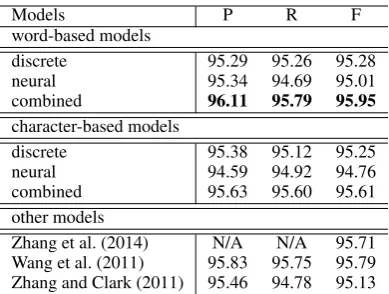
[image:7.595.84.279.60.207.2]Zhang et al. (2014) N/A N/A 95.71 Wang et al. (2011) 95.83 95.75 95.79 Zhang and Clark (2011) 95.46 94.78 95.13 Table 5: Main results on CTB60 test dataset.
2013; Durrett and Klein, 2015; Zhang and Zhang, 2015). We investigate the usefulness of such inte-gration to our word-based segmentor on the devel-opment dataset. We study it by two ways. First, we compare the error distributions between the discrete and the neural models. Intuitively, differ-ent error distributions are necessary for improve-ments by integration. We draw a scatter graph to show their differences, with the (x, y) values of each point denoting the F-measure scores of the two models with respect to sentences, respectively. As shown in Figure 6, the points are rather disper-sive, showing the differences of the two models.
Further, we directly look at the results after in-tegration of both discrete and neural features. As shown in Table 4, the integrated model improves the accuracies from 95.45% to 96.30%, demon-strating that the automatically-induced neural fea-tures contain highly complementary information to the manual discrete features.
5.3 Final Results
Table 6 shows the final results on CTB6 test dataset. For thorough comparison, we implement discrete, neural and combined character-based models as well.7 In particular, the character-based
discrete model is a CRF tagging model using char-acter unigrams, bigrams, trigrams and tag transi-tions (Tseng et al., 2005), and the character-based neural model exploits a bi-directional LSTM layer to model character sequences8and a CRF layer for
7The code is released for research reference under GPL at
https://github.com/SUTDNLP/NNSegmentation.
8We use a concatenation of character unigram and bigram
embeddings at each position as the input to LSTM, because our experiments show that the character bigram embeddings are useful, without which character-based neural models are significantly lower than their discrete counterparts.
Models PKU MSR
our word-based models
discrete 95.1 97.3
neural 95.1 97.0
combined 95.7 97.7
character-based models
discrete 94.9 96.8
neural 94.4 97.2
combined 95.4 97.2
other models
Cai and Zhao (2016) 95.5 96.5 Ma and Hinrichs (2015) 95.1 96.6 Pei et al. (2014) 95.2 97.2 Zhang et al. (2013a) 96.1 97.5 Sun et al. (2012) 95.4 97.4 Zhang and Clark (2011) 95.1 97.1
Sun (2010) 95.2 96.9
Sun et al. (2009) 95.2 97.3
Table 6: Main results on PKU and MSR test datasets.
output (Chen et al., 2015b).9 The combined model
uses the same method for integrating discrete and neural features as our word-based model.
The word-based models achieve better perfor-mances than character-based models, since our model can exploit additional word information learnt from large auto-segmented corpus. We also compare the results with other models. Wang et al. (2011) is a semi-supervised model that exploits word statistics from auto-segmented raw corpus, which is similar with our combined model in using semi-supervised word information. We achieve slightly better accuracies. Zhang et al. (2014) is a joint segmentation, POS-tagging and dependency parsing model, which can exploit syntactic infor-mation.
To compare our models with other state-of-the-art models in the literature, we report the perfor-mance on the PKU and MSR datasets also.10 Our
combined model gives the best result on the MSR dataset, and the second best on PKU. The method of Zhang et al. (2013a) gives the best performance on PKU by co-training on large-scale data.
5.4 Error Analysis
To study the differences between word-based and character-based neural models, we conduct error analysis on the test dataset of CTB60. First, 9Bi-directional LSTM is slightly better than a single
left-right LSTM used in Chen et al. (2015b).
10The results of Chen et al. (2015a) and Chen et al. (2015b)
[image:7.595.335.495.60.261.2]0.8 0.84 0.88 0.92 0.96 1 0.8
0.84 0.88 0.92 0.96 1
word
character
Figure 7: Sentence accuracy comparisons for word- and character-based neural models.
5 10 15 20 25 30 35 40 45 50+ 92
94 96 98
F-measur
es(%)
[image:8.595.96.266.63.209.2]word character
Figure 8: F-measure against character length.
we examine the error distribution on individual sentences. Figure 7 shows the F-measure val-ues of each test sentence by word- and character-based neural models, respectively, where the x-axis value denotes the F-measure value of the word-based neural model, and the y-axis value de-notes its performance of the character-based neu-ral model. We can see that the majority scat-ter points are off the diagonal line, demonstrating strong differences between the two models. This results from the differences in feature sources.
Second, we study the F-measure distribution of the two neural models with respect to sen-tence lengths. We divide the test sensen-tences into ten bins, with bin idenoting sentence lengths in
[5∗(i−1),5∗i]. Figure 8 shows the results. Ac-cording to the figure, we observe that word-based neural model is relatively weaker for sentences with length in[5,10], while can better tackle long sentences.
Third, we compare the two neural models by their capabilities of modeling words with different lengths. Figure 9 shows the results. The
perfor-1 2 3 4+
75 80 85 90 95
Figure 9: F-measure against word length, where the boxes with red dots denote the performances of word-based neural model, and the boxes with blue slant lines denote character-based neural model.
mances are lower for words with lengths beyond 2, and the performance drops significantly for words with lengths over 3. Overall, the word-based neu-ral model achieves comparable performances with the character-based model, but gives significantly better performances for long words, in particular when the word length is over 3. This demonstrates the advantage of word-level features.
6 Related Work
Xue (2003) was the first to propose a character-tagging method to Chinese word segmentation, us-ing a maximum entropy model to assign B/I/E/S tags to each character in the input sentence sepa-rately. Peng et al. (2004) showed that better results can be achieved by global learning using a CRF model. This method has been followed by most subsequent models in the literature (Tseng et al., 2005; Zhao, 2009; Sun et al., 2012). The most effective features have been character unigrams, bigrams and trigrams within a five-character win-dow, and a bigram tag window. Special characters such as alphabets, numbers and date/time charac-ters are also differentiated for extracting features.
Zheng et al. (2013) built a neural network seg-mentor, which essentially substitutes the manual discrete features of Peng et al. (2004), with dense real-valued features induced automatically from character embeddings, using a deep neural net-work structure (Collobert et al., 2011). A tag tran-sition matrix is used for inference, which makes the model effectively. Most subsequent work on neural segmentation followed this method, im-proving the extraction of emission features by us-ing more complex neural network structures.
[image:8.595.318.517.63.169.2] [image:8.595.75.291.265.399.2]charac-ter bigrams. Pei et al. (2014) used a tensor neu-ral network to achieve extensive feature combi-nations, capturing the interaction between charac-ters and tags. Chen et al. (2015a) used a recur-sive network structure to the same end, extract-ing more combined features to model complicated character combinations in a five-character win-dow. Chen et al. (2015b) used a LSTM model to capture long-range dependencies between charac-ters in a sentence. Xu and Sun (2016) proposed a dependency-based gated recursive neural network to efficiently integrate local and long-distance fea-tures. The above methods are all character-based models, making no use of full word information. In contrast, we leverage both character embed-dings and word embedembed-dings for better accuracies. For word-based segmentation, Andrew (2006) used a semi-CRF model to integrate word fea-tures, Zhang and Clark (2007) used a percep-tron algorithm with inexact search, and Sun et al. (2009) used a discriminative latent variable model to make use of word features. Recently, there have been several neural-based models us-ing word-level embeddus-ing features (Morita et al., 2015; Liu et al., 2016; Cai and Zhao, 2016), which are different from our work in the basic frame-work. For instance, Liu et al. (2016) follow An-drew (2006) using a semi-CRF for structured in-ference.
We followed the global learning and beam-search framework of Zhang and Clark (2011) in building a word-based neural segmentor. The main difference between our model and that of Zhang and Clark (2011) is that we use a neural network to induce feature combinations directly from character and word embeddings. In addi-tion, the use of a bi-directional LSTM allows us to leverage non-local information from the word se-quence, and look-ahead information from the in-coming character sequence. The automatic neu-ral features are complementary to the manual dis-crete features of Zhang and Clark (2011). We show that our model can accommodate the inte-gration of both types of features. This is similar in spirit to the work of Sun (2010) and Wang et al. (2014), who integrated features of character-based and word-based segmentors.
Transition-based framework with beam search has been widely exploited in a number of other NLP tasks, including syntactic parsing (Zhang and Nivre, 2011; Zhu et al., 2013), information
ex-traction (Li and Ji, 2014) and the work of joint models (Zhang et al., 2013b; Zhang et al., 2014). Recently, the effectiveness of neural features has been studied for this framework. In the natural language parsing community, it has achieved great success. Representative work includes Zhou et al. (2015), Weiss et al. (2015), Watanabe and Sumita (2015) and Andor et al. (2016). In this work, we apply the transition-based neural framework to Chinese segmentation, in order to exploit word-level neural features such as word embeddings. 7 Conclusion
We proposed a word-based neural model for Chi-nese segmentation, which exploits not only char-acter embeddings as previous work does, but also word embeddings pre-trained from large scale corpus. The model achieved comparable per-formances compared with a discrete word-based baseline, and also the state-of-the-art character-based neural models in the literature. We fur-ther demonstrated that the model can utilize dis-crete features conveniently, resulting in a bined model that achieved top performances com-pared with previous work. Finally, we conducted several comparisons to study the differences be-tween our word-based model with character-based neural models, showing that they have different er-ror characteristics.
Acknowledgments
We thank the anonymous reviewers, Yijia Liu and Hai Zhao for their constructive comments, which help to improve the final paper. This work is sup-ported by National Natural Science Foundation of China (NSFC) under grant 61170148, Natu-ral Science Foundation of Heilongjiang Province (China) under grant No.F2016036, the Singapore Ministry of Education (MOE) AcRF Tier 2 grant T2MOE201301 and SRG ISTD 2012 038 from Singapore University of Technology and Design. Yue Zhang is the corresponding author.
References
Daniel Andor, Chris Alberti, David Weiss, Aliaksei Severyn, Alessandro Presta, Kuzman Ganchev, Slav Petrov, and Michael Collins. 2016. Globally nor-malized transition-based neural networks. In Pro-ceedings of the ACL 2016.
InProceedings of the 2006 Conference on EMNLP, pages 465–472, Sydney, Australia, July.
Deng Cai and Hai Zhao. 2016. Neural word segmen-tation learning for Chinese. InProceedings of ACL 2016.
Xinchi Chen, Xipeng Qiu, Chenxi Zhu, and Xuanjing Huang. 2015a. Gated recursive neural network for chinese word segmentation. InProceedings of the 53nd ACL, pages 1744–1753, July.
Xinchi Chen, Xipeng Qiu, Chenxi Zhu, Pengfei Liu, and Xuanjing Huang. 2015b. Long short-term memory neural networks for chinese word segmen-tation. InProceedings of the 2015 EMNLP, pages 1197–1206, September.
Michael Collins and Brian Roark. 2004. Incremen-tal parsing with the perceptron algorithm. In Pro-ceedings of the 42nd Meeting of the Association for Computational Linguistics (ACL’04), Main Volume, pages 111–118, Barcelona, Spain, July.
R. Collobert, J. Weston, L. Bottou, M. Karlen, K. Kavukcuoglu, and P. Kuksa. 2011. Natural lan-guage processing (almost) from scratch. Journal of Machine Learning Research, 12:2493–2537. John Duchi, Elad Hazan, and Yoram Singer. 2011.
Adaptive subgradient methods for online learning and stochastic optimization. The Journal of Ma-chine Learning Research, 12:2121–2159.
Greg Durrett and Dan Klein. 2015. Neural crf pars-ing. InProceedings of the 53nd ACL, pages 302– 312, July.
Chris Dyer, Miguel Ballesteros, Wang Ling, Austin Matthews, and Noah A. Smith. 2015. Transition-based dependency parsing with stack long short-term memory. In Proceedings of the 53nd ACL, pages 334–343, July.
Thomas Emerson. 2005. The second international chi-nese word segmentation bakeoff. In Proceedings of the Second SIGHAN Workshop on Chinese Lan-guage Processing, pages 123–133.
Sepp Hochreiter and J¨urgen Schmidhuber. 1997. Long short-term memory. Neural computation, 9(8):1735–1780.
Alex Krizhevsky, Ilya Sutskever, and Geoffrey E Hin-ton. 2012. Imagenet classification with deep con-volutional neural networks. In Advances in neural information processing systems, pages 1097–1105. Yann A LeCun, L´eon Bottou, Genevieve B Orr, and
Klaus-Robert M¨uller. 2012. Efficient backprop. In Neural networks: Tricks of the trade, pages 9–48. Springer.
Qi Li and Heng Ji. 2014. Incremental joint extraction of entity mentions and relations. InProceedings of the ACL 2014.
Yijia Liu, Wanxiang Che, Jiang Guo, Bing Qin, and Ting Liu. 2016. Exploring segment representations for neural segmentation models. InProceedings of IJCAI 2016.
Jianqiang Ma and Erhard Hinrichs. 2015. Accurate linear-time chinese word segmentation via embed-ding matching. In Proceedings of the 53nd ACL, pages 1733–1743, July.
Mairgup Mansur, Wenzhe Pei, and Baobao Chang. 2013. Feature-based neural language model and chinese word segmentation. In Proceedings of the Sixth International Joint Conference on Natural Language Processing, pages 1271–1277, Nagoya, Japan, October. Asian Federation of Natural Lan-guage Processing.
Hajime Morita, Daisuke Kawahara, and Sadao Kuro-hashi. 2015. Morphological analysis for unseg-mented languages using recurrent neural network language model. InProceedings of the 2015 Con-ference on EMNLP, pages 2292–2297.
Wenzhe Pei, Tao Ge, and Baobao Chang. 2014. Max-margin tensor neural network for chinese word seg-mentation. InProceedings of the 52nd ACL, pages 293–303, Baltimore, Maryland, June.
Fuchun Peng, Fangfang Feng, and Andrew McCallum. 2004. Chinese segmentation and new word detec-tion using condidetec-tional random fields. InProceedings of Coling 2004, pages 562–568, Geneva, Switzer-land, Aug 23–Aug 27.
Yanxin Shi and Mengqiu Wang. 2007. A dual-layer crfs based joint decoding method for cascaded seg-mentation and labeling tasks. InIJCAI, pages 1707– 1712.
Weiwei Sun and Jia Xu. 2011. Enhancing chinese word segmentation using unlabeled data. In Pro-ceedings of the 2011 Conference on EMNLP, pages 970–979, July.
Xu Sun, Yaozhong Zhang, Takuya Matsuzaki, Yoshi-masa Tsuruoka, and Jun’ichi Tsujii. 2009. A dis-criminative latent variable chinese segmenter with hybrid word/character information. InProceedings of NAACL 2009, pages 56–64, June.
Xu Sun, Houfeng Wang, and Wenjie Li. 2012. Fast on-line training with frequency-adaptive learning rates for chinese word segmentation and new word detec-tion. InProceedings of the 50th ACL, pages 253– 262, July.
Weiwei Sun. 2010. Word-based and character-based word segmentation models: Comparison and combi-nation. InColing 2010: Posters, pages 1211–1219, August.
Joseph Turian, Lev-Arie Ratinov, and Yoshua Bengio. 2010. Word representations: A simple and general method for semi-supervised learning. In Proceed-ings of the 48th Annual Meeting of the Association for Computational Linguistics, pages 384–394, July. Mengqiu Wang and Christopher D. Manning. 2013. Effect of non-linear deep architecture in sequence labeling. InProceedings of the Sixth International Joint Conference on Natural Language Processing, pages 1285–1291, Nagoya, Japan, October. Asian Federation of Natural Language Processing. Yiou Wang, Jun’ichi Kazama, Yoshimasa Tsuruoka,
Wenliang Chen, Yujie Zhang, and Kentaro Tori-sawa. 2011. Improving chinese word segmenta-tion and pos tagging with semi-supervised methods using large auto-analyzed data. In Proceedings of 5th IJCNLP, pages 309–317, Chiang Mai, Thailand, November.
Mengqiu Wang, Rob Voigt, and Christopher D. Man-ning. 2014. Two knives cut better than one: Chi-nese word segmentation with dual decomposition. In Proceedings of the 52nd ACL, pages 193–198, Baltimore, Maryland, June.
Taro Watanabe and Eiichiro Sumita. 2015. Transition-based neural constituent parsing. InProceedings of the 53rd ACL, pages 1169–1179, July.
David Weiss, Chris Alberti, Michael Collins, and Slav Petrov. 2015. Structured training for neural network transition-based parsing. InProceedings of the 53rd ACL, pages 323–333, July.
Jingjing Xu and Xu Sun. 2016. Dependency-based gated recursive neural network for chinese word seg-mentation. InProceedings of ACL 2016.
Nianwen Xue. 2003. Chinese word segmentation as character tagging. International Journal of Compu-tational Linguistics and Chinese Language Process-ing, 8(1).
Kaisheng Yao and Geoffrey Zweig. 2015. Sequence-to-sequence neural net models for grapheme-to-phoneme conversion. arXiv preprint arXiv:1506.00196.
Yue Zhang and Stephen Clark. 2007. Chinese seg-mentation with a word-based perceptron algorithm. In Proceedings of the 45th ACL, pages 840–847, Prague, Czech Republic, June.
Yue Zhang and Stephen Clark. 2011. Syntactic pro-cessing using the generalized perceptron and beam search. Computational Linguistics, 37(1):105–151. Yue Zhang and Joakim Nivre. 2011. Transition-based
dependency parsing with rich non-local features. In Proceedings of the 49th ACL, pages 188–193, June. Meishan Zhang and Yue Zhang. 2015. Combin-ing discrete and continuous features for determin-istic transition-based dependency parsing. In Pro-ceedings of the 2015 EMNLP, pages 1316–1321, September.
Longkai Zhang, Houfeng Wang, Xu Sun, and Mairgup Mansur. 2013a. Exploring representations from un-labeled data with co-training for Chinese word seg-mentation. In Proceedings of the EMNLP 2013, pages 311–321, Seattle, Washington, USA, October. Meishan Zhang, Yue Zhang, Wanxiang Che, and Ting Liu. 2013b. Chinese parsing exploiting characters. InProceedings of the 51st ACL, pages 125–134, Au-gust.
Meishan Zhang, Yue Zhang, Wanxiang Che, and Ting Liu. 2014. Character-level chinese dependency parsing. In Proceedings of the 52nd ACL, pages 1326–1336, Baltimore, Maryland, June.
Hai Zhao, Chang-Ning Huang, Mu Li, and Bao-Liang Lu. 2006. Effective tag set selection in chinese word segmentation via conditional random field model-ing. InProceedings of PACLIC, volume 20, pages 87–94. Citeseer.
Hai Zhao. 2009. Character-level dependencies in chi-nese: Usefulness and learning. In Proceedings of the EACL, pages 879–887, Athens, Greece, March. Xiaoqing Zheng, Hanyang Chen, and Tianyu Xu.
2013. Deep learning for Chinese word segmentation and POS tagging. InProceedings of the 2013 Con-ference on EMNLP, pages 647–657, Seattle, Wash-ington, USA, October.
Hao Zhou, Yue Zhang, Shujian Huang, and Jiajun Chen. 2015. A neural probabilistic structured-prediction model for transition-based dependency parsing. In Proceedings of the 53rd ACL, pages 1213–1222, July.