152
Retrieve, Rerank and Rewrite: Soft Template Based Neural
Summarization
Ziqiang Cao1,2 Wenjie Li1,2 Furu Wei3 Sujian Li4
1Department of Computing, The Hong Kong Polytechnic University, Hong Kong 2Hong Kong Polytechnic University Shenzhen Research Institute, China
3Microsoft Research, Beijing, China
4Key Laboratory of Computational Linguistics, Peking University, MOE, China
{cszqcao, cswjli}@comp.polyu.edu.hk
[email protected] [email protected]
Abstract
Most previous seq2seq summarization sy-stems purely depend on the source text to generate summaries, which tends to work unstably. Inspired by the traditio-nal template-based summarization appro-aches, this paper proposes to use existing summaries as soft templates to guide the seq2seq model. To this end, we use a po-pular IR platform to Retrieve proper sum-maries as candidate templates. Then, we extend the seq2seq framework to jointly conduct template Reranking and template-aware summary generation (Rewriting). Experiments show that, in terms of infor-mativeness, our model significantly out-performs the state-of-the-art methods, and even soft templates themselves demon-strate high competitiveness. In addition, the import of high-quality external sum-maries improves the stability and readabi-lity of generated summaries.
1 Introduction
The exponentially growing online information has necessitated the development of effective automa-tic summarization systems. In this paper, we fo-cus on an increasingly intriguing task, i.e., ab-stractive sentence summarization (Rush et al., 2015a), which generates a shorter version of a given sentence while attempting to preserve its original meaning. It can be used to design or refine appealing headlines. Recently, the ap-plication of the attentional sequence-to-sequence (seq2seq) framework has attracted growing atten-tion and achieved state-of-the-art performance on this task (Rush et al.,2015a;Chopra et al.,2016; Nallapati et al.,2016).
Most previous seq2seq models purely depend on the source text to generate summaries. Howe-ver, as reported in many studies (Koehn and Kno-wles,2017), the performance of a seq2seq model deteriorates quickly with the increase of the length of generation. Our experiments also show that seq2seq models tend to “lose control” sometimes. For example, 3% of summaries contain less than 3 words, while there are 4 summaries repeating a word for even 99 times. These results largely re-duce the informativeness and readability of the ge-nerated summaries. In addition, we find seq2seq models usually focus on copying source words in order, without any actual “summarization”. The-refore, we argue that, the free generation based on the source sentence is not enough for a seq2seq model.
Template based summarization (e.g.,Zhou and Hovy (2004)) is a traditional approach to ab-stractive summarization. In general, a template is an incomplete sentence which can be filled with the input text using the manually defined ru-les. For instance, a concise template to conclude the stock market quotation is: [REGION] shares [open/close] [NUMBER] percent [lower/higher], e.g., “hong kong shares close #.# percent lower”. Since the templates are written by humans, the produced summaries are usually fluent and infor-mative. However, the construction of templates is extremely time-consuming and requires a plenty of domain knowledge. Moreover, it is impossible to develop all templates for summaries in various domains.
nee-ded to build new summaries from them. Due to the strong rewriting ability of the seq2seq frame-work (Cao et al., 2017a), in this paper, we pro-pose to combine the seq2seq and template based summarization approaches. We call our summa-rization system Re3Sum, which consists of three modules: Retrieve,Rerank andRewrite. We uti-lize a widely-used Information Retrieval (IR) plat-form to find out candidate soft templates from the training corpus. Then, we extend the seq2seq mo-del to jointly learn template saliency measurement (Rerank) and final summary generation (Rewrite). Specifically, a Recurrent Neural Network (RNN) encoder is applied to convert the input sentence and each candidate template into hidden states. In Rerank, we measure the informativeness of a can-didate template according to its hidden state rele-vance to the input sentence. The candidate tem-plate with the highest predicted informativeness is regarded as the actual soft template. In Rewrite, the summary is generated according to the hidden states of both the sentence and template.
We conduct extensive experiments on the po-pular Gigaword dataset (Rush et al.,2015b). Ex-periments show that, in terms of informativeness, Re3Sum significantly outperforms the state-of-the-art seq2seq models, and even soft templates themselves demonstrate high competitiveness. In addition, the import of high-quality external sum-maries improves the stability and readability of ge-nerated summaries.
The contributions of this work are summarized as follows:
• We propose to introduce soft templates as additional input to improve the readabi-lity and stabireadabi-lity of seq2seq summariza-tion systems. Code and results can be
found at http://www4.comp.polyu.
edu.hk/˜cszqcao/
• We extend the seq2seq framework to conduct template reranking and template-aware sum-mary generation simultaneously.
• We fuse the popular IR-based and seq2seq-based summarization systems, which fully utilize the supervisions from both sides.
2 Method
As shown in Fig. 1, our summarization system consists of three modules, i.e., Retrieve, Rerank
and Rewrite. Given the input sentence x, the Retrieve module filters candidate soft templates
C={ri}from the training corpus. For validation
and test, we regard the candidate template with the highest predicted saliency (a.k.a informativeness) score as the actual soft templater. For training, we choose the one with the maximal actual sa-liency score inC, which speeds up convergence and shows no obvious side effect in the experi-ments.
Then, we jointly conduct reranking and rewri-ting through a shared encoder. Specifically, both the sentence x and the soft template r are con-verted into hidden states with a RNN encoder. In the Rerank module, we measure the saliency ofr
according to its hidden state relevance to x. In the Rewrite module, a RNN decoder combines the hidden states ofxandrto generate a summaryy. More details will be described in the rest of this section
2.1 Retrieve
The purpose of this module is to find out candidate templates from the training corpus. We assume that similar sentences should hold similar sum-mary patterns. Therefore, given a sentencex, we find out its analogies in the corpus and pick their summaries as the candidate templates. Since the size of our dataset is quite large (over 3M), we le-verage the widely-used Information Retrieve (IR) system Lucene1 to index and search efficiently. We keep the default settings of Lucene2 to build the IR system. For each input sentence, we select top 30 searching results as candidate templates.
2.2 Jointly Rerank and Rewrite
To conduct template-aware seq2seq generation (rewriting), it is a necessary step to encode both the source sentencexand soft templaterinto hid-den states. Considering that the matching net-works based on hidden states have demonstrated the strong ability to measure the relevance of two pieces of texts (e.g.,Chen et al.(2016)), we pro-pose to jointly conduct reranking and rewriting through a shared encoding step. Specifically, we employ a bidirectional Recurrent Neural Network (BiRNN) encoder (Cho et al.,2014) to readxand
r. Take the sentencexas an example. Its hidden state of the forward RNN at timestamp ican be
1
Figure 1: Flow chat of the proposed method. We use the dashed line for Retrieve since there is an IR system embedded.
represented by:
− →
hxi = RNN(xi, − →
hxi−1) (1)
The BiRNN consists of a forward RNN and a backward RNN. Suppose the corresponding out-puts are[−→hx1;· · · ;−→hx−1]and[←h−x1;· · ·;←−hx−1], re-spectively, where the index “−1” stands for the last element. Then, the composite hidden state of a word is the concatenation of the two RNN repre-sentations, i.e.,hxi = [−→hix;←−hxi]. The entire repre-sentation for the source sentence is[hx1;· · ·;hx−1]. Since a soft template r can also be regarded as a readable concise sentence, we use the same BiRNN encoder to convert it into hidden states
[hr1;· · · ;hr−1].
2.2.1 Rerank
In Retrieve, the template candidates are ranked according to the text similarity between the cor-responding indexed sentences and the input sen-tence. However, for the summarization task, we expect the soft template r resembles the actual summary y∗ as much as possible. Here we use the widely-used summarization evaluation metrics ROUGE (Lin, 2004) to measure the actual sa-liencys∗(r,y∗) (see Section3.2). We utilize the hidden states ofxandrto predict the saliency s
of the template. Specifically, we regard the output of the BiRNN as the representation of the sentence or template:
hx = [ ←−
hx1;−→hx−1] (2)
hr = [ ←−
hr1;−→hr−1] (3)
Next, we use Bilinear network to predict the sa-liency of the template for the input sentence.
s(r,x) =sigmoid(hrWshTx +bs), (4)
where Ws and bs are parameters of the
Bili-near network, and we add the sigmoid activation function to make the range of s consistent with the actual saliency s∗. According to Chen et al. (2016), Bilinear outperforms multi-layer forward
neural networks in relevance measurement. As shown later, the difference of sand s∗ will pro-vide additional supervisions for the seq2seq fra-mework.
2.2.2 Rewrite
The soft template r selected by the Rerank mo-dule has already competed with the state-of-the-art method in terms of ROUGE evaluation (see Ta-ble4). However,rusually contains a lot of named entities that does not appear in the source (see Ta-ble5). Consequently, it is hard to ensure that the soft templates are faithful to the input sentences. Therefore, we leverage the strong rewriting ability of the seq2seq model to generate more faithful and informative summaries. Specifically, since the in-put of our system consists of both the sentence and soft template, we use the concatenation function3 to combine the hidden states of the sentence and template:
Hc= [hx1;· · ·;hx−1;hr1;· · ·;hr−1] (5)
The combined hidden states are fed into the pre-vailing attentional RNN decoder (Bahdanau et al., 2014) to generate the decoding hidden state at the positiont:
st=Att-RNN(st−1, yt−1,Hc), (6)
whereyt−1is the previous output summary word.
Finally, asof tmaxlayer is introduced to predict the current summary word:
ot=sof tmax(stWo), (7)
whereWois a parameter matrix.
2.3 Learning
There are two types of costs in our system. For Rerank, we expect the predicted saliency s(r,x)
close to the actual saliency s∗(r,y∗). Therefore,
3We also attempted complex combination approaches
Figure 2: Jointly Rerank and Rewrite
we use the cross entropy (CE) betweensands∗as the loss function:
JR(θ) = CE(s(r,x), s∗(r,y∗)) (8)
=−s∗logs−(1−s∗) log(1−s),
whereθstands for the model parameters. For Re-write, the learning goal is to maximize the esti-mated probability of the actual summaryy∗. We adopt the common negative log-likelihood (NLL) as the loss function:
JG(θ) =−log(p(y∗|x,r)) (9)
=−X
tlog(ot[y
∗
t])
To make full use of supervisions from both sides, we combine the above two costs as the final loss function:
J(θ) =JR(θ) +JG(θ) (10)
We use mini-batch Stochastic Gradient Descent (SGD) to tune model parameters. The batch size is 64. To enhance generalization, we introduce dropout (Srivastava et al., 2014) with probability
p = 0.3for the RNN layers. The initial learning rate is 1, and it will decay by 50% if the generation loss does not decrease on the validation set.
3 Experiments
3.1 Datasets
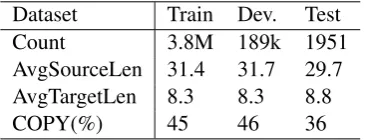
We conduct experiments on the Annotated En-glish Gigaword corpus, as with (Rush et al., 2015b). This parallel corpus is produced by pai-ring the first sentence in the news article and its headline as the summary with heuristic ru-les. All the training, development and test data-sets can be downloaded athttps://github. com/harvardnlp/sent-summary. The sta-tistics of the Gigaword corpus is presented in Ta-ble1.
Dataset Train Dev. Test
Count 3.8M 189k 1951
AvgSourceLen 31.4 31.7 29.7
AvgTargetLen 8.3 8.3 8.8
COPY(%) 45 46 36
Table 1: Data statistics for English Gigaword. AvgSourceLen is the average input sentence length and AvgTargetLen is the average summary length. COPY means the copy ratio in the summa-ries (without stopwords).
3.2 Evaluation Metrics
We adopt ROUGE (Lin,2004) for automatic eva-luation. ROUGE has been the standard evalua-tion metric for DUC shared tasks since 2004. It measures the quality of summary by computing the overlapping lexical units between the candi-date summary and actual summaries, such as uni-gram, bi-gram and longest common subsequence (LCS). Following the common practice, we report ROUGE-1 (uni-gram), ROUGE-2 (bi-gram) and ROUGE-L (LCS) F1 scores4in the following ex-periments. We also measure the actual saliency of a candidate templaterwith its combined ROUGE scores given the actual summaryy∗:
s∗(r,y∗) =RG(r,y∗) +RG(r,y∗), (11)
where “RG” stands for ROUGE for short.
ROUGE mainly evaluates informativeness. We also introduce a series of metrics to measure the summary quality from the following aspects:
LEN DIF The absolute value of the length diffe-rence between the generated summaries and the actual summaries. We use mean value±
standard deviation to illustrate this item. The average value partially reflects the readability and informativeness, while the standard devi-ation links to stability.
[image:4.595.326.510.217.287.2]LESS 3 The number of the generated summaries, which contains less than three tokens. These extremely short summaries are usually unre-adable.
COPY The proportion of the summary words (without stopwords) copied from the source sentence. A seriously large copy ratio indica-tes that the summarization system pays more attention to compression rather than required abstraction.
NEW NE The number of the named entities that do not appear in the source sentence or ac-tual summary. Intuitively, the appearance of new named entities in the summary is likely to bring unfaithfulness. We use Stanford Co-reNLP (Manning et al., 2014) to recognize named entities.
3.3 Implementation Details
We use the popular seq2seq framework Open-NMT5 as the starting point. To make our mo-del more general, we retain the default settings of OpenNMT to build the network architecture. Specifically, the dimensions of word embeddings and RNN are both 500, and the encoder and de-coder structures are two-layer bidirectional Long Short Term Memory Networks (LSTMs). The only difference is that we add the argument “-share embeddings” to “-share the word embeddings between the encoder and decoder. This practice largely reduces model parameters for the mo-nolingual task. On our computer (GPU: GTX 1080, Memory: 16G, CPU: i7-7700K), the trai-ning spends about 2 days.
During test, we use beam search of size 5 to generate summaries. We add the argument “-replace unk” to “-replace the generated unknown words with the source word that holds the hig-hest attention weight. Since the generated sum-maries are often shorter than the actual ones, we introduce an additional length penalty argument “-alpha 1” to encourage longer generation, likeWu et al.(2016).
3.4 Baselines
We compare our proposed model with the fol-lowing state-of-the-art neural summarization sys-tems:
ABS Rush et al. (2015a) used an attentive CNN encoder and a NNLM decoder to summarize
5https://github.com/OpenNMT/OpenNMT-py
the sentence.
ABS+ Rush et al.(2015a) further tuned the ABS model with additional hand-crafted featu-res to balance between abstraction and ex-traction.
RAS-Elman As the extension of the ABS model, it used a convolutional attention-based enco-der and a RNN decoenco-der (Chopra et al.,2016).
Featseq2seq Nallapati et al.(2016) used a com-plete seq2seq RNN model and added the hand-crafted features such as POS tag and NER, to enhance the encoder representation.
Luong-NMT Chopra et al. (2016) implemented the neural machine translation model of Lu-ong et al. (2015) for summarization. This model contained two-layer LSTMs with 500 hidden units in each layer.
OpenNMT We also implement the standard at-tentional seq2seq model with OpenNMT. All the settings are the same as our system. It is noted that OpenNMT officially examined the Gigaword dataset. We distinguish the official result6 and our experimental result with suf-fixes “O” and “I” respectively.
FTSum Cao et al.(2017b) encoded the facts ex-tracted from the source sentence to improve both the faithfulness and informativeness of generated summaries.
In addition, to evaluate the effectiveness of our joint learning framework, we develop a baseline named “PIPELINE”. Its architecture is identical to Re3Sum. However, it trains the Rerank module and Rewrite module in pipeline.
3.5 Informativeness Evaluation
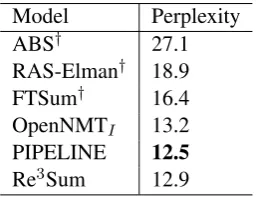
Model Perplexity
ABS† 27.1
RAS-Elman† 18.9
FTSum† 16.4
OpenNMTI 13.2
PIPELINE 12.5
[image:5.595.353.482.544.643.2]Re3Sum 12.9
Table 2: Final perplexity on the development set.† indicates the value is cited from the corresponding paper. ABS+, Featseq2seq and Luong-NMT do not provide this value.
Let’s first look at the final cost values (Eq. 9) on the development set. From Table 2, we can
Model RG-1 RG-2 RG-L
ABS† 29.55∗ 11.32∗ 26.42∗
ABS+† 29.78∗ 11.89∗ 26.97∗
Featseq2seq† 32.67∗ 15.59∗ 30.64∗ RAS-Elman† 33.78∗ 15.97∗ 31.15∗ Luong-NMT† 33.10∗ 14.45∗ 30.71∗
FTSum† 37.27 17.65∗ 34.24
OpenNMT†O 33.13∗ 16.09∗ 31.00∗ OpenNMTI 35.01∗ 16.55∗ 32.42∗
PIPELINE 36.49 17.48∗ 33.90
[image:6.595.312.522.61.146.2]Re3Sum 37.04 19.03 34.46
Table 3: ROUGE F1 (%) performance. “RG” re-presents “ROUGE” for short. “∗” indicates statis-tical significance of the corresponding model with respect to the baseline model on the 95% confi-dence interval in the official ROUGE script.
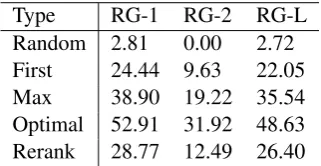
Type RG-1 RG-2 RG-L
Random 2.81 0.00 2.72
First 24.44 9.63 22.05
Max 38.90 19.22 35.54
Optimal 52.91 31.92 48.63
[image:6.595.81.283.61.213.2]Rerank 28.77 12.49 26.40
Table 4: ROUGE F1 (%) performance of different types of soft templates.
see that our model achieves much lower perplexity compared against the state-of-the-art systems. It is also noted that PIPELINE slightly outperforms Re3Sum. One possible reason is that Re3Sum ad-ditionally considers the cost derived from the Re-rank module.
The ROUGE F1 scores of different methods are then reported in Table3. As can be seen, our mo-del significantly outperforms most other approa-ches. Note that, ABS+ and Featseq2seq have uti-lized a series of hand-crafted features, but our mo-del is completely data-driven. Even though, our model surpasses Featseq2seq by 22% and ABS+ by 60% on ROUGE-2. When soft templates are ignored, our model is equivalent to the standard
at-Item Template OpenNMT Re3Sum
LEN DIF 2.6±2.6 3.0±4.4 2.7±2.6
LESS 3 0 53 1
COPY(%) 31 80 74
NEW NE 0.51 0.34 0.30
Table 5: Statistics of different types of summaries.
Type RG-1 RG-2 RG-L
+Random 32.60 14.31 30.19
+First 36.01 17.06 33.21
+Max 41.50 21.97 38.80
+Optimal 46.21 26.71 43.19
+Rerank(Re3Sum) 37.04 19.03 34.46
Table 6: ROUGE F1 (%) performance of Re3Sum generated with different soft templates.
tentional seq2seq model OpenNMTI. Therefore,
it is safe to conclude that soft templates have great contribute to guide the generation of summaries.
We also examine the performance of directly re-garding soft templates as output summaries. We introduce five types of different soft templates:
Random An existing summary randomly se-lected from the training corpus.
First The top-ranked candidate template given by the Retrieve module.
Max The template with the maximal actual ROUGE scores among the 30 candidate tem-plates.
Optimal An existing summary in the training cor-pus which holds the maximal ROUGE sco-res.
Rerank The template with the maximal predicted ROUGE scores among the 30 candidate tem-plates. It is the actual soft template we adopt. As shown in Table4, the performance of Random is terrible, indicating it is impossible to use one summary template to fit various actual summaries. Rerank largely outperforms First, which verifies the effectiveness of the Rerank module. However, according to Max and Rerank, we find the Rerank performance of Re3Sum is far from perfect. Like-wise, comparing Max and First, we observe that the improving capacity of the Retrieve module is high. Notice that Optimal greatly exceeds all the state-of-the-art approaches. This finding strongly supports our practice of using existing summaries to guide the seq2seq models.
3.6 Linguistic Quality Evaluation
[image:6.595.101.262.304.387.2]Source grid positions after the final qualifying session in the indonesian motorcycle grand prix at the sentul circuit , west java , saturday : UNK
Target indonesian motorcycle grand prix grid positions Template grid positions forbritishgrand prix
OpenNMT circuit
Re3Sum grid positions for indonesian grand prix
Source india ’s children are getting increasingly overweight and unhealthy and the government is asking schools to ban junk food , officials said thursday .
Target indian government asks schools to ban junk food Template skoreanschools to bansodajunk food
OpenNMT india ’s children getting fatter Re3Sum indian schools to ban junk food
Table 7: Examples of generated summaries. We use Bold font to indicate the crucial rewriting behavior from the templates to generated summaries.
Re3Sum, the standard deviation of LEN DF is 0.7 times larger in OpenNMT, indicating that Open-NMT works quite unstably. Moreover, OpenOpen-NMT generates 53 extreme short summaries, which se-riously reduces readability. Meanwhile, the copy ratio of actual summaries is 36%. Therefore, the copy mechanism is severely overweighted in OpenNMT. Our model is encouraged to generate according to human-written soft templates, which relatively diminishes copying from the source sen-tences. Look at the last row “NEW NE”. A number of new named entities appear in the soft templates, which makes them quite unfaithful to source sentences. By contrast, this index in Re3Sum is close to the OpenNMT’s. It highlights the rewriting ability of our seq2seq framework.
3.7 Effect of Templates
In this section, we investigate how soft templates affect our model. At the beginning, we feed diffe-rent types of soft templates (refer to Table4) into the Rewriting module of Re3Sum. As illustrated in Table6, the more high-quality templates are pro-vided, the higher ROUGE scores are achieved. It is interesting to see that,while the ROUGE-2 score of Random templates is zero, our model can still generate acceptable summaries with Random tem-plates. It seems that Re3Sum can automatically judge whether the soft templates are trustworthy and ignore the seriously irrelevant ones. We be-lieve that the joint learning with the Rerank model plays a vital role here.
Next, we manually inspect the summaries ge-nerated by different methods. We find the out-puts of Re3Sum are usually longer and more
flu-ent than the outputs of OpenNMT. Some illustra-tive examples are shown in Table7. In Example 1, there is no predicate in the source sentence. Since OpenNMT prefers selecting source words around the predicate to form the summary, it fails on this sentence. By contract, Re3Sum rewrites the tem-plate and produces an informative summary. In Example 2, OpenNMT deems the starting part of the sentences are more important, while our mo-del, guided by the template, focuses on the second part to generate the summary.
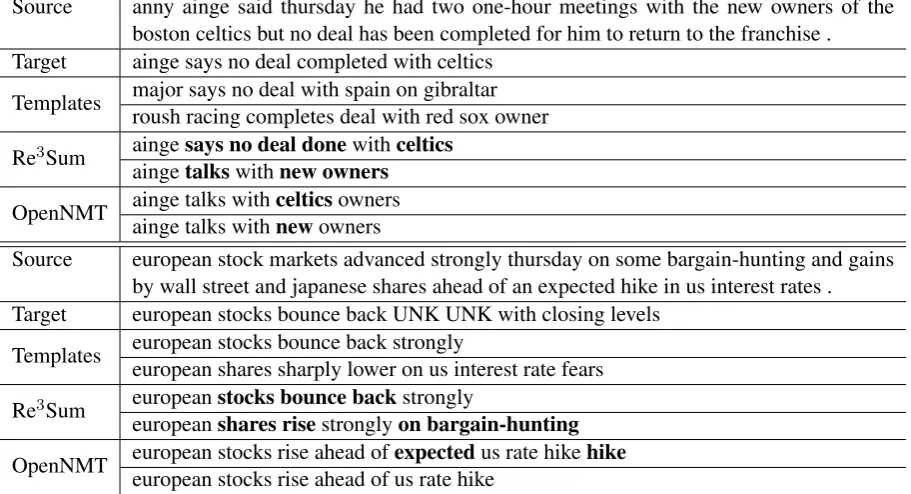
In the end, we test the ability of our model to generate diverse summaries. In practice, a system that can provide various candidate summaries is probably more welcome. Specifically, two can-didate templates with large text dissimilarity are manually fed into the Rewriting module. The cor-responding generated summaries are shown in Ta-ble8. For the sake of comparison, we also present the 2-best results of OpenNMT with beam search. As can be seen, with different templates given, our model is likely to generate dissimilar summaries. In contrast, the 2-best results of OpenNMT is al-most the same, and often a shorter summary is only a piece of the other one. To sum up, our mo-del demonstrates promising prospect in generation diversity.
4 Related Work
summariza-Source anny ainge said thursday he had two one-hour meetings with the new owners of the boston celtics but no deal has been completed for him to return to the franchise . Target ainge says no deal completed with celtics
Templates major says no deal with spain on gibraltar roush racing completes deal with red sox owner
Re3Sum aingesays no deal donewithceltics aingetalkswithnew owners
OpenNMT ainge talks withcelticsowners ainge talks withnewowners
Source european stock markets advanced strongly thursday on some bargain-hunting and gains by wall street and japanese shares ahead of an expected hike in us interest rates . Target european stocks bounce back UNK UNK with closing levels
Templates european stocks bounce back strongly
european shares sharply lower on us interest rate fears
Re3Sum europeanstocks bounce backstrongly
europeanshares risestronglyon bargain-hunting
[image:8.595.72.528.66.313.2]OpenNMT european stocks rise ahead ofexpectedus rate hikehike european stocks rise ahead of us rate hike
Table 8: Examples of generation with diversity. We use Bold font to indicate the difference between two summaries
tion include template-based methods (Zhou and Hovy, 2004), syntactic tree pruning (Knight and Marcu,2002;Clarke and Lapata,2008) and statis-tical machine translation techniques (Banko et al., 2000). Recently, the application of the attentional seq2seq framework has attracted growing atten-tion and achieved state-of-the-art performance on this task (Rush et al.,2015a;Chopra et al.,2016; Nallapati et al.,2016).
In addition to the direct application of the ge-neral seq2seq framework, researchers attempted to integrate various properties of summarization. For example, Nallapati et al. (2016) enriched the encoder with hand-crafted features such as na-med entities and POS tags. These features have played important roles in traditional feature based summarization systems. Gu et al. (2016) found that a large proportion of the words in the sum-mary were copied from the source text. There-fore, they proposed CopyNet which considered the copying mechanism during generation. Recently, See et al.(2017) used the coverage mechanism to discourage repetition. Cao et al. (2017b) enco-ded facts extracted from the source sentence to en-hance the summary faithfulness. There were also studies to modify the loss function to fit the evalu-ation metrics. For instance, Ayana et al. (2016) applied the Minimum Risk Training strategy to maximize the ROUGE scores of generated
sum-maries. Paulus et al. (2017) used the reinforce-ment learning algorithm to optimize a mixed ob-jective function of likelihood and ROUGE scores. Guu et al. (2017) also proposed to encode human-written sentences to improvement the per-formance of neural text generation. However, they handled the task of Language Modeling and rand-omly picked an existing sentence in the training corpus. In comparison, we develop an IR sy-stem to find proper existing summaries as soft templates. Moreover, Guu et al. (2017) used a general seq2seq framework while we extend the seq2seq framework to conduct template reranking and template-aware summary generation simulta-neously.
5 Conclusion and Future Work
This paper proposes to introduce soft templates as additional input to guide the seq2seq summa-rization. We use the popular IR platform Lucene to retrieve proper existing summaries as candi-date soft templates. Then we extend the seq2seq framework to jointly conduct template reranking and template-aware summary generation. Experi-ments show that our model can generate informa-tive, readable and stable summaries. In addition, our model demonstrates promising prospect in ge-neration diversity.
vari-ous aspects. On the one hand, since the candidate templates are far inferior to the optimal ones, we intend to improve the Retrieve module, e.g., by in-dexing both the sentence and summary fields. On the other hand, we plan to test our system on the other tasks such as document-level summarization and short text conversation.
Acknowledgments
The work described in this paper was supported by Research Grants Council of Hong Kong (PolyU 152036/17E), National Natural Science Founda-tion of China (61672445 and 61572049) and The Hong Kong Polytechnic University (G-YBP6, 4-BCDV).
References
Shiqi Shen Ayana, Zhiyuan Liu, and Maosong Sun. 2016. Neural headline generation with minimum risk training. arXiv preprint arXiv:1604.01904.
Dzmitry Bahdanau, Kyunghyun Cho, and Yoshua Ben-gio. 2014. Neural machine translation by jointly learning to align and translate. arXiv preprint arXiv:1409.0473.
Michele Banko, Vibhu O Mittal, and Michael J Wit-brock. 2000. Headline generation based on statisti-cal translation. InProceedings of the 38th Annual Meeting on Association for Computational Linguis-tics, pages 318–325. Association for Computational Linguistics.
Ziqiang Cao, Chuwei Luo, Wenjie Li, and Sujian Li. 2017a. Joint copying and restricted generation for paraphrase. InAAAI, pages 3152–3158.
Ziqiang Cao, Furu Wei, Wenjie Li, and Sujian Li. 2017b. Faithful to the original: Fact aware neural abstractive summarization. arXiv preprint arXiv:1711.04434.
Danqi Chen, Jason Bolton, and Christopher D Man-ning. 2016. A thorough examination of the cnn/daily mail reading comprehension task. arXiv preprint arXiv:1606.02858.
Kyunghyun Cho, Bart Van Merri¨enboer, Caglar Gul-cehre, Dzmitry Bahdanau, Fethi Bougares, Holger Schwenk, and Yoshua Bengio. 2014. Learning phrase representations using rnn encoder-decoder for statistical machine translation. arXiv preprint arXiv:1406.1078.
Sumit Chopra, Michael Auli, Alexander M Rush, and SEAS Harvard. 2016. Abstractive sentence sum-marization with attentive recurrent neural networks.
Proceedings of NAACL-HLT16, pages 93–98.
James Clarke and Mirella Lapata. 2008. Global infe-rence for sentence compression: An integer linear programming approach. Journal of Artificial Intelli-gence Research, 31:399–429.
Jiatao Gu, Zhengdong Lu, Hang Li, and Victor OK Li. 2016. Incorporating copying mechanism in sequence-to-sequence learning. arXiv preprint arXiv:1603.06393.
Kelvin Guu, Tatsunori B Hashimoto, Yonatan Oren, and Percy Liang. 2017. Generating senten-ces by editing prototypes. arXiv preprint arXiv:1709.08878.
Zongcheng Ji, Zhengdong Lu, and Hang Li. 2014. An information retrieval approach to short text conver-sation. arXiv preprint arXiv:1408.6988.
Kevin Knight and Daniel Marcu. 2002. Summarization beyond sentence extraction: A probabilistic appro-ach to sentence compression. Artificial Intelligence, 139(1):91–107.
Philipp Koehn and Rebecca Knowles. 2017. Six chal-lenges for neural machine translation. arXiv pre-print arXiv:1706.03872.
Chin-Yew Lin. 2004. Rouge: A package for automatic evaluation of summaries. InProceedings of the ACL Workshop, pages 74–81.
Minh-Thang Luong, Hieu Pham, and Christopher D Manning. 2015. Effective approaches to attention-based neural machine translation. arXiv preprint arXiv:1508.04025.
Christopher D. Manning, Mihai Surdeanu, John Bauer, Jenny Finkel, Steven J. Bethard, and David McClosky. 2014. The Stanford CoreNLP natural language processing toolkit. InProceedings of ACL: System Demonstrations, pages 55–60.
Ramesh Nallapati, Bowen Zhou, Caglar Gulcehre, Bing Xiang, et al. 2016. Abstractive text summari-zation using sequence-to-sequence rnns and beyond.
arXiv preprint arXiv:1602.06023.
Romain Paulus, Caiming Xiong, and Richard Socher. 2017. A deep reinforced model for abstractive sum-marization.arXiv preprint arXiv:1705.04304.
Alexander M Rush, Sumit Chopra, and Jason Wes-ton. 2015a. A neural attention model for ab-stractive sentence summarization. arXiv preprint arXiv:1509.00685.
Alexander M. Rush, Sumit Chopra, and Jason Weston. 2015b. A neural attention model for abstractive sen-tence summarization. InProceedings of EMNLP, pages 379–389.
Horacio Saggion. 2017. Automatic text simplification.
Abigail See, Peter J Liu, and Christopher D Man-ning. 2017. Get to the point: Summarization with pointer-generator networks. arXiv preprint arXiv:1704.04368.
Nitish Srivastava, Geoffrey E Hinton, Alex Krizhev-sky, Ilya Sutskever, and Ruslan Salakhutdinov. 2014. Dropout: a simple way to prevent neural networks from overfitting. Journal of Machine Learning Re-search, 15(1):1929–1958.
Yonghui Wu, Mike Schuster, Zhifeng Chen, Quoc V Le, Mohammad Norouzi, Wolfgang Macherey, Maxim Krikun, Yuan Cao, Qin Gao, Klaus Mache-rey, et al. 2016. Google’s neural machine translation system: Bridging the gap between human and ma-chine translation. arXiv preprint arXiv:1609.08144.