Munich Personal RePEc Archive
Revisiting the Impacts of Exchange Rate
Movement on the Dollarization Process
in Cambodia
Samreth, Sovannroeun and Sok, Pagna
2018
Revisiting the Impacts of Exchange Rate Movement on the
Dollarization Process in Cambodia
*
Sovannroeun Samreth
a, §and Pagna Sok
ba Graduate School of Humanities and Social Sciences, Saitama University, Japan b Economic Research and International Cooperation Department, National Bank of
Cambodia.
§ Corresponding author. Email: [email protected]
Abstract
Previous studies on factors affecting the substitution process between domestic currency and foreign currency (i.e., the dollarization process) in Cambodia indicate that exchange rate movement is one of its important determinants. These studies tend to assume that the effects of this movement are symmetric. However, domestic currency appreciation and depreciation can have asymmetric impacts on people’s behaviors when substituting between domestic currency and foreign currency. Therefore, this study re-examines the impacts of exchange rate movement on the dollarization process in Cambodia by taking into account the possibility of these asymmetric effects. A cointegration analysis framework is adopted for the estimation of a model that also incorporates a hysteresis effect of the dollarization process. The estimation results of quarterly data between 1994Q2 to 2017Q4 indicate that Cambodian Riel depreciation and appreciation do have asymmetric impacts on its dollarization process. These results provide some implications for policy actions addressing the dollarization issue in Cambodia.
JEL Classification Codes: E51, F41
Keywords: Asymmetric Effects, Currency Substitution, Dollarization
1. Introduction
Cambodia is a country currently experiencing a widespread circulation of foreign currency, mainly the U.S. dollar, in its economy as a means of payment, a unit of accounts, and a store of value, even though the foreign currency is not officially adopted. As
discussed in various studies such as Kem (2001), Zamaróczy and Sa (2002), and Menon (2008), this phenomenon of dollarization is a consequence of various factors. One of those factors is the availability of foreign currency due to the huge inflows of foreign aid and external finance used for peacekeeping operations by the United Nations Transitional Authority in Cambodia (UNTAC) during the period of political and socioeconomic transition in the early 1990s. Another factor is the loss of confidence in the value of Cambodian Riel resulting from socioeconomic and political instability during that transitional period. This led to a widely observed phenomenon of substituting foreign currency for Riel in economic activities. Figure 1 illustrates the share of foreign currency deposits (FCDs) in broad money (M2) in Cambodia between 1993 and 2017 (this share is often used to capture the dollarization level in a country1). The figure generally shows a
rapid increase in the share of FCDs in M2 during the 1990s. The share has constantly increased since the early 2000s and exceeded 80% in 2017. This very high share of FCDs
indicates that Cambodia is a highly dollarized economy. It is widely known that dollarization brings both costs and benefits to countries experiencing the phenomenon. Generally, the costs of dollarization may include the loss of seigniorage and the restraint of the implementation of monetary policy, and its benefits may include the enhancement of financial sector development and price stabilization.2 For Cambodia, such effects are
discussed and examined from a macroeconomic viewpoint by studies such as Kem (2001), Zamaróczy and Sa (2002), Kang (2005), Samreth (2010, 2011), and Duma (2011). Although there can be both costs and benefits of dollarization from an economic viewpoint, motivated by non-economic reasons such as a national pride, a highly dollarized country
1 Although the degree of dollarization should also take into account foreign currency in circulation, in practice, this is virtually impossible due to the lack of data.
like Cambodia usually seeks to de-dollarize its economy in the long term.3 For this purpose,
understanding factors affecting the dollarization process is very important.
Our study attempts to provide a better understanding on the substitution process between domestic currency and foreign currency (i.e., the dollarization process) in
Cambodia by focusing on exchange rate movement as its main factor. Previous studies such as Kem (2001) and Ra (2008) actually provide evidence supporting the important role of exchange rate movement in the dollarization process in Cambodia. Samreth (2011) also reaches the same conclusion even after the hysteresis effect of dollarization process is taken into account.4 A drawback of these previous studies is their assumption of the
symmetric effects of exchange rate movement. However, domestic currency appreciation and depreciation can have asymmetric impacts on behaviors of people in substituting between domestic currency and foreign currency. In this study, we re-examine the effects
3 The regular annual celebration of Riel Day by the National Bank of Cambodia (NBC) over recent years reflects the policy preference promoting the use of Riel and de-dollarization.
4 Lay et al. (2012) also examine the relationship between exchange rate movement and dollarization process in Cambodia. But, their focus is on the impact of dollarization on exchange rate movement.
[image:4.612.109.504.189.356.2]Data source: Economic and Monetary Statistics Review, NBC (2018)
of exchange rate movement on the dollarization process in Cambodia by taking into account the possibility of these asymmetric effects. The estimation equation is built upon the equation derived and used by Samreth (2011), in which the hysteresis effect of the dollarization process is considered. The autoregressive distributed lag (ARDL) approach to
cointegration suggested by Pesaran et al. (2001) is adopted as the estimation method. Using quarterly data between 1994Q2 and 2017Q4, the estimation results indicate that the impact of Riel depreciation is larger than that of Riel appreciation, confirming asymmetric impacts of exchange rate movement on the dollarization process. Our findings may suggest some implications for addressing the dollarization issue in Cambodia. Carefully monitoring exchange rate movement and policy efforts focusing on a gradual appreciation of Riel may be needed for enhancing de-dollarization.
The remaining structure of this paper is organized as follows. Section 2 presents the estimation equation in which the definition and the construction of variables in consideration are explained. Section 3 presents the estimation method. Section 4 explains data used for the estimation. Section 5 presents the estimation results and discussion. Section 6 concludes the paper.
2. Estimation Equation
For the estimation, we adopt the equation derived and used by Samreth (2011) under
the theoretical framework of a money-in-the-utility model.5 In that model, the utility
function of the representative household has two components. One is the utility part gained from the consumption of non-tradable and tradable goods. Another is the utility part gained from holding or using domestic and foreign currency. The model also takes into account the hysteresis effect of the dollarization phenomenon; that is, the past pervasiveness of foreign currency use or holdings is considered to have an impact on current levels of foreign currency use or holdings. By solving the household utility maximization problem, Samreth (2011) derived the following equation.6
5 The theoretical framework in Samreth (2011) is built upon that of Rojas-Suarez (1992), İmrohoroğlu (1994), Uribe (1997), Sawada and Yotopoulos (2001), Cuddington et al. (2002), and Kumamoto and Kumamoto (2008).
ln 𝐶𝑆𝑡= 𝛽0+ 𝛽1ln 𝐻𝑡+ 𝛽2𝐸𝑡𝑍𝑡+1, (1)
where CSt is the ratio between foreign and domestic currency balances (i.e., the currency
substitution ratio) at time t; Zt+1 is growth of the exchange rate between periods t and t+1;
Ht represents the hysteresis effect of foreign currency use or holdings (i.e., dollarization
phenomenon) at time t; Et represents the expectation at time t; and ln indicates the natural
logarithm. A positive value of Z represents a depreciation of domestic currency, and its negative value is an appreciation. Following Samreth (2011), it is assumed that the
expectation of the rate of change of the exchange rate equals its actual growth, EtZt+1=Zt.
Hence, Equation (1) can be rewritten as follows.
ln 𝐶𝑆𝑡= 𝛽0 + 𝛽1ln 𝐻𝑡+ 𝛽2𝑍𝑡+ 𝜀𝑡, (2)
where an error term, ɛ, is included to capture the elements that cannot be observed in the model. The expected signs of the coefficients in Equation (2) are as follows. β1 is expected
to be positive since higher level (i.e., an increase in H) of the past pervasiveness of foreign currency use or holdings can increase current level of foreign currency use or holdings. For β2, it is also expected to be positive since more depreciation of domestic currency (i.e., an
increase in Z) can lead to more substitution of foreign currency for domestic currency. In Equation (2), the impacts of domestic currency depreciation and appreciation are considered to have the same magnitude as measured by β2. However, there is a possibility
The decomposition of Z follows the partial sum process adopted by Shin et al. (2014).7
Specifically, Z can be decomposed as the partial sum of its positive change (Zd) and its negative change (Za) as follows.
𝑍𝑡 = 𝑍0+ 𝑍𝑑𝑡+ 𝑍𝑎𝑡, (3)
where Z0 is the value of Zt at time t = 0 and Zd and Za are constructed as follows.
𝑍𝑑𝑡 = ∑𝑡𝑗=1Δ𝑍𝑑𝑡= ∑𝑡𝑗=1max(Δ𝑍𝑗, 0), (4) 𝑍𝑎𝑡= ∑𝑡𝑗=1Δ𝑍𝑎𝑡 = ∑𝑡𝑗=1min(Δ𝑍𝑗, 0), (5)
where Δ represents the first difference. Replacing Z in Equation (2) with Zd and Za, the following estimation equation is obtained.
ln 𝐶𝑆𝑡 = 𝛾0+ 𝛾1ln 𝐻𝑡+ 𝛾2𝑍𝑑𝑡+ 𝛾3𝑍𝑎𝑡+ 𝜐𝑡, (6)
where υ represents an error term. Between two periods, if Z increases (i.e., ΔZ > 0), then the change in Z is captured by Zd (more depreciation of Riel) and Za remains constant. If Z
decreases (i.e., ΔZ < 0), then the change in Z is captured by Za (more appreciation of Riel) and Zd remains constant. Hence, Zd always increases (i.e., more depreciation of domestic currency) or remains constant, and Za always decreases (i.e., more appreciation of domestic currency) or remains constant. From this, both γ2 and γ3 are expected to be
positive if the substitution effect between domestic currency and foreign currency is observed. Specifically, with an expectation of a higher depreciation rate of domestic currency (i.e., a more increase in Zd), people are expected to substitute foreign currency for domestic currency and the opposite occurring with an expectation of a higher appreciation rate (i.e., a more decrease in Za) of domestic currency.
Following Samreth (2011), a dummy variable, Polidu, is included in Equation (6) to capture the effects of violent conflicts and political unrest in Cambodia over 1997-1998. The estimation equation can be rewritten as follows.
ln 𝐶𝑆𝑡 = 𝛼0+ 𝛼1ln 𝐻𝑡+ 𝛼2𝑍𝑑𝑡+ 𝛼3𝑍𝑎𝑡+ 𝛼4𝑃𝑜𝑙𝑖𝑑𝑢𝑡+ 𝜈𝑡, (7)
where Polidut = 1 for t = 1997Q3-1998Q4 and Polidut = 0 elsewhere; ν is an error term.
3. Estimation Method
The ARDL approach to cointegration proposed by Pesaran et al. (2001) is used for the estimation. The adoption of this method is based on its advantages compared to the residual-based approach by Engle and Granger (1987) and the maximum likelihood-based
approach by Johansen and Juselius (1990). Specifically, the ARDL approach does not require the same integration order of variables in the estimation equation, although the variables cannot have the integration of two or higher.8 The error correction representation of the ARDL model of Equation (7) that incorporates both short-run and long-run effects
of the independent variables in consideration is expressed as follows.
∆ ln 𝐶𝑆𝑡= 𝛿0+ ∑ 𝛿1𝑖∆ ln 𝐶𝑆𝑡−𝑖
𝑚1
𝑖=1
+ ∑ 𝛿2𝑖∆ ln 𝐻𝑡−𝑖
𝑚2
𝑖=0
+ ∑ 𝛿3𝑖∆𝑍𝑑𝑡−𝑖
𝑚3
𝑖=0
+ ∑ 𝛿4𝑖∆𝑍𝑎𝑡−𝑖
𝑚4
𝑖=0
+ ∑ 𝛿5𝑖∆𝑃𝑜𝑙𝑖𝑑𝑢𝑡−𝑖
𝑚5
𝑖=0
+ 𝜆1ln 𝐶𝑆𝑡−1+ 𝜆2ln 𝐻𝑡−1+ 𝜆3𝑍𝑑𝑡−1+ 𝜆4𝑍𝑎𝑡−1
+ 𝜆5𝑃𝑜𝑙𝑖𝑑𝑢𝑡−1+ 𝜇𝑡
, (8)
where μ is an error term and denotes the difference. In Equation (8), the part of differenced variables captures the short-run effects and the part of level variables captures
the long-run effects.
In the ARDL approach to cointegration, the statistical test on the existence of the long
-run relationship among the variables under consideration is required. Specifically, the null hypothesis of no cointegration or no long-run relationship relating to the coefficients of
lag-level variables in Equation (8), H0: λ1 =λ2 =λ3 = λ4 = λ5 = 0, is tested against its
alternative, H1: λ1 ≠ 0,λ2 ≠ 0, λ3 ≠0,λ4 ≠ 0, λ5 ≠ 0. This statistical test is implemented by
using an F-test. To judge if the null hypothesis is rejected, the statistics obtained from this
test are compared with their critical values (CVs) as computed by and provided in Pesaran et al. (2001). If the computed statistic is larger than the upper bound of the CV at a standard significance level, then the null hypothesis is rejected, implying the existence of the long-run or cointegration relationship among variables in consideration. If it is smaller
than the lower bound of the CV at a standard significance level, then the null hypothesis cannot be rejected, meaning this does not support the existence of the long-run or
cointegration relationship among variables. Moreover, if it is between the lower and upper bounds of the CV at a standard significance level, it is inclusive. After the statistical test of the existence of long-run or cointegration, the ARDL model incorporating both short-run
and long-run effects is estimated by using Schwarz information criterion (SIC) for optimal
lag order selection of variables in the estimation equation. The selected ARDL model is represented by using an error correction term to replace the long-run part (i.e., the part of
lag level variables) in Equation (8). The selected ARDL model can be expressed as follows.
∆ ln 𝐶𝑆𝑡 = 𝜃0+ ∑ 𝜃1𝑖∆ ln 𝐶𝑆𝑡−𝑖 𝑛1
𝑖=1
+ ∑ 𝜃2𝑖∆ ln 𝐻𝑡−𝑖 𝑛2
𝑖=0
+ ∑ 𝜃3𝑖∆𝑍𝑑𝑡−𝑖
𝑛3
𝑖=0
+ ∑ 𝜃4𝑖∆𝑍𝑎𝑡−𝑖+ ∑ 𝜃5𝑖∆𝑃𝑜𝑙𝑖𝑑𝑢𝑡−𝑖
𝑛5
𝑖=0 𝑛4
𝑖=0
+ 𝜑𝐸𝐶𝑡−1+ 𝜁𝑡
, (9)
where EC is the error correction term and ζ is an error term. EC captures the adjustment to the long-run equilibrium, and it can be expressed as 𝐸𝐶 = ln 𝐶𝑆 − 𝜋0− 𝜋1ln 𝐻 − 𝜋2𝑍𝑑 −
results in the selected ARDL model. The related long-run estimated equation is expressed
as follows.
ln 𝐶𝑆̂𝑡= 𝜋̂0+ 𝜋̂1ln 𝐻𝑡+ 𝜋̂2𝑍𝑑𝑡+ 𝜋̂3𝑍𝑎𝑡+ 𝜋̂4𝑃𝑜𝑙𝑖𝑑𝑢𝑡, (10)
where ln 𝐶𝑆̂ represents the predicted ln 𝐶𝑆; 𝜋̂0, 𝜋̂1, 𝜋̂2, 𝜋̂3, and 𝜋̂4 are the estimated
coefficients of 𝜋0, 𝜋1, 𝜋2, 𝜋3 and 𝜋4, respectively.
In our estimation, the stability tests of the estimated model are also presented. This is done by applying the statistical tests on the cumulative sum of recursive residuals and their squares of the selected ARDL model.
4. Estimation Data
Quarterly data from 1994Q2 to 2017Q4 are used for the estimation. This sample period selection is based on data availability of all variables in consideration. To construct the substitution ratio between foreign currency and domestic currency, CS, data of foreign money and domestic money balances are used. Domestic money balance is the Cambodian Riel-denominated monetary aggregate M2, consisting of currency in circulation, demand
deposits, and time and saving deposits of Riel in financial system. Foreign money balance is the deposits of foreign currency in the financial system. The data are obtained from Economic and Monetary Statistics published by the National Bank of Cambodia (NBC). Foreign currency circulating in Cambodia is mostly dominated by the U.S. dollar. Foreign currency circulating outside banking system is not considered, since its data are virtually not available, following Kem (2001), Ra (2008), and Samreth (2011). As adopted by Samreth (2011), the past peak value of CS is used as the proxy of the hysteresis effect of the dollarization process (H) as follows.9
𝐻𝑡 = max𝑗 𝐶𝑆𝑗, 𝑗 = 0, 1, 2, … , 𝑡 − 1 (11)
To construct the partial sum of positive change, Zd, and the partial sum of negative change, Za, of Z, the period average data of the market exchange rate between Riel and the U.S. dollar, defined as Riel per U.S. dollar, are used. Data of market exchange rate are obtained from the NBC. The descriptive statistics for variables in consideration are
[image:11.612.97.515.213.296.2]presented in Table 1.
Table 1: Descriptive Statistics
Variable Observations Maximum Minimum Mean Median Std. Dev. lnCS 97 1.6923 -0.5884 0.9872 0.9273 0.5488 lnH 97 1.6923 -0.2985 1.0218 0.9273 0.5424 Zd 97 0.8820 0.2214 0.7283 0.7652 0.1519
Za 97 0.0000 -0.5822 -0.4250 -0.4630 0.1545
5. Estimation Results and Discussion
5.1. Unit Root Test and Cointegration Relationship Test Results
Table 2: Augmented Dickey-Fuller Unit Root Test
Level First Difference
Intercept Trend and Intercept Intercept Intercept and Trend lnCS -2.9720** -3.1042 -14.4774*** -14.8481*** lnH -2.3768 -2.8113 -2.6110* -2.7182 Zd -5.6319*** -5.3539*** -4.6357*** -5.5049***
Za -5.4016*** -4.7847*** -4.8268*** -5.4448***
1. The null hypothesis: non-stationary.
2. The asterisks ***, **, and * denote the rejection of the null hypothesis at the 1%, 5%, and 10% significance levels, respectively.
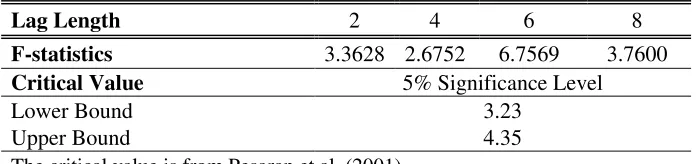
The computed F-statistics with various lag lengths from this test are presented in Table 3. From the table, generally, there is evidence supporting the existence of a long-run or cointegration relationship among the variables in consideration. Though the F-statistics with some lag orders are between the lower and upper bounds of CVs, implying the inclusive judgement of the F-test, the statistical significance of the error correction term,
[image:12.612.133.482.420.502.2]EC, in the next estimation reconfirms the long-run or cointegration relationship.
Table 3: F-statistics for Test of Cointegration or Long-Run Relationship
Lag Length 2 4 6 8
F-statistics 3.3628 2.6752 6.7569 3.7600 Critical Value 5% Significance Level
Lower Bound 3.23
Upper Bound 4.35
The critical value is from Pesaran et al. (2001).
5.2. Short-Run Estimation Results
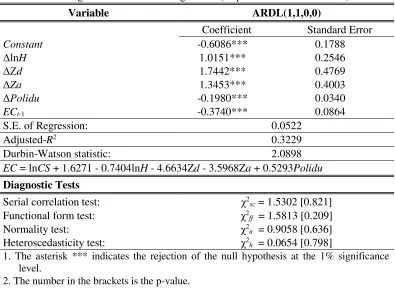
The results of the ARDL-based short-run estimation of Equation (9) are shown in Table 4. We set the maximum lag length to eight for the estimation in order to sufficiently
indicates a high speed of adjustment to equilibrium when there is a shock. Approximately 37% of the divergence in the previous period converges back to the equilibrium. This high adjustment speed may be due to the widespread availability of currency substitution in Cambodia, where people can widely substitute between Riel and foreign currency.
Table 4: Estimation Results of Error Correction Representation for Selected Autoregressive Distributed Lag Model (Dependent Variable: ΔlnCS)
Variable ARDL(1,1,0,0)
Coefficient Standard Error
Constant -0.6086*** 0.1788
ΔlnH 1.0151*** 0.2546
ΔZd 1.7442*** 0.4769
ΔZa 1.3453*** 0.4003
ΔPolidu -0.1980*** 0.0340
ECt-1 -0.3740*** 0.0864
S.E. of Regression: 0.0522
Adjusted-R2 0.3229
Durbin-Watson statistic: 2.0898
EC = lnCS + 1.6271 - 0.7404lnH - 4.6634Zd - 3.5968Za + 0.5293Polidu
Diagnostic Tests
Serial correlation test: χ2
sc = 1.5302 [0.821]
Functional form test: χ2
ff = 1.5813 [0.209]
Normality test: χ2
n = 0.9058 [0.636]
Heteroscedasticity test: χ2
h = 0.0654 [0.798]
1. The asterisk *** indicates the rejection of the null hypothesis at the 1% significance level.
2. The number in the brackets is the p-value.
Moreover, from Table 4, the coefficients of ΔZd and ΔZa are statistically significant and have the expected signs, supporting the substitution effects between Riel and foreign currency. This is consistent with the results of Kem (2001), Ra (2008), and Samreth (2011). However, the impacts of ΔZd and ΔZa are not the same. This is also confirmed by a Wald test, wherein the null hypothesis that the coefficients of ΔZd and ΔZa are the same is
rejected at the 5% significance level.10 The different size impacts of ΔZdand ΔZa indicate
asymmetric effects of Riel depreciation and appreciation on currency substitution in Cambodia. Specifically, the impact of a higher Riel depreciate rate on the substitution
process between Riel and foreign currency (i.e., the U.S. dollar) is stronger than that of higher Riel appreciation rate.
To examine the validity of the estimation equation, the tests of serial correlation, functional form, normality, and heteroscedasticity are implemented. Their results are also
provided in Table 4. From the table, the estimation equation passes all of these tests, strengthening the validity of the estimation equation being used.
5.3. Long-Run Estimation Results
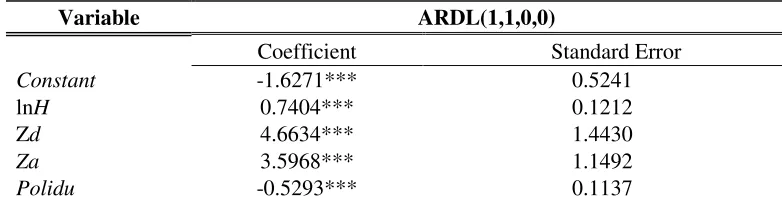
[image:14.612.109.500.316.415.2]The estimation results indicating the long-run or cointegration relationship among variables in consideration are provided in Table 5.
Table 5: Long-Run Estimation (Cointegration) Results (Dependent Variable: lnCS) Variable ARDL(1,1,0,0)
Coefficient Standard Error
Constant -1.6271*** 0.5241
lnH 0.7404*** 0.1212
Zd 4.6634*** 1.4430
Za 3.5968*** 1.1492
Polidu -0.5293*** 0.1137
The asterisks *** indicates the rejection of the null hypothesis at 1% significance level.
Based on the results in the table, the relationship can be expressed as follows.
ln 𝐶𝑆̂𝑡 = −1.63 + 0.74 ln 𝐻𝑡+ 4.66𝑍𝑑𝑡+ 3.60𝑍𝑎𝑡− 0.53𝑃𝑜𝑙𝑖𝑑𝑢𝑡, (12)
(0.52) (0.12) (1.44) (1.15) (0.11)
where t = 1994Q2 to 2017Q4 and Polidut = 1 for t = 1997Q3-1998Q4, and Polidut = 0,
elsewhere; the numbers in parentheses are the standard errors.
constructed by taking into account only foreign currency deposits in financial system. As discussed in Samreth (2011), this result may reflect the fact that violent conflicts and political unrest make domestic residents rush to withdraw their foreign currency deposits from financial institutions, leading to a decrease in the CS ratio.
For the impacts of exchange rate movement, the results show that both coefficients of
Zd and Za are statistically significant and positive. This means that an increase in Zd
reflecting a higher Riel depreciation rate causes a substitution of foreign currency for Riel, thereby enhancing the dollarization process, and a decrease in Za reflecting a higher Riel appreciation rate leads to a substitution of Riel for foreign currency, thereby reducing the dollarization level.11 These findings are consistent with that of Kem (2001), Ra (2008), and
Samreth (2011). However, unlike these previous studies, by taking into account the possibility of asymmetric effects of exchange rate movement, our estimation identifies that the impact of Zd is larger than that of Za. This result is also supported by a Wald test, wherein the null hypothesis that the coefficients of Zd and Za are the same is rejected at the
5% significance level.12
It is worth noting that exchange rate movement in Cambodia seems to show a structural change in which it illustrates a highly depreciating trend before the Asian financial crisis and a stable trend after that.13 The exchange rate stability in Cambodia after
the Asian financial crisis may be a result of socio-economic stability and its policy preference for a managed floating regime. This policy preference widely observed in many other developing countries reflects the “fear of floating” as indicated by Calvo and Reinhart (2002). In this study, we also conduct an estimation focusing on the period after the Asian financial crisis (between 1997Q3 to 2017Q4), during which exchange rate movement is relatively stable. The ARDL-based estimation results show that the
coefficient of Zd is statistically significant and positive, although the coefficient of Za is
11 Note that, as mentioned earlier, Zd always increases (i.e., more Riel depreciation) or remains constant, and Za always decreases (i.e., more Riel appreciation) or remains constant by construction.
12 The computed Wald statistic from this test is χ2(1) = 4.0667 with the p-value = 0.044.
statistically insignificant.14 These results also provide evidence supporting the significant
asymmetric effect of exchange rate movement on dollarization process in Cambodia.
5.4. Stability Tests
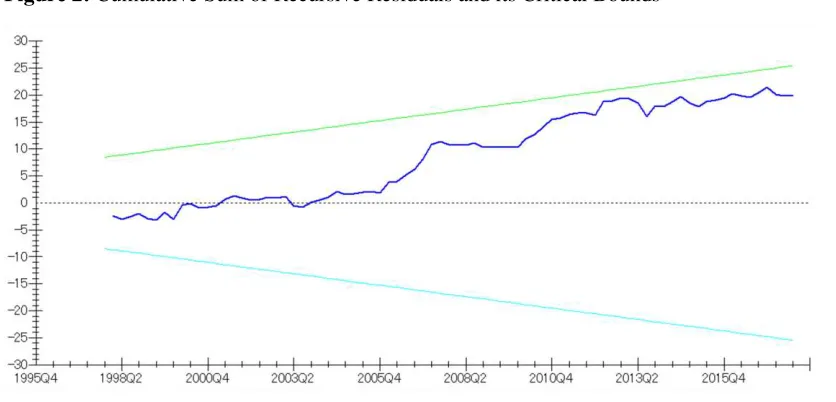
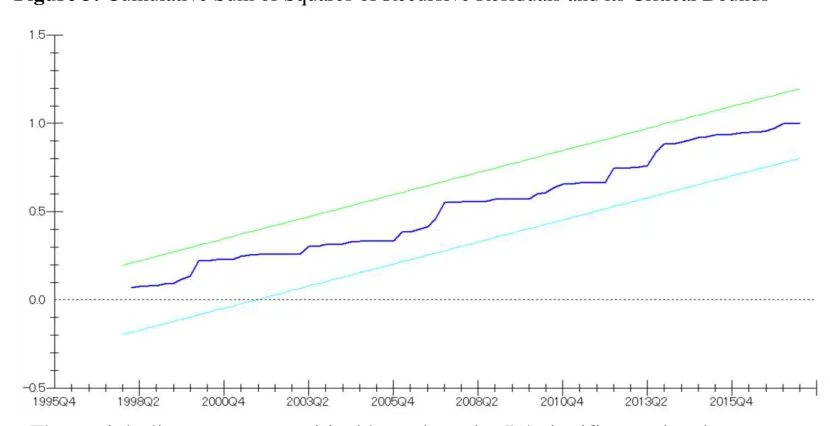
The selected ARDL model is tested for its stability by applying statistical tests on the cumulative sum of recursive residuals and their squares. Figures 2 and 3 indicate that their graphs are between the related critical bounds at the 5% significance level. These results support the stability of our selected ARDL model over the sample period. This provides more evidence strengthening the appropriateness of the estimation model specification.
[image:16.612.92.510.293.494.2]
14 Estimation results can be provided upon request. Another possibility for future study is to adopt a regime-switching model for the estimation.
Figure 2: Cumulative Sum of Recursive Residuals and its Critical Bounds
5.5. Discussion
The estimation results in our study reconfirm the hysteresis effect in the dollarization process in Cambodia as shown by Samreth (2011). They also indicate that the impact of a higher Riel depreciation rate on the currency substitution process is stronger than that of higher Riel appreciation rate. This implies that the currency substitution process toward foreign currency holdings (i.e., dollarization process) is stronger when Riel depreciates more. These asymmetric effects of exchange rate movement may be due to the delicacy of confidence on Riel and a widespread availability of foreign currency, mainly the U.S. dollar, in the Cambodian economy. Our findings provide some implications for addressing the dollarization issue in Cambodia.
The existence of the hysteresis effect in the dollarization process in Cambodia may suggest the need to address it by direct policy actions such as regulation on foreign currency deposits or restriction on economic transactions that use foreign currency. However, such measures need to be carefully considered. From other countries’
[image:17.612.87.502.86.299.2]experiences as discussed in Menon (2008), Kokenyne et al. (2010), and Samreth (2011), a forced de-dollarization can be ineffective or even counterproductive. Policy actions may need to occur in such a way that enhances people’s incentive in using or holding domestic currency. As explained above, our estimation shows that the impact of a higher Riel
Figure 3: Cumulative Sum of Squares of Recursive Residuals and its Critical Bounds
depreciation rate on the currency substitution process is larger than that of a higher Riel appreciation rate. These results suggest a careful monitoring of the Riel exchange rate movement and the need of policy actions that focus more on appreciation (maybe, a gradual one) of Riel. This can encourage the public’s demand for Riel, thereby reducing
currency substitution (i.e., enhancing the de-dollarization process). However, it is also important to note that the appreciation of Riel can provide both advantages and disadvantages for Cambodia, implying the need for careful actions regarding dollarization policy.15
Based on a survey of selected 2,273 households across Cambodia between October 2014 and January 2015, Odajima and Khou (2017) found that, in spite of being a highly dollarized country, a large share of household income in various regions in Cambodia is denominated in Riel. This study also indicates that a very high share of household transactions is conducted by using Riel. The appreciation of Riel can increase purchasing power of such households. From another survey of selected 856 enterprises across Cambodia over the same period, Aiba and Tha (2017) showed that Riel is highly used among enterprises in various regions in Cambodia, and a significant share of their revenue is denominated in Riel. The appreciation of Riel can also be a gain for such enterprises.
For the Cambodian government, given that its revenue and expenditure are in Riel in many cases, it can also gain from Riel appreciation. Additionally, since Cambodia depends on foreign borrowings (MEF, 2017), Riel appreciation can mitigate exchange rate risks relating to its debt and reduce its debt repayment burden. Another positive effect of Riel appreciation is that it can enable Cambodia to accumulate international reserves with lower costs. International reserves can play an important role in reducing the country’s vulnerability when there are external shocks.
However, the appreciation of Riel can also have various drawbacks for those whose earnings are significantly denominated in a foreign currency. According to Odajima and Khou (2017), although a large share of the income of surveyed households in various regions in Cambodia is denominated in Riel, households in areas such as Phnom Penh and
Banteay Meanchey have a significant share of their income in foreign currency. The appreciation of Riel can negatively affect the purchasing power of such households. Additionally, Aiba and Tha (2017) found from a survey that large enterprises and enterprises engaging in trade and tourism sector have a very large share of their income in
foreign currency. Riel appreciation can result in an income loss for them. In another study, from data of 15 financial institutions in Cambodia, Aiba and Sok (2017) indicate that a very high share of deposit and loan portfolio of these financial institutions is denominated in foreign currency, and therefore Riel appreciation may cause disadvantages for them. Another drawback is that it may negatively affect the competitiveness of the Cambodian export sector. But, this negative effect is ambiguous, given that Cambodia is still a highly dollarized economy where the goods and services transactions, including those for exporting, are widely conducted in foreign currency, mainly the U.S. dollar.
From the discussion, Riel appreciation can have both benefits and costs for Cambodia. Hence, any policy actions attempting to enhance the de-dollarization process through exchange rate management need to be considered with caution and require detailed study of the associated benefits and costs. How and to what extent such policy actions can be implemented is another challenge, given that for an economy following a market regime, its exchange rate movement may follow its economic fundamentals (e.g., Clark and MacDonald, 1998) and the “law of one price” in the long run from macroeconomic perspectives.
6. Conclusion
Riel depreciation rate is larger than that of a higher Riel appreciation rate. This may suggest that any policy efforts attempting to enhance the de-dollarization process in Cambodia through exchange rate management should be more focused on Riel appreciation. However, it is necessary to note that Riel appreciation can have both positive
and negative socio-economic consequences. The analysis on how and to what extent such policy actions can be implemented and the examination on their costs and benefits are the subject of further study.
References
Aiba, D. and P. Sok (2017), Financial dollarization: evidence from a survey on branches of Cambodian financial institutions. Hitotsubashi Economics, 10, 81-116.
Aiba, D. and R. Tha (2017), Dollarization and enterprise’s behaviors: the case of Cambodia. Hitotsubashi Economics, 10, 49-80.
Bahmani-Oskooee, M. and S. Bahmani (2015), Nonlinear ARDL approach and the demand for money in Iran. Economics Bulletin, 35, 381-391.
Bahmani-Oskooee, M., Xi, D. and S. Bahmani (2016), Asymmetric effects of exchange rate changes on the demand for money in China. Applied Economics Letters, 23, 1104-1109.
Bahmani-Oskooee, M., Halicioglu, F. and S. Bahmani (2017), Do exchange rate changes have symmetric or asymmetric effects on the demand for money in Turkey? Applied Economics, 49, 4261-4270.
Calvo, G. and C. Reinhart (2002), Fear of floating. Quarterly Journal of Economics 117, 379-40.
Clark, P. and R. MacDonald (1998), Exchange rates and economic fundamentals: a methodological comparison of BEERs and FEERs, Working Paper No. 98/67, International Monetary Fund, Washington D.C.
Cuddington, J.T., Garcia, R.M. and D.M. Westbrook (2002), A micro-foundations model of dollarization with network externalities and portfolio choice: the case of Bolivia. Mimeograph.
Duma, N. (2011), Dollarization in Cambodia: causes and policy implications. IMF Working Paper No. 11/49, International Monetary Fund, Washington D.C.
Engle, R.F. and C.W.J. Granger (1987), Co-Integration and error Correction: representation, estimation, and testing. Econometrica, 55, 251-76.
İmrohoroğlu, S. (1994), GMM estimates of currency substitution between the Canada dollars and US dollars. Journal of Money, Credit and Banking, 26, 792-807.
Johansen, S. and K. Juselius (1990) Maximum likelihood estimation and inference on cointegration-with applications to the demand for money. Oxford Bulletin of Economics and Statistics, 52, 169-10.
Kang, K. (2005), Is dollarization good for Cambodia? Global Economic Review, 34, 201-211.
Kokenyne, A., J. Ley and R. Veyrune (2010), Dedollarization. IMF Working Paper No. 10/188, International Monetary Fund, Washington D.C.
Kumamoto, H. and M. Kumamoto (2008). Currency substitution, network externalities and hysteresis effects. Shogaku Ronshu (Journal of commerce, economics and economic history), 77, 1-13.
Lay, S., Kakinaka, M. and K. Kotani (2012), Exchange rate movement in a dollarized economy. ASEAN Economic Bulletin, 29, 65-78.
MEF (2017), Cambodia public debt statistical bulletin volume 5, Ministry of Economy and Finance, Cambodia. Available at https://gdicdm.mef.gov.kh/en/2018/03/23/1957.html (Access date: September 07, 2018)
Menon, J. (2008), Cambodia’s persistent dollarization: causes and policy. ASEAN Economic Bulletin, 25, 228-237.
Mongardini, J. and J. Mueller (2000), Ratchet effects in currency substitution: An application to the Kyrgyz Republic. IMF Staff Papers, 47, 218-237.
Narayan, P. K. (2004), Fiji’s tourism demand: the ARDL approach to cointegration.
Tourism Economics, 10, 193-06.
NBC (2018), Economic and Monetary Statistics Review, National Bank of Cambodia.
Odajima, K. and V. Khou (2017), Foreign currency usage and perception: evidence from a Survey on Cambodian households. Hitotsubashi Economics, 10, 9-48.
Pesaran, H.M., Shin, Y. and R.J. Smith (2001), Bounds testing approaches to the analysis of level relationships. Journal of Applied Econometrics, 16, 289-26.
Ra, H.R. (2008), Modeling the dollarization: a case study for Cambodia, Laos and Vietnam.
Global Economics Review, 37, 157-169.
Rojas-Suarez, L. (1992), Currency substitution and inflation in Peru. IMF Working Paper No. 92/33.
Samreth, S. (2010), Currency substitution and seigniorage-maximizing inflation: the case of Cambodia. Applied Economics, 42, 1907-1916.
Samreth, S. (2011), An empirical study on the hysteresis of currency substitution in Cambodia. Journal of Asian Economics, 22, 518-527.
Sawada, Y. and P.A. Yotopoulos (2001), Currency substitution, speculation, and crises: theory and empirical analysis. ESRI Discussion Paper Series No. 7, Economic and Social Research Institute, the Cabinet Office of Japanese Government.
Uribe, M. (1997), Hysteresis in a simple model of currency substitution. Journal of Monetary Economics, 40, 1299-1303.