Proceedings of the Workshop on Machine Reading for Question Answering, pages 78–88 78
Neural Models for Key Phrase Extraction and Question Generation
Sandeep Subramanian♠♣ Tong Wang♣ Xingdi Yuan♣ Saizheng Zhang♠ Yoshua Bengio♠† Adam Trischler♣
♣Microsoft Research, Montr´eal ♠MILA, Universit´e de Montr´eal †CIFAR Senior Fellow
Abstract
We propose a two-stage neural model to tackle question generation from doc-uments. First, our model estimates the probability that word sequences in a doc-ument are ones that a human would pick when selecting candidate answers by training a neural key-phrase extractor on the answers in a question-answering cor-pus. Predicted key phrases then act as tar-get answers and condition a sequence-to-sequence question-generation model with a copy mechanism. Empirically, our key-phrase extraction model significantly out-performs an entity-tagging baseline and existing rule-based approaches. We fur-ther demonstrate that our question genera-tion system formulates fluent, answerable questions from key phrases. This two-stage system could be used to augment or generate reading comprehension datasets, which may be leveraged to improve ma-chine reading systems or in educational settings.
1 Introduction
Question answering and machine comprehension has gained increased interest in the past few years. An important contributing factor is the emergence of several large-scale QA datasets ( Ra-jpurkar et al.,2016;Trischler et al.,2016;Nguyen et al.,2016;Joshi et al.,2017). However, the cre-ation of these datasets is a labour-intensive and ex-pensive process that usually comes at significant financial cost. Meanwhile, given the complexity of the problem space, even the largest QA dataset can still exhibit strong biases in many aspects in-cluding question and answer types, domain cover-age, linguistic style, etc.
To address this limitation, we propose and eval-uate neural models for automatic question-answer pair generation that involves two inter-related components: first, a system to identify candidate answer entities or events (key phrases) within a passage or document (Becker et al.,2012); second, a question generation module to construct ques-tions about a given key phrases. As a financially more efficient and scalable alternative to the hu-man curation of QA datasets, the resulting system can potentially accelerate further progress in the field.
Specifically, We formulate the key phrase ex-traction component as modeling the probability of potential answers conditioned on a given docu-ment, i.e., P(a|d). Inspired by successful work in question answering, we propose a sequence-to-sequence model that generates a set of key-phrase
boundaries. This model can flexibly select an ar-bitrary number of key phrases from a document. To teach it to assign high probability to human-selected answers, we train the model on large-scale, crowd-sourced question-answering datasets. We thus take a purely data-driven approach to understand the priors that humans have when selecting answer candidates, working from the premise that crowdworkers tend to select enti-ties or events that interest them when formulat-ing their own comprehension questions. If this premise is correct, then the growing collection of crowd-sourced question-answering datasets ( Ra-jpurkar et al.,2016;Trischler et al.,2016) can be harnessed to learn models for key phrases of inter-est to human readers.
the pointer-softmax mechanism (Gulcehre et al., 2016). This component is also trained to max-imize the likelihood of questions estimated on a QA dataset. When training this component, the model sees the ground truth answers from the dataset.
Empirically, our proposed model for key phrase extraction outperforms two baseline systems by a significant margin. We support these quantita-tive findings with qualitaquantita-tive examples of gener-ated question-answer pairs given documents.
2 Related Work
2.1 Key Phrase Extraction
An important aspect of question generation is identifying which elements of a given document are important or interesting to inquire about. Ex-isting studies formulate key-phrase extraction in two steps. In the first, lexical features (e.g., part-of-speech tags) are used to extract a key-phrase candidate list exhibiting certain types (Liu et al., 2011; Wang et al., 2016; Le et al., 2016; Yang et al.,2017). In the second, ranking models are of-ten used to select a phrase from among the candi-dates.Medelyan et al.(2009);Lopez and Romary (2010) used bagged decision trees, while Lopez and Romary(2010) used a Multi-Layer Perceptron (MLP) and Support Vector Machine to perform binary classification on the candidates. Mihalcea and Tarau(2004);Wan and Xiao(2008);Le et al. (2016) scored key phrases usingPageRank. Heil-man and Smith (2010b) asked crowdworkers to rate the acceptability of computer-generated nat-ural language questions as quiz questions, and Becker et al.(2012) solicited quality ratings of text chunks as potential gaps forCloze-stylequestions. These studies are closely related to our pro-posed work by the common goal of modeling the distribution of key phrases given a document. The major difference is that previous studies begin with a prescribed list of candidates, which might significantly bias the distribution estimate. In con-trast, we adopt a dataset that was originally de-signed for question answering, where crowdwork-ers presumably tend to pick entities or events that interest them most. We postulate that the resulting distribution, learned directly from data, is more likely to reflect the true relevance of potential an-swer phrases.
Recently, Meng et al. (2017) proposed a gen-erative model for key phrase prediction with an
encoder-decoder framework that is able both to generate words from a vocabulary and point to words from the document. Their model achieved state-of-the-art results on multiple keyword-extraction datasets. This model shares certain sim-ilarities with our key phrase extractor, i.e., using a single neural model to learn the probabilities that words are key phrases. Since their focus was on a hybrid abstractive-extractive task in contrast to the purely extractive task in this work, a direct com-parison between works is difficult.
Yang et al. (2017) used rule-based methods to extract potential answers from unlabeled text, and then generated questions given documents and ex-tracted answers using a pre-trained question gener-ation model. The model-generated questions were then combined with human-generated questions for training question answering models. Experi-ments showed that question answering models can benefit from the augmented data provided by their approach.
2.2 Question Generation
Automatic question generation systems are of-ten used to alleviate (or eliminate) the burden of human generation of questions to assess reading comprehension (Mitkov and Ha,2003;Kunichika et al.,2004). Various NLP techniques have been adopted in these systems to improve generation quality, including parsing (Heilman and Smith, 2010a; Mitkov and Ha, 2003), semantic role la-beling (Lindberg et al.,2013), and the use of lex-icographic resources likeWordNet (Miller,1995; Mitkov and Ha, 2003). However, the majority of the proposed methods resort to simple, rule-based techniques such as template-rule-based slot fill-ing (Lindberg et al.,2013;Chali and Golestanirad, 2016;Labutov et al., 2015) or syntactic transfor-mation heuristics (Agarwal and Mannem, 2011; Ali et al.,2010) (e.g., subject-auxiliary inversion, (Heilman and Smith, 2010a)). These techniques generally do not capture the diversity of human generated questions.
per-formance with policy gradient techniques. Wang et al. (2017) proposed a generative model that learns jointly to generate questions or answers from documents.
3 Model Description
3.1 Notations
Several components introduced in the following sections share the same model architecture for en-coding text sequences. The common notations are explained in this section.
Unless otherwise specified,wrefers to word to-kens,eto word embeddings andhto the annota-tion vectors (also commonly referred to as hidden states) produced by an RNN. Superscripts specify the source of a word, e.g.,dfor documents,pfor key phrases,afor (gold) answers, andqfor ques-tions. Subscripts index the position inside a se-quence. For example,edi is the embedding vector for thei-th token in the document.
A sequence of words are often encoded into an-notation vectors (denoted h) by applying a bidi-rectional LSTM encoder to the corresponding se-quence of word embeddings. For example,hqj = LSTM(eqj,hqj−1) is the annotation vector for the
j-th word in a question.
3.2 Key Phrase Extraction
In this section, we describe a simple baseline as well as two proposed neural models for extracting key phrases (answers) from documents.
3.2.1 Entity Tagging Baseline
As our first baseline, we use spaCy1 to predict all entities in a document as relevant key phrases (call this model ENT). This is motivated by the fact that entities constitute the largest proportion (over 50%) of answers in the SQuAD dataset (Rajpurkar et al., 2016). Entities includes dates (September 1967), numeric entities (3, five), peo-ple (William Smith), locations (the British Isles), and other named concepts (Buddhism).
3.2.2 Neural Entity Selection
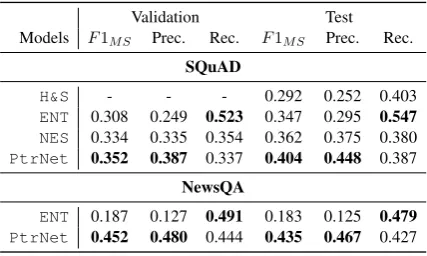
The baseline model above na¨ıvely selects all en-tities as candidate answers. One pitfall is that it exhibits high recall at the expense of precision (Table1), since not all entities lead to interesting questions. We first attempt to address this with a neural entity selection model (NES) that selects a
1https://spacy.io/docs/usage/entity-recognition
subset of entities from a list of candidates provided by our ENT baseline. Our neural model takes as input a document (i.e., a sequence of words),
D = (wd1, . . . , wdn
d), and a list ofneentities as a
sequence of (start,end) locations within the doc-ument, E = ((estart1 , eend1 ), . . . ,(estartne , eendne )). The model is then trained on the binary classifica-tion task of predicting whether an entity overlaps with any of the human-provided answers.
Specifically, we maximize Pne
i log(P(ei|D)).
We parameterizeP(ei|D)using a three-layer mul-tilayer perceptron (MLP) that takes as input the concatenation of three vectors hhdn
d;h d
avg;heii.
Here, hdavg and hdnd are the average and the fi-nal state of the document annotation vectors, re-spectively, and hei is the average of the
annota-tion vectors corresponding to thei-th entity (i.e.,
hdestart i , . . . ,h
d eend
i ).
During inference, we select the top k entities with highest likelihood under our model. We use
k= 6in our experiments as determined by hyper-parameter search.
3.2.3 Pointer Networks
While a significant fraction of answers in QA datasets like SQuAD are entities, entities alone may be insufficient for detecting different aspects of a document. Many documents are entity-less, and entity taggers may fail to recognize some entities. To this end, we build a neural model that is trained from scratch to extract all human-selected answer phrases in a particular document. We parameterize this model as a pointer network (Vinyals et al.,2015) trained to point sequentially to the start and end locations of all labeled an-swers in a document. An autoregressive decoder LSTM augmented with an attention mechanism is then trained to point (attend) to all of the start and end locations of answersfrom left to right, condi-tioned on the annotation vectors (extracted in the same fashion as in the NES model), via an atten-tion mechanism. We add a special terminaatten-tion to-ken to the document and train the decoder to attend to it once it has generated all key phrases. This en-ables the model to extract variable numbers of key phrases depending on the input document. This is in contrast to the work of Meng et al. (2017), where a fixed number of key phrases is generated per document.
where the target sequence consists of positions in the source sequence. An autoregressive de-coder RNN is trained to attend to these po-sitions in the input conditioned on an encod-ing of the input produced by an encoder RNN. We denote the decoder’s annotation vectors as
(hp1,hp2, . . . ,hp2na−1,hp2na), wherenais the
num-ber of answer key phrases, hp1 and hp2 corre-spond to the start and end annotation vectors for the first answer key phrase, and so on. We parameterize P(wdi = start|hp1. . .hpj,hd) and
P(wdi = end|h1p. . .hpj,hd) using the general at-tention mechanism (Luong et al., 2015) between the decoder and encoder annotation vectors,
P(wid|hp1. . .hpj,hd·) = softmax(W1hpj ·hd·),
whereW1 is a learned parameter matrix. The in-puts at each step of the decoder are words from the document that correspond to the start and end locations pointed to by the decoder.
During inference, we employ a decoding strat-egy that greedily picks the best location from the softmax vector at every step, then post process re-sults to remove duplicate key phrases. Since the output sequence is relatively short, we observed similar performances when using greedy decoding and beam search.
We also experimented with a BIO tagging model using an LSTM-CRF (Lample et al.,2016) but were unable to make the model predict any-thing except “O” for every token.
3.3 Question Generation
The question generation model adopts a sequence-to-sequence framework (Sutskever et al., 2014) with an attention mechanism (Bahdanau et al., 2014) and a pointer-softmax decoder (Gulcehre et al.,2016). We make use of the pointer-softmax mechanism since it lets us take advantage of the inherent nature of RC datasets re-using words in the document when framing questions. Our setup for this module is identical to (Yuan et al.,2017). It takes a documentwd1:nd and an answerw1:ana as input, and outputs a questionwˆ1:qnq.
An input wordwi{d,a}is represented by concate-nating its word embeddingeiwith character-level
embedding echi. Each character in the alphabet
receives an embedding vector, andechi is the final
state of a bi-LSTM running over the embedding vectors corresponding to the character sequence of the word.
To leverage the extractive nature of answers in SQuAD, we encode an answer using the document annotation vectors at the answer-word positions. Specifically, if an answer phrasewa1:noccupies the document spanwad1:an, we first encode the corre-sponding document annotation vectors with a con-dition aggregation BiLSTM into h01:n. The con-catenation of the final state h0n with the answer annotation vectorhanas the answer representation. The RNN decoder employs a pointer-softmax module (Gulcehre et al., 2016). At each step of the generation process, the decoder decides adap-tively whether to (a) generate from the decoder vocabulary or (b) point to a word in the source sequence (the document) and copy over. The pointer-softmax decoder thus has two components — a pointer attention mechanism and a generative decoder.
The subsequent mathematical notation deviates from the previous notation slightly, we use (t) as the superscript. In the pointing decoder, recur-rence is implemented with two cascading LSTM cellsc1andc2:
s(1t) = c1(y(t−1),s(t −1)
2 ) (1)
s(2t) = c2(v(t),s(1t)), (2)
wheres(1t)ands2(t)are the recurrent states,y(t−1)
is the embedding of decoder output from the pre-vious time step, and v(t) is the context vector, which is the sum of the document annotationshdi
weighted by the document attentionα(it)(Equation (3)):
v(t)= n
X
i=1
α(it)hdi.
At each time step t, the pointing decoder com-putes a distributionα(t) over the document word positions (i.e., a document attention, Bahdanau et al. 2014). Each element is defined as:
α(it)=f(hdi,ha,s1(t−1)), (3)
wherefis a two-layer MLP withtanhandsoftmax
activation, respectively.
Thegenerative decoder, on the other hand, de-fines a distribution over a prescribed decoder vo-cabulary with a two-layer MLPg:
Table 1: Model evaluation on key phrase extrac-tion
Validation Test Models F1M S Prec. Rec. F1M S Prec. Rec.
SQuAD
H&S - - - 0.292 0.252 0.403
ENT 0.308 0.249 0.523 0.347 0.295 0.547
NES 0.334 0.335 0.354 0.362 0.375 0.380 PtrNet 0.352 0.387 0.337 0.404 0.448 0.387
NewsQA
ENT 0.187 0.127 0.491 0.183 0.125 0.479
PtrNet 0.452 0.480 0.444 0.435 0.467 0.427
Pointer-softmax is implemented by interpolating the generative and the pointing distributions:
P( ˆwt)∼s(t)α(t)+ (1−s(t))o(t),
wheres(t)is a switch scalar computed at each time step by a three-layer MLPh:
s(t)=h(s(2t),v(t),α(t),o(t)).
The first two layers ofhusetanhactivation with highway connections, and the final layer uses sig-moidactivation.2
4 Experiments and Results
4.1 Datasets
We conduct our experiments on the SQuAD ( Ra-jpurkar et al.,2016) and NewsQA (Trischler et al., 2016) datasets. These are machine comprehension corpora consisting of over 100k crowd-sourced question-answer pairs. SQuAD contains 536 para-graphs from Wikipedia while NewsQA was cre-ated on 12,744 news articles. Simple prepro-cessing is performed, including lower-casing and word tokenization usingNLTK. Since the test split of SQuAD is hidden from the public, we use 5,158 question-answer pairs (self-contained in 23 Wikipedia articles) from the training set for devel-opment, and use the official development data to report test results.
4.2 Implementation Details
We train all models by stochastic gradient descent, with a minibatch size of 32, using the ADAM op-timizer.
2
We also attach the entropy of the softmax distributions to the input of the final layer, postulating that this guides the switching mechanism by indicating the confidence of point-ing vs generatpoint-ing. We observed an improvement in question quality with this modification.
4.2.1 Key Phrase Extraction
Key phrase extraction models use pretrained, 300-dimensional word embeddings generated using a word2vec extension (Ling et al.,2015) and the En-glish Gigaword 5corpus. We used bidirectional LSTMs of 256 dimensions (128 forward and back-ward) to encode the document and an LSTM of 256 dimensions as our decoder in the pointer net-work. A dropout rate of 0.5 was used at the output of every layer in the network.
4.2.2 Question Generation
The question decoder uses a vocabulary of the 2000 most frequent words in the training data (questions only). This limited vocabulary is possi-ble because the question generator may copy over out-of-vocabulary words from the document with its Pointer-Softmax mechanism. The decoder em-bedding matrix is initialized with 300-dimensional
GloVe vectors (Pennington et al., 2014), and di-mensionality of the character representations is 32. The number of hidden units is 384 for both the en-coder and deen-coder RNN cells. Dropout is applied at a rate of 0.3 to all embedding layers as well as between the hidden states in the encoder/decoder RNNs across time steps.
4.3 Quantitative Evaluation of Key Phrase Extraction
Since each key phrase is itself a multi-word unit, we believe that a na¨ıve, word-level F1 that con-siders an entire key phrase as a single unit is not well suited to this evaluation. We therefore pro-pose an extension of the SQuAD F1 metric (for a single answer span) to multiple spans within a document, which we call themulti-span F1 score. This metric is calculated as follows. Given the predicted phraseˆei and a gold phraseej, we first construct a pairwise, token-levelF1score matrix of elements fi,j between the two phrases eˆi and ej. Max-pooling along the gold-label axis essen-tially assesses the precision of each prediction, with partial matches accounted for by the pair-wise F1 (identical to evaluation of a single an-swer in SQuAD) in the cells: pi = maxj(fi,j).
Analogously, the recall for label ej can be
com-puted by max-pooling along the prediction axis:
rj = maxi(fi,j). We define the multi-span F1
scoreusing the mean precision p¯ = avg(pi) and
recallr¯= avg(rj):
Table 2: Qualitative examples of detected key phrases and generated questions. Doc. inflammationis oneof the first responses of the immune system to infection. the symptoms of inflammation are redness ,
swelling , heat , and pain , which are caused by increased blood flow into tissue . inflammation is producedby eicosanoids and cytokines, which are released by injured or infected cells . eicosanoids include prostaglandins that produce fever and the dilation of blood vessels associated with inflammation , andleukotrienesthat attract certain white blood cells ( leukocytes )
. . .
Q-A
H&S by eicosanoids and cytokines— who is inflammation produced by ?
of the first responses of the immune system to infection— what is inflammation one of ?
Q-A
PtrNet
leukotrienes— what can attract certain white blood cells ? eicosanoids and cytokines— what are bacteria produced by ?
Q-A
Gold SQuAD inflamation— what is one of the first responses the immune system has to infection ?
eicosanoids and cytokines— what compounds are released by injured or infected cells , triggering inflammation ?
Doc. researchshowsthat student motivation and attitudes towards school are closely linked to student-teacher relationships. enthusiastic teachersare particularly good at creatingbeneficialrelations with their students . their ability to create effective learning environments that foster student achievement depends on the kind of relationship they build with their students . useful teacher-to-student interactionsare crucial in linking academic success with personal achievement . here , personal success is a student ’s internal goal of improving himself , whereas academic success includes the goals he receives from his superior .a teachermust guide his student inaligning his personal goals with his academic goals. students who receive this positive influence show stronger self-confidenche and greater personal and academic success than those without these teacher interactions .
Q-A
H&S research— what shows that student motivation and attitudes towards school are closely linked to student-teacher relation-ships ?
useful teacher-to-student interactions— what are crucial in linking academic success with personal achievement ?
to student-teacher relationships— what does research show that student motivation and attitudes towards school are closely linked to ?
that student motivation and attitudes towards school are closely linked to student-teacher relationships— what does re-search show to ?
Q-A
PtrNet student-teacher relationships— what are the student motiva-tion and attitudes towards school closely linked to ?
enthusiastic teachers— who are particularly good at creating beneficial relations with their students ?
teacher-to-student interactions— what is crucial in linking academic success with personal achievement ?
a teacher— who must guide his student in aligning his personal goals ?
Q-A
Gold SQuAD student-teacher relationships— ’what is student motivation about school linked to ?
beneficial— what type of relationships do enthusiastic teachers cause ?
aligning his personal goals with his academic goals .— what should a teacher guide a student in ?
student motivation and attitudes towards school— what is strongly linked to good student-teacher relationships ?
Doc. the yuan dynastywasthe first timethatnon-native chinese peopleruled all of china . in the historiography of mongolia , it is generally considered to be the continuation ofthe mongol empire. mongols are widely known toworship the eternal heaven . . .
Q-A
H&S the first time— what was the yuan dynasty that non-native chi-nese people ruled all of china ?
the yuan dynasty— what was the first time that non-native chi-nese people ruled all of china ?
Q-A
PtrNet the mongol empire— the yuan dynasty is considered to be the continuation of what ?
worship the eternal heaven— what are mongols widely known to do in historiography of mongolia ?
Q-A
Gold SQuAD non-native chinese people— the yuan was the first time all of china was ruled by whom ?
the eternal heaven— what did mongols worship ?
Doc. on july 31 , 1995 , the walt disney company announced an agreement to merge with capital cities/abc for$19 billion .. . .. in 1998 , abc premiered the aaron sorkin-created sitcom sports night , centering on the travails of the staff of a sportscenter-style sports news program ; despite earning critical praise and multiple emmy awards , the series was cancelled in 2000 after two seasons .
Q-A
H&S an agreement to merge with capital cities/abc for$19 billion — what did the walt disney company announce on july 31 , 1995 ?
the walt disney company— what announced an agreement to merge with capital cities/abc for$19 billion on july 31 , 1995 ?
Q-A
PtrNet 2000— in what year was the aaron sorkin-created sitcom sports night cancelled ?
walt disney company— who announced an agreement to merge with capital cities/abc for$19 billion ?
Q-A
Gold SQuAD july 31 , 1995— when was the disney and abc merger first an-nounced ?
sports night— what aaron sorkin created show did abc debut in 1998 ?
Note that existing evaluations (e.g., that of Meng et al.(2017)) can be seen as the above com-putation performed on the matrix of exact match scores between predicted and gold key phrases. By using token-level F1 scores between phrase pairs, we allow fuzzy matches.
Our evaluation of key phrase extraction systems by this metric is presented in Table1. We com-pare answer phrases extracted by the method of Heilman and Smith(2010a) (henceforth refered to as H&S),3 our baseline entity tagger, the neural
entity selection module, and the pointer network. As expected, the entity tagging baseline achieves the best recall, likely by over-generating candidate answers. TheNES model, on the other hand, ex-hibits much better precision and consequently out-performs the entity tagging baseline significantly in F1. This trend persists when comparing the
NES model and the pointer network. The H&S model exhibits high recall but lacks precision, sim-ilar to the baseline entity tagger. This is not sur-prising since that model is not trained on SQuAD’s answer-phrase distribution.
4.4 Qualitative Evaluation of Key Phrase Extraction
Qualitatively, we observe that the entity-based models have a strong bias for numeric types, which often fail to capture interesting informa-tion in a document. We also notice that entity-based systems tend to select the central topical en-tity as answer, which does not match the distri-bution of answers typically selected by humans. For example, given a Wikipedia article on Kenya stating that agriculture is the second largest con-tributor to kenya ’s gross domestic product (gdp), entity-based systems proposekenyaas an answer phrase. This leads to the (low-quality) question
what country is nigeria’s second largest contribu-tor to? 4 Given the same document, the pointer model pickedagricultureas the answer and asked
what is the second largest contributor to kenya ’s gross domestic product ?
4.5 Quantitative Evaluation of QA pairs
We can quantitatively evaluate our question gen-eration module by conditioning it on gold answers from the SQuAD development set. We can then use standard automatic evaluation metrics for gen-erative models of text such as BLEU. Our ques-tion generaques-tion model evaluated in such a manner yields 10.4 BLEU4.
However, there can exist a many possible ways to formulate a question given the same answer. BLEU thus becomes a less desirable metric by penalizing any generation that does not closely match (lexically) the reference question. To ad-dress this issue, we propose to evaluate a generated question by employing a pre-trained QA model. Specifically, suppose questionqˆis generated from
4Since the answer word
kenyacannot appear in the gen-erated question, the decoder produced a similar wordnigeria
instead.
documentdand answera, and the pre-trained QA model outputs answerˆagiven the inputdandqˆ. If the QA model is assumed to be able to answer the gold questionq with the gold answera, then the F1 score between aand ˆamay serve as a proxy to the semantic equivalence between q and qˆ— regardless of the amount of word/n-gram overlap betweenqandqˆ.
Quantitatively, a match-LSTM model (Wang and Jiang,2016) pre-trained on gold squad ques-tion/answer pairs achieves an F1 score of 72.4% on our generated questions in comparison to 73.8% on the SQuAD dev set.
In addition to the automatic evaluation metrics, we also undertook a human evaluation of gener-ated questions and answers.
4.6 Qualitative Evaluation of QA pairs
We present several answer-extraction and question-generation examples in Table 2. Each example contains a document and three corre-sponding QA pairs, generated respectively by H&S, by our two-stage framework, and by the original SQuAD crowdworkers.
We now discuss the relative qualities of QA pairs from each synthetic method.
H&S Key phrases selected by the H&S model are structurally distinct from the PtrNet and human-generated answers. For example, they may start with prepositions, such asof, by, andto, or consist of very long phrases likethat student mo-tivation and attitudes towards school are closely linked to student-teacher relationships. As seen in Figure 1, these key phrases may also contain vague phrases such as “this theory”, “some stud-ies”, “a person”, etc., which renders them less nat-ural for question generation. The H&S question generator appears to produce a few ungrammati-cal sentences, e.g., the first time – what was the yuan dynasty that non-native chinese people ruled all of china ?
Figure 1: A comparison of key phrase extraction methods. Red phrases are extracted by the pointer network, violet by H&S, green by the baseline, brown correspond to squad gold answers and cyan indi-cates an overlap between the pointer model and squad gold questions. The last paragraph is an exception wherelyndon b. johnsonandapril 20are extracted by H&S as well as the baseline model.
yuan dynasty is considered to be the continuation of what ? the model must resolve the pronounit
toyuan dynastyinit is generally considered to be the continuation of the mongol empire(third doc-ument in Table2).
4.7 Human Evaluation Studies
We carried out human evaluations on the question generation module in isolation as well as in con-junction with the key phrase extraction module.
Evaluating the ability of the Question Gener-ation Module to transfer to new settings We asked crowdworkers part of an internal evaluation system to evaluate two different aspects of ques-tions generated by our module - fluency and cor-rectness. Our system was provided Internet arti-cles and candidate answers selected from an inter-nal search engine thereby evaluating the model’s ability to generalize from simple RC datasets to the real world. For fluency evaluations, they were asked whether the generated questions sounded natural (ignoring semantics) with scores of 0/1/2 corresponding to ”No”, ”Somewhat” and ”Yes”. 17.5% were labeled 0, 22.7% were labeled 1 and 59.8% were labeled 2. For correctness evalua-tions, annotators were asked if the given answer was the correct answer for the given question. 64.4% of questions were labeled incorrect,
leav-ing 35.6% labeled as correct. This particular eval-uation differs slightly from others with regard to the module used (it was trained a combination of SQuAD + NewsQA + TriviaQA (Joshi et al., 2017)). Also the documents and answers used pro-vided via an internal tool. 1,302 annotations were collected.
Comparison to human generated questions
We present annotators with documents from SQuAD’s official development set and two sets of question-answer pairs, one from our model (ma-chine generated) and the other from SQuAD (hu-man generated). Annotators are then asked to identify which question-answer pair is machine generated. The order in which the pairs appear is randomized across examples. Annotators are free to use any criterion to make a distinction, such as poor grammar, the answer phrase not correctly an-swering the generated question, unnatural answer phrases, etc.
We presented 14 annotators with a total of 740 documents, each with 2 corresponding QA pairs. Annotators identified the machine generated pairs 77.8% of the time with a standard deviation of 8.34%.
an implict comparison grounded in human gener-ated QA pairs from SQuAD. We present human annotators with a document and two QA pairs – one that comes from the true development set and the other from either our system or H&S, at ran-dom. Annotators are not told that there are two different models generating QA pairs. As above, annotators are asked to identify which QA pair is human generated and which is synthetic.
We presented a single annotator with 100 doc-uments, each with two QA pairs. For 45 docu-ments, the synthetic QA pair came from from our model; for the remaining 55, the synthetic pair was from H&S. The annotator distinguished cor-rectly between our system’s output and the human-generated pair in 30 cases (66.7%), and did so in 45 cases (81.8%) for H&S. This experiment sug-gests that our system’s generated QA pairs are less distinguishable from human QA pairs.
Comparison to H&S In a more direct evalua-tion, we present annotators with documents from the SQuAD development set along with one QA pair generated by the H&S model and one gener-ated by ours. We then ask annotators which QA pair they prefer.
We presented the same single annotator with 200 such examples. In 107 cases (53.5%), the an-notator preferred the pair generated by our model. This suggests that, without human generated QA pairs for comparison, the annotator considers the two models’ outputs to be roughly equal in qual-ity.
5 Conclusion
We propose a two-stage framework to tackle the problem of question generation from documents. First, we use a question answering corpus to train a neural model to estimate the distribution of key phrases that are likely to be picked by humans to ask questions about. We present two neural mod-els, one that ranks entities proposed by an entity tagging system, and another that points to key-phrase start and end boundaries with a pointer net-work. When compared to an entity tagging base-line, the proposed models exhibit significantly bet-ter results.
We adopt a sequence-to-sequence model to gen-erate questions conditioned on the key phrases se-lected in the framework’s first stage. Our question generator is inspired by an attention-based trans-lation model, and uses the pointer-softmax
mech-anism to dynamically switch between copying a word from the document and generating a word from a vocabulary. Qualitative examples show that the generated questions exhibit both syntac-tic fluency and semansyntac-tic relevance to the condi-tioning documents and answers, and appear use-ful for assessing reading comprehension in educa-tional settings. In future work we will investigate fine-tuning the two-stage framework end to end. Another interesting direction is to explore abstrac-tive key-phrase extraction.
6 Acknowledgements
The authors would like to thank the reviewers for their valuable feedback.
References
Manish Agarwal and Prashanth Mannem. 2011. Auto-matic gap-fill question generation from text books. In Proceedings of the 6th Workshop on Innovative Use of NLP for Building Educational Applications, pages 56–64. Association for Computational Lin-guistics.
Husam Ali, Yllias Chali, and Sadid A Hasan. 2010. Automation of question generation from sentences. InProceedings of QG2010: The Third Workshop on Question Generation, pages 58–67.
Dzmitry Bahdanau, Kyunghyun Cho, and Yoshua Bengio. 2014. Neural machine translation by jointly learning to align and translate. CoRR, abs/1409.0473.
Lee Becker, Sumit Basu, and Lucy Vanderwende. 2012. Mind the gap: learning to choose gaps for question generation. In Proceedings of the 2012 Conference of the North American Chapter of the Association for Computational Linguistics: Human Language Technologies, pages 742–751. Associa-tion for ComputaAssocia-tional Linguistics.
Yllias Chali and Sina Golestanirad. 2016. Ranking au-tomatically generated questions using common hu-man queries. InThe 9th International Natural Lan-guage Generation conference, page 217.
Xinya Du, Junru Shao, and Claire Cardie. 2017. Learn-ing to ask: Neural question generation for readLearn-ing comprehension. arXiv preprint arXiv:1705.00106.
Caglar Gulcehre, Sungjin Ahn, Ramesh Nallap-ati, Bowen Zhou, and Yoshua Bengio. 2016. Pointing the unknown words. arXiv preprint arXiv:1603.08148.
Annual Conference of the North American Chap-ter of the Association for Computational Linguistics, pages 609–617. Association for Computational Lin-guistics.
Michael Heilman and Noah A Smith. 2010b. Rating computer-generated questions with mechanical turk. InProceedings of the NAACL HLT 2010 Workshop on Creating Speech and Language Data with Ama-zon’s Mechanical Turk, pages 35–40. Association for Computational Linguistics.
Mandar Joshi, Eunsol Choi, Daniel S Weld, and Luke Zettlemoyer. 2017. Triviaqa: A large scale distantly supervised challenge dataset for reading comprehen-sion.arXiv preprint arXiv:1705.03551.
Hidenobu Kunichika, Tomoki Katayama, Tsukasa Hi-rashima, and Akira Takeuchi. 2004. Automated question generation methods for intelligent english learning systems and its evaluation. In Proc. of ICCE.
Igor Labutov, Sumit Basu, and Lucy Vanderwende. 2015. Deep questions without deep understanding. InACL (1), pages 889–898.
Guillaume Lample, Miguel Ballesteros, Sandeep Sub-ramanian, Kazuya Kawakami, and Chris Dyer. 2016. Neural architectures for named entity recognition.
arXiv preprint arXiv:1603.01360.
Tho Thi Ngoc Le, Minh Le Nguyen, and Akira Shi-mazu. 2016. Unsupervised keyphrase extraction: Introducing new kinds of words to keyphrases. 29th Australasian Joint Conference, Hobart, TAS, Aus-tralia, December 5-8, 2016.
David Lindberg, Fred Popowich, John Nesbit, and Phil Winne. 2013. Generating natural language ques-tions to support learning on-line. ENLG 2013, page 105.
Wang Ling, Chris Dyer, Alan W Black, and Isabel Trancoso. 2015. Two/too simple adaptations of word2vec for syntax problems. In HLT-NAACL, pages 1299–1304.
Zhiyuan Liu, Xinxiong Chen, Yabin Zheng, and Maosong Sun. 2011. Automatic keyphrase extrac-tion by bridging vocabulary gap. the Fifteenth Con-ference on Computational Natural Language Learn-ing.
Patrice Lopez and Laurent Romary. 2010. Humb: Au-tomatic key term extraction from scientific articles in grobidp. the 5th International Workshop on Se-mantic Evaluation.
Minh-Thang Luong, Hieu Pham, and Christopher D Manning. 2015. Effective approaches to attention-based neural machine translation. arXiv preprint arXiv:1508.04025.
Olena Medelyan, Eibe Frank, and Ian H Witten. 2009. Human-competitive tagging using automatic keyphrase extraction.Empirical Methods in Natural Language.
Rui Meng, Sanqiang Zhao, shuguang Han, Daqing He, Peter Brusilovsky, and Yu Chi. 2017. Deep keyphrase generation. Inthe 55th Annual Meeting of the Association for Computational Linguistics. As-sociation for Computational Linguistics.
Rada Mihalcea and Paul Tarau. 2004. Textrank: Bring-ing order into text. Empirical Methods in Natural Language.
George A Miller. 1995. Wordnet: a lexical database for english. Communications of the ACM, 38(11):39– 41.
Ruslan Mitkov and Le An Ha. 2003. Computer-aided generation of multiple-choice tests. In Proceed-ings of the HLT-NAACL 03 workshop on Build-ing educational applications usBuild-ing natural language processing-Volume 2, pages 17–22. Association for Computational Linguistics.
Nasrin Mostafazadeh, Ishan Misra, Jacob Devlin, Mar-garet Mitchell, Xiaodong He, and Lucy Vander-wende. 2016. Generating natural questions about an image. arXiv preprint arXiv:1603.06059.
Tri Nguyen, Mir Rosenberg, Xia Song, Jianfeng Gao, Saurabh Tiwary, Rangan Majumder, and Li Deng. 2016. Ms marco: A human generated machine reading comprehension dataset. arXiv preprint arXiv:1611.09268.
Jeffrey Pennington, Richard Socher, and Christopher D Manning. 2014. Glove: Global vectors for word representation. In Empirical Methods in Natural Language Processing (EMNLP), pages 1532–1543.
Pranav Rajpurkar, Jian Zhang, Konstantin Lopyrev, and Percy Liang. 2016. Squad: 100,000+ questions for machine comprehension of text. arXiv preprint arXiv:1606.05250.
Ilya Sutskever, Oriol Vinyals, and Quoc V Le. 2014. Sequence to sequence learning with neural net-works. InAdvances in Neural Information Process-ing Systems, pages 3104–3112.
Adam Trischler, Tong Wang, Xingdi Yuan, Justin Har-ris, Alessandro Sordoni, Philip Bachman, and Ka-heer Suleman. 2016. Newsqa: A machine compre-hension dataset. 2nd Workshop on Representation Learning for NLP.
Oriol Vinyals, Meire Fortunato, and Navdeep Jaitly. 2015. Pointer networks. InAdvances in Neural In-formation Processing Systems, pages 2692–2700.
Minmei Wang, Bo Zhao, and Yihua Huang. 2016. Ptr: Phrase-based topical ranking for automatic keyphrase extraction in scientific publications. 23rd International Conference, ICONIP 2016.
Shuohang Wang and Jing Jiang. 2016. Machine com-prehension using match-lstm and answer pointer.
arXiv preprint arXiv:1608.07905.
Tong Wang, Xingdi Yuan, and Adam Trischler. 2017. A joint model for question answering and question generation. 1st Workshop on Learning to Generate Natural Language.
Zhilin Yang, Junjie Hu, Ruslan Salakhutdinov, and William W. Cohen. 2017. Semi-supervised qa with generative domain-adaptive nets. Inthe 55th Annual Meeting of the Association for Computational Lin-guistics. Association for Computational Linguistics.