ISSN Online: 2151-4771 ISSN Print: 2151-4755
DOI: 10.4236/ce.2017.813141 Oct. 23, 2017 2091 Creative Education
Students’ and Instructors’ Perceptions of
Turnitin: A Plagiarism Deterrent?
Najwa Saba Ayon
College of Arts, Rafik Hariri University, Mechref, Lebanon
Abstract
Academicians consider plagiarism a major threat to academia. To combat that threat, a lot of universities, including the researcher’s university, have been using Turnitin. It is believed that this software is likely to deter students’ pla-giarism. The aim of this study is, therefore, to investigate 1) the impact of Turnitin on students’ plagiarism from the perspectives of both students and instructors in a private Lebanese English-speaking university and 2) the rea-sons that push students to plagiarize. A concurrent mixed-methods design is employed, and different data collection methods are used. The data are ana-lyzed quantitatively and qualitatively. Findings reveal that although a lot of the participants perceive Turnitin as a good deterrent to plagiarism, it did not completely inhibit it. The findings also reveal that not all instructors were committed enough to use Turnitin in their courses. Some of the reasons for plagiarism that the participants named are lack of citation skills, laziness, and indifference among students to abide by ethical writing norms. Besides rein-forcing the use of Turnitin among all instructors, the researcher recommends that students’ writing and citation skills be improved and that students be helped to become more ethical writers.
Keywords
Plagiarism, Turnitin, Perceptions, Higher Education, Lebanon
1. Introduction
Academic integrity, which could be referred to as the ethical code of academia, has been a major concern in higher education because university’s success is de-pendent on ensuring this moral policy. Whether plagiarism is defined as “the intentional use of the ideas and words of others without the clear acknowledge-ment of the source of that information” (Smith, Ghazali, & Minhad, 2007: 122)
or “literary theft” (Merriam-Webster Online Dictionary, 2005), academicians
How to cite this paper: Saba Ayon, N. (2017). Students’ and Instructors’ Percep-tions of Turnitin: A Plagiarism Deterrent? Creative Education, 8, 2091-2108.
https://doi.org/10.4236/ce.2017.813141
Received: August 17, 2017 Accepted: October 20, 2017 Published: October 23, 2017
Copyright © 2017 by author and Scientific Research Publishing Inc. This work is licensed under the Creative Commons Attribution International License (CC BY 4.0).
DOI: 10.4236/ce.2017.813141 2092 Creative Education
consider it a major threat to academia in general and to academic integrity in specific. In fact, Baker, Thornton, & Adams (2008: 1), citing Koch (2000), state that about “75 percent of university students have violated academic integrity rules during their educational careers, many of them do so consistently”. To en-sure academic integrity and to combat that threat, a lot of universities, including the researcher’s university, are using Turnitin (Ti), known as a plagiarism de-tecting software or more accurately as Rowell, Carroll, Morris, & Jameson (2009: 157) define it an “electronic text-matching tool”. It is believed that such software is likely to deter students’ plagiarism.
Based on the literature, Ti has been effective in reducing plagiarism in stu-dents’ writing assignments (Turnitin.com, 2015ab;Batane, 2010;Baker, Thorn-ton & Adams, 2008 among others). Several factors were also found to contribute to students’ plagiarism such as lack of awareness, laziness, lack of skills in aca-demic writing, lack of understanding, personal attitudes, and unpunished stu-dents’ plagiarism acts (Batane, 2010; Baker, Thornton, & Adams, 2008; Smith, Ghazali, & Minhad, 2007).
However, the researcher is still encountering acts of students’ plagiarism in almost every class she teaches although Ti has been used at the researcher’s uni-versity, a private Lebanese institution, for almost 6 years. Therefore, to deter-mine the effectiveness of this software in fighting plagiarism at her university, the researcher aims to examine university students’ and instructors’ perceptions of Ti and the extent to which they perceive it as a deterrent to students’ plagiar-ism. In order to get a better understanding of these perspectives, the reasons that push students to plagiarize are also examined.
In the following sections, the researcher reviews some of the related literature and then presents the research questions that guided this research study. After-wards, the researcher proceeds to give a detailed description of the methodology and data-collection methods. Discussion of the findings follows and the re-searcher ends with a conclusion and a set of recommendations that are likely to increase the effectiveness of Ti at her university and other similar contexts.
2. Literature Review
This section is divided into three sub-sections, each of which reviews some of the recent studies related to plagiarism and the effectiveness of Ti.
2.1. Effectiveness of Turnitin in Reducing Plagiarism
DOI: 10.4236/ce.2017.813141 2093 Creative Education
had fewer unoriginal writing, i.e. less plagiarism. It was interesting to note that year after another, except for the first year, the level of plagiarism was dropping. Moreover, the surveyed instructors (350) in year 2012 reported that Ti reduced their grading time by 31 percent on average, improved the quality of their feed-back on students’ writing, and increased students’ engagement (8).
Similarly, Baker et al. (2008) found that Ti has been effective in reducing pla-giarism among business graduates’ reports in a small southern university in the US. The sample consisted of 2 groups of graduates taking the same management course with the same professor, but one group (27 students) taught off-campus was provided with access to Ti to check their work for plagiarism (experimental group) and the other group (26 students) taught on campus was not provided such access. Using descriptive statistics and T-Test comparison of the means of the two groups, the researchers found that the level of plagiarism in the experi-mental group is much lower than that of the control group.
Other research studies showed that Ti in itself has no magic power in com-bating plagiarism but the way instructors use it is a major contributing factor to eliminate unoriginal writing. For example, Heckler, Rice, & Bryan (2013) inves-tigated the effectiveness of Ti in deterring digital plagiarism among students in a southern American university. The participating students consisted of a random sample of 664 students enrolled in Introduction to Sociology course taught by the same instructor in two semesters. In the first semester, the participants were not informed that their papers would be checked through Ti, whereas the par-ticipants in the second semester were aware of this strategy as they themselves had to submit their papers to their instructor on Ti. Using quantitative analysis (independent samples t-test and hierarchal multiple regression), the researchers found that student plagiarized less when they knew that their work would run through Ti; thus, it was serving at least as a prevention strategy (Heckler et al. 2013). This study highlights the major role instructors could play in deterring plagiarism. That is why Hecker et al. (2013) argue that instructors should take responsibility for deterring plagiarism.
Similar findings were also reported by Chao et al. (2009: 32) who aimed to investigate the effect of “plagiarism-prevention instructions” on reducing pla-giarism in graduate and undergraduate business students’ writings. Using a quasi-experimental study design, these researchers found that the participants that received instructional treatment about plagiarism and proper documenta-tion had lower plagiarism rate than those who were not exposed to the same treatment but only informed that Ti would be used. Chao et al. (2009: 39) ar-gued that lack of documentation skills is a primary reason for students’ unin-tentional plagiarism. Thus, the software itself has a limited role in reducing plagiarism, and it should be coupled with instructions on proper documenta-tion skills in order to help students improve their writing and to achieve aca-demic integrity.
DOI: 10.4236/ce.2017.813141 2094 Creative Education
pilot project is multiple, namely 1) to determine the level of internet plagiarism at this university, 2) to investigate the impact of Ti on students’ plagiarism, 3) to identify the factors responsible for students’ plagiarism, and 4) to report prob-lems faced during the implementation of Ti as well as to recommend ways to overcome these problems in the future. Using convenience sampling, the re-searcher selected 272 students from classes that required essay writing assign-ments and 12 lectures, two from each of the six faculties at the university. Dif-ferent data-collection methods were used, the first of which is a “pretest-posttest comparison approach” (4). In more detail, two of the participants’ essay assign-ments were submitted on Ti to determine the level of plagiarism at different time interval, before and after introducing the software to students. In addition, par-ticipating students’ and lecturers’ opinions on plagiarism and the use of Ti were surveyed, but only 120 student participants and 7 lectures completed the ques-tionnaire, which consisted of closed- and open-ended questions. Findings show that although there was a difference in the level of plagiarism between the pretest and the posttest, plagiarism did not disappear. Thus, the author concludes that Ti decreased the level of plagiarism in undergraduate students’ essays, but it did not deter students’ plagiarism (8). Batane (2010) argues that to eliminate pla-giarism, it is essential to address the reasons that push students to plagiarize (further discussed in the next sub-section).
Graham-Matheson & Starr (2013) investigated the use of Ti in a new univer-sity in Kent. Although the use of Ti for originality checking was not obligatory then, it was employed in 17 out of 23 teaching departments across the 5 faculties. Through this investigation, the researchers aimed to help establish the Universi-ty’s plagiarism policy and to develop staffs’ and students’ understanding of this policy as well as the use of Ti in avoiding plagiarism. Using a case-study design, the researchers asked all students and staffs at the university to complete an on-line survey about their understanding, perceptions, and experiences of Ti, pla-giarism, and University policy; however, only 367 students and 62 staffs, not all of whom had used Ti before, completed the survey. Follow-up interviews were made with 34 participating students and 26 participating staffs. The researchers found that the staffs and students supported the use of Ti in originality reports and the majority of them understood the plagiarism policy and the role of Ti within. About half of the participating students who had used Ti reported that this software helped them improve their referencing skills, and quite a fewer of them talked about improved writing skills in general. What is interesting about this study was the adoption of Ti not only as a plagiarism-detection tool but as a teaching tool to help students avoid plagiarism. By sharing originality reports with students and discussing with them ways to avoid plagiarism, students were able to improve their writing in general and referencing skills in particular.
2.2. Factors for Students’ Plagiarism
DOI: 10.4236/ce.2017.813141 2095 Creative Education
contributing factor to students’ plagiarism, and most students denied that their plagiarism was due to lack of moral responsibility. A few students named lack of skills in academic writing, and some others attributed plagiarism to the tempta-tion of taking the easier route of copying and pasting informatempta-tion from the in-ternet in comparison to the long time and effort to write correctly. Another fac-tor students named was unpunished students’ plagiarism acts, which encouraged students to plagiarize. Finally, the tendency of lecturers to give the same essays and tests every year was also reported as another reason for students’ plagiarism (7).
Similarly, Chao et al. (2009) found that lack of knowledge in proper docu-mentation and paraphrasing is a primary reason for students’ plagiarism, at least inadvertently.
Although Baker et al. (2008: 1) found that lack of understanding is one major factor to plagiarism, unlike Batane (2010) and Chao et al. (2009), they reported that tolerance to cheating and plagiarism (such as not listing all sources, falsify-ing lab results or research data, fabricatfalsify-ing a reference list, misquotfalsify-ing a source intentionally) is another contributing factor to students’ plagiarism.
Likewise, Smith, Ghazali, & Minhad (2007), who quantitatively investigated students’ perceptions of the factors that are responsible for plagiarism in a Ma-laysian university, found that personal attitudes are a contributing factor to pla-giarism. Participants who perceived that citing sources was not important and that instructors would not be able to detect their plagiarism were likely to engage in plagiarizing acts. Another reported factor was lack of awareness of what pla-giarism was, what the penalties of plapla-giarism were, and what constituted correct procedures for citation and documentation. Lack of understanding and lack of competence were also identified as contributing factors to plagiarized acts among students. Students tend to copy information when they do not have full understanding of the subject. It was also found that male participants seem to plagiarize more than female participants do.
To sum up, poor writing skills, lack of understanding, and personal attitudes were reported as the most common factors for students’ plagiarism.
2.3. Attitudes of Students and Instructors toward Plagiarism and
Turnitin
DOI: 10.4236/ce.2017.813141 2096 Creative Education
proper citations. In fact, the majority of the participants indicated that the dis-cussion of the originality reports with their instructors and then revising their writings accordingly were very effective in improving their citation skills, and hence avoiding plagiarism (4).
Batane (2010) also reported that the majority of the student participants had a positive attitude toward the use of Ti because they believed this software would help them refrain from plagiarism and work harder to write correctly, hence improving their studies. Similarly, the participating lecturers supported the use of Ti as they believed it would help them identify plagiarized assignments, but they also believed that preventing plagiarism was within their hands rather than within the software (7).
In Graham-Matheson & Starr (2013: 11), staff and students at Canterbury Christ Church University were “supportive of the use of Turnitin in originality report”, and students found Ti a useful tool because it could help half of them avoid plagiarism.
Similar positive attitudes were found among professors at Kentucky Wesleyan College. An associate professor of English believed that Ti “helps students really become engaged in the writing process” and another physics and statistics pro-fessor stated that Ti “allows me to check students’ lab reports to ensure that the data, … in their documents are original” (Turnitin, 2015a).
However, different perceptions were found at the University of the Western Cape. Stoltenkamp & Kabaka (2014)investigated the adoption and implementa-tion of Ti at this university, where the use of Ti was intended not only to detect plagiarism but also to help students improve their writing skills; thus, a deve-lopmental rather than a punitive approach was followed. Using a case-study de-sign, the researchers collected qualitative data through 1) open-ended evaluation forms filled by lecturers about their use of Ti; their attendance of training ses-sions; and their understanding of the functions of Ti and 2) email responses ex-changed between lecturers and the Ti support team at the university. Out of the 871 lecturers, only 38 completed the form, which is a very small response rate. Fifty emails randomly selected out of 500 were analyzed. Results show that a few lecturers adopted and used Ti, which deprived students from the opportunity to avoid plagiarism and improve their writing through the originality reports they receive when they submit their assignments on Ti. Another major finding was that only 70% out of 38 participants fully understood the functions of Ti, and this little understanding contributed to the minimal use of Ti. Despite the small sample, it could be inferred that lecturers’ commitment is essential in using Ti effectively, combating plagiarism, and hence improving students’ writing in general.
DOI: 10.4236/ce.2017.813141 2097 Creative Education
3. Research Questions
The following question and sub-questions guided this research study:
How does Ti impact students’ plagiarizing behavior from the perspectives of both students and faculty members?
1) What is the attitude of students toward plagiarism? 2) How do students and faculty members perceive Ti? 3) To what extent does Ti detect students’ plagiarism?
4) What are the factors that contribute to students’ plagiarism?
4. Methodology and Methods
The researcher employed the concurrent mixed- methods design whereby both quantitative and qualitative data were collected at the same time of the re-search study. The rere-searcher used two main data collection methods, namely a self-completion questionnaire and semi-structured interviews. Combining quantitative and qualitative data-collection methods is likely to provide “an expanded understanding of research problems” (Creswell, 2009: 203).
4.1. Description of Data-Collection Instruments
In this research, triangulation of methods was employed: the self-completion questionnaire, the interview with the students and that with the instructors so that the “findings may be cross-checked” (Bryman, 2008: 700). The question-naire employed in this study (see appendix A) has been adapted from two ques-tionnaires at
http://www.questionpro.com/a/showSurveyLibrary.do?surveyID=332806 &
http://ifets.info/journals/13_2/1.pdf. It consists of about 27 multiple-choice
items, some of which require the participants to justify or explain their choices as this is likely to help better understand the participants’ answers. These items survey the student participants’ perceptions of Ti, their attitudes toward plagiar-ism, and their views of the factors that push students to plagiarize.
To get deep, rich data, semi-structured interviews with faculty members and student participants were used. Each interview lasted for about 20 minutes dur-ing which open-ended questions were used to ask students and instructors about their experiences using Ti, their perceptions of the software, and the factors they perceived to lead to students’ plagiarizing behavior. Only participanting students were asked about their attitudes to plagiarism because the researcher assumed that instructors were supposed to follow the university’s policy on academic in-tegrity and hence be intolerant of plagiarism. The researcher used probing either to clarify some ideas discussed by the participants or to elicit richer data.
4.2. Description of Context
uni-DOI: 10.4236/ce.2017.813141 2098 Creative Education
versity, namely College of Business Administration (CBA), College of Engi-neering (CE), and College of Communication and Science Information Sys-tems (CSIS), in addition to the Language and Humanities Department (L & H) (now turned to College of Arts). This university, which aims to provide high-quality education, tries to instill academic integrity among its students. It has developed its own policy, which states, “[The University] embraces the values of academic honesty and integrity and expects all to uphold strict ethi-cal and professional standards. The University forbids any unauthorized use of the work of others. Acts of plagiarism or cheating on exams or other types of work submitted for assessment as part of a course grade shall risk possible dis-ciplinary action” (Undergraduate Catalogue, 2017: 76). That is why it was among the first universities in Lebanon to utilize Ti services mainly as a plagiar-ism detection tool. Every instructor had an account on Turnitin.com and was expected to ask his/ her students to upload their writing projects/assignments on Turnitin.com for plagiarism detection.
4.3. Description of Participants
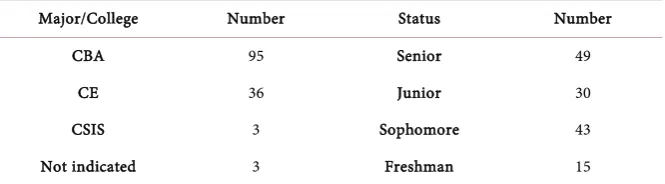
One-hundred fifty student participants were conveniently selected; the research-er asked those participants to take part in the study and they agreed. Howevresearch-er, data was collected only from 137 participants who completed the questionnaire. More information about the participating students is presented in Table 1 be-low.
[image:8.595.207.540.544.636.2]As it was shown in the table, the participating sample was from the different colleges in the university but in uneven number. This is due to the sampling method employed. The majority (95) was from CBA, and more seniors (49) par-ticipated in the study. The least to be represented were students from CSIS and those who were freshmen. Out of those participating students, 5 students that indicated their willingness to be interviewed were asked about their experiences and perceptions of Ti, as well as the reasons that push students to plagiarize.
Table 1. Description of Student Participants.
Major/College Number Status Number
CBA 95 Senior 49
CE 36 Junior 30
CSIS 3 Sophomore 43
Not indicated 3 Freshman 15
DOI: 10.4236/ce.2017.813141 2099 Creative Education
Although participants were from different colleges and of different statuses, the researcher cannot claim a real representation of the university’s population.
4.4. Description of Data Analysis
The collected data were analyzed both quantitatively and qualitatively. Survey data were entered into the SPSS (version19) for descriptive analysis, and Cronbach’s Alpha was .750. Thematic analysis was employed for interview data. The research-er read through the transcribed intresearch-erviews and dresearch-erived the recurrent themes. The conclusions derived from the different analyses of the multi-sourced data were triangulated. There were a lot of similarities among the derived conclusions, con-tributing to the trustworthiness of the findings.
5. Findings
The findings are presented in four sub-sections. A lot of these findings echoed with those presented in the literature.
5.1. Perceptions of Ti
In this sub-section, students’ and instructors’ perceptions of Ti are presented. The researcher maintained the voice of her respondents by quoting exactly what the participants said in their interviews or wrote in the open-ended questions. Thus, some quotes were inaccurate, and some other quotes were in the third person as the participants were referring to other students who might have pla-giarized.
5.2. Students’ Perceptions
Students’ perceptions of Ti varied as it is shown in Table 2 below.
Although about 75% of the student participants support the use of Ti in the university, only about half of them (57%) rated their experiences with this soft-ware as effective and fewer perceive the use of it beneficial to students’ overall education (about 48.9%).
Table 2. Students’ perceptions of Ti.
Perceptions Percentages
Support the use of Ti 74.5%
Ti is effective 57%
Ti is beneficial to students’ education 48.9%
DOI: 10.4236/ce.2017.813141 2100 Creative Education
without copying”; however, they complained about the inconsistency in the use of Ti among departments and faculty members “not used in all courses”, “using it in English department only [Languages and Humanities]”, “not all instructors use it”, “not all departments use it”, and “not forced in our de-partment to use it”.
5.3. Instructors’ Perceptions
Most of the participating instructors were of the opinion that Ti is an effective software to detect plagiarism, and they recommended it to be used in all courses due to its effectiveness. However, one faculty member in the Department of Languages and Humanities stated that Ti’s effectiveness has limitations and ex-plained this limitation as follows: “Ti cannot detect plagiarism when a student copies from a printed textbook or when he/she copies from an Arabic textbook and translates it into English”.
Nevertheless, instructors in the CE seem to have different perceptions of Ti as reflected in what the participant from that college stated, “we do not use Ti in order to maintain a trustful relationship with our students, and hence students will refrain from tricking their teachers and plagiarizing”.
These findings were similar to those presented in the literature review (c.f.
Turnitin.com, 2015b; Batane, 2010; Graham-Matheson & Starr, 2013). Except for a few participants, student participants believed that Ti was beneficial to their writing skills, and they support its use at the university. Similarly, the majority of the instructors believed that Ti was an effective tool in detecting plagiarism.
5.4. Students’ Attitudes towards Plagiarism
As stated earlier, instructors’ attitudes towards plagiarism were not sought as it was assumed that they were following the University’s policy on academic inte-grity.
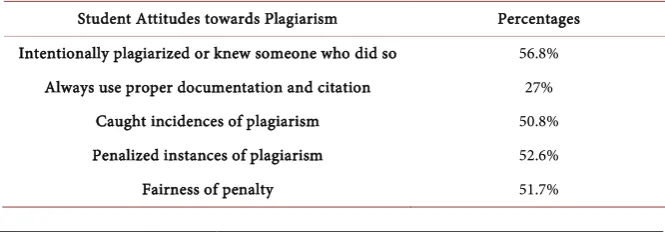
[image:10.595.205.538.622.738.2]Quite a number of student participants seemed to be tolerant of plagiarizing behavior. This is quite reflective in the quantitative data (see Table 3). About 57% intentionally plagiarized or knew someone who did so, but only 27% ad-mitted using proper documentation and citation all the time. Their tolerance could have been reinforced when the plagiarizing behavior had not been caught or penalized for. Indeed, the student participants reported that about 51% of the
Table 3. Student attitudes towards plagiarism.
Student Attitudes towards Plagiarism Percentages Intentionally plagiarized or knew someone who did so 56.8%
Always use proper documentation and citation 27%
Caught incidences of plagiarism 50.8%
Penalized instances of plagiarism 52.6%
DOI: 10.4236/ce.2017.813141 2101 Creative Education
plagiarism attempts were not caught, and only about 53% of the plagiarized acts were penalized. In other words, quite a lot of plagiarism in the university was neither noticed nor penalized for.
5.5. Factors for Students’ Plagiarism
The opinions of the participants, both students and faculty members, were sought about the factors that push students to plagiarize. These views were re-ported below in different sub-sections.
5.6. Perceptions of Students
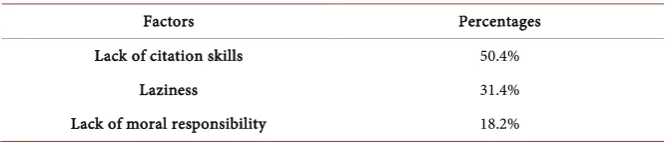
[image:11.595.206.540.344.415.2]The student participants named several factors that could be responsible for their plagiarizing behavior. The mostly named factor is lack of citation skills (about 50%); more than half of them believe that the university does not provide them with enough skills to avoid plagiarism. The other mostly reported factors were laziness (about 31%) and lack of moral responsibility (about 18%) among students (see Table 4).
Table 4. Factors for plagiarism.
Factors Percentages
Lack of citation skills 50.4%
Laziness 31.4%
Lack of moral responsibility 18.2%
The qualitative data added more insights and was almost consistent with the quantitative. The student participants were of the opinion that poor writing skills are a main factor to their plagiarism. They blamed the university in general and their instructors in specific “They [instructors] don’t teach us how to pa-raphrase”, “some instructors don’t take good care of it”, “intensive courses aren’t effective, … They must improve our writing skills, …” Other reasons they named are “plagiarizing when under pressure” and “achieving higher grades”.
These findings echoed what was presented in the literature review section (c.f.
Baker, 2010;Choa et al., 2009;Smith et al., 2007).
5.7. Perceptions of Instructors
Like student participants, most faculty participants named poor citation and documentation skills and students’ lack of confidence in their writing skills. One more faculty participant said that “some students copy and paste in their as-signments to get higher grades as they don’t trust their writing abilities”.
DOI: 10.4236/ce.2017.813141 2102 Creative Education
answers on the internet”. Most probably this participant is referring to global plagiarism, where the student copies the whole assignment and presents it as his/hers, and he seems not to be quite aware of the different types of plagiarism, patchwork and incremental plagiarism.
5.8. Impact of Ti on Students’ Plagiarism
[image:12.595.206.539.269.345.2]The findings reveal that the impact of Ti on students’ plagiarism was not as it was expected, a deterrent to plagiarism. This could be sensed from the student participants’ responses. Although about 56% of the participants stated that they would not plagiarize if they knew that their papers would be checked through Ti, about 20% of them would do so and about 24% might plagiarize.
Table 5. Impact of Ti on students’ plagiarism. Continue plagiarism even if I know the paper
will be checked on Ti Percentages
Yes 19.7%
No 56.2%
Maybe 24.1%
Thus, Ti seems to be acting at least as a preventive plagiarism tool for more than half of the participants. However, it is not to the others, probably due to three main reasons: 1) previous students’ experiences with unpunished plagiar-ism acts, 2) the poor implementation of the policy by the majority of the colleges and faculty instructors, and 3) students’ perceptions that Ti is not 100% effective in catching plagiarized assignments, “can’t always be relied on”.
6. Conclusion and Recommendation
Using a concurrent mixed-methods design, the researcher investigated the per-ceptions of students and instructors of Ti, as well as the factors that contribute to students’ plagiarism, in a small-sized private university in Lebanon. The find-ings, which reinforce a lot of those presented in the literature, reveal that a lot of the participants perceive Ti as a good detector for plagiarism although it did not completely prevent it. The main reasons that push students to plagiarize ac-cording to most of the participants are poor citation and documentation skills besides laziness, poor morals, working under pressure, and striving for high grades.
The researcher argues that the inconsistent use of Ti in the university, the un-spotted acts of plagiarism, and the unpunished acts of plagiarism could have contributed to some students’ continual commitment or tolerance to plagiarism.
DOI: 10.4236/ce.2017.813141 2103 Creative Education
matter.
This study presents further evidence that students’ attitudes and instructors’ commitment to Ti are crucial to ensure the effectiveness of this software. By un-derstanding the reasons for students’ plagiarism as well as educating them about the dangers of plagiarism, instructors could help their students avoid plagiarism and become better writers.
For Ti to be more effective, the researcher recommends the following: 1) Because instructors’ commitment seemed to be essential to ensure the ef-fectiveness of Ti, instructors should consistently use Ti and implement the policy of plagiarism adopted at the university.
2) To improve students’ writing skills in general and their documentation skills in specific, the instructors should adopt a developmental approach to the use of Ti instead of punitive approach, whereby instructors share the originality reports with students and discuss with the students ways to avoid plagiarism and to document properly.
3) Because students’ personal attitudes to plagiarism could be a contributing factor to plagiarism, instructors should educate students about the danger of plagiarism, raise their awareness about academic integrity, and help them be-come ethical writers who will avoid plagiarism even if Ti is not utilized.
4) As Ti was enforced on all departments last year, it would be interesting to research this topic further to better understand the impact of this software on students’ plagiarism.
Acknowledgements
The researcher would like to thank all the student participants and her col-leagues for their time and contribution to this research.
References
Baker, R. K., Thornton, B., & Adams, M. (2008). An Evaluation of the Effectiveness of Turnitin.Com as a Tool for Reducing Plagiarism in Graduate Student Term Papers.
College Teaching Methods & Styles Journal, 4, 1-4.
Batane, T. (2010). Turning to Turnitin to Fight Plagiarism among University Students.
Educational Technology & Society, 13, 1-12.
Bryman, A. (2008). Social Research Methods (3rd ed.). New York: Oxford University Press.
Chao, C. A., Wilhelm, W., & Neureuther, B. D. (2009). A Study of Electronic Detection and Pedagogical Approaches for Reducing Plagiarism. The Delta Pi Epsilon Journal, L1, 31-42.
Creswell, J. W. (2009). Research Design: Qualitative, Quantitative, and Mixed Methods Approaches (3rd ed.). US: Sage Publications.
Graham-Matheson L., & Starr, S. (2013). Is It Cheating or Learning the Craft of Writing? Using Turnitin to Help Students Avoid Plagiarism. Research in Learning Technology,
21, 1-13.https://doi.org/10.3402/rlt.v21i0.17218
DOI: 10.4236/ce.2017.813141 2104 Creative Education College Classrooms. Journal of Research on Technology in Education, 45, 229-248. https://doi.org/10.1080/15391523.2013.10782604
Koch, K. (2000). Cheating in Schools. CQ Researcher, 10, 747-757. Merriam-Webster Online Dictionary (2005). Retrieved from
https://www.informationvine.com/index?q=Merriam+Webster+Online+Dictionary%2 0&%20qo=relatedSearchNarrow%20&%20o=603081%20&%20l=sem
Rowell, R., Carroll, J., Morris, E., & Jameson, S. (2009). Educational Resource Review.
Journal of Hospitality, Leisure, Sport and Tourism Education, 8, 157-166.
Smith, M., Ghazali, N., & Minhad, S. F. N. (2007). Attitudes towards Plagiarism among Undergraduate Accounting Students: Malaysian Evidence. Asian Review of Account-ing, 15, 122-146.https://doi.org/10.1108/13217340710823350
Stoltenkamp, J., & Kabaka, M. (2014). Turnitin Adoption and Application at a HEI: A Developmental Approach. Creative Education, 5, 1043-1052.
https://doi.org/10.4236/ce.2014.512118
Turnitin.com (2014). Research Study: Turnitin Effectiveness in U.S. Colleges and Univer-sities. Retrieved from http://www.turnitin.com/en_us/resources
Turnitin.com (2015a). Shift Perceptions of Plagiarism in a Digital Age. Retrieved from http://www.turnitin.com/en_us/why-turnitin/success/kentucky-wesleyan-college Turnitin.com (2015b). What Do Students Think of Turnitin? Retrieved from
http://www.turnitin.com/en_us/resources Undergraduate Catalogue (2017). Retrieved from
DOI: 10.4236/ce.2017.813141 2105 Creative Education
Appendix A: Questionnaire
Dear Participants
I am conducting a research study on Turnitin and plagiarism. This research aims at understanding students’ perceptions of plagiarism and Turnitin. Using con-venient sampling, I would like you to answer this questionnaire as sincerely as possible. There is no right or wrong answer; that is why I appreciate selecting the answer that best reflects your opinion.
Although your participation is optional, I strongly recommend that you take part in this study. Your answers will help me understand your perceptions and attitudes to Turnitin and plagiarism. I promise you confidentiality and anonym-ity.
Hint: In this questionnaire, plagiarism is referred to as the act of copying of someone else’s work and pasting it in one’s assignments without citing the au-thor. Turnitin is a software program that is used in our university to detect for similarity/plagiarism.
Thank you for your time and help. Sincerely,
Researcher
Directions: Please circle one answer that best applies to you, and write
down your answers on the provided space if needed. 1. Which school do you belong to?
a. Business b. Engineering c. CSIS
2. What is your status? a. Freshman
b. Sophomore c. Junior d. Senior
e. Others. Specify ________________________________
3. How often do you use the internet for journal sources and websites to help you in your university assignments?
a. All the time b. Very often c. Fairly often d. Occasionally e. Very few times
f. Others, specify_____________________________________________ 4. When you use these sources, how often do you correctly document/cite what
is used in your assignments? a. All the time
DOI: 10.4236/ce.2017.813141 2106 Creative Education
d. Occasionally e. Very few times
f. Others, specify ____________________________________________ 5. Are you familiar with Turnitin?
a. Yes b. No
6. How did you learn about Turnitin? a. Instructor
b. Friends/Classmates c. This survey
d. Others, specify ____________________________________________ 7. Have you ever used Turnitin?
a. Yes b. No
(If you have answered yes to question 7, answer questions 8, 9 and 10; otherwise, go to number 11)
8. How often do you use this software? a. Once a semester
b. Twice a semester
c. Every time I submit a written assignment for evaluation
d. Others, specify ____________________________________________ 9. In which courses did you use Turnitin?
__________________________________________________ How would you rate your experience using Turnitin? a. Effective
b. Ineffective c. No opinion.
Please justify your answer __________________________________________ 10.In your opinion, why do students plagiarize?
a. Laziness
b. Lack of skills in citing and referencing the material c. Lack of moral responsibility
d. Do not think they can be caught
e. Others, specify _____________________________________________ 11.Have you, or anyone you know, ever intentionally plagiarized? a. Yes
b. No c. Maybe d. Don’t know
12.Have you, or anyone you know, ever been detected for plagiarism? a. Yes
DOI: 10.4236/ce.2017.813141 2107 Creative Education
(If you answered yes or maybe in question 13, answer questions 14 and 15; otherwise go to question 16)
13.Was the individual (who plagiarized) penalized for his/her plagiarism? a. Yes
b. No c. Maybe d. Don’t know
14.In your opinion, was the penalty fair? a. Yes
b. No c. Maybe d. Don’t know
15.As a student, I fall into the pressures of concentrating on achieving high marks.
a. True b. False
16.If you answered true to Q. 16, this is mainly due to: (Mark at least two that best apply to you)
a. Society Expectations b. My self-image c. Family Expectations d. University Expectations e. Not Applicable
f. Others, specify ____________________________________________ 17.When under these pressures, plagiarism is a resort for me?
a. True b. False
18.In your opinion, does the university provide you with enough skills to write properly without plagiarizing?
a. Yes b. No
Justify your answer _______________________________________________ 19.How do you personally rate the university’s policy to plagiarism?
a. Very strict b. Strict c. Fair/Regular d. Lenient e. Too Lenient
20.Is this policy consistently implemented in your college? a. Yes
b. No
DOI: 10.4236/ce.2017.813141 2108 Creative Education
a. Yes b. No
22.Would you continue to plagiarize after knowing that your paper will be checked through Turnitin?
a. Yes b. No c. Maybe
23.Do you support the use of Turnitin to fight plagiarism among students? a. Yes
b. No
24.In your opinion, to what extent can Turnitin detect plagiarism? a. Greatly
b. Fairly c. Barely d. Not all
25.How do you rate the use of Turnitin in our university? a. Excellent
b. Good c. Fair d. Poor
Why do you think so? _______________________________________
26.Do you think that the use of Turnitin will benefit students’ overall education? a. Yes
b. No c. Maybe d. Don’t know