49
MoRTy: Unsupervised Learning of Task-specialized Word Embeddings
by Autoencoding
Nils Rethmeier
German Research Center for AI (DFKI) Alt-Moabit 91c
10559 Berlin. Germany [email protected]
Barbara Plank
Department of Computer Science IT University of Copenhagen
Rued Langgaards Vej 7 2300 Copenhagen S, Denmark
Abstract
Word embeddings have undoubtedly revolu-tionized NLP. However, pre-trained embed-dings do not always work for a specific task (or set of tasks), particularly in lim-ited resource setups. We introduce a simple yet effective, self-supervised post-processing method that constructs task-specialized word representations by picking from a menu of reconstructing transformations to yield im-proved end-task performance (MORTY). The method is complementary to recent state-of-the-art approaches to inductive transfer via fine-tuning, and forgoes costly model archi-tectures and annotation. We evaluate MORTY
on a broad range of setups, including different word embedding methods, corpus sizes and end-task semantics. Finally, we provide a sur-prisingly simple recipe to obtain specialized embeddings that better fit end-tasks.
1 Introduction
Word embeddings are ubiquitous in Natural Lan-guage Processing. They provide a low-effort, high pay-off way to improve the performance of a spe-cific supervised end-task by transferring knowl-edge. However, recent works indicate that univer-sally best embeddings are not yet possible (Bolle-gala and Bao,2018;Kiela et al.,2018a;Dingwall and Potts,2018), and that they instead need to be tuned to fit specific end-tasks using inductive bias – i.e., semantic supervision for the unsupervised embedding learning process (Conneau et al.,2018; Perone et al.,2018). This way, embeddings can be tuned to fit a specific single-task (ST) or multi-task (MT: set of tasks) semantic (Xiong et al.,2018).
Fine-tuning requires labeled data, which is of-ten either too small, not available or of low quality and creating or extending labeled data is costly and slow. Word embeddings are typically induced from huge unlabeled corpora with bil-lions of tokens, but for limited-resource domains
like biology or medicine, it becomes less clear whether there is still transfer. We set out to cre-ate task-specified embeddings cheaply, with self-supervision, that are able to provide consistent im-provements, even in limited resource settings.
We evaluate the impact of our method, named MORTY, on 18 publicly available benchmark tasks developed by Jastrzebski et al. (2017)1 us-ing two ways to induce embeddus-ings, Fasttext and GloVe. We test them in two setups corresponding to two different overall aims: (a) to specialize em-beddings to better fit a single supervised task or, (b) to generalize embeddings for multiple super-vised end-tasks, i.e., to optimize MORTYs for sin-gleormulti-tasksettings. Since most embeddings are pre-trained on large corpora, we also investi-gate whether our method further improves embed-dings trained on small corpus setups.
Hence, we demonstrate the method’s applica-tion for single-task, multi-task, small, medium and web-scale (common crawl) corpus-size set-tings (Section 4). Learning to scale-up by pre-training on more (un-)labeled data is both: (a) not always possible in low-resource domains due to lack of such data, and (b) heavily increases the compute requirements of comparatively small su-pervised down-stream task. This not only leads to high per model-instance costs but also limits
learning to scale-out, i.e., when combining many smaller models into a larger dynamic model as is desirable in continual learning settings, where models, inputs and objectives may emerge or dis-appear over time. To provide an alternative in such settings we design MORTYas a learning-to-scale-downapproach, that uses less data and com-pute to achieve a performance improvement de-spite forgoing (un-)supervised fine tuning on tar-get domain data. Consequently, MORTY uses
1https://github.com/kudkudak/
very little resources,2 producing a low carbon footprint, especially regarding recent, compute in-tensive,scale-upapproaches like ELMo or BERT (Peters et al.,2018;Devlin et al.,2018) which have high hardware and training time requirements and a large carbon footprint as recently demonstrated byStrubell et al.(2019). As a result, we demon-strate a simple, unsupervised scale-down method, that allows further pretraining exploitation, while requiring minimum extra effort, time and com-pute resources. As in standard methodology, op-timal post-processed embeddings can be selected according to multiple proxy-tasks for overall im-provement or using a single end-task’s develop-ment split—e.g., on a fast baseline model for fur-ther time reduction.
2 MoRTy embeddings
Our proposed post-processing method provides a
MenuofReconstructingTransformations toyield improved end-task performance (MORTY).
Approach: The key idea of MORTYis to create a family of embeddings by learning to reconstruct the original pre-trained embeddings space via au-toencoders.
The resulting family or representations (post-processed embeddings) gives a “menu” which can be picked from in two ways: (a) standard devel-opment set tuning, to gain performance at asingle
supervised task (ST), or (b) via benchmark tasks, to boost performance ofmultiple tasks(MT). The first is geared towards optimizing embeddings for a single specific task (specialization), the latter aims at embedding generalization, that works well across tasks.
In more details, the overall MORTY recipe is: (1) Train (or take): an original (pre-trained) em-bedding space Eorg using embedding method f.
(2) Reconstruct Eorg: compute multiple
ran-domly initialized representations ofEorg using a
reconstruction loss (mean square error, cf. below).
(3) Pick: performance-optimal representation for the end-task(s) via a task’s development split(s) or proxy tasks, depending on the end-goal, i.e., spe-cialization or generalization. (4) Gain: use opti-mal MORTY (Epost) to push relative performance
on end task(s).
2<1GB memory including the whole dataset, computes fast on GPU and CPU and inherits FastText’s dynamic out-of-vocabulary token embedding generation, which is useful in handling unforeseen words in down-stream tasks.
Which autoencoder variant? For step (2), we found the following autoencoder recipe to work best: A linear autoencoder with one hidden layer, trained via bRMSE (batch-wise root mean squared error), the same hidden layer size as the original embedding model and half of its learning rate3– i.e.,a linear, complete autoencoder, trained for a single epoch (cf. end of Section3).
We experimented with alternative autoen-coders: sparse (Ranzato et al., 2007), denois-ing, discrete (Subramanian et al., 2018), and un-dercomplete autoencoders, but found the simple recipe to work best. In the remainder of the pa-per, we test this ‘imitation-scheme’ setup recipe.
3 Experiments
With the aim of deriving a simple yet effective ‘best practice’ usage recipe, we evaluate MORTY
as follows: a) using two word embedding methods f; b) corpora of different sizes to induceEorg, i.e.,
small, medium and web-scale; c) evaluation across 18 semantic benchmark tasks spanning three se-mantic categories to broadly examine MORTY’s impact, while assessing both single and multi-task end goals; and finally e) evaluate 1-epoch setups in relation to different corpus sizes.
Embeddings and Corpus Size: We evaluate embeddings trained on small, medium (millions of tokens) and large (billions of tokens) corpus sizes. In particular, we train 100-dimensional embed-dings with Fasttext (Bojanowski et al.,2016)4and GloVe (Pennington et al., 2014)5 on the 2M and
103M WikiText created by Merity et al. (2016). We complement them with off-the-shelf web-scale Fasttext and GloVe embeddings (trained on 600B and 840B tokens, respectively). This re-sults in the following vocabulary sizes for Fast-text and GloVe embeddings, respectively: on 2M
25,249 and 33,237 word types. For103Mwe get 197,256 and 267,633 vocabulary words. Public, off-the-shelf – common-crawl trained – Fasttext and GloVe embeddings have very large vocabular-ies of 1,999,995 and 2,196,008 words.
To account for variation in results, we train both embedding methods five times each6 on the two WikiText corpus sizes. We observed only minor
3
Original Fasttext and GloVe usedlr = 0.05, solr ≈
0.025is a ‘careful’ rate and used throughout the experiments in this paper.
4
To train Fasttext we usedhttps://fasttext.cc
5
variations,<0.5%between runs for both Fasttext and GloVe, in overall performanceΣ– i.e., when summing the scores of all benchmark tasks.
Semantic benchmark tasks: We use a publicly available word embedding benchmark implemen-tation developed byJastrzebski et al.(2017) – cho-sen for reproducibility and breadth. The 18 tasks span three semantic categories: (a) word similarity (6 tasks), (b) word analogy (3 tasks), and (c) word and sentence categorization (9 tasks).7
Evaluation and Experimental Details For the single-task setup we show MORTY’S relative, percentual performance change (ST % change) produced by choosing the best MORTY embed-ding per task – 18 MORTYs. Correspondingly, for multi-task results we show MT % change ob-tained by choosing the MORTY embedding with the best score over all tasksΣ– i.e., one MORTY
for all tasks. Performances in Table 1 are aver-aged over 5 runs each of Fasttext and GloVe per corpus size. To maximize MORTY’Susability we
evaluate a 1-epoch training scheme. We test its robustness –particularly for limited resource use
– by training 1 epoch on three corpus sizes (small to web-scale), using the best multi-task (MT/Σ) base embedder – see Fasttext Table1. We again account for variation by using 3 randomly initial-ized MORTYruns, each over the 5 respective runs per corpus size. In this experiment, a single epoch yielded very stable boosts, that are comparable to multi-epoch training.
4 Results
The main results are provided in Table1and Fig-ure1. There are several take-aways.
f: Fasttext and GloVe: First, regarding the base embeddings (cf. per-category base perfor-mance scores in Table1): i) we notice that Fasttext performs overall better than GloVe; ii) classifica-tion and similarity results improve the larger the corpus; consistently overf; and iii) GloVe is bet-ter for the analogy tasks on web-scale data.8
(fasttext.cc) default parameters. GloVe was trained with the same parameters as in (Pennington et al.,2014) – Figure 4b. Though, 4a gave the same results.
7
Jastrzebski et al.(2017) use measures form the dataset literature: Spearman correlation for similarity, 3CosAdd for analogy and accuracy and cluster purity for categorization.
8GloVe 3CosAdd matches (Levy and Goldberg,2014).
MORTY for multi-task application: Second,
the MT % change columns show that a
sin-gle best MORTY improves overall performance
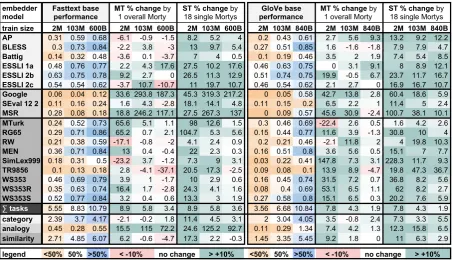
Σ (black row)9 – the sum of 18 tasks – by 8.9, 5.8 and 3.4 percent compared to Fasttext base. As corpus size increases, there is less space for MORTY to improve Σ scores. What is
inter-esting to note is that MORTY is able to recover analogy performance on 103M (to more than 2M level). This is also reflected in the Google and MSR analogy scores doubling and tripling (mid-dle column). On 2M we also see a modest im-provement (6.2) for similarity tasks, while classi-fication on 2M slightly dropped. Regarding GloVe (3 rightmost columns) we notice lower overall per-formance (black column), which is consistent with findings byLevy et al.(2015). MORTY on GloVe produces lower but more stable improvements for the MT setting (middle column), with analogy and similarity performance noticeably increasing for the small 2M dataset. Generally, we see both per-formance increases and drops for individual task, especially on 2M and Fasttext, indicating that, a single overall best MORTY specializes the base Fasttext embedding to better fit a specific subset of the 18 tasks, while still beating the base embed-dersf in overall score (Σ).
MORTYfor single-task application: In theST
% changecolumns we see best single task (ST)
results for task-specific optimal MORTY
embed-dings. Both embedders get consistent boosts, with Fasttext exhibiting significantly higher improve-ment from MORTYon 2M and 103M, despite
al-ready starting out at a higher base performance.
training corpus size (small, medium, common crawl)
sc
o
re
i
n
%
(
18
t
as
ks
)
100 102 104 106 108 110
600B
103M 103M 103M 103M 103M
2M 2M 2M 2M 2M
[image:3.595.306.529.542.634.2]FastText Morty run 1 Morty run 2 Morty run 3
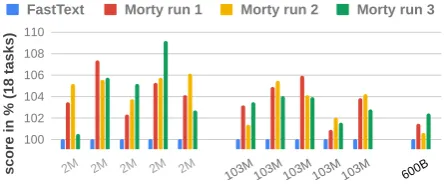
Figure 1: 1-epoch MORTY (MT %) performance change over Fasttext: Blue bars show Fasttext base-line performance (100%). 3 Morty runs: trained on Fasttext for1 epoch(2x5 Fasttext for corpus sizes 2M and 103M and 1x for 600B). Detailed description on next page.
9Note that, % change forΣis not the average of the
embedder model
Fasttext base performance
MT % change by 1 overall Morty
ST % change by 18 single Mortys
GloVe base performance
MT % change by 1 overall Morty
ST % change by 18 single Mortys
train size 2M 103M 600B 2M 103M 600B 2M 103M 600B 2M 103M 840B 2M 103M 840B 2M 103M 840B AP 0.31 0.59 0.68 -6.1 -0.9 -1.5 8.2 5.2 4 0.2 0.43 0.61 2.7 5.6 9.3 13.2 9.2 12.2 BLESS 0.3 0.73 0.84 -2.2 3.8 -3 13 9.7 5.4 0.27 0.51 0.85 1.6 -1.6 -1.8 7.9 7.9 4.7 Battig 0.14 0.32 0.48 -3.6 0.1 -3.7 7 4 0.5 0.1 0.19 0.46 3.5 2 1.9 7.4 5.4 8.5 ESSLI 1a 0.48 0.76 0.77 2.2 4.3 17.6 27.5 10.2 17.6 0.46 0.63 0.75 0 3.1 9.1 8 8.9 12.1 ESSLI 2b 0.63 0.75 0.78 9.2 2.7 0 26.5 11.3 12.9 0.51 0.74 0.75 19.9 -0.5 6.7 23.7 11.7 16.7 ESSLI 2c 0.54 0.54 0.62 -3.7 10.7 -10.7 11 19.7 10.7 0.46 0.54 0.62 2.1 2.7 0 16.9 16.7 10.7 Google 0.06 0.04 0.12 33.6 293.8 187.3 45.3 319.3 217.2 0 0.05 0.58 42.7 13.8 2.8 60.4 18.6 5.9 SEval 12 2 0.11 0.16 0.24 1.6 4.3 -2.8 18.1 14.1 4.8 0.11 0.15 0.2 6.5 2.2 1 11.4 5 2.4 MSR 0.28 0.08 0.18 18.8 246.2 117.1 27.5 267.3 137 0 0.09 0.57 45.6 30.9 -2.4 100.7 38.1 10.1 MTurk 0.24 0.52 0.73 65.6 5.1 1.1 98 12.6 1.5 0.3 0.46 0.69 -22.4 2.6 0.5 1.6 4.2 2.6 RG65 0.29 0.71 0.86 65.2 0.7 2.1 104.7 5.3 5.6 0.15 0.44 0.77 11.6 3.9 -1.3 30.8 10 4 RW 0.21 0.38 0.59 -17.1 -0.8 -2 4.1 2.4 0.9 0.2 0.21 0.46 -2.1 11.8 2 4 19.8 10.3 MEN 0.36 0.71 0.84 13 0.4 -0.4 22 2.3 0.3 0.16 0.51 0.8 3.6 5.6 0.5 15.1 7 7.7 SimLex999 0.18 0.31 0.5 -23.2 3.7 -1.2 7.3 9 3.1 0.03 0.22 0.41 147.8 7.3 3.1 228.3 11.7 9.3 TR9856 0.1 0.13 0.18 2.8 -4.1 -37.1 20.5 17.3 -2.5 0.09 0.08 0.1 13.9 8.9 -4.7 19.8 47.3 36.7 WS353 0.46 0.69 0.79 3.9 1 -1.7 10 2.9 0.6 0.16 0.45 0.74 31.5 7.2 0.7 36.8 8.2 5.6 WS353R 0.35 0.63 0.74 16.4 1.7 -2.8 24.3 4.1 1.6 0.08 0.4 0.69 53.1 6.5 1.1 62 8.2 2.7 WS353S 0.52 0.77 0.84 3.2 0.4 0.6 13.3 3 1.9 0.27 0.58 0.8 15.1 6.5 0.3 20.2 7.6 5.9
∑ tasks 5.55 8.83 10.79 8.9 5.8 3.4 8.9 5.8 3.6 3.56 6.68 10.84 7.8 4.3 1.9 7.8 4.3 1.9
category 2.39 3.7 4.17 -2.1 -0.2 1.8 11.4 4.5 3.1 2 3.04 4.05 3.5 -0.8 2.4 7.3 3.3 5.5 analogy 0.45 0.28 0.55 15.5 115 72.2 24.6 125.2 92.7 0.11 0.29 1.34 7.4 4.2 1.3 12.3 15.8 6.5 similarity 2.71 4.85 6.07 6.2 -0.6 -4.7 17.3 2.2 -0.3 1.45 3.35 5.45 9.2 1.8 0 11 6.3 2.9
[image:4.595.73.527.64.324.2]legend <50% 50% >50% < -10% no change > +10% <50% 50% >50% < -10% no change > +10%
Table 1: MORTYon Fasttext and GloVe: Above are scores for: 18 individual tasks (AP-WS353S), the sum of 18 scoresΣ, and scores grouped by semantic: similarity (AP-ESSLI2c), analogy (Google-MSR), classifica-tion (MTurk-WS253S).Left column: shows absolute scores of the original embedder. Middle column: shows % score change after fine-tuning with the MORTY that has the highest overall score Σ– i.e., 1 MORTY for all tasks (multi-task). Right column: shows % score change after applying 18 individually best MORTYs persingle-task– i.e., 18 MORTYs . Each column is further split by corpus size – 2M, 103M(illion) and 600/840B(illion) tokens. All scores are averages over 5 original embedder scores and respective MORTYchanges.
Applying the MORTY 1-epoch recipe So far, we saw MORTYs potential for overall (ST/MT/Σ) performance improvements, but will we observe the same in the wild? To answer this question for the MT use-case, we apply a 1-epoch train-ing only recipe. That is, we train 1-epoch us-ing a linear, complete autoencoder usus-ing half of the base embedders learning rate on three ran-domly initialized MORTYs, and then test them on the 18 task (MT) setup. Figure 1shows con-sistent MT/Σscore improvements for each of the 3 MORTY-over-Fasttext runs (red, yellow, green) on 2M, 103M, and 600B vs. base Fasttext (blue 100).
We see that, for practical application, this al-lows MORTY to boost supervised MT perfor-mance even without using a supervised develop-ment split or proxy task(s), while also eliminat-ing multi-epoch tuneliminat-ing. Both Figure1and Table1 show similar overall (MT) improvements per cor-pus size, which suggests that 1-epoch training is sufficient and that MORTY is especially benefi-cial on smaller corpora– i.e., in limited resource settings.
5 Related Work
There is a large body of work on informa-tion transfer between supervised and unsuper-vised tasks. First and foremost unsupervised-to-supervisedtransfer includes using embeddings for supervised tasks. However, transfer also works vice versa, in a supervised-to-unsupervised
setup to (learn to) specialize embeddings to better fit a specific supervised signal (Ruder and Plank, 2017;Ye et al.,2018). This includes injecting gen-erally relevant semantics via retrofitting or auxil-iary multi-task supervision (Faruqui et al., 2015; Kiela et al., 2018b). Supervised-to-supervised
methods provide knowledge transfer between su-pervised tasks which is exploited successively (Kirkpatrick et al., 2017), jointly (Kiela et al., 2018b) and in joint-succession (Hashimoto et al., 2017).
Bao(2018) proposemeta-embeddingsvia denois-ing autoencoders to merge diverse (Fasttext and GloVe) embeddings spaces. The later, is also a low-effort approach and closest to ours. How-ever, it focuses on embedding merging that they
tuned on a singlesemantic similarity task, while MORTY provides an overview of tuning for 19 different settings. Furthermore, MORTY requires only a single embedding space, which contributes to the literature by outlining that meta-embedding improvements may partly stem from re-encoding rather than only from semantic merging.
6 Conclusion
We demonstrated a low-effort, self-supervised,
learning scale-down method to construct task-optimizedword embeddings from existing ones to gain performance on a (set of) supervised end-task(s) without direct domain adaptation. De-spite its simplicity, MORTY is able to produce significant performance improvements for single
and multi-task supervision settings as well as for a variety of desirable word encoding proper-ties while forgoing building and tuning complex model architectures and labeling.10 Perhaps most importantly, MORTY shows considerable bene-fits for low-resource settings and thus provides a
learning-to-scale-downalternative to recent scale-upapproaches.
7 Acknowledgements
This work was supported by the German Fed-eral Ministry of Education and Research (BMBF) through the project DEEPLEE (01IW17001) and by the European Unions Horizon 2020 research and innovation programme under grant agree-ment No 780495 (BigMedilytics). We also thank Philippe Thomas and Isabelle Augenstein for helpful discussions.
References
Piotr Bojanowski, Edouard Grave, Armand Joulin, and Tomas Mikolov. 2016. Enriching word vectors with subword information.CoRR, abs/1607.04606.
Danushka Bollegala and Cong Bao. 2018. Learning word meta-embeddings by autoencoding. In Pro-ceedings of the 27th International Conference on Computational Linguistics, pages 1650–1661. Asso-ciation for Computational Linguistics.
10Source code at https://github.com/
NilsRethmeier/MoRTy
Alexis Conneau, Germ´an Kruszewski, Guillaume Lample, Lo¨ıc Barrault, and Marco” Baroni. 2018.
What you can cram into a single $&!#* vector: Probing sentence embeddings for linguistic proper-ties. InProceedings of the 56th Annual Meeting of the Association for Computational Linguistics (Vol-ume 1: Long Papers), pages 2126–2136. Associa-tion for ComputaAssocia-tional Linguistics.
Jacob Devlin, Ming-Wei Chang, Kenton Lee, and Kristina Toutanova. 2018. Bert: Pre-training of deep bidirectional transformers for language understand-ing.arXiv preprint arXiv:1810.04805.
Nicholas Dingwall and Christopher Potts. 2018. Mit-tens: an extension of glove for learning domain-specialized representations. InProceedings of the 2018 Conference of the North American Chapter of the Association for Computational Linguistics: Human Language Technologies, Volume 2 (Short Papers), pages 212–217. Association for Computa-tional Linguistics.
Manaal Faruqui, Jesse Dodge, Sujay Kumar Jauhar, Chris Dyer, Eduard Hovy, and Noah A Smith. 2015.
Retrofitting word vectors to semantic lexicons. In Proceedings of the 2015 Conference of the North American Chapter of the Association for Compu-tational Linguistics: Human Language Technolo-gies, pages 1606–1615. Association for Computa-tional Linguistics.
Kazuma Hashimoto, caiming xiong, Yoshimasa Tsu-ruoka, and Richard Socher. 2017. A joint many-task model: Growing a neural network for multiple nlp tasks. InProceedings of the 2017 Conference on Empirical Methods in Natural Language Pro-cessing, pages 1923–1933. Association for Compu-tational Linguistics.
Stanislaw Jastrzebski, Damian Lesniak, and Woj-ciech Marian Czarnecki. 2017. How to evalu-ate word embeddings? on importance of data efficiency and simple supervised tasks. CoRR, abs/1702.02170.
Douwe Kiela, Changhan Wang, and Kyunghyun Cho. 2018a. Context-attentive embeddings for improved sentence representations.CoRR, abs/1804.07983.
Douwe Kiela, Changhan Wang, and Kyunghyun Cho. 2018b. Dynamic meta-embeddings for improved sentence representations. In Proceedings of the 2018 Conference on Empirical Methods in Natural Language Processing, pages 1466–1477. Associa-tion for ComputaAssocia-tional Linguistics.
Omer Levy and Yoav Goldberg. 2014.Linguistic regu-larities in sparse and explicit word representations. In Proceedings of the Eighteenth Conference on Computational Natural Language Learning, pages 171–180. Association for Computational Linguis-tics.
Omer Levy, Yoav Goldberg, and Ido Dagan. 2015. Im-proving distributional similarity with lessons learned from word embeddings.Transactions of the Associ-ation for ComputAssoci-ational Linguistics, 3:211–225.
Stephen Merity, Caiming Xiong, James Bradbury, and Richard Socher. 2016. Pointer sentinel mixture models.CoRR, abs/1609.07843.
Jeffrey Pennington, Richard Socher, and Christopher Manning. 2014. Glove: Global vectors for word representation. In Proceedings of the 2014 Con-ference on Empirical Methods in Natural Language Processing (EMNLP), pages 1532–1543. Associa-tion for ComputaAssocia-tional Linguistics.
Christian S. Perone, Roberto Silveira, and Thomas S. Paula. 2018. Evaluation of sentence embeddings in downstream and linguistic probing tasks.
Matthew E. Peters, Mark Neumann, Mohit Iyyer, Matt Gardner, Christopher Clark, Kenton Lee, and Luke Zettlemoyer. 2018. Deep contextualized word rep-resentations.CoRR, abs/1802.05365.
Marc’ Aurelio Ranzato, Y-Lan Boureau, and Yann Le-Cun. 2007. Sparse feature learning for deep belief networks. InProceedings of the 20th International Conference on Neural Information Processing Sys-tems, NIPS’07, pages 1185–1192, USA. Curran As-sociates Inc.
Sebastian Ruder and Barbara Plank. 2017.Learning to select data for transfer learning with bayesian opti-mization. InProceedings of the 2017 Conference on Empirical Methods in Natural Language Process-ing, pages 372–382. Association for Computational Linguistics.
Emma Strubell, Ananya Ganesh, and Andrew McCal-lum. 2019. Energy and policy considerations for deep learning in nlp. InProceedings of ACL 2019, Florence, Italy, July 28 - August 2, 2019. Associa-tion for ComputaAssocia-tional Linguistics.
Anant Subramanian, Danish Pruthi, Harsh Jhamtani, Taylor Berg-Kirkpatrick, and Eduard Hovy. 2018.
Spine: Sparse interpretable neural embeddings. In Thirty-Second AAAI Conference on Artificial Intelli-gence.
Shufeng Xiong, Hailian Lv, Weiting Zhao, and Donghong Ji. 2018. Towards twitter sentiment clas-sification by multi-level sentiment-enriched word embeddings.Neurocomputing, 275:2459–2466.
Zhe Ye, Fang Li, and Timothy Baldwin. 2018. En-coding sentiment information into word vectors for