Understanding MOOC Discussion Forums using Seeded LDA
1Arti Ramesh,1Dan Goldwasser,1Bert Huang,1Hal Daum´e III,2Lise Getoor 1University of Maryland, College Park 2University of California, Santa Cruz
{artir, bert, hal}@cs.umd.edu, [email protected], [email protected]
Abstract
Discussion forums serve as a platform for student discussions in massive open online courses (MOOCs). Analyzing content in these forums can uncover useful informa-tion for improving student reteninforma-tion and help in initiating instructor intervention. In this work, we explore the use of topic models, particularly seeded topic models
toward this goal. We demonstrate that fea-tures derived from topic analysis help in predictingstudent survival.
1 Introduction
This paper highlights the importance of under-standing MOOC discussion forum content, and shows that capturing discussion forum content can help uncover students’ intentions and motiva-tion and provide useful informamotiva-tion in predicting course completion.
MOOC discussion forums provide a platform for exchange of ideas, course administration and logistics questions, reporting errors in lectures, and discussion about course material. Unlike classroom settings, where there is face-to-face in-teraction between the instructor and the students and among the students, MOOC forums are the primary means of interaction in MOOCs. How-ever, due to the large number of students and the large volume of posts generated by them, MOOC forums are not monitored completely. Forums can include student posts expressing difficulties in course-work, grading errors, dissatisfaction in the course, which are possible precursors to students dropping out.
Previous work analyzing discussion forum con-tent tried manually labeling posts by categories of interest (Stump et al., 2013). Unfortunately, the effort involved in manually annotating the large amounts of posts prevents using such solutions on
a large scale. Instead, we suggest using natural language processing tools for identifying relevant aspects of forum content automatically. Specifi-cally, we exploreSeededLDA(Jagarlamudi et al., 2012), a recent extension of topic models which can utilize a lexical seed set to bias the topics ac-cording to relevant domain knowledge.
Exploring data from three MOOCs, we find that forum posts usually belong to these three categories—a) course content, which include dis-cussions about course material (COURSE), b)
meta-level discussions about the course, including feedback and course logistics (LOGISTICS), and c)
other general discussions, which include student introductions, discussions about online courses
(GENERAL). In order to capture these categories
automatically we provide seed words for each cat-egory. For example, we extract seed words for
the COURSE topic from each course’s syllabus.
In addition to the automatic topic assignment, we capture the sentiment polarity usingOpinionfinder
(Wilson et al., 2005). We use features derived from topic assignments and sentiment to predict student course completion(student survival). We measure course completion by examining if the student attempted the final exam/ last few assign-ments in the course. We follow the observation
thatLOGISTICS posts contain feedback about the
course. Finding high-confidenceLOGISTICSposts
can give a better understanding of student opinion about the course. Similarly, posting in COURSE
topic and receiving good feedback (i.e., votes) is an indicator of student success and might con-tribute to survival. We show that modeling these intuitions using topic assignments together with sentiment scores, helps in predicting student sur-vival. In addition, we examine the topic assign-ment and sentiassign-ment patterns of some users and show that topic assignments help in understanding student concerns better.
2 Modeling Student Survival
Our work builds on work by Ramesh et al. (2013) and (2014) on modeling student survival using Probabilistic Soft Logic (PSL). The authors in-cluded behavioral features, such as lecture views, posting/voting/viewing discussion forum content, linguistic features, such as sentiment and subjec-tivity of posts, and social interaction features de-rived from forum interaction. The authors looked at indication of sentiment without modeling the context in which the sentiment was expressed: positive sentiment implying survival and negative sentiment implying drop-out. In this work, we tackle this problem by adding topics, enabling rea-soning about specific types of posts. While senti-ment of posts can indicate general dissatisfaction, we expect this to be more pronounced in LOGIS -TICSposts as posts in this category correspond to
issues and feedback about the course. In contrast, sentiment in posts about course material may sig-nal a particular topic of discussion in a course and may not indicate attitude of the student toward the course. In Section 4.3, we show some examples of course-related posts and their sentiment, and we illustrate that they are not suggestive of student survival. For example, in Women and the Civil Rights Movement course, the post—“I think our values are shaped by past generations in our fam-ily as well, sometimes negatively.”—indicates an attitude towards an issue discussed as part of the course. Hence, identifying posts that fall under
LOGISTICS can improve the value of sentiment in
posts. In Section 3, we show how these are trans-lated into rules in our model.
2.1 Probabilistic Soft Logic
We briefly overview the some technical details be-hind Probabilistic Soft Logic (PSL). For brevity, we omit many specifics, and we refer the reader to (Broecheler et al., 2010; Bach et al., 2013) for more details. PSL is a framework for collec-tive, probabilistic reasoning in relational domains. Like other statistical relational learning methods (Getoor and Taskar, 2007), PSL uses weighted rules to model dependencies in a domain. How-ever, one distinguishing aspect is that PSL uses continuous variables to represent truth values, re-laxing Boolean truth values to the interval [0,1]. Table 1 lists some PSL rules from our model. The predicate posts captures the relationship be-tween a post and the user who posted it. Predicate
polarity(P)represents sentiment via its truth value in [0,1], where 1.0 signifies positive sentiment, and 0.0 signifies negative sentiment. upvote(P)is 1.0 if the post has positive feedback and 0.0 if the post had negative or no feedback.UandPrefer to
userandpostrespectively. These features can be combined to produce rules in Table 1. For exam-ple, the first rule captures the idea that posts with positive sentiment imply student survival.
• posts(U, P)∧polarity(P)→survival(U) • posts(U, P)∧ ¬polarity(P)→ ¬survival(U) • posts(U, P)∧upvote(P)→survival(U)
Table 1: Example rules in PSL
3 Enhancing Student Survival Models with Topic Modeling
Discussion forums in online courses are organized into threads to facilitate grouping of posts into top-ics. For example, a thread titled errata, grading issuesis likely a place for discussing course logis-tics and a thread titledweek 1, lecture 1is likely a place for discussing course content. But a more precise examination of such threads reveals that these heuristics do not always hold. We have ob-served thatcourse contentthreads often house lo-gistic content and vice-versa. This demands the necessity of using computational linguistics meth-ods to classify the content in discussion forums.
In this work, we—1) use topic models to map posts to topics in an unsupervised way, and 2) employ background knowledge from the course syllabus and manual inspection of discussion fo-rum posts to seed topic models to get better sep-arated topics. We use data from three Cours-era MOOCs: Surviving Disruptive Technologies,
Women and the Civil Rights Movement, andGene and the Human Conditionfor our analysis. In dis-cussion below, we refer to these courses asDISR
-TECH,WOMEN, andGENE, respectively.
3.1 Latent Dirichlet Allocation
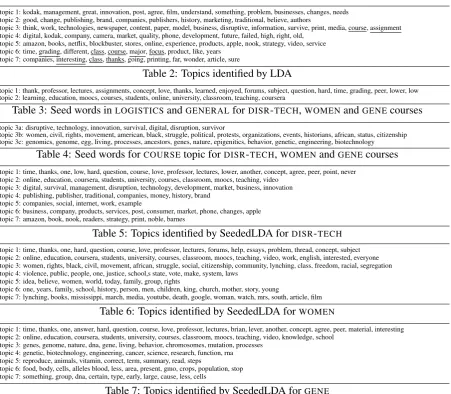
Table 2 gives the topics given bylatent Dirichlet allocation(LDA) on discussion forum posts. The words that are likely to fall under LOGISTICSare
underlined in the table. It can be observed that these words are spread across more than one topic. Since we are especially interested in posts that are
on LOGISTICS, we use SeededLDA (Jagarlamudi
et al., 2012), which allows one to specify seed
topic 1: kodak, management, great, innovation, post, agree, film, understand, something, problem, businesses, changes, needs topic 2: good, change, publishing, brand, companies, publishers, history, marketing, traditional, believe, authors
topic 3: think, work, technologies, newspaper, content, paper, model, business, disruptive, information, survive, print, media, course, assignment topic 4: digital, kodak, company, camera, market, quality, phone, development, future, failed, high, right, old,
topic 5: amazon, books, netflix, blockbuster, stores, online, experience, products, apple, nook, strategy, video, service topic 6: time, grading, different, class, course, major, focus, product, like, years
[image:3.595.81.533.66.460.2]topic 7: companies, interesting, class, thanks, going, printing, far, wonder, article, sure
Table 2: Topics identified by LDA
topic 1: thank, professor, lectures, assignments, concept, love, thanks, learned, enjoyed, forums, subject, question, hard, time, grading, peer, lower, low topic 2: learning, education, moocs, courses, students, online, university, classroom, teaching, coursera
Table 3: Seed words inLOGISTICSandGENERALforDISR-TECH,WOMENandGENEcourses
topic 3a: disruptive, technology, innovation, survival, digital, disruption, survivor
topic 3b: women, civil, rights, movement, american, black, struggle, political, protests, organizations, events, historians, african, status, citizenship topic 3c: genomics, genome, egg, living, processes, ancestors, genes, nature, epigenitics, behavior, genetic, engineering, biotechnology
Table 4: Seed words forCOURSEtopic forDISR-TECH,WOMENandGENEcourses
topic 1: time, thanks, one, low, hard, question, course, love, professor, lectures, lower, another, concept, agree, peer, point, never topic 2: online, education, coursera, students, university, courses, classroom, moocs, teaching, video
topic 3: digital, survival, management, disruption, technology, development, market, business, innovation topic 4: publishing, publisher, traditional, companies, money, history, brand
topic 5: companies, social, internet, work, example
topic 6: business, company, products, services, post, consumer, market, phone, changes, apple topic 7: amazon, book, nook, readers, strategy, print, noble, barnes
Table 5: Topics identified by SeededLDA forDISR-TECH
topic 1: time, thanks, one, hard, question, course, love, professor, lectures, forums, help, essays, problem, thread, concept, subject topic 2: online, education, coursera, students, university, courses, classroom, moocs, teaching, video, work, english, interested, everyone topic 3: women, rights, black, civil, movement, african, struggle, social, citizenship, community, lynching, class, freedom, racial, segregation topic 4: violence, public, people, one, justice, school,s state, vote, make, system, laws
topic 5: idea, believe, women, world, today, family, group, rights
topic 6: one, years, family, school, history, person, men, children, king, church, mother, story, young
topic 7: lynching, books, mississippi, march, media, youtube, death, google, woman, watch, mrs, south, article, film
Table 6: Topics identified by SeededLDA forWOMEN
topic 1: time, thanks, one, answer, hard, question, course, love, professor, lectures, brian, lever, another, concept, agree, peer, material, interesting topic 2: online, education, coursera, students, university, courses, classroom, moocs, teaching, video, knowledge, school
topic 3: genes, genome, nature, dna, gene, living, behavior, chromosomes, mutation, processes topic 4: genetic, biotechnology, engineering, cancer, science, research, function, rna topic 5: reproduce, animals, vitamin, correct, term, summary, read, steps
topic 6: food, body, cells, alleles blood, less, area, present, gmo, crops, population, stop topic 7: something, group, dna, certain, type, early, large, cause, less, cells
Table 7: Topics identified by SeededLDA forGENE
3.2 Seeded LDA
We experiment by providing seed words for top-ics that fall into the three categories. The seed words for the three courses are listed in tables 3 and 4. The seed words for LOGISTICS andGEN -ERAL are common across all the three courses.
The seed words for theCOURSEtopic are chosen
from the course-syllabus of the courses. This con-struction of seed words enables the model to be applied to new courses easily. Topics3a,3b, and
3cdenote the course specific seed words forDISR
-TECH, WOMEN, and GENE courses respectively.
Since the syllabus is only an outline of the class, it does not contain all the terms that will be used in class discussions. To capture other finer course content discussions as separate topics, we include
kmore topics when we run the SeededLDA. We notice that not including more topics here, only including the seeded topics (i.e., run SeededLDA with exactly three topics) results in some words
from course content discussions, which were not specified in the course-seed words, appearing in
the LOGISTICS or GENERAL topics. Thus, thek
extra topics help representCOURSEtopics that do
not directly correspond to the course seeds. Note that these extratopics are not seeded. We exper-imented with different values of kon our exper-iments and found by manual inspection that the topic-terms produced by our model were well sep-arated fork = 3. Thus, we runSeededLDAwith 7 total topics. Tables 5, 6, and 7 give the top-ics identified for DISR-TECH, WOMENand GENE
bySeededLDA. The topic assignments so obtained are used as input features to the PSL model—the predicate for the first topic isLOGISTICS, the
sec-ond one isGENERALand the rest are summed up
to get the topic assignment forCOURSE.
3.3 Using topic assignments in PSL
We construct two models—a)DIRECT model,
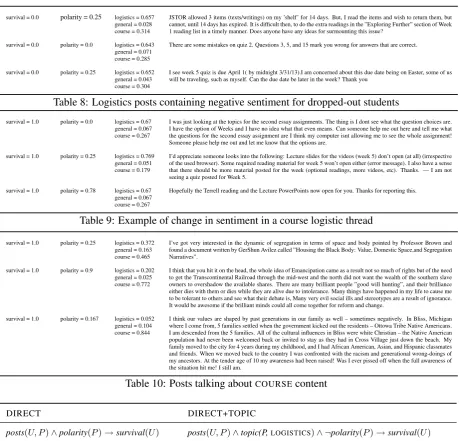
survival = 0.0 polarity = 0.25 logistics = 0.657 general = 0.028 course = 0.314
JSTOR allowed 3 items (texts/writings) on my ’shelf’ for 14 days. But, I read the items and wish to return them, but cannot, until 14 days has expired. It is difficult then, to do the extra readings in the ”Exploring Further” section of Week 1 reading list in a timely manner. Does anyone have any ideas for surmounting this issue?
survival = 0.0 polarity = 0.0 logistics = 0.643 general = 0.071 course = 0.285
There are some mistakes on quiz 2. Questions 3, 5, and 15 mark you wrong for answers that are correct.
survival = 0.0 polarity = 0.25 logistics = 0.652 general = 0.043 course = 0.304
[image:4.595.72.532.57.498.2]I see week 5 quiz is due April 1( by midnight 3/31/13).I am concerned about this due date being on Easter, some of us will be traveling, such as myself. Can the due date be later in the week? Thank you
Table 8: Logistics posts containing negative sentiment for dropped-out students survival = 1.0 polarity = 0.0 logistics = 0.67
general = 0.067 course = 0.267
I was just looking at the topics for the second essay assignments. The thing is I dont see what the question choices are. I have the option of Weeks and I have no idea what that even means. Can someone help me out here and tell me what the questions for the second essay assignment are I think my computer isnt allowing me to see the whole assignment! Someone please help me out and let me know that the options are.
survival = 1.0 polarity = 0.25 logistics = 0.769 general = 0.051 course = 0.179
I’d appreciate someone looks into the following: Lecture slides for the videos (week 5) don’t open (at all) (irrespective of the used browser). Some required reading material for week 5 won’t open either (error message). I also have a sense that there should be more material posted for the week (optional readings, more videos, etc). Thanks. — I am not seeing a quiz posted for Week 5.
survival = 1.0 polarity = 0.78 logistics = 0.67 general = 0.067 course = 0.267
Hopefully the Terrell reading and the Lecture PowerPoints now open for you. Thanks for reporting this.
Table 9: Example of change in sentiment in a course logistic thread
survival = 1.0 polarity = 0.25 logistics = 0.372 general = 0.163 course = 0.465
I’ve got very interested in the dynamic of segregation in terms of space and body pointed by Professor Brown and found a document written by GerShun Avilez called ”Housing the Black Body: Value, Domestic Space,and Segregation Narratives”.
survival = 1.0 polarity = 0.9 logistics = 0.202 general = 0.025 course = 0.772
I think that you hit it on the head, the whole idea of Emancipation came as a result not so much of rights but of the need to get the Transcontinental Railroad through the mid-west and the north did not want the wealth of the southern slave owners to overshadow the available shares. There are many brilliant people ”good will hunting”, and their brilliance either dies with them or dies while they are alive due to intolerance. Many things have happened in my life to cause me to be tolerant to others and see what their debate is, Many very evil social ills and stereotypes are a result of ignorance. It would be awesome if the brilliant minds could all come together for reform and change.
survival = 1.0 polarity = 0.167 logistics = 0.052 general = 0.104 course = 0.844
I think our values are shaped by past generations in our family as well – sometimes negatively. In Bliss, Michigan where I come from, 5 families settled when the government kicked out the residents – Ottowa Tribe Native Americans. I am descended from the 5 families. All of the cultural influences in Bliss were white Christian – the Native American population had never been welcomed back or invited to stay as they had in Cross Village just down the beach. My family moved to the city for 4 years during my childhood, and I had African American, Asian, and Hispanic classmates and friends. When we moved back to the country I was confronted with the racism and generational wrong-doings of my ancestors. At the tender age of 10 my awareness had been raised! Was I ever pissed off when the full awareness of the situation hit me! I still am.
Table 10: Posts talking aboutCOURSEcontent
DIRECT DIRECT+TOPIC
posts(U, P)∧polarity(P)→survival(U) posts(U, P)∧topic(P,LOGISTICS)∧ ¬polarity(P)→survival(U)
posts(U, P)∧ ¬polarity(P)→ ¬survival(U) posts(U, P)∧topic(P,LOGISTICS)∧ ¬polarity(P)→survival(U)
posts(U, P)→survival(U) posts(U, P)∧topic(P,GENERAL)→ ¬survival(U)
posts(U, P)∧upvote(P)→survival(U) posts(U, P)∧topic(P,COURSE)∧upvote(P)→survival(U)
posts(U1, P)∧posts(U2, P)∧ topic(P,COURSE)∧ survival(U1) → survival(U2)
Table 11: Rules modified to include topic features
modeling, and b) DIRECT+TOPIC model,
includ-ing the topic assignments as features in the model.
Our DIRECT model is borrowed from Ramesh
(2014). We refer the reader to (Ramesh et al., 2013) and (Ramesh et al., 2014) for a complete list of features and rules in this model.
Table 11 contains examples of rules in the DI -RECT model and the corresponding rules
includ-ing topic assignments in DIRECT+TOPIC model.
The first and second rules containing polarity are changed to include LOGISTICS topic feature,
fol-lowing our observation that polarity matters in
meta-courseposts. While the DIRECT model
re-gards posting in forums as an indication of sur-vival, in the DIRECT+TOPIC model, this rule is
changed to capture that students that post a lot of
generalstuffonlyon the forums do not necessar-ily participate in course-related discussions. The fourth rule containingupvotepredicate, which sig-nifies posts that received positive feedback in the form of votes, is changed to include the topic-feature COURSE. This captures the significance
of posting course-related content that gets posi-tive feedback as opposed to logistics or general
of positive votes (upvote), but do not necessarily indicate student survival. For example, some in-troduction threads have a lot of positive votes, but do not necessarily signify student survival. 4 Empirical Evaluation
We conducted experiments to answer the follow-ing question—how much do the topic assignments from SeededLDA help in predicting student sur-vival? We also perform a qualitative analysis of topic assignments, the sentiment of posts, and their correspondence with student survival.
COURSE MODEL AUC-PR
POS. AUC-PRNEG. AUC-ROC
DISR-TECH DIRECTDIRECT+TOPIC 0.7640.794 0.6280.638 0.6880.708
WOMEN DIRECTDIRECT+TOPIC 0.6540.674 0.8990.900 0.8200.834
GENE DIRECTDIRECT+TOPIC 0.8740.894 0.7800.791 0.8600.873
Table 12: Performance of DIRECT and DI
-RECT+TOPIC models in predicting student
sur-vival. Statistically significant scores typed in bold.
4.1 Datasets and Experimental Setup
We evaluate our models on three Coursera MOOCs:DISR-TECH,WOMEN-CIVIL, andGENE,
respectively. Our data consists of anonymized stu-dent records, grades, and online behavior recorded during the seven week duration of each course. We label students assurvival = 1.0if they take the fi-nal exam/quiz and survival = 0.0 otherwise. In our experiments, we only consider students that completed at leastonequiz/assignment. We eval-uate our models using area under precision-recall curve for positive and negativesurvivallabels and area under ROC curve. We use ten-fold cross-validation on each of the courses, leaving out 10% of users for testing and revealing the rest of the users for training the model weights. We evaluate statistical significance using a paired t-test with a rejection threshold of0.05.
4.2 Survival Prediction using topic features
Table 12 shows the prediction performance of the
DIRECT and DIRECT+TOPIC model. The
inclu-sion of the topic-features improves student sur-vival prediction in all the three courses.
4.3 Discussion topic analysis using topic features
Table 8 shows some posts by users that did not survive the class. All these posts have negative
sentiment scores by Opinionfinderand belong to
LOGISTICS. Also, in the forum, all these posts
were not answered. This suggests that students might drop out if their course-logisticsquestions are not answered. Table 9 gives examples of stu-dent posts that also have a negative sentiment. But the sentiment of the thread changes when the issue is resolved (last row in the table). We observe that these two students survive the course and a timely answer to their posts might have been a reason in-fluencing these students to complete the course.
Tables 8 and 9 show how student survival may depend on forum interaction and responses they receive. Our approach can help discover potential points of contention in the forums, identifying po-tential drop outs that can be avoided by interven-tion.
Table 10 shows posts flagged asCOURSEby the
SeededLDA. The polarity scores in the COURSE
posts indicate opinions and attitude toward course specific material. For example, post #3 in Table 10 indicates opinion towards human rights. While the post’s polarity is negative, it is clear that this po-larity value is not directed at the course and should not be used to predict student survival. In fact, all these users survive the course. We find that par-ticipation in course related discussion is a sign of survival. These examples demonstrate that analy-sis onCOURSEposts can mislead survival and
jus-tify our using topic predictions to focus sentiment analysis onLOGISTICSposts.
5 Discussion
References
Stephen H. Bach, Bert Huang, Ben London, and Lise Getoor. 2013. Hinge-loss Markov random fields: Convex infer-ence for structured prediction. InUncertainty in Artificial Intelligence.
Matthias Broecheler, Lilyana Mihalkova, and Lise Getoor. 2010. Probabilistic similarity logic. InUncertainty in Ar-tificial Intelligence (UAI).
Lise Getoor and Ben Taskar. 2007.Introduction to Statistical Relational Learning (Adaptive Computation and Machine Learning). The MIT Press.
Jagadeesh Jagarlamudi, Hal Daum´e, III, and Raghavendra Udupa. 2012. Incorporating lexical priors into topic
models. In Proceedings of the 13th Conference of the
European Chapter of the Association for Computational Linguistics, EACL ’12, pages 204–213, Stroudsburg, PA, USA. Association for Computational Linguistics.
Angelika Kimmig, Stephen H. Bach, Matthias Broecheler, Bert Huang, and Lise Getoor. 2012. A short introduction to probabilistic soft logic. InNIPS Workshop on Proba-bilistic Programming: Foundations and Applications. Arti Ramesh, Dan Goldwasser, Bert Huang, Hal Daume III,
and Lise Getoor. 2013. Modeling learner engagement in
MOOCs using probabilistic soft logic. InNIPS Workshop
on Data Driven Education.