Predicting Machine Translation Adequacy
with Document Embeddings
Mihaela Vela Saarland University Saarbr¨ucken, Germany
Liling Tan Saarland University Saarbr¨ucken, Germany
Abstract
This paper describes USAAR’s submis-sion to the themetrics shared taskof the Workshop on Statistical Machine Transla-tion (WMT) in 2015. The goal of our sub-mission is to take advantage of the seman-tic overlap between hypothesis and ref-erence translation for predicting MT out-put adequacy using language independent document embeddings. The approach pre-sented here is learning a Bayesian Ridge Regressor using document skip-gram em-beddings in order to automatically evalu-ate Machine Translation (MT) output by predicting semantic adequacy scores. The evaluation of our submission – measured by the correlation with human judgements – shows promising results on system-level scores.
1 Introduction
Translation is becoming an utility in everyday life. The increased availability of real-time machine translation services relying on Statistical Machine Translation (SMT) allows users who do not un-derstand the language of the source text to quickly gist the text and understand its general meaning. For these users, accurate meaning of translated words is more important than the fluency of the translated sentence.
However, SMT suffers from poor lexical choices. Fluent but inadequate translations are commonly produced due to the strong bias to-wards the language model component that prefers consecutive words based on the data that the sys-tem is trained on.
Current state of art MT evaluation metrics are generally able to identify problems with grammat-icality of the translation but less evidently accu-racy of translated semantics, e.g. incorrect trans-lation of ambiguous words or wrong assignment
of semantic roles. In the example below, the ideal Machine Translation (MT) evaluation metric should appropriately penalise poor lexical choice, such as braked, and reward or at least allow lee-way for semantically similar translations, such as external trade.
Source (DE):
Auch der Auenhandel bremste die Konjunktur. Phrase-based MT:
The foreign trade braked the economy. Neural MT:
External trade also slowed the economy. Reference (EN):
Foreign goods trade had slowed, too.
The German word bremste is commonly used asbrakedin the context of driving, but the appro-priate translation should have beenslowed in the example mentioned above. Although the phrase external tradediffers fromforeign goods trade in the reference sentence, it should be considered as an acceptable translation.
We propose a semantically grounded, language independent approach using Semantic Textual Similarity (STS) to evaluate the adequacy of the machine translation outputs with respect to their reference translations.
The remainder of this paper is structured as fol-lows. Section 2 gives an overview of the related work in the field of MT evaluation. Section 3 presents the approach behind the USAAR submis-sion to the metrics shared task. In Section 4 we present the data and experiments for this submis-sion. Section 5 covers the evaluation of our metric by the WMT2015 metrics task organisers and in Section 6 we conclude on our WMT2015 metrics task submission.
2 Related Work
Researchers in the field of MT evaluation have proposed a large variety of methods for assess-ing the quality of automatically produced trans-lations. Approaches range from fully automatic quality scoring to efforts aimed at the development of ”human” evaluation scores that try to exploit the (often tacit) linguistic knowledge of human evalu-ators.
2.1 Automatic Evaluation of MT
MT output is usually evaluated by automatic language-independent metrics that can be applied to MT output, independent of the target language. Automatic metrics typically compute the close-ness (adequacy) of a hypothesis to a reference translation and differ from each other by how this closeness is measured. The most popular MT eval-uation metrics are IBM BLEU (Papineni et al., 2002) and NIST (Doddington, 2002), used not only for tuning MT systems, but also as evalua-tion metrics for translaevalua-tion shared tasks, such as the Workshop on Statistical Machine Translation (WMT).
IBM BLEU uses n-gram precision by match-ing machine translation output against one or more reference translations. It accounts for adequacy and fluency by calculating word precision, i.e. the n-gram precision.
BLEU =BP·exp XN
n=1
wnlogpn !
(1)
BP =
(
1 ifc > r
−e(1−r/c) ifc≤r (2)
In order to deal with the over generation of com-mon words, precision counts are clipped, mean-ing that a reference word is exhausted after it is matched against the same word in the hypothesis. This is then called the modified n-gram precision. For BLEU, the modified n-gram precision is calcu-lated with N=4, the results being combined by us-ing the geometric mean. Instead of recall, BLEU computes the Brevity Penalty (BP) (see formula in 2), thus penalising candidate translations which are shorter than the reference translations.
The NIST metric is derived from IBM BLEU. The NIST score is the arithmetic mean of modified n-gram precision for N=5 scaled by the BP. Addi-tionally, NIST also considers the information gain
of each n-gram, giving more weight to more infor-mative (less frequent) n-grams and less weight to less informative (more frequent) n-grams.
Another often used machine translation evalu-ation metric is METEOR (Denkowski and Lavie, 2014). Unlike IBM BLEU and NIST, METEOR evaluates a candidate translation by calculating precision and recall on the unigram level and com-bining them into a parametrised harmonic mean. The result from the harmonic mean is then scaled by a fragmentation penalty which penalizes gaps and differences in word order. METEOR is de-scribed in detail in Section 3.1.
Besides these evaluation metrics, several other metrics are used for the evaluation of MT out-put. Some of these are the WER (word error-rate) metric based on the Levensthein distance (Leven-shtein, 1966), the position-independent error rate metric PER (Tillmann et al., 1997) and the trans-lation edit rate metric TER (Snover et al., 2006) with its newer version TERp (Snover et al., 2009). The semantics of both hypotheses and reference translations is considered by MEANT (Lo et al., 2012). MEANT, based on HMEANT (Lo and Wu, 2011a; Lo and Wu, 2011b; Lo and Wu, 2011c), is a fully automatic semantic MT evaluation metric, measuring semantic fidelity by determining the degree of parallelism of verb frames and seman-tic roles between hypothesis and reference trans-lations. Some approaches aim at combining sev-eral linguistic and semantic aspects. Gonz`alez et al. (2014) as well as Comelles and Atserias (2014) introduce their fully automatic approaches to ma-chine translation evaluation using lexical, syntac-tic and semansyntac-tic information when comparing the machine translation output with reference transla-tions.
2.2 Human Evaluation of MT
Adequacy judgements require annotators to rate the amount of meaning expressed in the reference translation that is also present in the translation hy-pothesis. Fluency judgements require annotators to rate how well the translation hypothesis in the target language is formed, disregarding the sen-tence meaning. Although evaluators are asked to assess the fluency and adequacy of a hypothesis translation on a Likert scale separately, Callison-Burch et al. (2007) reported high correlation be-tween annotators’ adequacy and fluency scores.
MT output is also evaluated by measuring hu-man post-editing time for productivity (Guerberof, 2009; Zampieri and Vela, 2014), or by asking eval-uators to rank MT system outputs (by ordering a set of translation hypotheses according to their quality). Vela and van Genabith (2015) show that this task is very easy to accomplish for evaluators, since it does not imply specific skills, a homoge-neous group being enough to perform this task. This is also the method applied during the last years WMTs, where humans are asked to rank ma-chine translation output by using APPRAISE (Fe-dermann, 2012), a software tool that integrates fa-cilities for such a ranking task.
An indirect human evaluation method, that is also employed for error analysis, are reading com-prehension tests (e.g. Maney et al. (2012), Weiss and Ahrenberg (2012)). Other evaluation metrics try to measure the effort that is necessary for “re-pairing” MT output, that is, for transforming it into a linguistically correct and faithful transla-tion. One such metric is HTER (Snover et al., 2006), which uses human annotators to generate targeted reference translations by means of post-editing, the rationale being that by this the shortest path between a hypothesis and its correct version can be found.
2.3 Semantic Textual Similarity
Given two snippets of text, the Semantic Textual Similarity (STS) task attempts to measure their se-mantic equivalence on a scale of 1 to 5 (Agirre et al., 2014). The STS task is organized annually dur-ing the SemEval workshop and systems are evalu-ated based on their Pearson correlation coefficient with the human annotations.
The STS is similar to the task of determining the adequacy of a translation hypothesis with re-spect to a reference translation. The STS task is usually treated as a regression task where systems
are trained using features such as:
(i) linguistics annotation overlaps between the two text snippets, e.g. syntactic dependency, lexical paraphrases, part of speech (ˇSari´c et al., 2012; Han et al., 2012; Pilehvar et al., 2013)
(ii) machine translation metrics as features in training a supervised regressor (Rios et al., 2012; Barr´on-Cede˜no et al., 2013; Huang and Chang, 2014; Tan et al., 2015b)
(iii) word/document embeddings similarity (Sul-tan et al., 2015; Arora et al., 2015).
Linguistic annotations are restricted by the availability of the annotation tools, that are often language dependent. Machine translation evalua-tion metrics generally provide a shallow compari-son between hypotheses and reference translations focusing on capturing the grammatical similari-ties between the texts, whereas the use of docu-ment embeddings focuses on capturing the seman-tic similarity between texts. Word embeddings dates back to the traditional Latent Semantic Anal-ysis (LSA) vector spaces used for information re-trieval (Landauer and Dutnais, 1997) to the current trend of using neural nets for NLP/MT tasks (Bor-des et al., 2011; Huang et al., 2012; Bor(Bor-des et al., 2012; Chen and Manning, 2014; Bowman et al., 2015).
3 Our Approach
Although consensus exists that lexical-based met-rics cannot cover the entire range of linguistic phe-nomena (Vela et al., 2014a; Vela et al., 2014b), the goal in the MT community remains to have a language independent metric that takes into ac-count for lexical, syntactic and semantic infor-mation when mapping the MT output against the reference translation. The questions that have to be accounted for in such a language-independent metric are:
(i) Is there a lexical overlap between reference and hypothesis translation?
(ii) Is there a syntactic overlap between reference and hypothesis translation?
In the ideal situation one would also take into account lexical, syntactic and semantic informa-tion from the source text. Specific informainforma-tion (on lexical, syntactic, semantic level) from the source text could help improving not only the translation process, but also the evaluation.
As pointed out in Section 2, there are several approaches which tend to cover the entire range of linguistic phenomena in the evaluation process. The approach presented in this paper is leaned on the STS approach, mentioned in Section 2.3, aim-ing to provide a language independent adequacy score using document embedding similarity as op-posed to the traditional synonyms and paraphrase overlap approach used in METEOR. The match-ing of synonyms in METEOR relies on Word-Net (Miller, 1995), which is a limited resource, making it impossible to use the synonymy mod-ule from METEOR for other languages than En-glish. The provided or self-extracted paraphrase tables for METEOR are available only for lan-guages for which big corpora are available, mak-ing it difficult to provide paraphrases for under-resourced languages. Since METEOR relies on the WordNet synonymy and language dependent paraphrase tables for its semantic component, our goal is to substitute this components with a lan-guage independent component.
Different from the STS task, the WMT metrics task provides the ranks of the systems’ hypothe-ses instead of absolute human evaluation scores of the translation hypotheses. To generate the abso-lute scores, we use the METEOR scores between the translation hypotheses and the reference trans-lations.
To induce the word embeddings, we trained a skip-gram model phrasal word2vec neural net (Mikolov et al., 2013) using
gensim ( ˇReh˚uˇrek and Sojka, 2010). The neural nets were trained to produce 400 dense features for 100 epochs with a window size of 5 for all words from the WMT metrics task data.
v(doc) =
Pn i v(wi)
n (3)
doc={w1, ..., wn}
To generate the document embeddings, v(doc), we sum the word embeddings from the docu-ment and normalised it by the number of words. The setup for the skip-gram model and the
docu-ment vector is similar the techniques uses in STS tasks (Sultan et al., 2015; Tan et al., 2015a).
sim(hyp, ref) =v(hyp)·v(ref) (4) The document embedding similarity is achieved by the dot product between the translation hypoth-esis (hyp) and the reference translation (ref). Ge-ometrically, the dot product between the hypothe-sis and the reference translation yields the cosine similarity between two vectors. Alternatively, one could also calculate the cosine similarity by sum-ming the square of the word vector of the intersect-ing word embeddintersect-ings and normalise the document by the root of the sum square for all words in the documents (Tan, 2013)1.
Using the similarity scores between the hy-pothesis and reference embeddings, we train a Bayesian Ridge Regressor targeting the METEOR scores as the desired output.
3.1 METEOR
METEOR (Metric for Evaluation of Translation with Explicit ORdering) (Denkowski and Lavie, 2014) is an MT evaluation metric which tries to consider both grammatical and semantic knowl-edge. The metric is based on the alignment be-tween a hypothesis translation and a reference translation containing four modules. The num-ber of modules to be used depends on the avail-ability of resources for a specific language. The first module generates the alignments based on the surface forms of the words in the hypothesis and reference translation. The next module performs the alignment on word stems, followed by the alignment of words listed as synonyms in Word-Net (Miller, 1995). The last module is responsible for the paraphrase matching between the hypoth-esis and reference translation, based on the pro-vided or the self-extracted paraphrase tables. For the final score calculation all matches are gener-alised to phrase/chunk matches with a start posi-tion and phrase length in each sentence.
Different from other evaluation metrics, ME-TEOR makes the distinction between content words and function words in the hypothesis (hc, hf) and reference (rc, rf) translation. This
distinction is made by a provided function words list.
From the final alignment between hypothesis and reference translation, precision (P) and re-call (R) is calculated by weighting content words and function words differently. This is described by Denkowski and Lavie (2014) as follows. For each of the matchers (mi) count the number of
content and function words covered by matches of this type in the hypothesis (mi(hc), mi(hr))
and reference (mi(rc), mi(rr)) translation. The
weighted precision (P) and recall (R) is com-puted by using the matcher weights wi...wn and
the function word weightγas shown in 5 and 6.
P =
P
iwi·(δ·mi(hc) + (1−δ)·mi(hc))
γ· |hc|+(1−γ)· |hf |
(5)
R=
P
iwi·(δ·mi(rc) + (1−δ)·mi(rc))
γ· |rc|+(1−γ)· |rf |
(6) The harmonic mean is calculated by the formula in equation 7.
Fmean= α·P+ (1P ·R−α)·P (7)
METEOR also accounts for word order differ-ences and gaps by scalingFmeanby the
fragmen-tation penalty (P en). The fragmenfragmen-tation penalty (P en) in equation 8 is computed by using the total number of matched words(m)and the number of chunks(ch).
P en=γ·
ch m
β
(8)
The final score is then:
Score= (1−P en)·Fmean (9)
The parametersα,β,γ,δ andwi...wn are
pa-rameters that can be used for tuning METEOR for a given task.
3.2 Cosine Similarity
Cosine similarity is a similarity measure that can handle the fact that very similar documents (in our case sentences) may have different lengths. The cosine similarity of two documents is calculated by deriving a vector (~V) for each sentence or doc-umentd, denoted as~V(d)2. The set of documents 2The normalization of the terms in the vector is computed by using usingT F∗IDF
in a collection is viewed as a set of vectors in a vector space, each term (meaning a word) having its own axis. By this kind of representation the ini-tial ordering of terms in the document is lost, since cosine similarity does not incorporate context.
The cosine of two vectors can be derived by us-ing the Euclidean dot product formula:
a·b=|a||b|cosθ (10) Derived from the formula in (10) the similarity between two documents d1 and d2 can be
com-puted by the cosine similarity of their vector rep-resentations~V(d1)and~V(d2).
cos(θ) = ~V(d1)·~V(d2)
| ~V(d1)|| ~V(d2)| (11)
The numerator in (11) represents the dot prod-uct of the vectors~V(d1)and~V(d2)and is defined
as shown in equation (12).
~V(d1)·~V(d2) =
n X
i=1
~Vi(d1)×~Vi(d2) (12)
The denominator corresponds to the product of the Euclidean length of the vectors ~Vi(d1) and
~Vi(d1).
|~V(d1)|=
v u u tXn
i=1
~Vi(d1) (13)
The vectors are length normalised by the formu-las in (13) and (14).
|~V(d2)|=
v u u tXn
i=1
~Vi(d2) (14)
3.3 ZWICKEL: A Regression-based Metric Similar to the Semantic Textual Similarity (STS) and MT Quality Estimation approaches (Scarton et al., 2015), we treat the MT metric task as a re-gression task with the aim of learning a Bayesian Ridge function that maps the cosine similarity fea-ture to the target METEOR score.
A Bayesian Regressor finds a maximum a pos-teriori solution under a Gaussian priorN over the parameters w with the precision of λ−1. The α
andλparameters are treated as random variables estimated from the data.
The Bayesian Ridge estimates a probabilistic regression model with a zero-mean prior for the parameterw, given by a spherical Gaussian:
p(w|λ) =N(w|0, λ−1I
p) (16)
Without the caveats of mathematical argot, we refer to the cosine similarities as X, and to the METEOR scores asY. We aim to learn a regres-sor that outputs the paraphrase and synonym ME-TEOR scores using the cosine similarities, without the paraphrase/synonym tables. Essentially, this leads to a language independent METEOR mea-sure based on cosine similarity between transla-tion and reference vectors.
3.4 COMET: A Combination of METEOR and ZWICKEL
We noticed that the outputs of the basicZWICKEL
score is conservative and does not allow an ex-treme 0.0 or 1.0 score unlike the METEOR score. Thus, we created a ”switch-like metric”, COMET, that treat the METEOR scores as oracle when ME-TEOR reports 0.0 or 1.0 scores, otherwise it falls back toZWICKEL.
4 Experiments
This year’s USAAR submission to the WMT met-rics shared task concentrated on evaluating trans-lations into German and into English, assigning a score both at sentence and system level.
4.1 Training Data
For training our system we used the available data from the previous WMT shared tasks by conflat-ing them into a sconflat-ingle data set3. The into German set consisted of 359545 sentence pairs and the into English set consisted of 1194017 sentence pairs. 4.2 Test Data
The test data for our evaluation metrics consist of all system outputs from this year’s translation task performed on the newstest2015 data set. Depend-ing on the source language the data sets consist of a different number of sentences. Into English we evaluated MT systems having the following source languages:
• Czech with 10 system submissions and 2655 translated sentences per system
3We have compiled the WMT08-15 metrics task data sets into a single python-readable library that is easily accessible athttps://github.com/alvations/warmth.
• German with 13 system submissions and 2168 translated sentences per system
• Finnish with 14 system submissions and 1369 translated sentences per system
• Russian with 13 system submissions and 2817 translated sentences per system
Into German we evaluated 16 systems with 2168 translated sentences per system.
Based on the sentence scores we provided also a system score for each language pair. The sys-tem score was calculated by using different means (median, arithmetic mean, arithmetic geometric mean, harmonic mean and root squared mean) for each proposed metric.
4.3 USAAR’s Submission to the WMT2015 Metrics Shared Task
In order to evaluate the efficacy of our method we contributed with three systems to the metrics task:
• COSINE: the raw document embedding sim-ilarity, i.e.sim(hyp, ref)
• ZWICKEL: the cosine-based metric outputs from the regressor described above
• COMET: the combination of ZWICKEL out-puts from the regressor and METEOR 5 Evaluation
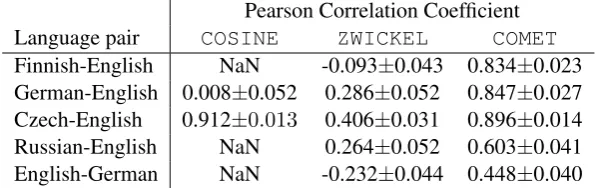
All submissions to the metrics task were evalu-ated4 at system level by computing their Pearson correlation coefficient with human judgements. For the evaluation of translations into English our best submission is COMET, achieving on average a correlation coefficient of 0.788±0.026. For the evaluation of translations from English into Ger-man, COMETis again our best submission with a correlation coefficient of 0.448±0.40.
Table 5 shows the system-level Pearson cor-relation coefficient for COSINE, ZWICKEL and
COMET5 for each language pair into English and for the language pair English-German.
Spearman’s correlation coefficient was also computed, but just the average over all language 4The numbers reported in this section are provided by the organisers of the WMT2015 metrics shared task
Pearson Correlation Coefficient Language pair COSINE ZWICKEL COMET
Finnish-English NaN -0.093±0.043 0.834±0.023 German-English 0.008±0.052 0.286±0.052 0.847±0.027 Czech-English 0.912±0.013 0.406±0.031 0.896±0.014 Russian-English NaN 0.264±0.052 0.603±0.041 English-German NaN -0.232±0.044 0.448±0.040 Table 1: Pearson correlation coefficient forCOSINE,ZWICKELandCOMET.
Spearman’s Correlation Coefficient Average COSINE ZWICKEL COMET
[image:7.595.148.449.64.158.2]into English 0.122±0.079 0.066±0.087 0.665±0.069 into German 0.084±0.084 -0.235±0.069 0.588±0.072
Table 2: System-level Spearman’s correlation coefficient forCOSINE,ZWICKELandCOMET.
pairs into English and into German. From the results in Table 5 we notice that COMET was the metric performing best for both translations into English and German, achieving a coefficient of 0.665±0.069 for translations into English and 0.588±0.072 for translations from German into English.
6 Conclusion
This paper presents USAAR’s submission to the WMT2015 metrics shared task. Our aim of our submission was a language independent method for predicting MT adequacy based on the semantic similarity between hypothesis and reference trans-lation by using document embeddings. We con-tributed with three evaluation metrics, COMET, a combination of a cosine-based metric and ME-TEOR, being the one correlating best with the hu-man evaluators.
Previous studies have shown that METEOR systematically underestimate the quality of the translations (Vela et al., 2014b). Future work on our approach using document embeddings and co-sine similarities could be used to also predict dif-ferent scores (i.e. other than METEOR). Addi-tionally, further experiments on document/word embeddings would be beneficial to find the best-fit solution for the cosine similarity calculation between a machine translation and its reference translation.
Acknowledgements
The research leading to these results has received funding from the People Programme (Marie Curie
Actions) of the European Union’s Seventh Frame-work Programme FP7/2007-2013/ under REA grant agreement no. 317471.
References
Eneko Agirre, Carmen Banea, Claire Cardie, Daniel Cer, Mona Diab, Aitor Gonzalez-Agirre, Weiwei Guo, Rada Mihalcea, German Rigau, and Janyce Wiebe. 2014. SemEval-2014 Task 10: Multilingual Semantic Textual Similarity. InProceedings of the 8th International Workshop on Semantic Evaluation (SemEval 2014), Dublin, Ireland, August.
Piyush Arora, Chris Hokamp, Jennifer Foster, and Gareth Jones. 2015. DCU: Using Distributional Semantics and Domain Adaptation for the Seman-tic Textual Similarity SemEval-2015 Task 2. In Pro-ceedings of the 9th International Workshop on Se-mantic Evaluation (SemEval 2015), pages 143–147, Denver, Colorado, June.
Alberto Barr´on-Cede˜no, Llu´ıs M`arquez, Maria Fuentes, Horacio Rodriguez, and Jordi Turmo. 2013. UPC-CORE: What Can Machine Trans-lation Evaluation Metrics and Wikipedia Do for Estimating Semantic Textual Similarity? In 2nd Joint Conference on Lexical and Computational Semantics (SEM), pages 143–147, Atlanta, Georgia, USA, June.
Antoine Bordes, Jason Weston, Ronan Collobert, and Yoshua Bengio. 2011. Learning Structured Embed-dings of Knowledge Bases. In Proceedings of the Association for the Advancement of Artificial Intel-ligence (AAAI).
Samuel R. Bowman, Christopher Potts, and Christo-pher D. Manning. 2015. Learning Distributed Word Representations for Natural Logic Reasoning. In Proceedings of the Association for the Advancement of Artificial Intelligence Spring Symposium (AAAI), pages 10–13, March.
Chris Callison-Burch, Cameron Fordyce, Philipp Koehn, Christof Monz, and Josh Schroeder. 2007. (Meta-) Evaluation of Machine Translation. In Pro-ceedings of the 2nd Workshop on Statistical Machine Translation (WMT), pages 136–158.
Danqi Chen and Christopher Manning. 2014. A Fast and Accurate Dependency Parser using Neural Net-works. In Proceedings of the Conference on Em-pirical Methods in Natural Language Processing (EMNLP), pages 740–750, Doha, Qatar, October. Elisabet Comelles and Jordi Atserias. 2014. VERTa
Participation in the WMT14 Metrics Task. In Pro-ceedings of the 9th Workshop on Statistical Ma-chine Translation (WMT), pages 368–375, Balti-more, Maryland, USA, June. Association for Com-putational Linguistics.
Michael Denkowski and Alon Lavie. 2014. Me-teor Universal: Language Specific Translation Eval-uation for Any Target Language. In Proceedings of the Workshop on Statistical Machine Translation (WMT).
George Doddington. 2002. Automatic Evaluation of Machine Translation Quality Using N-gram Co-Occurrence Statistics. InProceedings of the 2nd In-ternational Conference on Human Language Tech-nologies (HLT), pages 138–145.
Christian Federmann. 2012. Appraise: An Open-Source Toolkit for Manual Evaluation of Machine Translation Output.PBML, 98:25–35, 9.
Meritxell Gonz`alez, Alberto Barr´on-Cede˜no, and Llu´ıs M`arquez. 2014. IPA and STOUT: Leverag-ing LLeverag-inguistic and Source-based Features for Ma-chine Translation Evaluation. In Proceedings of the 9th Workshop on Statistical Machine Translation (WMT), pages 394–401, Baltimore, Maryland, USA, June. Association for Computational Linguistics. Ana Guerberof. 2009. Productivity and Quality in the
Post-editing of Outputs from Translation Memories and Machine Translation. International Journal of Localization, 7(1).
Aaron L. F. Han, Derek F. Wong, and Lidia S. Chao. 2012. LEPOR: A Robust Evaluation Metric for Ma-chine Translation with Augmented Factors. In Pro-ceedings of COLING 2012: Posters, pages 441–450, Mumbai, India, December.
Pingping Huang and Baobao Chang. 2014. SSMT:A Machine Translation Evaluation View To Paragraph-to-Sentence Semantic Similarity. InProceedings of the 8th International Workshop on Semantic Evalu-ation (SemEval 2014), pages 585–589, Dublin, Ire-land, August.
Eric H. Huang, Richard Socher, Christopher D. Man-ning, and Andrew Y. Ng. 2012. Improving word representations via global context and multiple word prototypes. InProceedings of the 50th Annual Meet-ing of the Association for Computational LMeet-inguistics (ACL), pages 873–882.
Thomas K. Landauer and Susan T. Dutnais. 1997. A Solution to Platos Problem: The Latent Semantic Analysis Theory of Acquisition, Induction, and Rep-resentation of Knowledge. PSYCHOLOGICAL RE-VIEW, 104(2):211–240.
Vladimir Iosifovich Levenshtein. 1966. Binary Codes Capable of Correcting Deletions, Insertions and Re-versals. Soviet Physics Doklady, 10(8):707–710. Linguistics Data Consortium. 2005. Linguistic Data
Annotation Specification: Assessment of Fluency and Adequacy in Translations.
Chi-Kiu Lo and Dekai Wu. 2011a. MEANT: An Inex-pensive, High-accuracy, Semi-automatic Metric for Evaluating Translation Utility Based on Semantic Roles. In Proceedings of the 49th Annual Meet-ing of the Association of Computational LMeet-inguistics: Human Language Technologies (ACL-HLT), pages 220–229.
Chi-Kiu Lo and Dekai Wu. 2011b. SMT vs. AI re-dux: How Semantic Frames Evaluate MT More Ac-curately. InProceedings of the 22nd International Joint Conference on Artificial Intelligence (IJCAI). Chi-Kiu Lo and Dekai Wu. 2011c. Structured vs. Flat
Semantic Role Representations for Machine Trans-lation Evaluation. InProceedings of the 5th Work-shop on Syntax and Structure in Statistical Transla-tion (SSST).
Chi-kiu Lo, Anand Karthik Tumuluru, and Dekai Wu. 2012. Fully Automatic Semantic MT Evaluation. In Proceedings of the 7th Workshop on Statistical Ma-chine Translation (WMT), pages 243–252, Montr´eal, Canada, June. Association for Computational Lin-guistics.
Tucker Maney, Linda Sibert, Dennis Perzanowski, Kalyan Gupta, and Astrid Schmidt-Nielsen. 2012. Toward Determining the Comprehensibility of Ma-chine Translations. InProceedings of the 1st PITR, pages 1–7.
Tomas Mikolov, Kai Chen, Greg Corrado, and Jeffrey Dean. 2013. Efficient Estimation of Word Repre-sentations in Vector Space. arXiv, 1301.3781. George A. Miller. 1995. WordNet: A Lexical
Database for English.Communications of the ACM, 38(11):39–41, November.
Mohammad Taher Pilehvar, David Jurgens, and Roberto Navigli. 2013. Align, Disambiguate and Walk: A Unified Approach for Measuring Seman-tic Similarity. In Proceedings of the 51st Annual Meeting of the Association for Computational Lin-guistics, pages 1341–1351, Sofia, Bulgaria, August. Miguel Rios, Wilker Aziz, and Lucia Specia. 2012. UOW: Semantically Informed Text Similarity. In The 1st Joint Conference on Lexical and Computa-tional Semantics (SEM), pages 673–678, Montr´eal, Canada, June.
Carolina Scarton, Marcos Zampieri, Mihaela Vela, Josef van Genabith, and Lucia Specia. 2015. Searching for Context: a Study on Document-Level Labels for Translation Quality Estimation. In Pro-ceedings of the 18th Annual Conference of the Euro-pean Association for Machine Translation (EAMT), pages 121–128, Antalya, Turkey, May.
Matthew Snover, Bonnie Dorr, Richard Schwartz, Lin-nea Micciulla, and John Makhoul. 2006. A Study of Translation Edit Rate with Targeted Human An-notation. InProceedings of the Association for Ma-chine Translation in the Americas (AMTA), pages 223–231.
Matthew Snover, Nitin Madnani, Bonnie Dorr, and Richard Schwartz. 2009. Fluency, Adequacy, or HTER? Exploring Different Human Judgments with a Tunable MT Metric. In Proceedings of the 4th Workshop on Statistical Machine Translation (WMT), pages 259–268.
Md Arafat Sultan, Steven Bethard, and Tamara Sum-ner. 2015. DLS@CU: Sentence Similarity from Word Alignment and Semantic Vector Composition. InProceedings of the 9th International Workshop on Semantic Evaluation (SemEval 2015), pages 148– 153, Denver, Colorado, June.
Liling Tan and Francis Bond. 2013. Xling: Matching query sentences to a parallel corpus using topic mod-els for wsd. InProceedings of the 7th International Workshop on Semantic Evaluation (SemEval 2013), pages 167–170, Atlanta, Georgia, USA, June. Liling Tan, Rohit Gupta, and Josef van Genabith.
2015a. Usaar-wlv: Hypernym generation with deep neural nets. InProceedings of the 9th International Workshop on Semantic Evaluation (SemEval 2015), pages 932–937.
Liling Tan, Carolina Scarton, Lucia Specia, and Josef van Genabith. 2015b. USAAR-SHEFFIELD: Se-mantic Textual Similarity with Deep Regression and Machine Translation Evaluation Metrics. In Pro-ceedings of the 9th International Workshop on Se-mantic Evaluation (SemEval 2015), pages 85–89, Denver, Colorado, June.
Liling Tan. 2013. Examining Crosslingual Word Sense Disambiguation. Master’s thesis, Nanyang Techno-logical University.
Christoph Tillmann, Stephan Vogel, Hermann Ney, Alexander Zubiaga, and Hassan Sawaf. 1997. Ac-celerated DP Based Search For Statistical Transla-tion. InProceedings of the EUROSPEECH, pages 2667–2670.
Mihaela Vela and Josef van Genabith. 2015. Re-assessing the WMT2013 Human Evaluation with Professional Translators Trainees. InProceedings of the 18th Annual Conference of the European Associ-ation for Machine TranslAssoci-ation (EAMT), pages 161– 168, May.
Mihaela Vela, Anne-Kathrin Schumann, and Andrea Wurm. 2014a. Beyond Linguistic Equivalence. An Empirical Study of Translation Evaluation in a Translation Learner Corpus. In Proceedings of the EACL Workshop on Humans and Computer-assisted Translation (HaCat), pages 47–56, April.
Mihaela Vela, Anne-Kathrin Schumann, and Andrea Wurm. 2014b. Human Translation Evaluation and its Coverage by Automatic Scores. InProceedings of the Language Resources and Evaluation Con-ference Workshop on Automatic and Manual Met-rics for Operational Translation Evaluation (MTE), pages 20–30, May.
Radim ˇReh˚uˇrek and Petr Sojka. 2010. Software frame-work for topic modelling with large corpora. In Proceedings of Language Resources and Evaluation Conference, pages 46–50, Valletta, Malta.
Frane ˇSari´c, Goran Glavaˇs, Mladen Karan, Jan ˇSnajder, and Bojana Dalbelo Baˇsi´c. 2012. TAKELAP: Sys-tems for Measuring Semantic Text Similarity. In Proceedings of the 1st Joint Conference on Lexical and Computational Semantics (SEM), pages 441– 448.
Sandra Weiss and Lars Ahrenberg. 2012. Error Pro-filing for Evaluation of Machine-translated Text: a Polish-English Case Study. In Proceedings of the 8th Language Resources and Evaluation Conference (LREC), pages 1764–1770.