Anders Søgaard
Center for Language Technology University of Copenhagen
Njalsgade 142 DK-2300 Copenhagen [email protected]
Abstract
PP attachment has attracted considerable in-terest the last two decades. The standard set-up has been to extract quadruples of verbs, direct objects, prepositions and prepo-sitional complements from the Wall Street Journal and classify them as either low or high attachments. State-of-the-art results al-most equal human performance in the stan-dard set-up. Recently, however, Atterer and Sch ¨utze (2007) has questioned this methodol-ogy. In this paper, we show that state-of-the-art results can be achieved by simpler means than what has previously been shown, using graphical models, but also that state-of-the-art parsers perform insignificantly worse than state-of-the-art PP attachment classifiers. This questions the usefulness of previous studies of PP attachment, even if the methodology in these studies is sound.
1 Introduction
One of the main challenges in parsing has for a long time been assumed to be the resolution of ambiguity. One frequently studied type of ambiguity is preposi-tional phrase (PP) attachment. Given a quadruple of a verb, a direct object, a preposition and a preposi-tional complement (the head of the NP2 embedded in the PP), PP attachment – or PP re-attachment – is the task of determining whether the PP should tach to the verb (V) or the direct object (N). PP at-tachment is thus construed as a binary classification problem, typically with labels N and V.
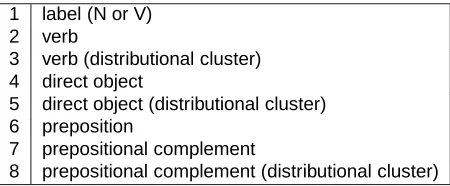
The standard features for PP-attachment used in Ratnaparkhi et al. (1994) and subsequent studies are listed in Figure 1. The seven features are the
ones in rows 2–8. A distributional cluster is a set of words that have similar distributions according to a hierarchical clustering algorithm, typically based on probabilities in a bigram language model. The granularity of clusters varies, but we will use a 1000 clusters in our experiments below.
Example. To see the complexity of this learning problem, consider the following four examples:
(1) (Andy Warhol) painted paintings with 3D-glasses.
(2) (Andy Warhol) painted [portraits with 3D-glasses].
(3) (Andy Warhol) painted [paintings with ice-cream].
(4) (Andy Warhol) painted portraits with ice-cream.
The square brackets indicate likely low attach-ment, i.e. that the prepositional phrase most nat-urally modifies the noun. Note that the four data points have an XOR-like distribution in two-dimensional space:
3D-glasses V N
ice-cream N V
paintings portraits
The distributional cluster features are of no help here, since there is a function from words to clusters. In sum, the learning problem has few dimensions, but variables are highly interdependent.
1 label (N or V) 2 verb
3 verb (distributional cluster) 4 direct object
5 direct object (distributional cluster) 6 preposition
7 prepositional complement
[image:2.612.202.427.66.159.2]8 prepositional complement (distributional cluster)
Figure 1: Standard features in PP-attachment.
in the literature on the standard Wall Street Jour-nal dataset for English PP attachment) to consider graphical models.
The most important of our seven features is un-doubtedly the prepositions (feature 6). This has been noted before, for example by Collins and Brooks (1995) who base their backed-off estimate on this observation (Sect. 6): ”A key observation in choosing between these tuples is that the preposi-tion is particularly important to the attachment deci-sion.” Moreover, selecting PP attachment site only by the preposition typically provides a relatively strong baseline. This observation was also central in the models used by Toutanova et al. (2004).
Previous studies are reviewed in Sect. 2. Atterer and Sch¨utze (2007) recently questioned the method-ology used in these studies, however. We briefly summarize their discussion in Sect. 3.
Sect. 4 presents two PP attachment algorithms based on graphical models that are simpler than the one proposed by Toutanova et al. (2004), yet per-form as well as theirs. This is an interesting empiri-cal result independently of whether the methodology in re-attachment studies is sound or not.
Sect. 5 qualifies the discussion in Atterer and Sch¨utze (2007), showing that state-of-the-art depen-dency parsers perform about as well as state-of-the-art re-attachment classifiers on the standard PP at-tachment dataset. This strengthens the claim in At-terer and Sch¨utze (2007) that PP re-attachment stud-ies are of little practical relevance.
2 Previous studies
Collins and Brooks (1995) use a simple backed-off estimate for modeling PP attachment. In a way sim-ilar to nearest-neighbor learning, they first look for identical quadruples in the training data, then for
triples and then for pairs. They report a score of 84.5% on the Wall Street Journal dataset. This is identical to the score reported with cross-product features above. It is also similar to what was re-ported in Abney et al. (1999) (84.6%). It is also sim-ilar to what was achieved by Vanschoenwinkel and Manderick (2003) using SVMs and kernel methods (84.8%).
Toutanova et al. (2004) present an approach to PP attachment similar to ours. They manually construct a Markov chain Bayesian network with only two in-dependence assumptions; namely, that given a ver-bal attachment, the second noun is independent of the first noun, and that given a nominal attachment, the second noun is independent of the verb. The pa-rameters of the graphical model are learned discrim-inatively by random walks. In addition to the train-ing data, Toutanova et al. (2004) use large amounts of automatically parsed quadruples from the BLLIP corpus (Charniak, 2000). They also use morphologi-cal analysis and WordNet features to achieve the best reported results in the literature. Without these ad-ditional resources they report an accuracy of 85.9%. Using morphological analysis they achieve 86.2%, and using all features, incl. WordNet features, they achieve 87.6% which is very close to human perfor-mance. One of the algorithms proposed below will be similar to this algorithm, but we will learn the graph structure automatically from the training data using no additional resources.
data, ranging from 83.1% to 86.5%.
Finally, there has been some work in what has been referred to as ”unsupervised” PP attach-ment (Ratnaparkhi, 1998; Kawahara and Kurohashi, 2005). The idea in this work is to extract unam-biguous examples of triples or quadruples from large amounts of raw data, typically based on automat-ically inferred part-of-speech. The methods sub-sequently used are standard supervised techniques, so in a way this can be seen as supervised learn-ing with outlier detection on large amounts of data. It is therefore not that surprising that results are good. Ratnaparkhi (1998), who pioneered this ap-proach, report an accuracy of 81.9% (compared to 81.6% in his earlier work), and Kawahara and Kuro-hashi (2005) report an impressive 87.3%, but in an explorative study where different results are re-ported.
3 Is re-attachment sound?
Previous studies of PP attachment have, as should be clear now, assumed an oracle that provides pre-liminary syntactic structure, i.e. extracts the relevant quadruples from gold-standard parse trees. The task is then to re-attach the involved PPs. PP attach-ment classifiers perform considerably worse in the absence of oracles, however.
Atterer and Sch¨utze (2007) present empirical ev-idence for this and discuss the difficulties with the standard methodology of using extracted quadru-ples. One problem arises if the parser does not find the direct object and the prepositional phrase and then does not recognize the ambiguity. It is also harder to decide low or high attachment if the head words of the direct object and the prepositional com-plement are not correctly identified. Accuracy with-out oracles drops abwith-out 5%.
Atterer and Sch¨utze (2007) also argue that state-of-the-art parsers do almost as good attachment de-cisions as re-attachers in realistic scenarios, i.e. in the absence of oracles. In Sect. 5 we show that state-of-the-art also do almost as good attachment deci-sions as attachment classifiers when oracle quadru-ples are provided.
4 Using graphical models for PP attachment
Graphical models (Jordan, 1998) are a happy mar-riage between probability theory and graph the-ory, and graphical models are best understood as a framework for talking about and generalizing over various known models, including mixture models, factor analysis, hidden Markov models, Kalman fil-ters and Ising models. Graphical models are also ways of compactly representing joint probability distributions. Their discriminative analogues, con-ditional random fields (Lafferty et al., 2001), which model conditional probabilities directly rather than joint probabilities, will also be included under the term graphical models here. We will refer to gener-ative graphical models as Bayesian networks, and to discriminative graphical models as conditional ran-dom fields. In general, graphical models are graphs in which each node represents a variable whose dis-tribution is to be inferred, and edges represent de-pendencies.
4.1 Bayesian networks with cross-product of features
Using Bayesian networks we need a method for learning directed graphs over our variables and a method for doing inference in them. This is in con-trast to Toutanova et al. (2004) who designed the Bayesian network by hand, guided by linguistic in-tuition. In the experiments below, we focus on hill
climbing for learning graphs (Jordan, 1998).
Esti-mation or inference is simple. The choice of us-ing hill climbus-ing is primarily motivated by replica-bility and computational efficiency, but our initial experiments showed that more advanced methods such as K2 or conditional independence tests did not lead to better results on development data. We also restrict ourselves to Bayesian networks where all nodes have at most one parent. In other words, our graphical models are unordered trees. Experi-ments showed that allowing for two or three parents did not lead to better results either. This means that our graphical models are much simpler than the ones used in Toutanova et al. (2004).
The estimation method is simply to compute
arg max
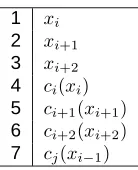
1 xi
2 xi+1 3 xi+2 4 ci(xi)
[image:4.612.166.235.64.149.2]5 ci+1(xi+1) 6 ci+2(xi+2) 7 cj(xi−1)
Figure 2: Feature template used in all experiments for classifiercj.
Finally, we take the cross-product of the standard features (Figure 1). Since some of these feature pairs may be irrelevant, we use a particle swarm approach to assign weights to each feature. In particular, we use the RapidMiner 4.6 implementation of particle swarm feature weighting with a default parameter setting of 40 generations of size 6.1
4.2 Stacked conditional random fields
In conditional random fields, each node in our graphs has an exponential family distribution. Some variables are observed, whereas others are to be in-ferred (in our case using a quasi-Newton approach). In classification, there is really only one hidden vari-able, but we will pretend that there are as many as there are observable variables. The new hidden vari-ables will just be copies of this variable.
In particular, we will assume chain graphs, i.e. a subclass of the graphs considered in Bayesian net-works. In addition, we will condition each hidden variable on the corresponding observed variables and the two succeeding observable variables.2 The full set of features is presented in Figure 2. A feature ci(xi)means the prediction of the classifier trained on sequences of lengthiprediction for nodei(its fi-nal prediction). Note that these features are orthog-onal to the features of the underlying classification problem (Figure 1). The features of the classifica-tion problem only affect the length of the sequences that are given to our stacked sequential labeler.
Our learning algorithm C2C transforms an n -dimensional classification problem to a sequence la-beling task for sequences ofmlength withm≤n. In some cases we will group two or more variables
1http://rapid-i.com/
2The intuition here is that the preceding observable variables
are reflected in the previous classifier’s predictions; see below.
together in nodes, which is whymmay be smaller than n. This happens, for example, if we use both word forms and distributional clusters to represent words in PP attachment (in a way similar to Rat-naparkhi et al. (1994)). Each node is then repre-sented by two features, som = n2. Note also that all sequences in our data will have the same length, i.e. the number of attributes in the original classifi-cation data set. Note also that the special case where we group nvariables together reduces to standard classification.
Otherwise (when m = n) we will transform a classification data set with data points:
yi xi1 xi2 . . . xin
into a sequence labeling task for sequences xi1. . . xin.
The idea is then to train n many models; the smallest model will be trained on sequences of length 1 (the first feature xi1 paired with the class label), the next smallest model on sequences of two nodes (x′1, x′2), and so on. The largest model will be trained on the full length sequences. Each node will be augmented with a prediction feature initialized as ’NULL’ for all nodes. Each model on sequences of lengthjwill be used to set the value of the prediction feature of nodeiin each sequence, basically repre-senting the class prediction this far in the sequence.
So our model is in a way similar to ensemble-based methods or corrective modeling, i.e. a form of stacking (Wolpert, 1992). The smallest model in PP-attachment may try to guess low or high PP-attachment based on the verb, for example. The next model sees the next word, say the object noun, but also the class predicted by the smaller model and tries to guess whether the PP attaches to the verb or to the object noun. The next model then sees the preposition also and possibly corrects the guess, and finally the larger model produces the final class prediction. Note that the bigger models when predicting the label of node xijboth have access to the predictions of the smaller
models and its own last prediction forxi
j−1. Herein lies the strength of our model.
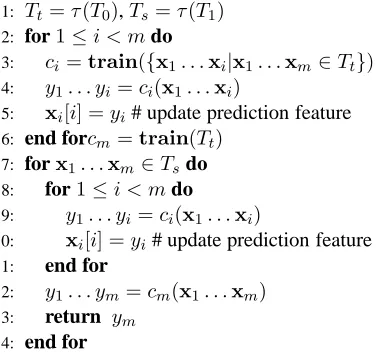
see-1: Tt=τ(T0),Ts=τ(T1)
2: for1≤i < mdo
3: ci=train({x1. . .xi|x1. . .xm∈Tt})
4: y1. . . yi=ci(x1. . .xi)
5: xi[i] =yi# update prediction feature
6: end forcm=train(Tt)
7: forx1. . .xm∈Tsdo
8: for1≤i < mdo
9: y1. . . yi=ci(x1. . .xi)
10: xi[i] =yi# update prediction feature
11: end for
12: y1. . . ym=cm(x1. . .xm)
13: return ym
[image:5.612.99.287.67.245.2]14: end for
Figure 3:C2C.
ing the pairs of attributes and class labels as se-quences. We then dom−1iterations. In each iter-ation, we train a sequential labelercion sequences ofilength inT0,1≤i < m(line 3). The sequen-tial labeler is then applied to parsequen-tial sequences, and the final prediction (for nodei) is used to update the prediction feature of this node. This information is then used for training the classifier in the next itera-tion. We return the prediction for the last node in the sequences of lengthmin the test data.
4.3 Data
In our experiments we use the PP attachment dataset presented in Ratnaparkhi et al. (1994).3 The dataset contains 20,801 quadruples from the syntactically annotated Wall Street Journal (Penn Treebank 0.5) with attachment decisions for training, 4,039 for de-velopment, and 3,097 for testing. Each quadruple consists of a verb, a direct object, a preposition and a prepositional complement, e.g.:
prepare dinner for family (V) shipped crabs from province (V) ran broadcast on way (N) is apartment with floors (N)
Remember the label N means low attachment, while V means that the preposition is a complement of the verb. The quadruples are extracted from the Wall Street Journal relying on manual annotation. Consider some suggested lower and upper bounds
3ftp://ftp.cis.upenn.edu/pub/adwait/PPattachData/
on this dataset:
Acc (%)
Majority baseline 59.0
Most likely for each preposition 72.2
Human (quadruples) 88.2
Human (sentences) 93.2
Majority baseline is the accuracy of a system that always predict low attachment. Here, ’Most likely for each preposition’ means use the attachment seen most often in training data for the preposition seen in the test quadruple. The human performance results are taken from Ratnaparkhi et al. (1994), and are the average performance of three treebanking experts on a set of 300 randomly selected test events from the Wall Street Journal corpus, first looking at the four head words alone, then using the whole sentence. The results are thus not directly comparable to those obtained using the test section.
Ratnaparkhi et al. (1994) use the standard features listed in Figure 1, but also suggest to usen-gram fea-tures (1 ≤n ≤ 4) over words and Brown clusters. Ratnaparkhi et al. (1994) used logistic regression to learn from these presentations.
In our experiments, we only use unigrams. Our feature vectors are therefore very short; we use eight features in the standard representation, namely words and clusters of verbs, direct objects, preposi-tions and prepositional complements, and four and ten features in the two alternative representations. Actually, since all prepositions belong to the same cluster in our hierarchical clustering, we only need to consider seven variables in the standard repre-sentation. For reproduceability, we use the Brown clusters available on the website that accompanies Turian et al. (2010) with C = 1000, to build our feature representations.
4.4 Results
We compare Bayesian networks andC2Cwith pre-vious studies of PP attachment. Ratnaparkhi et al. (1994) used logistic regression on standard fea-tures. Since we do not use exactly the same hier-archical clusters as they did, we include both his reported results and results obtained with our fea-ture representations using generalized iterative scal-ing (GIS).4Our graphical models are learned using
hill climbing and with the restriction that each node has at most one parent (P=1).
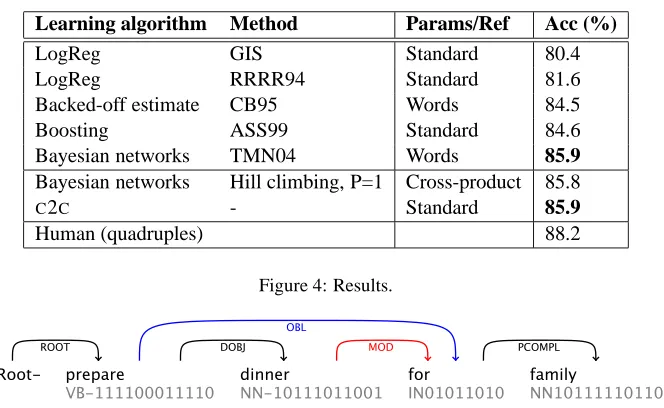
Our results are presented in Figure 4. Note that both our approaches perform as good as the ap-proach in Toutanova et al. (2004).
5 How well do parsers perform?
PP attachment became an interesting topic with Rat-naparkhi et al. (1994) at a time where most parsers were grammar-based, and statistical PP attachment was necessary for ambiguity management. Statisti-cal parsers of course do PP attachment themselves finding the most probable parse, but re-attachment may still improve the overall quality of parsers if at-tachment classifiers are trained specifically to deal with this problem.
Atterer and Sch¨utze (2007) showed that attach-ment classifiers are only a little better than mod-ern statistical parsers in realistic scenarios where quadruples are not known. Here we show that mod-ern parsers are almost as good as re-attachment clas-sifiers, even when quadruples are known.
To cast the re-attachment task as a dependency parsing problem, we convert the labeled quadruples into dependency structures the following way:
In a low attachment the preposition, which is the head of the prepositional complement and thereby head of the PP, is a dependent of the noun, and the dependency between them is labeled MOD for mod-ifier. If the label is V, the preposition is a dependent of the verb, and the dependency is labeled OBL for oblique.
Consider, for example, the dependency structure in Figure 5. The black dependencies are correct and predicted dependencies. The blue dependency is correct, and the red is predicted. In other words, this quadruple, which is the first in the test section of our dataset, is annotated as V, but a low attachment is predicted.
The information available to the dependency parser in Figure 5 is words and hybrid POS tags and clusters. POS tags are obviously redundant on their own. In general, we tried three different fea-ture representations: using only words, using words and clusters, and using words and hybrid POS tags and clusters. Note that the hybrid setting is similar to what was used for semi-supervised dependency
Parser Acc (%) Toutanova et al. (significance) MaltParser 83.1 <0.01
MSTParser 84.1 >0.05
Opt. MaltParser 85.1 >0.05
[image:6.612.324.531.67.148.2]Bikel 83.7 <0.05
Figure 6: PP re-attachment accuracy of state-of-the-art parsers.
FORM CPOSTAG
Input 0,1 1
Stack 0,1 0,1
Figure 7: Features used in Opt. MaltParser. 0 is the first word on the buffer (Input) or stack; 1 the second, and so on.
parsing in Koo (2008). This setting led to the best results on the development data.
We trained two different parsers on the converted PP attachment dataset, namely MaltParser (Nivre et al., 2007) and MSTParser (McDonald et al., 2005). We report results for the two parsers with default pa-rameters and a result for MaltParser with a feature model partially optimized on development data; all results are listed in Figure 6. The optimized fea-ture model is presented in Figure 7.5 The third col-umn reports significance compared to the results in Toutanova et al. (2004), usingχ2test. The result of the Bikel parser (Bikel, 2004) is taken directly from Atterer and Sch¨utze (2007).
It follows that state-of-the-art dependency parsers are not significantly worse than state-of-the-art PP attachment classifiers. This questions the usefulness of PP attachment classifiers in statistical parsing.
6 Conclusions
We have contributed to the PP attachment literature in two ways. First we have presented two new al-gorithms that equal state-of-the-art in their perfor-mance on the standard Wall Street Journal dataset. One is based on Bayesian networks, the other is based on conditional random fields. Second we have strengthened the claim in Atterer and Sch¨utze (2007)
5Optimization was performed by greedily removing features
[image:6.612.360.494.192.231.2]Learning algorithm Method Params/Ref Acc (%)
LogReg GIS Standard 80.4
LogReg RRRR94 Standard 81.6
Backed-off estimate CB95 Words 84.5
Boosting ASS99 Standard 84.6
Bayesian networks TMN04 Words 85.9
Bayesian networks Hill climbing, P=1 Cross-product 85.8
C2C - Standard 85.9
[image:7.612.151.483.62.266.2]Human (quadruples) 88.2
Figure 4: Results.
Figure 5: PP re-attachment as parsing problem.
that statistical parsers can do PP attachment almost as good as specialized classifiers in the absence of oracles. In fact, we have shown that state-of-the-art dependency parsers are insignificantly worse than such classifiers even in the presence of oracles. In particular, we showed that the difference between a statistical parser and the best re-attachment classi-fiers was less than 0.8%.
References
Steven Abney, Robert Schapire, and Yoram Singer. 1999. Boosting applied to tagging and PP-attachment. In
EMNLP.
Michaela Atterer and Hinrich Sch ¨utze. 2007. Preposi-tional phrase attachment without oracles.
Computa-tional Linguistics, 33(4):469–476.
Daniel Bikel. 2004. Intricacies of collins parsing model.
Computational Linguistics, 30(4):479–512.
Eugene Charniak. 2000. A maximum entropy-inspired parser. In NAACL.
Michael Collins and James Brook. 1995. Prepositional phrase attachment through a backed-off model. In
Workshop on Very Large Corpora.
Michael Jordan, editor. 1998. Learning in graphical
models. MIT Press.
Daisuke Kawahara and Sadao Kurohashi. 2005. Pp-attachment disambiguation boosted by a gigantic vol-ume of unambiguous examples. In IJCNLP.
Terry Koo, Xavier Carreras, and Michael Collins. 2008. Simple semi-supervised dependency parsing. In ACL.
John Lafferty, Andrew McCallum, and Fernando Pereira. 2001. Conditional random fields: probabilistic models for segmenting and labeling sequence data. In ICML. Ryan McDonald, Fernando Pereira, Kiril Ribarov, and
Jan Hajiˇc. 2005. Non-projective dependency parsing using spanning tree algorithms. In HLT-EMNLP. Joakim Nivre, Johan Hall, Jens Nilsson, Atanas Chanev,
G¨ulsen Eryigit, Sandra K¨ubler, Svetoslav Marinov, and Erwin Marsi. 2007. MaltParser: a language-independent system for data-driven dependency pars-ing. Natural Language Engineering, 13(2):95–135. Adwait Ratnaparkhi, J Reynar, and S Roukos. 1994. A
maximum entropy model for prepositional phrase at-tachment. In ARPA Workshop on Human Language
Technology.
Adwait Ratnaparkhi. 1998. Statistical models for un-supervised prepositional phrase attachment. In
COL-ING.
Kristina Toutanova, Christopher Manning, and Andrew Ng. 2004. Learning random walk models for inducing word dependency distributions. In ICML.
Joseph Turian, Lev Ratinov, and Yoshua Bengio. 2010. Word representations: a simple and general method for semi-supervised learning. In ACL.
B Vanschoenwinkel and B Manderick. 2003. A weighted polynomial information gain kernel for resolving pp attachment ambiguities with support vector machines. In IJCAI.
David Wolpert. 1992. Stacked generalization. Neural
Networks, 5:241–259.
method for resolving PP-attachment ambiguity. In