Applying Sentiment-oriented Sentence Filtering to Multilingual Review
Classification
Takashi Inui and Mikio Yamamoto
Graduate School of Systems and Information Engineering University of Tsukuba
1-1-1 Tenoudai, Tsukuba, Ibaraki 305-8573, JAPAN {inui,myama}@cs.tsukuba.ac.jp
Abstract
A method for multilingual review classi-fication is described. In this classifica-tion task, machine translaclassifica-tion techniques are used to remove language gaps in the dataset, but many translation errors occur as a side-effect. These errors cause a de-crease in the review classification perfor-mance. To resolve this problem, we intro-duce a sentiment-oriented sentence filter-ing module to the process of multilfilter-ingual review classification. Experimental results showed that the proposed method achieved 81.7% classification accuracy for the eval-uation data.
1 Introduction
People can nowadays easily disseminate informa-tion including their personal subjective opinions on products and services on the Internet. The mas-sive amounts of this type of information are ben-eficial for both product companies and users who are planning to purchase and use the products. The information is mainly presented in a textual form, so in the research field of natural language pro-cessing, many researchers have focused on devel-oping techniques forsentiment analysis(or opin-ion mining) (Pang and Lee, 2008; Tang et al., 2009).
One fundamental technique in sentiment anal-ysis (opinion mining) is to classify review texts. Unlike the conventional topic-based text classi-fication task, classifiers for review classiclassi-fication must discriminate between positive and negative
aspects of opinions in a review text. In the re-view classification task, supervised machine learn-ing methods such as Naive Bayes and Support Vector Machines have been mostly applied (Pang et al., 2002; Mullen and Collier, 2004; Whitelaw et al., 2005). These supervised approaches have
achieved good performance, but they have a cru-cial issue: they require a large amount of labeled data, which involves the high cost of manual an-notation.
Approaches to reduce or avoid the cost of annotation have been proposed, such as semi-supervised and substitutional data approaches. Semi-supervised approaches (e.g., that by Aue and Gamon (2005)) provide a simple solution by combining labeled and unlabeled data. Sub-stitutional data approaches provide subSub-stitutional labeled data, available at low costs, instead of pure labeled data. The tasks of domain adaption (Blitzer et al., 2007) and multilingual text clas-sification (Banea et al., 2008; Wan, 2009; Banea et al., 2010) are special cases of substitutional ap-proaches.
In this paper, we examine the effectiveness of applying a sentence filtering module to multilin-gual document classification, especially to mul-tilingual review classification. In multilingual review classification, machine translation tech-niques are usually used to remove language gaps in the dataset. But, even if one can use the state-of-the-art machine translation techniques, many translation errors occur as a side-effect. These er-rors cause a decrease in the review classification performance. In this study, to resolve this prob-lem, we introduce a sentiment-oriented sentence filtering module to the process of multilingual re-view classification. we focus on the quality rather than the quantity of the training data, and attempt to filter out some worthless sentences from the dataset.
The rest of this paper is organized as follows. First, we provide an overview of multilingual re-view classification in Section 2. In addition, an issue essentially related to the task of multilingual review classification is presented. In Section 3, we explain our sentiment-oriented sentence filtering method. In Section 4, we report on our
���������������
��������������������
���������
������
����������
�����������
�������
�����������
����������
�����������
�����������
����������
�����
�����
[image:2.595.312.543.67.340.2]���
Figure 1: Monolingual review classification
ments investigating the effectiveness of applying our filtering method to multilingual review classi-fication.
2 Multilingual Review Classification
2.1 Overview
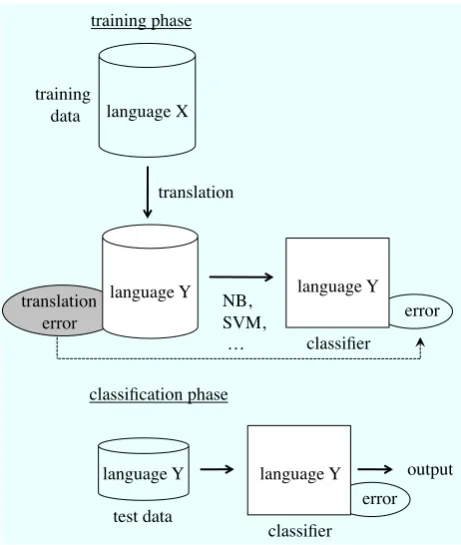
Figure 1 shows an ordinary processing flow of text (review) classification with monolingual data. In a monolingual setting, in both the training phase and classification phase, text documents in the dataset are described in the same language (language X
in Figure 1). Figure 2, in contrast, shows a mul-tilingual setting for review classification. In this setting, text documents in the classification phase are described in a different language,Y, fromX.
To remove the language gap between the train-ing and test datasets, machine translation (MT) techniques are used in the training phase. By translating text documents in the dataset from the source language X into the target language Y, an MT system automatically generates a substi-tutional dataset in which text documents are de-scribed in the target languageY1.
2.2 The issue
Here, the MT system succeeds in removing the language gap between X and Y. However, many translation errors occur in the dataset as a side-effect. In general, a text classifier uses information
1Note that even though a small amount of original labeled
documents is described (i.e., not translated) in languageYin general cases, this is omitted in Figure 2 for simplicity.
���������������
��������������������
���������
������
����������
�����������
�������
����������
�����������
����������
�����
�����
���
������������
������������
������
�����������
������
�����������
������
�����������
Figure 2: Multilingual review classification
about word distributions over the dataset. When there are erroneous translations in the dataset, a situation is invoked in which the distributions of each word in the dataset differ between the train-ing data and the test data. As a result, these er-rors cause increase of text classification erer-rors in-directly (dotted line in Figure 2).
3 Applying Sentiment-oriented Sentence
Filtering
In this section, our method for reducing the in-fluences of translation errors is proposed. In the proposed method, documents translated by an MT system are then compressed by a sentiment-oriented sentence filtering module. We begin with discussion about our key idea of the proposed method, and then explain our sentiment-oriented sentence filtering.
3.1 Key idea
[image:2.595.82.279.67.264.2]be-��������� ������
����������
�����������
�����������
������������
������������ ������
�����������
�����������
��������� ����������
[image:3.595.79.284.65.316.2]���������
Figure 3: Multilingual review classification with sentence filtering
cause if the labeled data increase, the translation errors included in them may also increase. That is, the number of translation errors may be propor-tional to the number of labeled documents.
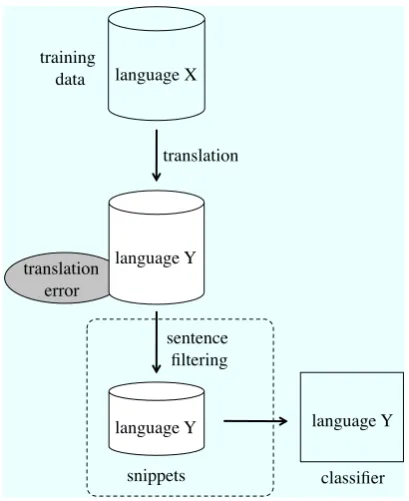
According to the above discussion, we focused our attention on thequality rather than the quan-tity of the labeled data. To achieve this change of focus, we introduce a sentence filtering module after the machine translation step. Figure 3 shows the training phase of multilingual review classifi-cation with the sentence filtering module. In the sentence filtering module, a translated document is compressed into a snippet consisting of impor-tant parts of the translated document for the review classification task. Since the generated snippet is shorter than the input document, and recalling that the number of translation errors may be propor-tional to the quantity of the dataset, applying sen-tence filtering should help to prevent errors being incorporated into the dataset.
3.2 Sentiment-oriented sentence filtering
Our sentence filtering module aims to generate text snippets by excluding translation errors from the input translated documents. To do so, we developed a sentiment-oriented sentence filtering method.
We need to develop criteria by which sentences
should be extracted. The most direct approach is that all sentences correctly translated are ex-tracted and all remaining erroneous sentences are excluded. This may work well, but it is infeasible because detecting whether a sentence is correctly translated is difficult.
Instead, we consider an alternative approach based on sentiment information. Pang et al. (2004) found that an important factor for a review classification task is whether each sentence in a document to be classified holds subjective aspects. Generally, subjective sentences contribute to the performance of review classification, while objec-tive sentences do not. According to this finding, we adopted the following sentence filtering crite-ria: all sentences holding subjective aspects are extracted and all remaining objective sentences are excluded.We consider that objective sentences with translation errors are not only unnecessary but also harmful for the multilingual review clas-sification.
In this study, we detect a sentenceSY as
hold-ing subjective aspects when all the followhold-ing con-ditions are fulfilled.
(1) SY includes at least one polarity word,
(2) A sentenceSX, which has a translation
rela-tion toSY, also includes at least one polarity
word,
(3) All the polarity words inSX andSY have the
same sentiment polarity.
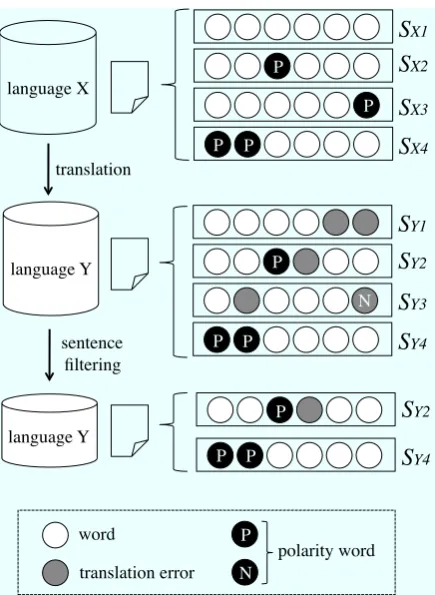
Condition (1) is commonly used in the field of sentiment analysis (Kim and Hovy, 2005). Condi-tions (2) and (3), on the other hand, are originally derived from the translation process in the mul-tilingual review classification. By adding these two conditions, we achieve more robust subjec-tivity detection. Figure 4 shows an example of the sentence filtering process. SentencesSY2 and SY4fulfill all the conditions and thus are extracted.
SentencesSY1andSY3are excluded.SY1violates
condition (1): it has no polarity words. SY3
vi-olates condition (3): althoughSY3 has a negative
polarity word, SX3 has a positive polarity word.
�����������
������������
�����������
�
���
�
���
�
���
�
���
�
���
�
���
�
���
�
���
�
���
�
���
����
��
�� ��
��
� ��
���������
���������
�����������
�� ��
�����
��������������
������������������ ��
��
[image:4.595.78.296.65.363.2]��
Figure 4: Example of sentence filtering process
4 Evaluation
We conducted experiments for investigating the effectiveness of applying our sentiment-oriented sentence filtering method to the multilingual re-view classification.
4.1 Experimental settings
4.1.1 Multilingual review classification methods
Review classification methods that enable han-dling of multilingual data have been proposed. We adopted those proposed by Banea et al. (2008) and Wan (2009) in our experiments, since theirs are well-known and standard methods.
Banea’s method (2008) has two classification models that are dependent on the running position of the MT system.
Training data Translation Model (TrTM) This model is actually shown in Figure 2. A text classifier is learned using a dataset described in the target language. To do so, before the text classifier is learned, documents (reviews) in the training dataset that are described in the source language are translated into the
same language as those in the test dataset. We do not need to do anything with the test dataset.
Test data Translation Model (TeTM) This is a reverse version of TrTM. A text classifier is learned using a dataset described in the source language. In this model, documents in the test dataset are translated into the same language as that in the training dataset be-fore the classification phase is run. We do not need to do anything with the training dataset.
Wan’s method (2009) combines the above two models through the multi-viewpoint style co-training approach proposed by Blum and Mitchell (1998). Here, the source language and the target language are considered as each viewpoint. The sets of features extracted from dataset described in each language are simultaneously used in the co-training framework. This method iteratively runs TrTM and TeTM. For each iteration, two sets of additional unlabeled review dataset, one is described in the target language and another is the same dataset but is translated into the source language, are applied as input to TrTM/TeTM to predict their (temporal) class label. Of all pre-dicted review data, a subset confidently prepre-dicted is added into the original labeled training dataset. We call this method theCo-training Modelin the remainder of this paper.
The sentence filtering mentioned in the previous section is a preprocessing stage of multilingual re-view classification. Therefore, each classification model (TrTM, TeTM, and Co-training) is able to run without any modifications. We can directly use the snippets as elements of the training/test dataset.
4.1.2 Dataset
Works on sentiment analysis have usually been carried out in English because there is a large amount of English linguistic resources available for sentiment analysis. Thus, in this study we set English as a source language and Japanese as a target language.
Table 1: Number of English/Japanese polarity words polarity words all positive negative
English 1,392 609 783
[image:5.595.157.440.168.240.2]Japanese 724 340 384
Table 2: Number of documents/sentences including a polarity word data type #documents #sentences
English 9,738/10,000 (97%) 51,661/82,310 (63%) EtoJ 8,283/10,000 (83%) 26,424/82,310 (32%) Japanese 955/1,000 (96%) 3,498/7,466 (47%) JtoE 985/1,000 (99%) 5,017/7,466 (67%)
First, we prepared a common product list. This is a list of products that can be purchased through both Amazon.com and Amazon.co.jp. We used in this study a list of MP3 audio players, such as “iPod (Apple)” and “Walkman (Sony)”. Sec-ond, we retrieved and crawled a set of reviews by using the above list from Amazon.com and Ama-zon.co.jp. All crawled reviews hold an up-to-five-star user rating. We regarded reviews holding four or five stars as positive reviews and those holding one or two stars as negative reviews. As a result, we obtained 1,000 Japanese reviews (500 positive
/ 500 negative reviews), and 10,000 English re-views (5,000 positive / 5,000 negative reviews). In our setting, the source language was English. The volume of English reviews was 10 times that of Japanese ones. All reviews were original, and there were no duplicates.
4.1.3 Polarity dictionary
We need to prepare a set of polarity words to run sentiment-oriented sentence filtering. We used a polarity dictionary generated as follows.
1) We constructed initial polarity dictionaries by using the methods by Takamura et al. (2005b) and Takamura et al. (2005a) 2. In these methods, the English polarity dic-tionary is constructed based on WordNet (1998) information, and the Japanese polarity dictionary is constructed based on Iwanami Japanese-language dictionary (1994), respec-tively. Each method output a set of
2The essential part of the above both papers is the same.
The difference is only that language for the input. In the (Takamura et al., 2005b) the authors introduced for the En-glish polarity dictionary, and in the (Takamura et al., 2005a) introduced for the Japanese polarity dictionary.
word/polarity pairs with a confidence level.
2) We manually corrected words with a high confidence level, and we eliminated words with a low confidence level from the initial dictionary.
Table 1 shows the number of English/Japanese polarity words in our dictionary.
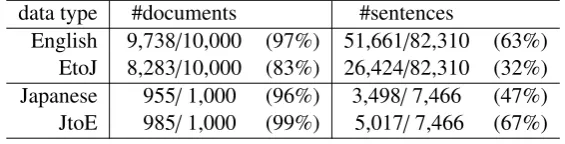
Table 2 shows the number of docu-ments/sentences including a polarity word in the dataset. The abbreviation EtoJ means English documents were translated to Japanese. The abbreviation JtoE means translation in the oppo-site direction. On the document level, excepting the case of EtoJ (83%, slightly low percentage), almost all documents (reviews) included at least one polarity word. This means that the set of polarity words used in the experiments has wide coverage.
4.1.4 Other settings
We used as a machine translation system the Ex-cite automatic translation service3. This site pro-vides rule-based machine translation between En-glish and Japanese (both EtoJ and JtoE).
For learning review classifiers, we used a lin-ear kernel support vector machine (SVM) and the software package Classias4for training SVM clas-sifiers. Unigram-based binary feature vectors were constructed. As the tokenization process (recog-nizing word separations) for Japanese reviews, we used a well-known Japanese NLP programming software package, MeCab5. All English words in
3http://www.excite.co.jp/world/
4http://www.chokkan.org/software/classias/ index.html.en
���
���
���
���
���
���
����� ����� ������������
��������0 �������0
������0 �������0
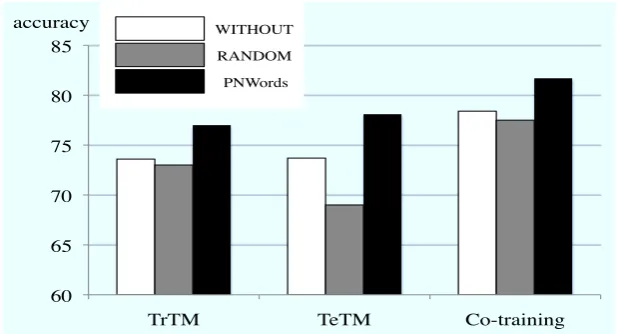
Figure 5: Effects of sentence extraction
the dataset were lower-cased.
We used ten-fold cross-validation for the evalu-ation.
4.2 Experimental results
The experimental results are shown in Table 3 (see also Figure 5). The value in each cell indicates the classification accuracy. Each column shows the multilingual review classification method, and each row shows the sentence extraction method in the sentence filtering step. PNWordsis the sen-tence extraction method described in Section 3, i.e., our proposed method. The others are base-line methods for comparison. WITHOUTmeans that the sentence filtering step was skipped at the training phase of text classifiers; all sentences in the reviews in the training dataset were used in the training phase. RANDOM means that snip-pets were generated by randomly extracting K per-cent of sentences from the original reviews in the dataset. We set K=50 in the experiments. Un-like WITHOUT and PNWords, RANDOM had es-sentially randomness. Therefore, we prepared five sets of snippets by running RANDOM five times and then measured five accuracy values. The aver-age accuracy is shown in Table 3.
We also developed a system which was trained on documents written in Japanese in order to see what is the accuracy of the system when a MT is not used. The accuracy of this system is 77.9%.
[image:6.595.144.453.67.234.2]To investigate the performances of the three multilingual classification methods, we first ig-nored the effects of sentence filtering modules and simply compared the accuracies of the first row, i.e., the results obtained by WITHOUT. Table 3
Table 3: Effects of sentence extraction TrTM TeTM Co-training WITHOUT 73.6 73.7 78.4
RANDOM 73.0 69.0 77.5 PNWords 77.0 78.1 81.7
shows that the accuracy of Co-training is higher than that of both TrTM and TeTM. Thus, the co-training model is considered to have an advan-tage over both TrTM and TeTM. This result cor-responds with those reported by Wan (2009). We confirmed that Wan’s co-training method outper-forms TrTM and TeTM in a multilingual review classification problem.
5 Related Works
Several methods of monolingual document-level sentiment classification have been proposed. In the early works in this field, such as by Pang et al. (2002), Mullen and Collier (2004), and Ga-mon (2004), the interest was in simply applying machine learning approaches. The latest works in this field have discussed some specific features for sentiment analysis. For example, Li et al. (2009) and Dasgupta and Ng (2010) considered shifting polarity and ambiguous polarity in documents.
The multilingual setting is also a recent topic. As described in Section 4, Banea et al. (2008) pro-posed a simple solution using machine translation. Wan (2009) extended Banea’s work, and applied for English/Chinese reviews. Denecke (2008) also proposed a similar method for English/German re-views. He used SentiWordNet6, which is an en-hanced lexical resource for sentiment analysis and opinion mining.
In the word-level multilingual sentiment classi-fication area, Mihalcea et al. (2007) proposed two methods for translating polarity words using bilin-gual dictionaries and a parallel corpus. Scheible (2010) proposed a graph-based approach to obtain translation information of polarity words. He used English/German dataset.
In the sentence-level multilingual sentiment classification area, Banea et al. (2010) conducted experiments with six languages (English, Arabic, French, German, Romanian and Spanish) , and re-ported that one can predict sentence-level subjec-tivity in languages other than English, by leverag-ing on a manually annotated English dataset, with 71.3% (for Arabic) to 73.66% (for Spanish).
6 Conclusion
We investigated the effectiveness of applying our sentiment-oriented sentence filtering method to re-duce the influence of translation errors in multi-lingual document-level review classification. Our filtering method can improve the performance of multilingual review classification. Experimental results showed that the proposed method achieved 81.7% classification accuracy.
The following issues will need to be addressed to refine our method.
• In this study, we treated sentence-level lin-guistic units to reduce the influence of trans-6http://sentiwordnet.isti.cnr.it/
lation errors. In the future, we will also in-vestigate performances when extracting fine-grained linguistic units, such as words and phrases. For example, Wei and Pal (2010) attempted to apply structural correspondence learning (Blitzer et al., 2006; Blitzer et al., 2007) to find a low dimensional document representation.
• We applied the proposed method only to En-glish/Japanese dataset. Additional experi-ments with other languages should be con-ducted for further and more sophisticated data analysis.
• Yang et al. (2009) handled heterogeneous data in a framework of transfer learning (Pan and Yang, 2010). The relationship between our approach and transfer learning would be interesting to examine.
References
Anthony Aue and Michael Gamon. 2005. Customiz-ing sentiment classifiers to new domains: a case study. InProceedings of Recent Advances in Nat-ural Language Processing.
Carmen Banea, Rada Mihalcea, Janyce Wiebe, and Samer Hassan. 2008. Multilingual subjectivity analysis using machine translation. InProceedings of the Conference on Empirical Methods in Natural Language Processing, pages 127–135.
Carmen Banea, Rada Mihalcea, and Janyce Wiebe. 2010. Multilingual subjectivity: Are more lan-guages better? In Proceedings of the 23rd Inter-national Conference on Computational Linguistics, pages 28–36.
John Blitzer, Ryan McDonald, and Rernando Pereira. 2006. Domain adaptation with structural correspon-dence learning. InProceedings of the Conference on Empirical Methods in Natural Language Process-ing, pages 120–128.
John Blitzer, Mark Dredze, and Fernando Pereira. 2007. Biographies, bollywood, boom-boxes and blenders: Domain adaptation for sentiment classi-fication. In Proceedings of the 45th Annual Meet-ing of the Association for Computational LMeet-inguis- Linguis-tics, pages 440–447.
Sajib Dasgupta and Vincent Ng. 2010. Mine the easy and classify the hard: Experiments with automatic sentiment classification. InProceedings of the 47th Annual Meeting of the Association for Computa-tional Linguistics, pages 701–709.
Kerstin Denecke. 2008. Using SentiWordNet for mul-tilingual sentiment analysis. InProceedings of the ICDE Workshop on Data Engineering for Blogs, So-cial Media, and Web 2.0, pages 507–512.
C. Fellbaum. 1998. WordNet: An Electronic Lexical Database. The MIT Press.
Michael Gamon. 2004. Sentiment classification on customer feedback data: Noisy data, large feature vectors, and the role of linguistic analysis. In Pro-ceedings of the 18th International Conference on Computational Linguistics.
Soo-Min Kim and Eduard Hovy. 2005. Automatic de-tection of opinion bearing words and sentences. In Proceedings of the 2nd International Joint Confer-ence on Natural Language Processing, pages 61–66.
Shoushan Li, Sophia Yat Mei Lee, Ying Chen, Chu-Ren Huang, and Guodong Zhou. 2009. Sentiment classification and polarity shifting. InProceedings of the 23rd International Conference on Computa-tional Linguistics.
Rada Mihalcea, Carmen Banea, and Janyce Wiebe. 2007. Learning multilingual subjective language via cross-lingual projections. InProceedings of the 45th Annual Meeting of the Association for Compu-tational Linguistics.
Tony Mullen and Nigel Collier. 2004. Sentiment anal-ysis using support vector machines with diverse in-formation sources. In Proceedings of the Confer-ence on Empirical Methods in Natural Language Processing, pages 412–418.
M. Nishio, E. Iwabuchi, and S. Mizutani. 1994. Iwanami Japanese-language dictionary. Iwanami Shoten.
Sinno Jialin Pan and Qiang Yang. 2010. A survey on transfer learning. IEEE Transactions on Knowledge and Data Engineering, 22(10):1345–1359.
Bo Pang and Lillian Lee. 2004. A sentimental edu-cation: Sentiment analysis using subjectivity sum-marization based on minimum cuts. InProceedings of the 42th Annual Meeting of the Association for Computational Linguistics, pages 271–278.
Bo Pang and Lillian Lee. 2008. Opinion Mining and Sentiment Analysis. Now Publishers Inc.
Bo Pang, Lillian Lee, and Shivakumar Vaithyanathan. 2002. Thumbs up? sentiment classification using machine learning techniques. InProceedings of the Conference on Empirical Methods in Natural Lan-guage Processing, pages 76–86.
Christian Scheible. 2010. Sentiment translation through lexicon induction. In Proceedings of the ACL 2010 Student Research Workshop, pages 25– 30.
Hiroya Takamura, Takashi Inui, and Manabu Okumura. 2005a. Extracting semantic orientation of words using spin model. In IPSJ SIG Note (NL-168-22), pages 141–148. (In Japanese).
Hiroya Takamura, Takashi Inui, and Manabu Okumura. 2005b. Extracting semantic orientations of words using spin model. InProceedings of the 43rd An-nual Meeting of the Association for Computational Linguistics, pages 133–140.
Huifeng Tang, Songbo Tan, and Xueqi Cheng. 2009. A survey on sentiment detection of reviews. Expert Systems with Applications, 36(7):10760–10773.
Xiaojun Wan. 2009. Co-training for cross-lingual sen-timent classification. InProceedings of the 47th An-nual Meeting of the Association for Computational Linguistics, pages 235–243.
Bin Wei and Christopher Pal. 2010. Cross lingual adaptation: An experiment on sentiment classifica-tions. In Proceedings of the 48th Annual Meeting of the Association for Computational Linguistics, pages 258–262.
Casey Whitelaw, Navendu Garg, and Shlomo Arga-mon. 2005. Using appraisal groups for sentiment analysis. InProceedings of the ACM 14th Confer-ence on Information and Knowledge Management.